SocraticGadfly: Supreme Court
Showing posts with label Supreme Court. Show all posts

July 17, 2026

"Without Precedent" but WITH looking at Scotus through left hand of the duopoly framing

Without Precedent: How Chief Justice Roberts and His Accomplices Rewrote the Constitution and Dismantled Our Rights

Without Precedent: How Chief Justice Roberts and His Accomplices Rewrote the Constitution and Dismantled Our Rights by Lisa Graves
My rating: 3 of 5 stars

3.5 stars rounded down. 3.0 stars period at the end of my thoughts, per the bottom. Little new for a deep reader. I hadn't before read the details of Gorsuch's frat-boy college life, but could have found them elsewhere, and didn't know that Barrett, as well as Roberts and Kavanaugh, was involved with Bush v. Gore work.

And, that's it.

It's written from the left hand of the duopoly.

And, as a non-duopoly voter (and no, I didn't "really" vote for Trump; shut up), it's got holes.

Take the "god" chapter. Never mentions the Bladensberg Cross case (technically American Legion v American Humanist Association, nor Breyer's disastrous concurring opinion (with Kagan riding along), written in part, IMO, to make his opinion in Van Orton into precedent.

Or, beyond "god," take the "First Amendment" chapter.

I'm sorry, there is none. So we don't get to read the reality of Ginsburg bagging on Colin Kaepernick and other issues.

Beyond that, Democratic-appointed justices past and present have at times been squishes on civil rights and related issues, especially if they involve people arrested for crimes. So far, Ketanji Brown Jackson has been pretty good, but who knows if that will last. (Related? Don't forget that the Antiterrorism and Effective Death Penalty Act was passed while the Slickster was prez. The Senate could have easily overriden a veto, but he might have gotten enough representatives to change their minds to sustain. That, of course, was just one of several issues where Clinton squished out in 1996.)

And, IMO, contra the author, this is as serious issue as Congress, in 1988, passing the Supreme Court Case Selections Act of 1988 that, as cited by her, lessened the Supreme Court's mandatory cases. But, Reagan was president in 1988, so from a duopoly framework, it's easier to bag on this than bag on Clinton.

This Wiki page shows a decline in rulings before 1988 that moderately accelerated for a few years after that, but looked like the decline might be slowing down again, until after 1996.

Finally, per her epilogue, and the background to it, Trump v United States, one can indeed argue it was wrongly decided, but the ruling was not 100 percent de novo. Related? Blame the Nixon Administration's Office of Legal Counsel within the DOJ for wrongly claiming that sitting presidents can't be indicted, and blame John Sirica and Leon Jaworski for accepting that idea. See here.

In other words, the idea of the president as king has a longer history than Graves presents, and the left hand of the duopoly, or at least people touted by it, have played their part in making that what it is.

I could rate it lower than 3.0 stars, and I could give it the mendaciousness tag, but I'm holding off. Graves believes these things sincerely, so I won't accuse her of conscious mendaciousness. Yes, I could say "Mendacity," but I used the other word for my bookshelf and besides, I'm an editor; I can invent that word. For similar reasons, it didn't get the "disappointment" tag but it DID get the "meh" tag. Otherwise, I won't rate it lower than 3 stars because it's good for showing how the left hand of the two-party duopoly can go down a tribalist road. 

Yes, the left hand of the duopoly is better than the right hand, but that's small potatoes. And, per what I said early in the review, it wouldn't surprise me if Graves saw my takes and did claim that I "really voted for Trump."

And, all of the above is once again why the annual four-year cry of #BlueAnon, "Oh the SCOTUS," sways me not.

View all my reviews

May 30, 2025

Three Dems on SCOTUS, no environmentalists

This is yet another reason why I'm not a Democrat and why "oh, but the Supreme Court" chants every four years fail to move me. SCOTUS has UNANIMOUSLY gutted the National Environmental Policy Act. 

Here's the basics:

Justice Brett Kavanaugh wrote the opinion for the court and there were no dissents. Ultimately, both liberal and conservative justices agreed with the bottom line decision.

Then the libruls trying to nuance the issue:

The court’s three liberals – Justices Sonia Sotomayor, Elena Kagan and Ketanji Brown Jackson – agreed with the outcome of the case but had different reasoning. Writing for the three, Sotomayor said that such environmental reviews conducted by federal agencies should be limited to their own expertise. The Surface Transportation Board, which conducted the review in this case, is primarily focused on transportation projects, not oil refining.
“Under NEPA, agencies must consider the environmental impacts for which their decisions would be responsible,” Sotomayor wrote. “Here, the board correctly determined it would not be responsible for the consequences of oil production upstream or downstream from the railway because it could not lawfully consider those consequences as part of the approval process.”

Uh, sure! That's Jesuitical.

So, under this standard, BLM, USFS etc should no longer be allowed to consider climate change for drilling permit leases, etc.

I first mentioned this in the 2016 election with "Notorious RBG," aka Ruth Bader Ginsberg, after her death, noting her flag-burning love / First Amendment hatred and other things. 

Actually, I mentioned it earlier that year with Breyer being a squish on a Fourth Amendment case.

I followed up a year later and noted how the Supreme Court has generally hated third parties.

Two years later, when Dems whipped out "Oh the SCOTUS" on Tony the Pony Kennedy's retirement, I noted not just Breyer but Sotomayor at times being Fourth Amendment squishes along with Ginsberg's problems etc.

A year later, Breyer (to preserve an earlier ruling by him as a precedent) and Kagan, in the Bladensberg Cross case, helped gut the First Amendment.

==

The libruls, per SCOTUSblog, also declined to review a case from Aridzona that will expedite copper mining in an Apache sacred site.  Once again, think of him what you will otherwise, Justice Gorsuch continues to show full consideration for American Indian legal rights and general issues.

February 14, 2025

Steve Vladeck – BlueAnon legal institutionalist selling tribalist lies

I can't remember when I started following him on Substack; in part, I can't remember whether, in a chicken-or-egg moment, it was before or after I read his seemingly at the time very good book, but one which now comes off as a petard-hoister. (More on that in a minute.)

I know I'd seen Kuffner reference him a few times before either the chicken or the egg. I should have been more skeptical then, but was not.

So, what "triggered" me?

This Substack of late Monday, trying to .... ameliorate?? ... Bagger Vance and his comments about the judiciary exceeding their bounds. What he says Vance is right about is a commonplace; what he claims Vance is not right about is petard-hoisting.

The wrong is getting wrong the rulings of John Marshall in Worcester (and a degree on Cherokee Nation) and Roger Taney in ex parte Merryman.

I fired first on Merryman, being a Civil War buff and quite familiar with the basics of it. On Lincoln vs Taney on Merryman, Lincoln DID ignore Taney until submitting the matter in general to Congress. Plus, Wiki notes that there’s a question of just what type of decision Taney was making. 

To expand beyond that as a Substack note? Lincoln asked Attorney General Edward Bates for a legal opinion, but only a day AFTER he sent a message to Congress as part of the start of its special session that he had called.

On Worcester, since Indians are “sovereign nations” under the constitution, Jackson’s US government would, in theory, be needed to enforce the ruling if white traders ignored Cherokee policing. So, Vladeck is hair-splittingly wrong there.

Here's where the nutgraphs come

That said, Marshall was chicken-shit for not compelling US Marshals, if nothing else, per Wiki’s article, to enforce it. That said, Taney was also chicken-shit, in that he never actually ordered Merryman’s release. And, THIS is the bottom line.

And, Vladeck knows it.

In both these significant cases, Chief Justices deliberately chose NOT to push their theoretical enforcement power so as to not see how much it would be folded, spindled and mutilated.

Then, there's this.

But the reality is that there is no history or tradition in this country of presidents ignoring judicial rulings on the ground that they are “illegal.”

The fact he has "illegal" in scare quotes, in my opinion, says that he knows he's engaged in hand-waving. 

Also, and related, with Lincoln, as the Merryman piece notes, later on in 1861, various officers of his administration more fully ignored habeas writs, including blocking or even arresting the people serving the writs. That's despite Taney explicitly saying that was verboten.

I'm sure Vladeck knows all I wrote in the paragraph above, or he should If not, he should, including that Lincoln, AFTER the July 4 special session of Congress to boot, had these arrests or blockings, which Congress had not addressed, merely the presidential power over suspending habeaus when it was not in session.

Finally, the petard-hoisting, since I have a quote from Vladeck's book that I typed into my review, namely:

The Court cannot ... independently coerce obedience to its decrees. ... (The Court's power) lies in its legitimacy, a product of substance and perception that shows itself in the people's acceptance of the Judiciary as fit to determine what the Nation's law means. ... The Court must take care to speak and act in ways that allow people to accept its decisions on the terms the Court claims for them, as truly ground in principle, not as compromises with social and political pressures.

I love the sound of petards being hoist in the morning!

And people are forking over, cumulatively, tens of thousands of dollars a month for such tribalist #BlueMAGA brilliance?

August 08, 2024

Biden's term limits on SCOTUS justices — still unconstitutional, contra Chris Geidner and Brennan Center

I pulled this from the Texas Progressives weekly roundup to run it separately.

Law Dork analyzes the Biden/Harris Supreme Court reform proposal. There, Chris Geidner ignores that the term limits part is surely unconstitutional without amendment. (An active justice/senior justice model, rather than flat term limits, as discussed by the Brennan Center, might pass muster without amendment.)

However, per Wiki's page on senior status, it appears that this is a voluntary, "opt-in" provision. A judge at the district or appellate level can only be forced into senior status if the chief judge deems they have a disability. Yeah, the Angel Hernandez "umpire" of the Supreme Court is going to do that to Clarence Thomas. Sure.

And, beyond THAT? The Brennan Center doesn't tell you the dirty secret. We ALREADY have that senior status for the Supreme Court! Here, from that same Wiki page.

In 1937, the option was extended to Supreme Court justices, although justices so electing are generally referred to as "retired" justices rather than having senior status. A senior justice is essentially an at-large senior judge, able to be assigned to any inferior federal court by the chief justice, but receiving the salary of a retired justice. However, a retired justice no longer participates in the work of the Supreme Court itself. That same year, Willis Van Devanter became the first Supreme Court justice to exercise the option. Since this option became available to Supreme Court justices, only ten have died while still in active service, the most recent being Ruth Bader Ginsburg on September 18, 2020.

This is sad. It's clear the provision is voluntary and applies only to judges who have already decided to retire.

The primary author, Alicia Bannon, clerked for Sotomayor. So, beyond sad, this is tribalist. Geidner claimed that coment to that end on his site was "nonsense." Well, he's a tribalist, too. And Law Dork, if not him personally, have been tagged in a Twitter follow-up to my original comment to Brennan and Bannon. I called Geidner a BlueAnon a month ago and once again, he's proven me true. Indeed, per a search of my blog, though the term didn't exist then, Geidner was a BlueAnon FIFTEEN years ago. Then, he was DEFENDING Dear Leader claiming that Slick Willie's indefensible Defense of Marriage Act wasn't that bad, and co-defending Barney Frank making the same claim. It's no wonder Kuff loves him.

So, once again, this is clearly all tribalist, and that's how and why Chris Geidner richly earned being called a #BlueAnon. It's more surprising that the likes of an Elie Mystal signed off on this. But, not totally surprising. He knows where his duopoly bread is buttered at The Nation. But, you're wrong too.

That said, Biden's reforms aren't the be-all and end-all. Eliminating the idea of justices hearing all cases en banc is another, per Steve Vladeck's book. Expanding the size of the court to, say, 13 so each appellate court has a justice "riding circuit" with no doubling up is another.

Interestingly, and where the graphic came from, a site called "SCOTUS Term Limits" was launched back in 2020. Way back then, it peddled the same bullshit that we're now getting today, the claim that "during good behaviour" allows term limits without an amendment. At least it wasn't tribalist on it.

Steven Calabrisi at the Volokh Conspiracy gets the issue right, and cites British common law back to 1761. Sadly, he goes wingnut-libertarian tribalist in claiming this attacks an independent federal judiciary.

Wrong. Rather, contra both originalists and librul originalist Constitution interpreters, just as the "Founding Fathers" (Rush Limbaugh voice) did not envision California with 60x the population of Wyoming (vs Virginia with 12x that of New Hampshire) on electoral votes, nor machine guns as "weapons," nor computers and social media on free speech, they didn't envision a significant chunk of Americans, including judges and justices, living into the second half of their octogenarian decade.

Side note: whenever a libertarian, without explicitly identifying with a capital L, calls out Democrats on something like this, it's a tell they're actually a Republican.

Term limits is the right thing.

But, there's only one way to get there.

==

One last side note: Though both Congresscritters and Presidents of both parties pretend to know the Constitution, this couldn't of course be applied to current justices as its an ex post facto law. (The same would be true of an amendment, IMO, at least unless that language was written into the amendment.)

I say this because our alleged constitutional law scholar president signed into law, and willingly, a bill of attainder against ACORN.

July 29, 2024

Biden's Supreme Court reform is unconstitutional

Yeah, I'm not a lawyer and Elie Mystal at The Nation is, but he was wrong two weeks ago when this was rumored, and Liberalmonger Joe is wrong now.

Term limits for justices are unconstitutional. The "good behavior clause" seems clear.

Update: Constitutional law scholar professor Erwin Chemerinsky agrees with me:

The problem with term limits for Supreme Court justices, and certainly ones that would apply to the current justices, is that they would require a constitutional amendment. The Supreme Court has long said, starting with McCulloch v. Maryland in 1819 and increasingly in recent years, that history and tradition are important in interpreting the Constitution. The tradition has always been that a Supreme Court justice holds the position for life, unless the justice resigns or is impeached and removed. Article III, Section 1, makes that clear: “The Judges, both of the supreme and inferior Courts, shall hold their Offices during good Behaviour.”

Can't be clearer than that.

For that matter, arguably, so is a binding code of ethical conduct.

And, the "no immunity for presidents"?

I've said it before. Blame Watergate and a legally nugatory OAG Office of Legal Counsel position. 

Now, of course, it could be made constitutional, by amendment. Different story.

On Chemerinsky, unfortunately, he transitions to a duopoly-based plea to beat Trump without looking at larger issues of how "librul" Supreme Court justices have been less than perfect on the First, Fourth, and Sixth Amendments, among others, or how other issues of court reform are also needed.

==

An in-depth brand new post challenging further, and generally tribalist, nuttery on this issue by the likes of Law Dork Chris Geidner, is now up.

July 06, 2024

SCOTUS roundup briefs

The Trump immunity ruling is everything wrong about today's SCOTUS. It's partisan; it pretends not to be partisan; it takes an initial bite of the apple while pretending that it won't take more bites when the case comes back; and that's just for starters.

I think the delay was not only to put this at the end, but also to figure out how exactly to craft the decision with all the particulars above. 

Beyond that, the 1970s Office of Legal Counsel's ruling that presidents couldn't be indicted? Constitutionally nugatory, as I said long ago (during the Mueller report, when Ball-less Bob failed). 

In light of that, this current Supreme Court ruling has been teed up for 50 years, just waiting for the next Nixonian or worse president to come along.

Or, 55 years, as Joyce Alene says, essentially, that absolute immunity for constitutionally prescribed acts creates Bill Douglas-like shadows and penumbras for lesser levels and degrees of immunity. Alternet has a summary of her take, and general left-liberal, but not leftist, reaction.

That said?

The biggest problem with the Trump immunity ruling itself starts with the whole "originalism" idea. "The Federalist" is a one-sided document. Many of the Philadelphia 1787 White men who signed off on, and physically signed, the constitution, did not have the same interpretations of the document as Hamilton, Madison and Jay. The idea that an "energetic" executive was desired is belied by the actual governance of the U.S. through the time of Andrew Jackson, with the lead-up to that being the setting for Jackson himself being called "King Andrew."

That said, the Blind Umpire et al selectively read "The Federalist" anyway.

There you go. Shocking, I know. Selective reading?

Let us not forget that Henry Clay got the Senate to officially censure Jackson.

Let us also not forget the exclusion of non-Whites and non-males. Well did William Lloyd Garrison call it a "covenant with death." Sadly, even Frederick Douglass internalized the over-veneration of the constitution. One will notice here the lowercasing of the word "constitution."

And, per the "teed up"? The Nine have been cutting blank and semi-blank checks for executive authority since, oh, probably since Reagan's time and definitely since Shrub Bush's time. And, Democrats' failure to impeach Reagan over Iran-Contra added to this.

And, that's why this non-librul leftist does NOT "revere" the constitution.

==

Second, contra the wingers, SCOTUS did NOT say in Murthy that Team Biden can coerce social media. Rather, it DID say that plaintiffs lack standing. The is the latest of several cases this year where the court has said the Fifth Circuit has simply gotten wrong, and egregiously wrong in most cases, the issue of standing. The 6-3 opinion also said that no actual injuries had been shown, nor was it shown that the social media content moderation in the particular cases was due to government coercion.

I don't totally agree with that last one, and have said so here before.

That said, I do agree with SCOTUS at a minimum sending the two Net Choice cases back to lower courts. Because it was the plaintiff, unlike Murthy, there was no standing issue. But, rather than overturn the lower courts and set some sort of standard for what governments can't do, the court punted that back to lower courts without guidance beyond saying Net Choice improperly framed its argument.

==

And, was this a Dobbs-type leak? SCOTUS's opinion allowing the federal government to let ER doctors, at least in Idaho, perform emergency abortions, was accidentally posted online before being hauled down. It's not a ruling for the Biden Administration; rather, it's a ruling for its injunction. The Notorious KBJ noted that. Unfortunately, nobody at Bloomberg, who first noted it, did a copy-paste of web information, or a download of the PDF, if the full opinion was indeed posted. As it turns out, the actual was basically the same as the leaked opinion, so, if deliberate, nobody was swayed.

Slate notes that the leaked document indicates that, long term, there's support for Idaho's stance, and even suggests that simply ruling on the stay punts the final ruling past the November election calendar.

==

Is criminalizing homelessness, with many other locales surely primed to follow Grants Pass now, really going to stop homelessness? (I picture the Umpire saying, "The only way to stop homelessness is for people to stop being homeless.") Of course not. That said, if the third arrest results in 30 days in jail, max, upon conviction, in Grants Pass, what does the city do when it runs out of jail room?

Answer: Having grown up in Gallup, New Mexico, and seeing the sad Sunday morning, and sometimes Monday morning, parade from the drunk tank at the Gallup city jail that was right across the "Perkie" from our house, these people aren't being held 30 days.

==

Without officially gutting Chevron, the SEC ruling continued to erode it at the edges.

And then, right after that, the court finished the job. Details of Loper here. On Twitter, as far as deference to expert agencies or lack thereof now, somebody noted Gorsuch not knowing the difference between nitrogen oxide pollutants and nitrous oxide laughing gas. That was in the case involving EPA's "good neighbor rule," which of course was also gutted. A whole set of rulings of last week tipped SCOTUS' hand before the shiv was wielded.

Next? OSHA is a probable target. And, per the Corner Post case, a bunch of rich wingnuts can now deliberately launch a start-up shell business just for the purpose of challenging federal regulations.

==

The Sackler ruling was, I think, correct. Not just re the Sacklers, but per the general idea.

==

Very good, on the gunz front, after the ruling allowing bump stocks? The court has, after affirming that states can prevent people with domestic abuse issues from owning guns, that in light of that, it will reject challenges to state laws on felons being barred from guns, Illinois' ban on assault weapons and more. It's not perfect; it continues a pattern of this court of ducking many issues, but in this case, it told lower courts to rehear the cases in light of the Rahimi decision.

==

As far as how bad each is? Really, only dyed-in-the-wool Blue Anon think the Trump immunity ruling is the worst. In actuality, it's Loper, especially when seen in conjunction with Corner Post, that's the worst. Hands down, or hands semi-down, at least.

June 17, 2024

Recent SCOTUS updates vs BlueAnon

Our newest Supreme Court justice got a bit of hagiography treatment last week.

As pictured at left, the details of that photo will be explained near the bottom.

All nine justices, essentially, threw the National Labor Relations Board under the bus in its attempt to intervene to block the firing of Starbucks employees by trying to obtain an injunction against that.

Yes, all nine. Apparently, BlueAnon reading comprehension isn't perfect:

"JACKSON, J., filed an opinion concurring in part, dissenting in part, and concurring in the judgment."

"Concurring in the judgment" is pretty clear by Justice Ketanji Brown Jackson. Look, if you want to save face by calling it 8-0-1 because she would have used a different "fork" in the process, OK, I'll give you that. But, 8-1, it was NOT. As I told one person on Twitter, she may be the best current justice, but, as a non-duopoly leftist, I don't have to put her on a pedestal.

And, I quote from her CONCURRENCE:

I agree with the majority that nothing in the National Labor Relations Act (NLRA) clearly strips courts of their equitable discretion to determine whether to issue a so-called §10(j) injunction. And I concur in the conclusion that we should vacate and remand for the Sixth Circuit to reevaluate this case under our traditional four-factor test for assessing requests for preliminary injunctions. But I cannot join the majority in ignoring the choices Congress has made in the NLRA about how courts should exercise their discretion in light of the National Labor Relations Board’s authority over labor disputes.

Seems pretty clear here, namely, that she's disagreeing about that "fork" in how the court got to this point, contra the BlueAnon who called me obtuse. Mark Joseph Stern at Slate and others also called it 8-1 and are also wrong. Shock me. 

To put it another way? I'm not a lawyer, but I am a journalist and I know how to read English.

Not being an open BlueAnon, Ronald Mann at SCOTUSBlog knows how to read. And, his last graf, quoting from her, actually shows how she punted:

Jackson joined her colleagues in the decision to send the case back to the lower court for reevaluation under the four-factor test. But she differed on the court’s conclusion about the likelihood-of-success factor. Thomas’s opinion, she wrote, ignored Congress’s “clear and comprehensive” directives in the NLRA on how courts should exercise discretion when it comes to the NLRB’s authority over labor disputes. “Unfortunately,” she wrote, “today’s decision appears to be another installment in a series of labor cases in which this Court has failed ‘to heed Congress’s intent.’” And in what may come to ring like a theme for the term, Jackson closed by saying, “I am loath to bless this aggrandizement of judicial power where Congress has so plainly limited the discretion of the courts, and where it so clearly intends for the expert agency it has created to make the primary determinations.”

You may be "loath to agree," but .... YOU DID!

"Law Dork" Chris Geidner also got it wrong at Substack. When I restacked his piece with a note, he didn't like being called a "BlueAnon" and responded. I replied that, regardless of his real or coy denials of being a BlueAnon, he still got it wrong.

I quote from him:

In Starbucks v. McKinney, Justice Ketanji Brown Jackson continued her role from last term of eagerly being the sole justice standing up forcefully in protection of labor rights.
Last term, she issued a solo dissent about the essential nature of “the right to strike.”
This term, on Thursday, she issued a solo partial dissent...

Geidner didn't get it AS wrong as Stern, but "solo partial dissent" is still not right, in my book. Per that big pull quote, if she really thought the wrong "fork" was being used on review, and on how that affected the likelihood of success, she would have done a full dissent. PBS, after all, notes that the ruling "tightened the standards." They weren't alone. CNN's header said "makes it harder." LA Times: "Limits power to protect ..."

(Update: Steve Vladeck [shock] also got it wrong.)

Again, if Jackson REALLY had a problem, she would have done a FULL dissent. Period.

Side note: I am also of raised eyebrows over the "KBJ" meme on Twitter. I know where that's coming from; it's a riff on the overrated, BlueAnon cult legend Ruth Bader Ginsburg. Barf me.

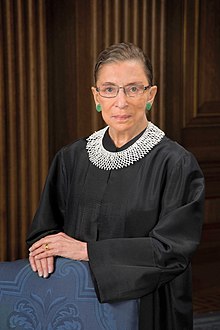
And, in celebration of this? The mugshot up top? Via one of those free "morpher" websites, it's KBJ morphed into RBG. Notoriously morphed.

==

The mifepristone ruling? Was it simply a dodge to rule unanimously (against Matthew Kacsmaryk) on the standing issue, as Slate (and likely other BlueAnon outfits) claim? I think not. I think that the nine will smack the Fifth Circuit or whomever even harder if they don't toss the state AGs' parallel action on standing grounds as well. Tis true that Kavanaugh, in his opinion for everybody but the concurring Thomas, did leave some doors open. But, even with that, he only left the door open for challenges to the FDA's second, and expanded, 2021 approval beyond the original 2016 approval.

That said, we once again have Slate saying, but, but. That's for political campaigning, advertising or other dinero and eyeball reasons. Don't be fooled.

==

In the "even a blind hog occasionally finds an acorn" moment, Larry Tribe, he of 2A flip-flopping, thinks the egregious fees justices are taking for things like foreign travel leaves them open to removal from office on "good behavior" grounds.

But, he ignores one problem. Outside of impeachment, the Constitution specifies no other mechanism for removal enforcement.

April 08, 2024

The problems of the shadow docket and the need for Supreme Court reform

This is an extended version of my review of Stephen Vladeck's "The Shadow Docket."

The Shadow Docket: How the Supreme Court Uses Stealth Rulings to Amass Power and Undermine the RepublicThe Shadow Docket: How the Supreme Court Uses Stealth Rulings to Amass Power and Undermine the Republic by Stephen Vladeck
My rating: 5 of 5 stars

Vladeck gets five stars but in my quarter-star system, he's not quite there. See below. (Note: I liked Goodreads platform updates of a year ago as far as they went. I decry it not following Storygraph and giving us quarter-star, or even half-star, review rating tweaks. As clunky as the website is, I still think they could have done it.)

Having read essays and journalism pieces by Vladeck already (bits of some incorporated into this book) I figured it would be good and wasn't disappointed. The "Conclusion" chapter makes clear what's wrong today. In a nice bit of petard hoisting, near the end of the last pre-Conclusion chapter, Vladeck uses as a starting point a quote from the plurality controlling opinion of three justices in the Casey case:
The Court cannot ... independently coerce obedience to its decrees. ... (The Court's power) lies in its legitimacy, a product of substance and perception that shows itself in the people's acceptance of the Judiciary as fit to determine what the Nation's law means. ... The Court must take care to speak and act in ways that allow people to accept its decisions on the terms the Court claims for them, as truly ground in principle, not as compromises with social and political pressures.

And yet, this illustrates why the book is 4.5-4.75 stars and not quite a 5 star 5 star.

Vladeck COULD have mentioned the timing of Kennedy's resignation, his son work for Trump lender of mega-resort as well as last resort Deutsche Bank as Trump's banker and other things. He nowhere references the book Dark Towers, which covers a lot of this.

Elsewhere in the penultimate chapter, Vladeck rightly faults Biden's commission on judicial reforms for "milquetoast" recommendations and for being used by Biden for taking a 2020 election year pass. But, he doesn't plump too much for specific recommendations himself.

Personally? Per one thing I learned early on in the book, that the American Bar Association proposed an alternative at the time to what emerged as the 1925 Judges' Bill? That's my takeoff. The ABA proposed adding seats to the High Court (which Cowardly Lion Joe Biden has passed on) and having the justices address most appeals like a final version of a federal court of appeals — three-judge panels.

Today? We have 11 enumerated circuit courts plus the DC Circuit. Under the idea that Roberts (and other Chiefs) are chief justice of the US, not the Supreme Court, that means we need 13 justices, so each of the 12 associates "rides circuit" on one and only one appeals court, no doubling up, and the chief does do on none.

Excluding the chief from panels, then, that gives you four groups of three justices that could hear four appeals at one time. When all four are done, a computer redraws the 12 names and start over. Then, when that's done, you leave time for petitioners, as at a circuit court, to ask for en banc hearings, decide which of those to grant, and leave time for full court work.

Per Vladeck, it sounds like the ABA wanted all cases taken by panel. I would tweak that to reserve some cases, by law, for going straight to en banc, for sure, at least some of the cases where the Supreme Court has original jurisdiction, but this would still strongly reduce docket work, remove an excuse for abusing the shadow docket and more. The chief, meanwhile, could focus on non-circuit courts, ie FISA, the International Trade Court and the few other Article III courts that aren't in the regular district-circuit parameters, and in concurrence with Congress on so-called Article I courts. 

With 13 justices, one would adjust the votes for cert. Should it be six, parallel the four now? Maybe only raise it to five, since we're going to use three-judge panels for most appeals.

Also, within the 13 justices, since the DC Circuit is a sort of tertiam quid, maybe we designate an "associate chief justice" who gets that circuit as their riding.

This all said, in an April 15 Substack, and with linked older pieces within it, Vladeck does mention ideas for reform, and ones he likes less, including expansion. (In this, he sounds like a liberal not a leftist.)

Specifically on expansion, via one of those links, he pretty much hates it. As with the elimination of the filibuster, he thinks this would only politicize the court even more. I chalk that up to balllessness of Democrats (assume Vladeck is one, and not a non-duopolist) as much as anything. As for it reducing hte legitimacy of the court? The court's done that to itself, but yeah, to some degree, if it further reduced its legitimacy, I'm one of those people Vladeck references that would at least halfway welcome that.

View all my reviews

July 12, 2023

Texas progressives talk Paxton, special session, races

Many Texas Senate Rethuglicans are reportedly worried about being primaried over the Paxton impeachment.

Mike Miles is going to can 500 people at Houston ISD. (I wouldn't be surprised if that eventually rises.) Piece is originally from Houston Landing; interesting or "interesting" that the Trib is doing republishing now.

The Lege actually did a bit of good: HOAs can no longer discriminate against Section 8 tenants.

Speaking of, as state House and Senate tussle over property tax issues, and Danny Goeb and will renters get any help? The story notes that some more enlightened states, unlike Tex-ass, give direct pass-through relief to tenants; it also notes that no Rethuglican bill proposes that.

Speaking of that, Chris Hooks once again excoriates Strangeabbott. This is an overview of his eight-plus years as Gov and his relationship with the Lege, starting with how he burned that in his first year, and going on from there to the mule-headed stubbornness that he refuses to relinquish, most notably on vouchers. From there, it's his petulance in calling the first special session for the day after the regular ended.
 
State Sen. Roland Guitierrez has officially thrown his hat in the ring, challenging Colin Allred for the right to run against Havana Ted Cruz. Allred had a big money haul recently, and may have somewhat more name recognition, but I don't see this as that big of an uphill battle.

Strangeabbott is going through interim AGs like he goes through Secretaries of State.

Off the Kuff
 looked at Houston's lawsuit against the Death Star bill, the first of what will surely be many lawsuits filed against far-right legislation.

Neil at the Houston Democracy Project says Mayoral candidate Gilbert Garcia's platform is silent on issues of protecting and expanding democracy in Houston.

SocraticGadfly dips into international affairs, with a multi-part look at Russia-Ukraine issues, tied in part to the Prigozhin mutiny. First is his take on the announcement of backdoor US-Russia peace talks, with a sidebar on what such talks might involve, and some Yevgeny Prigozhin issues. Second, he discusses the US mainstream media's problematic analysis of the Prigozhin mutiny. Third, he notes that, per a phrase from Counterpunch's Jeff St. Clair, that "more credulous precincts of the left" still cut Putin blank checks over how he handled that.

A good overview here of the current status of global oil issues and the background geopolitical maneuvers. (The story has one fail: Not mentioning that Iran is now an official member of the Shanghai Cooperative.)

Richard D. Wolff can complain with a straight face about US' China-bashing without once mentioning Uyghurs. "Shock me," unsurprisingly.


Vladeck is unequivocal about the SCOTUS hard right turn. 
 
Speaking of, Sonia Sotomayor just told Clarence Thomas to "Hold my beer (and read about it my my next book)."

Chris Geidner manages to find some reasons to be optimistic despite it all. 

Juanita never has any fun.
 
LA City Council (and city administration staff): hypocrites on homelessness.

June 27, 2023

SCOTUS hypocrisy on lawsuits

Remember a year-plus ago, before the Dobbs decision officially overturned Roe, how the Supreme Court let stand through repeated stall-outs the Texas law allowing for citizen abortion enforcement by lawsuit?

This piece, on SCOTUS saying that the feds have broad power to dismiss "qui tam" whistleblower lawsuits, shows the rank hypocrisy of the further-right justices:

A dissent from Justice Clarence Thomas was notable less for its arguments in favor of an alternative reading of the statute – Thomas agreed with Polansky that the government loses its authority to dismiss a suit once it declines to intervene – and more for its broader suggestion that the entire qui tam system may be unconstitutional. While only Thomas wrote in support of his argument about the extent of the government’s authority to dismiss, Justice Brett Kavanaugh issued a concurring opinion, joined by Justice Amy Coney Barrett, in which he agreed with Thomas that “[t]here are substantial arguments that the qui tam device is inconsistent with Article II and that private litigators may not represent the interests of the United States in litigation … the Court should consider the competing arguments on the Article II issues in an appropriate case.”

Emphasis mine.

So, private litigators can't represent the USofA, but CAN represent the Great State of Tex-ass? Got it.

March 24, 2022

Will Ketanji Brown Jackson be a better justice than her old boss Breyer?

As Ketanji Brown Jackson has wended her way through the first round of Senate dick-swinging at the Judiciary Committee level, the "august" committee within the "august" body has tried to pin her down. And, since it's touted that she clerked for Stephen Breyer, it's fair to ask if she'd be better than him.

Shit, from my perspective, it would be hard to be worse. Breyer was lamer than even the so-called "Notorious RBG," and I've shown in detail that Ruth Bader Ginsburg was a bad justice on the First and Fourth Amendments, even hating on Colin Kaepernick.

But, Breyer was worse. 

First, all the "pergressuve" justices, as I have detailed, have been problematic at times, to put it mildly. Sotomayor was arguably the least bad, but had an appellate court record on the Fourth. Kagan, of course, was Dear Leader's Solicitor General. And, hated on Louisiana defendants as a justice.

On the First Amendment, all of them hate the freedom of assembly clause. They hated it almost a decade ago. Friendly reminder: The First Amendment has five clauses.

But, Breyer was especially odious on the freedom of religion clause. Kagan joined him in being craptacular on American Legion vs American Humanist Association. As I noted, Breyer was trying to protect and defend his legacy of being craptacular on Von Orton vs Perry.

And, before Breyer, moderate and librul justices, including Thurgood Marshall, gave us qualified immunity.

That said, if it was more than suck-up-itis for Jackson, per her CNN bio, to talk about Breyer's "brilliant legal mind," we're in fucking trouble.

We are in other ways, too. This adds another Ivy League grad to the bench.

If Biden REALLY wanted diversity, a gay or lesbian secularist socialist would have fit the bill.

September 20, 2020

Some initial thoughts on a Trump-McConnell pre-election (or lame duck) rush job to fill the RBG seat

Unless you've been living in a cave or under a rock for the past 48 hours, you know of the recent death of Supreme Court Justice Ruth Bader Ginsburg. My thoughts on her legacy, her cult and more are here.

You also are likely aware of Donald Trump's plans to send a quick nomination to the U.S. Senate — this and insider baseball in D.C. explains his short list from last week even though nobody would talk publicly that Ginsburg was about to die, for us plebs — and Mitch the Turtle's plans to try to shove it through.

Democrats, beyond the "Oh the SCOTUS" that can't sway independent leftists, are engaged in serious hand-wringing. But, how realistic are these worries.

Not that much, IMO. We're too close to an election. And, I'm not talking about the time frame of a nomination, FBI background check, Senate Judiciary Committee Hearings and floor hearings, with Harry Reid of filibuster-ending fame offering Senate Dems every tip and trick to stall things out that they can, before late October. Jeffrey Toobin talks more about the time frame, while saying it's theoretically possible to pull it off.

No, I'm talking election politics and calculus.

As for a Trump-McConnell attempt to reverse engineer the Merrick Garland and do a rushed replacement? Not likely, despite blather. Susan Collins will vote no for sure unless she's going to officially write off her Senate future. Ditto Arizona's McSally, who trails Mark Kelly. Alaska's Murkowski is independent enough to likely say no on more principled grounds, both on the rush job and possible concerns on an actual candidate. Cory Gardner in Colorado is in the same back-seat re-election boat as Collins and McSally. In Iowa, at least per the Des Moines Register, Ernst is behind. Even throwing out Murkowski, that's an even 50. Adding her, you're at 49. Ernst would be 48, unless she says damn any fallout. And, Thom Tillis in North Carolina is also in a tight race. 

And, Murkowski and Collins have already gone on the record as "no." I presume Murkowski, at least, would hold true on a lame-duck Senate trying this if Biden beat Trump. Ernst's colleague Chuck Grassley, in addition, has said that "in the abstract" he'd have the same stance as in 2016. Toobin notes in his story that Lindsay Graham, Lamar Alexander and Mitt Romney (with Graham also up for re-election and in a surprisingly tight race) have, like Grassley, expressed "abstract" reservations. He also notes, as you can find elsewhere, that Arizona law would allow Kelly to take office Nov. 30 if he beats McSally, making a lame-duck nomination more difficult. Reportedly, similar is true in Georgia, if special-elected Kelly Loeffler loses her race for a full term. BUT, unless a bunch of Dems drop off, that's going to a runoff.

UPDATE on Senator weigh-ins. Huckleberry J. Butchmeup has already said yes. Lamar is radio-silent. GrassMan is yes. And now, the biggie. Despite fellow Mormon ex-Sen Flake encouraging GOPers not to do it, Mittens is yes.

Toobin also notes, especially if this whole thing gets really dirty and Dems reclaim the Senate as well as Biden winning, that it's very possible they'll eliminate the filibuster period. He also wonders if the Dems would expand the court.

The NYT also has a timeline story. It notes that McConnell may try to do this in a lame-duck session. Well, I think the "abstracters" listed above, if they have principles, would still object, or at least some of them. Murkowski would, I'm sure. Romney probably would. Grassley or Alexander might. And, if Kelly wins and is in, that blocks that there, too.

So, two basic thoughts:

  1. Not likely;
  2. IF it does happen, it does so in the lame-duck.

McConnell's Monday statement, by mentioning BOTH the number of days left before the election AND the number left in the session, indicates he's on two-track strategy.

Beyond that, follow the money. Act Blue is already shitstorming for money over this.

(Update: It's kind of funny to see Toobin call Dems "wimps.")

September 18, 2020

RIP Ruth Bader Ginsburg, the "notorious RBG" — and no, its not too soon for this type of obit

First, I speak from outside the duopoly, where I know that all the current Democrat-appointed SCOTUS justices, including the late Ginsburg, are or were some degree of squishes on the First, Fourth and Sixth Amendments.

So, no, Dems who think you own my vote, you don't, and this doesn't change things.

Here's some of the not so highlights of Ginsburg only, separated from Kagan, Breyer and Sotomayor.

First, clearly not even a left-liberal, let alone a leftist, on things like protesting, calling Kaepernick "dumb and disrespectful," while never calling out BFF Hillary Clinton for wanting to recriminalize some flag-burning even after SCOTUS' Johnson ruling. 

UPDATE, Oct. 13, 2021: Katie Couric, in her new memo, says she edited out even worse shit that Ginsburg said in that interview in 2016.

And, worse yet? She suspected Ginsburg didn't understand the question. She asked the Notorious Bobo Whisperer, David Brooks, and he agreed!

If they were right, they agreed to protect a senile Justice, and in an election year no less. 

For the record, here's what's edited out:

In new memoir, Going There, Couric writes that she edited out a part where Ginsburg said that those who kneel during the national anthem are showing 'contempt for a government that has made it possible for their parents and grandparents to live a decent life.'

Wow.

In reality, I HIGHLY doubt Ginsburg was senile or close to it.  Instead, Katie and the Bobo had to protect the St. Notorious of Scaliaburg from herself.

I'd actually call her take on the issue "dumb and disrespectful." Disrespectful to Black Lives Matter. Disrespectful to the spirit of the First Amendment while giving lip service to its letter. Disrespectful to a minority when a member of an oft-oppressed minority herself. (If another Jew failed to stand for the National Anthem after we refused to, say, bomb the rail lines to Auschwitz in late 1944, or after we turned away the MS St. Louis in 1939, would she have called that "dumb and disrespectful"?

I was disgusted enough with the Kaep comment at the time. And, with everything that's happened since George Floyd's death, I find her equivalent of a knee-jerk conservative's take on Kaep to be nothing other than despicable.

I'm more disgusted yet on learning that she later did a non-apology "apology," admitting that what she said was crass and saying it would have been better not to respond, but never actually apologizing. She was also a weasel for not even doing this personally, but rather having the Supreme Court press office do a release.

ZERO attempt to understand him, just like wingnuts. But, not surprising. She, along with the WHOLE rest of the Court at the time, per that top link, hated the freedom of assembly clause of the First Amendment. And, of course, that's what protects protests.

Book of Face claims that, re Kaepernick, she wasn't very Black-friendly in her personal hiring, either. And one Roe-related statement sounds eugenicist. And, she was a good anti-environmentalist capitalist earlier this year, too.

That said, there may be more to it, per that and the above. Stanners of the Notorized RBG — if they know this — don't really like to talk about her having no black clerks as an appeals judge, and just one in TWENTY-FIVE YEARS on the Supreme Court. If it walks, talks, and quacks like a duck ... 

Ginsburg had little love for civil liberties for the less fortunate abroad, as well. As Mondoweiss notes, she had little love lost (and that's probably being polite) for Palestinians.

That link above is from the New Yorker (tho I got it via Counterpunch), not exactly a radical site. It does also follow up on what I noted at the start of the piece — Ginsburg was a squish on civil liberties, especially for criminals.

As for the flag burning and BFF Hillary's take? Ginsburg had sold her mess of pottage to become a "centrist liberal" well before Bill nominated her to the Supreme Court. This is only more confirmation. And yes, "centrist liberal" is correct, and that's not just my take. Her 2019 biographer called her that, repeatedly, and elsewhere, Counterpunch has noted said biographer pulled punches to get as much access as she did to family and friends of Ginsburg.

Then there was her strange bromance with Nino Scalia. (Sidebar: The Nation noted early last year that she did a partial cave to him on Bush v Gore. And, the piece noted, as well, that there was a cult among her devotees, and that said cult had a dark side. 

It wasn't wrong, those claims of a cult; I wrote about said cult back in 2016. We're going to see more of that over the next week or so; there's plenty of it on Twitter tonight. As I updated in 2019, her new biographer called her a "centrist" within liberal federal judges of the last generation. Calls her that more than once. At that Nation link, Mari Uyehara also uses the word "centrist." And I agree.

Her last case? A concurrence with the wingers on the court that a 1996 Slickster law limiting habeas appeals for asylum-seeking immigrants is still constitutional. It was shit like this that led the Edelmans to ditch the Clintons — and Ginsburg to stay "loyal."

And, for her cultists, who are all in the left half of the duopoly, not outside of it? Schadenfreude is a bitch, especially if Biden loses. 

And I am SHOCKED that Jill Lepore, author of an error-riddled, interpretive-error-riddled, "centrist liberal" American history, is part of the RBG cult. I am MORE SHOCKED that Lepore was ALSO the author of the other New Yorker piece, up above. Actually, this time, I actually AM shocked.

At Slate, commenting on Trump's would-be replacement for Ginsburg, Dahlia Lithwick is also part of the cult, claiming a Ginsburg care level for the less fortunate that isn't quite true.

Counterpunch, in another example of editorial unevenness, runs a Ginsburg-stanning piece.

Speaking of Twitter, now, we the plebs know what all the Trump Supreme Court shortlist chatter was about over the past week.

As for the chances of Trump and McConnell trying to fill her seat before Nov. 3? Not likely, as I see it, but a lame-duck move is more possible.

Update, Oct. 3, 2023: Part of James Bamford's early writings against the NSA offer further reason to loathe Ginsburg. Read also his latest book, SpyFail.

May 29, 2020

The duopoly, lesser evilism and the Supreme Court

Last month, when Bernie Sanders was on the verge of dropping out, but hadn't yet, "Clarence Thomas and Anita Hill" started trending on Twitter, and I knew why.

Anybody who remembers Senate Judiciary Committee Chairman Joe Biden's cave-in to committee Republicans remembers.

Of course, many a Democrat was ready to counter with "Oh the SCOTUS," Clarence Thomas being enabled aside.

The reality, as Tweeted in a thread? Just as Democratic presidents have been "lesser evilism" compared to Republicans, so, too have their Supreme Court appointments. Democratic appointments, including Antonin Scalia lover Ruth Bader Ginsburg, aka "The Notorious RGB," have had various degrees of lack of enthusiasm for the First, Fourth and Sixth Amendments.

(Insert: After I first got this done, but before it hit its publish date, as I had other more time sensitive stuff in the hopper, Justice Kagan gave more more ammunition. She hated on criminals in the Ramos case, voting with Alito and Roberts to still allow non-unanimous criminal jury verdicts.)

Let’s refresh ourselves.
The First Amendment. Congress shall make no law respecting an establishment of religion, or prohibiting the free exercise thereof; or abridging the freedom of speech, or of the press; or the right of the people peaceably to assemble, and to petition the Government for a redress of grievances.
Our fundamental “speech acts,” worship — and freedom FROM worship for we secularists — freedom of the press (though misinterpreted by the media at times as a license to stand above the general public), freedom to strike (though severely curtailed by the feds), protest, boycott and many other things, and finally, to ask our gummint to fix things, and tell them to fuck off in the process.

The Fourth Amendment:
The right of the people to be secure in their persons, houses, papers, and effects, against unreasonable searches and seizures, shall not be violated, and no Warrants shall issue, but upon probable cause,supported by Oath or affirmation, and particularly describing the place to be searched, and the persons or things to be seized. 
A biggie in today’s world, of the Internet, electronic surveillance and GPS systems. Governments at all levels and private businesses both abuse it. (Suits against businesses have rarely been tested, and the courts, unless something is truly egregious, usually grant even more carte blanche here than to government officials.)

The Sixth Amendment:
In all criminal prosecutions, the accused shall enjoy the right to a speedy and public trial, by an impartial jury of the State and district wherein the crime shall have been committed, which district shall have been previously ascertained by law, and to be informed of the nature and cause of the accusation; to be confronted with the witnesses against him; to have compulsory process for obtaining witnesses in his favor, and to have the Assistance of Counsel for his defence.
This is perhaps less assaulted than the Fourth, but it’s still assaulted. Let’s dig in.

I last visited this issue in a general way when Tony the Pony Kennedy retired. The one handclap lauding of him made it clear that Democrat-type liberals appreciated him on gay rights and were glad he did not go further right than a middle ground breach on abortion. They didn't care about First Amendment nuances, like the muddled and awful but not horrible Town of Greece decision Kennedy foisted on us, because the New York or San Francisco city councils never have invocatioms. Worse yet, they ignore that Obama's DOJ filed an amicus, not on behalf of Galloway, but on the behalf of Town of Greece. Why? Dem-type liberals generally aren't irreligious. Worse, they halfway believe in the Christian nation mythos, as long as it's baptized into the civic religion that Scalia and Rehnquist, especially, liked to cite.

This guzzling of the civic religion Kool-Aid has been done the most Clinton squish Stephen Breyer and Obama squish Elena Kagan. Their being Jewish, to be honest, may be a factor. They may think the "Judeo fig leaf" half of the "Judeo-Christian tradition" is necessary to uphold, under the guise of civic religion, for Jewish protection. Or maybe not. In whatever case, they were wrong.

And more wrong when they indulged warmongering by connecting Christian crosses and military burials with evading the First Amendkment. Their ruling on American Legion vs American Humanist Association, commonly known as Bladensburg Cross, was godawful, pun intended. And, contra Hemant Mehta, Breyer's old Van Orton ruling which he used as precedent was almost as godawful.

Breyer, pulled out as a separate link from one of my blog posts, earlier hated the First Amendment's free speech protections whenever a cop might get butt-hurt you were exercising your free speech against him.

Wise Latina Sonia Sotomayor? Before nomination, on the appellate bench? A squish on Freedom of Information Act requests (First), churches freedom from labor laws (First) and minors' free speech rights (First).

Sotomayor, since getting on the court, has joined Breyer in being a Fourth Amendment squish.

Notorious RGB? Not come up in court cases, but Kaepernick-hater Ginsburg is a personal squish on symbolic speech acts such as flag burning. As a Hillz friend, this isn't surprising. Pulled from that blog post, The Nation talks about her as a squish in general. Hypocrisy alert, though. The Nation will never say a word outside the duopoly because it never has before.

Before that, ALL justices were squishes against the freedom of assembly clause of the First Amendment (told you it gets disrespected) when they ruled that Shrub Bush's Secret Service (a practice followed when allegedly protecting candidate Obama, then by President Obama) was OK in creating "cattle pens" of protestors way, way away from the president. Having been at multiple Bush protests, and in Denver the day before the start of the 2008 Democratic National Convention, I've seen this stuff firsthand.

Related? ALL justices have been Voting Rights Act squishes whenever the issue of voting rights isn't ethnic minorities but third parties.

Pre-SCOTUS, Elena Kagan was a political squish on drug laws, namely the Slickster's crack vs powder cocaine punishment difference.

Before this time, back in the 1990s, Slick Willie appointees Ginsburg and Breyer both voted to uphold capital punishment, restric habeas corpus, and even to allow Boston's St. Pat's parade, which was not church-organized, to ban gay groups. That one, even with less enlightenment nationally on gay rights 25 years ago, was disgusting enough then. Today? It's totally repulsive, and it's also totally repulsive that, when Tony the Pony was still on the court, nobody ever found occasion to overturn it.

Hell, within his own race to some extent, Thurgood Marshall was a Fourth Amendment squish. The Terry case is the blackest mark on his record. The case's language is full of loopholes that subsequent local, state and federal law enforcement have driven Mack Trucks through. True, it passed 8-1, or 6-1-1-1 if one wants to count concurrences by White and Harlin (both joined the main ruling as well). But Marshall, as an African-American, by joining the opinion without even a concurrence to nuance it.

The big takeaway, setting aside the Marshall footnote? Democratic Justices care little more about criminal rights, by and large, than Republican ones. They care no more about third-party voting rights. (Besides the link I offered, the fact that SCOTUS has consistently allowed, even required, state government elections officials to act as tools of the duopoly parties has shown this antipathy to run deep.) And, Democratic justices care not a lot more about expansion of executive branch powers than Republican ones.

==

Underscoring this, with the killing of George Floyd in Minneapolis, is SCOTUS' ongoing refusal to deal with the legal doctrine of qualified immunity, which has let many killer cops avoid even going to trial. Remember, it only takes four judges to grant cert. So, unless four librulz were highly worried that they'd spoil future cases on qualified immunity by granting cert to a less than perfect case, they're full of shit.

As USA Today explains, qualified immunity as a legal doctrine didn't exist until 1982. The court then had two definite liberals, Marshall and Bill Brennan. Harry Blackmun had by that time become a moderate liberal. Stevens was a moderate conservative. (He later became a moderate but never was a liberal, myth aside.) Powell and White were all definite conservatives, but not Rehnquist-type wingnut. Burger was a pompous conservative squish.  O'Connor was new, a conservative, but not Rehnquist.

Know what the vote was in Harlow v. Fitzgerald, the 1982 determinative case? 8-1. Burger the one dissent. Marshall among those supporting qualified immunity, as was Brennan. In Pierson v. Ray, both also signed off on the precursor to today's qualified immunity; Bill Douglas the only no vote there.

Per Wiki's page on qualified immunity, the eight justices, many of whom would go on two years later to bend backward for cops on the first phases of good-faith exceptions to the exclusionary rule, now said it would be unfair for them and others to go on trial to distinguish a state of mind when they were acting.  Wiki's page is good at bottom in noting an attorney defending a killer cop will always claim there isn't an EXACT precedent, and that qualified immunity has no obvious root in common law.
November 29, 2019

Clarence Thomas, enigma

The Enigma of Clarence ThomasThe Enigma of Clarence Thomas by Corey Robin
My rating: 4 of 5 stars


This is an edited and expanded version of my review of Corey Robin's "The Enigma of Clarence Thomas."

An excellent, succinct book on some of the roots of Clarence Thomas’ thinking. Basically, Robin’s thesis is that much of Thomas’ approach to the constitution is driven by a black nationalism that flowered in his collegiate times and that still burns inside him despite his move rightward since then.

Robin doesn’t just say this out of nowhere. He gets information from collegiate classmates, takes seriously Thomas’ own comments on his formative influences (beyond black nationalism, he has actually read Ayn Rand) and more.

Unfortunately, given Thomas’ penchant for not commenting to people like book authors, or to much of the media BESIDES conservative ideological media — as Robin shows, he comments to them in spades — Robin can’t bounce all of these thoughts off Thomas, though most of them seem largely correct.

The book opens by noting some white liberals have treated Thomas to the same “lazy black” and “ideological puppet of a white justice on the court” motif that Thurgood Marshall faced from white conservatives. Thomas is encouraging readers to take Thomas at his word, through this. (I saw a white liberal former editor of The New Republic, Isaac Chotiner, do just this, claiming on Twitter Thomas didn’t understand the word “deign” when he used it during his confirmation hearings, while I was reading this book.)

I found this very good, probably borderline 4/5 stars, and gave it the bump upward.

I have a few observations, as well as a couple of questions I posted for Robin on social media. I’ll update this review with any response.

Observation: I never thought it was worth my time reading Thomas Sowell and Robin confirmed that. If Sowell really thinks capitalism allowed black slaves to limit the power of slaveowner capitalists, he needs to read the likes of Edward Baptist’s “The Half Has Never Been Told.” Fact is that white masters new from experience just how much torturous punishment to use. Fact is that white slaver ship captains knew from experience what an acceptable loss rate was. Sowell also ignores “Breeder” slaves. He also ignores W.E.B. Dubois’ estimates on how many black slaves were illegally brought into the U.S. after 1807.

That said, Sowell made a left-to-right pilgrimage similar to Thomas’ and Thomas was introduced to his writing for just that reason.

Robin shows that part of black nationalism is an emphasis on black patriarchy. The 60s peace and love movements had problems with women and gender issues in general; the Black Panthers had them in spades.

Robin has two takeaways from this. One is that Thomas basically makes no effort to extend his constitutional jurisprudence on race to issues of gender. Unspoken: To do so would empower black women and undercut an old-time patriarchy.

Second, because of this, Anita Hill was an “overdetermined” challenge for Thomas. Black and female both, an “intersectionality” hit, if one will. That said, Thomas still believes “his truth” about the confirmation hearings and his time working with Hill. And, his anger was real.

That said, I would have liked some additional pages here. Have any black nationalist orgs of today, like The New Black Panthers, or even Nation of Islam, asked Thomas to speak to them? Did Robin think to ask any of these groups for their thoughts on Thomas?

After all, Thomas praised Louis Farrakhan in 1983 — twice, but then repudiated his anti-Semitism in 1991, kind of like Obama and Rev. Wright. (Corey didn't mention this, for whatever reason.)

Robin also shows that, contra traditional modern black (and white) liberalism, blacks should not expect salvation at the ballot box. His hostility to most Voting Rights Acts claims are as great or greater than any white conservative justice. His bottom line, per Robin is that “we’re outnumbered.”

So: Why does Thomas (if he says anything) think the 2nd Amendment will uniquely save black America when, per his "We're outnumbered" thesis, there are a lot more whites with guns just like there's a lot more white voters? I’m sure that, since Thomas is as selective in his constitutional theorizing as any other justice, he has no answers.

Question: Does Thomas really reconcile 13th-15th Amendments with his "original Constitution" or is this more a rhetorical trope? Thomas himself of course wouldn't answer such questions if presented them by Robin, but Robin could have made an educated guess as to whether this is reality or trope.

Related observation: I know Lincoln et al appealed BEYOND the Constitution to the Declaration; sounds like Thomas is trying to have his cake and eat it too. Again, thought, this is something that he probably would have no answer for.

I did think Robin, on a related issue, did probably “force” the idea of dividing Thomas’ thoughts into “White Constitution” and “Black Constitution.”

One last question, which I indirectly asked on Twitter before I started reading.

Everybody who knows Thomas knows that Ginni Thomas is white. People who know more know that he was married before and his first wife was black. Given the black nationalism issue, and that black pride and purity were emphasized by groups like the Panthers, when did Thomas shift in his personal life and why? Was this a calculated move, just as it was to hire a couple of constitutional scholars for “coaching” not too long before his was nominated to the appellate bench?

And, did Robin at least try looking for anything that, given Thomas' race solidarity on relationship issues when younger, led him to abandon that?

Not having received answers after a month, and with more reflection, I dropped this to four stars.

Thomas' second marriage has long been a matter of curiosity to me, and, when I first heard about some of his black nationalist background, even before word of Robin's book, it moved beyond low-level curiosity.

Perhaps there is no public answer to this, and even to his closest friends, Thomas hasn't revealed his heart and mind. It would have been nice to get an official "I tried" from Robin, though.


View all my reviews

July 16, 2019

RIP John Paul Stevens, a librul only by SCOTUS standards

John Paul Stevens, named to the Supreme Court by Gerald Ford and serving until Obama replaced him with Elena Kagan, has died at 99. He was the third-longest serving justice ever.

He eventually — near the end of his career — became known as a liberal of some sort. That's only because in the Rehnquist Court, especially from Shrub Bush's time on, and then the Roberts Court, the Overton Window of the Supreme Court shifted right a whole house from even the Burger Court and a whole neighborhood from the Warren Court.

At the time many Republicans bitched about the "apostasy" of David Souter, Stevens did not face complaints like that, though he did have a few murmurings. Indeed, as Jeffrey Rosen wrote, he still considered himself a "judicial conservative" as late as 2007.
I don’t think of myself as a liberal at all.
Emphasis is in the original.

Indeed, a year AFTER that, he voted with a largely conservative majority to uphold a photo ID requirement on voting, in Crawford vs Marion County, basically opening the doors for the Kris Kobachs of the world, and buying the reasoning behind such claims. That said, at Ballot-Access, Richard Winger says he often voted in favor of third-party voting issues.

Per that shifting Overton Window, Rosen records Stevens as saying:
"It is my firm conviction,” Justice John Paul Stevens wrote in the case striking down race-based enrollment policies in public schools, “that no Member of the Court that I joined in 1975 would have agreed with today’s decision.” 
No doubt there.

Indeed, Stevens himself noted the Overton Window:
Including myself, every judge who’s been appointed to the court since Lewis Powell has been more conservative than his or her predecessor. Except maybe Justice Ginsburg. That’s bound to have an effect on the court.
I see him as some version of a Bob Dole Main Street type conservative. But not a liberal.

I otherwise encourage readers to read through the full Rosen piece. It goes beyond just the Overton Window to look how liberalism had changed since the Warren Court. Rosen doesn't use the word "neoliberal," but he does use words like "technocratic."
Even the most liberal justices today have little appetite for the old approach.
 Judicial liberalism, in other words, has largely become a conservative project: an effort to preserve the legal status quo in the face of efforts by a younger generation of conservatives to uproot the precedents of the past 40 years.
Well put.

Stevens also, Rosen notes, was fairly generous on criminal rights. OTOH, he hated flag burning and supported it being declared unconstitutional non-speech.

Beyond his political stances, Stevens was idiosyncratic. For example, he tried to ground abortion rights in a freedom from religion interpretation of the First Amendment. I agree with such an interpretation, but without even having to reference prominent secularist AND prominent pro-lifer Nat Hentoff, could have told Stevens that was a no go.

But, he also was a hard worker. As Wiki notes, he wrote first drafts of opinions himself. Also, he took the first look at cert positions himself. Most justices liberal and conservative alike have their clerks do this.

And, this all said, thank doorknob he was not an originalist, as it's a crock of shit. And, per Rosen, at least he's not one of the modern technocrat libruls, among whom Breyer is the worst, and arguably to the right of where Stevens was on First Amendment issues. Ditto Kagan.

That said, he had some other, also serious problems.

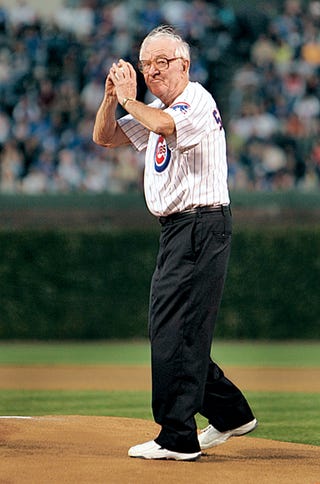
Like being a Cubs fan!

And, I say that not just as a Cardinals fan.

Since Stevens was born on Chicago's South Side, he was some sort of front-runner, and traitor to the White Sox. That too probably ties with him being not at all a liberal.

After all, as he defended himself because the White Sox kind of sucked when he was a kid, liberals are supposed to like the downtrodden.

Well, the Cubs pretty much sucked after 1945, too. So there.