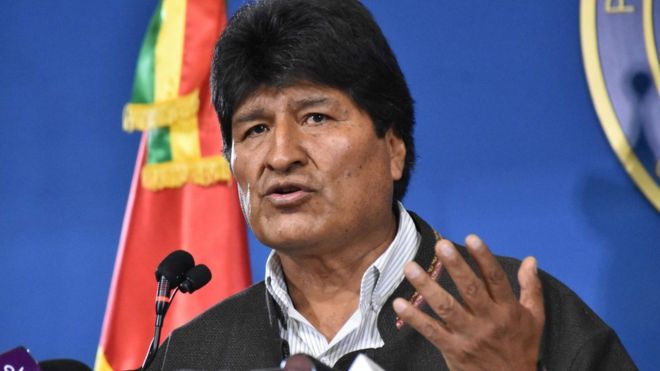
(And, per the update below about Bolivia's redo 1 year later, I'm getting square in some faces again.)
Let's start from what ticked me off:
At The Nation, Mark Weisbrot calls it a coup, while listing Morales' past history — but without any criticism. I've responded that I'll call the past few weeks' action a "countercoup" IF he'll use the C-word for Morales from three years ago up to a month ago.
Ahh, yes the Dangl I did reference.
Let's go to Counterpunch, where, already back in 2016 Dangl was sounding the alarm about Morales' apparent moves toward wanting to be the stereotypical president for life. Dangl (also at Truthout) discusses Morales' electoral corruption leading up to that referendum that failed, and even more notable for lefties who would put him on a platform, promises already either failing or broken.
(Update, Nov. 18: Speaking of Putin, or at least of Russia? Hat-tip to Ken Silverstein [tho I had to Google myself to find the actual link]. Russia allegedly meddled on Morales' behalf. Says who? The Organization of American States? The New York Times? No, Quartz says this was first reported by Proekt, a Russian independent media outlet. If only this Australian native had encouraged leakers inside Russia ...
The piece offers compelling reasons why. Russia wants a cut of Bolivian lithium, like all developed nations do. It though the opposition would be less favorable to mining on Russian terms, or to follow through with plans to buy nuclear reactor construction from Russia.
Now, Quartz reports that Americans who don't write for the NYT think Morales would have won anyway. On the other hand, both cited analysts write before the alleged Russian meddling was revealed. Proekt's original report was on Oct. 23, before Morales agreed to new elections, let alone to a nudge to leave office. It's in English, meaning they want it read outside Russia, obviously. How much it WAS read in the first two weeks after that date? About zero, I'm guessing. The actual meddling was allegedly by Rosatom, but I doubt, if true, that it was working in a vacuum.
Indeed, the piece notes that in 2016, Rosatom head Sergey Kiriyenko became Russia's first deputy head of the presidential administration, which sounds roughly equivalent to White House deputy chief of staff. He maintained Rosatom connections by become head of its supervisory board. Proekt adds that the Kremlin "was only aware" about the effort. In other words they knew, and probably hoped Rosatom would do well enough on its own.
Also contra Quartz's two American consultants, on Oct. 20, Proekt says the spread between Morales and the second vote-getter was within 10 percent, which would mean a runoff unless the rural votes pulled it off. Who knows?
It's interesting that the MSM and the official U.S. government has not cited this piece so far, though. [AFAIK, it's not been referenced.])
And, contra Weisbrot's handwaving about OAS claiming fraud then doing no more, Wikipedia would disagree.
And, it's not just Dangl among lefty journalists who's been skeptical of Morales.
Also unnoted by many leftist stenos, but written up at Truthout by Emily Achtenberg? The degree to which Morales had become a populist nationalist. That link also notes how Morales did some Mandela-like compromises to get elected to a third term. (Actually four, but his first term was before the two-term limit was enshrined in the constitution.) Achtenberg, like Dangl, knows Morales, has reported on his extensively, and is a left-liberal or leftist who doesn't buy the bipartisan foreign policy establishment line.
(Also, per that link just above from Achtenberg? The US forcing down Morales' plane in 2013 shows that the OAS isn't always a total US toady. Plus? Morales accepted its call for new elections. Either he believed he was caught dead to rights, or, unlike Hugo Chavez, he had no huevos, no cojones.)
So, again, Tom (and Ken) if I do grant your claims that coup-like behavior happened, I'm only calling it a counter-coup.
Meanwhile, to get this organized better than yesterday, here's why Morales was really running a slow-acting coup himself.
What's that? Constitution breaking? Aaron Maté, Glenn Greenwald, Silverstein, Weisbrot and others haven't told me that.
Bolivia has a term limit on presidents, instituted in 2009.
Morales, in 2015, pushed a referendum to overturn that part of the constitution. And lost.
So? The country's high court, the Bolivarian Tribunal of Supreme Justice, replacing the old Supreme Court at the same time, was approached by Morales and his political party. He got it to rule that term limits were unconstitutional because they violated his human rights. Background on Wiki. What's laughable indeed is that the American Convention on Human Rights not only says nothing about term limits being a violation of human rights, it limits its own commissioners to two terms. Given this fact, if Bolivia's Bolivarian Tribunal appealed to Article 23 of the ACHR, which is the only thing that comes within five parsecs of Evo's claims and its ruling, it's just barmy. (At the time of the ruling, the OAS rejected such interpretation.)
In addition, Bolivia's Tribunal of Supreme Justice is not only wrong, it's hypocritical. Its own members are elected and ...
Wait for it, wait for it ...
Cannot be re-elected. And, it was inaugurated in 2009, along with other constitutional changes, all designed to make Bolivia .... more democratic. Since it was a new agency, and members couldn't be re-elected, it was ripe for manipulation, even if their elections were allegedly non-partisan. (And, yeah, some right-winger would do the same.) Every judge on the tribunal had come into office since Morales' 2009 election.
In addition, most of Latin America has some sort of limits, if not on overall terms, at least on consecutive terms, per Wiki. The only exceptions? Suriname (set it aside), Nicaragua and .... wait for it ... Venezuela. And also, no recent previous president, whether leftist or rightist, has appealed to the ACHR to overthrow those limits.
So, right there, we're seeing Morales moving toward stereotypical Latin American tinpot dictator territory. (And, giving it an alleged "rule of law" veneer on "snowflake" grounds.)
Next step was then following through and running for a fourth term.
Next step after that was not stepping down, or at least accepting calls for a new election, after this one had charges of major fraud.
Weisbrot claims the OAS was misinterpreting, yes. And, yes, some "slowness" in late rural precincts might happen. But ... we never heard about this in 2009 or 2014.
It seems clear that more and more Bolivians had tired of Morales, constitution-breaking aside. His percentage totals (even accepting his 2019 claims as legitimate) of 47 percent were 15 percentage points or more below his 2009 and 2014 totals.
Let's start from what ticked me off:
At The Nation, Mark Weisbrot calls it a coup, while listing Morales' past history — but without any criticism. I've responded that I'll call the past few weeks' action a "countercoup" IF he'll use the C-word for Morales from three years ago up to a month ago.
Ditto goes for you, Ken Silverstein, where I saw Weisbrot's piece. Also "interesting" is that both of them reference Benjamin Dangl without referring to any of his above work.OK, I'll call it a countercoup, IF you'll go back to 2016, when Morales decided to violate the constitution & use the c-word for his stacked court reversal, none of which you actually criticize. Plus, other leftists have found Morales less than all that. https://t.co/PPXkoNM9mv— reallyDonaldTrump 🚩🌻 (@AFCC_Esq) November 11, 2019
Ahh, yes the Dangl I did reference.
Let's go to Counterpunch, where, already back in 2016 Dangl was sounding the alarm about Morales' apparent moves toward wanting to be the stereotypical president for life. Dangl (also at Truthout) discusses Morales' electoral corruption leading up to that referendum that failed, and even more notable for lefties who would put him on a platform, promises already either failing or broken.
If Weisbrot wants to say "rule of law," beyond my in-depth refudiation below? Even Putin had the constitutional decency, on paper, to serve a term as prime minister.Gotta love softheaded lefties justifying Evo Morales breaking the Bolivian constitution by saying "but the supreme court said" and so #RuleOfLaw. Putin's Russia also has a supreme court. At least Putin himself had decency to serve a term as prime minister. https://t.co/PPXkoNM9mv— reallyDonaldTrump 🚩🌻 (@AFCC_Esq) November 11, 2019
(Update, Nov. 18: Speaking of Putin, or at least of Russia? Hat-tip to Ken Silverstein [tho I had to Google myself to find the actual link]. Russia allegedly meddled on Morales' behalf. Says who? The Organization of American States? The New York Times? No, Quartz says this was first reported by Proekt, a Russian independent media outlet. If only this Australian native had encouraged leakers inside Russia ...
The piece offers compelling reasons why. Russia wants a cut of Bolivian lithium, like all developed nations do. It though the opposition would be less favorable to mining on Russian terms, or to follow through with plans to buy nuclear reactor construction from Russia.
Now, Quartz reports that Americans who don't write for the NYT think Morales would have won anyway. On the other hand, both cited analysts write before the alleged Russian meddling was revealed. Proekt's original report was on Oct. 23, before Morales agreed to new elections, let alone to a nudge to leave office. It's in English, meaning they want it read outside Russia, obviously. How much it WAS read in the first two weeks after that date? About zero, I'm guessing. The actual meddling was allegedly by Rosatom, but I doubt, if true, that it was working in a vacuum.
Indeed, the piece notes that in 2016, Rosatom head Sergey Kiriyenko became Russia's first deputy head of the presidential administration, which sounds roughly equivalent to White House deputy chief of staff. He maintained Rosatom connections by become head of its supervisory board. Proekt adds that the Kremlin "was only aware" about the effort. In other words they knew, and probably hoped Rosatom would do well enough on its own.
Also contra Quartz's two American consultants, on Oct. 20, Proekt says the spread between Morales and the second vote-getter was within 10 percent, which would mean a runoff unless the rural votes pulled it off. Who knows?
It's interesting that the MSM and the official U.S. government has not cited this piece so far, though. [AFAIK, it's not been referenced.])
And, contra Weisbrot's handwaving about OAS claiming fraud then doing no more, Wikipedia would disagree.
And, it's not just Dangl among lefty journalists who's been skeptical of Morales.
Also unnoted by many leftist stenos, but written up at Truthout by Emily Achtenberg? The degree to which Morales had become a populist nationalist. That link also notes how Morales did some Mandela-like compromises to get elected to a third term. (Actually four, but his first term was before the two-term limit was enshrined in the constitution.) Achtenberg, like Dangl, knows Morales, has reported on his extensively, and is a left-liberal or leftist who doesn't buy the bipartisan foreign policy establishment line.
(Also, per that link just above from Achtenberg? The US forcing down Morales' plane in 2013 shows that the OAS isn't always a total US toady. Plus? Morales accepted its call for new elections. Either he believed he was caught dead to rights, or, unlike Hugo Chavez, he had no huevos, no cojones.)
So, again, Tom (and Ken) if I do grant your claims that coup-like behavior happened, I'm only calling it a counter-coup.
Meanwhile, to get this organized better than yesterday, here's why Morales was really running a slow-acting coup himself.
What's that? Constitution breaking? Aaron Maté, Glenn Greenwald, Silverstein, Weisbrot and others haven't told me that.
Bolivia has a term limit on presidents, instituted in 2009.
Morales, in 2015, pushed a referendum to overturn that part of the constitution. And lost.
So? The country's high court, the Bolivarian Tribunal of Supreme Justice, replacing the old Supreme Court at the same time, was approached by Morales and his political party. He got it to rule that term limits were unconstitutional because they violated his human rights. Background on Wiki. What's laughable indeed is that the American Convention on Human Rights not only says nothing about term limits being a violation of human rights, it limits its own commissioners to two terms. Given this fact, if Bolivia's Bolivarian Tribunal appealed to Article 23 of the ACHR, which is the only thing that comes within five parsecs of Evo's claims and its ruling, it's just barmy. (At the time of the ruling, the OAS rejected such interpretation.)
In addition, Bolivia's Tribunal of Supreme Justice is not only wrong, it's hypocritical. Its own members are elected and ...
Wait for it, wait for it ...
Cannot be re-elected. And, it was inaugurated in 2009, along with other constitutional changes, all designed to make Bolivia .... more democratic. Since it was a new agency, and members couldn't be re-elected, it was ripe for manipulation, even if their elections were allegedly non-partisan. (And, yeah, some right-winger would do the same.) Every judge on the tribunal had come into office since Morales' 2009 election.
In addition, most of Latin America has some sort of limits, if not on overall terms, at least on consecutive terms, per Wiki. The only exceptions? Suriname (set it aside), Nicaragua and .... wait for it ... Venezuela. And also, no recent previous president, whether leftist or rightist, has appealed to the ACHR to overthrow those limits.
So, right there, we're seeing Morales moving toward stereotypical Latin American tinpot dictator territory. (And, giving it an alleged "rule of law" veneer on "snowflake" grounds.)
Next step was then following through and running for a fourth term.
Next step after that was not stepping down, or at least accepting calls for a new election, after this one had charges of major fraud.
Weisbrot claims the OAS was misinterpreting, yes. And, yes, some "slowness" in late rural precincts might happen. But ... we never heard about this in 2009 or 2014.
It seems clear that more and more Bolivians had tired of Morales, constitution-breaking aside. His percentage totals (even accepting his 2019 claims as legitimate) of 47 percent were 15 percentage points or more below his 2009 and 2014 totals.
Also per Dangl, after the 2019 election started? Morales disempowered the indigenous people he claimed to represent
So, Morales appeared to be trying to start a cult of personality, a la Chavezismo. But, he didn't have the country's non-rightists, or the military, as securely in his corner as Hugo Chavez in Venezuela. So, constitution breaking, combined with largely ignoring the campesinos in his current term, left him on the semi-outs.
==
That said, I'm not alone. Jacob Sugarman, at TruthDig, also called out Morales for illiberalism and refusal to accept the referendum result.
==
Meanwhile, even into 2020, Jacobin and others continue to spin away the truth about Morales. I stand where I stood. I'll call the actions against him a countercoup IF they'll call Morales' actions against the Bolivian constitution a coup.
I have no doubt that organized rightist elements were lying in wait, looking for their main chance. I also have no doubt that Morales gave them their main chance.
I also have no doubt that Jacobin and others will continue to refuse to look at the serious issues Latin American leftism continues to face, starting with cult of personality issues.
==
Update, Oct. 20, 2020: With Bolivia holding a new presidential election, on Twitter, the UNskeptical cadre of leftists and ALLEGED outside the box thinkers are all laughing at this AP story. In reality, per everything I've posted above, it's fair, evenhanded and insightful. Like this:
A boyhood llama herder who became prominent leading a coca grower’s union, Morales was immensely popular as Bolivia boomed, but support was eroding due to his reluctance to leave power, increasing authoritarian impulses and a series of corruption scandals.
He shrugged aside a public vote that had set term limits, and competed in the October 2019 presidential vote, which he claimed to have narrowly won outright. But a lengthy pause in reporting results fed suspicions of fraud and nationwide protests followed, leading to the deaths of at least 36 people.
Actually, if anything, the AP story still bends over backward in Morales' favor. Contra my first piece on his constitutional coup, it doesn't talk about the laughable ruling by his packed high court that term limits on the presidency were a human rights violation, nor the hypocrisy that the high court making that ruling was itself term-limited. Nor does it mention that some of Morales' own civilian allies were telling him to move along a year ago.
As for who's going to REALLY be Bolivia's new president? It AIN'T, per this blogger, going to be the "duly elected" Luis Arce.
Morales, who turns 61 this month, said at a news conference in Buenos Aires, Argentina, on Monday that he plans to return to Bolivia, though he did not say when.
Like Arce, he took a conciliatory tone and called for “a great meeting of reconciliation for reconstruction.”
“We are not vengeful,” he said.
He declined to say if he would have a role in the government. But few expect the sometimes-irascible politician — Bolivia’s first Indigenous president — to sit by idly.
“Arce is not Morales, but the question is, who is going to govern Bolivia facing the approaching crisis,” said political science professor Franklin Pareja.
THAT's the man, whether he holds official office or not, who will once again be actually holding office.
Evo Morales Thought, anyone? Speaking of? It's almost as bad as UNskeptical lefies, including Green Party thought leaders, stanning for Xi Jinping Thought. I of course checked Howie Hawkins' Twitter feed, as these Green stanners were and are in his campaign, and there we go.
Congratulations to Socialist Luis Arce for his electoral victory in #Bolivia! The Movement Towards Socialism got 20 points more than the closest right wing competitor. #Indigenous people recovered democracy after bloody coup backed by U.S. #Evo https://t.co/9XmY5SP2cC
— Howie Hawkins (@HowieHawkins) October 20, 2020
Teh other parts of the AP story are true, too. The economic bloom was coming off the Moralean installation of Hugo Chavez-type Bolivareanism even before last year's election. But, that will all be blamed on the U.S.
Nobody blamed Hugo Chavez for not diversifying the Venezuelan economy more. Nobody blamed Hugo Chavez for not having Venezuelan petroleum engineers trained in sufficient numbers to adequately extract Venezuela's sour, heavy oil after he nationalized the industry. It was all America's fault. (Nor did Green types among lefties note that Chavez had left Venezuela dependent on sour, heavy, particularly climate change inducing oil!) I referenced this in passing in my RIP for Kevin Zeese, which was prelude to my Xi-stanning piece.
Finally, the fact that Bolivia is having a "do-over" election less than one full year after Morales' (semi)-coup failed shows that the rightists there who were so maligned by American liberals as well as UNskeptical leftists just maybe weren't all evil, or at least that centrists had more power in the whole situation than many left-of-center Merikans chose to admit. I mean, contra people sneering at the AP story, interim president Jeanine Añez quickly accepted the result. Also, per that Wiki link, with a link to a Spanish-language news site, Morales was snooty enough he refused to debate challengers in all elections he was in. And Arce pulled the same thing.
And, shock me that Greenwald is among the liars about this. First, he ignores that the reason the "do-over" was twice postponed was because of COVID. Second, he ignores Añez ruling herself out of running. Yes, it may have been belated, and to help another candidate, but she did. Third, calling this a U.S. coup ignores what I said above about even political associates of Morales telling him not to run in the first place. And, of course, all of this halfway ignores Morales' own semi-coup against the constitution, Glenn. (Greenwald does refer to it, but in HIGHLY euphemistic language. He does also admit even someone like Lula, as well as some U.S. leftists, had become skeptical if not critical. But he doesn't tell you why. And, for Bolivia's economic success, he has to pull up a 2014 piece.
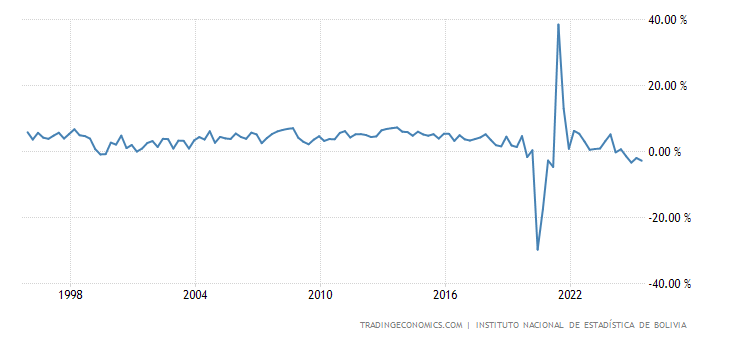
(Did he distribute that wealth better? Arguably. Did he increase wealth by increasing an extractive economy focus? Unargubly.)
The larger reality is that, if you go to the same link above and do something like GDP per capita PPP, arguably the best reasonably common way to look at things, Morales' administration saw some acceleration of a growth rate that had already started accelerating before he became president.
And, speaking of natural gas? Morales, especially with more time in power, wasn't always the best environmentalist. Ecuador's Correa had a similar history.
Oct. 23: Threats to freedom of the press and freedom of speech are already starting. Doesn't matter if the statement is racist. (It is.) But, threatening to take the reporter to court? Already chilling.
Nov. 9: As I predicted three weeks ago, Morales HAS snuck his ass back into Bolivia. This was the day after Arce was sworn in. How long before Morales starts being his puppetmaster?
Nov. 14: Just reading Dangl's post-election article. He does talk about a coup, does NOT call it US-backed, and in his story this spring about the Añez government, again notes that Morales brought some of his problems on himself.
==
New update, Nov. 30, 2021: Looks like Morales' flunky-puppet President Luis Arce ain't so popular with a bunch of home folks. Those protestors have since drawn counter-protestors. And, it's drawing flies from right and left elsewhere in Latin America.