SocraticGadfly: water rights
Showing posts with label water rights. Show all posts

October 28, 2025

Texas High Plains farmers and ranchers are wrong on Proposition 4

I'm talking about people like Suzanne Bellsnyder.

I've previously discussed how it's an economic boondoggle and antienvironmental. Now, we're pivoting directly to Texas' High Plains and Panhandle, places like Sherman and Hansford counties where Ms. Bellsnyder is.

The biggie of the 17 constitutional amendments on the Nov. 4 ballot is Proposition 4. Vote NO, NO, and NO. Any librul or alleged leftist organization telling you to vote yes is full of it. I covered this a month ago, and specifically called out Lone Star "Left" for saying vote yes. It's a boondoggle fiscally AND, even worse, for anybody truly to the left? It's horribly antienvironmental. Since then, I noted something worse: The state doesn't even know how much water these "data centers" will use, and it has basically no regulations to that end.

Lone Star "Left," per Cactus Ed Abbey, seems to believe in growth for growth's sake without admitting that's the theology of the cancer cell.

Now note to likes of Suzanne Bellsnyder: Agricultural wells are declining because of over-appropriation and climate change on the high plains, like your Texas Panhandle. Marc Reisner wrote about the former 40 years ago in "Cadillac Desert." I saw that in action 25-plus years ago in eastern New Mexico, as far as the Ogallala Aquifer.

See this piece for details:

Much of this water used for farming is actually wasted; flood or furrow irrigation, the most widely used irrigation technique involving running water through small trenches in crop fields [9], loses about 50% of its water to evaporation and runoff [8]. According to the USGS, 23,000 acres of cropland were irrigated with flood techniques in 2015, using about 43.3 billion gallons of water per day — and wasting half of that [9]. 
Despite its known wastefulness, western farming still relies heavily on flooding irrigation because of its low cost. Government subsidies encourage farmers to purchase more land to produce more crops, requiring larger irrigation equipment — all of which costs money. To try to break even, farmers are forced to turn to fast and reliable irrigation techniques. This cycle is running the aquifer dry.

In fact, the Okie state Extension service says that, because of people like you, Ms. Bellsnyder, parts of the Ogallala could run dry in 30 years. 

In other words, rewarding bad behavior is what Prop 4 is all about, in addition to being anti-environmental etc. 

Per that piece, especially at the federal level but also the state level, there's all sorts of policies we could undertake to preserve the Ogallala. Like this, from that piece above:

Economically, farmers can use lowering groundwater levels as a tax write off on equipment. Replacing tax write offs with tax credits for conserving groundwater could be a compelling incentive to monitor and save more water

There you go.

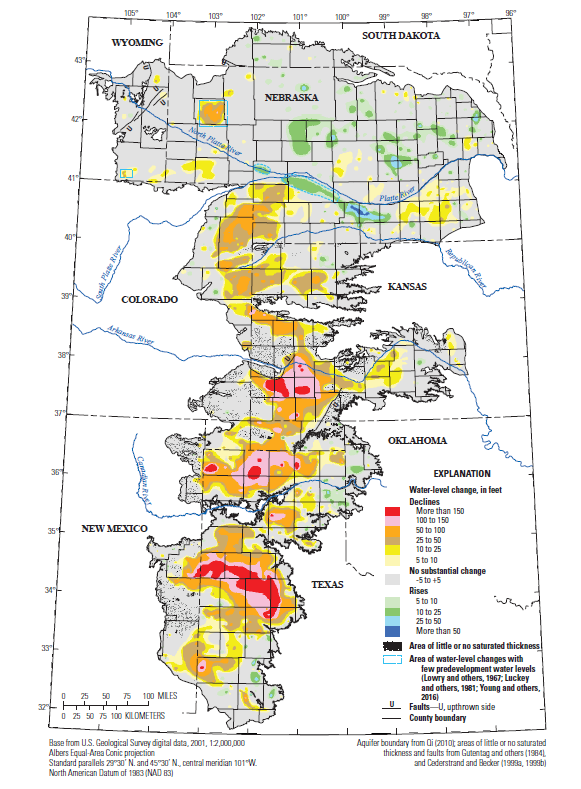
Meanwhile, yes, people in Ms Bellsnyder's counties, second from left and middle at the top row of the Texas Panhandle, are indeed drawing down water. In some cases, 50-100 feet as of 2001, per the image. Think of how much more it's dropped today.

It's not all farmers. Reportedly, Nebraska is somewhat better, Colorado modestly better, and Tex-ass and Kansas the worst. And, there's the issue of drought likely to continue in the Southwest for the rest of this century due to climate change. (I browsed pieces on Bellsnyder's Substack, and didn't find that phrase, "climate change.") That's the facts. Per this piece, the Ogallala is likely to go pretty much full-on belly-up in 20 years. Part of it is lack of cooperation between states. Part of it is Tex-ass having purely voluntary laws for water conservation.

Until that's fixed, that's another reason to vote NO on Prop. 4. 

Charles Perry, bring the public some water conservation issues with teeth in them, before anything else. 

Sadly, per Ballotpedia, all Democraps in both House and Senate supported it. (Twelve House Rethuglicans were opposed.) Also, sadly, no non-Gang Green environmental org, like Center for Biological Diversity, registered official opposition, whether or not speaking to that end. 

And, a follow-up note to Bellsnyder in general. No, contra your unwarranted assumptions (which you as a newspaper publisher, and a former Texas Lege staffer, should know better than to make) not everybody in rural Tex-ass is Rethuglican. Nor are they all "people of faith." Gack. And barf.

June 06, 2025

Texas' real water problem ...

Is one that Charles Perry won't touch. And, that is the need to regulate groundwater pumping amounts, as the Trib details. Having lived on both sides of the state line in the Ogallala Aquifer's southern end, I know what a problem this is.

As the story notes, groundwater districts are essentially "toothless" on the rule of capture, and rural Rethuglicans in the Lege like it that way; so do many of the Anglo rurales on the High Plains. As noted, it fits the "rugged individualism" mythos which is of course a lie.

The real issue is that the Lege won't address the issue of groundwater in aquifers being like a stream or river. And, given past battles with New Mexico, it's a hypocrite on this.

Beyond the state level, the feds aren't doing enough via the Interstate Streams Commission, either.

August 14, 2024

Declining Rio Grande reservoirs aren't all Mexico's fault

They're Texas' as well.

Note to Strangeabbott et al? It's called climate change.

As for the degree this might have been New Mexico's fault, before a Texas-New Mexico settlement that a 6-3 SCOTUS majority rightly nixed?

Note to Tiffany Lashmet Dowell, who I thought was better than this? The feds rowing their oar in on the Texas-New Mexico Rio Grande deal is not some new version of Agenda 21 or something.

Given that the Texas-New Mexico water settlement could affect "deliverables," which in turn might affect treaty obligations, even if the Supreme Court ruling in the case didn't explictly mention the US-Mexico treaty of 1944 covering both the Rio Grande and the Colorado, it DID mention the nation of Mexico, and thus, the empirical issues behind that treaty. The majority opinion was the right one.

Blame the special water master for not looping the feds in from the start, as the feds had requested.

To use an analogy? And to take it from conditions on that other river of international treaty?

Assume, hypothetically, that there are still portions of the All-American Canal that are not lined by concrete. Picture the state of California claiming that leakage water flows into Mexico. (It probably flows more into the Salton Sea, if there is any, but play along.) Picture, whether as part of negotiations to extend and update the Colorado River Compact, or just a unilateral California declaration, it telling the other six states in the compact that it thinks that water should count as part of US deliverables to Mexico under treaty and so it will increase its take.

The six other states would, in general, laugh. Well, Aridzona would get irate, not laugh.

The feds would also laugh — and then row their oar into the issue. The analogy is complete because both the Colorado River Compact and the original Texas-New Mexico deal on the Rio Grande were completed before the US-Mexico treaty.

There's also the framing issue. Below El Paso, this isn't "Texas" delivering water to Mexico; it's the US. I didn't really care for Dowell going there; it felt close to Texas exceptionalism. The analogy holds here, too. Below Yuma, it's not Aridzona delivering water to Mexico, it's the US.

And, Lashmet also doesn't tell you, which NPR does (though ignoring why Mexico is holding some bits of water) that it has one full five-year cycle after a current one when it's behind the curve to make up a water deficit. As for that why, otherwise? Mexican president Lopez Obrador has been water-stingy since Strangeabbott started putting the razor wire in the river.

June 20, 2023

More on Navajo water rights vs Aridzona

As blogged about recently Navajo water rights claims stand before the Supreme Court, on which it could rule later this month. And, it's just possible that, even if the feds, behind Arizona, win, the victory would be Pyrrhic. See here.

(Update, June 22: The Navajos lost on a 5-4 vote, as Gorsuch couldn't get the Umpire or the Drunk to join him and the three liberalish members.)

Update to the last point? This HCN/Pro Publica piece about Aridzona screwing over Indians in general on water rights begins by noting just how this water could be used, but can't currently be used. A new hospital on the Big Rez stands unused because it doesn't have a guaranteed adequate water supply. And, it's not all Colorado River Compact states, it's Aridzona. This:

The Navajo Nation has negotiated with all three states where it has land — Arizona, New Mexico and Utah — and has completed water settlements with two of them. “We’re partners in those states, New Mexico and Utah,” said Jason John, the director of the Navajo Nation Department of Water Resources, “but when it comes to Arizona, it seems like we have different agendas.”

Is the nickel version.

(Update 2, June 26: Pro Publica offers an update to its previous piece.)

It's horseshit, to be blunt and pun, that alfalfa grown by White people takes precedence over something like the Dilkon Medical Center.

That said, per the story, Aridzona doesn't do this just to Navajos. It's all tribes in the state. And, it is hardball:

The state — through its water department, courts and elected officials — has repeatedly used the negotiation process to try to force tribes to accept concessions unrelated to water, including a recent attempt to make the state’s approval or renewal of casino licenses contingent on water deals. In these negotiations, which often happen in secret, tribes also must agree to a state policy that precludes them from easily expanding their reservations. And hanging over the talks, should they fail, is an even worse option: navigating the state’s court system, where tribes have been mired in some of the longest-running cases in the country.

Hardball.

It's a spinoff of Aridzona being stubborn against California early on in the Colorado River Compact, as documented by Marc Reisner in "Cadillac Desert" and others.

Speaking of hardball? To expand on my blog post last month about the three-year temporary non-rescued of the Lower Colorado Basin? It's softball and a boondoggle. 

More here from Gary Wockner of Writers on the Range on how this deal essentially is a boondoggle. With the "bribery" angle in place (for 3 years, $1.2 billion of Inflationmonger Joe's Inflation Reduction Act), alfalfa farmers will dig in their heels in four years. And, it ignores dams in the pipeline on the river's Upper Basin.

His nutgraf is near the end:

What this deal does do is set the precedent that the American taxpayer will backfill any and every financial loss caused by a changing climate. It has been estimated that the Colorado River’s water generates $1.4 trillion in economic activity per year. As climate change further depletes the river, will the U.S. taxpayer always be on the hook?

Couldn't say it better.

Update: Again, lest one thing that this is just about Navajos, High Country News has a new piece about Aridzona hating Hopi water rights, too. And yet another, about the Chemehuevi's water, though that's from Californicating on the other side of the river, actually. Both these are also in conjunction with Pro Publica.

April 20, 2020

The Saudis milk Arizona for all it's worth,
but state woes were at least partially preventable

I hope Arizonans like growing alfalfa for Saudi Arabia even as their own towns and counties that aren't getting Central Arizona Project or other Colorado River moisture dry up. And cave in. No, literally, per that link. The silver lining, to the degree there is one? After enough of the state literally implodes enough from ground subsidence, maybe more of them will move back to Iowa, Illinois or Minnesota. You know, where the water is.

IMO, Obama, as part of the Great Recession bailout, should have bought out free and clear people in Phoenix and Vegas who were underwater (reverse pun recognized) on mortgages — but with a legally binding stipulation they didn't move back to anywhere in the Colorado River Basin for 20 years. And, since the bailout would ultimately benefit banks, they'd have to sign off on not "replacing" these people.

Now, I'm not a lawyer, nor do I play one on teevee. But I'm sure this would have been doable, in one or another way, shape or form.

If banks squawked on the "no replacement homeowners," a real prez simply would have given cash equal to the base payment value of what was left on the mortgage (base payment, as in no interest portion) and then required the same deal out of these folks. In exchange, if the banks kept squawking, a real prez would have offered a wink and a nod to these migrating homeowners about what federal law, at least, would not do to them. If the banks squawked further, some FDIC audits might have been a wake-up call.

Unfortunately, Dear Leader, compromising the compromise away in advance, and putting Lil Timmy Geithner in charge of most financial elements, wasn't a real prez.

October 04, 2019

Kumbaya is not a solution to Western water rights

That's even though John Fleck claims it is.

Fleck, a former Albuquerque Journal reporter, is now an adjunct professor at UNM and director of its water resources program. He is right that collaborative water governance is needed in the Colorado basin and elsewhere in the Southwest, but his blog (with a sometimes co-author, Eric Kuhn) tends to go overboard. He claims that most past reporting on the issue has been unduly alarmist and achieved little. He's half right on that.

A lot of it has been alarmist. Unduly? Maybe, maybe not. As for whether the alarmism helped prod collaboration under fear, maybe it didn't but maybe it did.

He's wrong that past history of water issues indicate that "Kumbaya" type interactions have been how all this collaborative governance has been achieved. Often, collaborative government has only resulted after legal threats. I don't consider a mailed fist in the background, even if not actually used, to be "Kumbaya." (And, that's setting aside the times that collaboration between different water governance entities only happened AFTER the mailed fist hit something.) And unlike alarmist headlines (or even books: Fleck semi-sneers about Marc Reisner's renowned "Cadillac Desert"), where benefit or lack thereof is near-impossible to determine, lawsuits, or even the threat of them, causing change can be clearly measured.

And, yes, IMO, sneered is the right word on "Cadillac Desert." Look for yourself.

Another red flag of sorts, that I noted as I wrapped this up? Fleck's UNM position is in its department of economics, not Geography and Environmental Science, which probably says something right there.

With that in mind, I eventually decided to read his 2016 book. What's below is an adapted Goodreads review.

Water is for Fighting Over: and Other Myths about Water in the WestWater is for Fighting Over: and Other Myths about Water in the West by John Fleck
My rating: 1 of 5 stars

Intellectually dishonest, in my opinion.

He, or his friends, know the numbers stuff. But, he's Preznit Kumbaya on his framing.

So, knowing Fleck had written this book, and that he had a new one coming out, I wanted to see what he was like in more than blogging depth.

Answer?

Worse than on the blog.

Let’s start with the most egregious issue. A 2016 book about Colorado River water issues doesn’t even use the words “climate change” until page 199? UNACCEPTABLE.

Second, and the point behind the header?

Much of the “Kumbaya” that Fleck mentions was only achieved with the threat of a legal mailed fist behind it. Kumbaya by force of law is hardly Kumbaya.

Other issues that pop up early on?

More dissing of Reisner. After initial mention, simply ignoring James Powell, author of “Dead Pool.” I have re-read “Cadillac Desert” have a dozen times and “Dead Pool” twice. Both are in my small “keepers” library.

Next? More Kumbaya, even as places like today’s Aral Sea basin, Jordan River, Tigris-Euphrates and Nile show that Kumbaya ain’t working so well as we speak.

We don't even need to go outside the Colorado Basin! The fate of the Hohokam should indicate that Kumbaya doesn't always win.

Next next? Ignoring that Colorado River water usage has been mitigated by ever-heavier drawdowns of groundwater, both in groundwater basins connected to the Colorado (Arizona) and in those not (California), though there it’s more to reduce Sacramento-San Joaquin water u se in the Central Valley.

Next next next? Ignoring the connection between groundwater basins and river recharge. Anybody who knows the godawful state of southern Arizona tributaries of the Gila also knows why.

And, we’ll keep going. In supporting growing alfalfa as a flexible crop, he ignores that the methane farts of the cows it feeds contribute to the climate change that is making the Colorado ever drier. But, since he doesn't mention climate change until the end of the book ...

A lot of the Kumbaya cooperation Fleck cites, like in SoCal, has the fist of threatened legal power behind it, in specific, just as has most Colorado River stuff. Doesn’t matter if the threat is rarely invoked; it exists. That’s “forced Kumbaya,” not Kumbaya.

Also, it comes off as a bit cherry-picking to discuss a couple of small Southland water districts and never discuss the massive water headaches in the Central Valley, which were a large part of Reisner’s book.

One other reviewer notes water fights in the Central Valley (speaking of) are even worse than in the Colorado, and large scale corporate farms have no problems putting their thumb on the scales.

Back inside the Colorado basin, and after the date of this book, Arizona’s state Speaker of the House Bowers nearly gutted a needed agreement for new water use reductions earlier this year with a proposed rider on the bill. Only the threat of the Maricopa affiliation of Indian tribes forced his hand. Fleck made light of it.

Speaking of that, that water agreement was required because of Lake Mead hitting 1.075 elevation. Fleck, near the end of the book, notes that a previous agreement didn’t directly address 1,075, but appears to believe there that this point wouldn’t hit until after 2020.

Well, Fleck, it hit before then, and it hit before then in spite of a record Rockies snowpack in 2019. Did you talk about climate change in your new book?

One other point vis-à-vis the Anglo water world in the Southwest in general, American Indian water rights are the 800-pound gorilla in the room. Fleck does eventually discuss them – for half a dozen pages or so in the last 10 percent of the book. But he doesn’t go into detail.

Next, he never considers whether a “moon shoot” shouldn’t overhaul the current Upper / Lower Basin divisions. (I say it should; I’d put the Virgin River in the lower basin and the Little Colorado in the upper.) Related to that, on his blog, Fleck appears wedded to giving the Upper Basin just as much water despite its lesser population and its agricultural challenges.

Something almost as inexcusable as not mentioning climate change until the end of the book? Talking early on about the Mormons and the amount of water management ideas they spread around the West while ignoring that they got much of that, in turn, by learning from the majordomos who ran (and still run, in many cases) acequias in New Mexico. It’s doubly inexcusable not to mention this since Fleck is a long term reporter at the Albuquerque Journal.

That’s even though he mentions it in his blog. While, at the same time, it's a throwaway line.

Look, some "gloom and doom" newspaper reporting and books over the state of the Colorado may have been too much. BUT, they were reasonable extrapolations from the status quo at the time they were written. Killing a perhaps sometimes overdone angle the way Fleck has done is proverbial gnat meeting sledgehammer.

Of course, a sledgehammer can't be swung quickly and accurately enough to actually kill a gnat.

Finally, beyond the thumb-on-scales slant, I just don't think the book is that well written. The throwaway nature of the Mormon comment would be one example.


View all my reviews

And, it's not just the book.

Here's a post from late September about how much Albuquerque has cut its water use.

My thoughts back?

Of course, not all of this is due to Kumbaya let's all be nice.

Any water reduction agreement with the threat of a legal mailed fist behind it is NOT Kumbaya.

And, it's not just from other Anglos or whatever. Fleck's own former paper noted how the state is fighting Navajos winning new San Juan water rights. That's even though it says it agrees with the result.

And, less non-Navajo water right on the San Juan means less water to divert to the Chama.

Various pueblos had water rights confirmed in 2017. Again, mailed legal fist, or threat of it, to established municipal users. 

There's also the issue of water purity. I'm sure that Fleck knows Isleta won a ruling on that 20 years ago. It's indirectly related to water rights, though the main issue was about treating water for quality. Non-Puebloans using less water means that water that remains, or treated water that is better treated when returned to the river, will more easily meet the requirements.

Also, the carrot of tax credits for low-flow showerheads, low-flush toilets, etc. and the stick of higher water rates have been part of the mix. The carrot could be called Kumbaya; the stick not so much.

High Country News has done a number of stories on Indian water rights. Here's one from a year ago. An important takeaway from that is that it often takes decades for the rubber of a new Indian water rights legal confirmation to hit the road of reality on how that affects other water users.

No wonder Ted Nordhaus' Breakthrough Institute has a page on him. And, you know, if you look at Breakthrough's board, tech-libertarians and their likes abound.

Yeah, Reisner is dated. That said, despite one commenter on Fleck's page, he's NOT that dated; the revised edition is 25 years old, not 40. And Powell, who DOES mention climate change, is only half a decade old and not out of date at all. Worster's not out of date either. And, he's spot on about noting issues of class and water rights, which play out especially on American Indian issues but also somewhat elsewhere.

And, instead of reading this book, or Fleck's new one, read Powell. Or the new "Downriver" from Heather Hansman. Or, beyond the narrow issue of water, Christopher Ketchum's new "This Land." Just don't bother reading John Fleck.

July 24, 2008

Straw man in the ‘Cadillac Desert’ critique

Yes, some things about agriculture in California have changed since 1986. That ignores the fact that U.S. farmers in the Desert Southwest, compared to counterparts in places like Israel, are wasteful of water.

But, that’s not the only problem. Marc Reisner’s magnum opus, “Cadillac Desert,” isn’t all about agriculture, and the part that is about agriculture, which is the major part, true, isn’t all about agriculture in Southern California. It’s not even all about agriculture west of the Rockies.

More specifically, a lot of the book is about water impoundment and water rights; another large chunk of it is about the politics of western water; a third chunk is about bureaucratic infighting between Reclamation and the Corps of Engineers; a fair amount of it is not about agriculture at all. O’Hare knows that too, if he’s actually read the book.

So, in saying “Cadillac Desert is not a Bible ,” Michael O’Hare is setting up at least a bit of a straw man if not more than a bit.

And, agricultural use of water isn’t SoCal’s problem anyway; O’Hare is either focusing narrowly on refuting both some misconceptions about “Cadillac Desert” and his straw man version thereof, so narrowly that he won’t tackle the real issue, or else he’s ignorant of the margin of severity of the real issue.

As for other specific straw man claims of theirs, I, for one, whether commenting to Drum’s blog or posting here, have never claimed that agriculture uses 80 percent of California water, or that it is ridiculous to grow certain crops in the desert.

I HAVE claimed that agriculture, at least off Reclamation projects, gets its water at subsidized rates, though I have never actually used the phrase “next to nothing.”

Given that he lumps “energy” and “environment” under one tag, and the paucity of water-related postings under that tag , I’ll assume ignorance.

First, as I’ve blogged before, Lake Mead could be DEAD in a dozen years or so. Along with that, the whole Colorado River could wind up looking like the Amu Darya or Syr Darya in Kazakhstan.

Second, I think O’Hare sets up a straw man version of “Cadillac Desert,” as noted above.

Third, to combine No. 1 and No. 2, doesn’t matter WHO uses the most water if, er…

Lake Mead is dead!

Fourth, there’s this dam, called Hoover Dam, that produces electricity for SoCal and Vegas. Umm, if Lake Mead is dead, Kevin, you ain’t getting any electricity from Hoover Dam for OC. For SoCal, more than Vegas (or Phoenix), this is a serious problem in its own right.

Remember, Der Governator has pledged to get more electricity only from environmentally-friendly sources. Well, at some point in the not-too-distant future, he or a successor may have to REPLACE some electricity that’s CO2 friendly, if not necessarily environmentally friendly in the larger sense.

Fifth, after criticizing David Zetland, O’Hare is wrong himself on his “market-forces” idea of what drives water costs.
What the cost of water represents is the economic resources needed to get it to where someone wants to use it, mostly pumping and for urban water, cleaning and purifying. To get it to agricultural land is much, much cheaper than to get it to your tap pure enough to drink.

As anybody in the West can tell you, who controls water/water rights/water access is a major determinant, whether it’s used for ag or runs out of a city tap. In California, despite sales of water rights to cities (and the issue of whether or not water rights created for agriculture should be fungible or not is an issue O’Hare simply ignores), that is still a consideration, depending on the source of the water.

Other factors that the post ignores is the crop toll of salinized water, the cost to desalinate when farmers finally have to bite the bullet and more.

Sixth, on the enviro costs of Big Ag, O’Hare undercuts himself in his own post.

Seventh, the only reason CD is less relevant is because Reisner died in his mid-50s before he could do a third edition. I have no doubt he would have factored global warming into that third edition.

But, let's get back to the big picture, which is what both O'Hare and Reynolds, his linkee, miss.

To talk about narrow-based water-pricing issues without talking about water-supply issues, is like talking about someone throwing a lit cigarette out a car window in SoCal in August without talking about Santa Ana winds. Or like arguing about whether the lantern Mrs. O’Leary’s cow kicked over was fueled by kerosene or white gas while ignoring high winds as contributory to the Chicago fire. Or, it would be, as you’ll understand, like blogging about Peak Oil by only writing about oil in Oklahoma.

In other words, O’Hare AND Reynolds are straining at gnats when there’s much bigger fish to fry.

Finally, I've got a bitchfest comment about their blog. Right now, at least, TypeKey won't let me post there and Haloscan won't let me trackback. I suspect it's a problem with their blog, not either service.

Shouldn't the "Reality Based Community" be better at allowing and promoting discussion?

May 17, 2008

Say goodbye to the Colorado River as you know it

As the U.S. Southwest is expected to heat up faster than the world average during the coming decades of global warming, what’s that mean for the lifeblood of the Southwest, the Colorado River?

The U.S. Geological Survey says it could hit a 500-year low in its flow.

Between that and reduced snowpack in the Sierras, 40 percent of SoCal’s water supply could become vulnerable in the next 20 years. Farmers will either get pressured to sell more water rights to cities (which I contend is illegal under the Newlands Act, which established the Bureau of Reclamation; read Marc Reisner’s excellent “Cadillac Desert” for more on this in particular and Desert Southwest water issues in general), or else pony up the money (which SoCal’s big corporate farms can easily afford) to get more efficient with irrigation, like folks like the Israelis do.

Remember, the Colorado is NOT the Mississippi or even close to it. In fact, it’s closer in size (and geographic setting) to the Amu Darya and Syr Darya rivers of (the former Soviet) Centra Asia, the Oxus and Jaxartes of Alexandrine fame. (The Amy Darya is shown at right, on the Afghanistan/Tajikstan border; doesn’t that just look like the Colorado Plateau?) And we all know what has happened to the Aral Sea as a result of too much tapping of these two rivers.

The USGS has predicted a 25-30 percent chance of a basin-wide water shortage by 2020. That’s the basis of the prediction, made last month, that Lake Mead could dry up by that date.

USGS scientist Gregory McCabe, the author of the report, is due to testify to Congress next month. Stay tuned.

April 06, 2008

Georgia wants a re-do on the map

Of its state line with Tennessee, that is.

Why?

Having lost legal battles with Alabama and Florida that require it to maintain water releases from Georgia reservoirs on interstate rivers, it’s hoping to get a piece of the Tennessee River instead.

Georgia officials maintain the original survey drew the state’s border with Tennessee 1.1 miles too far south. They hope a new survey will give them a toehold on the Tennessee River. If mapmakers won’t redraw, the legislation, headed to Gov. Sonny Perdue, calls for legal action.

But, according to my Rand McNally, 1.1 miles would still leave Georgia a solid half-mile short of touching the river in Chattanooga.

March 19, 2008

‘Virtual water’ wins prize

No, this isn’t a joke for the gullible. The scientist who figured out how much water is used in any production process, such as the ultimate water cost of a cup of morning java, has been awarded the 2008 Stockholm Water Prize . Here’s what John Anthony Allan’s discovery is all about, according to the Stockholm Water Institute:
“Behind that morning cup of coffee, there are 140 liters of water that was consumed to grow, produce, package and ship the beans.”

That is about as much water as a person in England uses on average for all daily drinking and household needs.

“For a single hamburger, an estimated 2,400 liters of water are needed. In the USA, the average person consumes nearly 7,000 liters of virtual water every day.” It said that was more than three times the average consumption of a Chinese person.

In other words, Allan’s work is a vital tool in analyzing global water use and management issues. As “developing nations” seek to become “developed,” water use is probably second only to oil use as a factor in this. That said, in many parts of the world, high-quality water supplies are about as scarce as oil, too.

March 15, 2008

What it’s like to be a Navajo – and how water rights could change that

Unemployment officially at 50 percent and possibly 67 percent. Per-capita income at $8,000 a year. Driving as much as 40-50 miles off the Big Rez to get water in Gallup. Living as close as you can to “Third World” existence here in the United States.

That’s why Navajos want their cut of Colorado River water.

But, will they? The 1922 Colorado River Compact only made allowance for the seven states of the river basin. No Navajos, or other Indian tribes, need apply. But, the Supreme Court’s Winters decision, in another case, gave Indian tribes the right to retroactively claim water rights. Given that Navajos live bordering both a long stretch of the Colorado and most of its third largest tributary, the San Juan River, they’re in a position to make some claims. And, the Navajos’ eligibility for those rights go back to the founding of their reservation in 1868, before most of the Colorado River Basin was settled and when only two of the current seven basin states were established as such.

Plus, the compact itself says:
“Nothing in this compact shall be construed as affecting the obligations of the United States of America to Indian tribes.”

The Navajo, like other tribes, can either sue for their rights, or negotiate compacts with various states, pending Congressional approval. The Navajos have already started down the latter path:
That’s the path that the Navajo Nation has taken in New Mexico. In 2004, the tribe and the state announced a settlement agreement that would award the Navajo 326,000 acre-feet of water from the San Juan River, a major tributary of the Colorado. (An acre-foot is enough for about two families in Phoenix or Las Vegas for a year.) The settlement also authorizes more than $800 million in federal and state money to build a pipeline that will take the water to the east side of the reservation and to the city of Gallup. The Navajo Nation is now seeking congressional approval of the deal, the tribe’s first step toward asserting its rightful claims on the Colorado.

Stanley Pollack, an assistant attorney general for the Navajo Nation’s Department of Justice, says the Navajos could claim as much in Arizona, plus 100,000 acre-feet more in Utah. Out of the 17.5 million acre-feet the compact claimed the river produced, or the 15 million that is a more realistic yet still quite optimistic number, 800,000 acre-feet is huge.

Let’s put it this way. It’s half again the water rights of the city of Las Vegas. And, going by age, the Central Arizona Project is the last in line.

But, Pollack is a bilagaana — a white man — and so, distrusted by many Navajos. With Arizona pushing back against Navajo claims, and Pollack very much a pragmatist, he’s even been accused of creating a water rights holocaust against the Navajos.

And, that problems stems back to legendary, and ultimately criminal, former Navajo Tribal Chairman Peter McDonald. McDonald tried to get a Navajo water rights claim based on their current reservations, but “Dinetah” — the Navajo claim to all the land inside their four holy mountains. Problems with that include not only that the federal and state governments wouldn’t recognize that, but McDonald and other Navajos were ignoring the Hopi, Utes, Zuni, Jicarilla Apache and the 19 Indian pueblos on the Rio Grande who lived in the area, as the High Country News article notes.

But the dreams went up in smoke with Peter Mac’s arraignment on corruption charges, for which he was eventually convicted.

But, the idea still holds sway in many Navajo minds. And, Jack Utter, a bilagaana conspiracy theorist who also works for the tribe, is fueling the anger against Pollack.

Anyway, who knows how this will turn out. As far as intra-Navajo scrums, the HCN story quotes an old aphorism:
The Navajos would rather have 100 percent of nothing than 50 percent of something.

Growing up in Gallup, I can attest to this having some degree of truth.

And, in this case, the Peter McDonald will-o’-the-wisp could be 100 percent of nothing for decades.

Or, with global warming and a drought of nearly a decade and counting tightening its grip on the Colorado Plateau, the Navajos could be pragmatic while still sitting in a large driver’s seat.

Anyway, read the full, in-depth story. This is why I subscribe to High Country News.

March 01, 2008

Environmental news roundup — whale protection, Gore on warming, Southeastern states disagree on water

Appeals court upholds restrictions on Navy sonar

A three-judge appellate panelhas upheld a federal district court ruling that the Navy must take whale-protection precautions with its use of long-range sonar.

Per the ruling, the Navy must maintain a 12 nautical mile no-sonar buffer zone along the California coast, shut down sonar when marine mammals are seen within 2,200 yards, avoid whale habitats and undertake similar other precautions. The Navy has 30 days to appeal to the Supreme Court.

Gore: Global warming getting short shrift in presidential campaign

So, the Nobelist former vice president will turn up the heat himself. His Alliance for Climate Protection will launch a national campaign pressuring candidates to describe in more detail how they will fight global warming.

Southeastern states can’t agree on divvying up diminishing water pot

Even intensifying drought can’t make good neighbors of Alabama, Florida and Georgia. White House-brokered negotiations between the three over water sharing in the Apalachicola-Chattahoochee-Flint and the Alabama-Coosa-Tallapoosa river basins, which have been the occasion of 20 years of wrangling, means the Army Corps of Engineers will impose its own plan.

Georgia, upstream, wants to hold more water in reservoirs around Atlanta while Florida and Alabama argue the Peach State didn’t plan for growth well enough. Meanwhile, legal action between the three will stay on the front burner, and perhaps even have new elements added to it.

Critical-level drought in the area has exacerbated the ongoing water fight. Gore’s comments seem prescient.

And, I can’t wait for something similar to play out in the Colorado River basin between California (Los Angeles), Arizona (Phoenix) and Nevada (Las Vegas).

May 16, 2007

Why Arizona is going to dry up and blow away

Even outside the desert parts of the state, water is getting scarcer and scarcer.

Take Prescott, where my sister lives. In 40 years, its greater area could be 540,000, compared to about 100,000 today. Yet already today, people in the area on individual wells are having to have them redrilled as much as 300 feet deeper at a cost of as much as $12,000.

And, Arizona apparently doesn’t have a state engineer or other “water czar,” at least not one with a lot of power, unlike most western states. The fact that a lot of diversion ditches off the Verde River have no state regulation shows that. And, as I detail beneath a few quotes from the High Country News story, that river is about to be sucked dry, if the city of Prescott and some “growth for growth’s sake” wingnuts have their way.

Here’s how bad the current water situation is:
In the Prescott area, water levels have dropped at least half a foot each year going all the way back to 1982, and more quickly since 1994 — anywhere from 1.5 to 4 feet a year. Today, the area is pumping its groundwater supplies almost twice as fast as they’re being replenished.

Throw in global warming and drought, and the Prescott area is ripe to blow away well before it gets to 540,000 people.

And that’s even with the efforts of wingnuts like former state legislator and current county supervisor (commissioner) Carol Springer, who could definitely stand a few Ed Abbey quotes, specifically about “growth for growth’s sake being the theology of the cancer cell.”
But in 1992, she pushed a bill through the Legislature authorizing the Prescott pipeline, which now stands to cost sponsoring cities $192 million — not counting interest. Her bill authorized Prescott to tap water from the Big Chino sub-basin, which lies north of the Little Chino sub-basin where the city has historically sunk its wells. Twelve years later, Prescott paid $23 million to buy a ranch in the Big Chino to obtain its water rights.

Springer’s bill created the only exception anywhere in Arizona to a previously approved ban on inter-basin water transfers — a law aimed at preventing one region from stripping another of its water resources, Chinatown-style. Her explanation for the need for the transfer is that a community must “grow or die.”

“If we can’t grow at all in the future, because we lose our right to pump groundwater, we will cease to exist,” Springer said. “There is no such thing as a static kind of a situation in terms of a community. You can’t not grow at all and survive. We have to have some element of growth.”

The Big Chino transfer bill wasn’t Springer’s only political effort relating to water supplies in the Verde Basin. Just last year, she chaired the group behind a successful statewide “takings” initiative that requires compensation of any landowner who can prove a new regulation reduces his property value. Some say the initiative could make it harder for the state to regulate development in rural areas with inadequate water supplies.

Unfortunately, she’ll likely be dead long before the catastrophic shit of her actions hits the fan.

The biggest crapola? Prescott’s plan to drill new wells into the Big Chino Basin, estimated to be 86 percent of the water source of the upper Verde River. The Verde flows south through central Arizona, basically from along the western edge of the Mogollon Rim down to mid-altitude desert before hitting the Salt River. Still undammed, it’s home to a great variety of birds and other wildlife, including bald eagles.

And, because it eventually flows into the Salt River Project, administrators of that project, and the Phoenix economic interests behind them, are also concerned. (Of course, there’s probably already too damned many people in Phoenix, but that’s another story.) Since about 40 percent of the SRP’s water comes from the Verde, this is a high-stakes issue. Of course, the SRP isn’t much more forward-thinking than the Prescott folks a lot of times, anyway.

Note: This post has been corrected to reflect that the 86 percent stat is for the upper Verde only. Also, the blogger's sister lives in Prescott; he knows first-hand about some of the issues.