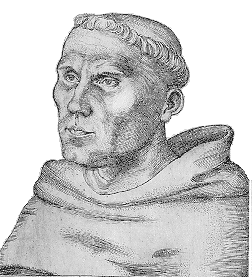
I blogged nearly three years ago about myth vs reality on
Martin Luther, well in advance of the 500th anniversary of his allegedly doing
something with some theses. Indeed, I started with that legend, for legend it
is, that he nailed them to the door of the Wittenberg Castle Church.
And, I was already planning on starting a series of blog
posts with the anniversary nearing vision.
Unfortunately, I didn’t think that a liberal American
opinion magazine would be the spark for my memory, to get started.
But, it is.
The Nation uncritically repeats the legend about the 95 theses
(It's unclear whether any of the books it reviews have this, or just
itself) in a review of several new biographies about Luther and/or his times.
The 95 Theses has been refuted here and
here. (OTOH, another Luther friend claims he nailed the Theses to other church doors in Wittenberg as well as the Castle Church. Doubtful. Wiki's article, with a link, claims this was university custom. In THAT case, Melancthon either got a distorted version of the story, or else clipped out the other churches for dramatic effect. In either case, they were in Latin and affected the average Wittenberger not one bit. However, I consider this doubtful, due to the length of the theses. Hand writing multiple copies of that, with a quill pen, in a relatively short time? Besides, not only was Georg Rörer not only not an eyewitness, he didn't even attend Wittenberg.
Luther also did not say, as best as we know, "Here I stand, I can do no more," at the Diet of Worms in 1521. The "Here I stand" legend is refuted at the first of the two links in the paragraph above and also here.
He wasn't the son of peasants, either. His father owned copper-smelting operations and relatives of his mother advanced him the money to buy in. One of his mother's brothers was a doctor. A more distant relative was mayor of Eisenach at one time.
Oh, and Luther himself apparently started the "son of peasants" myth. That said, Eric Metaxas, who refutes that in his new Luther bio, repeats a polished-up version of the 95 Theses myth, along with several others in a book that won't get more than 3 stars on my review.
(That said, the link has been updated to my Goodreads review of the book. It SUCKS. It got 1 star because he does far worse than that, including running Luther through an American evangelical sheep dip, including neoconservativism and Islamophobia. See this blog post for an expansion on my original review. And go here for a better dual bio of Luther and Erasmus.)
He wasn't the son of peasants, either. His father owned copper-smelting operations and relatives of his mother advanced him the money to buy in. One of his mother's brothers was a doctor. A more distant relative was mayor of Eisenach at one time.
Oh, and Luther himself apparently started the "son of peasants" myth. That said, Eric Metaxas, who refutes that in his new Luther bio, repeats a polished-up version of the 95 Theses myth, along with several others in a book that won't get more than 3 stars on my review.
(That said, the link has been updated to my Goodreads review of the book. It SUCKS. It got 1 star because he does far worse than that, including running Luther through an American evangelical sheep dip, including neoconservativism and Islamophobia. See this blog post for an expansion on my original review. And go here for a better dual bio of Luther and Erasmus.)
Beyond that, the largest Lutheran denomination in the US rejects or
questions some Luther myths, including the 95 Theses and the
Here I stand. However (shock me) the Lutheran Church-Missouri Synod, the main denomination of the fundamentalist wing of American Lutheranism (and, yes, you are fundamentalists) accepts the castle church door legend wholeheartedly, as it does again in this timeline at a spinoff Reformation anniversary.
What else can it do? If you're a literalistic church body on things like the inspiration of scripture itself, you probably have to double down and be literalistic on the Textus Receptus history of your founder.
It's clear that on the theses, they were only submitted to Luther's superior, Archbishop Albrecht of Mainz, under cover of an explanatory level. Most the myth-busters note that the doors of churches, in general, were not used as community bulletin boards or even ecclesiastical ones. Had Luther wanted to provoke discussion, he would have posted a copy somewhere within the university, instead. I mean, that's where the academics were. Peasants walking by a church door, being illiterate in German, let alone Latin, would have cared less about a piece of paper tacked up there, or, as the split-the-difference smarmy Metaxas claims, pasted up there.
Also, the second "here" that is linked above notes that Luther granted indulgences himself early in his ecclesiastical career. He just didn't sell them.
A good bio of Luther shows he was sincerely tormented with guilt over sinfulness. And, contra Erickson, this was not misplaced Freudian paternal-directed anger. At the same time, he was far from alone. His anger seems to have become more intense, and floated to the surface, as he realized more how much the medieval church had strayed from its, say, pre-400 or pre-500 roots or semi-roots.
(Of course, Luther didn't look at how much the post-Nicene church strayed from its pre-200 roots in erecting a theological edifice that probably would have astounded Jesus and his followers.)
His anger was mixed with a stubborn obstinacy that spilled beyond indulgences and related issues, not only to the authority of the papacy, but to the formation of a new tradition.
That said, the church of Luther's era was not only led by corrupt popes, it was also increasingly ossified. Indulgences had been a problem for 300 years or more by the time Luther drafted his theses, yet neither the Fourth Lateran Council nor the Council of Constance, among other church meetings, seriously and lastingly addressed the issue.
Combined with incipient proto-German nationalism, the abuse was ripe for the plucking.
Let's remember that a fair amount of why Luther got a "name" was luck. Neither John Wyclif nor Jan Hus had a printing press to spread their ideas, nor, in Wyclif's case, to spread his vernacular Middle English bible. Wyclif had no relatively semi-critically edited Greek New Testament for the basis of that bible. Wyclif also was in an era where ferment for reform was fairly low, and being in England, he was at the edge of Western Christendom, unlike Luther or Hus.
Unfortunately, but only semi-surprisingly, not fully so, the S-USIH history blog repeats both of the two top Luther legends.
L.D. Burnett does back off his claims to certainty, on the first at least, in a follow-up comment. He does open more interesting questions with the attempt to nail the start of the Reformation to a certain date. But, what does that do to Hus or Wyclif? For that matter, what does that do to Zwingli, and how much or how little he was influenced by Luther?
POST-1521
What else can it do? If you're a literalistic church body on things like the inspiration of scripture itself, you probably have to double down and be literalistic on the Textus Receptus history of your founder.
It's clear that on the theses, they were only submitted to Luther's superior, Archbishop Albrecht of Mainz, under cover of an explanatory level. Most the myth-busters note that the doors of churches, in general, were not used as community bulletin boards or even ecclesiastical ones. Had Luther wanted to provoke discussion, he would have posted a copy somewhere within the university, instead. I mean, that's where the academics were. Peasants walking by a church door, being illiterate in German, let alone Latin, would have cared less about a piece of paper tacked up there, or, as the split-the-difference smarmy Metaxas claims, pasted up there.
Also, the second "here" that is linked above notes that Luther granted indulgences himself early in his ecclesiastical career. He just didn't sell them.
A good bio of Luther shows he was sincerely tormented with guilt over sinfulness. And, contra Erickson, this was not misplaced Freudian paternal-directed anger. At the same time, he was far from alone. His anger seems to have become more intense, and floated to the surface, as he realized more how much the medieval church had strayed from its, say, pre-400 or pre-500 roots or semi-roots.
(Of course, Luther didn't look at how much the post-Nicene church strayed from its pre-200 roots in erecting a theological edifice that probably would have astounded Jesus and his followers.)
His anger was mixed with a stubborn obstinacy that spilled beyond indulgences and related issues, not only to the authority of the papacy, but to the formation of a new tradition.
That said, the church of Luther's era was not only led by corrupt popes, it was also increasingly ossified. Indulgences had been a problem for 300 years or more by the time Luther drafted his theses, yet neither the Fourth Lateran Council nor the Council of Constance, among other church meetings, seriously and lastingly addressed the issue.
Combined with incipient proto-German nationalism, the abuse was ripe for the plucking.
Let's remember that a fair amount of why Luther got a "name" was luck. Neither John Wyclif nor Jan Hus had a printing press to spread their ideas, nor, in Wyclif's case, to spread his vernacular Middle English bible. Wyclif had no relatively semi-critically edited Greek New Testament for the basis of that bible. Wyclif also was in an era where ferment for reform was fairly low, and being in England, he was at the edge of Western Christendom, unlike Luther or Hus.
Unfortunately, but only semi-surprisingly, not fully so, the S-USIH history blog repeats both of the two top Luther legends.
L.D. Burnett does back off his claims to certainty, on the first at least, in a follow-up comment. He does open more interesting questions with the attempt to nail the start of the Reformation to a certain date. But, what does that do to Hus or Wyclif? For that matter, what does that do to Zwingli, and how much or how little he was influenced by Luther?
POST-1521
And, as noted in that original piece, Luther’s virulent
anti-semitism is no legend at all.
Peasants' Revolt
A lighter-hearted mythbusting site, from within the liberal wing of Lutheranism, itself gets a thing or two partially wrong. Luther perhaps may not have hated all peasants. But, citing the fact that his grandfather was a farmer is proof of nothing. Many acorns fall close to the tree, but to reverse the cliche, the dandelion seed head blows far away. It seems pretty clear that he DID hate "uppity" peasants, especially ones who might be trying to implement a 1500s version of social gospel, let alone liberation theology. Luther's "Admonition" to both peasants and lords was not as 50-50 as claimed. In any case, even for that day and age, arguably, The Twelve Articles of the Swabian Peasants are more irenic than, say, something written in conjunction with the Wat Tyler Revolt in England 150 years earlier.
The real issue is that, when he wrote "On the Thieving, Murderous Hordes," and afterward, Luther (in my own debunking of another myth) refused to admit he was wrong. Appeals to people to prove him wrong were, by 1525 at the latest, nothing more than rhetorical tropes.
Given his father being a member of the ownership class, and his mother coming from a family background both richer and much more educated, and more politically corrected, a few conclusions can be drawn.
Above all, that is that Luther was much closer to being a proto-capitalist than a proto-Marxist, despite East Germany's attempts to exploit Luther 450th anniversary events.
Meanwhile, as noted above, by 1525, that stubborn obstinacy at the core of Luther's character spilled elsewhere, with further major consequences.
Dealings with the Reformed
He shows this clearly in his dealings with non-Lutheran Reformed brethren, starting with, but by no means limited to, Ulrich Zwingli. Even a middleman like Martin Bucer came in for Luther's wrath. In general, he used the same language on Reformed leaders as he did on Catholics, even though their language in response was, and remained, much more irenic.
If there's a "fault," beyond irreconcilable doctrinal issues, that, in Germany and beyond, there wasn't a more united Protestantism (until the Prussian Union in much of Germany, and the rise of more liberal theology in general), the fault lies with Martin Luther more than any other single person.
As far as the keystone there, Luther's take on the "Real Presence" in the Eucharist, this was a literalistic vs more humanistic take on what the human nature of Jesus implied. That said, even in his post-Resurrection appearances, Jesus in a Pauline spiritual body, while shown appearing out of nowhere, is never shown as appearing in multiple ways at the same time.
On the other hand, neither Luther nor his Reformed brethren at the Marburg Colloquy appeared to wrestle with John 6 — only the Synoptics.
Speaking of, as Orthodoxy accepts John's timeline for the Passion, and more pertinently, rejects Augustinian ideas of original sin, a good bio of Luther, unlike Metaxas, will do at least a bit of putting Luther into the context of ALL Christianity, not just its western variants. Many Orthodox post-Nicaea theologians, or, per the real breaking point time, post-Carolingian ones, would have laughed, if nothing else, at Luther's turmoils. However, unlike a Cajetan telling Luther to just say "revoco" and follow Rome, Orthodox thinkers would have laughed for other serious reasons.
Also, while Orthodoxy believes in penance as a sacrament, and in a quasi-purgatory, it has never had a practice of indulgences. Luther himself, other than noting the Eastern churches were free of Rome, made no real effort to learn about post-Nicene, and certainly not about post-Carolingian, Orthodoxy.
(Prayers for the dead, on which purgatory is partially based, have some tenuous New Testament basis. And more, below that, from early Christian tradition.) And, per Wiki (follow links) Philip Melanchthon accepted that prayers for the dead were part of Christian tradition in the Apology to the Augsburg Confession (XXIV 96). (That's of note given that Luther mailed out his 95 Theses copy on All Saints Eve.)
Also vis-a-vis the Reformed, Luther's luck again shines through. Unlike Zwingli, he didn't get killed. And, he happened to be older than Calvin, as well as Bucer and others who deliberated between Lutheranism and the Reformed stream of thought. Had Bucer been closer to Luther in age, more of Lutheranism might have been steered in a more Reformed direction.
Transubstantiation, the Real Presence and the pre-Reformed
The Reformed theologians, along with Luther, agreed in rejecting transubstantiation. Whether the Reformed thought about it or not, beyond their actually expressed reasons, they had others for rejecting Luther's stance.
Basically, Luther was trying to walk a petard between two horns of a dilemma with his stance, although neither he nor the Reformed appear to have seen that.
The horns?
One was ex opere operato, in other worse, the very thing that Luther found lying behind transubstantiation when he rejected it. In this case, if it is faith itself that makes Jesus bodily present for a believer in the sacrament, well that too is ex opere operato. Luther might raise two objections — the biggie is that belief comes from the Holy Spirit.
That leads to another problem. In that case, going beyond Luther's single-predestination version of predestination, a human in this case becomes nothing more than an automaton, a playtoy for Jethro Tull's "Bungle in the Jungle." Luther would also reject that, but he'd have no grounds for that other than his own stubbornness, or else appeals to god's inscrutability. THAT, in turn, leads to the Psychological Problem of Evil, about which I've blogged before, more than once.
The other horn? Scholasticism, and angels on heads of pins. If neither a state of faith nor a particular statement of faith at the time of the blessing and offering of the Eucharist makes Jesus bodily present, then exactly when and exactly how IS he? Does the reading of the Biblical words of the Institution, not as a priestly act, but simply the presence of the words, do it? In that case, the words of the bible are themselves close to becoming the fourth person of the Trinity. Islam, in some extremely "high" versions of theology of the nature of the Quran, ran into similar issues.
Infant baptism faces similar horns, unless one ditches Lutheran ideas and instead treats it merely as a sign of grace or entrance into a Christian covenant, paralleling circumcision.
Antichrist
Oh, and he was wrong about the papacy being the Antichrist. Antichrist, whether a person or spiritual stance, in 1 John, is not the same as the "man of lawlessness" in 2 Thessalonians. (That sets aside, of course, the issue of whether "the man of lawlessness" is the papacy. And, even on a literalist, even fundamentalist, reading of 2 Thessalonians, that's a hard stance to take.) 1 John mentions nothing about Antichrist being in a position of authority.
Critical theology, not mentioned much at the Wiki page, at least MY critical theology, says that, instead of Nero, the pseudo-Pauline author, like the Synoptic gospels, may have been envisioning the Jewish revolt, temple takeover and temple destruction, which also gives us a terminus a quo for the book.
Assuming the author wrote before Titus, in the name of Vespasian, finished the conquest, that would have us talking late-60s CE. I'd argue that it most likely refers to one or more of the Jewish leaders who took over the temple and started the revolt.
The Jews
Luther is well known for his violence-laden invective against Jews. That said, most people think it was confined to the latter years of his life, and his apologists use this, and his health issues then, as an excuse.
Not true. As Michael Massing notes in his great new "Fatal Discord," a parallel dual biography of Luther and Erasmus which is reviewed here, Luther was already expressing such thoughts in his pre-95 Theses lecture notes on the book of Psalms, right in the mix of the Reuchlin-Pfefferkorn controversy. This started in 1513; see pages 187ff of the book.
That said, Massing also notes that, while not violently, or too virulently, expressed, Erasmus had his own boatload of anti-Semitism. It was more anti-Jewish religion than Luther's, trading less in "moneygrubbing" stereotypes. A fair chunk of it was claiming that the "Law" of the Torah — legalism — led in a direct line to the legalism of the Catholicism of his own day. In other words, perpetuating a legend that goes in part all the way back to Paul. THAT then said, Massing notes that many humanists held ideas like this.
Today
The "yes I'm right" stance of Luther himself, not only vis-a-vis things where he clearly was, but other issues, such as versus the Reformed on the Eucharist, versus many Reformed and other Lutherans on the issue of adiophora and more, seems to still run strong in much of the conservative wing of Lutheranism. (Let's not forget that Luther thought he was competent to condemn Copernicus' heliocentric theory of the solar system, and rushed to do so when his book was published.)
That's not a total surprise, though. Fundamentalist versions of Christian denominations, just like fundamentalist strains in other world religions, stay fundamentalist due to mindsets.
Outside of being the largest single fulcrum for the Reformation, and secondly, the anti-Semitic issue, Luther contributed little to the larger world. No German state had any New World colonies, for one thing. Many individual Lutheran emigrants to early America were Mennonite, not Lutheran.
As "Anglo-Lutheran-Catholic" groups call for reunion with Rome, and as Stanley Hauerwas wrongly claims there's little difference between Protestants and Catholics today, Luther's importance in the religious world remains. Hauerwas has a fair degree of arrogance on "Protestants won," too.
"Mush god" believers from either the liberal wings of mainline denominations may have their own reasons for playing down differences, just as do Anglo-Catholics, etc. That doesn't mean they don't still exist, either in the minds of their more traditionalist Protestant brethren or Opus Dei type Catholics.
On that piece, not all Catholics of 1517 held to a "legalistic perversion," first. Second, transubstantiation divides Rome from all Protestants, as does a married priesthood. Even a non-transubstantiated Real Presence is a Eucharistic minority among Protestants, as is the idea of a priestly apostolic succession. Hauerwas also ignores papal infallibility ex cathedra, a renewed focus on sainthood under John Paul II and many other things.
Finally, not only does trying to pin the start of the Reformation to one date risk subsuming Wyclif and Hus, and a whole trend of the desire and ferment for reform of which they are two exemplars, it also risks subsuming the degree of independent thought that Zwingli brought to his own push for reform.
NB: Expect one major update three-plus years from now, with a further look at the Diet of Worms.
Peasants' Revolt
A lighter-hearted mythbusting site, from within the liberal wing of Lutheranism, itself gets a thing or two partially wrong. Luther perhaps may not have hated all peasants. But, citing the fact that his grandfather was a farmer is proof of nothing. Many acorns fall close to the tree, but to reverse the cliche, the dandelion seed head blows far away. It seems pretty clear that he DID hate "uppity" peasants, especially ones who might be trying to implement a 1500s version of social gospel, let alone liberation theology. Luther's "Admonition" to both peasants and lords was not as 50-50 as claimed. In any case, even for that day and age, arguably, The Twelve Articles of the Swabian Peasants are more irenic than, say, something written in conjunction with the Wat Tyler Revolt in England 150 years earlier.
The real issue is that, when he wrote "On the Thieving, Murderous Hordes," and afterward, Luther (in my own debunking of another myth) refused to admit he was wrong. Appeals to people to prove him wrong were, by 1525 at the latest, nothing more than rhetorical tropes.
Given his father being a member of the ownership class, and his mother coming from a family background both richer and much more educated, and more politically corrected, a few conclusions can be drawn.
Above all, that is that Luther was much closer to being a proto-capitalist than a proto-Marxist, despite East Germany's attempts to exploit Luther 450th anniversary events.
Meanwhile, as noted above, by 1525, that stubborn obstinacy at the core of Luther's character spilled elsewhere, with further major consequences.
Dealings with the Reformed
He shows this clearly in his dealings with non-Lutheran Reformed brethren, starting with, but by no means limited to, Ulrich Zwingli. Even a middleman like Martin Bucer came in for Luther's wrath. In general, he used the same language on Reformed leaders as he did on Catholics, even though their language in response was, and remained, much more irenic.
If there's a "fault," beyond irreconcilable doctrinal issues, that, in Germany and beyond, there wasn't a more united Protestantism (until the Prussian Union in much of Germany, and the rise of more liberal theology in general), the fault lies with Martin Luther more than any other single person.
As far as the keystone there, Luther's take on the "Real Presence" in the Eucharist, this was a literalistic vs more humanistic take on what the human nature of Jesus implied. That said, even in his post-Resurrection appearances, Jesus in a Pauline spiritual body, while shown appearing out of nowhere, is never shown as appearing in multiple ways at the same time.
On the other hand, neither Luther nor his Reformed brethren at the Marburg Colloquy appeared to wrestle with John 6 — only the Synoptics.
Speaking of, as Orthodoxy accepts John's timeline for the Passion, and more pertinently, rejects Augustinian ideas of original sin, a good bio of Luther, unlike Metaxas, will do at least a bit of putting Luther into the context of ALL Christianity, not just its western variants. Many Orthodox post-Nicaea theologians, or, per the real breaking point time, post-Carolingian ones, would have laughed, if nothing else, at Luther's turmoils. However, unlike a Cajetan telling Luther to just say "revoco" and follow Rome, Orthodox thinkers would have laughed for other serious reasons.
Also, while Orthodoxy believes in penance as a sacrament, and in a quasi-purgatory, it has never had a practice of indulgences. Luther himself, other than noting the Eastern churches were free of Rome, made no real effort to learn about post-Nicene, and certainly not about post-Carolingian, Orthodoxy.
(Prayers for the dead, on which purgatory is partially based, have some tenuous New Testament basis. And more, below that, from early Christian tradition.) And, per Wiki (follow links) Philip Melanchthon accepted that prayers for the dead were part of Christian tradition in the Apology to the Augsburg Confession (XXIV 96). (That's of note given that Luther mailed out his 95 Theses copy on All Saints Eve.)
Also vis-a-vis the Reformed, Luther's luck again shines through. Unlike Zwingli, he didn't get killed. And, he happened to be older than Calvin, as well as Bucer and others who deliberated between Lutheranism and the Reformed stream of thought. Had Bucer been closer to Luther in age, more of Lutheranism might have been steered in a more Reformed direction.
Transubstantiation, the Real Presence and the pre-Reformed
The Reformed theologians, along with Luther, agreed in rejecting transubstantiation. Whether the Reformed thought about it or not, beyond their actually expressed reasons, they had others for rejecting Luther's stance.
Basically, Luther was trying to walk a petard between two horns of a dilemma with his stance, although neither he nor the Reformed appear to have seen that.
The horns?
One was ex opere operato, in other worse, the very thing that Luther found lying behind transubstantiation when he rejected it. In this case, if it is faith itself that makes Jesus bodily present for a believer in the sacrament, well that too is ex opere operato. Luther might raise two objections — the biggie is that belief comes from the Holy Spirit.
That leads to another problem. In that case, going beyond Luther's single-predestination version of predestination, a human in this case becomes nothing more than an automaton, a playtoy for Jethro Tull's "Bungle in the Jungle." Luther would also reject that, but he'd have no grounds for that other than his own stubbornness, or else appeals to god's inscrutability. THAT, in turn, leads to the Psychological Problem of Evil, about which I've blogged before, more than once.
The other horn? Scholasticism, and angels on heads of pins. If neither a state of faith nor a particular statement of faith at the time of the blessing and offering of the Eucharist makes Jesus bodily present, then exactly when and exactly how IS he? Does the reading of the Biblical words of the Institution, not as a priestly act, but simply the presence of the words, do it? In that case, the words of the bible are themselves close to becoming the fourth person of the Trinity. Islam, in some extremely "high" versions of theology of the nature of the Quran, ran into similar issues.
Infant baptism faces similar horns, unless one ditches Lutheran ideas and instead treats it merely as a sign of grace or entrance into a Christian covenant, paralleling circumcision.
Antichrist
Oh, and he was wrong about the papacy being the Antichrist. Antichrist, whether a person or spiritual stance, in 1 John, is not the same as the "man of lawlessness" in 2 Thessalonians. (That sets aside, of course, the issue of whether "the man of lawlessness" is the papacy. And, even on a literalist, even fundamentalist, reading of 2 Thessalonians, that's a hard stance to take.) 1 John mentions nothing about Antichrist being in a position of authority.
Critical theology, not mentioned much at the Wiki page, at least MY critical theology, says that, instead of Nero, the pseudo-Pauline author, like the Synoptic gospels, may have been envisioning the Jewish revolt, temple takeover and temple destruction, which also gives us a terminus a quo for the book.
Assuming the author wrote before Titus, in the name of Vespasian, finished the conquest, that would have us talking late-60s CE. I'd argue that it most likely refers to one or more of the Jewish leaders who took over the temple and started the revolt.
The Jews
Luther is well known for his violence-laden invective against Jews. That said, most people think it was confined to the latter years of his life, and his apologists use this, and his health issues then, as an excuse.
Not true. As Michael Massing notes in his great new "Fatal Discord," a parallel dual biography of Luther and Erasmus which is reviewed here, Luther was already expressing such thoughts in his pre-95 Theses lecture notes on the book of Psalms, right in the mix of the Reuchlin-Pfefferkorn controversy. This started in 1513; see pages 187ff of the book.
That said, Massing also notes that, while not violently, or too virulently, expressed, Erasmus had his own boatload of anti-Semitism. It was more anti-Jewish religion than Luther's, trading less in "moneygrubbing" stereotypes. A fair chunk of it was claiming that the "Law" of the Torah — legalism — led in a direct line to the legalism of the Catholicism of his own day. In other words, perpetuating a legend that goes in part all the way back to Paul. THAT then said, Massing notes that many humanists held ideas like this.
Today
The "yes I'm right" stance of Luther himself, not only vis-a-vis things where he clearly was, but other issues, such as versus the Reformed on the Eucharist, versus many Reformed and other Lutherans on the issue of adiophora and more, seems to still run strong in much of the conservative wing of Lutheranism. (Let's not forget that Luther thought he was competent to condemn Copernicus' heliocentric theory of the solar system, and rushed to do so when his book was published.)
That's not a total surprise, though. Fundamentalist versions of Christian denominations, just like fundamentalist strains in other world religions, stay fundamentalist due to mindsets.
Outside of being the largest single fulcrum for the Reformation, and secondly, the anti-Semitic issue, Luther contributed little to the larger world. No German state had any New World colonies, for one thing. Many individual Lutheran emigrants to early America were Mennonite, not Lutheran.
As "Anglo-Lutheran-Catholic" groups call for reunion with Rome, and as Stanley Hauerwas wrongly claims there's little difference between Protestants and Catholics today, Luther's importance in the religious world remains. Hauerwas has a fair degree of arrogance on "Protestants won," too.
"Mush god" believers from either the liberal wings of mainline denominations may have their own reasons for playing down differences, just as do Anglo-Catholics, etc. That doesn't mean they don't still exist, either in the minds of their more traditionalist Protestant brethren or Opus Dei type Catholics.
On that piece, not all Catholics of 1517 held to a "legalistic perversion," first. Second, transubstantiation divides Rome from all Protestants, as does a married priesthood. Even a non-transubstantiated Real Presence is a Eucharistic minority among Protestants, as is the idea of a priestly apostolic succession. Hauerwas also ignores papal infallibility ex cathedra, a renewed focus on sainthood under John Paul II and many other things.
Finally, not only does trying to pin the start of the Reformation to one date risk subsuming Wyclif and Hus, and a whole trend of the desire and ferment for reform of which they are two exemplars, it also risks subsuming the degree of independent thought that Zwingli brought to his own push for reform.
NB: Expect one major update three-plus years from now, with a further look at the Diet of Worms.


