A skeptical leftist's, or post-capitalist's, or eco-socialist's blog, including skepticism about leftism (and related things under other labels), but even more about other issues of politics. Free of duopoly and minor party ties. Also, a skeptical look at Gnu Atheism, religion, social sciences, more.
Note: Labels can help describe people but should never be used to pin them to an anthill.
As seen at Washington Babylon and other fine establishments
The European Union has said that any "candidate states" that attend Russia's Victory Day (known in the US as VE Day because of the ongoing Pacific War that Russia jumped into belatedly three months later) will be excluded from further EU consideration.
Isn't this confirmation that the EU is more and more the European political adjunct of NATO?
At the same time, doesn't this expose more and more the hypocrisy of the EU not giving Turkey/Turkiye official candidate status?
Yes and yes.
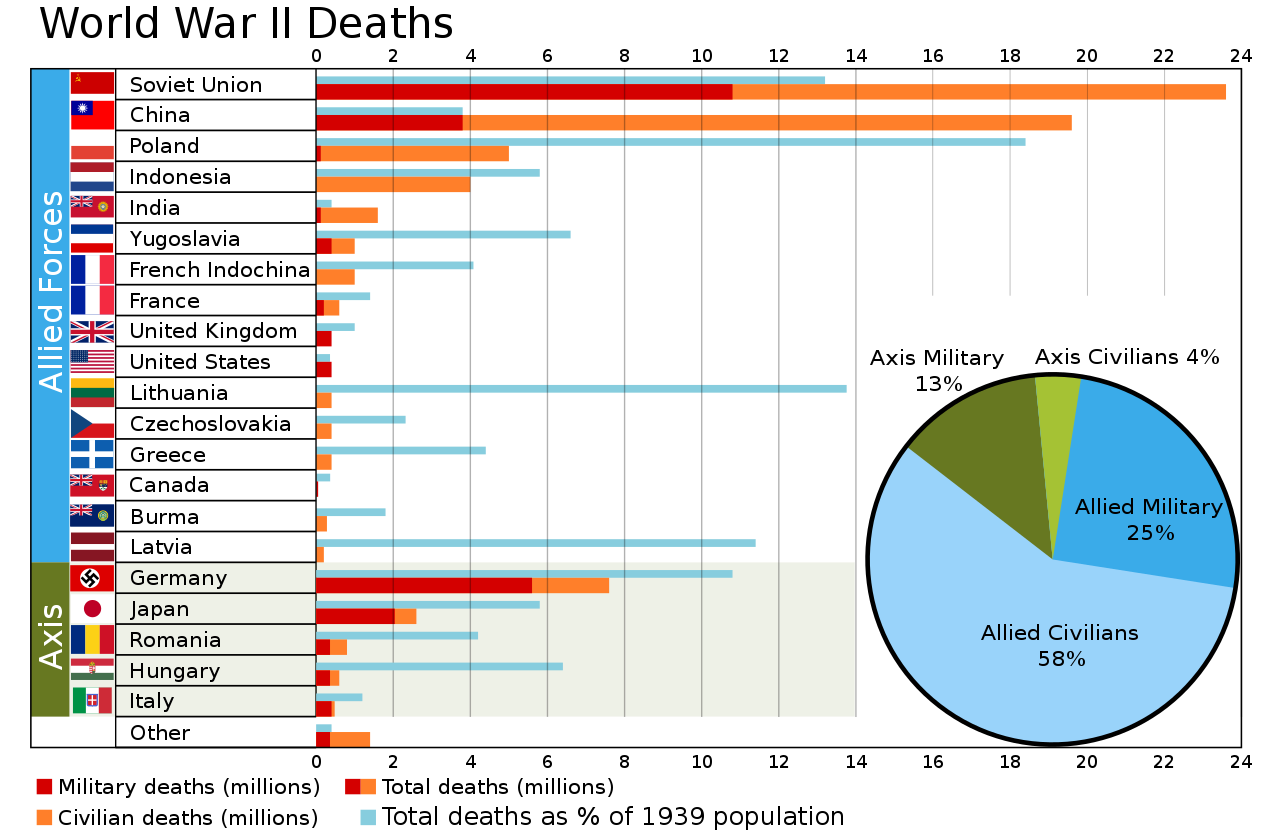
At the same time, for tankies and tankies 2.0 that celebrate the effort of the USSR under Glorious Comrade, Vozhd and Generalissimo Joseph Stalin, as shown by all the Soviet war dead? (Stalin may have been iffy about being called Vozhd as it's a direct equivalent of Führer or Duce.)
Both the civilian and military deaths could have been halved if you eliminate both of those. Even with the Red Army purges, better prep for the invasion could have been cut by at least one quarter if not one third.
And, per the blue lines, if adjusted, that means the USSR would have had lower deaths, by percentage of population, than did Germany. As is, the USSR is below both Poland and Lithuania.
And, of course, we haven't even mentioned the Molotov-Ribbentrop Pact that gave Stalin more than 18 months to prepare, and that left Britain holding the bag for more than a year after the fall of France. Nor have we mentioned the Red Army's struggles in invading "its half" of Poland, or against Finland in the Winter War, that gave Stalin warning he needed to speed up preparations. Nor have we talked about the repeated warnings from both spies and the British government that Barbarossa was indeed coming. Nor does Wikipedia, the image's source, make clear how much of the casualties in Poland and the Baltics was due to Hitler and how much was due to Stalin.
So, celebrate what, again, tankies? Stalin's stupidity? Stalin using human wave tactics that resemble those of Khomenei's Iran in the Iran-Iraq War? Stalin having the Politburo so cowed that, when Beria, Kaganovich et al approached him after his near-nervous breakdown, he thought it was a coup — and it should have been a coup but they were too cowed? Stalin, like Hitler, following Schopenhauer's "World as Will and Idea" and thinking that if he believed away the idea that Hitler was about to invade, it would actually go away?
Beyond that, even Stalin would admit at times that certain elements of Lend-Lease were vital to the Soviet war effort. The good old American Jeep was one. The original Jeep, with its light weight and large tires, could float over the "roads" that General Mud often left in those lands. Neither the Soviets nor the Nazis had anything similar.
These are not necessarily blog posts written in June, but ones most popular with readers in the last month.
Topping my list was my call-out of pergressuves (you, Bernie) who want single-payer, but without reining in doctor and hospital prices. I stand by the idea that I don't want the government to go broke on health care costs any more than private individuals.
Second was my statement that I doubt Royce West will seek the Democratic nomination to run against John Cornyn. As of now, I stand by that.
Third was my D-Day post, focused on everything Nigel Hamilton got wrong as well as right in the last book of his trilogy about FDR as Commander in Chief.
Antiwar activist Justin Raimondo, one of the most vocal voices in opposing not only the Iraq War but the Afghanistan one as well, has died at 67.
Justin was not only antiwar, he was Antiwar as in Antiwar.com, which, as its linked eulogy for him notes, he cofounded in 1995 with Eric Garras.
On Twitter, I noted that he was an "always interesting political thinker and wanderer." And, that he was, though not in ways I'd agree with. Nor do I agree with every antiwar stance of his; I am against more dumb wars than Barack Obama, though I'm not a pacifist.
I was wrong to go along with the mainstream on Afghanistan. Raimondo's successor as editorial director at Antiwar, Scott Horton, in a recent interview with Ken Silverstein, pointed out the options we had there short of a full invasion. Ted Rall is someone else who was right about this.
That said, Raimondo founded the site over Bosnia. And, while non-Serb actors both inside and outside Bosnia were themselves less than perfect, genocide was happening in the Balkans. Just as it was earlier in Rwanda, which we ignored because "darkest Africa." So, I disagree with Raimondo, Alexander Cockburn and others. Could we have done some things better in the Balkans? Yes. Some things without focusing on American empire? Yes. But, we shouldn't have ignored that genocide, nor Rwanda.
Now, that's just the antiwar part of Raimondo.
Outside of that, he was a full nutter, and I'd forgotten that until I wrote this up.
The piece first notes that from childhood, he was a Randian. As in THAT Rand. Ayn Rand. Objectivism.
It adds that he was an anarcho-libertarian in the 1980s.
The piece also notes that he supported Pat Buchanan in all three of his runs for president, in 1992, 1996 and 2000.
You have to have either a high degree of cognitive dissonance or else a high degree of political and personal self-partitioning to be so antiwar-driven that as an uncloseted gay and organizer of libertarian anarchism to support a paleoconservative Catholic (Tridentine mass, maybe even?) who agrees with you on about nothing other than antiwar issues. I mean, Pat is anti-gay, and though Raimondo is not Jewish, Pat's also anti-Semitic and just plain racist. Plus, as a paleocon, as in his take on the Central Park Five, he's perfectly fine with coercive state power if it wears a blue uniform.
So, while I admire the strength of his antiwar activism, and wish that like him, Ted Rall, and some others, I had thought more about Afghanistan as well as Iraq at the time, overall, I shook my head at him for years. Plus, as a Libertarian Radical, I suppose Raimondo supported nutter positions such as people not needing driver's licenses to drive.
That said, Raimondo, and even more, Garras, had Lew Rockwall connections in their political history, too. Here's one sample of Raimondo, and specifically on war issues, being in bed with Rockwell. Garris, like Raimondo, is gay, and like Raimondo, a past backer of Buchanan, too.
Weirder yet, Raimondo jumped from backing Buchanan the last time in 2000 to supporting Ralph Nader in 2004. That said, if you read his defense of that support, you recognize he's at least partially right in calling Nader a "voice of the Old Right."
I know some current or former Greens, like Jeff St. Clair of Counterpunch, were totally butt-hurt at David Cobb getting the nomination in 2004. That said, there was no deck-stacking; it was the bottom-up stacking of state Green Party organizations that was (and still is) the problem. Frankly, outside of nuclear power issues, I don't think Nader was or is all that much of a Green, and he sure as hell isn't an ecosocialist.
Of course, Raimondo had no problem believing in a conspiracy theory or two. Like claiming Trump was a false flag for Hillary Clinton to get elected. We do know she did what she could to help him, but the idea that the Clintons officially, let alone outside forces, "planted" him? Tosh. And, contra Raimondo's "no true Scotsman," the likes of Corey Robin have shown that Trump's in line with much of American conservativism. And Raimondo followed that claim with later butt-kissing Trump. As for his claim that Alexander Litvinenko radioactively poisoned himself? His nuclear smuggling happened six years before he was killed. And Raimondo himself, in a piece linked inside that, noted that Po-210 has a has a half-life of just 138 days.
And, above all, Raimondo, in book length, repeated and developed a version of the canard that Israel knew about 9/11 in advance, while then going on to claim that 9/11 Falsers who claimed the buildings had been rigged to blow up were themselves a false flag. And, from this and other things, he's probably earned his own reputation as anti-Semitic even without taking into consideration his Pat Buchanan endorsements.
Horton is right on spelling out the options we had to a full invasion of Afghanistan.
He's right on that we shouldn't have entered WWI, but doesn't go into details. (The correct answer is not that all war is bad, but that, beyond the idea that wars fought for vague "national interest" are bad, the US had no compelling national interest in this fight and that Wilson's neutrality was fake.)
Then, he totally jumps the shark by blank-check supporting Robert Stinnett's "Day of Deceit," a Pearl Harbor conspiracy theory book. Beyond the refudiations at the Wiki link, the claims that FDR hoped to use Pearl to lead us to war with Germany as well are refuted by two actual facts.
First, we'd been in an undeclared naval war with Germany for six months before Pearl. I am sure Horton is not that uninformed.
Second, on Dec. 8, 1941, FDR ONLY asked Congress to declare war on Japan. Germany was not mentioned, which left Churchill crestfallen. I am quite sure Horton knows this, too.
Meanwhile, a Google search has Horton claiming in more than one place that he's abandoned conspiracy theories. Really? Corey Robin busted you in a Democratic Party related conspiracy theory just a year ago and nearly a full year after you said you gave up conspiracy theories. Robin has since deleted that Tweet, but Bernhard at Moon of Alabama (himself a nutter in many ways) links to it and quotes it.
That said, to the degree Horton has partially given up conspiracy theories, he's had some doozies of his own invention on his record.
And, through uncritical interviewing of Julian Assange's toady and flunky Craig Murray, he's done his bit to help perpetuate the Seth Rich conspiracy theory.
So, in answer to the rhetorical question: "Antiwar — what's it good for?"
Louis Proyect, kind of a nutter at times himself, warned about right-left or red-black alliances, specifically mentioning Raimondo. He also notes there that Raimondo's god, Murray Rothbard, was a Holocaust denier, or at least, a fellow traveler. No wonder Raimondo and Horton opposed any involvement in even Bosnia.
So, what's Antiwar worth?
Good god, not much.
Oh, and Ken? Respectfully but firmly, speaking of uncritical interviewing? Don't let Horton pass on conspiracy theory bullshit unchallenged in the future.
Basically, up to Yalta, this was a 4-star book. The chapters about Yalta are about 3.25 stars. The post-Yalta stuff is 2 stars. If that. I may have been generous.
This is an edited version of my Goodreads review.
As we mark the 75th anniversary of D-Day, many people may not know that British Prime Minister Winston Churchill was leery of Operation Overlord. And, even those who know that in general may not realize this went beyond being just leery.
In a generally great first two-thirds of this, the third volume of a trilogy about FDR as Commander in Chief, Nigel Hamilton shows just how much Churchill dug in his heels against the invasion.
Unfortunately, there are spotty problems even in the first two-thirds, which increase exponentially the closer and closer one gets to the end of this volume, sadly marring it.
In a generally chronological look at the book, and the military history behind that, we'll see Hamilton's excellence, then his excellence thrown away on hagiography to the point of outright error.
Hamilton rightly eviscerates Churchill’s attempted blocking of Overlord. He does this in context of Churchill’s senseless pinpricks in the eastern Mediterranean, while noting that more of the same plus Italy to the mythical Ljubljana Gap would have had almost as many casualties. He then puts this in context of Churchill at Gallipoli in WWI and Dieppe in WW11.
He also shows how Churchill rushed Shingle into place with no beach trials, no real preparation (while not acknowledging that with both more prep and more daring, it could have worked).
Also explains how Churchill’s insistence on Anzio helped delay Overlord by a month.
And he — and rightly so — does all this more thoroughly and vigorously than the typical WWII history or even WWII military history.
That said, while not over the top, his Churchill-bashing was a bit strained at times. Dieppe was not intended to be an invasion, and it was seen as being in part a learning experience. After all, no major contested amphibious operation had been attempted up to that time in the history of mechanized warfare. Before that, the British at both the Crimea and before that at New Orleans were not opposed at the time of landings.
Even within its parameters, it was arguably more a failure than a success tactically.
That then said, Hamilton also nowhere mentioned that Churchill pushed for Dieppe in part due to Uncle Joe pushing for a second front already then. Nor does he mention that some lessons were learned from Dieppe in time for Torch.
Beyond THAT, which Hamilton (I presume deliberately) doesn't tell the reader is that in the last few weeks before Dieppe was launched, German counterintelligence in France had rolled up British SOE agents and uncovered all the main points of the Dieppe plan.
But, there was plenty of bad outside of this.
First, he has NO look at FDR’s military options on Hungary after Nazi takeover and no asking why he didn’t. Briefly brings up Hungary again in the second half of the book, but still doesn't address these issues. Many military historians today believe that rail line bombing could have at least slowed the transport of Hungarian Jews to Auschwitz and that it was even feasible, even without Russian help, to take a shot at bombing Auschwitz itself. BIG failure for Hamilton to not discuss this issue.
Even people who give FDR a pass on pre-US entry into the war tightfistedness on Jewish refugees, but who are thoughtful historians, struggle with the Hungarian Jews issue.
But Hamilton doesn’t “struggle” at all.
Second, he repeats that FDR had polio even though this is being more and more questioned, with many forensic medical historians believing Guillain-Barré syndrome felled him instead.
That’s why the pre-Yalta stuff is 4.25 star, no more.
The Yalta chapters themselves aren’t horrendous. I’ve never thought we really “lost” a lot at Yalta. But, FDR could have tried to have been firmer. And, contra the UN, the spheres of influence that Churchill and Stalin had agreed to DID keep Greece non-communist.
The biggest black mark is that Hamilton is already trying to whitewash Stalin here. And it gets worse in the post-Yalta chapters, to which I now head.
First, 480ff claims, or seems to, that Hitler was behind Operation Sunrise. This is not true, nor is the claim that Hitler was behind Himmler’s late attempts to negotiate a separate piece. And, there simple IS NOT an “Operation Wool” that was a grand plan for this, despite his claim on 481. I have NO idea where this came from. I did a Google because I had NEVER heard of such a thing, and I’ve read Hastings, Kershaw and many other modern WWII historians.
But, the ultimate goal of Hamilton’s inaccurate slant here seems to be what it had been at Yalta — throw Churchill further under the bus, wrongly as well as rightly, and then türd-polish Stalin, mostly wrongly.
On 485, appears to blame Truman, of all things, for FDR not meeting with him privately to inform him more on serious issues, starting with the bomb. Hamilton knows FDR held one-on-ones with few people even when he was in good health. And, this totally tries to otherwise whitewash FDR. If his musings about resigning in just months were truly meant, then he should have truly sat down with Truman.
I directly quote:
Why, then, in the circumstances, did he not summon Harry Truman, his chosen vice president, to come and discuss, in private, the challenges the former senator would soon enough have to face. This was something no biographer or historian would ever be able to comprehend ...
"Yet in the subsequent four weeks before he left the capital he met with Truman only once, for ninety minutes, and that was in the company again of Speaker Rayburn [and others]. ...
Truman had NOT [emphasis added) complained. Highly intelligent, a quick study and a bon viveur when it came to whiskey and cards, Truman had not thought to request a private meeting.
Other than throwing Truman under the bus, this is a failure as an argument from silence. How do we KNOW Truman never requested a private meeting? There's no footnote here citing a Truman diary entry that says something like "Asked Pres. 3 days ago for private meeting. Still no response."
There was one just plain weird thing, from FDR’s last State of the Union.
Halifax wasn’t one-armed; he was missing his left hand, and the arm higher up was at least somewhat atrophied; also, calling him such out of the blue on 467 came off as irrelevant to the narrative and jarring.
Had other parts of the book not been so well, the last 60 pages were enough I might have two-starred it. The book is simply marred at the end. As though Nigel Hamilton had hit his own medical wall or something.
Or else he hit the print job rush wall, to have the book in print before the 75th anniversary of D-Day. I saw that a few years back, when the Civil War sesquicentennial was winding down. Ditto in spades on Joel Brinkley's Teddy Roosevelt book. It happens. But, while being a possible explainer, it's not an excuse. Not a valid one.
I had read the second volume in the trilogy and Goodreads shot me an alert when this came out. That second volume may have been moderately hagiographic (a commenter to my review said he thought it was highly so), but it didn't have outright errors like this.
If Churchill had somehow persuaded FDR to his strategy, what would have gone differently in WWII?
Well, the ETO would have lasted longer. Hitler probably would not have been defeated until late summer of 1945.
More importantly for the future, Russian troops would have been on the Rhine and Allied trust would have been lower. Stalin would have dared Churchill (if he could have delayed British elections and kept a coalition, if not Atlee) and Truman to try to claim occupation zones in Germany. Neither would have risked WW3, and probably would have settled for a Rhineland area after stiff negotiations. This affects the whole Cold War.
At the same time, Russia doesn't enter Asia until after Truman bombs Hiroshima and Nagasaki. With bitterness in Europe, Truman might scramble troops to occupy all of Korea, which obviously changes the war there. Kim Il Sung probably then becomes a Ho Chi Minh, trying to inflict a Vietnam on America.
With all of that, no D-Day and no true Second Front also means no United Nations, which is far from perfect, but still better indeed than nothing.
That said, moving back from Hamilton's hagiography to the reality-based world, the always insightful and hard-hitting Robert Fisk notes that the UN, and the "international community" in general, has done little to uphold promises made to and about the Middle East at Cairo, Teheran and Yalta.
Contra some nuclear apologists of both years past and today, yes, nuclear weapons are, to some degree, qualitatively different than other so-called "conventional" arms.
Are they different from others in the class of what once was more neutrally called ABC weapons, for Atomic, Biological and Chemical, or what is today called, with emotional edge, "weapons of mass destruction"?
I think not.
Yes, radiation sickness and cancers killed people years after Hiroshima and Nagasaki.
And pneumonia and other pulmonary illnesses killed World War I veterans who hadn't gotten their gas masks on in time for years and years later, too.
As for the immorality in general?
Sorry, but the cadre of left-liberals who says we should never have dropped either bomb at all, like Gar Alperowitz, or yesterday, Christian Appy?
No, they don't leave me cold, they leave me angry. Because they're simply not correct, and not telling the truth. (And, people, don't claim I haven't read this stuff; I read Alperowitz's whole book.)
First, a sidebar. I have not said, and do not say, the bombings were "justified." Philosophy minded friends of mine in general should take note that I generally reject the use of that word period, based largely on Walter Kaufmann and his thought-provoking "Without Guilt and Justice," reviewed by me here.
Or, another way to look at Hiroshima is in the words of former Secretary of State Henry Stimson, who called the nuclear bombs the "least bad" option. I think that gets it about right.
First, naval blockade alone wouldn't have hastened the end of the war very much at all. Not even when the Soviet Union jumped in. Yes, that caught Japan off-guard. (It didn't catch them by "surprise"; Japanese leaders ignored that Stalin's lieutenants stopped talking to them after May 8, 1945 and that their neutrality treaty had a 90-day opt-out. Say what you will about Stalin elsewhere, and note that he used those 3 months to refit his European theater veteran units, but he scrupulously waited those 90 days, declared war, and attacked.)
But, Japan could have moved troops from elsewhere in China to Manchuria. Iwo Jima did bring us closer to bombing more of mainland China, to interdict roads and railroads, but, it wouldn't have stopped troop movements, just bollixed them. It could have pulled Unit 731's labs back into Korea, while releasing its terror on Soviet troops had it wanted to do so.
Meanwhile, more and more Japanese troops would have died in fighting in China, Southeast Asia, etc. More and more Chinese and Soviet troops, and American naval and air forces, and army troops in the Philippines, would have died, too.
To the degree a naval blockade might have had partial effect, more and more Japanese civilians would have died of starvation, or hunger-related illnesses. And, more and more would have died from conventional bombing. I've read estimates that, if we blockaded Japan for six months, and cut links between the different Home Islands as part of that, more Japanese would have died from starvation in 1946 than were killed at Hiroshima and Nagasaki combined.
As it was, Japan did not ask for the face-saving Imperial-conditional surrender until after the second bomb at Nagasaki.
AND, AND, AND ...
Hirohito, in his Imperial announcement or rescript, ONLY cited the Hiroshima and Nagasaki bombs and not the Soviet invasion of Manchuria. (He does mention reaching out to its government, as well as the American and British ones, in seeking peace; that's the only mention of the USSR, and there's not even a hint about its invasion of Manchuria.)
Ward Wilson says that Hirohito DID mention the USSR's war entry, and ignored the Bomb, on a separate rescript Aug. 17.
However, that just illustrates my point. It was for just the troops, not the general public. Given that the Japanese Army had long wanted to fight the Russkies, could be that's why Hirohito told the troops exactly what he did.
Beyond that, historians in general normally mean the rescript of the radio broadcast to the Japanese pubic, the link I first gave. And, I'm pretty sure Ward Wilson knows that.
As for how many, or how few, American or allied lives Hiroshima and Nagasaki saved? To put it in blunt war terms, if ONE life was saved, that was enough.
Unlike Appy, and perhaps a straw man he's creating, I've never claimed the bomb was an act of "mercy." I've long claimed, per the immortal William T. Sherman's "war is hell," that it was an act of realism indeed.
And, speaking of military officers, Chet Nimitz, Ernie King and others at the end of WWII should have read them some Sherman before blanketly opposing the bomb, too.
Maybe this is another way in which Clemenceau is right: "War is too important to be left to the generals."
Or, maybe the brass hats with scrambled eggs said this because, especially with things like the later 1940s tests of blowing up fleets with atomic weapons, they were worried about becoming irrelevant. They clearly exhibited that attitude later on in fights over what service branch would control the military missile program.
And, per this whole issue, this is definitely why I identify myself here as a "skeptical left-liberal."
As for leftists who call Hiroshima a war crime? No, the real war crime was that Hirohito, the man who knew plenty about Unit 731 and the Rape of Nanking at the time they were happening, didn't surrender sooner.
Also re Hirohito? Until late spring of 1945, he hoped to retain all Japanese possessions up to 1920, ie, what it got after World War I. Even up to just before the Soviet intervention, he appeared to hope to retain the Empire as it was in 1905, after the Russo-Japanese War.
==
A new book, "Unconditional," largely confirms Richard Frank's take
in "Downfall" on Imperial Japan while putting this all within contemporary US
politics, including people trying to tie what terms of surrender we
offered Japan into trying to end the New Deal. That continued to play
out in both postwar occupation and rebuilding of Japan, on the far side
of the Pacific, and on continued assessments of Truman's decision over
here.
This is a good introduction to the appeasement days in late 1930s Britain. It spells out how backbencher anti-appeasement Tories gradually accumulated the numbers to indirectly force the resignation of Neville Chamberlain.
I said indirectly. I had for whatever reason thought Chamberlain lost the no-confidence vote shortly after the invasion of France. Not true; he won, but by narrow enough margin that, after vacillating, and even dreaming of scheming, he decided to step down.
On the biographical side, Chamberlain comes off as an unconstitutional autocrat domestically, even more than a dithering appeaser. Eden is portrayed as someone rightly abandoned by the rebels as the man to replace Chamberlain. Churchill is shown as too blindly loyal to Chamberlain in some ways, especially in the days between the no-confidence vote and his resignation.
The one big name from all of this to actually go up, if you will, is Macmillan.
Also, as an American wishing we had a parliamentary system here, seeing it at work in daily detail, both its good and bad sides, at a period of ongoing stress, is another reason I found this a good read.
It has been said of French president Clemenceau that he had one illusion, France, and one disillusion, mankind, including Frenchmen.
Arthur Herman, in his magisterial Gandhi & Churchill, five-starred by me at Amazon, shows how the same could be said of his twin protagonists over India and Indians.
Churchill’s illusion was that Britain could continue to hold on to the old British Raj, even after World War II and a bankrupt British treasury. His disillusion was rather a cynicism about Indian capacity for self-government, lumping Gandhi in with millions of other religious fakirs.
Gandhi’s illusion was multiple, but basically of two parts. The second was that a medieval-age India, with 300 million people all picking up Gandhi’s spinning wheel, was possible, was the best way for India to go, and was desired by most Indians. His second, more tragic illusion was that India without Muslim-Hindu partition was the only way to go, and that it could only be done on his terms.
Herman documents how Gandhi, not Churchill, not Viceroy Archibald Wavell, not Muhammad Ali Jinnah or anybody else, wrecked the last reasonable shot at an unpartioned India because it wasn’t done his way.
Gandhi’s illusion? That Indians wanted to follow his way of satyagraha, or “soul force,” in its nonviolence, as well as to become peasant-based, rather than Nehru’s vision of technology-driven socialism. Herman shows that British actions in Gandhi’s years of the Raj were NOT driven by nonviolence but rather, the fear of violence that accompanied most of Gandhi’s arrests, fasts from prison, etc.
In short, Gandhi comes off badly in this book, and deservedly so.
The mythical Gandhi of Ben Kingsley’s acting and of previous bios of the Mahatma is just that — a myth. Herman rightfully shows that Gandhi impeded India’s independence (at the times he wasn’t irrelevant). And the myth already gets shattered in his South Africa years.
Churchill, meanwhile, was Gandhi’s tar baby. His 1930s “years in the wilderness” were all due to India, ultimately. His irrationality on the subject had some influence on some of his wilder military tactics proposals during World War II, as well.
But Herman doesn’t stop there. He gets deeper into the personages of both, what drove them, and how neither could understand the other’s drives. Churchill, who was a secularist his adult life, could never understand, let alone accept, Gandhi’s religious revitalization. Gandhi, meanwhile, could understand Churchill more but would never lower himself from his hyper-idealist pinnacle enough to translate that into action.
If not for these two, India would have been independent earlier, and likely would have remained in the British Commonwealth.
An excellent book. And one of which this long review only scratches the surface.
And Herman, who helped his dad with galley proofs of a new translation of the Bhagavad-Gita when he was a child, has the academic and personal background to make this book excellent.
Wallenberg, as World War II buffs know, was the Swedish diplomat who saved as many as 100,000 Hungarian Jews from Auschwitz. But, after he and his Hungarian driver drove off from Budapest in early 1945 with a Soviet escort, he disappeared from the pages of history.
Did he die in 1947, as has long been believed, or did he live on for years or even decades? Was his rescue mission financed by the Office of Strategic Services, the forerunner of the Central Intelligence Agency? If so, was he spying on the Soviets as well as rescuing Hungarian Jews?
In the 1990s, the CIA acknowledged that the OSS recruited Wallenberg. It would seem he was an operative for the Pond, a supersecret agency unknown to all but President Franklin D. Roosevelt and select War and State Departments insiders.
About the Pond, little is known. But later this year the CIA is to release a stash of Pond-related papers accidentally discovered in a Virginia barn in 2001. These are the papers of John Grombach, who headed the Pond from its creation in 1942. CIA officials say they should be turned over to the National Archives in College Park, Md. …
The Pond relied on contacts in private corporations and hand-picked embassy personnel. It worked closely with the Dutch electronics company N.V. Philips, “which had access to ‘enemy’ territory as well as a far-flung corporation intelligence apparatus in its own right,” said former CIA analyst Mark Stout, who wrote a brief unofficial history of the Pond.
The Swedish government has posted 1,000 pages of Wallenberg documents on government websites, which should also help.
As far as what happened to him inside the USSR, outside research suggests he lived until the 1980s, and not dying in 1947 as the Soviets claimed. He probably was in gulags, psychiatric hospitals and other Soviet custody situations.
n 1991, the Russian government assigned Vyacheslav Nikonov, deputy head of the KGB intelligence service, to spend months searching classified archives about Wallenberg.
“I think I found all the existing documents,” Nikonov e-mailed The Associated Press last month. The Soviets believed Wallenberg had been a spy, he said, but unlike many political detainees he never had a trial.
Nikonov’s conclusion: “Shot in 1947.”
Later in 1991, Russia and Sweden launched a joint investigation that lasted 10 years but failed to reach a joint conclusion.
The 2001 Swedish report said: “There is no fully reliable proof of what happened to Raoul Wallenberg,” and listed 17 unanswered questions.
The Russian report bluntly said, “Wallenberg died, or most likely was killed, on July 17, 1947.” It named Viktor Abakumov, the head of the “Smersh” counterintelligence agency, as responsible for the execution and cover-up. It said the Russians consider the Wallenberg case “resolved.”
Unsatisfied, independent consultants and academics have kept digging, analyzing, reassessing old information and pressing for the Kremlin to release missing files.
That said, Sweden admits it had chances to at least try to regain Wallenberg’s freedom in the two years between his arrest by the Soviets and their claimed date of his execution, but that it had a “passive” attitude.
That then leads to the question: Did Stockholm know the OSS had recruited Wallenberg? Was it forced to take a more passive attitude on trying to win his release?
In the mid-1950s, the Swedes pursued the case more aggressively, the story notes. That prompted a memo from Soviet Foreign Minister Andrei Gromyko in 1957 that Wallenberg had died of heart failure in detention 10 years earlier. Note how that contradicts Nikonov’s claim he was shot.
Here’s why the Soviets feared and mistrusted Wallenberg:
Wallenberg's very name may have been enough to arouse Russian distrust. Throughout the war, his cousins Marcus and Jacob Wallenberg, the czars of a banking and industrial empire, had done business in Germany, producing the ball bearings that kept its army on the move.
The Wallenbergs also were involved in discreet, unsuccessful peace efforts between the Allies and Germany, which Stalin feared would leave him excluded — a foretaste of global realignment that would lead to the Cold War.
There’s plenty of additional fascinating stuff at the link, enough for somebody to start thinking about a great movie. There’s also more testimony from Russians who claim to have seen him alive after 1947, and links to websites with more about Wallenberg and his humanitarian deeds.
I think Wallenberg lived; I think Stalin would not have been stupid enough to execute him. And, how could his name be brought up in post-1947 spy swaps?
Assuming he did live, or even if he was shot in 1947, it’s time for post-Soviet Russia to do the proper things. Repatriate his remains, and open all the archives.
Ditto for the U.S. Beyond Wallenberg, World War II historians would love to learn more about the Pond.
An exchange of a couple e-mails today with a friend of mine led to the light bulb of “why” going off in my head.
To me, by just talking about the U.S. in World War II in any depth, and especially not talking about the Soviet contribution, is of a piece with the degree of American exceptionalism Burns has in many of his other documentaries.
Look at “The Civil War,” for example. Burns went fairly light on the racial foundation of secession; one of his primary interlocutors was Shelby Foote, who was considered by some historical critics to almost approach Douglas Southall Freeman-lite status on interpretation of — or defense of — Southern attitudes during the Civil War. Of course, Burns did not have anything about Reconstruction as part of his epic; when he finally did get to it, it was just a two-hour “American Experience” show on PBS, almost as if Burns had finally succumbed to pressure.
Sidebar: For more on Foote’s attitude to the Confederacy, see this interview from the McNeil-Lehrer Newshour of his opinion of South Carolina flying the Confederate flag. I quote:
The flag is a symbol my great grandfather fought under and in defense of. I am for flying it anywhere anybody wants to fly it. I do know perfectly well what pain it causes my black friends, but I think that pain is not necessary if they would read the confederate constitution and knew what the confederacy really stood for. This country has two grievous sins on its hands. One of them is slavery - whether we'll ever be cured of it, I don't know. The other one is emancipation - they told 4 million people, you're free, hit the road, and they drifted back into a form of peonage that in some ways is worse than slavery.
So, you have Foote saying, in essence, the Confederacy really wasn’t all that bad. Foote later accuses flag-criticizers of “hiding from history.” On emancipation, he nowhere mentions either southern resistance to it, via the Klan founded by Foote’s Civil War hero, Nathan Bedford Forrest, or southern co-option of it via “Redeemer” governments.
When I first watched “The Civil War” I was more conservative than now, and while I had read some of Foote’s history, I hadn’t heard background comments by him, or analysis of him. As I grew more progressive, and added that up with Burns’ initial failure to tackle Reconstruction, that’s when Burns really started going downhill in my estimation.
My friend said he thought Burns was showing the ugliness of war enough that his wife thought Shrub, our beloved George W. Bush, ought to be tied down and forced to watch.
I replied that I thought Burns was painting WWII battlefield mayhem more in the light of tragedy than ugliness.
Beyond that, if Uncle Walter Cronkite voicing over same-week, if not same-day, Vietnam fighting on the CBS Evening News, rather than six-decade-old newsreel action, isn’t enough (and wasn’t enough for draft-dodging Shrub) to see the ugliness of war, nothing is.
Especially given the attitude of much of the GOP, beyond Shrub himself, toward war, I said I found Burns’ indulgence of American exceptionalism potentially dangerous.
To put it more kindly, if you want “The Greatest Generation” on emotional steroids, “The War” is good, even great. If you want an educational documentary about the full scope of World War II and its place in world history, “The War” gets a B-minus at best. Now, if you want a “Greatest Generation” take, that’s fine. But I was hoping, against hope, for something more. (And please don’t tell me Burns couldn’t do more within his time constraints.)
Doorknob help us if Burns decides to do a documentary on the Gulf War (or the Mexican War, dipping back into history).
The biggest way in which it confirmed my limited expectations is that it is NOT about WWII, just about the U.S. part in it.
Burns missed some excellent educational opportunities, such as letting more people know the USSR took 90 percent of Allied WWII casualties. He provides no detail about Lend-Lease; so far (and I’ve been catching bits and pieces), I’ve seen nothing about Allied leader wartime summits.
Where’s the French Resistance? Where’s Vichy? Where’s the war before U.S. involvement?