SocraticGadfly: genetics
Showing posts with label genetics. Show all posts

February 28, 2020

Real Cherokees vs Elizabeth Warren,
VERSUS Black Cherokees vs. Real Cherokees

I'd been threatening to do this on Twitter since Wednesday morning, when the issue of Warren and her American Indian false moves, plural popped up.

I've blogged and Tweeted about Warren plenty, from the exposure of her claims to American Indian ancestry to the stupidity of her doing a DNA test, then over-interpreting it while publicizing it, and all sorts of things in between.
But, I'd also referenced, on Twitter, black Cherokees from time to time.

And now, with Oklahoma's primary coming up on Tuesday, and folks behind a Medium site called "ewarrenisnotcherokee" writing her an open letter about these issues, it's time to fire back.

Since I'm a deliberate contrarian (I'm also at times a troll on Twitter, but columns like this are deliberate contrarian stuff, not trollery), this is right up my alley.

That's in part because the "real Cherokees" behind some of this stuff hoist themselves by their own petard, and most of them know the history they're swimming upstream against when they do this.

Let's start here:

While the average American thinks of Native Americans as a racial category, we are actually political groups.
So, that means you can't exclude black Cherokees on blood quantum grounds. At least not logically and non-hypocritically.

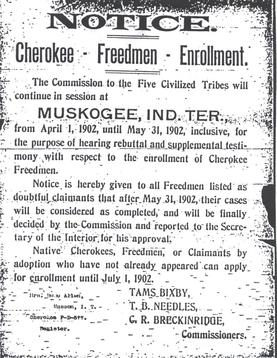
What? What? What? you may be telling yourself. Who are these "black Cherokees" and why have they been excluded from anything and why can't they be?

Well, Wikipedia calls it the "Cherokee freedmen controversy." I'll give you the nickel version.

Slave cabin kitchen, Chief Vann House.
The Cherokees, like others of the white-labeled "Five Civilized Tribes," practiced chattel slavery of Africans, just as did whites. (Set aside that many American Indian tribes, including the Cherokees, practiced other types of slavery before the Columbian contact. It was different in large part because slave status was not generally heritable.)

Chief Vann, the owner of the slaves who lived in that cabin, owned more than 100 by the year 1800. That put him in the top 10 percent of all slaveowners in the U.S. Son Joseph Vann had more than 200.

This also led to things like slave codes in Indian Territory and above all, in Cherokee lands there, just as in southern states. HNN has the details.

Of course, after 1865, this was illegal. These tribes had fought as co-belligerents with the Confederacy. Post-Civil War treaties generally required them to give their freed slaves tribal citizenship.

Starting in the 1980s, the Cherokee, along with Creek and Seminole, started tightening tribal rolls. See more here for "Black Indians" in general. (Specifically, in 1983, Black Cherokees lost voting rights because they were "not Cherokee by blood.")

The hypocrisy grows deeper with the Cherokees, because the efforts to exclude the freedmen used blood quantum as a tool. This process was completed under the (great, or "great") Chief Wilma Mankiller.

In a long and messy legal process with multiple parts that eventually moved from the Cherokee court system to the federal court system, the federal judiciary eventually restored freedmen's citizenship.

Here's my analogy, and where we're going to hear those petards further.

If the Cherokee (and other tribes) are sovereign nations, it is still and nonetheless under a certain aegis of the federal government. That would include the Fourteenth Amendment. As black slaves, sub specie slavo, were members of the Cherokee Nation, I think a correct extension of the Fourteenth Amendment supports the federal court ruling. Wiki also notes that the 1866 agreements, if the Cherokee want to play up the sovereign nation angle, have treaty status and there's an argument to be made that they can't be unilaterally broken. (OTOH, the USofA did just that regularly.)

Beyond that, as Wiki also notes, the Cherokee have willingly incorporated other people, whether individuals or groups, in the past.

This particular issue also seems to be fueling intra-Cherokee conflect between the Cherokee Nation, incorporated after people of the tribe got back full tribal election rights, and the old United Keetoowah Band. The UKB does use, and require, a blood quantum (one-quarter) but, at the same time, offers honorary associate memberships. And, to square the circle, a number of signatories of the open letter specifically identify as UKB members.

Cherokee Chief John Ross,
not a Cherokee if one
follows UKB blood quantum.
And, to throw the circle into total disorder, famed principal Chief John Ross wouldn't meet the one-quarter blood quantum.

In all of this, as some Cherokees also admit, there's a certain amount of racism. What? Racism by Indians? Yes, and click that "black Indians" link above for more, and it exists among Indian tribes who never had slaves, either.

And, given that the court ruling was just six years ago and final acceptance just three years ago, this is still an open issue.

So, I challenge every signatory of that letter to declare his or her personal stance on the Cherokee freedmen issue. That goes double for any hypocrite signatories identifying as UKB.

I've already asked one directly. On Twitter earlier, I responded to a tweet from a friend who had responded to Rebecca Nagle, a signatory of that letter:
Having since, via Memeorandum, seen that letter, I went back to the Tweet, rechecked the name, and of course, did a search down the page on Medium and found her name.

So, I Tweeted back to her, Dave and the other two:
And, I'll either have a response or not. As of the time this went live, I did not.

Yeah, Twitter's low signal-to-noise ratio means one shouldn't read too much into it, if Nagle doesn't respond.

On the other hand, I'm not just tagging her, I'm responding to part of a dialogue. 

So? If she doesn't say anything? Per the old proverb: "Silence gives assent."

Meanwhile, another signee, Santee Dakota Kim TallBear, writes a piece about this for High Country News. Hypocrisy from her for not mentioning the black Cherokees, and what I will only take as willful ignorance from HCN, and not the first time from it on identity politics. This one, with Instagram Influencers in the great, capitalist-invested outdoors, claiming they were being picked on because racism, not capitalism, was a doozy. (And HCN has never pulled back on it.)

Per this New Scientist profile piece about her, it appears the Santee, like the UKB Cherokee, use a blood quantum.

So, both among the Santee and among many Cherokee, we gots us a bunch of fricking hypocrisy.

I want to get back to pre-Contact versions of American Indian slavery, which continued post-Contact. In many such cases, slaves were eventually adopted into the tribe. Which means, of course, no blood quantum for the new adoptee.

I don't agree with Dawes-type termination, but all of this indicates that the federal government would be best behooved by having a uniform policy, not just on tribal membership, but on many other things, with all tribes/nations.

It's true that tribes have had to jump through hoops at times with the federal government, as the modern Cherokee Nation essentially replacing the UKB shows. Having grown up in the Southwest, I know this. That said, in a general sense, the feds have not forced specific methods of tribal membership determination on particular tribes except in cases like this where other legal issues were involved. Nor did Southerners, whether individuals or state governments, force the Cherokee or others of the "civilized tribes," whether qua tribes or qua individuals, to adopt chattel slavery in addition to older non-heritable versions of slavery.

Once again, I agree that fictitious appropriation of American Indian history — whether by Elizabeth Warren or someone else, and Cherokees or another tribe involved — is a real problem.

But, we need to talk about the actual forms of such history, not whitewashed or New Agey versions of such.

And, as for the racism? It's real. Growing up next to the Big Rez, I know plenty a Navajo expressed anti-black comments.

As for HCN? This is just another log on the smouldering fire of why I let my subscription lapse and have no current plans to renew it.

October 20, 2016

You're far more than your genes

Herding Hemingway's Cats: Understanding how our genes workHerding Hemingway's Cats: Understanding how our genes work by Kat Arney
My rating: 5 of 5 stars

Throw out what you thought you knew about genes, DNA, etc.

Several great things here.

First, the book explains in good detail things I've already known about how genes can code for proteins for various things, whether in combination with one, two or ten or more other genes.

Second, it explains in good detail what I've known about non-gene "control switch" areas of DNA, including how they usually act more like dimmer switches than on/off straight up/down switches.

Third, it revealed a lot I didn't know.

First, the DNA near the center of the nucleus is generally more "active." Arney talks about this, the relation to histones in positioning segments of DNA and more.

Second, coding areas on DNA evolve much more rapidly than genes themselves and are usually the primary driver of evolutionary change.

Third, epigenetics, while not all wet, probably needs more skepticism than it's gotten at times. She gives some detailed insight into this, and the exceptions to it.

Fourth, after splashing cold water on epigenetics, she brings to a boil something I wasn't aware of — micro-RNA. Apparently this has at least as much effect on inheritance as the biggest touters of epigenetics have claimed for it in the past. For example, sperm cells appear to have micro-RNA, and are NOT, therefore, just a load of DNA and that's it.

Also note that there are multiple different types of micro-RNA.

Fifth, although these discoveries aren't quite "Lamarckianism," nonetheless (and she barely touches on prions, speaking of) they put "genes" in a whole new context.

In short, the Human Genome Project and similar likely won't be in that much better position to tell us that much more about "you" and "me" twenty years from now than it is today.


View all my reviews

December 13, 2013

DNA not for genes only

Epigenetics has been in the news more and more recently, with new claims that a propensity to suffer from anxiety, even anxiety over exposure to a specific smell, can be passed on from generation to generation, at least in mice.

Then came David Dobbs' new article about gene plasticity and expression, which starts with this:
At the front of the room, a bug-obsessed neuroscientist named Steve Rogers was describing these two creatures — one elegant, modest, and well-mannered, the other a soccer hooligan.

The grasshopper, he noted, sports long legs and wings, walks low and slow, and dines discreetly in solitude. The locust scurries hurriedly and hoggishly on short, crooked legs and joins hungrily with others to form swarms that darken the sky and descend to chew the farmer’s fields bare.

Related, yes, just as grasshoppers and crickets are. But even someone as insect-ignorant as I could see that the hopper and the locust were radically different animals — different species, doubtless, possibly different genera. So I was quite amazed when Rogers told us that grasshopper and locust are in fact the same species, even the same animal, and that, as Jekyll is Hyde, one can morph into the other at alarmingly short notice.
Dobbs goes on to note that two animals with the same DNA can express it in radically different ways, and goes further, with these rhetorical questions:
This raises a question: if merely reading a genome differently can change organisms so wildly, why bother rewriting the genome to evolve? How vital, really, are actual changes in the genetic code? Do we always need DNA changes to adapt to new environments? Are there other ways to get the job done? Is the importance of the gene as the driver of evolution being overplayed?
He doesn't reject the importance of genes, but suggests, as I understand, their "centrality" should be reduced from 98 percent to, say, 78 percent, on average. But, I'm giving a brief summary of a long article.

Some old-line geneticists poo-pooh reading too much into epigenetics, or even Dobbs' article. That would be you, Jerry Coyne.

P.Z. Myers is a cautious one on epigenetics, though not as tight as Coyne. And, while admitting he's in the minority of a selective sampling of his peers, he sees nothing wrong with Dobbs' piece:
I am saying that understanding genes is fundamental, important, and productive, but it is not sufficient to explain evolution, development, or cell biology. ...

I will also rudely tell you that we don’t understand the process (of gene expression) yet. Knowing the genes is not enough.

It’s as if we’re looking at a single point on a hologram and describing it in detail, and making guesses about its contribution to the whole, but failing to signify the importance of the diffraction patterns at every point in the image to our perception of the whole. And further, we wave off any criticism that demands a more holistic perspective by saying that those other points? They’re just like the point I’m studying. Once I understand this one, we’ll know what’s going on with the others. ...

We forget that our theories are purely human constructs designed to help us simplify and make sense of a complex universe, and most seriously we fail to see how our theories shape our interpretation of the data…and they shape what data we look for! That’s my objection to the model of evolution in The Selfish Gene: it sure is useful, too useful, and there are looming barriers to our understanding of biology that are going to require another Dawkins to disseminate.

Let me try to explain with a metaphor — always a dangerous thing, but especially dangerous because I’m going to use a computer metaphor, and those things always grip people’s brains a little bit too hard.

In the early days of home computing, we had these boxes where the input to memory was direct: you’d manually step through the addresses, and then there was a set of switches on the front that you’d use to toggle the bits at that location on and off. When a program was running, you’d see the lights blinking on and off as the processor stepped through each instruction. ...

That’s where we’re at in biology right now, staring at the blinking lights of the genome. 
P.Z.'s Gnu Atheism? Totally disagree. But, he has some solid evolutionary biology insights. Also, vis-a-vis Coyne, he's not a hard-core determinist on free will, which I think is driving Coyne's thoughts on evolutionary genetics, too.

And now, the newest applecart upsetter of the "genetic dogma" of Francis Crick and James Watson is this — the idea that there may be two codes in our DNA, one for coding for proteins (i.e., genes) and another for epigenetic-like modulation:
“For over 40 years we have assumed that DNA changes affecting the genetic code solely impact how proteins are made,” said Dr. James Stamatoyannopoulos, who led the UW team. “Now we know that this basic assumption about reading the human genome missed half of the picture. These new findings highlight that DNA is an incredibly powerful information storage device, which nature has fully exploited in unexpected ways.”

The researchers discovered that some codons, part of the 64-letter alphabet which makes up the genetic code, can have two meanings – one related to protein sequence and another related to gene control.

These duons apparently evolved together, researchers said, and the gene control instructions appear to stabilize beneficial features of proteins and how they’re made.
Maybe this will finally break the slavish devotion some people have to Richard Dawkins' The Selfish Gene. I know Myers feels at least a bit that way.

Of course, really, Stanley Prusiner's fingering of prions as causing mad cow disease long ago upset the central dogma of Crick and Watson. That's why so many biologists were so strident against Prusiner getting a Nobel. It's also why the one he got was in chemistry, and not physiology or medicine.

And, it's also why John Horgan is wrong with a book called "The End of Science." We're not even close to that.

April 16, 2013

Is gene patenting illegal?

I'm not asking if it should be illegal, though that's a fairly connected question. I'm not asking, either, per today's Supreme Court hearing, if it's unconstitutional, or if it should be.

I'm asking if, at least in certain circumstances, it is currently illegal.

What makes me say that?

In a word, HIPAA. Specifically, the privacy rule part of the Health Insurance Portability and Accountability Act. Given the "immortal cells" of Henrietta Lacks and many other hypercapitalism-driven invasions of our genetic privacy, I'd argue that the default position behind the idea of gene patenting violates HIPAA, and that, therefore, some sort of "prior restraint" applies.

You'll never get today's Supreme Court, and probably not any lesser-level federal court, to follow such a line of reasoning.

Too bad. I think it's very strong.

Per the HHS summary of who is covered, I think it applies.

December 08, 2011

It's all in your RNA

No, it's not all in your genes, unless, per this story on the latest RNA findings, we expand what we define as a "gene." And, this isn't about epigenetic controls on DNA, it's about what previously might have been called "junk RNA." So, it may not "all" be in your RNA, but more of "it" may be there than previously thought.
Only now have scientists begun identifying the previously invisible contractors who make sure that materials get where they are supposed to be and in the right order to build a human being or any other creature. Some of these little-known workers belong to a class of molecules called long intergenic noncoding RNAs.
Scientists used to think that these “linc­RNAs” were worthless. As their name suggests, these molecules — at least 200 chemical letters long — do not encode information that the body’s manufacturing machinery can use to cobble together proteins. And the lincRNAs originate in what scientists used to view as barren wastelands between protein-coding genes. But new research is showing that these formerly underappreciated workers have important roles in projects both large and microscopic.
“They regulate every process under the sun,” says John Rinn, an RNA researcher at Harvard Medical School.
It seems this lincRNA works in a way similar to epigenetic markers on DNA, but more closely connected with "coding" RNA than epigenetic markers are with genes.

To me, this says even more. It raises in more depth the question about what the "original replicator" was, just how "alive" we should consider viruses to be and more. Per the late Lynn Margulis, we may have hints of a new, lower level of co-evolution or symbiosis than she demonstrated with the eukaryotic cell.

Was there some evolutionary competition as well as co-evolution? Etc., etc.

And, do we need to worry about RNA mutations as well as DNA mutations, more than previously thought? Per the story, probably so.

Meanwhile, another story on noncoding RNA is just out, too, from Public Library of Science. This one says that noncoding RNA might be one of the factors that accelerated human brain development beyond other primates. It's at the eye-glazing level of microbiology for me, much more so than a story about string theory (absent too, too much math) would be. And, it sounds a bit speculative, per comments about it on Google+. But, the fact that noncoding RNA is being tentatively linked to specific evolutionary development reinforces the possibility of some of the ideas I draw from the Science News story.

The flip side? If genes, environmentally-influenced epigenetics, other environmental factors, and noncoding RNA all have roles to play in human development, things like a "cure for cancer" just faded further into the distance, and on similar lines, the idea of "genetic medicine" both got more complex and of less immediate potential. Somebody alert Ray Kurzweil and other futurists.

January 13, 2011

Needed - psychological meta-structure

Where? In DSM-V, if we really want to do mental health diagnosis and treatment better, Scientific American says. If not there, then in the next edition after that.

The idea is that the various categories in the current Diagnostic and Statistical Manual of Mental Disorders are too rigid for reality.
(A)n enormous number of family and genetic studies have not only failed to validate the major DSM disorders as natural kinds, but instead have suggested that they are more akin to chimaeras. ...

I would argue, is that, at least for the purposes of research, the current DSM diagnoses do not work. They are too narrow, too rigid, altogether too limited. Reorganization of the DSM is hardly a panacea, but science cannot thrive if investigators are forced into a cognitive straitjacket.

Agreed on that.

So, what's this about meta-structure?
Genetic studies focused on finding variations in DNA sequences associated with mental disorders have repeatedly found shared genetic risks for both schizophrenia and bipolar disorder. Other studies have found different sequence variations within the same genes to be associated with schizophrenia and autism spectrum disorders.

The bottom line is in these two points:
First, DSM disorders do not breed true. What is transmitted across generations is not discrete DSM categories but, perhaps, complex patterns of risk that may manifest as one or more DSM disorders within a related cluster. Second, instead of long-term stability, symptom patterns often change over the life course, producing not only multiple co-occurring diagnoses but also different diagnoses at different times of life.

The rest of the very insightful story tells us more.

April 23, 2010

Science smarts is no guarantee of ethics

What else can you say about a geneticist who says that, when taking people's DNA samples, "informed consent" does NOT include telling them what specific lines of study the research is intended to be about, or even, if such information is given, necessarily limiting oneself to such lines of study.
“I was doing good science,” Therese Markow, now a professor at the University of California, San Diego, said in a telephone interview.
Maybe you were doing going science, in a narrow definition, but you were doing terrible ethics.

Is it any wonder that indigenous people around the world, including the Havasupai Indians mentioned in the story, don't trust various life scientists treading into their homelands?

And, it gets worse.
“Everyone wants to be open and transparent,” said Dr. David Karp, an associate professor of internal medicine at the University of Texas Southwestern Medical Center in Dallas, who has studied informed consent for DNA research. “The question is, how far do you have to go? Do you have to create some massive database of people’s wishes for their DNA specimens?”
Yes, you do!

And, while the question is foremost for and about indigenous peoples, I know full well that I don't want scientists with the ethical stances of Karp or Markow asking me to participate in DNA research, either.

And, the historical obtuseness doesn't just stop there. The exploitation of Henrietta Lack's DNA, without informing her or her family, some 50 years ago, just became public earlier this year.

Related to that, and back to the Havasupai and Therese Markow we haven't even talked about the monetary angle. If Markow had found some new genetic marker common to Havasupai, would she have tried to create research — money-making research — off of it? Would she even have tried to done some patentable reverse engineering? What do you think?

And, that's why Markow and Karp are bleating as their ox is being gored, at least in part, I'll wager.

March 31, 2010

Judge slaps down biopatent for pseudowork

The ruling by U.S. District Judge Robert Sweet that just because you isolate a gene doesn't mean you can patent it sounds like it's entirely on the right track. The genes in question were not re-engineered, inserted into a chromosome of another species or otherwise had anything done to them to add to their value.

March 16, 2010

One gene, two mutations, two different disorders

The headline? That fact has been documented for the first time. The different disorders aren't THAT different; they're both nerve-related.

January 11, 2010

Genes and epigenetics, nature VIA nurture

If you haven't kept up with recent research on heredity, population genetics or anything similar, the new Time has a GREAT story on epigenetics. Look it up and read it. Then throw away any simplistic ideas you have about "genetic inheritance."

If you are familiar with the basic idea of epigenetics, some of the newest findings may still surprise you, such as the rate of influence, the depth of influence, and more. Giraffes' necks aside, maybe Lamarck wasn't so wrong. Certainly, Stan Prusiner looks ever more right on prions, in light of stuff like this.

Obviously, we are nowhere near the end of discovering what epigentic findings mean. But, I think we can put paid to a few of the more outlandishly positivistic ideas of late 20th-century genetics.

Individualized medicines? Not likely to happen, and certainly not any time soon. You'd have to check at least some epigenetic as well as genetic factors. The price for that and an even higher level of individualizing the medications, would seem to pretty much rule that out.

Insurance, insurance, privacy, snooping, pre-existing conditions? All in a new realm now.

Drug testing? Some lawyer will raise an epigenetic argument at some point, whether it's legit or a red herring.

September 15, 2009

New info on the whys of the Y chromosome

The way it divides during cell division is a major factor in a number of sex-related syndromes and conditions.

In light of that, other committee Dems are already poised to amend the bill.

July 02, 2009

Mental illness is in your 30,000 genes

In an understatement of the month story, researchers say genetic tests for mental illness propensity are far, far away.

Technically, it’s 30,000 gene variations, not 30,000 separate genes, for schizophrenia, but, headlines for blogs or Twitter can’t be too long.

Of course, this is another example, also, of how the highly-touted idea of genetically personalized medicine is just as much just around the corner as are peaceful nuclear fusion power and fuel-cell cars in mass production.

June 17, 2009

Single gene-depression link refuted

The original 2003 study claiming a single gene had a lot of responsibility for depression has been iffy for some time, now, but further research says it definitely doesn’t hold up to scrutiny.

On the “popular front” level, what does this mean?

Well, several popular Americanisms (some of them not just pop-level but held by a certain segment of scientists) get the kibosh.

1. A hypermechanistic, technological view of medicine, with quick fixes either here today or just around the corner.
2. Something that’s already been on the ropes over other issues, the one-gene, one-behavior theory, gets another good, swift kick. (That’s at the scientific as well as pop level.)
3. A simplistic view of life in general held by most Americans hand in hand with American exceptionalism. There are no easy solutions to most mental health issues, and, perhaps that’s why, in the U.S., depression is on the rise.

February 13, 2009

A cure for the common cold here?

Scientists are cracking enough of the genetic code of the common rhinovirus that a vaccine, or other cure or quasi-cure, may be getting closer.

The many mutations of the virus were clustered into about 15 groups, allowing research to proceed easier from there.

The findings would probably lead to something similar to flu vaccines. Something not 100 percent effective, but, say 65-75 percent effective, needing renewal on an annual basis, with scientists keeping up with the evolution of new strains of the virus from year to year.

February 12, 2009

Celebrating Darwin – looking for the ‘third wave’ in evolution

For the Darwin bicentennial, Seed magazine has an excellent collection of special articles.

One of the most seminal, to my mind, is Eva Jablonka’s call to integrate much more epigenetics into the modern neo-Darwinian synthesis.

Things like Lynn Margulis’ symbiosis have already been incorporated, as a big enough issue. But, as Jablonka notes herself, epigenetics would more directly challenge the integration of genetics into Darwinism that brought about the neo-Darwinian synthesis as the “second wave” of modern evolution.

After starting by noting the evidence is accumulating for more than just DNA being involved with evolution, Jablonka gives us a definition:
Epigenetics is a term that includes all the processes underlying developmental flexibility and stability, and epigenetic inheritance is part of this. Epigenetic inheritance is the transmission of developmental variations that have nothing to do with changes in DNA base sequences. In its broad sense, it covers the transmission of any differences that do not depend on gene differences, so it encompasses the cultural inheritance of different religious beliefs in humans and song dialects in birds. It even includes the developmental legacies that a young mammal may receive from its mother through her placenta or milk — transmitted antibodies, for example, or chemical traces that tell the youngsters what the mother has been eating and, therefore, what they should eat. But epigenetic inheritance is commonly associated with cellular heredity, in which differences that arise among genetically identical cells are transmitted to daughter cells.

She then notes that epigentics is connected to cell differentiation within an embryo, and even more, once differentiation starts, how kidney cells “reproduce true.”

Next, she notes that more and more evidence has accumulated for the transference of epigenetic traits between organisms.

From there, she goes to the mother lode of the need to go to a “third wave” of evolution:
Induced and heritable epigenetic change may guide genetic changes.

That’s one big reason I score down, and scorn, modern Pop Evolutionary Psychology, too. It takes no account of epigenetics.

Anyway, read the full story for an idea of where evolutionary research is headed, and where its main theorists need to be focused.

January 23, 2009

Pinker – Nature-nurture debate over, but on MY terms!

Updated, to reflect comments, Jan. 23: Contrary to claims in comments by Prof. Gregory, philosopher of science Robert Buller has MOST CERTAINLY not been refuted in his critique of what he has, in the past, called Evolutionary Psychology with capital letters, and what he now calls "Pop EP."

FAR FROM IT.

Rather, Buller is one of the feature authors in the January issue of Scientific American, the issue especially denoted to Darwin's birth bicentennial. And, Pinker gets one of Buller's biggest smackdowns.

Because of this, further comments on either this post, or on future posts of mine about Pop Evolutionary Psychology, to use Buller's new term, which claim he has been "refuted," will be deleted.

Note 2 to Gregory. As for TicS, I was drawing a blank on it when you mentioned it. I of course read Buller's original article; I skimmed the crique of him by Cosmides et al; skimmed his TiCS response to that (done with co-authors); then read his Skeptic article from later that same year, which was, in essence, his solo response to the NON-refutation of him earlier that year.

He still stands unrefuted, Gregory. (And others.) All his major critiques, about the Pleistocene focus on evolutionary environmental, the overdone focus on sexual issues, the over-focus on optimality (some psycological traits or artifacts could be, per Gould, nothing other than spandrels, stand unrefuted. Claims otherwise will be considered trolling from this point out.


Cognitive psychologist Steven Pinker has a long interview in the New York Times Magazine. An extended comment of his on page 2 jumped out at me:
The most prominent finding of behavioral genetics has been summarized by the psychologist Eric Turkheimer: “The nature-nurture debate is over. . . . All human behavioral traits are heritable.” By this he meant that a substantial fraction of the variation among individuals within a culture can be linked to variation in their genes. Whether you measure intelligence or personality, religiosity or political orientation, television watching or cigarette smoking, the outcome is the same. Identical twins (who share all their genes) are more similar than fraternal twins (who share half their genes that vary among people). Biological siblings (who share half those genes too) are more similar than adopted siblings (who share no more genes than do strangers). And identical twins separated at birth and raised in different adoptive homes (who share their genes but not their environments) are uncannily similar.

I have several problems with this.

First, knowing a bit about addictive behavior, I know that predisposition to cigarette smoking or alcoholic drinking does NOT have “substantial fraction” due to heritability.

Second, on behaviors like that, people like Pinker have never even made an effort to sort out familiar social influence.

Third, the “uncannily similar” comes off as being nothing more than a door-slamming phrase, i.e., “How can you be scientific if you question it”?

Well, with twins, I question it on several grounds.

First, identical twins themselves differ on when after fertilization the twinning event occurred:
• Do they have separate amniotic sacs and placentas?
• Share a sac but with different placentas?
• Share even placentas?

All of the above are of course environmental and not genetic effects, but Pinker conveniently ignores that.

Second, are identical twins “uncannily similar”? Not necessarily. Again, Pinker refers us to no research; he just throws out a statement to us and demands we accept it as gospel truth.

’Tis true, Pinker does qualify both his own comments, and those of Turkheimer, with some more general versions of what I just noted, on the next webpage. But, to me, the carts was enough before the horse, and emphasized enough more, to tell me where Pinker falls.

And, on page 5, Pinker shows we still have far to go in our understanding of the how and of the specific genes of genetic heritability.

Height is widely acknowledged, due to the information from statistical correlation, as being the single most heritable human trait. But, as Pinker notes, in 2007 a genomewide scan of nearly 16,000 people turned up a dozen height-related genes. However, these genes collectively accounted for just 2 percent of the height variation; plus, a person who had most of the genes was barely an inch taller, on average, than the general population.

And, I haven’t even gotten to Pinker’s biggest flop, or deliberate oversight.

It’s becoming ever more clear that what has to this point been called “junk DNA” isn’t; rather, some of it may code for frequency of expression of a gene, or control what genes interact together and when, etc. And, though still looked askance by some geneticists precisely for what it hints at, Stanley Prusiner’s work on prions, along with other research, shows that the heritability pathway may not be a one-way street at the cellular level.

Pinker starts to wrap up his take on the science of personal genomics with this:
At the same time, there is nothing like perusing your genetic data to drive home its limitations as a source of insight into yourself.

Too bad, he doesn’t realize, or refuses to accept, the limitations of genetic data today go far beyond that.

November 11, 2008

Genes — the 1 percent ‘solution’

Individualized genetic medicine? Not so fast there

Yes, that’s right.

The “binary” bits alleged to be the centerpiece of human heredity, beloved of evolutionary biologists, population geneticists, and above all, capital-letter Evolutionary Psychologists, in reality are only the 1 percent solution of heritability. Elementary!

As to WHY the gene is only the “1 percent solution,” here’s the details of the latest research.

First, one strand of DNA may code for several different proteins. (In a process known as alternative splicing, a cell can select different combinations of exons to make different transcripts, the story notes.)

Second, said “gene” can combine with several other different genes, in different situations, to produce yet more different proteins.

Third, genes often encode for RNA, not proteins.

So, throw out the 1 gene = 1 protein idea.

Beyond that, “genes” may make up as little as 1 percent of DNA. “Junk DNA,” which more and more is proving itself to be anything but junk, makes up much of the remainder.

And, non-coding introns can lie in the middle of a stretch of DNA that makes up a single coding exon.

Also, some DNA, such as methyl caps, and histones, controls whether or not an exon can even be expressed, or how. They’re part of “epigenetic marks,” an area of DNA far more poorly understood than genes, as traditionally described. And, it gets fun with them:
When an embryo begins to develop, the epigenetic marks that have accumulated on both parents’ DNA are stripped away. The cells add a fresh set of epigenetic marks in the same pattern that its parents had when they were embryos.

This process turns out to be very delicate. If an embryo experiences certain kinds of stress, it may fail to lay down the right epigenetic marks.

But, that’s not always the case. Sometimes, epigenetic marks can be inherited.

And, in a bit of quasi-Lamarckianism (though not quite as much so as prions), it takes RNA to guide these markers to the right spot on DNA.

And, if that’s not enough, studies of micro-RNA and half a dozen other “non-basic RNAs” show even more the role RNA plays, no subservience to DNA involved, in cellular development

So, this all his tie-ins for our commercial, chemical modern world.

Very preliminary research indicates that chemicals that appear to cause “genetic” damage may well be causing epigenetic damage instead.

That, in turn, throw the whole biotech tout sheet of “the promise of genetic medicine” into a big kink.

And, we haven’t even talked about the amount of viral DNA stuck inside yours and mine.

Are your mom and dad fighting inside your brain?

No, I’m not talking Freudian psychology. Nor gestalt, nor modern humanistic or self-actualization theories.

I’m talking about the latest theory on the heritability of mental illness.

Bernard Crespi and Christopher Badcock claim this:
An evolutionary tug of war between genes from the father’s sperm and the mother’s egg can, in effect, tip brain development in one of two ways. A strong bias toward the father pushes a developing brain along the autistic spectrum, toward a fascination with objects, patterns, mechanical systems, at the expense of social development. A bias toward the mother moves the growing brain along what the researchers call the psychotic spectrum, toward hypersensitivity to mood, their own and others’. This, according to the theory, increases a child’s risk of developing schizophrenia later on, as well as mood problems like bipolar disorder and depression.

My first thought? It may not be Freudianism, but it carries as much sexual stereotyping baggage as Freud did.

That said, the story notes that their work leans heavily on David Haig. A decade ago, he argued that pregnancy was in part a biological struggle for resources between the mother and unborn child, with natural selection favoring mothers who could limit the nutritional “vampirism” of fetusus and fathers whose offspring were greedy as they could be in the womb.

So, Crespi and Babcock aren’t totally barking up the wrong tree.

But, beyond their sexist-sounding take on mental illness, they seem to have a black-and-white view of genetic and epigenetic effects, too, which leads them into their one-axis view of all mental health conditions.

So, right now, if mom and dad are fighting inside you, they are more likely to be fighting inside your mind rather than in genetic or epigenetic coding in your brain.

March 18, 2008

Diabetes not two diseases but three at least

Traditional Type 1 and Type 2 diabetes are both multi-genic on the “nature” side of their cause. Well, now, scientists are finding several varieties of single-gene diabetes. And, we’re learning more about the traditional two types as well:
That brings us to the 16 genes discovered so far to play a role in Type 2 diabetes, and at least 14 in Type 1.

Surprisingly, the Type 2 genes don't affect how the body uses insulin, thought to be the trigger. Instead, they alter how the pancreas makes insulin in the first place, explains Dr. David Altshuler of Harvard and the Massachusetts Institute of Technology.

What this means? More targeted medications, and possibly more targeted dietetic suggestions, too.