SocraticGadfly: carbon tariffs
Showing posts with label carbon tariffs. Show all posts

April 15, 2025

A carbon tariff? Really? Hot damn (Update: Maybe hot meh?)

AP Photo, from story below, is from Santos, Brazil.

Call it a tariff, call it a tax. Call it something I've been calling for, for a decade or more.

A global carbon tariff.

It's limited. It's just on global shipping. And, the thresholds are fairly high.

Nonetheless, this is the real deal.  It is indeed a step in the right direction:

“By approving a global fuel standard and greenhouse gas pricing mechanism, the International Maritime Organization took a crucial step to reduce climate impacts from shipping. Member states must now deliver on strengthening the fuel standard over time to more effectively incentivize the sector’s adoption of zero and near-zero fuels, and to ensure a just and equitable energy transition,” said Natacha Stamatiou of the Environmental Defense Fund.

And, it has some additional target areas:

The previous day, delegates approved a proposal to designate an emissions control area in the North-East Atlantic Ocean. Ships traveling through the area will have to abide by more stringent controls on fuels and their engines to reduce pollution. It will cover ships coming into and leave ports in the North Atlantic, such as the United Kingdom, Greenland, France and the Faroe Islands. It will oblige ships from North America, Asia and many other destinations to reduce emissions, said Sian Prior, lead adviser to the Clean Arctic Alliance.

Interesting. 

Here's one loophole of sorts:

One major issue during the meetings was the way the fee would be charged. More than 60 countries entered the negotiations pushing for a simple tax charged per metric ton of emissions. They were led by Pacific island nations, whose very existence is threatened by climate change.
Other countries with sizable maritime fleets — notably China, Brazil, Saudi Arabia and South Africa — wanted a credit trading model instead of a fixed levy. Finally, a compromise between the two models was reached. The compromise is in the ambition of the measure, since the fee is not a universal levy on all emissions.

I guess it was necessary, and perhaps can be tweaked in the future. 

And? It was reached outside of the auspices of the UN, and with the US refusing to participate. Here's The Donald and minions:

The United States didn’t participate in the negotiations in London and urged other governments to oppose the emission measures being considered. The Trump administration said it would reject any efforts to impose economic measures against its ships based on emissions or fuel choice, which it said would burden the sector and drive inflation. It threatened possible reciprocal measures if any fees are charged.

Trump would actually be dumb enough to do this. The carbon shipping tariff serves as a de facto tariff on China, since we're a massive importer, and is one allowed under WTO rules, but Trump would be dumb enough to shoot himself in the foot. 

The NYT notes no other country followed the US out the door. Not even China with its massive shipping fleet and massive amount of exporting. So, Trump's attempts to derail this will surely fail:

“The U.S. is just one country and that one country cannot derail this entire process,” said Faig Abbasov, shipping director for Transport and Environment, a European advocacy group that has pushed for measures to clean up the maritime industry. “This will be first binding decision that will force shipping companies to decarbonize and switch to alternative fuels.”

The NYT adds that the fees apply to ships of all countries, no matter where registered or how flagged.

Now, such a tariff has lost some of its bite with the tariff wars started by Trump 1.0, largely continued by Biden, and now escalated by Trump 2.0. It's still better than nothing. 

And, we should also curb our enthusiasm in other ways until this plays out. After all, nearly 15 years ago, the Environmental Defense Fund touting this carbon shipping tariff in the first pull quote was touting how much good carbon cap and trade would do. (And, its economist in the piece was saying that we needed to ultimately change lifestyles.)

Nonetheless, it’s a start. And, since global shipping makes up 3 percent of carbon emissions, nipping it in the bud any little bit helps. A little bit.

And, beyond The Donald, per my piece yesterday, the International Maritime Organization also enacted this tariff even as many hypercapitalists are engaging in ever more climate cynicism.

==

Update, April 28:

Yale Climate Connections has several people who have told them, in essence, "but on the other hand." Let's take a look.

Peter Newman, a professor of sustainability at Australia’s Curtin University, was one of three coordinating lead authors for the transport chapter of the IPCC Working Group III report. In an email, Newman expressed concern about what the chapter referred to as “minimal commitment to new technologies” within the shipping and aviation sectors.
“Most of the people I respect in the international transport space say that the IMO and ICAO [International Civil Aviation Organization] are doing as little as possible and are trying to make it look like they are doing a lot,” Newman said. “They have not been funding the kind of R&D that was done on land transport. I think they are not doing nearly enough to help avert a major global climate crisis.”
More than 30 institutions that finance more than 80% of global shipping are signatories to the Poseidon Principles, which call for assessing and disclosing how closely the financial infrastructure of shipping is in line with adopted climate goals. “The setting of a global levy on international shipping’s emissions is a historic event,” said Poseidon Principles chair Michael Parker in a press statement. Acknowledging that the draft IMO agreement is “disappointing to many,” Parker added, “it will set in process a framework and methodology that can be built upon.”
“The shipping sector’s first binding emissions targets are laudable, but not enough to drive needed investments,” said the nonprofit Global Maritime Forum in a statement. “Uncertainties remain, as future revisions may be needed to ensure the zero-emission goals are met. National governments need to step up to bridge the cost difference between fossil and e-fuels, support the development of required infrastructure and fuel production, and ensure that more is done to promote the transition in the Global South.”

Per the rest of the story, modern big-money shipping needs more of a push to get it way from "bunker oil," the heavy fuel oil ships use. 

Biofuel is not an answer, just as ethanol biofuel is not the answer for gasoline.

Ammonia would be better, but has the same issues as, say, natural gas replacing gasoline for cars, or hydrogen — compression and storage.

Not mentioned is the growing, though still small, use of sails with shipping. Also not mentioned is solar power, though where you put them on a container ship, I don't know. On a VLCC oil tanker, ironically, that's not a problem.

October 20, 2021

ConservaDems, Status Quo Joe and sheepdogging Bernie and climate change

Oh, it's fun with the Overton Window gang that can't shoot straight!

Status Quo Joe is caving in to Big Coal Boss Hogg Joe Manchin on the climate change of Build Back Better, or Can We Build Something, or whatever. Maybe if we put some of Sinema's Big Pharma Big Bucks drug products inside wind turbines, would she kill Manchin? ConservaDem Jon Tester can stand up for Biden's bill; why can't they?

Meanwhile, St. Bernard of Sanders, fulfilling the sheepdogging of his past and most recently mentioned by Counterpunch for that, blames the media for not knowing what's in the bill. Since there's really not a fixed bill yet, even as Sleepy Joe gives away more, this is sheepdogging. Of course, nobody's asked Bernie about those F-35s for the Vermont National Guard. It's always good to be selectively against more defense spending.

To break the Senate impasse, or Boss Hogg's obstruction, Ron Wyden is now proposing a carbon tax! I'm all for it, but it has zero political chance unless Wyden attaches a carbon tariff, which is the globally right thing to do anyway. I've said more than once, more than ten times, that a carbon tariff, at least to a degree, forces the whole world onto the same carbon emissions page. Sure, there's international measurement issues and cheating concerns. But, there's the same thing with private biz on carbon offsets and cap-and-trade as I type.

But a carbon tax has other devilish details all its own. First, how high do you set it? Second and related, how much below the final price do you start at to phase it in? Third, without making it too painful, how do you do something besides direct rebates to help out carbon taxpayers? (I've argued with Chris Tomlinson and others that there HAS to be some pain for it to work.)

Credit to Wyden for phasing out fossil fuel tax credits as part of his bill. It's stupid indeed for something like the House Ways and Means carbon tax idea to keep them in place.

At the Atlantic, via MSN, Robinson Mayer supports the Clean Energy Program, which Boss Hogg reportedly opposes instead. It's true that we need more renewable energy, especially to recharge electric cars in the future beyond replacing fossil fuel electricity. But, this doesn't have to be an either-or, and shouldn't; both-and is what we need. It's carrot and stick, large scale. Meyer does have one point. A carbon tax leaves the gummint possibly becoming dependent on that revenue. What happens when it does get phased out? This is like funding National Park Service repair catch-ups with money from Interior oil and minerals leases.

This all said, per the one link near top? Tester isn't signed off on all climate change plans, though he is interested in electric tractors, should they come around. (Actually, even with bigger farms, if you're out west and got rooftop solar? An electric

Finally, as the Pentagon is the country's biggest carbon emitter, how do you tax it?

November 20, 2020

We may finally have the tool we need
for carbon tax plus carbon tariff on climate change

I have long touted that we need regulatory sticks, and not the carrots at best of carbon exchanges, or the toothless Jell-O of Paris Accord agreements.

Mainly, I've said that one of three countries/groups in the world needs to adopt a serious carbon tax PLUS carbon tariff on imports. The WTO allows this; Paul Krugman was saying this at the same time I did.

You have to have a country big enough for the tariff to affect a lot of other countries, of course. That leaves the U.S. and China, and maybe Japan, and the EU as a group, if its individual member states would agree to a bloc-wide policy. Individually, Germany just doesn't have the throw weight, I think, though it might from how interconnected EU trade is. On the other hand, for both better and worse, this might finish shattering the EU.

A bonus of a carbon tariff is that it makes a domestic carbon tax more palatable.

Of course, were the US to go this route, measuring carbon emissions elsewhere, especially with, say, a China that won't admit its own general air pollution problems, would be tough.

Not any more.

Enter Climate TRACE. Per Yale Climate Connections, it allows a much greater degree of tracking carbon emissions than before. I don't know if it's quite granular enough to meet my ideas. That's doubly true if it relies in part on voluntary participation, as the sensor installation part certainly does. But it's still a big leap forward.

April 22, 2019

It's another Earth Day with the earth continuing to be lost


The biggest lost is further delays in addressing the massive problem of climate change.

I've discussed AOC's aspirational Green New Deal, the one started by neoliberals who are the youth division of Gang Green environmentalist org Sierra Club, versus the Green Party's better but not perfect version, three times already, with a fourth in the hopper.  Part three, with links to one and two, is here.

My personal purple iris Earth Day gift.
Among problems with the Gang Green New Deal is, beyond it generally being aspirational and not concrete, it talks little about a carbon tax and nothing at all about a carbon tariff. A carbon tariff rightly addresses the political question of "why should we shoot ourselves in the foot?" and the moral issue of "we need to all be on the same page." It would not harm developing nations, as many, especially in subSaharan Africa, have not committed to a 20th-century style western grid or industrialization in the first place.

Second, to riff somewhat on other people, and without saying Ocasio-Cortez doesn't care about other environmental issues, climate change is only one issue.

Habitat degradation and species extinction beyond what's being caused by climate change are another. Potential Green Party presidential candidate Howie Hawkins discusses this and more.

With our Gen Z kids, device addiction and nature apathy is also big. Actually, it's big for their parents and even older adults as well.

If you're at an Earth Day event, whether one affiliated with the national Earth Day group or not, turn your phone OFF. Not just to "silent" but OFF.

If you don't, you're part of the problem. It's hard to care about nature if you can't occasionally focus on it.

That said, the planet WILL be around. And, the planet will recover — eventually — from most human degradation.

But, we may not. This is like an asteroid 66 million years ago, but we're aiming it at ourselves. Only the mega-rich of libertarian ilk could seriously tout the idea that we as a civilized, settled species could just pack up and relocate our entire civilization from its largely coastal and riverine current location.

February 11, 2019

Green New Deal vs Green New Deal, part 2
Cost, affordability and more

My first post comparing Alexandria Ocasio-Cortez and other Dems' version of a Green New Deal to the original US political version of that by the Green Party had gotten so many updates, I realized that it was time for a second post.

First, now that AOC has released her own Green New Deal document, it looks highly aspirational. No carbon tax or other sticks to go with carrots. No real estimate of costs. No carbon tariff to increase domestic political feasibility, plus, per the reality of climate change, to force the whole world on the same page. These are going to be questions that need to be answered, issues that need to be addressed. Carl Beijer notes this, in noting AOC's document does discuss "funding" with no talk about real costs. The Green Party has also weighed in, saying it has fossil fuel industry loopholes. And that photo reminds us where, within the political world, the idea first articulated in the US>

Michael Grunwald has another critique. That is that the manifesto is a laundry list grab back. Agreed! Prioritization is important. For example, were I president? Climate change and national healthcare would be the top priorities. A step below that would be a minimum wage hike. Other things fall yet lower.

As for the cost? Contra a Reason claim of $7 trillion, this Stanford study goes much lower, without specific final numbers. Among other things, it says that reduced electric generation costs would offset some of the construction and installation costs. I'm going to say $3 trillion over a time period until 2040 rather than 2030, and scrapping some localization issues of the Stanford study. Still pricey? Yes, but not THAT pricey. At $150 billion/year, less than half of DoD's budget. And, Reason also ignores technology improvements, as well as the possibility of nuclear being part of the renewables mix. The Green Party response to AOC, meanwhile, notes that cutting the defense budget by 50 percent would take care of things. The allegedly libertarian Reason, often a foreign policy imperialist squish, ignores that.

And, it is a squish. That includes, under a No True Scotsman pleading, the claim that capitalism does not almost inexorably lead to imperialism. Small-l libertarians are generally squishes on imperialism. The Libertarian Party is better ... though not perfect. The Koch Bros help fund a Latin American think tank growth project, which is OK with local think tanks that are OK with military-backed authoritarianism, including when it's connected to the US.

European Greens have done some calculations years ago and say 3 percent of GDP per year. In the US?

Showing that the wingnuts are running scared, the Washington Times has also weighed in. There's a fair amount of whataboutism in the piece. Let's just tackle a couple of them.

1. High-speed rail. It talks about the cost of this while ignoring the cost of airport runways, the higher cost of airports vs train stations, the cost of air traffic controllers and many other things.

2. Interstate Highway System? Ike got the money by declaring it the National System of Interstate and Defense Highways, as the 1956 act notes. Klein surely knows that and ignores it. The Green Party specifically notes we can cut defense spending by 50 percent. At the same time, speaking of, the Pentagon is repeatedly on the record as noting that climate change is an issue.

3. Apollo? This is silly. The rockets were already being built for the Defense Department at Mercury and Gemini stages. And, the capsule and lander were all contracted out to defense contractors. Apples and oranges.

4. World War II? Well, not silly, since many people have said we need the equivalent of a Manhattan Project funding level and mindset to tackle climate change. Manhattan Project? Refresh me again if that wasn't about national defense and national security.

That said, I'm seeing a trend here. Let's call this the National Defense Green New Deal. Problem solved! (We can also put former, post-abolishment, ICE workers to new use, eh?)

==

Update, Feb. 22: The New Republic, of all places, not a leftist outfit, now asks if some Dems (not necessarily AOC) are deliberately trying to steal Greens' thunder.

June 20, 2017

eXXXon head-fakes on #carbontax part three

I guess two separate blog posts about Exxon Mobil's alleged enthusiasm for a carbon tax, and the reality behind that, aren't enough to get some allegedly green people to open their eyes.

They're now Tweeting the newest version of its idea, written in conjunction with other Big Oil companies and "moderate Republicans," a species in reality almost as extinct as the dinosaurs from which eXXXon gets its oil.

Here’s big problem No. 1:
The proposal also says companies that emit greenhouse gases should be protected from lawsuits over their contribution to climate change.
I presume that is eXXXon wanting a legal shield if New York State’s attorney general brings it to trial over misrepresenting to shareholders its liabilities over carbon. More details in the Carbon Leadership Council's "Four Pillars," the fourth of which is specifically titled "Significant Regulatory Rollback."

NO, NO, NO!

A legal flack at the piece then says if carbon is taxed high enough, that would be better than lawsuits. Un, Michael Gerrard, only if part of that carbon tax remediates climate damage also done. And, that doesn’t address the shareholder issue.

Then, a direct rebate of the tax?

NO, NO, NO! 

I’ve addressed various problems with that in both previous posts.

From the first blog post, I brought up this issue directly when I asked rhetorically if eXXXonMobil had suddenly "gotten religion" about climate change because it's calling for a carbon tax?

Don't you believe it, not for a minute, I responded.

Here's the nut graf:
The world's largest oil company wants a simple tax charged on extracted carbon, such as oil and gas, in lieu of complicated regulations or trading schemes that too often create unintended consequences. Exxon chief executive Rex Tillerson also wants the money returned to the public to offset the cost to consumers.
Note the last sentence.

No, what that really does is remove any "bite" from a carbon tax, making it a toothless tiger, hence harmless to Tillerson, eXXXon and the rest of Big Oil.

And, there's also the fact that this might be a deliberate trap, as I noted in the second post.

How the hell are you going to cut rebates, as nearly exactly as possible, for 320 million Americans? You imagine how massive a bureaucracy that would take?

I suspect eXXXon already HAS imagined just that, and envisions a full rebate as a black knight, lead anchor, or whatever. Something that would make a carbon tax prohibitively expensive.

Next, "border adjustments" aren't the same as "carbon tariff." Until I hear "carbon tariff" out of these folks' mouths, I have another reason to stay skeptical.

Don't even cite Nature Conservancy. Yes, it protects land, but other than that, it's the most right of Gang Green environmental groups.

In my second blog post, I asked mainstream biz media:
Why don't you ask old Rex Tillerson about that, next time he talks up a carbon tax? Why don't you also ask him why his company continues to fund climate change denialist groups? That alone should tell you the carbon tax proposal it has on the floor is a head fake, a big biz move, or both.
I make that same statement now to alleged greenies touting the eXXXon move. DO NOT trust these people. Like anybody who has worked for David Brock, they have forfeited the right to be trusted.

The fact that tech-neoliberals from Silicon Valley, like Steve Jobs' widow, are signing off on this, make me even more skeptical. So does that of Michael Bloomberg. Folks like this will only support something like this if it does little to hurt hypercapitalism, which comes ahead of truly addressing the problem.

Between individuals and businesses signing off, you've got petroleum and related businesses that would be hurt by a real carbon tax, vulture capitalists both inside and outside politics, and turd-polishing politicos and academics.

I'm still trying to figure out how skeptical, or not, basic income guru Scott Santens is of libertarian versions of basic income. His touting of this eXXXon PR move doesn't help him on the basic income count in my eyes.

April 22, 2017

#EarthDay 2017 — how much hope?

Pinkladies ultrawide 2

Here we are at another Earth Day. Looking at the nice pretty flowers isn't good enough.

Little was known about details of anthropogenic climate change in 1970 at the first Earth Day. Plenty is known now.

We know that we're already halfway to the 2°C temperature rise beyond which things are deemed, if not fully unacceptable, at least somewhat so. We also know that in all likelihood, we're going to bust that by 2100, and there's a shot we bust 3°C. We also know that the UNPCC's estimates on climate change run from somewhat conservative to quite conservative.

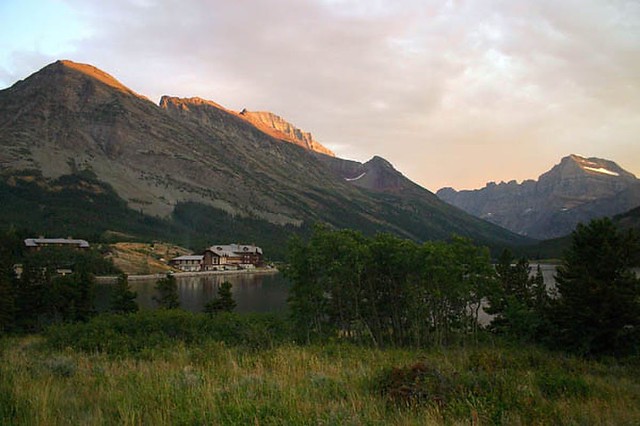
These glaciers in Glacier National Park, behind Many Glacier Lodge:

Glacier - Many Glacier - lodge at sunset

Are almost certainly doomed by 2050.

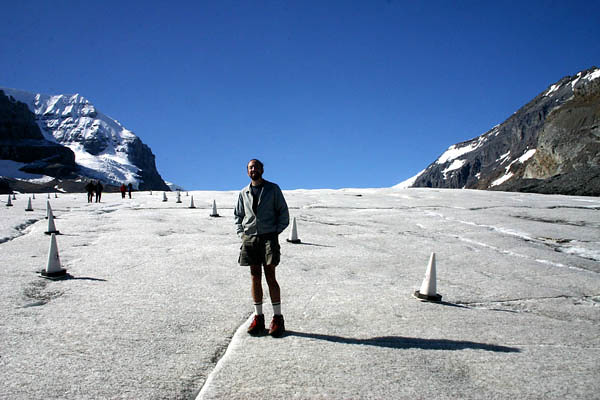
And, this glacier at Canada's Jasper National Park (yes, you can walk out on it!)

Jasper - Athabasca Glacier - me on it 2

is probably gone by 2100; at a minimum, the portion below the crest in the photo is gone by or before then. (And, the center of this glacial system, in Jasper and Banff national parks in Canada, feeds the North and South Saskatchewan river systems, among others, on the Atlantic side, and the Columbia on the Pacific side.)

But, there are many things — glaciers, polar ice, flora, fauna, and more — that we can save.

But, we need to realize some things.

"The market" won't do it, because it thinks short term, as does instinctual human nature. Carbon cap and trade schemes in the European Union have already shown it.

Only a carbon tax, by an economy as big as the US, the united EU, or China, when combined with a carbon tariff to force everybody on the same page, can do it.

We can't stop 2°C. Only a carbon tax + tariff gives us a puncher's chance of stopping 3°C.

And, as I've written before, this carbon tax cannot be fully redistributed back to the public with rebates or similar. It must have teeth enough to force changes in behavior. And, readers should be skeptical of corporate carbon tax proposals like eXXXon's.

July 06, 2016

#Exxon head-fakes on #climatechange and a #carbontax

Has eXXXonMobil suddenly "gotten religion" about climate change because it's calling for a carbon tax?

Don't you believe it, not for a minute.

Here's the nut graf:
The world's largest oil company wants a simple tax charged on extracted carbon, such as oil and gas, in lieu of complicated regulations or trading schemes that too often create unintended consequences. Exxon chief executive Rex Tillerson also wants the money returned to the public to offset the cost to consumers.
Note the last sentence.

No, what that really does is remove any "bite" from a carbon tax, making it a toothless tiger, hence harmless to Tillerson, eXXXon and the rest of Big Oil.

That's why this:
While Exxon first advocated for a revenue-neutral carbon tax in 2009, the company has recently stepped up lobbying in Washington and around the world. The move was sparked by President Barack Obama's Clean Power Plan, the world's adoption of the Paris Agreement to fight climate change and the U.S. House of Representatives' resolution to condemn any tax on carbon.
Is both true and trivial.

I don't want to harm the lower and middle classes too much, though.

So, here's the halfway house.

Use this money to fund new tax credits on renewable energy.

Like electric cars.

How about it, Rex?

Again, I'm not looking to penalize consumers, but, to really work, a carbon tax has to have bite. By bite, I mean something similar to sin taxes on booze and cigs.

What if I said the IRS said both you and your brother owed back taxes, but that if you both paid them all off, it would refund his taxes to you and vice versa? You'd think it had a hole in its collective head.

Or, per my sin tax reference above, we know cigarette smokers tilt poor, but we don't rebate excise taxes on each pack of Marlboros.

And, what's the right tax level, with or without a direct rebate?

A Houston-area Green Party Congressional candidate Tweets:
Erm, I'm skeptical of many things without necessarily being cynical, but, it's eXXXon, and the two merge. Note first that a certain Democrat, non-socialist but alleged socialist, was elected President and took office then with Democratic Congressional majorities.

Second, does eXXXon's tax include just carbon, in the narrow sense, or "carbon," in the broad sense, i.e, methane and other greenhouse gases? We know eXXXon has a not-insignificant natural gas portfolio.

Third, does eXXXon favor a carbon tariff as well as tax? That's my stance.

Fourth, the fact that eXXXon's proposal is higher than already in place elsewhere in the developed world makes me more skeptical. Note also that many places with a carbon tax in place do NOT rebate.

I would MUCH prefer $20/ton, no rebate, to eXXXon's idea. I suspect it would be more effective.

And, let's use the money for climate mitigation. Fund electric car purchases. Fund hybrid-drive buses. (GM's Allison division has made them for years; did you know that?) Fund more mass transit in more rural areas.

Beyond that, it's clear that eXXXon's stance on carbon and climate change is just that: a stance, for PR reasons. I agree with Alternet. It seems clear eXXXon has a PR, and a legal strategy of "uncertainty," or hedging the issue, just like Big Tobacco, at whose feet eXXXon and the rest of Big Oil has studied so hard. And, a Green Party Congressional candidate who unskeptically  swallows it should look in the mirror.

Beyond that, Exxon, if it really did care about climate change, could publicly disavow the likes of Lamar Smith at any time. But it doesn't.

September 14, 2015

The phony European refugee crisis

Now that I've got your attention with that headline, let me explain what I'm talking about.

It's not that refugees from Syria, Iraq, Libya, or even further south in African are phonies in person, or their reasons for leaving their old countries are phony.

It's arguable that part of the grudging European acceptance of the refugees — a grudgingness most notable in the UK and David Cameron — is the phoniness.

(That sets aside the issue, as shown in this piece about Germany taking temporary border measures to try to force the hand of other E.U. states, how "Europe" ultimately remains a concept more than anything else.)

Hundreds of thousands of refugees are hitting Europe, yes. That said, before the Great Recession made opportunities here in the U.S. less attractive, millions of migrants — some whom might well be identifiable as refugees — hit American lands from Mexico, and increasingly, from points further south. (Mexico itself is near zero population growth by birthrate, like the U.S.)

And, while we've had our share of clamor about the largely Hispanic influx of illegal immigration, it's arguably nothing like that of Europe.

Let's start with some additional context. Europe is about the same geographic size as the U.S. minus Alaska, per this site, which talks about making fair, geographic-based comparisons between Europe and America in other ways. Even if we throw out Russia and other countries of the old Soviet Union, the rest of Europe is as big as the US west of the Mississippi.

With half again as much population as the whole U.S.

And, without even going into the issue of legal vs. illegal immigration, as for actual, documented, United Nations-referred refugees? The U.S. has taken 70 percent of the world's share in the last five years. (To be fair, I should note that, as the Chronicle fails to note, our invasion of Iraq created a lot of those refugees.)

Now, some Europeans might argue that means they have no room. On the contrary, Europe has no deserts, no semi-deserts like the Western high plans, and while it does have the Alps and their extensions, the US has both the Rockies and the Sierras, among other things. And, if we're throwing out Russia, Europe has no North Dakota, eastern Montana or northern Minnesota in terms of winters, either.

To put this in terms of population densities, Hungary, a mainly flatland Central European country, might be taken as "representative." Ohio, a mainly flatland state in the non-mountainous, non-desert part of the U.S., not the most dense, and fighting Sunbelt migration, might be compared.

And, the have almost equal population densities at around 110 people per square kilometer. (So does France, with a mix of densely urban areas and the densely-rural-like Central Massif.)

In short, Europe can handle the refugee "flood." It can do so at least as easily as the United States. U.S. states like Minnesota, with less high-density use land than Hungary, have in the past taken significant numbers of Hmong and Somali refugees.


September 09, 2015

On #climatechange this time, Jon Chait has his neoliberal head up his ass and Dear Leader's

I've come to loathe Chait, possibly to the degree Ken Silverstein loathes Nick Kristof, since, a few years ago, the degree of Chait's in-the-tank Obamiac-dom became apparent.

I've little doubt that Chait's Pollyanna tome on how "winning the war against climate change is just around the corner" has a fair amount to do with Dear Leader still being in office.

First, yes, greenhouse gases were flat in 2014. But, projecting a one-year trend into the future is nonsense. Chait either does know that, or should.

Related to that, as of September 2014, GHGs were projected to increase. It's possible that the Chinese recession was already starting last year, and that's why they didn't increase. Chait doesn't consider that possibility.

Second, he talks about "China this" and "China that." The non-Western world includes more than China, notably India. Indeed, per the third link, India's rate of increase in 2013 was higher than China's.

Third, China may not add 18 gigawatts of solar this year, do to the recession.

Fourth, the only mutually reinforcing treaty, or similar, is a carbon tax plus carbon tariff. If we do it first, China has to play ball. If China does it first, we have to play ball (with a tariff on our agricultural exports, primarily). And, Dear Leader has never come even close to talking about a carbon tax. That's in part because he has no cojones, and in part because a tax, and/or a tariff, would not be a "market based solution."

Fifth, promises have been made at climate conferences for 20 years and more now. If Chait really thinks promises this year will become reality, he'll probably sell you on the idea that Dear Leader will give post-presidential speeches for free.

Related to that, it's not just conservatives who scorned the U.S.-China agreement on climate change; see this blog post by yours truly. Or, in relation to the nanny-state scolding that Obama likes to engage in, I tackle that issue and how Obama wants to use it on climate change here.

Sixth, speaking of Dear Leader again, Chait talks about his trip to Alaska while ignoring his permitting of drilling in the Arctic Ocean.

Seventh, Chait's wrong for singling out U.S. conservatives. See "Harper, Stephen" and "Conservative Party, Canada."

As for Chait? I've called him a fellator of Obama (after previously calling him a fellator of Obama before that). I've then called him out as NOT a member of "the reality-based community."

Because New York magazine has continually and repeatedly blown massive money on his sorry ass, and yet doesn't have a paywall, I've put the "no follow" tag on the story. No need to reward their pageview count for analytics.

February 24, 2015

Obama vetoes #KeystoneXL bill — what's next?

President Obama's veto of the KeystoneXL bill from Congress isn't surprising. And on narrow grounds, of Congress trying to dictate foreign policy, it's the right move. That's doubly true with Speaker of the House John Boehner's invitation to Israeli Prime Minister Bibi Netanyahu to address Congress coming at about the same time the Keystone bill passed.

But, barring a more in-depth veto statement, it's possibly not the best big-picture move.

I suggested a couple of weeks ago that Obama should make such a statement, pledging to pass a similar bill if it were tied to a carbon tariff and carbon tax.

Today's announcement story explains why:
Last year, an 11-volume environmental impact review by the State Department concluded that oil extracted from the Canadian oil sands produced about 17 percent more carbon pollution than conventionally extracted oil.
There's the justification for a carbon tariff, which would require a domestic carbon tax.

The AP notes that Obama's veto was without fanfare. Well, per my angle, it should have had some fanfare indeed.


That said, as I also noted in that previous blog post, the State Department has said that Alberta tar sands oil will be sold — and delivered — somewhere, somehow, with or without the current pipeline. Work is underway to build an all-Canada pipeline to Quebec; work is struggling to send another pipeline west to British Columbia. And tar sands oil is already coming into the U.S. by rail, claims of some environmentalists to the contrary notwithstanding, as well as by more circuitous pipeline routes.

Beyond that, environmentalists with brains know not to pin too much hope on Obama.

His "all of the above" hydrocarbons strategy has bent, folded, spindled and mutilated the Endangered Species Act, as with the dunes sagebrush lizard.

And, at the same time his administration expanded protection in the Arctic National Wildlife Refuge, it announced plenty of drilling leases in the Arctic Ocean, as Greenpeace notes.

And, note the "no fanfare" in the AP story link.

In other words, President Obama can often be an "on the one hand" environmentalist.

And, as I noted in my link from my previous blog post, he's also not a "big picture" president. Of course, that's neoliberal incrementalism in general.

February 11, 2015

Needed: A "grand bargain" on #KeystoneXL

I'm on record on this blog as opposing the Keystone pipeline as a stand-alone piece of legislation. I have posted about the myths of job creation that won't happen, and other things.

At the same time, I'm also on record about the fact that Canada's going to export tar sands oil from Alberta (as long as its profitable, and there's debate about the break-even oil price for it), and if it doesn't do it by pipeline into the U.S., it's going to do it by rail. That's even more carbon-negative, and, although pipelines still leak now, it's also potentially worse on spill effects, if there is a train crash. It also ties up U.S. rail lines, delaying harvested crops in the summer, manufactured goods and more.

I just heard somebody from the National Resources Defense Council (a Gang Green environmental group), Susan Casey-Lefkowitz, claim on NPR that no tar sands oil is coming from Canada by rail. Well, we know that fracked oil from Canada — and at least a bit of tar sands oil — is entering the US by rail. And, that's from 360Yale, very respected in the environmental world.

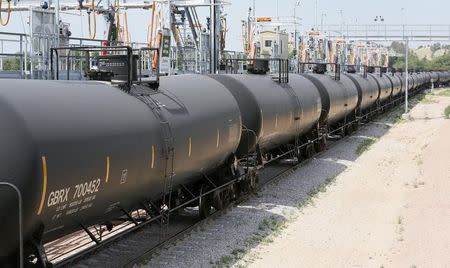
Will the US Dept. of Transportation succeed in replacing old
DOT-111 tank cars with better ones? Rick Wilking/Reuters
Now, per that link, whether this means "resistance is futile" or not is an open question. It does mean that at least one Gang Green group isn't being totally honest.

The rest of that link is good reading. It notes that tar sands/bitumen has to be treated either for tank car or pipeline shipping. It notes that this means that the amount of tar sand oil via rail is limited right now, and that this bottleneck (article is a bit over a year old) depresses tar sands oil prices.

But, if more tank cars are built, and of a theoretically safer upgraded version of the DOT-111, that bottleneck may at least be lessened. Since oil prices are so depressed in general right now, contra that December 2013 article, it's really no big deal if it takes another 12-18 months from today for a lot of new tank cars to come online.

And, the US Department of Transportation, in conjunction with Canadian counterparts, has released a new safety proposal. Stand by to see if this becomes an official requirement.

Related: The explosive West Virginia train derailment last week involved newer, safer tank cars. Update: So did an early March accident in Illinois.

More here, on a specific project for tar-sands rail transport. This story, from just last October, also documents snafus and problems. But, per the Yale piece, while not saying resistance is futile, the environmental world should consider at least the possibility that, when oil prices rebound, the rail bottleneck will be at least a little bit lessened, and that oil companies will work on lessening it more.

Anyway, yes, it's not a lot. It's not a lot more than a blip. But it's more than nothing, and Ms. Casey-Lefkowitz specifically said "nothing" and also claimed that Marsha McNutt, a member of the National Academy of Sciences, who had changed her stance on KeystoneXL because of the rail issue, was flat-out wrong.

Ms. Casey-Lefkowitz owes an apology, but probably won't be forthcoming.

Also contra her and some other last-ditchers, one intra-Canadian pipeline, to greater Montreal, has already gotten Canadian approval. And, TransCanada is pushing ahead with plans to build a pipeline going the other way from Keystone — connecting Bakken oil to a trans-Canadian line.

And, our own Dear Leader approved Keystone South back in 2012, and it opened for business last year. To some degree, per that link, continuing to fight KeystoneXL now is an issue of barn doors and horses.

Such bending of honesty, along with Gang Green groups themselves adding to the carbon problem through things such as massive passing out of made-in-China stuffed plushes, is why I stopped giving them money.

I discussed some of this (with less detail, and with skepticism about President Obama's backbone) two months ago.

That said, per the graphic at left, right now, it's definitely unprofitable to mine for tar sands. And, contra former Texas Speaker of the House Tom Craddick, and perhaps contra claims that $45 is the break-even point here in Texas, as I previously blogged, right now, it's borderline unprofitable to be producing oil here in Texas, unless it's what's left in conventional plays.

That graphic comes from "the letter O" in an A-to-Z encyclopedia of the current oil situation from Canada's newsmagazine, Maclean's. The whole encyclopedia is well worth a read.

Finally, even before Paul Krugman tumbled on to it, I said in these spaces that, as I understood it, World Trade Organization rules allowed a carbon tariff on imports from other countries, as long as a country had a carbon tax on domestic manufacturing, shipping, etc., that was at least as high. Click the carbon tax tag if you don't believe me about how long I've been mentioning it; my first post with the phrase was back in 2009.

Well, now that the new House has joined the Senate and passed a Keystone bill with a large, yet still veto-short majority, here's that grand compromise.

Obama tells Congress, after vetoing this bill, that he's sign a Keystone bill that's got a carbon tax and tariff attached.  And, since tar sand oil is more carbon-dirty than some other oils, this puts an extra price on it, and probably more of an extra price than what's paid now with shipping it by rail instead of pipe.

That said, the hypocrisy of Texas Gov. Greg Abbott supporting Keystone XL because it will provide not just jobs, but UNION jobs has to be in the neighborhood of a new hypocrisy high from him. We all know that it will only provide a few dozen permanent jobs, and even the temporary jobs will likely be far short of the 42,000 the State Department predicts.

Hey, Greg, if you really about union jobs, why don't you discuss worker safety at refineries — refineries that will be handling Keystone oil, among others?

Of course, this is Washington DC. Most of the House GOP and a fair amount of the Senate GOP are wingnuts, while Obama wouldn't know a bold political idea if it hit him in the face. (Or hit his TelePrompTer — snark alert.)

Meanwhile, short of, and shortly after, Obama's presumed veto, what will be happening on oil prices? See the poll at right to cast your vote on where you think West Texas Intermediate will be on March 31.

May 06, 2014

#ClimateChange is real — even oil companies agree

A lot of people have surely already seen this, but it's worth noting on these pages anyway.

The Obama Administration has just released a major new report on the impacts of anthropogenic climate change within these United States.

And, it's not pretty. Without getting into exact percentages of causation, it lays part of the problem of some major regional short-term climatic effects, like drought in California and the Southwest, at the foot of climate change.
Scientists are reluctant to attribute any of these specific events to human-caused climate change, but they say that such heavy rains are consistent with what they expect in a warming climate.
They also refute the "snowpocalypse" and similar nuttery that Faux News likes to trot out almost every chance it can:
The new report emphasized, however, that people should not expect global warming to happen at a steady pace, or at the same rate throughout the country. Bitterly cold winters will continue to occur, the report said, even as they become somewhat less likely.
Indeed. In fact, almost no all-time record lows were set this winter. Some 30 years ago, winter 2014 would have been seen as on the low edge of normal and not much worse.

Related? Not just to variability in climate change, but politics? This:
And the regional pattern varies for many effects beyond precipitation: for instance, while most of the country has warmed sharply over the past century, the Deep South has barely warmed at all, and a section of southern Alabama has even cooled slightly. In general, colder, more northerly regions are warming faster.
The Deep South is red-state ground zero, of course. Even more than the light and white northern High Plains. That said, Texas has seen more change, at least on precipitation, than the traditional cis-Mississippi Deep South. Ditto for Oklahoma. But they, too, have not had, overall, massive temperature increases.

So, especially if the older phrase of "global warming" gets used, Faux and its Amen corner find it easy to shoot that down in a mental circle jerk. But, to the degree flooding intensity and other such things can be connected to "climate change," it's a different story.

Per the NYT's story, the advisory committee behind this includes a supply chain representative of ConocoPhillips and an environmental adviser with Chevron. The secretariat includes a senior fellow from Monsanto, which, unless it can quickly engineer a line of drought-resistant grains, has a lot riding on climate change.

The story notes that some Republicans who aren't total wingnuts accept the reality of the change and, at least to some degree, the man-made degree of it. But, they and many moderate-to-conservative Democrats as well (and isn't that describing more and more Democrats these days) fret about the cost in jobs and dollars of addressing this.

To me, this is like the old 1970s-80s Fram commercial. We can pay a little bit (relatively speaking) now, or a whole lot later.
“Yes, climate change is already here,” said Richard B. Alley, a climate scientist at Pennsylvania State University who was not involved in writing the report but reviewed a late draft. “But the costs so far are still on the low side compared to what will be coming under business as usual by late in this century.”
That said, Dear Leader, preoccupied by offering us a head fake on real health insurance reform and underestimating the size of the Great Recession, never did or would give full focus on climate change. Big business was ready to sign off on a carbon tax bill, even, rather than cap-and-trade.

And, speaking of, per the Chinese carbon beast in the corner, I reiterate, and reiterate that I said it before Paul Krugman — the WTO, as I read it, allows for carbon tariffs on imports.

Beyond that, how do we "market" the need to take action to people who are conservative, but not wingnut, and "sell" them on the idea that we need serious action before we face serious costs?

The Pentagon has talked up the national security issue for some time. However, Smithsonian has a piece (with a few historical and analogical flaws) saying that's not the best angle. Its author says talk about climate change as a public health issue.

In the US, it could well increase malaria. We've already seen struggles with West Nile virus the past few years. Other tropical and subtropical diseases could also hit us harder. And, reduced water supplies are public health matters, too.

At the same time, we must avoid "selling" the technocratic solution, one that falls under my rubric of "salvific technologism." Climate engineering is not the answer. It could, like the massive transportation of species to non-native habitats in the last century or so, massively backfire.

That said, per the start of this piece, there are still countless numbers of wingnuts out there who believe fighting climate change is socialism, or even part of the alleged secret part of the UN's Agenda 21. Two of them are out in force on the Smithsonian piece. I've rhetorically wondered before, and I'll put it in more detail now. Do right-wing think tanks pay trolls like this to go hunting for pieces like the Smithsonian's?

And, they exemplify every stereotype. Verbal bullies. Logorrhea that a dictionary fermented in Kaopectate couldn't cure.

I'll usually engage in two, maybe three, rounds of comments with such folks. I'll then post a general-level snarky comment, then disengage.

Of course, that's what the pseudoscientist verbal bullies like. They think they've "won" when people stop responding.

And, beyond the wingnuts, the Texas Commission on Environmental Quality, with Rick Perry-appointed oversight wingnuts, also remains in denialist mode, claiming this is part of war against "Big Coal."
“It is clear that the science of global warming is far from settled,” the TCEQ countered. For example, reducing coal use, the agency said, would raise energy prices, especially on the poor.

“This is the true environmental impact of the war on coal,” the TCEQ said.
That's even though a Texas Tech professor was on the committee, too. Not everybody in this state is a wingnut. Just the majority, about all the time, and a great majority, much of the time.

January 16, 2014

We're going to need big carbon straws by 2030

That's the consensus of the latest part of an updated climate change report from the UN's Intergovernmental Panel on Climate Change. It says, per the link, that, if we don't do more to limit carbon emissions by 2030, that the only way to stop major global warming is going to be by sucking carbon dioxide out of the atmosphere.

And of course, as the story notes, no such technology exists today, and it likely won't in 2030.

Plus, as the story doesn't note, such technology itself would be a major carbon producer. Can you imagine the energy involved?

And, for some conservatives and moderates who accept that some degree of change is happening, but that we can adapt? Er, this:
Even as the early effects of climate change are starting to be felt around the world, the panel concluded that efforts are lagging not only in reducing emissions, but in adapting to the climatic changes that have become inevitable.
That, too, will cost money and willpower.

On the containment, not the mitigation, here's the bottom, bottom line:
As scientists can best figure, the target requires that atmospheric concentrations of carbon dioxide, the main greenhouse gas, stay below 500 parts per million. The level recently surpassed 400, and at present growth rates will surpass 500 within a few decades.
Actually, even at current rates of change, we'll be at at least 450 ppm by 2030. 

And, per the top of the story, here's what that will mean in detail:
If emissions do overshoot the target, the report found, future generations would likely have to develop ways to pull greenhouse gases out of the air. It is fairly clear this will be technically possible. It could be achieved, for instance, by growing bioenergy crops that take up carbon dioxide, burning the resulting fuel, and then injecting the emissions into underground formations. But the large-scale use of land to grow energy crops would compete with food production, already under strain as a consequence of the planetary warming.

Machinery might be developed that could directly extract greenhouse gases from the air; in fact, early work on such systems has begun. But experts have said the costs, safety and practicality of such techniques cannot be foreseen today. They believe it would be much cheaper to find ways to avoid putting the gases into the air in the first place.
And, even growing bioenergy crops is optimistic. Where?

And, this is already going to be problematic. I've blogged earlier about the fading future of the Colorado River. The Southwest, and even more the Pacific Coast, continue to face drought, a drought that may be exacerbated by jet stream changes in turn affected by climate change.

Shareholder resolutions to cut carbon sound fine, but they're worth little more than the paper upon which they're written. And, they may end up being as much  of "carbon indulgences" as planting trees for carbon offsets has become.

The only realistic answer starts with a carbon tax domestically combined with carbon tariffs on imports, to keep American businesses from further "cheating" by exporting carbon dioxide generation.

And, given that West Texas is expected to get drier, as well as hotter, with climate change, and a lot of central and eastern Texas depend on it, via downstream river flows, for a lot of water?

Texas climate change denialists should remember the old Fram commercial: You can pay me a little bit now or a whole lot later. 

More proof here: Flow into the Texas Colorado River's Highland Lakes was the second-lowest on record last year.

October 23, 2013

Ted Cruz vs Terry Gross, Krugman vs WTO, and other news bits

NPR's Fresh Air host Terry Gross said today,"I don't think Ted Cruz is that connected to Christian conservatives."

That's despite this piece showing just how much he and his dad are plugged into dominionist theology.

Mad yourself? Fresh Air's Twitter account is here. And webmail is here.

I mean, along with a few true liberal friends of mine, I've long said NPR stands for Nice Polite Republicans, but that's just ridiculous. Especially when Gross's webpage claims:
Gross, who has been host of Fresh Air since 1975, when it was broadcast only in greater Philadelphia, isn't afraid to ask tough questions. 
Yeah, right. Like that "tough" statement above?

Note: This isn't an opinion/commentary issue of whether one agrees with Cruz, or dominionist theology, or not. It's a straight news issue of being informed, or not.

NPR, if it's not just for Republicans who want to think they're liberal, is also for neoliberal Democrats, the Volvo-driving, latte-sipping, Meyer-lemon squeezing ones, who also want to think they're liberal.

Beyond NPR in general, I just listen to Gross on the Waco NPR station when I'm driving. (I can't quite pick up WRR, the Dallas classical station, until I get closer to Waco itself.) But, she's never floated my boat. In fact, I find her, again along with some of my friends, an easy object of parody.

===

Someone bigger-named and better-known than me touts my idea of carbon taxes domestically, plus carbon tariffs on imports from places like China, to address the "free rider" issue on global warming. And, like me, says he thinks WTO regulations allow it. And, like me, says, the hell with the WTO if it doesn't.

That "someone"? Paul Krugman, in this book review. The review is in depth, and the book itself sounds good. And, in my opinion, carbon cap-and-trade's been a failure in Europe. Business knows that carbon taxes are a better way of addressing this, and, businesses who don't import cheap crap from China know that carbon tariffs on imports is a way to force other countries to play along.

===

If you missed it last night, PBS' "Frontline" had a good episode on multiple-antibiotic-resistant germs. It promises a spring follow-up on how CAFO agriculture and its antibiotic use play into this. It's scary, as is news that came out during the government shutdown that we may have salmonella bacteria that now resist 165-degree meat temperature on properly-cooked (theoretically, at least) chicken.

I may, at some point, contribute money to PBS again. But, I doubt I'll ever contribute to any local NPR station, nor the specific affiliates that produce most of its programming.

January 03, 2013

RIP Kyoto Treaty

The tower of a church is seen between the smoke-billowing
chimneys of the brown coal power plan Frimmersdorf
in Grevenbroich near Duesseldorf, Germany.
(Frank Augstein/Associated Press)/via CBC
Per a Canadian Broadcasting Corporation report, the Kyoto Treaty officially died with the end of 2012. And, as the recent Doha round of climate talks shows, we have little to replace it with.

It's arguable that if Bill Clinton (pre-Monica Lewinsky, too, but post-re-election) never had plans to submit the bill for Senate ratification even at the time the meetings in Kyoto started, he never should have inked his name, or made pledges he wasn't even going to try to deliver.

Second, it's too bad that, already then, Kyoto did lump all developing nations into one basket. Conservatives around the world are right to complain on this one — China is not the same as Botswana.

Third, it's also too bad that the old G-7, at that time, didn't already start talking about what mechanisms, in terns of tax, economic and other government policies, were most likely to work the best to obtain results.

Today, we know a simple, straightforward carbon tax is the answer. But, one moderate recession and one whopper semi-depression recession later, that's a much harder sell than 15 years ago.

And, with more economic muscle on its part, putting China in a separate basket from Botswana, per Point No. 2, is an almost impossible sell today.

That said, there is an answer for both, which I have mentioned more than once —

Carbon tariffs on imports.

As far as I understand the World Trade Organization, it allows such carbon tariffs as long as they're not steeper than carbon taxes.

There you go.

September 17, 2012

If this is optimism about controlling global warming

I'll pass on what Noah Smith has to offer at the Atlantic.

First,  Smith poo-poos the use of carbon taxes, because India and China won't go along. He ignores the idea, legal under World Trade Organization regs as I understand them, of combining a carbon tax and carbon tariffs.

Second, he says we should just give away a lot of our solar and other green technology. Excuse me? China manufactures plenty already. And, is doing enough research on solar panel efficiency, I'm sure.

Third, he buys all the hype about natural gas when some studies show, that if wellhead and transmission leaks are bad enough, it could be almost as bad a greenhouse fuel as coal.

Fourth, he stereotypes all environmentalists as "panicking" over shale gas fracking rather than working to try to correct its worst problems.
This means working with gas companies, which often are also the same oil companies that have funded denial of global warming. Environmentalists will be understandably wary about partnering with such entities.
Excuse me? Where are the corporate folks like Chesapeake? They're doing bupkis on their end of the stick, by and large.

Which is why Smith's next comment is lame, too:
But remember, the true enemy is not corporations; it's global warming. If Exxon can help fight warming by replacing coal with gas, then they are temporarily on the side of the good guys. (And take heart; the fall in solar costs, if it continues, will eventually render all of this fighting irrelevant.)
Wrong on all counts. Exxon is trying to replace coal with gas because it drills plenty of gas and mines zero coal. Because it makes zero solar panels, it has no interest in that getting a boost.

Finally, there's no mention of doing more conservation. No, that's not a huge part of the long-term answer, but it's not insignificant, either.

The only thing Smith gets right is the need for conservatives to admit solar is real.

Daveed Gartenstein-Ross, though working for a conservative think tank, is right about how to do that, and more: sell it as a national defense issue.


June 23, 2012

#Rio20 a big fat flop - blame #US and #BRIC - and #China

Rio-20 is a big fat flop, the spin aside. Arguably, while the fault likes primarily with the developed world, the BRIC nations need to bear more scrutiny.

We need a three-tier, not a two-tier, ranking of nations. China would definitely be in that, as would Brazil. India might.

My solution would be a carbon tax here in the US, which, under WTO rules, if I am correct, allows carbon tariffs on imports. China, and Brazil/India, would have to get cleaner.

And, this would, beyod the eglobal warming angle, satisfy so many domestic US constituencies.

Non-wingnut US businessmen who manufacture here would knoiw we're not selling out domestic industry. That includes US utilities.

Labor/New Deal liberals know that part of the money from this could fund job (re)training, as well as be a price incentive to bring at least a few jobs back to America.

Environmentalists know that beyond global warming itself, this could help the environment more broadly. (That said, some fellow environmentalists need to get on the breeder reactor bus, IMO.)

So, let's do it!

Or, we can have business as usual.

That said - a bit of schadenfreude; red states will get hit worse by much of the change. That includes Texas and Oklahoma, definitely, Arizona and Utah most definitely. And, somewhat, Florida. Of course, purplish Colorado and split Nevada and New Mexico will also get swept up. In California, the more "red" southern Cal will hurt worse.

I'd love to be president and veto any and all agriculture disaster bills due to drought-related crop loss on the Plains until red-state senators knuckled under.

September 08, 2011

Controlling #CO2: What chance do we have?

Gernot Wagner, an economist at the Environmental Defense Fund, in a distressing, depressing, but honestly realistic op-ed at the NYT, says: Not a lot.

Unless we end what he calls "planetary socialism":
(M)arkets are truly free only when everyone pays the full price for his or her actions. Anything else is socialism. The reality is that we cannot overcome the global threats posed by greenhouse gases without speaking the ultimate inconvenient truth: getting people excited about making individual environmental sacrifices is doomed to fail.
That said, Wagner claims cap-and-trade systems are already cutting CO2 in Europe, and slated to do so "everywhere from China to California."

Not so fast. Tradeable caps were underpriced, and gamed, in the EU. I'll believe that cap-and-trade is workable in a nation as corrupt as China about 20 years after it's implemented. And, in California? Not too much good on a state-level bases, given the way our federal system works. And, CO2 isn't point-source pollution, so it's ... well, it's intellectually dishonest, in a sense, for him to point to cap-and-trade's success with point-source air pollutants.

So, Mr. Wagner should perhaps be more pessimistic. And more honest. Only carbon taxes, combined with carbon tariffs on recalcitrant nations, stand a real chance of success.

And, those of us who recognize that should be depressed that another leading light in another Gang Green environmental organization can depress us, but ... won't depress us quite as much as is needed.

July 03, 2011

Another Obama enviro fail

Why is his administration fighting the EU's proposed carbon permits for airlines? Rather, if he really were an environmentalist, he'd back this and use it as leverage to try to get something similar, if m ore modest, done here in America while challenging American jet engine makers like GE and Pratt & Whitney, to do better.