SocraticGadfly: Occupy Wall Street
Showing posts with label Occupy Wall Street. Show all posts

February 28, 2025

The Resistance 2.0's "buy nothing" is supposed to do what?

First of all, the likes of Adbusters was promoting a "Buy Nothing Day," on Black Friday, the day after US Thanksgiving Day, 25 or more years ago. So, what the "24 hour economic blackout" today from this People's Union USA will accomplish, I don't know. And, what do you do after the 24 hours is up? And, do you address other issues besides people buying too much shit? And, this John Schwartz, interviewed here, know about this? Does he know any of this past history?

But, The Resistance™ wants to resist something.


It also wants to grift, or John Schwartz does.

Look at this merch page! More than $15 for a coffee mug. Nearly $30 for a T-shirt. WOW.

And? I clicked one of the T-shirts. I then clicked "Product Details."

The product details did NOT include company of manufacture. If you can't guarantee American-made, as hard as it might be to get that, per "Making It in America," then aren't you at least somewhat part of the problem, not part of the solution?

Update, March 5?

The People's Union, or "People's" Union until he has more transparency, is doing more grifting:

Starting in the second week of March, I will be releasing exclusive member only video blogs right here on The People’s Union USA website! These will be powerful, inspiring, and detailed video messages covering:
  • How we can organize more effectively
  • Upcoming events & strategic actions
  • Updates on the movement, website, and progress
  • Real discussions on where we go from here
This is just the beginning of something bigger. Together, we are building a movement that cannot be ignored. Stay tuned, stay engaged, and let’s keep making history.

And, how much will a membership cost? I will give Schwartz credit on the FAQ page for talking about legal organizational issues and also mentioning further boycotts.

On the T-shirts, he says he has a new maker, but I presume that only means for the screen printing and it's still made in China or wherever actual shirts.

That said, re Adbusters? They're generally butthurt graphic artists who think they should be working for slick fashion magazines in New York. They were the grifters who called for Occupy Wall Street, while engaging in that butt-hurt fashionista mindset, straight from Kalle Lasn himself.

OWS itself? 

People selling $30 T-shirts might be a junior division of the same general idea. 

And also? Schwartz has no board of directors, advisors, or anybody else on his "about" page.

Hard pass, dude. 

And, per an Axios story about the org (about Schwartz, really, per above), it's got no political affiliation. Oh, you do, even if you don't want to admit it. Or, it will be pinned on you. So, is he that naive? Or is this part of his branding to go with the grifting? I'll take option 2.

December 03, 2021

The Dawn of Everything? Rather, a mendacious scrapbook pastiche

If late friend Leo Lincourt, a lover of David Graeber, were still alive, he'd surely disagree with me, both in my take on this book and on his previous "Debt," based on the second of not one but TWO fluffy New Yorker reviews, even though I have on record from my RIP for Graeber that Leo at least admitted he was "uneven."

But, from what I first read on the Atlantic's review, and now at the Guardian excerpt?

I think it's oversold. WAY oversold now that The Nation has crushed it.

(Note: This is an updated and expanded version of the review posted on my philosophy blog, designed to not only look at the newer information about the book, but to focus more on the political angles behind it. That review was more about facts, or lack of them, on history and social sciences and interpretation.)

That starts and ends with the title and subtitle: "The Dawn of Everything: A New History of Humanity."

It's overarching, and oversold. And, especially via that review at The Nation and Brad DeLong? It's arguably mendacious, not just oversold. (That said, per the title, overselling something willfully is part of being mendacious, is it not?)

(Note: This is a reworking of the original review on my philosophy blog. That's in part because the second fluffy New Yorker review reminds me of Graeber's connections with Occupy and the Black Bloc, which I have long despised, and that puts us into modern politics.

Note 2: I have now given it a MUCH more thorough deconstruction at Goodreads, with a 2-star review.)

I've read multiple books that have already touched on how the old archaeological and anthropological paradigm of a straight,  permanent, line from hunter-gathering  to farming is wrong. Against the Grain covered this four years ago. Five years ago, John Wathey offered up new ideas on the development of early religion and spirituality, which this pair don't appear to cover at all.

Or, via Academia.edu, while not discussing the early "civilizations" of Southwest Asia, here's a paper FROM 1998 about the Fremont culture of today's Utah, discussing a mix of part-time foragers/part-time farmers, full-time foragers, full-time farmers, farmers who flipped to foraging and foragers who became farmers. (Unlike in the Old World, pastoral nomadism wasn't an option in most the New World before Columbian contact, due to lack of domesticated livestock, of course.)

OR? I'll certainly venture that their "everything" doesn't include a new date of 50,000 years, yes FIFTY THOUSAND years before present for the oldest figural, representational human-created art.

So, the pair aren't saying anything new, they're building on others, and right there, it's not a new history, and it's not complete, so not "everything."

It also smacks to me of trying to build on the reputation of Graeber, who died in the last year. Now, he could have been a great capitalist within his anarchism; anarcho-capitalism is a thing, complete with its own Wiki page. But, from what I know of Graeber on my own and via Leo? Uh, no. He would have shuddered to be in the same breath (I think) as Murray Rothbard. (Per the Guardian extract, that's why it's funny for the duo to talk about capitalists talking about social connections at Christmas WITH the implication that they're doing that INSTEAD OF capitalism rather than as a marketing adjunct.)

Now, to some specifics, via a trio of (unanswered, Twitter, natch, low signal to noise ratio) Tweets to the author of the Atlantic review.

First, I noted the pair were by no means alone, per the above.

Second, I noted that the HIGHLY sympathetic reviewer, William Deresciewicz, undercut himself in links in his piece, one in particular, in the claim that "towns" existed long before a permanent shift to agriculture (note that I also tagged Wengrow, also unresponsive):

Finally, I said that, at least per what the review says and more importantly, doesn't say, it's NOT about "everything."

OK,

Now, off to the Guardian excerpt, since I saw that later.

First, the pair are right that just about all of us, including our African Homo sapiens ancestors before leaving Africa, have DNA and mitochondrial DNA from other species within us. Nonetheless, that's yet more dilute than the bits of Neanderthal and / or Denisovan DNA that the typical non-African has. Ergo, the concept of "DNA Adam" and "mitochondrial DNA Eve" is still a good working theory and Graber-Wengrow come close to strawmanning. (The pair actually had a chance of tackling residual racial bias in human population genetics, that said, but at least here, appear to take a pass.)

Second, since cultural evolution is not evolution, unless the pair are slaves to evolutionary psychology, this is largely irrelevant to cultural evolution, contra their claims. So, without reading the full book? Lost a star. And, ev psych has a lot of political tie-ins and overtones as well. Seems to me like they're undercutting some of their other politics to even flirt with it. See Steve Gould and Richard Lewontin.

Third, they do next admit previous recent study of places like Göbekli Tepe, so a kudo of sorts back. That said, I see it as like Pueblo Bonito and the whole Chaco Canyon structures. We still don't know for sure what THAT was — permanent settlement, religious site with sparse permanent inhabitation, some mix of that, or something else. They're just claiming it was X not Y without support.

Fourth, it may be true that inequalities of various sorts were actually worse before a permanent transition to agriculture and a permanent transition to settled cities. Or it may not be. Right now, there's just not enough evidence to say that. We do have enough evidence to say we should get rid of old paradigms, but not enough to create new ones. Contra cheap versions of hot takes on Thomas Kuhn, paradigm shifts as in not just abandoning an old one but immediately replacing it with a new one, just aren't that common.

OK, so they got that much wrong about the past. And more.

Via Molly Fischer, the second fluffy New Yorker review (I'll get to her in a minute), leading me to a Brad DeLong Tweet, I see The Nation has some skepticism about the book, too. Daniel Immerwahr nails it, which is why DeLong Tweeted the link:

(H)e was better known for being interesting than right, and he would gleefully make pronouncements that either couldn’t be confirmed (the Iraq War was retribution for Saddam Hussein’s insistence that Iraqi oil exports be paid for in euros) or were never meant to be (“White-collar workers don’t actually do anything”).

Yep. Now, that's today's politics, but Immerwahr also tackles the past that they tackle.

Just before that, Immerwahr noted a tendentious reading of Mayan ruins by the pair, claiming that the site in question does NOT show "lords" or similar.

The latter third of the review raises a big-ticket item. Accepting that late Neolithic humans did indeed "experiment" with sedentary farming, state structures, etc., for 2-3 millennia or more, at some point, they "locked in" and we became "stuck." This is definitely true in most of Eurasia plus North Africa, and also true, albeit at a lower level of hierarchy and without firm territories, in the Americas and much of sub-Saharan Africa pre-Columbian contact. And, Immerwahr says they never answer why this happened, at least not in satisfactory fashion. 

Since they can't construct an overarching narrative for that? He says that makes the book a "scrapbook" as much as anything.

At the New Yorker, Gideon Lewis-Krous also appears to give it a fluffy review, the first of the two I noted. His take is addressed between me and Immelwahr, above. He also petard-hoists, re what Immelwahr says about interpreting Mayan ruins at Tikal. They basically claim that about everybody else has gotten it wrong but voila, here we are! And we know you're all right rather than all wet why?

Lewis-Krous doesn't address the Immelwahr bottom line critique, either. At some point, whether triumphalist or defeatist, to use his words, much of the world DID "lock in" on sedentary agriculture. Per my notes above about the Americas and sub-Saharan Africa, while hunter-gatherers will have very limited rulerships and hierarchies, this is not the same as "none." And, pastoral nomadists have plenty of both. Genghis Khan, anybody?

In turn, that seems to be, from all the reviews, something the pair just ignores. After all, after livestock were domesticated in the Old World, and especially after somebody realized you could ride a horse instead of eating it, boom! Pastoral nomadism became a third alternative to both hunter-gatherer and sedentary agriculture lifestyles. BUT! As I see it, it requires a conscious commitment and you can't wobble in and back out of it.

On to a second New Yorker fellation of Graeber and the book by Molly Fischer. Fischer does remind me of Graeber not only being the "intellectual voice" behind Occupy, but a supporter of Black Bloc types, including their property destruction, which this leftist of some sort has long rejected. It also reminds me of the lies told about Occupy in general and Occupy New York in particular being "leaderless," which it was not. Fischer starts with New York City's Direct Action Network, a predecessor of Occupy NY that got a new round of prominence after the Black Bloc destructiveness at the Seattle WTO event in 1998. 

I should note that this is why, other than what I've called the pretentiousness of the name, I don't identify with the so-called "antifa": their Black Bloc roots, including the anarchism. A lot of this gets coupled with myths about the police, whether from anarchists, New Left not including them, or libertarians. I've exploded many of them.

With that, per Fischer's piece, I wonder if Graeber, with the Malagasy and others of his anthropology work, while being right on them being anarchist in not having formal governments, nonetheless had leadership structures that he either flat missed, or ignored by de-emphasis, or else willfully turned a blind eye to. I say that because of his claim that Occupy "worked," a claim rejected by many people who, like him, were involved with it.

Re what I said above about their work, the Graeber-Wengrow for the book, not being new? Fischer reports that professional colleagues said at first, on their first journal submission, that it was insufficiently new. They should have stuck with that.

As for "Debt"? First, Brad DeLong has receipts on how error-ridden it is. And, how smug and defiant Graeber is about the errors. (Note Lewis-Krous review.)

Second, per this blog post, I long ago tackled the bullshit claim that Occupy Wall Street was leaderless. And, for Graeber, a PhD anthropologist, to claim that it was? That's mendaciousness. Given that he was essentially a cofounder of OWS, and he and Marissa Holmes were acknowledged as "primus inter partes," and all the other leadership sociological structures mentioned at at the second link, he knew it was bullshit. And, per those links, by lying about OWS leaderlessness, Graeber was ultimately an accomplice to bandit predatory capitalism. He was also arguably an accomplice to the classism and racism that a good anarchist should have despised, as self-done demographic surveys indicate that Occupy Wall Street had a fair chunk of both, and with that, probably was largely nowhere near as idealistic as Graeber tried to make it out to be.

Third, per what Fischer seems to say about it, Graeber seems to have the same belief about how antiquity treated debt as does Michael Hudson. I've dealt with Hudson before; in brief, he takes the aspirational stances of ancient texts on debt jubilees as realities. Any good biblical critic knows better about Israel. Second, to flat-foot Graeber, this was nation-states doing this. Private lenders can't be forced to tear up debts on their own without the power of a nation-state. I can, as a private person, per the Lukan version of the Lord's Prayer, forgive a debt. But, short of a nation-state, who will force me? Likewise, per Jesus' parable of the two debtors, I can't force anybody to pay it forward. Pre-state society may not have been as brutish as Hobbes posits. But, the evolutionary biology problem of free riders hits Homo sapiens as much if not more, than any other eusocial species.

I tackled this most recently in that RIP up top; here it is again.

As for modern monetary theory, dinging both him and Hudson again? I called it a Maoist cult.

And, I'm glad I did this longer update as, per the RIP link, it reminds me that I indeed won't miss Graeber that much. Nor any cult around him.

Update, Dec. 22: Here's another way of seeing what's wrong with the book, to summarize the first part of this post: It's "Big History," with all its problems, including its myth-creation.

==

Update, July 19, 2022: Turns out not all the mendacity is Graeber's. Per a fawning review of the book mixed with a fawning interview of Wengrow, Wired's Virginia Heffernan (who, per past Twitter call-outs of her, has reached her Peter Principle) says that Wengrow invented the book title.

As the story goes on, it's clear that Heffernan ignores not only criticisms of what the pair got wrong, but also critiques like mine that a fair chunk of what the pair did get right is nowhere near new and in fact, re the Agricultural Non-Revolution, has been academically discussed for 20 years. It's also a flat lie that this critic balks at its ambition more than its research, exactly for the reasons of intellectual theft I just mentioned.

I will add a compendium of two other criticisms that she linked.

The first is devastating, noting that the pair appear to reject evolutionary theory. That's a move by many leftists who conflate Darwinism and social Darwinism, or use the idea that others conflate them to reject both. The same reviewer also notes that their world civilizational survey basically just ignores sub-Saharan Africa!

The second starts out by petard-hoisting the pair, always good in my book. It goes on to secondly note their angle remains anarchism first, socialism or even Marxism a distant second. And, that this too colors their background thoughts. Note what I said above about their take on "out of Africa" and human evolution. This ties in with that review.

September 04, 2020

RIP David Graeber; you'll be a bit but not totally missed here

David Graeber, the somewhat "heterodox" economist and historian of economics anthropologist, died yesterday. I had thought he was an economist but am informed otherwise.

 Late friend Leo Lincourt turned me on to him while also noting that his writing and thought were ... "uneven." He was specifically speaking about the book "Debt," so it's not only neoliberals who have criticized it.

Here's an interview of him about basic income and bullshit jobs, discussed by him in detail here. Generally good stuff.

But?

His one big idea, as in his book "Debt"? Built on somewhat false pretenses.

Like heterodox economist Michael Hudson, Graeber called for jubilee years like those in the Old Testament or Hebrew Bible.

Problem? Those jubilee years of every seven years (actually the sabbatical year), and the super-jubilees of every 50, were almost surely aspirational, ideational. They weren't real. They come from the P section of the Tanakh, drafted in Babylonian exile or after. I mean, per the Wiki page for the book, even Jacobin, although it's not THAT far left, called it anecdotes that don't add up to proof. Wiki's pages on the sabbath year and the jubilee year are both useless. The sabbath year piece presents sabbath years as though they actually happened. The jubilee years piece cites Graeber as a reference, while even then noting that jubilees were (allegedly) offered when a new king was enthroned, and were for noncommercial debt only.

Contra conservative biblical scholars, 2 Kings 19 / Isaiah 37 do NOT imply a regular system of sabbath years at the time of Hezekiah. Rather, the passage seems to imply that Israelites couldn't plant in the current year, and in the second year, the soil might still be too disrupted (salted by Sennacherib?) to grow anything beyond more "volunteer" plants, and that "Yahweh would provide."

As for ancient Near Eastern kings doing this on their ascents in general? Given that we have but a few examples of this, and that "winners not only wrote history, they were the only ones writing" back then, if not fully ideational, there's probably less truth and more legend to these ideas than Graeber, Hudson or others would admit.

Per his Wiki page, he's then to blame, in part, for the myth of Occupy Wall Street vs. its reality? It wasn't as anarchist as he claims, though it was more than anarchist enough. Yet, it had leaders. Oh, it did. Also, riffing on the likes of Doug Henwood saying racism almost always reduces to classism? Graeber either missed, or papered over, that by demographics, OWS was BOTH racist AND classist.

He was also a big MMT touter, and I've called that a Maoist cult.

I don't know what all Leo had in mind by "uneven," but one piece I saw yesterday illustrated that to a T.

Here's a piece from him in The Baffler which shows the range of thought he had, though he's just wrong in his apparent support for panpsychism. And, his dismissal of the whole idea of emergent properties is simplistic. And, if, in light of the real thing called scientism, there's something called anti-scientism, this comes close.

And, in what must have enlivened editorial conversations at The Baffler, fellow writer there Thomas Frank said that Occupy Wall Street didn't accomplish shit. And, he was right

===

Update, March 3, 2022: I have given Graeber's posthumous "Dawn of Everything" a thorough deconstruction at Goodreads, with a 2-star review. I have also offered background to that, including links to other critical reviews and what I learned from them, at this blog post.

June 27, 2019

Green Party presidential favoritism

And, yes it is favoritism when the official Green Party US Twitter account announces Howie Hawkins' candidacy after having officially announced nobody's before that.

And now, via Independent Political Report, we see that Green candidate Ian Schlakman (announced some time before Hawkins) has called out Hawkins and his campaign staff, in part based on a joint letter by him and four other candidates announced before Hawkins.

So, expanding greatly on brief comments on Twitter last week?

First, beyond personality reputations that Kevin Zeese has (and I've heard them too), I'm leery of him for other reasons.

First, most his ideas that are Green-ish are also Libertarian; note his co-nomination in the 2006 Maryland US Senate race (which Schlakman refers to in his letter). Second, I don't know about Occupy in DC, but, in New York, I've pointed out its many wrongs, starting from the fact that Adbusters launched the Occupy movement in general through its being actually quite "leadered," contra myths of leaderlessness, and having lots of grifting associated with that. Click the tags below.

Beyond that, I've never really heard of him as being "green" to a huge degree, and certainly not an ecosocialist type.

Second, per Schlakman, is the association of Andrea Mérida Cuéllar with Hawkins. I am not as ready to throw her under the bus as he is, but I've heard enough elsewhere, from the likes of Bruce Dixon.

Third are the actual or possible conflicts of interest that Schlakman mentioned otherwise.

And, speaking of Dr. Margaret Flowers, does she support me and Jon Walker and others who say a good single-payer system must reign in payments to doctors and hospitals? She's very good at knowing the nuts and bolts on single payer vs the health insurance industry, but ... as a doctor ... is she ready to take less money, to fully, fully, abandon fee for service models and more?

And, so far, she has failed to respond to me! Shock. American fee-for-service medicine and everything connected to it — overdiagnosing, backscratching consulting arrangements and more, is almost as big a problems as AHIP in first and #BigPharma (plus medical device manufacturing) in second.

Back to the IPR post.

Site owner (I think) Paulie, who is (I think) Libertarian, doesn't outrightly call this a "nothingburger," but gives indication he thinks it's not much more than that.

Well, in a follow-up comment, I noted that DBC down in Houston was upset when he saw the Tweet. Saw favoritism in it. It's drawn comment and emotion from people in the unofficially Green Effbook group to which I belong, from people at least as Green-active as I am.

And Ian has that letter signed by the other candidates.

So, Ian may be making a Rocky out of Appalachia, but making a mountain out of a molehill? I don't think so.

==

Side note: Other than Howie himself, most the big players here are from Maryland. Ian, Kevin, Margaret, Brandy. Must be some fun state party meetings.

==

Both Hawkins and Hunter spoke at the Texas state meeting.

==

Update, Aug. 31: The state party, in emailing me about Hawkins' Sept. 7 visit to Dallas (which I doubt I can make but wish I could) included Hawkins money solicitations. I'm kind of not liking that, either, as this was a Texas Greens email and not one from Hawkins, and I've let the state folks know that on Twitter. I don't recall getting a separate, specific email just about his attendance when Dario Hunter spoke at the state convention this summer, let alone one with "donate" buttons embedded in the email. This all also makes me curious who the current state PR person is.

And, nemmind. On the Texas GP Facebook page, Alfred Molson explains that the Executive Committee has an "invite" open to all candidates to "tag along" with a mass blast via the state if they want to.

The flip side of the flip side is that other Green candidates may be piling on to Howie for believing that Russiagate, in terms of Russia meddling in US elections, is real. (AFAIK, Howie doesn't believe in Trump-Putin collusion; if he did, I'd drop him like a rock.) And Brains and DBC believing conspiracy theorists on this is disconcerting but not surprising.

January 10, 2019

The Green New Deal vs The Green New Deal

Let's start this off by stipulating that the DSA roses' "Green New Deal" is a pale imitation of the Green Party's offering. Andrew Stewart also talks about the original Green New Deal at Counterpunch. Carl Beijer (who allegedly worked on two Nader campaigns) says, "but the Democrats are the first to talk about the global climate issue."

That may well be true.

At the same time, it's not "the Democrats," Carl; it's a small subsection of Democrats, not a party stance. And, per those links, we'll see how well that small segment does at avoiding being co-opted by national leadership.

Indeed, the face of the Roses, Alexandria Ocasio-Cortez, has continued to move rightward since lauding John McCain and backing away from BDS-related issues, as this longform from Mint Press notes.

Mint Press focuses on the Green New Deal and how it is, at bottom, fauxgressive. It mentions things like entrepreneurialism and other neolib buzz words, and looks like it would be entirely open to a carbon cap-and-trade, not tax and tariff, as the primary government "tool." And, that is even before Speaker Pelosi guts it. The piece also notes the GND of the Roses is a plan to work on a plan much more than an actual plan.

OTOH, I would support Carl Beijer's idea of a more socialist Green New Deal than the Roses (or the US Green Party, I think he's right) have offered. OTTH (On the third hand) Beijer does a bit of shark-jumping for me when he claims that capitalism inexorably leads to fascism. There, he refuses to call himself a dialectical materialist, but does call himself a "historic materialist."

A difference that makes no diff, Carl. You're claiming to be a Commie, specifically of Marxist variety, not just a socialist. As I've said elsewhere, Marxism is bankrupt both scientifically and philosophically. Marx had basically no scientific data to back up his ideas (and economics was even less scientific then than today), and Hegelian dialectic is a bucket of warm shit within philosophical ideas. The Frankfurt school and other neo-Marxist ideas were better, but really, we need to shed these polarities, especially of Marxism vs fascism with nothing in between. We even, IMO, need to look beyond the lesser polarity of capitalism vs socialism (I mean socialism, not DSA or similar social democracy). Sadly, or worse than that — Beijer seems to be like others, whose general mindset I call out in that link — romancers of November 1917 Russia.

For New York Greens, Howie Hawkins gets that right when he notes that a real Green New Deal needs that, and adds that during World War II, with its analogies, FDR nationalized 25 percent of American industry. Speaking of, Stan Cox at Counterpunch notes that led to a massive new emission of carbon dioxide in his own call for a true Green New Deal to go beyond capitalism.

Andrew Stewart also remains skeptical of the AOC "wave election" and other things related to it.

Meanwhile, in "mainstream progressive" media, the likes of Emma Vigeland claims that John Cornyn supports a carbon tax (which she insinuates is in AOC's version of a Green New Deal). First, I found multiple examples from Cornyn's Twitter feed showing her wrong (and politely let her know). Second, per both Vox and Grist, it seems fairly clear that the nebulous GND proposed by AOC and allies doesn't have a carbon tax. Some of their think-tank allies are in outright opposition.

Per Grist, I don't see a massive expansion of renewables without a hammer of the carbon tax forcing it. Ending all onshore and offshore oil drilling on federal lands to try to force us out of internal combustion engines, or at least those without hybrid drives, won't do enough to #KeepItInTheGround in the US, let alone doing nothing about foreign oil. And, of course, that's where a carbon tariff (which the GND doesn't come close to mentioning) is part of the picture.

Finally, now that AOC has released her own Green New Deal document, it looks highly aspirational. No carbon tax or other sticks to go with carrots. No real estimate of costs. These are going to be questions that need to be answered, issues that need to be addressed. Carl Beijer notes this, in noting AOC's document does discuss "funding" with no talk about real costs. The Green Party has also weighed in, saying it has fossil fuel industry loopholes. Michael Grunwald has another critique. That is that the manifesto is a laundry list grab back. Agreed! Prioritization is important. For example, were I president? Climate change and national healthcare would be the top priorities. A step below that would be a minimum wage hike. Other things fall yet lower.

As for the cost? Contra a Reason claim of $7 trillion, this Stanford study goes much lower, without specific final numbers. Among other things, it says that reduced electric generation costs would offset some of the construction and installation costs. I'm going to say $3 trillion over a time period until 2040 rather than 2030, and scrapping some localization issues of the Stanford study. Still pricey? Yes, but not THAT pricey. At $150 billion/year, less than half of DoD's budget.

WHAT'S UP WITH THE SUNRISE MOVEMENT?

The biggest of "allies," or actually a progenitor, is the Sunrise Movement. Its homepage looks even whiter than the Green Party, despite its acknowledgement that much of climate change will hit poor of all ethnicities and especially minorities. The ambitious goals it lists, per the New Yorker, seem unobtainable without major funding for it. Major funding. And a carbon tax would help until much of this was in place. But ... like AOC, so far,  heavy on aspiration, light on perspiration.

If even more tax credits to renewables is a small part of the deal, fine. But, that alone won't lead to a ramp-up of the size needed to get us driving electric vehicles, as well as running our computers on renewable electricity. And, what about the Dick Cheney sneered-at "conservation"? What if we can't ramp up car batteries without massive environmental degradation? What if, in some ways, the world has peaked? I'm leery, from seeing things like a "smart grid" touted as a major part of the solution (overhauls of the current electric grid ARE needed, but the grid is already relatively smart as far as "switching") that we've got a dollop or three of salvific technologism running around here.

I am also distrustful of any organization which won't list its leadership on its website. Some of the founders claim inspiration from the Occupy movement, or Black Lives Matters. In both cases, we see what has happened with actual or alleged lack of leadership. The original Occupy at Zucotti Park had leadership, despite denials; I've written about that before. Black Lives Matter truly appears to be more leaderless, and by 2020, will probably have dissipated much of its original energy. (In fact, co-founder Evan Weber was part of Occupy. At least he admits it had leadership problems. The real truth is Occupy had leaders who tried to get others to believe the leaderlessness myth. It eventually sold out to Wall Street; remember that, when you see $20 T-shirts; a Sunrise Occupy-style debit card could be next. Occupy also had a 1 percenter problem.

Also, none of the Sunrise Movement have acknowledged ripping off the Green Party, or even really acknowledged its existence. Related big question: If there's a ConservaDem in a general election, after a failed primarying attempt, will it endorse Greens when they're running? SPUSAers or whomever, if Greens aren't available in a particular district?

I sent a second direct question to Sunrise after first indirectly tagging after starting work on this piece. We'll see what, if any, response I get. Don't believe me? Twitter link and screengrab. Account started in 2013. Wikipedia information? Organization started in 2017.

Reality, per Wikipedia? It's a youth front of Sierra Club that sat around and did nothing, it seems, for four years. And, people who have been long-term readers know what I think of Sierra in particular and Gang Green environmental groups in general. And, that explains why it hasn't credited the Green Party.

And more research. Stephen O'Hanlon's Downingtown is semi-ritzy. The man I presume is his dad would appear to have a ritzy yet small-scale law practice.

And, at least one claim, per its Twitter feed? To eliminate all greenhouse gases by 2030? Since cow farts are greenhouse gases, unless Sunrise makes the entire country vegetarian, that simply ain't happening.

But, per the tweet embedded below, that is exactly the claim.
I also find it interesting that Sunrise Movement's Twitter account says it was started in September 2013 ... which is long before the Sunrise Movement was allegedly started. (Both the "@" and the actual name are Sunrise-related, as you can see in the embedded Tweet, so it's not like it originally started as something else.

Finally, do not cite Modern Monetary Theory as a magic wand to pay for all of this. (I'm not specifically referring to the Sunshine Movement here.) I consider that some left-liberals, and a few leftists, version of snake oil or voodoo economics. Unless you find a magic way to eliminate the bond market as well, it doesn't work that way. It's one of my biggest disagreements with Michael Hudson, for the amount of good he has to say otherwise on economics.

Finally, none of this distinction between the GREEN New Deal and the Green New Deal matters as much, arguably, as the fact that Speaker Pelosi and House Democratic leadership allies of hers gutted the powers and mandate of the Select Committee on the Climate Crisis. (Update, Feb. 7: Pelosi has left AOC off the committee.)

And, the chair of that committee, Kathy Castor, is now talking about how "woke" Dear Leader was on climate change in his 2009 stimulus bill. Since that bill fell short on stimulus help, let's be honest and note that while it did "something" green, the something it did was entirely neoliberal, markets focused. (Of course, per all of the above, the AOC GND has too much of that itself.)


Update, Feb. 22: The New Republic, of all places, not a leftist outfit, now asks if some Dems (not necessarily AOC) are deliberately trying to steal Greens' thunder.

October 23, 2015

#FeelTheBern, #AntiSemitism, #SJW humor, #Occupy and #ConspiracyThinking Part 2

As I noted last week, after the first debate, in some corners of the Twitterverse and the blogosphere, the idea was started that some of the opposition to Bernie Sanders' presidential campaign is grounded in anti-Semitism.

As I further noted, one blogger behind this idea went down the ...

Well, went down the social justice warrior road.

Regular readers know that while I don't reject the idea of sociologically grounded, structural inequalities, I don't throw around such ideas lightly, especially when they're first espoused by New New Left types.

So, since Jodi Dean (linked at my earlier blog post) talked about "patriarchy" and "privilege" as part of what might be anti-Semitism against Sanders, let me further crush this nuttery.

First, as I already noted on my first blog post, talking about "patriarchy" when you're also bashing Hillary Clinton for repeatedly talking about the burden of being a woman running for high office is both self-defeating and illogical. (That said, such impediments are common — and commonly ignored — in the SJW world.)

Second, despite Vermont being just 1 percent Jewish, or a little less than half the national average, Sanders managed to be elected multiple times as both its single, statewide, U.S. Representative, then multiple times as one of its two statewide U.S. Senators, winning a total of eight House and two (so far) Senate elections. If Vermonters had anti-Semitism on their minds, they sure hid it well.

Third, on the privilege issue, let's just look at Sanders' bio, per Wikipedia, first of all.

It's true that he comes from an unprivileged background. His father was a Jewish immigrant who lost much of his family in the Holocaust. But, his parents weren't poor, either. Sanders graduated college, attending the University of Chicago for most of that time. And, I'm sure that UofC wasn't cheap then, either.

Finally, the Atlantic comes along and skewers a subset of Sanders supporters as the "Berniebro."

What happens? Someone like Doug Henwood, who should know better, but already showed that, with Sanders, just to use him as a Democratic whipping stick or whatever, refuses to "know better," laments the piece. Or at least, that was my takeaway.

In actuality, besides a skewering, there's probably a certain degree of truth to it.

Way back in 1968, Bobby Kennedy lost the Oregon Democratic primary to Eugene McCarthy. Why?

Primarily because white proto-hipster liberals in the Pacific Northwest wanted to oppose the Vietnam War and support environmentalism, but often did not want to talk about racial injustice. (And, I don't doubt that Henwood knows that.) I'm sure some of Sanders' supporters are that way today.

Hell, we don't need to go to Portland.

As I blogged about long ago, the ground zero for the Occupy movement, the original Zucotti Park gathering, was whiter, more highly educated, and richer (by parentage) than national average. This came from protestors' self-surveys, by the way.

Update, Oct. 27: If the Bern-Boosters keep up the claims that talking about Sanders speech volume in an underhanded anti-Semitic trope, I'm going to keep writing blog posts kicking you in the nads.

June 08, 2015

Your dumb Facebook #meme of the week: "mysterious" #bankster deaths

Maybe at some point, I'll either unfriend more people on Facebook, or else directly confront more of their ideas, but for right now, I have the idea for a new, occasional, thematic blog post series.

This week, we address the idea that big bankers are supposed dying "mysteriously."

Supposedly, a whole 36 did so last year. And, we're up to 3 this year! So says ... Natural News!

And, hold your horses! Banks have $680M of life insurance on employees payable to the banks, not the families.

First, 36 deaths in a year in a business that employs as many people as banking? Not much more than stastistical error, whether mysterious or not. And, by that count, we should be up to 15 this year, not three.

Of course, when Natural News, or American Thinker (homepage, can't find exact link referenced) — an anti-medicine conspiracy site and a junior semi-wingnut conservative political site, respectively, are among your sources, you've got problems right there.

As for all that life insurance?

All sorts of companies across the US regularly take out life insurance on their employees as a corporate investment. For doorknob's sake, my small newspaper company has a policy on me. I don't know about Wall Street on Parade in general, but I suspect that it's into seeing conspiracies where none exist.

Worst of all, the person who posted all of this identifies himself as a rationalist, presumably meaning a skeptic.

You might want to start being more skeptical about yourself. (And, no, the links he posted didn't look like he was challenging their claims.)

October 03, 2013

#Occupy decides to join #banksters instead of beating them - #OWS exploitation

Sadly, my hopes are officially mistaken
My Photoshopping, in part
In less than 500 words, from the new issue of the Baffler, Chris Bray tells us how the "Occupy" movement has officially sold out to the hypercapitalist Wall Street it allegedly loathed.

Damn, Baffler really kicks ass and takes names on this:
Occupy, being loosely defined in its goals and its membership—a movement, not an organization—has long been a theme waiting for its marketing opportunities, despite the apparent withering of the brand. Not much is being occupied by Occupy, anymore, but it still looks good on a T-shirt. Or splashed across a debit card, with a low $1.95 fee for cash withdrawals, because fight the power.
Yep, it's all about the branding and marketing. "Thanks," Adbusters.

But, wait, that's not all. It gets better!
As the seminal 1967 book infamously stated, the poor pay more, and a transition from a big corporation’s prepaid debit card to a social movement’s corporate-supported prepaid debit card won’t turn off the darker realities of the socioeconomic bottom. Maybe it’s time for Occupy payday loans, Occupy check-cashing storefronts, and Occupy pawn shops. 
I couldn't have said it better myself.

But, I've said similar on the branding and other things from the start.

Adbusters? Strikes me as a bunch of graphic artists pissed off that they couldn't get jobs at top U.S. or Canadian graphics or advertising shops.

OWS? Strikes me as a bunch of rich white kids who got either MBAs or JDs precisely because they wanted to work on Wall Street, then the Great Recession hammered them.

No, really: Their own internal demographics prove the richer, whiter and better educated, as I've blogged before. I just took a guess that the "better educated" is probably those two degrees, and why. Most the Occupy folks probably had parents with three times the income mine had.

Meanwhile, proof that they've joined the banksters? Felix Salmon had that earlier this week, discussing this debit card in detail, while noting it had no Visa logo (at that time). He covers the details of the apparent exploitation angle, noting it's no better than any other debit card:
Occupy Money says in its FAQ that its card is “more than just a prepaid card since it features additional services. It’s our aim to make the card and its associated charges less expensive than other cards on the market.” But it doesn’t feature an explicit price comparison. And if you look down the list of fees ($0.99 per month, $4.95 to load cash onto the card, $3.74 to deposit a check onto the card at a store, 4% for instant check deposit via your smartphone, $1.95 to withdraw cash from an ATM, $2 to speak to an agent, $0.99 for a balance inquiry, etc) then it’s hard to come away convinced that the cost of this card is really going to end up being lower than the cost of its competitors. As for the “additional services”, there’s no indication of what those might be. I find it hard to believe that they include anything you can’t get from Simple or GoBank.
Bray says he'll stick with his credit union. If you want to go more private than that, there's other options. The whole Islamic private banking system has been around for centuries.

Meanwhile, per what I first blogged about this yesterday, this is also just another case of Occupy hypocrisy. The lack of transparency involving Rolling Jubilee on debt reduction is nothing new. Thomas Frank agreed with me and many others in nailing them for this "horizontal leadership" nonsense, though Frank failed to note that that too is a myth, or rather, a lie, as I blogged here. The creation of the debit card only underscores this. Because, now that you've got a money-making tool in hand, your leaders will become more visible. It may not be by choice, but they will become more visible.

Hey, Occupy douchebags, why don't you go beyond the Visa partnership and pretend to like actual poor people? You could partner with McDonald's on their debit payroll cards.

Basically, I'm at the point that NOTHING some tentacle or another of the Occupy octupus does will surprise me. It may still disgust me, of course, but even that's going to fade.

Or another way, per another bete noire? The Occupy kiddies, the ones who were Ivy League gravy trainers? They strike me like the Atheist Plus movement, the offshoot of Gnu Atheism. And, yeah, in both cases, there's "leaders." The Occupy folks who were actually serious? I feel sorry for you. Of course, you were warned by better and more famous people than me, about the need for organization, visible leadership, planning and more. And, this is why America could use some of old Europe's hard-hitting, occasionally jaundiced, social skepticism.

As for you of the young who weren't the richer, whiter and better educated? Most of us are naive at times when we're young. I hope you learned some lessons. And, don't deep too deeply into Euro-style social skepticism, but just a bit. That includes being skeptical about the Adbusters and Anonymous types who pushed for this movement, fueled it, exploited it and everything else.

To wrap this up: To any of my real progressive friends? If you talk favorably about the Wall Street original of the "Occupy" movement any longer, I'll kick you in the gonads.

October 02, 2013

#Occupy brands itself, could rip people off

Felix Salmon is the starting point for this discussion about an "Occupy" debit card that could be more onerous than what it would seek to replace, and various and other sundry things. From there, we go to lack of transparency and end at a capitalist sellout.

Salmon points to Naked Capitalism, where Yves Smith asks Rolling Jubilee: "Where's the money?" As in half a million of it, or more.

Rolling Jubilee answers in ... well, in typically barf-inducing Adbusters-type Occupy language.

As Yves notes, the "horizontality" that RJ and other Occupy groups trumpet is itself part of the problem:
But the big problem seems to be the lack of a proper governance structure. A board, be it for a profit-making organization or a not-for-profit, is not supposed to be identical to the people running the venture. ...

And there red flags even in what little we can see of what Rolling Jubilee has been up to. ... All Board members are authorized to individually sign checks up to $10,000....
To put it politely, a $10,000 signing authority for a board member is simply unheard of.
On this, one wonders if, again, some of Occupy is not more equal than the rest.

Back to Salmon, who talks about that would-be credit card:
Occupy Money says in its FAQ that its card is “more than just a prepaid card since it features additional services. It’s our aim to make the card and its associated charges less expensive than other cards on the market.” But it doesn’t feature an explicit price comparison. And if you look down the list of fees ($0.99 per month, $4.95 to load cash onto the card, $3.74 to deposit a check onto the card at a store, 4% for instant check deposit via your smartphone, $1.95 to withdraw cash from an ATM, $2 to speak to an agent, $0.99 for a balance inquiry, etc) then it’s hard to come away convinced that the cost of this card is really going to end up being lower than the cost of its competitors. As for the “additional services”, there’s no indication of what those might be. I find it hard to believe that they include anything you can’t get from Simple or GoBank.
Oy. Salmon also adds that this can't be an official credit card yet, because it doesn't have a Visa (or MasterCard) logo. But, scroll down on that.

This not only isn't cheap, it lacks the very transparency that allegedly is part of Occupy's core.

As for the 'branding" that catches Salmon's eye? Is not that part of the whole Adbusters background to Occupy?

Beyond that, Occupy and Adbusters-fluff are simply reinventing the wheel (while adding the fluff of "branding.) The whole Islamic private banking system has been around for centuries.

As Salmon notes, running a bank is hard work, and that's even for people who, whether as owners/operators, or investors, have less tendentious relations to capitalism or similar economics. As a fellow skeptical left-liberal, Doug Henwood of Left Business Observer, noted at the time of OWS, most of its non-leader spokespeople had myths in their minds about businesses in general and banks in particular, to boot.

Finally, out of pure snark: With "horizontal leadership," how can anybody claim that any one particular website is "THE" website for Occupy Wall Street? Doorknob, I love the sound of petards hoisting in the evening.

And, from the new issue of the Baffler, it's even worse: "Occupy" has addressed Felix Salmon's note that it doesn't have a Visa logo on its credit card and officially sold out.

Damn, Baffler really kicks ass and takes names on this:
Occupy, being loosely defined in its goals and its membership—a movement, not an organization—has long been a theme waiting for its marketing opportunities, despite the apparent withering of the brand. Not much is being occupied by Occupy, anymore, but it still looks good on a T-shirt. Or splashed across a debit card, with a low $1.95 fee for cash withdrawals, because fight the power.
Yep, it's all about the branding and marketing. "Thanks," Adbusters.

But, wait, that's not all. It gets better!
As the seminal 1967 book infamously stated, the poor pay more, and a transition from a big corporation’s prepaid debit card to a social movement’s corporate-supported prepaid debit card won’t turn off the darker realities of the socioeconomic bottom. Maybe it’s time for Occupy payday loans, Occupy check-cashing storefronts, and Occupy pawn shops. 
I couldn't have said it better myself.

December 01, 2012

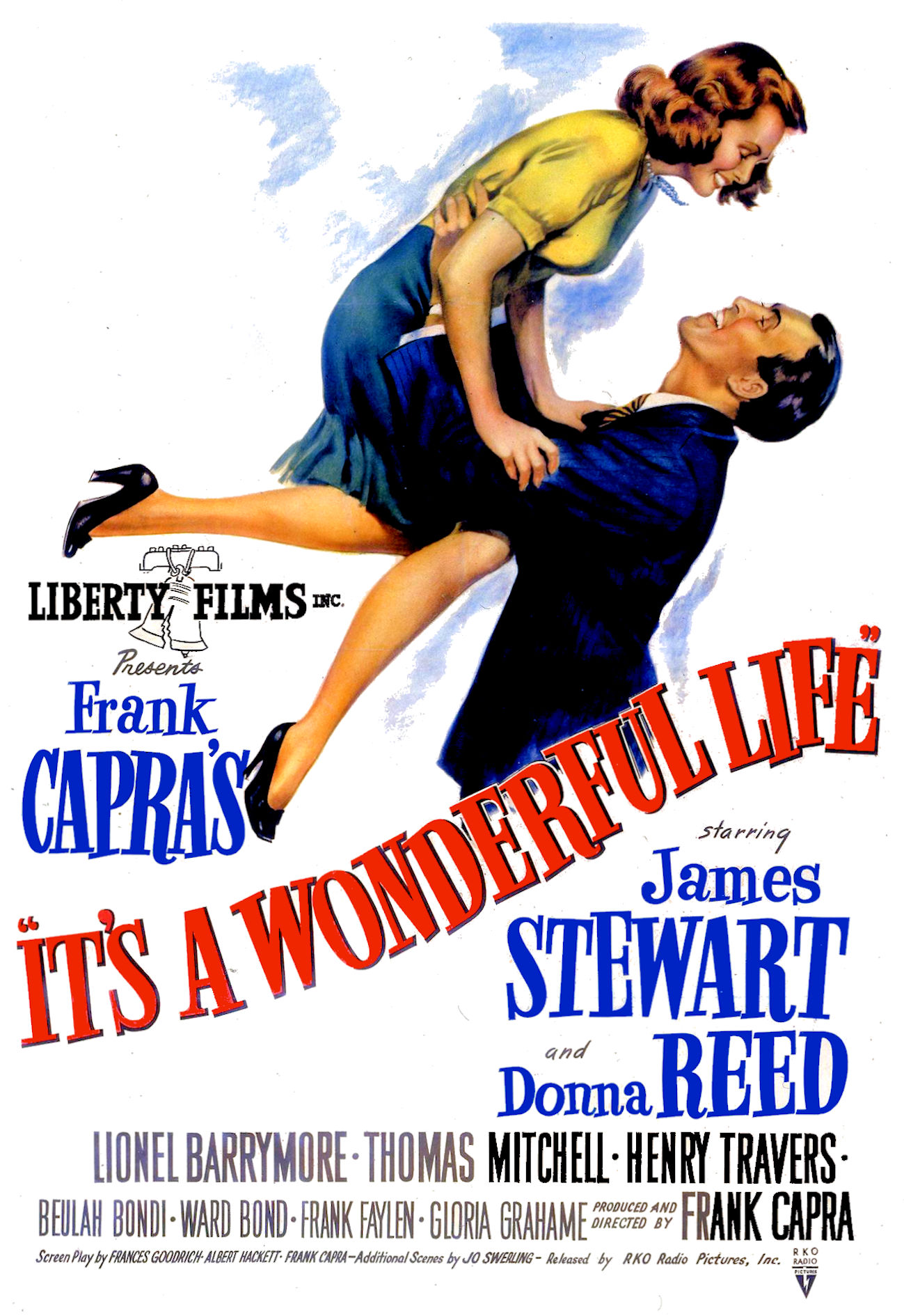
Does 'It's a Wonderful Life' need a remake?

"It's a Wonderful Life" is on TV again (Updated, Dec. 1, 2012). I am at home tonight, and per the linked follow-up blog post in the third paragraph, if I watch it tonight, it will be, contra past years before 2011, not be such a saccharine tear-jerker as usually has been for me. Indeed, I may turn a strongly critical eye on it, and a more introspective one on my past emotions.

And, I know that it is such a tear-jerker because it leaves me longing, more than just wistful, for a life that I never experienced that much growing up. (Since I didn't experience it, I can't be nostalgic about it.)

(Update, June 2, 2012: I've now come to the conclusion that behind the saccharine and my own tears, I loathe the ideas and philosophy behind it.)

Anyway, let's think of some alternative ideas for this movie, since it's a tear-jerker precisely because Frank Capra pulls  formulaic strings, while actually making it "Bentham’s Panopticon with picket fences," per a link below the fold.

What if Capra had ended the movie 20 minutes early with George Bailey, aka Jimmy Stewart, jumping from the bridge? Or, had run it out another 30 minutes after the tear-jerker ending? Would we see George take a more skeptical look at Bedford Falls? Would he perhaps wonder if a little bit of Potterville actually did lurk beneath the surface?

If you want to get more thought on that line of thought, go here; is IAWL "the most terrifying movie ever"?

Before I saw the Salon story, when I watched it (and, yes, cried again) this year, I thought that the end of what Rich Cohen calls "The Night Journey of George Bailey" had a major-key riff on the melody of the medieval church hymm of the Apocalypse par excellence, the Dies Irae. Cohan makes me wonder more.

The occurrence is just before Bert pulls up and says, "Where have you been, George"?" It just caught my ear. [That said, that's part of why I love Rachmaninoff, and I will hear the Dies Irae wherever it pops up. More on that "aha" here.] Given that Dmitri Tiomkin, who wrote the score, was born in Old Russia 21 years after Rachmaninoff, and studies there under Alexander Glazunov and later, in Berlin, under Ferruccio Busoni, it adds to the possibility. However, the original score was even darker.

Per the link, which talks about George's "resurrection," I think that IS a Dies Irae riff. (More on that thought here.) That said, to riff on some of the ideas in the link ... it would have been interesting if, in the "salvation by friends" scene at the end, the actual Dies Irae had been playing, sotto voce.

Anyway, Cohan says there's a darker meaning underneath the saccharine. I think he overstates his case, but may have something going on here.

So, per Cohan, and my own thoughts, maybe it's time to do a remake? Either cutting it short, or else extending it?

I think you could extend it, by about 15-20 minutes, cut about 4-5 minutes from the original, and do something "interesting." Along Cohan's line, could we make this an "Occupy Main Street" movie for today, taking "Occupy Wall Street" to the local level? Or would we have an "Occupy Shrugs," in which our updated George Bailey is crushed, bribed or otherwise taken out of the picture. Could we "darken" it further? Should we? Or make it more ambiguous in general?

Anyway, more thoughts on a remake, including suggested actors and directors, below the fold:

November 04, 2012

Thomas Frank nails why #OWS failed


With one failure, discussed below, Thomas Frank, in the new issue of The Baffler, has a great essay that largely agrees with me, and other critical observers such as Alexander Cockburn about why Occupy Wall Street failed as a movement. That’s along with taking well-earned potshots at people such as Chris Hedges for the massive amounts of ink spilled over a “movement” that hasn’t really … done anything! In fact, Frank semi-snidely compares OWS to the tea party. 

First, Frank says here’s what Hedges and other uncritical babblers were missing:
What we need to be asking about Occupy Wall Street is: Why did this effort fail? How did OWS blow all the promise of its early days? Why do even the most popular efforts of the Left come to be mired in a gluey swamp of academic talk and pointless antihierarchical posturing?
His answer? It focused on horizontal organizing, i.e., the “we have no leaders,” etc., while not actually focusing on what’s traditionally considered as “organizing,” and refusing to see the need for it.

More on that from Frank here:
To protest Wall Street in 2011 was to protest, obviously, the outrageous financial misbehavior that gave us the Great Recession; it was to protest the political power of money, which gave us the bailouts; it was to protest the runaway compensation practices that have turned our society’s productive labor into bonuses for the 1 percent. All three of these catastrophes, however, were brought on by deregulation and tax-cutting—by a philosophy of liberation as anarchic in its rhetoric as Occupy was in real life.
(Frank emphasis, not mine.)

Another way of phrasing this might be that the “eternal youth culture” many an old conservative feared would happen after Woodstock might be more likely post-OWS.

That said, by ignoring the presence of a security force guarding selected insiders, and other things, Frank fails to note that OWS had a “leadership” all along. And, so, he fails to answer the question of why this leadership eschewed traditional organizing.

For the reason that it has since the 1999 anti-WTO protests in Seattle, which Frank does mention elsewhere as a precursor, though failing to draw the appropriate lesson.

These folks wanted, and got … anarchy for anarchy’s sake. And, by not admitting to being, or showing themselves as being, leaders, and by not striving for vertical organization, they couldn’t be challenged on this except by the ground-level OWS rubes, who had been successfully diverted into the task of horizontal organization.

Frank has another opportunity to dig deeper on the whole “no demands” issue:
This was an inspired way to play the situation in the beginning, and for a time it was a great success. But it also put a clear expiration date on the protests. As long as demands and the rest of the logocentric requirements were postponed, Occupy could never graduate to the next level. It would remain captive to what Christopher Lasch criticized—way back in 1973—as the “cult of participation,” in which the experience of protesting is what protesting is all about.
But he never asks if, just maybe, OWS’s leaders, since we know it had them, wanted the movement to stay in arrested development.

Frank does tangentially tackle this, as part of discussing OWS’ failure in more detail:
Unfortunately, though, that’s not enough. Building a democratic movement culture is essential for movements on the left, but it’s also just a starting point. Occupy never evolved beyond it. It did not call for a subtreasury system, like the Populists did. It didn’t lead a strike (a real one, that is), or a sit-in, or a blockade of a recruitment center, or a takeover of the dean’s office. The IWW free-speech fights of a century ago look positively Prussian by comparison.
With Occupy, the horizontal culture was everything. “The process is the message,” as the protesters used to say and as most of the books considered here largely concur. The aforementioned camping, the cooking, the general-assembling, the filling of public places: that’s what Occupy was all about. Beyond that there seems to have been virtually no strategy to speak of, no agenda to transmit to the world.
But, again, he leaves it there with only a “what” himself, and no “why.”

That said, Frank fails to note the whiter than average, better-educated by far than average, and presumably richer than average demographics of OWS, as I have done.

If Frank had noted the demographics more readily, he would have had more to explain why OWS “cadres” readily fell for the pomo academia — they’d heard it spouted for years and probably spouted some of it himself. He’d also have more explanation for them believing the cant of leaderlessness and more. See the “lazy libertarianism” below.


He does, though, note their strongly academic background, and how this lead to the postmodernist diarrhea we heard in general, not just the “horizontal organization.” Stuff like this:
And dear god why, after only a few months of occupying Zuccotti Park, did Occupiers feel they needed to launch their own journal of academic theory? A journal that then proceeded to fill its pages with impenetrable essays seemingly written to demonstrate, one more time, the Arctic futility of theory-speak?
So, to all the OWS fluffers still out there, call me back when there’s a real movement.

He finishes by noting that OWS had a lot of similarities with tea partiers … even similar quasi-Randian ideas. He adds this observation:
The reason Occupy and the Tea Party were such uncanny replicas of one another is because they both drew on the lazy, reflexive libertarianism that suffuses our idea of protest these days.
Agreed. With the tea partiers, it seems a conservative version of “The Secret,” mixed with get-rich-quick ideas that Rick Perlstein, in this same issue of The Baffler, says regularly get peddled by the rich

With OWS? Per my link above, I’ll venture it’s a mix of helicopter moms and some vague sense of “entitlement.”

May 19, 2012

#NATO3 - terrorists, a set-up, or bits of both? #Occupy fallout?

Per the Chicago Sun-Times story, these three weren't choir boys, if a mortar was among items police found in the apartment of three men arrested on allegations they planned to attack Obama's Chicago headquarters as part of anti-NATA protests.

At the same time, exactly what they have have planned to do, both before their infiltration by Chicago undercover cops and afterward, is a matter that is certainly open to both conjecture and contention, and may never be solved for certain.

That said, ever since the Seattle G7 protest in the late 1990s, there's been a violence-based fringe element to such protests. Given that the anti-NATO protests have gotten wrapped up with the Occupy movement, it would probably behoove some Occupy spokespersons and leadership (and, yes, contra myth, there are Occupy leaders) to officially distance themselves from the violence to maintain some sort of credibility. That's especially since at least two of them claim connections with the Occupy movement.

My guess? Of the three arrestees, Betterly might have been considering something serious. Possibly Church, but not as a leader. (Interesting that his mom proclaims his innocence even though he allegedly burgled his parents' house in 2010.) Chase? He's the one I wouldn't trust ... he seems most likely, in a thumbnail sketch, to be interested in violence for violence's sake.

All three are surely guilty of non-criminal gross stupidity.

And, all of this is why skeptical left-liberals like me remain wary of the Occupy movement.

May 08, 2012

#Mayday for May Day, or #Occupy vandalism doesn't work

Atlantic has a great roundup of May Day pix. Unfortunately, especially in Oakland and Seattle (the pix are international, not just US), a fair amount of them show apparently/likely senseless vandalism.

First, a reetail store, or strip mall (both vandalized) aren't the same as big, bad bankster Wells Fargo (a location of it also vandalized).

Frankly, when I see that, I say we're seeing the same vandals for vandalism's sake that have plagued globalization events since the late 1900s G7 in ... Seattle! That's when this whole (to riff on that city) anarcho-grunge movement got started.

Not all "Occupiers" are of such a mindset; nonetheless, it's prevalent enough that non-vandal leaders of OWS (and, yes, as I've blogged before, it has leaders) should denounce such "tactics." Secularists, after all, call on the more liberal-minded religious folks to denounce the more strident stances of fundamentalists. So, why shouldn't the more left-liberal of us politically call on a movement that has energy and potential to officially, or semi-officially, denounce senseless vandalism?

And, actions deliberately designed to provoke police? Equally stupid and senseless. If you're arrested as "collateral damage" that's one thing; to be arrested for being arrested is another.

I'm not claiming I do know what WILL work, just that this doesn't. And, if a "winter of gestation" after the semi-coordinated "pause" on Occupy's side/semi-coordinated "shutdown" on cities' side hasn't provoked more creativity, what will?

Well, in Greece, voters thumbed their noses at both top political parties just after May Day. As I've said before, political involvement here, including third-party involvement, is part of what I see Occupiers need to do. On the far right, Tea Partiers don't get that they're stooges of the GOP and the big business interests that started class warfare. On the left, Occupiers need to learn that Obama won't help them and neither will political apathy.

In other words, check out the Green Party!

February 18, 2012

Dear #Occupy - #OWS still sounds a bit unrealistic

An Occupy Wall Street group called "The 99 Declaration" has its latest political manifesto up. (Link is to another website since the source website has no individual posts at this time.) Again, there's a lot of good ideas, many of which, of course, were around before OWS was. And there's some that are at least partially new to them, perhaps.


And then there's some that are a bit less realistic. Let's look at a few. (Links here are to the 99 Declaration's sublinks on this blog post.


1. No private benefits for public servants? Telling a federal employee, whether elected or appointed, he or she can never later work for a private entity related to one's period of federal employment would certainly be unconstitutional with appointed federal employees, let alone hired staff.
2. Term limits? It's arguable that corporate interests can actually more easily control legislatures that have term limits in place; you also lose institutional knowledge with term limits. The link only covers the federal level, but, nonetheless, it's dumb.
3. Emergency reform of public education says NOTHING about extending the school year  to 200 days or more, a major reason we fall further and further behind other countries. To me, any serious education reform MUST start with a longer school year; anything else is playing around the edges.
4. Replacing the Fed with a "public bank"? The Fed's not perfect, no. Neither is an entirely public central bank, which could become even more politicized. Look at the Bank of England's history, among other things.

As someone like Doug Henwood of Left Business Observer would say, there's still not necessarily a lot of depth of thinking to Occupiers.

Also, the second link in the top paragraph claims this:
Think Occupy Wall Street has dribbled to the oblivion of political history?  Think again.  It seems an offshoot of the OWS movement, The 99 Percent Working Group, Ltd., a non-profit, came up with the 99% Declaration and National General Assembly. They published a PETITION FOR A REDRESS OF GRIEVANCES and are organizing delegates, complete with voting rights, to ratify their platform.  Yup, a real specific platform and agenda.  They even bought a commercial. 
Big deal. None of the declaration items is new, nor more specific than before.

December 09, 2011

Obama: Jobless could hit 8%

That's the claim Dear Leader will make on "60 Minutes" Sunday, according to CBS transcript excerpts.

How realistic is this? With what caveats? And, what would that mean for his re-election?

The last first.

No-brainer against a wingnut. Solid winning odds against a Romney, unless the Mittster actually shows some creativity somewhere.

Now, the first and second.questions.

It's moderately realistic. If hopes get up, more people who have removed themselves from job hunting will get back in the game. My guess? September 2010 will be at 8.2 or 8.3 percent. Still improvement. Some increase in hope. Obama will take it and, of course, spin it.

Speaking of "spin," how much of this will be in the interview?
“For individual Americans, who are struggling right now, they have every reason to be impatient. Reversing structural problems in our economy that have been building up for two decades, that was going to take time. It was going to take more than a year. It was going to take more than two years. It was going to take more than one term. Probably takes more than one president.”
Reversing structural problems? This from the man who has given the back of his hand to Occupy Wall Street? From the president who rejected calls for direct jobs programs as part of his stimulus package? From the health care president who let insurers write much of Obamacare? Not to mention the man who's repeatedly caved to Republicans. AND, the president who thinks more people going to college is the answer when, in many cases, we have a glut of college grads right now.

Puhleeze.

The caveats? I mentioned one already, more people looking for work again. Others include the eurozone and oil prices. I think the economy can still limp on at up to $110/bbl, but not above that.

That, in turn gets back to what many Peak Oil watchers have been saying, that whenever the whole world seems to start to ramp up at once, it gets tripped up again by surging oil prices.

So, Obama's re-election prospects are in the hands of OPEC, followed by China and the EU, quite possibly. We know there will be no new U.S. structural reform to help.

December 08, 2011

American inequalities abound

Other than the obvious, if not to OWS, inequalities of black-white wages and employment, there's others that may pass below their radar screen.

For example, OWSers wanting an $18-20/hour minimum wage must be oblivious to a whole range of inequalities between rural/small town areas and urban/suburban/exurban ones.

Those include:
1. Income levels;
2. Job opportunity levels;
3. Entertainment levels;
4. And, somewhat related to all of those, perhaps, in our 21st century, is "connectedness" levels, i.e., broadband Internet.

That's probably why, with few exceptions, we didn't hear about things like Occupy Sioux Falls. Again, not snarky, but just saying "welcome to the world," kids of helicopter parents, to the degree that you, including the 20-percent plus with grad degrees, probably don't totally fit the profile of either inner-city minorities or rural red staters.

Here's a different one, even as conservatives try to privatize Social Security and liberals say it's fine. Why are SS benefits based on your 35 best years of income? Yes, it's halfway to being "socialistic," but far from all the way. Considering many of the people with lower earnings fall into the less well-off demographics just mentioned, can't we tweak this? Especially as growing income inequality is only going to make this worse in the future.

That's not to say that OWS concerns over job prospects or student loan repayments aren't real and aren't significant. It's just to put them into perspective.

But, just like there's no Occupy Sioux Falls, folks from Adbusters and Anonymous probably have done very little on-the-ground traveling in flyover territory.

OK, I stand corrected on the existence of Occupy Sioux Falls, on a technicality, per links from Sheldon's comment. Ten people in attendance at the latest meeting? I don't stand corrected on the spirit of what I said.

As for "cynical," I stand by my stance that it's skeptical first, and while I may be getting cynical as well as skeptical, I'm not alone.

Beyond that, my point isn't only to be skeptical about OWS. It's to get OWS to broaden itself, to wonder why it doesn't have more support in rural areas, to wonder why it doesn't have more support from minorities, especially blacks. And, given other posts, I'd like OWS to be realistic at times, too.

The "other inequalities" were listed precisely to show that there are other perspectives that don't feel they align with OWS.

A movement that continues to be seen as being to a fair degree the project of white privilege that's hit a road bump needs to do more on the marketing. I'm not perfect on recognizing non-white (outside of minority Ivy Leaguers and their legacies) lack of privilege, but I try.

This relates also to my post earlier this week about "flippers" being a major cause of the mortgage bubble. It's like the, say, 2-20 percent, which has in the past largely aligned itself with either Republicanism or the most neoliberal thoughts within the Democratic party, is having the shoe pinch. And, to some degree, thinks its pain is unique.

Related to that is the Occupy movement's failure to get longshoremen on board with blocking the port of Oakland.
“Support is one thing, organization from outside groups attempting to co-opt our struggle in order to advance a broader agenda is quite another,” Robert McEllrath wrote in a Dec. 6 letter to ILWU locals.
I'm not a fan of all unions, and I know that AFL-CIO unions have long been "co-opted" in various ways, ever since the 1950s and establishing foreign unions under CIA control. But, per the story, the ILWU isn't a union like that. And, among their issues is one that goes back to trucking deregulation under Carter. (Yes, not Reagan.)

Anyway, I'm not in the 2-20 percent, and probably never will be, this side of me and six lottery numbers coming into harmony.

That said, Sheldon, we'll see in the spring. Maybe Kalle Lasn will see his shadow Feb. 2, maybe he won't. But, is it really THAT "cynical" to say, in essense, "I agree with your issues, but, at the same time, wake up and smell the decades-old coffee?"