SocraticGadfly: books
Showing posts with label books. Show all posts

November 18, 2025

My Goodreads review system

Since the much-self-heralded overhaul of the Yellow Satan-owned book review website a little over a year ago failed to give us partial-star review options, unlike places like Storygraph, where my account has pretty much gone dormant, and my regional library, both of which have nowhere near Yellow Satan's money, I finally figured I'd knock out a piece here about how I use partial stars.

I'll look at non-fiction first, as what middlebrow or whatever fiction I read has a different review system and is of less depth. I'll also add comments about particular types of non-fiction as needed.

Side note to begin: Lack of an index on a non-fiction book can cost you up to one full star. 

Second note: I, like Goodreads friend Marquise, have become a more critical reviewer as I've gotten older. Books from a decade or more ago would probably in many cases rank a half star or more lower today. 

5 full stars:

Rare. For history, the book must have a good thesis, be well presented if it's controversial, etc. For military or diplomatic history, good analysis needed. Good and legible maps needed if the book needs them. Good photos, on plate pages, preferably, as needed. NO factual errors. Political science/political history? Minus the maps angle, pretty much the same. Science? Good info, at a non-dumbed down public level. Charts, graphs etc., as parallel to maps in things like military history, are a must. Again, they should be legible as well as explanatory. Critical religious studies? On biblical criticism and exegesis, new thought is fine, but anything flunking Ockham's Razor or even approaching that is not. This is even more the case on archaeology, anthropology and other social sciences.

Within 5 stars, you may get on my "worth buying" shelf if you truly nail all of this.

4.75 stars:

No obvious failures. May have minor, trivial and totally non-essential errors, but usually, I won't allow that. Usually, this is because the book just falls short of the pinnacle, and, in a Major League Baseball reference, re the Hall of Fame, I don't believe in a "big hall."

4.5 stars:

History? Very solid, informative, but not quite compelling. A less than fully-compelling narrative may be part of why. Maybe you fell short on picking up ideas hinted as in your thesis. Biblical criticism: Somewhat the same. Ditto on social sciences. "Hard" sciences: Maybe, especially in biology and evolution, the narrative wasn't quite there. Physics? You probably didn't sell me on just how important the idea is.

4.25 stars:

In all nonfiction areas, you've got something good, but it's not that new, not that broad beyond what I already know, whether in terms of information, or ideas, or narrative, or value. Or, if newer, you didn't sell it well enough.

4 stars:

In history, military history and political science, you either definitely didn't move enough beyond what's already out there, or else you had either a poorly formed thesis or else a poorly defended one if new. You also, where not only warranted but called for, were inadequate on maps, charts, photos, etc. And, if you have an index, but it's partial or inadequate, and the book was very good otherwise, you'll be here. 

3.75 stars:

Same as above, but you also may have become tendentious. This is also the case in biblical criticism, social sciences, etc. And, if you have an index, but it's partial or inadequate, and the book was pretty good otherwise, you'll be here. 

3.5 stars:

On history and related, usually, you're not that much more than conventional or received wisdom, but tidbits and nuggets here and there make this of some value. In the hard sciences, as well as to a lesser extent in the social sciences and some humanities, like philosophy, you probably did not do good work explaining items that needed explanation. Related may be that your writing was too dense, or quasi-academic.

3.25 stars:

Not used that often, but similar to the above, only with more problems on writing, whether narrative style, poor explanation, or more. Serious lack of the peripherals, of charts, graphs, photos, maps, etc., may get you here. Total lack of an index, combined with other problems, will get you here or worse.

3 stars: 

Basically, you're average in my take on average, per all of the above.

2.75 stars: 

Probably used even less than 3.25. Per becoming a more critical reviewer with age, and per "ars longior, vita brevis," I'm less likely to waste quarter-star nuance on you.

2.5 stars:

History and related? If your book needs a thesis, it's probably poorly written and poorly defended as well. You're also surely missing some of the peripherals above. Biblical criticism? You're getting either too close to fundagelical territory, or if Christian New Testament criticism, too close to either that or Jesus mythicism. Sociology, anthropology and some political science? For this leftist who's a skeptical leftist, you may also be getting too far into identitarian-based ideas. Or, you may be getting too far into "-isms"; this can be true with philosophy and philosophy of history type books, too. On hard science books, you probably haven't done a good job of explaining concepts and such well to educated laypersons, or similar. This is going to be especially true in things like serious "pop" physics. If I need half a hand, at least, on quantum gravity, and a full hand on your sub-version, and you don't supply it, for example, you'll be here. Archaeology, anthropology? Poor explanation of relations between different peoples, cultures, etc. can also get you here.

2.25 stars:

Might use this a bit more than 2.75. Basically, it says your book is near the fairly bad territory, but not quite there. Or, that it is fairly bad for me, but some people may find moderate redeeming value. 

2 stars:

Your book is fairly bad for several of the reasons above. In history, you may be over your head, on a poor thesis which isn't new, along with bad narrative plus not being able to organize raw information into history.

1.75 stars:

Used rarely. Basically, your book is falling into really bad territory, but it's not quite totally there.

1.5 stars:

Your book is pretty much really bad. It has no truly redeeming qualities, even for people less informed than me. In the hard sciences, you're at least flirting with pseudoscience. Ditto in health and medicine. In history, you're over your head, or at least flirting with the edge of conspiracy theories. On political science, some types of history, and some social sciences, you're getting strongly into identitarianism, or other isms. I may like crushing you.

1.25 stars:

Very rare. Possibly a charity rating half the time.

1 star:

You're more into conspiracy theory, in history and political science, even if not a central part of your thesis. You're into quack levels of pseudoscience. You're into hard-core identitarianism. You're failing on trying to defend things. I probably like crushing you.

Less than 1 star:

I review-bombed your conspiracy theory book is the usual. Or you write a book that appears to be knowledgeable, but in reality has a self-undercutting pseudo-thesis that isn't what the book is actually about, like Sapolsky's "Determined."  If it's not a review-bomb review, I totally like thoroughly crushing you.

==

Middlebrow fiction?

Something like Tony Hillerman's murder mysteries, or Ursula LeGuin's fantasy?

I use a three-part rating, looking at plot, narrative and characters. I then average out the three, with weighting toward one of the three areas as necessary. 

Plot: The scale runs from plausible to implausible. On mystery-type books, don't be either a Captain Obvious, or on the other side, offer up bizarro twists.

Narrative: Don't give me stilted dialogue, or stilted narrative moving the plot along, either. And, if your book is part of a series by you, do a reasonable job at book-to-book consistency.

Characters: Are they plausible as individuals, on psyche, personhood related to job and other situations in the book, and interactions with other characters? If part of a series, do they grow from book to book? Is the growth and changes reasonable?

On the sum of the parts, how am I being entertained? 

==

Highbrow fiction?

If it's philosophical fiction, whether Plato, Hume, or Camus, you're getting a mix of the three-elements judging plus how I would judge your philosophy as philosophy.

Historical fiction? Less emphasis on the three-elements judging, but not nonexistent by any means, and plausible history. I'm not expecting maps here, but if an Alison Weir, etc., photos/paintings of photos, of course. And, within your historical fiction, like history, some sort of thesis, defended.

Alt-history? If it's a novel, at a minimum, be better than Harry Turtledove. If it's an alt-history essay like in the "What If?" series of books, no more than one major twist, please, and otherwise, meet the canons of history writing.

Other "highbrow"? A Thomas Mann to cite someone I've read from within the 20th century? Beyond the three-elements judging, have you moved me? Have you made me think? Have you enlarged me? Middlebrow fiction might be about entertainment; highbrow, for me, is about these things.

==

Finally, a couple of other additional notes.

First, I will call out egregiously bad reviewers, either as a class, or individuals, in some cases. That's above all in political science, modern political history and related, where I suspect low-star reviewers as individuals or a class are doing so for narrowly political reasons.

Second, I've called out much further, in a blog post, an oft-wrong history reviewer who has willfully developed a cult around himself. Don't make yourself into another History Nerd/History Toddler. 

July 08, 2025

Brendan the History Nerd Toddler, the cult-followed book review idiot

This guy on Goodreads.

He calls himself, after his name, "History Nerds United."

Worse, he has a website, which he started three years before joining Goodreads. (Or rejoining, or jumping from Amazon, reading between some lines.) I had thought of deleting this post until I clicked through, but the "about" made me double down instead. 

First, plenty of history lovers, like me, don't consider ourselves "nerds." And, from that about:

Brendan Dowd is a full-time government consultant but is always a History Nerd. He lives in Vienna, Virginia with his daughter whom he regularly tortures with the double whammy of dad jokes and history jokes. He is the son of a history teacher (big surprise) and is originally from New York.

If your mom or dad think they're a nerd too, oy vey. 

Related is that this plays up to all sorts of history stereotypes. (And, if your mom or dad do that, too? Oy vey.)

I called him, in a comment on his review of "The Eagle and the Hart: The Tragedy of Richard II and Henry IV" the History Toddler instead of Nerd. Why? This:

I plan on going on quite a bit of diatribes in this review. So, before you say, "Brendan can you get to the point, please?" I will summarize it with this. Helen Castor's The Eagle and the Hart is magnificent and you should read it. It is long and in-depth but never boring. It is a dual character study while also putting its time period in perspective. It is definitely going on my list of best books of 2024. Okay, now on to the diatribes! If you want to exit now, I thank you for your time.
Still with me? Great! Now that the impatient and rude people have left, let me tell you something. I believe Richard II might be the reason men named Richard are nicknamed Dick. (My apologies to all Richards who do not deserve it.) Do I have any scholarly source on this? Absolutely not. Will I look it up? Definitely no. Was this all to elicit a cheap laugh from those people who share my sophomoric sense of humor? Not entirely! Castor's narrative did make me believe he is one of the worst English kings in history.

How can anybody take him seriously as a reviewer, at least anybody who actually cares about learning about history in depth? We start with pretentious, pontificating prattle. Then, it's off to insulting anybody who won't agree that his pretentious, pontificating prattle is more than that. Then, there's the claim that, after admitting his humor is sophomoric (grow up), that it has real insight behind that. (It does not.)

And, if he actually cared about history, and about getting his cult followers to learn it, he would have told them that Dick as a synonym for Richard predates Richard II

Again, how can anybody take him seriously. Well, his cultish followers do. And, I guess they like being, or at least being called, nerds as well.

So I mentioned that in this bon mot:

God, what a stupid review, with the second paragraph. Perhaps you could retitle yourself "History Nerd Toddler."

Which apparently fed his ego (shock me):

But that means you liked the other paragraphs though, right? By the way, truly enjoy you being so obsessed with my reviews. Thanks for reading!

To which, one last reply:

I just like pointing out stupidities. Otherwise, don't flatter yourself. (Not that that admonition has any chance of success.)

From here on out, I call him out in my reviews, as I first did here.

And also, dood, an occasional comment elsewhere doesn't mean obsessed. I think I've commented on four or five of his reviews.

Otherwise, taking right-wing nut job Maureen Callahan's book about JFK seriously, let alone 5-starring? You're not even serious as an alleged historian. He also reads a lot of semi-clickbait fluffy history.

And, as exemplified by "The Eagle and the Hart," many of his reviews are surface-level, not noting actual historical problems, as does my review. (I'm often the first reviewer to catch such things.)

And, that gets to the real problem. He says he wants to make history "fun." Fine. But, you know, history is more than just a "story." It's about ... history. And, good historical writing is — accurate, factual, empirical, etc., not just "fun."  (I've updated my Goodreads profile with a more extensive version of this.)

In short, Brendan is giving the cult, and non-cultic readers of his reviews, a bad idea of history. 

I'm going to drop this link in occasional reviews by me of books he's also read.

Side note: The cult didn't really develop until the last 18 months or so, it seems. Older reviews of his have generally no comments. So, was the "History Nerds United" itself a marketing ploy? I would have said yes, at first, but seeing the website game before the Goodreads, I am not sure.

Also, I find the "Dear Reader" affectation an insult to Isaac Asimov, whether Soy Boy adopted it in deliberate imitation of him or not. 

That said, the website has one more bit of pretentiousness, which also means no way in hell I delete this.

Above links to his social media sites, he does NOT say "Follow Me."

Rather?

"Follow Us."

You know exactly what you can do with your "royal we," dude. (And, that's what it is; you may do interviews on your podcast, but your site is a one-man band.)

Actually, per the start of the "about," there's more reason yet not to like him.

Former Army brass hat? Now a "government consultant"? He's either a Nat-Sec Nutsacks™ member (State) or military-industrial complex (DoD). Barf me either way. 

Edit: This does not necessarily mean that he works directly for either cabinet agency. Contractors, and not just defense contractors like Lockheed, but outsourced security, intelligence, etc. all exist. DynCorp, Fluor and many others.

Now, other than the cultism? The crux of the problem.

Soy Boy's reviews are often error-laden. This is usually errors of omission, as his likely breezy and superficial reading misses errors in many of his reads. Even worse, for an ex-US Army tanker, many of these errors of omission are in his reviews of military history books. 

Finally, per Rotary's Four-Way Test, which I thought of?

  1. Is it true? Yes.
  2. Is it fair to all concerned? Per Walter Kaufman, "fair" in reality and abstract are two different things, and fairness can never be universal all at the same time. It's close enough for jazz.
  3. Will it build goodwill? Not a concern.
  4. Is it helpful to all concerned? See "fair." It's certainly helpful, IMO, to people needing to find good history books.

There you are.

And so, if I AM obsessed, I've excised it, and it is now a WAS.

July 31, 2024

The Kingdom, the Power and The Glory: but no Red Heifer

The Kingdom, the Power, and the Glory: American Evangelicals in an Age of Extremism

The Kingdom, the Power, and the Glory: American Evangelicals in an Age of Extremism by Tim Alberta
My rating: 3 of 5 stars

This was a HARD book to rate, and so, as I’ve done once or twice before, I’m doing sub-ratings. These come from my dual background as a newspaper editor and a secularist with a graduate theological degree. And, I'm expanding on one issue from my original Goodreads review.

OK, subratings:

1. Conservative evangelicals in bed with Trump? (Note the word “conservative” and see below.) 3.5. The TL/DR answer that Alberta doesn’t expressly note (until the epilogue, spoiler alert)? Conservative evangelicals, or a large chunk of them, want to “own the libs,” like Trump. He says this indirectly, but no more than that, before that one aside in the epilogue. (That said, David French, Russell Moore and others appear to blow this as well, or else maybe they — and maybe Alberta, too — don’t want to admit that the desire to win, which Alberta does discuss, is that simple — and that crude. And, while more inchoate, was held long before Trump.)
Side note: Per my observation about Russell Moore last year, Christianity’s entanglement with politics in the US isn’t totally new either, per things like Teddy Roosevelt’s “Muscular Christianity.” And per that link, I have a more skeptical eye on Russell Moore’s past than Alberta does.

1A. Conservative evangelicals’ other problems, such as their version of the Catholic priests’ sex abuse scandal? 4.5. The interviews with Rachael Denhollander and Julie Roys and their legal and journalistic work, respectively, was very good. So was Denhollander’s speculation that whichever way the Southern Baptist Convention’s Ethics and Religious Life Commission breaks on the sexual abuse database issue, it’s going to cause a denominational schism.

1B. In brief, Alberta's starting with the Reagan era is good, as he shows evangelicals' interest in politics — and per Falwell Sr. being focused on taking down Jimmy Carter — as being an early driver. Could have been explored more, namely, the degree to which evangelicals overlooked Reagan's religious failings, such as divorce, child conceived (tho not born) out of wedlock, consulting astrologers (contra legends, Ronnie, not Nancy, took the initial lead on this long before the presidency) and more, just like with Trump. Let's also not forget that the National Day of Prayer was pushed on Ike by evangelicals, and other related Cold War items. 3.25 for not more explicitly making these ties, especially the pre-Reagan ones. Alberta is sincere in his worries about politics overtaking evangelical Christianity today, but, whether he's actually less sincere, or he just didn't want to go into depth on this, he risks looking less sincere by not having explored these ties more.
Beyond the focus of this book, I suspect that my childhood Missouri Synod Lutheranism, without a formal schism, will have 10 percent of its congregations hive off over the next decade or so and that Matt Harrison will stop being able to even halfway thread the needle over the Lutefash issue.

And, speaking of not exploring ties more? ...

1C. Where’s apocalypticism and where’s Israel? I only thought about that at the end, but .... See point 5 and explication for more. 2.5 as a placeholder, but also lowered the rating on broader political commentary, especially re the issue of Israel. On apocalypticism and eschatology, no, not every evangelical has the same take, but, they’re all generally contra mainline Protestants, and Catholics and Orthodoxy’s, amillenialism. And, hellz yes, this influences their interaction with politics, and especially, in foreign affairs, Israel. (NO 1- or 2-star reviewer picked up on this; 3-star reviews were too many to read but I expect it was missed there, too. I'll expand on this, either here or at my blog sites.)

And, yes, this is the issue that gets expansion.


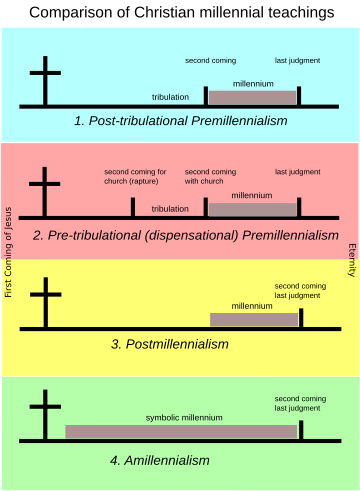
The Wikipedia page on millennialism is a good starter. For more on the three main options within Christianity, go to its pages on premillennialism, postmillennialism and amillennialism.

Premillennialism has two different stripes, one ancient and the other modern. Both, though, believe in a literal millennium, a 1,000-year rule of Jesus on earth. They differ on things like where to place the "Rapture" (scare quote needed) and the "Tribulation" vis a vis the millennium as a whole, but have broad similarities. Overall, historic premillennialism is less literalistic than modern dispensationalist versions, though, and it's those that drive the folks like Tim LaHaye and his "Left Behind" set.

To be complete? Postmillennialism is, per Wiki, more of a catch-all. That said, all varieties believe Jesus' second coming will not happen until AFTER a millennial period, hence the "post-" prefix. How literalistic or not to understand that millennial period itself has a wide variety of stances.


Amillennialism? Anything the bible says about a 1,000-year period is figurative.

As Wiki notes in the main article, some early church fathers were Historical Premillennialist. Others may have been around that. Postmillennialism in any form had no real foothold among the ante-Nicene fathers.

But then Nicaea happened. And everything related to it, like the legalization of Christianity inside the Roman Empire, followed by it being made the official state religion by Theodosius II less than 60 years later. And, no tribulation or any other premillennial verschnizzle had happened. (This is why, in the bible, most scholars think II Thessalonians is apocryphal; it totally ignores Paul's "Man of Lawlessness" of 1 Thessalonians. See here for the difference between that person, the Beast of Revelation and the various antichrists of Johannine epistles.)

Amillennialsts say that there is no literal millennium, and that Revelation is just referencing the time between Jesus' ascension and his return. There will be no reign of the righteous or improvability of the earth before he returns, contra postmillennialism, nor will he return to start a 1,000-year battle with the powers of darkness, let alone look for a rebuilt temple in Jerusalem after a spotless red heifer is found or anything like that.

So, per Alberta's book, who believes what?

Catholics, Eastern Orthodox are strongly amillennial. So is the Lutheranism of my youth. So is traditional Calvinism, including Alberta's Presbyterianism. Ditto on Anglicanism and Episcopalianism. "Fundamentalism" within old mainline Protestantism, as well as more liberal views of theology and interpretation in mainline Protestantism, are at least on paper, still amillennial today.

Baptist groups, and the broader Anabaptist tradition from which they arise? Also generally amillennial.

That said, premillennialism in modern times is not a 19th-20th century American issue. Many Puritans held that, seeing themselves as a "New Israel." And, tying that to the "ingathering" and conversion of all Israel. (Paul may have been speaking literalistically in Romans. But, he was still wrong.) It really exploded among 19th century British evangelicals, where John Nelson Darby essentially launched what became modern dispensationalism, then exploded further here in the U.S. with Cyrus Scofield and his infamous Scofield Reference Bible. Its impact was expanded even more by being printed right before World War I. Although Baptists' history is amillennial, dispensationalism has a strong foothold there. It does as well among charismatic and Pentecostal types.

As for where we're at now? The 1948 establishment of the nation of Israel factors largely into many dispensationalists' thoughts, including, yes, rebuilding a temple and other things.

And, ALL of this, and how it affects modern evangelical or fundagelical politics, versus Catholics, Methodists, Lutherans, and on paper, Alberta's childhood Presbyterians, is ignored by him.

2. Defining “evangelical”? 3 Alberta admits it’s complex, but, without using the word “fundagelical,” takes a pass in one way. See below. Let’s also not forget that “evangelical” arose in part as a “branding” term.

3. Biblical and early Christian interpretation, even within “fundagelical” culture? 2.5.

4. The above, outside that? 2.25

5. Broader political commentary? Rating based in part on overlapping past political coverage with Alberta: 1.75

A weighted average of all of the above, weighting more for the 1 and 1A gives 3.2 stars. An unweighted average is 2.8.

Summary: I think Alberta is sincere in his description — as far as it goes. Why it doesn’t go even further, on evangelical history, and the unmentioned elephant in the room, I don’t know. Get’s a gentleman’s C 3 stars. Because of his sincerity, and because at least one of the 1-star reviews is crap, this is a solid rating. But, if he writes another book just about evangelicalism, figure out his audience and pitch first. If he writes another book about evangelicals’ intersection with politics, and it doesn’t cover that elephant, don’t read it.

Early on, like Bart Ehrman’s Armageddon, Alberta appears to have a Marcionite view of the Old Testament. (Later, he talks about the sweetness of the New Jerusalem in Revelation, but ignores the amount of divine wrath there. He ignores Tertullian’s riff on Lazarus and Dives with Christians taking joy over the torments of the dammed.)

Also early on, Alberta indicates a belief in American exceptionalism, such as talking about America’s “miraculous” victory over Great Britain. Nothing miraculous about it when you recognize that Yorktown was a 75 percent French, 25 percent American, win, which doesn’t appear in Alberta’s narrative.

There’s also problems with biblical interpretation and criticism elsewhere. Contra page 131, no Nero didn’t persecute Christians after the Great Fire and the Tacitus account is almost certainly an interpolation by a minor church father circa 400 CE.

The page before is an error that even a fundagelical should not make. Saul/Paul did NOT “supervise” the stoning of Stephen and the plain text of Acts never says that. What Acts 7:54-58 DOES say:

54 When the members of the Sanhedrin heard this, they were furious and gnashed their teeth at him. 55 But Stephen, full of the Holy Spirit … 57 At this they covered their ears and, yelling at the top of their voices, they all rushed at him, 58 dragged him out of the city and began to stone him. Meanwhile, the witnesses laid their coats at the feet of a young man named Saul.


A few pages later, from that same Wheaton conference? Maybe part of why evangelicals think, wrongly, they’re being persecuted today is even more than conservative Catholics, they’ve swallowed myths of early Christian martyrdom that Candida Moss showed more than a decade ago simply aren’t true.

Much later, on page 386, this howler: “If these women had complied with the Jewish norms of the day, which forbade women from instructing men in public spaces…” then “it’s true that Paul wrote in one letter that women should not teach men.” Alberta never delves into the issue of inerrancy, nor the critical theology knowledge that Paul didn’t write those words in 2 Timothy, but a pseudonynomous author did circa 120 CE.

Yes, I know this is not a book of biblical, and ante-Nicene and post-Nicene Christian church fathers criticism. Nonetheless, with the exception of Saul/Paul and Stephen, getting these issues wrong, and continuing to wrongly hold them, especially combined with American exceptionalism (including as expressed by Alberta) means that evangelicals, whether they continue to try to be highly engaged politically or not, will in some way get their relation to politics wrong.

The idea of dividing the book into three sections, on “The Kingdom, The Power and the Glory,” riffing on the end of the Lord’s Prayer of today (that almost certainly was not part of the original, per textual criticism) was good. But, where was Augustine, specifically, “The City of God,” in the Kingdom section? He’s referenced in passing twice in the Power section by people Alberta interviews, and that’s it. MAJOR failure there.

Also? Not all evangelicals are conservative evangelicals and Alberta makes an error of omission here like many of his theological kin do. For example, Sojourners magazine, the people behind it, and the mag’s average readers? Nowhere mentioned in your book. (I checked the index; the Russian Orthodox Church, which is definitely not a US evangelical church, is mentioned five times, and Sojourners zero.) Per Wiki, the Sojourners Community that founded the mag started at Trinity Evangelical, and I’ll venture Alberta knows this. Alberta isn’t the only person to get this wrong. So does Fred Clark at Patheos, whom I suspect knows better, and who may be loath to identify himself as a “liberal evangelical” if he is one; The New Republic, which doesn’t; and others. Whether “liberal evangelical” is totally the right word for folks like Sojourners, I don’t know, but, at least, “moderate evangelicals.” And, Jimmy Carter still self-identifies as an evangelical, I think. And, what about academics in exegetical theology who accept historical-critical methodology in general but are on the conservative edge of it like a James McGrath? They’re not fundamentalists, not in a narrow sense.

There’s also the question of who’s an evangelical and who’s a fundamentalist? I consider the conservative Presbyterian church in which Alberta grew up, does have “evangelical” in its name, but? After all, “The Fundamentals” arose from within Presbyterianism, at least as far as the Stewart brothers who funded it. And, I consider the conservative wing of Lutheranism, whether the larger Missouri Synod or the smaller Wisconsin Synod (one of the events Alberta attends is at a Wisconsin Synod church) to be fundamentalist too. (These Lutherans, including my Missouri Synod pastor’s wife sister, hate being called fundamentalists, but it’s true, even if their fundamentals aren’t Presbyterian ones.)

There’s also the question of what the core audience is? If it’s conservative evangelicals, maybe it’s not long enough. If the general public? Too long. 450 pages in relatively small font and leading for todays hardbound book world is pretty long. See the top portion of my ratings.

There’s also a bigger background issue, via a question not raised by Alberta. And, Jeopardy style, I’ll provide the answer via Ed Abbey:

“Growth for growth’s sake is the theology of the cancer cell.”

Indeed, per a biblical reference missed by Alberta, in Acts, Gamaliel says that if the movement by Jesus’ disciples is from god, it will succeed and if not it won’t.

Setting aside divine origins, for any organization that is convinced in a non-arrogant way of the rightness of its mission and ideas, focusing on growth for growth’s sake simply shouldn’t happen.

Then, there’s the general politics coverage.

On 298, Alberta repeats the canard (it is, Tim) that national Democrats generally support “abortion on demand.” Once again, he either knows better or decided not to know better.

Many, many Democrats in the House and Senate supported the Hyde Amendment, barring Medicaid funding of abortions, from when Henry Hyde first wrote it. That includes our current president, Joe Biden, while in the Senate.

Related and connected? Biden, as well as Clinton and Obama, failed to ask Congress as the start of their respective administrations, when Democrats controlled both houses, for legislation offering any federal protections for any portion of Roe that could be federally protected. Alberta knows that, too.

Also, at one point in the book, Alberta seems to treat with a half-sneer the idea in the Shrub Bush administration of looking for “moderate Muslims.” If he didn’t mean that, then, he needs to be more careful in how he describes Muslims in America.

Finally, in a BIG old issue that Alberta totally ignores? And that’s of new relevance since Oct. 7, 2023? At least on paper, the mainline Lutheranism of my youth still doesn’t cut blank checks to Israel. This, and apocalyptic thought in general, and how it fuels and festers fear, is an issue for both political coverage and the intersection of religion and politics.

Related? As I said in 2018 (maybe he’s gotten better) Alberta is not a smart / informed political writer, to put it politely, or he’s … well, he’s the same word as he is on Democrats and abortion, to put it somewhat less politely, or an l-word, to put it totally unpolitely, about Beto O’Rourke’s political stances. I interviewed Beto, per the background to that link, and during the 2018 Senate campaign general election race, not the Dem primary. Beto talked about "access for all," and said single payer was "one way to get there," but contra Alberta, that's not single payer. Period. He refused to cosponsor John Conyers' HR 676 in the House. And, he said he didn't like Sanders' similar bill in the Senate. Now, Alberta wasn't alone in drinking the Kool-Aid; so, too, for reasons of her own, did his primary opponent, Sema Hernandez. That still doesn't excuse Alberta.

==

Finally, sidebar observations. One two-star reviewer needs to actually read Alberta with an open mind rather than chastise. She won’t recognize herself in the mirror (nor allow comments). Another in the same vein.
And another:

The craptacular one-star review is by an apparent Gnu Atheist.

View all my reviews

January 31, 2024

Texas Progressives talk climate, races, books, more

SocraticGadfly says that, contra Ryan Burge, the climate change minimizer/denier "gap" is ultimately religious-irreligious, not political as even Burge's own data show. 

Off the Kuff interviewed Rep. Lizzie Fletcher as well as Congressional candidates Amanda Edwards and Pervez Agwan

Biden has invited Kate Cox to speak at the State of the Union. No US relative of one of the more than 25,000 dead Palestinians has been invited, of course. 

Speaking of? Biden's war has indeed expanded, with three US troops killed in Jordan.

New Texas law says you can vote anywhere in large counties with countywide voting. Meeting the vote machine demand for that will likely fall short.

Scofflaw Aqua Texas continues to overpump the Trinity Aquifer in Hays County. Question: How many of its customers are semi-native Texas Republicans, semi-native Texas Dems, and how many are Californicators? (Hays County as a whole went approximately 55-45 for Biden in the 2020 presidential election.)

The Fifth Circuit (not a total shock to those of us who know its stance in general on First Amendment issues) upholds a federal district court ruling that Texas' school book semi-ban law is unconstitutional.

Those funny TxDOT highway message signs to buckle up and such, like the one I see north of Denton every Red River Shootout weekend? No evidence they work and the feds suggest states ditch them.

Neil at the Houston Democracy Project said Houston Republican Councilman Julian Ramirez quotes Martin Luther King but is silent of leaders of his party calling for the shooting of migrants or for the nullification of federal power at the border.

The Current reports on the Butthole Surfers' vinyl reissues.

The TSTA Blog points a finger at political failure as the cause of student underperformance.

Jef Rouner applauds HISD for rejecting chaplains as school counselors.

Finally, the TPA congratulates the employees of the Texas Tribune and San Antonio Report for their successful unionizing activities. (Houston Landing employees, wyd?)

January 06, 2024

Texas Observer: Just how Texan is it on books?

The Texas Observer has a flub-filled list of Top 20 Texas-related books of the year. Two biggest errors? Listing Jeff Guinn's Koresh/Waco book (good) and a much lesser one by Kevin Cook, while omitting Stephan Talty's is No. 1. No. 2 is omitting the new Larry McMurtry bio by Tracy Daugherty, profiled by the NYT. It's just one more sign of slippage from the Observer, which semi-sadly apparently raised just enough money late last year to save itself from a self-inflicted wrecking ball. 

I did a Tweet, compressed, of the third sentence of the paragraph above a few days ago. No response. Nor any updates to the list. Since this is called "must-read," nope, it's a failure. On Waco, Guinn is indeed a must-read. I'd argue Talty, with a different angle than Guinn is, as well. At minimum, he should have gotten a mention. Cook's book IS much lesser and little more than half the length.

And, how, how, how can you not list a McMurtry bio and one by a fellow Texan, no less? HUGE fail there.

Speaking of, while apparently not going under, they're still not paywalled and still not accepting advertising. And, as I've also said before, they're just not doing anything for me on half of their other stories. 

==

OTOH, for all its advance praise, maybe the Observer and its Austin bookstore flunky were right not to list the McMurtry bio, by fellow Texan Daugherty. Already on page 11, there's a big old geographic error, putting Fort Richardson in the Panhandle, instead of Jacksboro, just down the road southeast from Archer City. That follows seemingly putting the home of grandparents, Benton County, Missouri, NORTH of the Missouri River when it's actually south.

On page 18, no, New World horses didn't go extinct, or "extinct" in this claim, by going across the Bering land bridge. Rather, the American Indian invaders most likely killed them off.

October 05, 2023

Top blogging of September

Started this a couple of days late, but here we go. Again, these are not all from September, but the top 10 by viewership for the month. Old posts will be indicated as such.

No. 10? I called out British Army leadership warmonging on Ukraine, especially as doubled down on by warmonger Timothy Garton Ash.

No. 9? I called out BlueAnon for trying to prematurely apply the 14th Amendment to Trump.

No. 8 was a Texas Progressives roundup with Ken Paxton and Bryan Slaton news.

No. 7 was about the Texas Senate, "the best little whorehouse in Texas" in the Paxton trial.

No. 6? An oldie from 2021 but still true, as "Breath" is still classist and elitist New Age bullshit.

No. 5? Ralph Nader jumping the lesser evilism shark.

No. 4 was my review about Michael Kazin's bio of William Jennings Bryan, and Kazin portraying him overly glowingly and a Dem sheepdogger 100 years or so prior to St. Bernard of Sanders. See my sidebar / spinoff on Substack more explicitly about the history of Democratic sheepdogging.

No. 3 is about the new JFK assassination conspiracy theory book. (I'm willing to be harsher than Gerald Posner, who looked only at Paul Landis and not his coauthor, James Robenalt.)

No. 2, speaking of conspiracy theorists, is about RFK Jr.s deliberately leaked plans to run not as a Democrat but as an independent.

No. 1 is John Anthony Castro being a JAC-off.

September 14, 2023

William Jennings Bryan — the original Bernie Sanders

A Godly Hero: The Life of William Jennings Bryan

A Godly Hero: The Life of William Jennings Bryan by Michael Kazin
My rating: 3 of 5 stars

I was on about page 120, the run-up to the 1904 Democratic convention, when the light bulb turned on:

William Jennings Bryan was the 120-years-earlier predecessor to Bernie Sanders, on the legend even more than the reality, and related to that, the degree to which many peddled the Kool-aid or drank it for themselves, often long after the reality differed clearly. This includes the two protagonists. (Kazin may not like that comparison; for more on why, see the end of this extended review. See also my new Substack looking more explicitly at the sheepdogging angle.)

That said, this is one of those books that is both provocative and problematic at times. And, as is the norm with such books, I’ll have a greatly extended review on my blog. What I have here is the basics of what I learned new about Bryan as well as a basic-level critique.

Trying to rate it is also problematic. I do think this is well researched (Kazin also notes former recent, as of the 2007 date, biographers), but not necessarily well analyzed.

I don’t think I had read before about Bryan volunteering to serve in the Spanish-American War. Even if he saw no combat, it did look hypocritical next to previous anti-American statements.

That said, Kaplan gets some Spanish Empire wrong. The Philippines as well as Cuba and Puerto Rico were still a part. So was Spanish Morocco and Spanish Sahara. Bioko and Rio Muni, later united as Spanish Guinea, were held in equatorial west Africa.

As for his service, as a volunteer, why didn’t he resign before the 1898 midterms? Bryan obviously doesn’t tell us, but it’s another spanner in the spokes of his bicycle.

And, supporting the treaty? Wow. And, the Senate approved it by just 2 votes to spare. Bryan said, in essence, that we should follow Kipling’s adage and adopt the white man’s burden but shuck it quickly.

Then, after 1900, buying a rural mansion that in today’s terms would run at least $500K? Multiple guest rooms. Dining room that seated 24. Servants. (Peak Bryan was making $2K/week on the Chautauqua circuit and more besides. Bureau of Labor Statistics’ inflation calculator says $2K, in 1913, its earliest year, would be $62K today. Per week. Just for a dozen weeks of summer, $750,000 a year in today’s terms..)

1904? Not endorsing Hearst. Sure, Hearst’s womanizing was already known, but Bryan had shown himself a semi-hypocrite on imperialism already. Hearst probably wouldn’t have blocked Parker, by the 2/3 rule still in effect then, anyway, but maybe? Before people shifted votes after initial first ballot tallies, Parker was just short; Francis Cockrell, Bryan’s endorsee, was third. That said, all the shifts were Hearst defectors.

LaFollette had a newsletter, like Bryan’s The Commoner, but it didn’t explicitly promote him. Battling Bob missed a turn there, but, given his speaking style, what I’ve read about that, and other things, not a surprise.

Kazin believes the legend of Taft as conservative, which is only half true. For example, he doesn’t mention that, rather than “trimming” on the tariff, Taft traded tariff reform for getting the 16th Amendment out of the Senate. Nor does he mention that TR never tried tariff reform and that he didn’t push the 16th Amendment, either. As part of that, he’s also wrong about Gifford Pinchot. Doris Kearns Goodwin’s book on Taft and TR has a more nuanced portrayal. He also could have learned something about Nellie Taft, while there, per a bio of her . (Kazin’s book came out a full year later, and while Kearns wrote later than him, the door had long been open for revisionist Taft studies.)

That said, supporting the 1898 treaty foreshadows Bryan carrying Wilson’s water in Mexico before resigning over the Lusitania. And, carry that water he did.

There are other vignettes here, such as just how conservative TR was, claiming Bryan had “socialistic and communistic tendencies” in 1900. The claim, and the demagoguery, surprise nobody who knows the reality of Brownsville 1906.

Bryan was coopted by acceptance of Secretary of State. Wilson knew that.

Bryan's first big oops was not on Mexico but Federal Reserve. He did get Wilson to accept government oversight, but, with individual banks controlling the regional feds, especially the NY Fed, that was hollow. And, he was told that at the time. The remaining Populists and rising Progressives wanted something like the original, not watered down, Bank of North Dakota on lending requirements for the Fed, board of directors, etc.

Mexico/Caribbean? Bryan shared Wilson's paternalism. And, such it was, even if it shed the worst of GOP dollar diplomacy. It was the same paternalism Bryan showed in the Philippines.

WWI? Wilson hoped Bryan would resign already by end of 1914, reportedly. Kazin doesn’t tell us if Bryan had heard about that.

That said, Kazin misses the mark on Wilson as fake neutral, and being a fake neutral not a real one relatively early after the start of the war. He talks briefly about submarines not doing cruiser warfare as violating international law but says nothing about the same for blockade by extension and food as blockade weapon, even with his admiration for British law in general. Kazin notes later that the Lusitania was carrying munitions as well as passengers, but not that it was armed with guns more than big enough to sink a submarine if it surfaced. He lost a star right there. (He doesn't ask if Wilson knew either one at the time.)

Would siding with Bryan "have prompted a political rebellion"? Questionable. I don't know about Republicans, but most non-Southern Democrats west of the Mississippi in 1915 were still isolationist. He then claims the NY World spoke "for most of the American press" when it called German response to Wilson's diplomatic note "the answer of an outlaw." The World War I coverage in this book doesn't speak well for Kazin's handle on WWI in general, despite him writing a book about pre-US entry peace issues.

I had suspected Kazin would land here when, in his chapter on the 1912 convention, he indicated that Bryan plumping for Wilson instead of Champ Clark was a good thing. Yes, Clark was more parochial than Wilson, but he was opposed to WWI. (As Speaker, he didn't vote on the declaration, but his opposition was known. His son was an isolationist senator in the run-up to WWII.)

In Kazin's "War Against War," long review here he partially redeems himself — but not totally.

Sadly, as Kazin notes a bit in his Bryan bio and may cover more there, antiwar Congresscritters were ill-organized. A bill to block traveling on British ships wasn't introduced until 1916, and then, Thomas Gore et al had no answer to Wilson alleging they were making foreign policy on the fly.

Kazin redeems himself more fully at the end of the chapter: "In retrospect, he was quite right to oppose American entry into the Great War. It was not a conflict that history has justified."

But NOT totally fully. See what I said above about his thoughts on Bryan plumping for Clark as well as Wilson. And, going beyond what he said about “not justified,” it not only wasn’t justified for the world, it wasn’t justified for the US, even if Germany had still decided to smuggle Lenin into Russia.

Back to Wilson on the war. The reality is that, before the Luisitania, Wilson had, essentially, willingly made the US a “non-combatant co-belligerent.”

(I recognize I've gone a fair bit into Wilsonism, but, this is a very serious issue. Both as a matter of ethics, and even more, as a matter of governance and the American future, more than Vietnam, more than the Mexican War, overall, more than Iraq, too, this was the biggest foreign policy error in American history. And, it semi-directly set the stage for Iraq.)

As for history and alt-history, Bryan's unwillingness to either battle Wilson's renomination (with the two-thirds rule in effect, he might have succeeded in blocking it albeit without his own nomination) or run as a TR-type independent reinforced that he had nothing to offer but platitudes. And, John Reed type mocking aside, hadn't this long been true? (Some Progressives pushed to nominate Bryan after TR said no, but ultimately, they had only a Veep nominee.)

Re the 1916 campaign? This is the first time I've seen the claim that Debs passed on the Socialist nomination due to health. If true, he wouldn't have run for a Congressional seat, either, would he have? His later imprisonment did wreck his health, but he still stood for the 1920 nomination from his cell. Of course, he would have been in the cell anyway, but, it seems that he stepped aside in 1916 for other reasons.

On Scopes? Kazin claims his violation of the Tennessee law was UNintentional. Really? Sidebar: He grew up in Bryan's hometown of Salem, Illinois. Per Wiki, Bryan spoke at his HS graduation, and claims that Scopes was laughing. Per Wiki, the truth on the case may be not that it was an unintentional violation but that there was NONE — as in Scopes may not have taught any evolution that day. (If you're going to challenge legend, you should do it right.)

The big issue is how much Bryan was motivated by opposition to evolution by natural selection, ie, Darwinian theory, and how much by social Darwinism, and how much or how little he distinguished the two. Kazin never really addresses that how much/how little issue. And, while a fair chunk of touters of evolution also touted social Darwinism, even in the natural sciences, many did not. The same is likely true, to a lesser degree, of upper-class conservative politics. And, it's certainly true of liberal Christians. This is another less than total coverage by Kazin.

Was Bryan a fundamentalist? In the fullest sense of the book "The Fundamentals," no, but in a narrow sense, yes. In a vaguer sense, just like the members of the conservative wing of Lutheranism in which I grew up? Yes. Bryan might not preach hellfire to or about Catholics in public, but who knows what he thought in private. He was a biblical literalist. So, Kazin's "no" must be taken as a split verdict. The problem is, that Kazin doesn’t note the difficulty with analyzing Bryan as a fundamentalist today apples in a self-referential way. Just as Bryan didn’t have the politics of today’s fundamentalists, the fundamentalists 100 years ago. The lynchpin of “The Fundamentals” was not politics, but German-based higher criticism. Though we don’t have layman Bryan on record about higher criticism, he surely rejected it.

To wrap up, it seems that Kazin has a soft spot for Bryan — and enough of one that, on fundamentalism, and a few other things, he gave him a bit of a pass. (Other critics here have said that he does that with Bryan's racism, too. One or two other critics argue the other way, but even an occasional Southern politician explicitly denounced the Second Klan, for example.) Bryan leading the effort to BLOCK Klan condemnation in the 1924 Democratic platform does get mentioned, as does his undercount of Second Klan membership, but? "Mention" is all it gets. 

Here's another way of presenting it, and why I don't think this charge against Kazin is too harsh.

To look at a direct political contemporary? Eugene Debs evolved on many things, including race. (His original union, the American Railway Union, was segregated at first.) In prison — the WWI-related imprisonment, not his early one — he had his eyes opened about racial sentencing disparity — and talked about it.

Bryan never evolved.

Beyond the review, for today?

Kazin is a DSA Rosey, and per his Wiki bio, I am assuming some sort of sheepdogger against non-duopoly leftists. Given that, it's no wonder he doesn't want to compare Bryan to Debs more.  And, related to that, I forgot that he had a less-than-stellar essay in Myth America. This Slate piece has more. And, that is why I suspect that Kazin wouldn't like the light bulb of this non-duopoly leftist seeing William Jennings Bryan, and his legend vs. reality, closely paralleling that of St. Bernard of Sanders. And, his latest book, of last year, "What it Took to Win," appears to be sheepdogging writ large across party history, per at least one 3-star review. Per others, it seems like, per Dolly Parton, he tried to pack 10 pounds of potatoes in a 5-pound sack.

Beyond the review in general, thoughts that I had stimulated?

One thing I don’t get is why Sanders hasn’t pulled a Bryan and left the Senate and hit the rubber chicken circuit long ago. He, and even more I think, wife Jane, with the multiple houses and other things, like them some money. And, especially if he had done it before now, and very especially if he hadn’t fallen on his sword in 2020 for “his good friend Joe Biden,” Bernie probably could make half as much a speech as ex-presidents do. He would easily rake $500K a year if he wanted to.

Alt-history: Had Debs run again in 1916, he probably would have gotten enough additional votes in California and North Dakota alone to tip those states and the election to Hughes.

On the Great War? With a President Clark, he probably would have protested both British and German violations of international naval law. Britain would have decided the blockade with risk of sub warfare was better. (Germany had relatively few subs in 1915.) In response? Clark might have done like Washington and Adams in the 1790s, or Roosevelt in the 1930s, and issued a neutrality proclamation, then worked to get Congress to do even more, especially before the Lusitania. That would have specified no Americans on British ships. It would have specified no US government guarantees of “credits” by House of Morgan to Britain. With that, the British and French might have crumpled before Germany felt the need to smuggle Lenin. Hard to say.  

Anyway, that gets back to the review. If you really think WWI in general was that bad, and also think the US shouldn't have gotten involved (something that Kazin does NOT expressly say, so I'm not sure of his stance) then you can't let Bryan tilting the 1912 Democratic nomination pass in silence. (Nor can you let his susceptibility to Wilsonian flattery pass in semi-silence.) 

Update: Historians who know better, like Lawrence Goodwyn, would also like a word with Kazin about 1896 and the Populists.

View all my reviews

May 18, 2023

Florida book ban lawsuit looks fun, but likely full of trouble

Escambia County Schools (that's Pensacola, Panhandle, Redneck Riviera) is being sued by the big book publishers plus PEN for various book bans. The lawsuit looks fun. Winnable? Different.

First? Gotta loovvveee school board member Bill Slayton:

"We have been removing books that have been called inappropriate, pornography," he said. "I guess I'm a little surprised because this is going on all over the state of Florida, not just here. My reaction is our procedures are following what we have been told we have to do."

Sounds like Nazis' version of "just following orders."

Winnable? Different story.

This sounds great:

Suzanne Nossel, the CEO of PEN America, the lead plaintiff in the lawsuit, said in a statement the freedom to read “is guaranteed by the constitution.”

But, the Supreme Court has in the past said the First Amendment doesn't fully extend to children. Hazelwood is one example, a ruling tightened in Morse, the famous "Bong hits for Jesus" case. OTOH, by denying cert, the Court let stand the Guiles ruling, which indirectly and partially goes against. It's also said the right to an education is not fundamental.

The Fourteenth Amendment grounds might sound better, but there again, there's the school in loco parentis.

May 03, 2023

Top blogging of April

As is normal, these are the 10 most viewed blog posts in April, and not necessarily FROM the last month. This month, though, most of them are.

First, my cataloguing of various issues the Texas Observer, IMO, needs to face and fix before it gets fiscally (and editorially, in some ways) better.

Second, my take on the recent Pentagon leak.

Third? The hilarity, or more, the inanity, when a bad book gets even worse social media reviews.

Fourt, as I seemed to have a sort of run about writing and journalism issues, my cold take on various issues at New Mexico magazine.

Fifth? Journalism, broadcast version, with my snappy take on Fox, Cucker Tarlson et al.

Sixth? I heap scorn on Ryan Grim's puff piece on Marianne Williamson.

Seventh? One of the Texas Progressives round-ups for last month, calling out both local and Texas Lege stupidities.

Eighth goes back to the theme of the top half of the list, as I called out a media critique of reporting on COVID, for having its own problems.

Ninth, in what could become an occasional series on foreign policy issues for the Nat-Sec Nutsacks™ et al, Lula vs Merikkka.

Tenth, a Tumblr-length snarky piece about Finland joining NATO.

And, in what I don't think has happened in quite a while, all of my Top Ten for a month were indeed written in that month.

April 14, 2023

When social book reviewers get it wrong — wronger than the book

I just recently finished "The Bright Ages," which as you might guess, is a claim that the Middle Ages weren't all the Dark Ages. Between bad framing, narrow focus and outright errors, I knew halfway through that it probably wasn't even a 3-star book and the question was (since no half-stars from Goodreads after its self-vaunted [can others vaunt you?] website overhaul) was whether it would even hold 2 stars.

It doesn't, and shall also get only 1 even on Storygraph.

That said, what's funny, or more, "funny" with scare quotes, is the preconceptional whiffs of other 1-star reviewers, and a few 2-starrers.

A full one-quarter go full wingnut/Trumpy on their reviews, talking about "woke" presentation of women at this time and more.

And, almost as many of the reviewers on the "other side" (there's more than two sides by far here, per Idries Shah and as I shall show) actually exemplify "woke" (in the wrongful sense) attitudes, using words like "mansplaining" or "whitesplaining" in their takes.

It's neither. And I knew that before I checked it out from the library.

It's Catholic apologetics, or Catholic-splaining to use a modernized mash-up.  And, not getting that is why both the Trumpys and the Wokeys blew it. And, it's Catholic-splaining with a twist. Per a Google, after coming across this Medium piece which was a rejected form of an LARB of the book, David Perry is Jewish. Could have fooled me. The book still reeks of Catholic apologetics. That said, having seen this person's Twitter feed on it, no, the LARB editors were right in rejecting the original. The reviewer seems engaged in check-marking appropriate boxes, like calling out Gabriele and Perry for not mentioning "trans and queer folk," yet, since he has the option of doing so himself on Medium, not doing so! And, his review has other problems. It references "African Europeans," whose book website says: "As early as the third century, St Maurice—an Egyptian—became leader of the legendary Roman Theban Legion." Yes, true, but you couldn't have gone "up the ladder" to Emperor Septimius Severus? There's also the issue that both St. Maurice (patron saint of the HRE, namesake of St. Moritz) and the the Theban Legion are fictional.

That said, while the book is largely pabulum, it’s NOT pabulum for the reasons Trumpy 1-star reviews claim. (The wrongfully woke are closer to the mark, bad narratives and framing aside.) And, yes, their reviews reek of it, even as they ignore the reeking above because it doesn’t fit THEIR narratives. That then said, the portion of 1-starrers that call it out for "mansplaining" also miss the boat, though not quite as bad as the Trump-splainer types.

What follows is a selected version of my review.


The Bright Ages: A New History of Medieval EuropeThe Bright Ages: A New History of Medieval Europe by Matthew Gabriele
My rating: 1 of 5 stars

Brights book …. Flip side of Dennett’s Brights, it comes off as being!!! But, no historian has called all of the Middle Ages the Dark Ages. That said, if we look at the remains of the Western Roman Empire, the period 843-962, from the end of the Carolingian realm to the start of the HRE, could honestly merit the moniker. Those dates being the Treaty of Verdun ending the unitary Carolingian lands, then the start of the HRE.

So, yes, from the start, we’re going to be in the lands of strawmanning and cherry-picking. And, all in the service of Catholicism. And, yes, it still seems that way. To me, the whole book reeks of the Catholicism of its authors. While a modern evangelical half of fundagelical Protestants might have written a book like this, a traditional Lutheran, Calvinist or practitioner of Orthodoxy would not, nor would have a secular historian. And, yes, the word “reek” is deliberate. And, yes, it still seems that way.

Interesting to see Myth of Martyrdom author Candida Moss blurb it when the intro talks about a bunch of Catholic saintly martyrdoms that likely didn’t happen. (Sidebar: As people in the book publishing world, or familiar with it, know, this exemplifies one or both of two things. First is, that unless specifically barred from doing so in some way, marketing staff often take blurb comments out of context. Second is that blurbers often don't read the full book.) Those claims start, chronologically, in this book, with Peter in Rome, which certainly never happened.

Then, there’s other fun stuff, like the claim that the Western Roman Empire didn’t end when Odovacer deposed Romulus Augustulus. Oh, yes it did. And, yes, Rome became a sinkhole of population and other decline that was nowhere close to fully replaced.

Then, the claim in a chapter on Charlemagne that the HRE didn’t come until the later 12th century, not 962. Yes, the “sacrum” in Latin didn’t attach until Barbarossa, but any history book will tell you it began with Otto the Saxon.

Then, in the chapter on Vikings, I learned the Dneiper and Volga rivers are in western Asia! Neat! I halfway seriously wonder if this was a deliberate take, to de-Europeanize either Russia or Orthodox Christianity. Given that Slavic lands are nowhere further discussed, nor are details of the rise of Kievan Rus, I’m sure it’s deliberate.

There’s also a weird, and AFAIK, totally untrue claim that the Khazars later became Muslim. (I personally believe the bulk, tho not all, after the fall of the Khanate went on to become PART of Azhkenazi Jews. This is not anti-Semitic or anti-Zionist, contra the likes of Wikipedia, in one of its more iffy entries. The Ashkenazi/Sephardi split is itself a linguistic one, not an ethnic or sub-ethnic one, after all. And, I don't give a fuck if David Perry his own self sees this part. It's true.

First Crusade chapter overlooks cannibalism at the Siege of Ma’arra. Besides the cannibalism, the intolerance of Frankish surrender terms go unnoted. BUT, the authors DO engage in a nice bit of “presentism.” As in, a LOT of it.

Petrarch as in inventor of the idea of Renaissance is mentioned, mainly a an object of polite opprobrium. The earlier 12th-century Renaissance is mentioned in passing.

Weirdly NOT mentioned by two Catholic authors a Catholic author and a fellow traveler is previous reformations before THE Reformation. These surely would have fit the “bright ages” idea.

So, too, would the conversion of the last portions of Europe, the Balto-Finnic lands. Not mentioned.

Other one-star reviews go into more depth. Several go into Trump-splaining, with their takes perhaps even worse than this book.

View all my reviews

Sidebar: Not sure whether the bigger time-waster was this book or the Medium review.

February 10, 2023

Climate change book starts well, then goes WAY off the rails

This is an expanded version of my Goodreads review of "Nomad Century" by Gaia Vince.

Nomad Century: How Climate Migration Will Reshape Our World

Nomad Century: How Climate Migration Will Reshape Our World by Gaia Vince
My rating: 2 of 5 stars

An interesting book. No, a disappointing book, with a mixed 4/1.5 star rating.

First, Vince is rightly “hardheaded” that we’re likely to hit 4C by 2100, then reminds us that this is overall global temperature, including the slower-rising ocean temperature. Land temps will surely be higher yet.

From there, it’s into a long history of migration. Next comes a list of benefits of immigration, as noted by international development organizations, etc. Some might be overstated, but not bad overall. But, hold on to that to near the bottom of this.

Then, after an earlier basic discussion, comes info on details of climate change and how it’s going to force migration out of tropical and near tropical areas, and the reasons why — desertification, floods, extreme weather events, and unliveable wet-bulb temperatures.

Then, the clunkers. NO, not clunkers. Just downhill, first mildly, then badly.

Clunker? She talks about how climate change will allow more development of northern latitudes, noting it’s already allowing for more oil exploration in and near Greenland. True. Russia’s already eyeballing massive new offshore in its Arctic. Shell and others may revisit the Alaskan Arctic.

We CAN’T HAVE THAT!!!! And, she nowhere says that.

Then there’s the issue of modern migration necessitating entire new cities. If these are all Westernized cities, there’s more climate-change-inducing energy expenditure. (She even talks about the possibility of building cities in Antarctica.) And, there’s the techno-optimism about how easily this will be done. There’s also the techno-optimism that the economic boosts of relatively small-scale immigration today would come even close to translating to mass migration.

She also has little discussion of climate denialism and minimalism, which is prevalent across the developed world, not just the US. Ditto for climate action minimalism, which is prevalent across the neoliberal “consensus” of non-deniers in the developed world.

Disconnects like this make this a weird book.

But, here, we go from clunkers to straight downhill.

But wait. The techno-optimism gets worse.

She assumes that we can somehow, within just decades, make the global migration much easier when she notes that, in the “developing” world, the rural to urban migration there is fraught and problematic.

But wait. The techno-optimism gets worse.

From there, it’s on to meat replacement. She doesn’t discuss how much energy it takes to make a veggie burger, nor ask if this will scale up. (She also doesn’t note that veggie burgers are higher in sodium than actual meat, and otherwise not totally the bee’s knees on being healthier.) She then goes to lab meat, and assumes, laughably given its many push-back dates, that it’s going to be commercially in play by 2025 or so. I quote: “The next generation of lab-grown meats will reach mass market later this decade.” Having read plenty about delayed launches, and also knowing the humongous amounts of energy it will require to go commercial, I laugh.

But wait. The techno-optimism gets worse.

Next, she calls for an expansion of nuclear fusion. She doesn’t talk about long-term waste. She doesn’t talk about how France, with a top-down national government, used a mix of bullying and bribes to foist that issue on rural eastern France. Nor does she ask about more and more difficulty in mining and refining uranium ore.

But wait. The techno-optimism gets worse.

She believes the British government’s claim to have fusion plants by 2040 and even says, I quote, “The first fusion reactors could start entering grids by 2030.”

Sadly, this techno-optimism would be standard for the modern West, Gang Green type environmentalists, etc. It's no wonder that a Bill McKibben burbles in his blurb. And, that reference to the modern West is the whole point.

For the reality, it's more like this is a version of climate colonialism combined with tech-neoliberalism. For more on that, we go to Nathan J. Robinson's Current Affairs and a piece on just that issue, climate colonialism, by Jag Bhalla. It's a long read, but, the first half-dozen grafs will get you the basics. By 2050, IPCC models and other issues envision none of the Global South catching up with today's Global North on standards of living. To tie to this book? If migration boosts developed nations precisely because those better able to move do so, what about the left behind? Gaia Vince nowhere addresses issues like that. Nor does she discuss the equivalent of reparations for climate colonialism. Assuming many rural migrants in the developing world cannot get themselves moved to the developed world, what is the developed world going to do to help them in their home countries? Again, not discussed.

As for the benefits of migration? There's been many more destructive migrations. Like Europeans coming to the "New World." Or, when more directly done at the point of a spear or the barrel of a gun, invasive war. She mentions Genghis Khan and how a fair chunk of today's world is his progeny. She never talks about how he destroyed thriving civilizations of China, various states of Central Asia and Kievan Rus.

We’re at the point of either willful ignorance or self-delusion, and I grokked the last 30 pages before the conclusion.

It’s no wonder a neoliberal environmentalist like Bill McKibben favorably blurbs this book.

And, now, the mixed rating should be clearer. It’s 4.5 for the climate honesty, 4 for the migration impact honesty, and 1.5 for everything else. Scratch that; I combined the first and second into a single 4-star rating, as while it’s “nice” that she’s that firm on 4C, she’s far from alone. This will get a 2.5 at the StoryGraph, but couldn't go to 3 here.

And, with that, I’ll offer a “recommend against” further reading of Gaia Vince. And, how she got to a position like news editor of Nature, I have no idea.


View all my reviews

January 14, 2023

Bookwyrm: The not-so-new "new" kid on the book reading block

 Last year I joined Storygraph. I had been considering it even before Amazon gave me the Mafia horse's head in bed treatment and I eventually deleted my Amazon account, leaving me with nothing but Goodreads, solely owned by Amazon.

I had seen Storygraph mentioned by one of my Goodreads friends shortly before this denouement, which gave me the push to join it.

And now, on his blog, friend Brett Welch mentions he has joined Bookwyrm as well. I asked him at that moment what he liked about it, then when I went to its website I already had the answer.

It's "decentralized," a la Mastodon. In fact, it touts that, and its connection to Mastodon. (And, that's Brett's primary reason for joining, it seems)

Well, with Smelling Musky making Mastodon (and other sites, like Post/News) more interesting (and I may join Post/News), I already know something about Mastodon. Per the late Leo Lincourt, a "node" friend who connected me and Brett, I joined Mastodon when it first launched. I found the decentralization "clunky" then and also, per the different moderation standards of different servers, didn't think to check — and didn't really realize it was something good to check — which server I joined. I posted in depth some Mastodon yea/nay thoughts last month.

Given that my reading, in the nonfiction world, ranges from biblical criticism and occasional pop-ish philosophy, through serious "pop" science (Ed Young, Frans de Waal), through serious history (especially WWI and the US Civil War) to biography, but then on to modern culture and cultural sociology, but then on to a variety of sports books? Stops in Anasazi studies and other things are also in the mix.

I don't want a "federated" books site. Sounds like too much hassle. Besides, I haven't yet fully explored all I can do with Storygraph. And, Storygraph offers enough options itself, as well as not being owned by Yellow Satan, that I really don't have need for a third site. (See my "Storygraph vs Goodreads" post.) Also, since Bookwyrm touts "coding," it's more wonky than I need. (Storygraph has a feedback page that is more friendly than that of Goodreads, and I've used it.)

As for Bookwyrm touting its "integration" with Mastodon? I'd rather post a link to a review than integrate two different social media accounts.

Also, Bookwyrm has one big shortcoming, from what I can tell, and that is Goodreads' biggest shortcoming outside being owned by Amazon. From what I can tell without having joined, it does NOT offer fractional star reviews. A book with 21 reviews and no fractional-star reviews? Yeah, they were all imported, but I see noting, including the screengrab on Bookwyrm's front page, that would indicate those reviews can be tweaked into fractional stars or that fresh reviews can be done with fractional stars. Also, Bookwyrm, per its "about" page and "Mouse" history as admin, is more than 2 years old and is now slipstreaming in the new popularity of Mastodon and other "federated" social media. Storygraph is newer, offers other new things, and while not geeky, part of its pitch is in supporting non-Amazon, preferably non-chain, and especially minority-owned bricks and mortar bookstores.

There would also appear to be some "PR" with Bookwyrm that's an issue. Note its "docs" page and these comments. 

Since the project is still in its early stages, the features are growing every day, and there is plenty of room for suggestions and ideas.

Well, that's undercut you not being in quite such early stages. And, if you're getting a rush of new joiners, aren't they working on tweaks? (To be fair, StoryGraph is a few months to a year older.)

There's also going to be the issue that as more and more people with their own servers create more and more different "instances," will moderation standards differ enough that different instances block each other, as was the case with journalists on Mastodon?

Also, it seems to be "bare bones" on the features. Much as I scoffed at "content warnings" on Storygraph, I almost used them with one recent review. I do use the other "buttons," of, if a book is "informative," or "relaxing" or whatever.

That all said, Brett may have just inspired me enough to make part of my 2023 reading challenge learning more about what I can do on Storygraph.

Update: As I note above, StoryGraph has a pretty responsive Twitter account, plus a "roadmap" page where people can suggest new ideas. And, while it's bare bones, you can buy a subscription model for $4.99 a month I don't know that Bookwyrm even has a Twitter. 

For more? Wiki's page on StoryGraph. Note that there is NOT a  Wiki page for Bookwyrm.

October 10, 2022

StoryGraph vs Goodreads — initial impressions

Two biggest advantages?

Not owned by the Yellow Satan of Amazon, and offers half-star, even quarter-star, reviews. And, speaking of, if Amazon's going to treat you like the Mafia for reporting fact-free reviews, since it's removed both the unlike button and the opportunity to comment? Fuck Amazon and delete your account, like I did.

A third big advantage is listed further down.

Chaotic neutrals?

Goodreads has friends, while StoryGraph has a community where you can find or create friends. (Nobody that I know of on Goodreads is over there yet.)

Storygraph lets you mark books as not finished, or 50 or 75 percent read. Nice, but you can say that in the review itself as well.

Not quite so good on StoryGraph?

Its tags (limited to five per book) vs Goodreads shelves. Sorry, this isn't even close. One "versus" comparison site claims StoryGraph has shelves; that was at first news to me, but I eventually realized that the "tags" button on the home page for a book has Goodreads' shelves imported. BUT? I don't see a way to create new ones.

Then, one weird one, with a sidebar.

Goodreads lets you do hyperlinks as well as other basic HTML type stuff in the review. Storygraph has a "Medium"-type editor where it's simple clicks for bold, italic, bullet lists, etc.

DOES NOT let you do hyperlinks. Not only, unlike a Medium or a Patreon, does it not have a menu button to click, but if you drop a correctly formatted "a=href" in the body of your review, it still won't run it as hypertext, and it ALSO will not convert your bare URL inside that into a clickable link.

And, it has no immediate plans to do so, though that's under long term possibilities. A "roadmap" link mentions other items.

That iself, with all the crowdsourcing about ideas as well as transparency on what's under discussion? HUGELY better than Goodreads.

Goodreads has a bulletin-board like feedback page. They'll have listed ideas similar to yours if posted, but they will also censor you. No, really. I posted asking about fractional-star reviews and it was hauled down.

When I first launched on StoryGraph, I was confused about a couple things, and I eventually DMed its Twitter account. Very responsive, and eventually, the person there said "Hit us up with other future ideas."

A "neither / nor"? Goodreads is all free, cuz ... owned by Yellow Satan. I don't see ads on there (some people say there's ads on there) from all the "internet condoms" I use. StoryGraph is like MeWe, the alternative to Facebook created from old Google+ floor sweepings. Its basic version is free, then it has a paid upgrade version. (Maybe things like "shelves" are on the paid version.) And, in any case, paying $50 a year doesn't appeal to me.

Content warnings? Meh. In fact, they make me think that StoryGraph is "woke," and that these are like "trigger alerts." And, a lot of other stuff appears pegged at the younger half of GenX if not Millennials. And, despite what StoryGraph told me on Twitter DM when it was first talking to me, a lot of it appears pitched more to fiction than nonfiction.

Another issue, where StoryGraph's cure is worse than the illness, possibly. Goodreads allows "review bombing" by people who haven't read a book. That said, I do it on occasion, most recently on a book about female ghosts of New England or something, where it was filed under "history" and "memoir." Since ghosts don't exist, I noted the book couldn't be either. I also "bomb" things like JFK conspiracy theory books, but I know the conspiracy theory isn't true. I consider this different from Trump Trainers bombing modern politics reviews. Well, StoryGraph lets you mark a book as "did not finish." You can then state way, but you CANNOT give it a rating. 

And, at least under the free plan, I don't see where you can either "like" or comment on others' reviews.

There's also Powell's Bookstore reviews, if, like StoryGraph, you don't want to benefit Bezosville but do want to help an actual bookstore. And, it's in "librul" Portland, Oregon, and has or had a reputation tied to that. Sadly, for people who think Goodreads is clunky compared to StoryGraph, Powell's is 10x clunkier compared to Goodreads. AND, it's not publicized or promoted. Like Firefox vs Google Chrome, Powell's has had a marketing opportunity bonanza and done nothing.

So, right now? On some reviews, though not all, I've been posting a full review only at StoryGraph then linking to that at Goodreads.

December 03, 2021

The Dawn of Everything? Rather, a mendacious scrapbook pastiche

If late friend Leo Lincourt, a lover of David Graeber, were still alive, he'd surely disagree with me, both in my take on this book and on his previous "Debt," based on the second of not one but TWO fluffy New Yorker reviews, even though I have on record from my RIP for Graeber that Leo at least admitted he was "uneven."

But, from what I first read on the Atlantic's review, and now at the Guardian excerpt?

I think it's oversold. WAY oversold now that The Nation has crushed it.

(Note: This is an updated and expanded version of the review posted on my philosophy blog, designed to not only look at the newer information about the book, but to focus more on the political angles behind it. That review was more about facts, or lack of them, on history and social sciences and interpretation.)

That starts and ends with the title and subtitle: "The Dawn of Everything: A New History of Humanity."

It's overarching, and oversold. And, especially via that review at The Nation and Brad DeLong? It's arguably mendacious, not just oversold. (That said, per the title, overselling something willfully is part of being mendacious, is it not?)

(Note: This is a reworking of the original review on my philosophy blog. That's in part because the second fluffy New Yorker review reminds me of Graeber's connections with Occupy and the Black Bloc, which I have long despised, and that puts us into modern politics.

Note 2: I have now given it a MUCH more thorough deconstruction at Goodreads, with a 2-star review.)

I've read multiple books that have already touched on how the old archaeological and anthropological paradigm of a straight,  permanent, line from hunter-gathering  to farming is wrong. Against the Grain covered this four years ago. Five years ago, John Wathey offered up new ideas on the development of early religion and spirituality, which this pair don't appear to cover at all.

Or, via Academia.edu, while not discussing the early "civilizations" of Southwest Asia, here's a paper FROM 1998 about the Fremont culture of today's Utah, discussing a mix of part-time foragers/part-time farmers, full-time foragers, full-time farmers, farmers who flipped to foraging and foragers who became farmers. (Unlike in the Old World, pastoral nomadism wasn't an option in most the New World before Columbian contact, due to lack of domesticated livestock, of course.)

OR? I'll certainly venture that their "everything" doesn't include a new date of 50,000 years, yes FIFTY THOUSAND years before present for the oldest figural, representational human-created art.

So, the pair aren't saying anything new, they're building on others, and right there, it's not a new history, and it's not complete, so not "everything."

It also smacks to me of trying to build on the reputation of Graeber, who died in the last year. Now, he could have been a great capitalist within his anarchism; anarcho-capitalism is a thing, complete with its own Wiki page. But, from what I know of Graeber on my own and via Leo? Uh, no. He would have shuddered to be in the same breath (I think) as Murray Rothbard. (Per the Guardian extract, that's why it's funny for the duo to talk about capitalists talking about social connections at Christmas WITH the implication that they're doing that INSTEAD OF capitalism rather than as a marketing adjunct.)

Now, to some specifics, via a trio of (unanswered, Twitter, natch, low signal to noise ratio) Tweets to the author of the Atlantic review.

First, I noted the pair were by no means alone, per the above.

Second, I noted that the HIGHLY sympathetic reviewer, William Deresciewicz, undercut himself in links in his piece, one in particular, in the claim that "towns" existed long before a permanent shift to agriculture (note that I also tagged Wengrow, also unresponsive):

Finally, I said that, at least per what the review says and more importantly, doesn't say, it's NOT about "everything."

OK,

Now, off to the Guardian excerpt, since I saw that later.

First, the pair are right that just about all of us, including our African Homo sapiens ancestors before leaving Africa, have DNA and mitochondrial DNA from other species within us. Nonetheless, that's yet more dilute than the bits of Neanderthal and / or Denisovan DNA that the typical non-African has. Ergo, the concept of "DNA Adam" and "mitochondrial DNA Eve" is still a good working theory and Graber-Wengrow come close to strawmanning. (The pair actually had a chance of tackling residual racial bias in human population genetics, that said, but at least here, appear to take a pass.)

Second, since cultural evolution is not evolution, unless the pair are slaves to evolutionary psychology, this is largely irrelevant to cultural evolution, contra their claims. So, without reading the full book? Lost a star. And, ev psych has a lot of political tie-ins and overtones as well. Seems to me like they're undercutting some of their other politics to even flirt with it. See Steve Gould and Richard Lewontin.

Third, they do next admit previous recent study of places like Göbekli Tepe, so a kudo of sorts back. That said, I see it as like Pueblo Bonito and the whole Chaco Canyon structures. We still don't know for sure what THAT was — permanent settlement, religious site with sparse permanent inhabitation, some mix of that, or something else. They're just claiming it was X not Y without support.

Fourth, it may be true that inequalities of various sorts were actually worse before a permanent transition to agriculture and a permanent transition to settled cities. Or it may not be. Right now, there's just not enough evidence to say that. We do have enough evidence to say we should get rid of old paradigms, but not enough to create new ones. Contra cheap versions of hot takes on Thomas Kuhn, paradigm shifts as in not just abandoning an old one but immediately replacing it with a new one, just aren't that common.

OK, so they got that much wrong about the past. And more.

Via Molly Fischer, the second fluffy New Yorker review (I'll get to her in a minute), leading me to a Brad DeLong Tweet, I see The Nation has some skepticism about the book, too. Daniel Immerwahr nails it, which is why DeLong Tweeted the link:

(H)e was better known for being interesting than right, and he would gleefully make pronouncements that either couldn’t be confirmed (the Iraq War was retribution for Saddam Hussein’s insistence that Iraqi oil exports be paid for in euros) or were never meant to be (“White-collar workers don’t actually do anything”).

Yep. Now, that's today's politics, but Immerwahr also tackles the past that they tackle.

Just before that, Immerwahr noted a tendentious reading of Mayan ruins by the pair, claiming that the site in question does NOT show "lords" or similar.

The latter third of the review raises a big-ticket item. Accepting that late Neolithic humans did indeed "experiment" with sedentary farming, state structures, etc., for 2-3 millennia or more, at some point, they "locked in" and we became "stuck." This is definitely true in most of Eurasia plus North Africa, and also true, albeit at a lower level of hierarchy and without firm territories, in the Americas and much of sub-Saharan Africa pre-Columbian contact. And, Immerwahr says they never answer why this happened, at least not in satisfactory fashion. 

Since they can't construct an overarching narrative for that? He says that makes the book a "scrapbook" as much as anything.

At the New Yorker, Gideon Lewis-Krous also appears to give it a fluffy review, the first of the two I noted. His take is addressed between me and Immelwahr, above. He also petard-hoists, re what Immelwahr says about interpreting Mayan ruins at Tikal. They basically claim that about everybody else has gotten it wrong but voila, here we are! And we know you're all right rather than all wet why?

Lewis-Krous doesn't address the Immelwahr bottom line critique, either. At some point, whether triumphalist or defeatist, to use his words, much of the world DID "lock in" on sedentary agriculture. Per my notes above about the Americas and sub-Saharan Africa, while hunter-gatherers will have very limited rulerships and hierarchies, this is not the same as "none." And, pastoral nomadists have plenty of both. Genghis Khan, anybody?

In turn, that seems to be, from all the reviews, something the pair just ignores. After all, after livestock were domesticated in the Old World, and especially after somebody realized you could ride a horse instead of eating it, boom! Pastoral nomadism became a third alternative to both hunter-gatherer and sedentary agriculture lifestyles. BUT! As I see it, it requires a conscious commitment and you can't wobble in and back out of it.

On to a second New Yorker fellation of Graeber and the book by Molly Fischer. Fischer does remind me of Graeber not only being the "intellectual voice" behind Occupy, but a supporter of Black Bloc types, including their property destruction, which this leftist of some sort has long rejected. It also reminds me of the lies told about Occupy in general and Occupy New York in particular being "leaderless," which it was not. Fischer starts with New York City's Direct Action Network, a predecessor of Occupy NY that got a new round of prominence after the Black Bloc destructiveness at the Seattle WTO event in 1998. 

I should note that this is why, other than what I've called the pretentiousness of the name, I don't identify with the so-called "antifa": their Black Bloc roots, including the anarchism. A lot of this gets coupled with myths about the police, whether from anarchists, New Left not including them, or libertarians. I've exploded many of them.

With that, per Fischer's piece, I wonder if Graeber, with the Malagasy and others of his anthropology work, while being right on them being anarchist in not having formal governments, nonetheless had leadership structures that he either flat missed, or ignored by de-emphasis, or else willfully turned a blind eye to. I say that because of his claim that Occupy "worked," a claim rejected by many people who, like him, were involved with it.

Re what I said above about their work, the Graeber-Wengrow for the book, not being new? Fischer reports that professional colleagues said at first, on their first journal submission, that it was insufficiently new. They should have stuck with that.

As for "Debt"? First, Brad DeLong has receipts on how error-ridden it is. And, how smug and defiant Graeber is about the errors. (Note Lewis-Krous review.)

Second, per this blog post, I long ago tackled the bullshit claim that Occupy Wall Street was leaderless. And, for Graeber, a PhD anthropologist, to claim that it was? That's mendaciousness. Given that he was essentially a cofounder of OWS, and he and Marissa Holmes were acknowledged as "primus inter partes," and all the other leadership sociological structures mentioned at at the second link, he knew it was bullshit. And, per those links, by lying about OWS leaderlessness, Graeber was ultimately an accomplice to bandit predatory capitalism. He was also arguably an accomplice to the classism and racism that a good anarchist should have despised, as self-done demographic surveys indicate that Occupy Wall Street had a fair chunk of both, and with that, probably was largely nowhere near as idealistic as Graeber tried to make it out to be.

Third, per what Fischer seems to say about it, Graeber seems to have the same belief about how antiquity treated debt as does Michael Hudson. I've dealt with Hudson before; in brief, he takes the aspirational stances of ancient texts on debt jubilees as realities. Any good biblical critic knows better about Israel. Second, to flat-foot Graeber, this was nation-states doing this. Private lenders can't be forced to tear up debts on their own without the power of a nation-state. I can, as a private person, per the Lukan version of the Lord's Prayer, forgive a debt. But, short of a nation-state, who will force me? Likewise, per Jesus' parable of the two debtors, I can't force anybody to pay it forward. Pre-state society may not have been as brutish as Hobbes posits. But, the evolutionary biology problem of free riders hits Homo sapiens as much if not more, than any other eusocial species.

I tackled this most recently in that RIP up top; here it is again.

As for modern monetary theory, dinging both him and Hudson again? I called it a Maoist cult.

And, I'm glad I did this longer update as, per the RIP link, it reminds me that I indeed won't miss Graeber that much. Nor any cult around him.

Update, Dec. 22: Here's another way of seeing what's wrong with the book, to summarize the first part of this post: It's "Big History," with all its problems, including its myth-creation.

==

Update, July 19, 2022: Turns out not all the mendacity is Graeber's. Per a fawning review of the book mixed with a fawning interview of Wengrow, Wired's Virginia Heffernan (who, per past Twitter call-outs of her, has reached her Peter Principle) says that Wengrow invented the book title.

As the story goes on, it's clear that Heffernan ignores not only criticisms of what the pair got wrong, but also critiques like mine that a fair chunk of what the pair did get right is nowhere near new and in fact, re the Agricultural Non-Revolution, has been academically discussed for 20 years. It's also a flat lie that this critic balks at its ambition more than its research, exactly for the reasons of intellectual theft I just mentioned.

I will add a compendium of two other criticisms that she linked.

The first is devastating, noting that the pair appear to reject evolutionary theory. That's a move by many leftists who conflate Darwinism and social Darwinism, or use the idea that others conflate them to reject both. The same reviewer also notes that their world civilizational survey basically just ignores sub-Saharan Africa!

The second starts out by petard-hoisting the pair, always good in my book. It goes on to secondly note their angle remains anarchism first, socialism or even Marxism a distant second. And, that this too colors their background thoughts. Note what I said above about their take on "out of Africa" and human evolution. This ties in with that review.