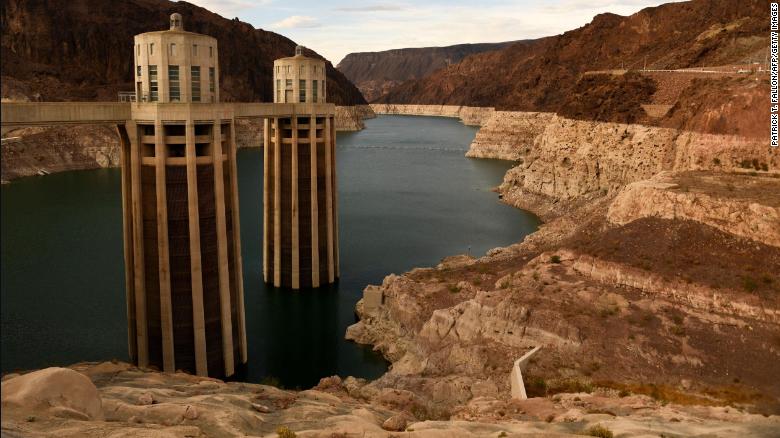
SocraticGadfly: Lake Mead
Showing posts with label Lake Mead. Show all posts

April 10, 2026

The Colorado River's situation is looking dire as Compact renewal looms

Two snapshots, which I will explain in more detail, in all likelihood, over at Substack.

First, the major drought that hit the Colorado River basin from the start of the year on, if not already late last year, was massively exacerbated, in terms of snow water, by the major heat-up in March. 

As a result? The Upper Colorado is down to just 25 percent of its median normal on snowpack water equivalent. For people unfamiliar with what this means, normally, there's snow melting in the upper Rockies in May and June that's filling the river, and more importantly, the river's damned lakes behind its damned dams, above all Lake Powell behind Glen Canyon Dam and Lake Mead behind Hoover Dam.

There will be little to no such snow this year. What snow is currently left will probably not be bulked up by any major new snowfall before the end of this month. The snow still left was already heated up, as was the surrounding ground, now snow-bare, and therefore it will melt off earlier.

This is going to be problematic, especially for Powell. 

How problematic?

EVERY dam has one red-line point that even a few non-Westerners may have heard of: Dead pool, also the title of a book by James Powell about Lake Powell. That's the point where what's left of water in a damned lake is below the outlet holes in a dam. Short of drilling new holes, that means what you have is something that's in the process of becoming a big silty mud puddle, absent major new water input.

Hydroelectric dams have a second red-line point. That's called "power pool."

That's where water in a lake falls below the top of penstock openings in a dam — the penstocks that feed turbines that generate electricity. This is problematic in two ways. One is the loss of electricity itself. The second is that the penstocks must be monitored for things like cavitation, should something like a major flash flood hit the lake and its drainage area and threaten to send lots of water through air-open feedways. Cavitation is what happened to Glen Canyon Dam's emergency water feed holes in the early 1980s when it had no choice but to draw down water as rapidly as possible. Marc Reisner discussed that in "Cadillac Desert."

That leads to our second issue.

Per BuRec, the old Bureau of Reclamation itself, there's a good chance Powell hits power pool by this August, even as the current Colorado River Compact ends later this year and the squabbling over renewal is only heating up. For government bureaucrats to issue a worry this openly pessimistic is huge.

In March, before the big heat-up, BuRec said Powell might hit power pool by this December. With that heat-up, it's advanced that to August. Before the Compact expired and also, for Phoenicians of Aridzona, before the summer expires. That means no more cheap electricity for AC in 105 or 110 F heat. 

Per the story, they have two main options. First is opening the gates at Flaming Gorge Dam on the Green River, the Colorado's main tributary, as much as possible. Flaming Gorge Reservoir is in northeast Utah and backs into southwest Wyoming. Both states oppose maximum drawdown but probably have little choice. Second is cutting the release of water out of Powell to Mead to the minimum allowable.

But outside agencies say even that won't be enough:

“Those two tools taken together at those levels are not sufficient to prevent Lake Powell from going below 3,500, according to these most recent forecasts,” said Anne Castle, a senior fellow at the University of Colorado’s Getches-Wilkinson Center.

There you are. 

Also, at a water height still slightly above power pool, the story notes, damage to the dam is possible.

For more on power pool and dead pool, complete with graphics, go here

BuRec promises another update later this month and you'll get more from me.

Longer term? The "panic button" has always been that one of the two dams has to die, and per private entities like Glen Canyon Institute, Glen Canyon Dam has always been the preferred option in the big picture, though the option vociferously opposed in Aridzona.

Now, per BuRec, Congress has technically said no to that idea.

Because of the many significant benefits provided by Lake Powell, Congress continues to include a direct prohibition concerning any planning actions or expenditure of public funds related to consideration or actions toward draining Lake Powell. Former Reclamation Commissioner, John W. Keys III said, "Previous administrations of both political parties, as well as the U.S. Congress, have said that Glen Canyon Dam is here to stay because it is serving millions of people in the Southwestern United States. Congress, through the passage of the Grand Canyon Protection Act of 1992, clearly stated that the dam and reservoir have a place in the tapestry of the country." Reclamation is committed to operating Glen Canyon Dam in accordance with the Law of the River and all applicable environmental laws.

But, not all of Congress nor all of Trump's Norman Vincent Peale can get rid of this reality. 

On electric juice, about all of Glen Canyon Dam's goes to Aridzona, while Mead's generally goes to California and Nevada. That Glen Canyon juice not only runs the AC in Phoenix, but pushes Central Arizona Project water uphill from the lower Colorado to farms in southern Arizona, and cities in greater Phoenix and Tucson.

BuRec's apparent pessimism is itself a shocker. Per another story from the Salt Lake Trib, the bureau usually pulls its punches on Colorado River water supply issues. 

If you live there, like my sis and brother-in-law, really, you should be moving. Really really, you should already have moved. 

It's time to face reality, per my previous posting on the subject. 

Maybe Phoenix only gets 5 percent of its electricity from the dam, but in summer, even that eliminates any cushion.

The CAP? The larger Western Area Power Administration, including but not limited to Glen Canyon Dam, supplies 80 percent or so of its electricity. 


February 07, 2023

The future of Lake Powell, and the whole Colorado

First, per Yale Climate, and rightly so, it will NOT be "solved" by one year of heavy snowpack. (As of Feb. 6, we were at 129 percent of the 10-year average.) In fact, it won't be "solved" within current parameters, period. (The only problem I have with Yale's piece is way too much quoting and referencing of neoliberal Kumbaya environmentalist John Fleck and his partner in neoliberal environmentalism crime Eric Kuhn.)

The key on the good, yet bad, is that Powell (and Mead) are now only at 10 percent danger of "power pool," per a BuRec update. As Bob Henson notes at the Yale piece, this of course drops a sense of urgency among the member states of the Colorado River Compact. It also lessens the possibility of BuRec threatening a banhammer, let alone following through on it, after its fake banhammer last summer.

In fact, contra Kumbaya Fleck, I expect one, or more, lawsuits to be the nudge to a new version of the compact. One lawsuit would be by one individual state vs. another. (Looking at you, Aridzona, vs. California, given early post-compact history.) A second would be by Upper Basin vs. Lower Basin states. A third would be one or more American Indian tribes suing one or more states and/or the federal government.

Bob's piece is creative in some ways. As people who are from the Colorado Plateau and surrounding areas note, evaporation, from both the two big lakes and the irrigation canals, is a problem. And a growing one. So, why not cover them with floating solar panels? Boaters would push back on the lakes, but push back on the pushback. They can steer around. And absolutely on the canals.

That said, the price for this would be huge on one or both of the lakes. You'd have to have transmission antennas beaming the electricity to some grid connection, for example. Panels fixed in place over irrigation canals wouldn't have such problems.

Outside of Nevada's conservation — which Bob didn't note was largely a one-off effort — the biggie, especially on the lower Colorado? Agriculture. Sorry, Johnny Peace, but the alleged romance of grazing cows on river-raised alfalfa? De-romanticize it.

For the unknowledgable, Yale then gives readers the nickel version of the Colorado River Compact. They then talk about climate change's impacts — important, as the snowpack numbers are based on just the seven previous years.

The biggie? Can the Compact be saved? Bob says yes, if there's enough flexibility in a highly overhauled new Compact. Color me skeptical, since, per Bob and big snow, the seven Basin states procrastinated past Jan. 31, as I expected, part of the impetus for his article.

That said, there's a flip side to that bathtub ring at Lake Powell, even if the lake itself is never fully restored. 

That's the unveiling of Glen Canyon itself, and its own self-restoration, documented in detail at High Country News by author Craig Childs and photographer Elliott Ross. The recovery of the canyon, with people now knowing about it, might partially replace the recreation dollars of Lake Powell, even as Jim Stiles shudders. Lessening total boating would also lessen fuel burning of the boats, and of driving them to the lake, too.

As for the actual vistas? I'd love to see at least a fraction of the re-revealed natural beauty from before Powell started filling, as in, see it in person wearing my own hiking boots. Ditto on seeing if some of the Anasazi or Fremont or Basketmaker or Archaic ruins, petroglyphs and pictographs survived 50 years or so of inundation.

December 01, 2021

Can Lake Mead be semi-saved?

With the kick-in of a federal Drought Contingency Plan earlier this year, Arizona, California and Nevada all have to cut the amount of lower Colorado River water they use. But, because of past deals Aridzona made with California so it wouldn't block progress on the Central Arizona Project, Aridzona will take the biggest hit, and California isn't really hit at all by Phase 1, as I discussed when the trigger hit.. That's even more true if Phase 2 of the DCP is triggered in just two years, which many people believe likely.

The Arizona Republic, via Yahoo, talks about a new voluntary plan hammered out among the three states that claims it will get deeper cuts than Phase 1 of the DCP mandates and so, hopefully, avoid Phase 2. 

Color me skeptical. We've already seen that  California water conservation seems to have hit a brick wall. While Pinal County, Aridzona farmers are drilling even deeper water wells, what if some of them start bringing up either sand or brine, and sooner rather than later? Or, some of this starts leaching from aquifers that are supposed to be part of the guaranteed 30-year water supply of new residential developments?

Per that second link, I expect negotiations to fail.

That said, what about DCP Phase 2, if it kicks in? Who's going to enforce the cutbacks? Them's fighting words.

That second link also indicates the lack of reality still in place.

Aridzona is talking about building desal plants in the Sea of Cortez and swapping that water with Mexico for a share of its Colorado River allotment. Desal plants, especially larger ones, have generally been a massive failure.

That ain't all. Lake Powell now reportedly has a 17 percent chance of hitting power pool in just three years. Power pool, per previous blogging, is when the lake falls below the level of the penstocks to generate hydroelectricity. That CAP water ain't going to Pinal County if there ain't juice to pump it there. And, considering that projection is by BuRec itself, the actual odds are surely higher.

Oops, that may be out of date. New BuRec report, per CNN, says 1-in-3, and by 2023. Same piece offers 66 percent chance of Mead hitting 1,025. That's DCP Stage 3. The first stage hit earlier this year at 1.075 feet; Stage 2 is at 1,050. At 1,000 feet, Vegas gets cut off. Also, at that point, Mead nears power pool.

August 17, 2021

Lake Mead water cuts invite Aridzona to face climate change reality; will it actually do so?

The question, of course, is, will it?

Yesterday, the feds announced that Lake Mead had fallen below the level to trigger the first round of water usage cuts next year. Within the three Lower Basin states (Google, and/or click the Wiki link, if you don't understand the Colorado River Compact), for a variety of reasons, the cuts hit Aridzona much more than Nevada. They don't hit California at all, though the next round, if triggered (the story is almost certainly correct that the next round WILL be triggered in just two more year), will hit all three states. 

(Update: Early predictions for US winter weather confirm that drought will remain and that the lower half of the West will also have dry weather. Those 2023 cuts WILL happen.)

(Update: As this piece at The Conversation reminds, canyons like the Black Canyon that holds Lake Mead, or the Glen Canyon of Lake Powell, narrow more and more as you get lower and lower, meaning that each additional foot of drop in elevation cuts water more than if you just had vertical square sides.)

The cuts on the lower Colorado start Jan. 1, 2022. Nevada must cut 7 percent, though it says it's already prepared. Aridzona must cut 18 percent. YES, you read that right.

Most of it will come out of the hide of agriculture, which makes the expansion of mega-dairies in Aridzona yet more problematic. Depleting groundwater for dairy cows and/or their alfalfa feed is beyond stupid.

But, what about urban water? The Aridzona Lege, several years ago, required new residential developments to prove they had a 100-year sustainable water supply. But, the language is loophole-ridden and is as much Jell-O as the Paris climate accords (which were similarly deliberately made so by Dear Leader and Xi Jinping). But, what about water banking? Well, Nevada (I think) is claiming that it's OK in part due to water banking. But, what if, in reality, such an account is already overdrawn? This is not like the federal government budget deficit, where you ignore it, or print more simollians if you have to. There is no more water to "print."

In addition, as of a couple of years ago, at least, it seems Aridzona did not have any withdrawal structure for water banked from the CAP. Since some of that water was banked for the state of Nevada? Erm, see above! In addition, per this piece, water banking was started for two reasons: one, as is true with most things Aridzona and water, as a reaction to those damned water-greedy Californians. Second, it was foisted as an idea for interstate water-banking and resale, as in, "we'll give those water-greedy Californians water if they pay us enough." But, it's hard to do that one, too, if you don't have a good mechanism for withdrawing water from the bank. See above! (The Wiki link also has thumbnail information on Aridzona's history of water animosity toward California.)
 
Robert Glennon, the University of Arizona prof who wrote the Conversation piece, agrees with me that cities and developers likely aren't yet going to smell the coffee.

Being ignored in this is how this affects hydroelectric generation. Mead has had new lower-elevation turbines installed in its penstocks which PARTIALLY alleviate the reduction in generation from a lower, lighter, lesser water load. But, it can't totally address that, and that's a one-time fix; if the lake falls to 950 feet elevation, it's near enough to "dead pool" to be a write-off. Per Glennon, the shape of canyons on water loss is a hydroelectric as well as a water issue, of course.

In essence, all of this above is part of Aridzonans wanting to continue to live in a "Cadillac Desert."

And, yes, I'm referencing Marc Reisner's book, which I own and have read cover to cover half a dozen times. (Reisner was good, as part of this, at tackling the socialism [no other word for it] that is the reality on Western water, and other thing, behind the myth of Western "rugged individualists.") As well as Donald Worster's "Rivers of Empire," which was able to pick up the climate change portion of the ball from where Reisner left it after his untimely death. And, the most recent installation in this on my shelves is James Powell's "Dead Pool," speaking of that subject. (Meanwhile, commenters at Glennon's piece are a mix of uninformed and delusional, mentioning things like pumping water from the Mississippi that Reisner already discussed 30-plus years ago, largely as wet dreams of hydrologist engineers with no connection to fiscal reality.)

And, with that, Glen Canyon Institute's proposal to reverse an atrocity, to "fill Mead first" and let Lake Powell essentially go away, seems to make sense. That said, what if water drops below outlet level there? How much does it cost to blow a hole in the dam, or the lesser option of "blowing multiple holes" in it by creation of new outlet tunnels? What about silt removal? (Powell did some initial looks at that.)
 
Related to that, Glennon reminds us of one other thing. Upper Basin states are required, by the Compact, to provide X acre-feet per year (on a 10-year rolling average, to be precise) to the lower basin. So dams of tributaries above Powell, like Flaming Gorge Reservoir, will be opening their penstocks wider and wider in the future.

And, this is only scratching the surface. Reisner discussed one other issue that has plagued irrigation-based civilizations throughout history — salinization. Especially if the rivers one uses for irrigation projects run through land with high salinity levels, also especially if irrigation canals are not carefully engineered with precise and even "drops," as in, say, 1/4 inch per foot, soil salinity builds up. Leaching is one tool to "flush" salinity from soil, when used with drainage, but ... it requires extra water beyond normal irrigation. Oops, that's not so available.

It's why, before Columbian, or Coronadan, contact, the Hohokam abandoned their canals in the Valley of the Sun. It's why a massive desal plant was built near the junction of the Colorado and Gila rivers. It's why clay 

We end with, what else? Two quotes from Cactus Ed Abbey:

"The desert always wins."

And:

"Growth for growth's sake is the theology of the cancer cell." 

August 05, 2014

Before #drought brings "dead pool," "dead power pool" could hit Powell and Mead

People who live in or near the Colorado River drainage (the real one, not the Texas one) know what the phrase "dead pool" means when applied to either Lake Mead or Lake Powell. It means that said damned lake has dropped so low that water can't flow through even the lowest outlet and we have a man-made Great Salt Lake.

Dead pool has been a worry for a few years among the knowledgeable, between persistent drought in the area — but not  unhistorical drought, as archaelogists and paleometeorologists know — and the effects of climate change.

But now, as High Country News notes, there's the worry of dead power pool, too.

That's where water levels in the lakes, even if not at dead pool yet, drop too low to generate significant hydroelectric power. Of course, the Colorado hits its lowest in August, right when sweltering Phoenix and Las Vegas are begging for kilowatts to juice up air conditioners.

A serious concern? Er, yes:
Here’s a sure sign that your region’s in drought: you stop paying your utility for the privilege of using water, and the utility starts paying you not to use water instead.

Outlandish as it sounds, that’s what four major Western utilities and the federal government are planning to do next year through the $11 million Colorado River Conservation Partnership. Under the agreement, finalized late last week between the Department of Interior and the utilities Denver Water, the Central Arizona Project, the Southern Nevada Water Authority and the Metropolitan Water District of Southern California, farmers, cities and industries will get paid to implement two-year, voluntary conservation projects that put water back into the Colorado River. The goal is to demonstrate that so-called “demand management” can prevent water levels in lakes Powell and Mead from dropping too low for their dams to generate electricity.
It's that serious.

So serious that requesting big farmers to fallow land on a rotating basis is part of the discussion.

Which is a discussion no farmer or rancher wants:
“Fallowing is really a blunt force tool that would harm agriculture,” said Terry Frankhauser, executive vice president of the Colorado Cattlemen’s Association. “We want to try to explore other ways of reducing demand,” like switching to less water intensive crops, watering less and accepting reduced yields, or water banking—foregoing diversions when you don’t need them in exchange for the right to use more later.
Well, you'd better figure it out soon, and start telling any of your members who are climate change denialists to get real. As it is, you and others are draining groundwater in the basin even faster than river reservoirs.

And, on Lake Powell, as a graphic at HCN shows, dead power pool will happen 1,200 feet above dead pool.

And, unless water usage is cut more, or else there's a massively snowy winter this year into next, dead power pool could happen as early as next year.

Have fun, climate change denialists in Arizona. If dead power pool actually happens in the next year or two, your summer electric rates in Phoenix will surely about triple, off the top of my head.

January 08, 2014

Requiem for a river: The Colorado

Lake Mead and its infamous bathtub ring, behind Hoover Dam./NYT photo
Good piece here from the New York Times, especially for Easterners unfamiliar with how overtapped the Colorado River already is, and its likely future.

Its likely future? For the man-made version of the river, in which almost none of the river flows "free" below Grand Canyon, and almost none ever reaches the Gulf of Mexico? Grim.

And getting grimmer.

The keys to the central and lower Colorado are two massive dams, Glen Canyon and Hoover, starting from upstream to downstream, and two massive (for now) man-made lakes behind them, Powell and Mead, respectively. (The two are, respectively, the second-largest and largest man-made lakes in the U.S.)

Mead, with both its water supply and its dam being closer to major user areas, and being the older of the two, is the biggie. And, "getting grimmer" indeed:
Lake Mead currently stands about 1,106 feet above sea level, and is expected to drop 20 feet in 2014. A continued decline would introduce a new set of problems: At 1,075 feet, rationing begins; at 1,050 feet, a more drastic rationing regime kicks in, and the uppermost water intake for Las Vegas shuts down. At 1,025 feet, rationing grows more draconian; at 1,000 feet, a second Las Vegas intake runs dry. 

But, Powell isn't off the hook.
Lake Powell is another story. There, a 100-foot drop would shut down generators that supply enough electricity to power 350,000 homes.
The story notes how the early 20th century was, as we now know, far wetter than normal, and thus water appropriations in the seven states of the upper and lower Colorado basins were "oversold." Sometimes massively so.

And, here's another part of the problem. Let's call it the "ostrich effect."
The federal Bureau of Reclamation’s 24-month forecasts of water levels at Powell and Mead do not contemplate such steep declines. But neither did they foresee the current drought. 
But, BuRec, as it's known out west, has no excuse for making such over-optimistic forecasts — other than pandering to all of the river's overallocated water users.

A fellow federal agency, the National Weather Service, says so. Per maps at the link, the Southwest is supposed to be above average on temperatures for all of 2014. (So much for the climate change denialists.) And, precipitation is supposed to be average through May. Given that, especially in the upper basin, the majority of precipitation is winter snow, this is a biggie.

Given that other research has said, per the Las Vegas Review-Journal, there's a 50-50 probability at least one of the two lakes hits "dead pool" by 2021, and that they hit minimum electric power generation by 2021, pandering to overallocated water (and electric) users is long past its expiration date.
The report unveiled Tuesday by the University of California-San Diego's Scripps Institution of Oceanography places Lake Mead's chances of running dry by 2021 at 50 percent, better than your odds of winning at any casino.

According to Scripps researchers, there is also a 50 percent chance that reservoir levels will fall low enough to shut down power generation at Hoover Dam by 2017, and a 10 percent chance the lake could be dry by 2014.

But the study's co-author, Tim Barnett, said those doomsday dates aren't as important as the overall message.
"The point is this is coming in 10 years, not 20 or 30 or 40. We're looking it in the face now," said Barnett, a research marine physicist who wrote the paper with climate scientist David Pierce.
Indeed. Pandering to users is long past its shelf life. The original report, here, has more detail. That's especially true since the report is now more than 5 years old and BuRec keeps its head buried in the (ever-increasing) sand.

As for claims that this will never happen, per the Review-Journal story? The BuRec is being ignorant, probably willfully so, of past history. It took decades of ongoing suits before Arizona finally joined the Colorado River Compact. It took more suits before the Central Arizona Project took off. It took an international lawsuit PLUS the first Arab oil embargo before we as a nation agreed to guarantee any Colorado River water to Mexico.

The idea that we would never let either lake reach dead pool has about as much guaranteed truth value as the idea that we'd never kill off every one of those 100 million passenger pigeons.

And, it's not even dead pool. If Lake Mead falls just over feet this year, instead of 20 feet, water rationing starts. This year. Not some date in the future.

And, it's possible. Beyond above average temperatures predicted for the Southwest through at least mid-summer, as of right now, the Rockies' snowpack is, overall, average to below average. And, the West Coast is just bone dry. Here's the details.

Plus, it's not just water issues. Note the other issue — power generation at Hoover Dam could die by 2017. Even if Las Vegas has some water, do people want to live there with almost guaranteed summer brownouts? Also, the lower the lake sinks, and the lower you have to run tubes to get water out of it, the more electricity you have to use to pump it, as Las Vegas, at 2,000 feet, is well above the bottoms of those siphons.

And, soon enough, the pressure's going to come for more water to be released from Lake Powell. Besides the lawsuits that will trigger, that will cut electric generation there. Phoenix gets to duel with Las Vegas as to which one has more brownouts and blackouts, then.

The answer? Far beyond what the Times quotes federal and state officials as saying. Rather than bailing out people in Arizona, Nevada, and exurban L.A's Inland Empire when the housing bubble burst, we should have paid to move them back to the Midwest.

Instead, if the Central Arizona Project is indeed taken out of commission by, say, 2025, and another one-third of the Imperial Valley in California faces the same fate, Phoenix, in addition to becoming even hotter, will face another problem.

Those haboobs that tea partiers think are the name for a Muslim incursion? They'll be carrying more and more agrichemicals from fallow desert farmland to the west and dumping it in the Valley of the Sun. People who either moved there themselves, or had ancestors do so, for their lungs, will be living in one of the most unhealthy areas in the country.

There is a bit of schadenfreude here. The area around the Valley of the Sun, plus Orange  County and San Diego County in California, are hardcore red staters. Climate denialists. Swelter away in intermittent summer electricity, and croak away in diminishing water.

It's also a bit of caution for Texas. The Rio Grande involves international compacts and the Pecos has an interstate one. Even where rivers are all in Texas, like the Colorado of Texas, the ones that start in West Texas, as heat and possible drought continue, are under similar pressures. And, given how the current Texas government has far more ostrichitis on climate change than BuRec, they're likely to mismanage addressing that pressure even worse than the feds.

February 18, 2011

'New normal' on Colorado Plateau starts having results

As most environmentalists know, the "drought" in the Colorado River watershed is really closer to the basin's long-term normal. Now, the lack of water in the overappropriated, overdammed river is starting to have fallout.

Boulder City, Nev.,and other smaller communities south of Vegas are finding hydropower from Hoover Dam is harder to come by. At the same time, they're finding that their current supplemental supplier is too expensive.

Of course, the real story is the explosive growth of Boulder City, Laughlin and other cities that are in the middle of a freaking desert! The city's use of dam power has dropped from 80 percent to 50 percent in the last 15 years.

And so, you white folks retirees slumming at small-town casino cities are getting hoist by your own capitalist petard.

Once again, I quote Ed Abbey: "The desert always wins."

Retire in Mississippi, where there's water, and hit one of the oceanfront floating casinos if you have to. (And, get more schadenfreude from more Class 4-5 hurricanes, maybe.)

September 29, 2010

Mother Nature monkey wrenches the Lower Colorado

True, it's Lake Mead, not Lake Powell, behind Hoover Dam, not Glen Canyon Dam, that's drying up, but ... it looks like the whole lower Colorado River Basin is getting a stiff blast of morning joe from Mother Nature, as water allocations are going to have to be trimmed back.

And, if the lower Colorado puts a "call" on Lake Mead, even if the upper basin isn't using all of its water, anti-Californianism in the Interior West could get hot and heated. True, it will actually be water latecomers Arizona and Nevada trying to save their desert-scurvy necks, but California will look like the ultimate water hog to places like Utah, Colorado and Wyoming.

Even scarier, if you're Las Vegas, especially? If Lake Mead falls another 25 feet, that may make the dam's turbines inoperative. No more cheap hydroelectric power for the glitzy Strip.

What was it Abbey said?

Oh, yeah: "The desert always wins."

February 24, 2009

Is the Colorado running dry?

Silly question for those of us who know Lake Mead has a 50 percent chance of going dry in 20 years.

But, if you’re NOT familiar with the idea, the proof that the Colorado River system is in danger continues to accumulate, and in a way that scares Colorado boosters who know they’re generally last in line for the river drainage’s water, even though much of it starts there.

February 12, 2008

Lake Mead could be dead in a dozen years — pop your champagne corks now

Lake Mead dry by 2021? Like Ed Abbey, were he still alive, I would soooo cry, NOT, if this actually happens:
What are the chances that Lake Mead, a key source of water for more than 22 million people in the Southwest, would ever go dry? A new study says it’s 50 percent by 2021 if warming continues and water use is not curtailed.

“We were stunned at the magnitude of the problem and how fast it was coming at us,” co-author Tim Barnett of the Scripps Institution of Oceanography said in a statement. “Make no mistake, this water problem is not a scientific abstraction, but rather one that will impact each and every one of us that live in the Southwest.”

“It's likely to mean real changes to how we live and do business in this region,” added co-author David Pierce, a Scripps climate scientist.

Oh, and if you think this is a worst-case scenario, the authors say, not at all:
The researchers also noted that their estimates are conservative — in other words, the water shortage is likely to be even more dire than they estimate. The conservative approach included basing their findings on:
• The premise that warming effects only started in 2007, though most experts consider human-caused warming to have likely started decades earlier.
• Averaging river flow over the past 100 years, even though it has dropped in recent decades.

If you allow for today’s waterflow and an earlier start to global warming, here’s what the results actually could be, they say:
• A 10 percent chance that Lake Mead could be dry by 2014.
• A 50 percent chance that reservoir levels will drop too low to allow hydroelectric power generation by 2017.
• The system could still run dry even if recently proposed mitigation measures are implemented.

Speaking of Abbey, can we get the Monkey Wrench Gang to blow up Hoover Dam instead of Glen Canyon Dam at that point, since there will no longer be a need for it?