SocraticGadfly: race
Showing posts with label race. Show all posts

May 19, 2021

Brief thoughts: Critical race theory and gender critical radical feminism

More and more nuttery is being spit out of one half, or now both, of the Pink Dome as the Texas Legislature races to bill-voting finish line.

We have one big one, per the first half of the header, and one that's NOT so nutty, despite attacks by some activists, per the second half of the header.

Let's dig in.

Schools can't teach critical race theory, but that was amended with window-dressing inclusion of speeches by Martin Luther King Jr. (of course) and Frederick Douglass (himself somewhat a racist toward American Indians and yes really). Rep. Mary González is right; the wingnuts don't even know what they're trying to semi-ban, but what else is new?

My personal take? I've actually read Eddie Glaude's Democracy in Black, who is on the edges of the movement, and Derrick Bell, a founder of the theory, whose Silent Covenants was a good introduction. 
 
I've also read many other books about how the concept of race was developed.
 
As for critical race theory itself? Beyond looking at the sociological development of race, I think they're half-right or more on how the law has in part been constructed to support the idea of race and support the elevation of White race-ness above other race-ness. Yes, that's an ugly phrasing, or rather, an ugly-looking hyphenated word, but it does the work I see it needs to do.
 
Whether the prescriptions of critical race theory are always right is a different issue, as is some of the methodology its proponents use to reach its prescriptions, or to reach its analysis with all current issues in race-oriented segments of law.

Update, June 20. While not every CRT touter may support these things mentioned in the tweet, the most ardent do. I remember years ago when resegregation first started raising its head to a great degree.
There you go. I retweeted it, but did not comment to it, as the tweeter appears to be a wingnut, or at least a wingnut fellow traveler.

One other thing I reject from CRT is that only White people can be racist. I've seen racism by members of all sociological race groups. The "top" group, Whites in the US, are the most likely to be so, is possible and even likely, as is the fact that their racism will generally be both the most pernicious and that with the strongest effects.

I also reject the corollary that by default, White people are racist. Now, there IS to some degree still a form of structural or institutional racism in America, and that supports White "privilege," or put more accurately to avoid SJW words, an accumulated White group socioeconomic power balance. That doesn't make all Whites today racist. It doesn't make all of them responsible for that power balance still tilting their way. It does, though, mean they still benefit from it.
 
That said, there is such a thing as individual racism as well. And, Blacks, American Indians, Asian Americans, Whites, can all be racist against people of other "races." I've personally witnessed individual representatives of every group but Asians doing this.
 
And, to the degree that critical race theory, or some of its more extreme proponents claim only Whites can be racist? That's the degree I reject CRT.
 
===
 
Also open for debate is the intersection of race and class, an intersection that "interestingly" is generally omitted from discussions by proponents of intersectionality. I personally reject the likes of Adolph Reed and Doug Henwood that issues of race almost always reduce to issues of class. That said, that's a semi-Marxist reductionism, which is wrong not only in being wrong, as I've told Henwood before, but also wrong in, per Dan Dennett, being an example of greedy reductionism in general.
 
At the same time, the likes of Reed and Henwood aren't fully wrong, either. Sometimes what looks like an issue of race is at least partially a class issue of not an issue of class more than race. Beyond that, then, there's the issue of class within each individual racial grouping. 

===
 
Now, on to the second half of the header, as it also relates to the Texas Legislature, with the Senate still pushing for restrictions on sex (sic) transition intervention for minors.

First, I see parallels between CRT and gender-critical radical feminism. Both have things to teach, and have taught me. At the same time, I don't agree with everything in either, and at the same time, sex and race are different things. Sex is more than skin-deep physiological markers. At the same time, contra some Greens battling the "trans activitists," I reject anything that approaches sex essentialism just like race essentialism. That said, to the degree that gender roles arise out of biological sex, sociological understandings and expressions of race are probably about 50 percent parallel. I wouldn't go further.

Speaking of, the Texas House's bill to ban medical interventions for transgender children is dead. The Senate has a similar version; we'll see.

My take? The bill was somewhat too far but NOT that much too far. Instead of a ban, put it age 16 for puberty blockers, require parental consent (this is FAR more than an abortion, so yes, parental CONSENT), and, only allow puberty blocker drugs when STRICTLY following the guidelines established by the Mayo Clinic and elsewhere, which I've noted before. And, speaking of books related to subjects, that includes selections from my review of Alice Dreger's Galileo's Middle Finger.
 
I know that to some regular readers, even some fellow leftists of some sort, this may be a shock. Well, I'm not alone among liberals, left-liberals and leftists, first. If you think I'm a loon or a bigot, you need to read more at those links.
 
Second, although I don't fully agree with GCRFs on this, I think they're at least partially right in that at least some non transsexual trans activists are men who are harmful to feminism.
 
Third, at that "noted before," puberty blockers have a laundry list of known and possible (as in correlation isn't yet necessarily causation) long-term (not short term) medical problems they cause. Many ground level cadres (sic) in the trans activist world don't even know this. Many of the leadership do and poo-poo this. Read for yourself at the links within that link about brittle bones, including full-on osteoporosis, major tooth decay and other issues.
 
Fourth, I have no doubt this is a fraught issue for parents. That said, per the Mayo Clinic, your first resource should be following its guidelines, including proper counseling for your child, before even considering any medical intervention. 
 
Fifth, leftists should know that American capitalism is finding $$$ in hopping on this bandwagon.

Sixth, on other specifics related to the Texas Senate bill? First, it's NOT unconstitutional, contra the LGBQ-plus / "trans activist" crowd. Second, on surgical intervention for minors? Once is once too many. Third, per Mayo Clinic guidelines, no, the No. 1 need for access re child suicide is sex/gender dysphoria counseling; No. 2 is limiting social media access in my personal opinion. Fourth, there ARE people who have started not just the chemical but the physical/surgical sex transition, or even completed it, and later regret it, and try to detransition. (Just like in pre-Maccabean Hellenistic Jerusalem, there were Jewish males who underwent decircumcision surgeries to compete in the gymnasion without embarrassment.) Opponents of the bill appear to continue to conflate sex and gender, too.
 
Seventh, within the Green Party? If this does shatter it, I've already thought that it's past its shelf life and its best-buy date. Per Mark Lause, I was already wondering that after the 2016 election. At the same time, per what I said above, some defenders of the Georgia Green Party, and some of its leadership, need to be more careful of their associations — if they care. Sometimes, the enemy of my enemy isn't even worth it to be invoked as a temporary ally of convenience.

Eighth, for left-liberals and leftists, here's an analogy I use that's very relevant to the current world situation: Gender is not sex like anti-Zionism is not antisemitism.
 
Ninth? "Detransitioning" is a real deal, and as noted, includes people who started into medical sex changes and had regrets. AND, these are adults. That's why "pushing" transitions, or even "pushing" puberty blockers, for minor children whose advanced abstract reasoning functions in their brain aren't fully developed, is horrendous and in this corner, arguably a form of child abuse. Parents? I don't care how often your kid asks. Maybe you need to just say no. And, yes, that counseling is HIGHLY needed. One sexual transitioner says he had 10 years of therapy before going forward. The number of detransitioners may be less than some claim, but it's almost certainly more than trans advocates deny.

Ninth, part two? Per the long-read second link in the above paragraph, those Mayo Clinic guidelines on mental health are observed MUCH more in the breach than in the practice, it seems.
 
Ninth, part three? That link is from Seattle's alt-weekly, so don't "@" me about wingnuts.

Tenth? Note to the GCRFs? Some detransitioners don't like you, or at a minimum, don't like some of your stances, much more than they like wingnuts. They definitely don't like your version of a red-brown alliance. (Neither do I.) You should take notes, but probably won't. 

Eleventh? At the same time, and contra trans advocates, many detransitioners cite peer pressure, whether in-person, online or both, for attempting sexual change in the first place.

==

Finally, with both CRT and GCRF, it's helpful to have at least a thumbnail understanding of the critical theory from which they arise. The Marxist background of critical theory, even if a watered-down reform Marxism of the Frankfurt school, is its biggest handicap. I've long said that Marx was spot on in his criticism of industrial capitalism of his day (tho failing to anticipate its changes). That is, he was spot on in the descriptive side. But, given that Hegelian dialectic is crappy philosophy and literally pseudoscience when made the basis of a scientific theory, he was all wet on the prescriptive side. 

Really finally? This is time for Idries Shah.

This is clearly an Idries Shah issue:
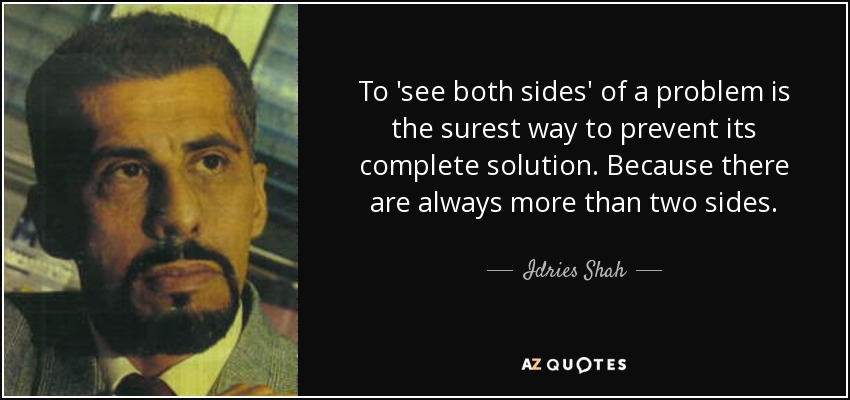

First, as I have said here and elsewhere, the enemy of my enemy may simply be an ally of convenience. That's another side right there. I used that exact phrase in a post last fall talking about Twitter cleanup, inspired by Julian Assange issues.

Second? Neither of the "two" sides in on the sexual transitioning issue (the one side having wingnut and GCRF sub-sides) wants compromises, I think. They want surrender by the other side, and will recruit allies of convenience in a war as needed.

I personally don't regret my degree of immersion in this. But, I even less regret pulling back before immersing even more.

And, with that? This will probably be close to my last in-depth thoughts on the issue until the deaccreditation of the Georgia Green Party. It's almost certain to happen. Georgia Greens should take their lumps and if they're serious about moving on, move on. (That said, I've heard that the SPUSA has already had a bit of this, twosiderism and all, themselves.)

September 26, 2018

Mudsills, part 5 — demographics

I've talked before about who mudsills are, and how they were part of Trump's winning campaign. Even if they weren't THAT important, they were a factor. And, Trump being Trump was an enabler for them to be more vocal about racism, and the specific type of racism which is associated with them as a sociological group – largely working-class whites looking for someone lower on the socioeconomic latter for them to kick. Several social psychology books talk about this phenomenon; I've read a couple.

This post?

I am going to offer a few takes on the demographics of mudsills in their most common locales, which I have previously identified as "Appalachia extended" — this allows for the mudsills who moved to places like Flint or Milwaukee to work in the auto plants and similar. (Steel mills, the older ones, were actually in Appalachia, the northern end, of course.)

The demographics will concern the locales as well as the mudsills themselves.

First, they're likely to live in an area with at least 3 percent black and / or 3 percent Hispanic population. It's likely that both minorities will be in non-insignificant numbers.

But — neither minority is likely to be above 25 percent, and definitely both will not. The area will also likely have few Asian-Americans.

In other words – enough minorities to be "visible" but in a white-majority population. In Appalachia itself, and often in Appalachia extended, if blacks also moved there from the original Appalachia and nearby, attitudes and relations from original mudsill times will largely still exist. And, there will be just enough Hispanics to be perceived as job stealers, and perhaps seen in the light of stealing jobs that mudsills think blacks should have still been working anyway.

Diet and health are other demographic markers.

Mudsill-heavy areas are likely to be above average in smoking rate. Note that the national rate of adults who have smoked just once in the past year is at 15 percent, according to the American Hearth Association. That's more empirical. So is higher to much higher use of smokeless tobacco.

Education is a biggie. Clear evidence indicates that racism declines with collegiate and post-collegiate education. That said, as Brains points out, the likes of Stephen Miller and Kris Kobach show that college doesn't eradicate racism among either the educated or the rich. It just provides a broader ground for new plants to outgrow the weeds of racism.

These observations are generalizations. However, I state that they are generalizations and NOT stereotypes. Based on modern informal logic, my take is that if an observation applies to more than 50 percent of a population group, it's a generalization, not a stereotype.

Oh, and the 2016 elections seem to reflect this in voting patterns. The Atlantic notes that, among working-class white voters, sociocultural anxiety, and NOT economic anxiety, pushed such voters who indulged any anxieties toward Trump.

May 30, 2018

Mudsills, part 4 — the problem with the rich

NOT the superrich, the rich.

"The Birth of a New American Aristocracy" is about the 9.9 percent of the rich below the 0.1 percent super-rich. Near the end of the piece, looking at the 2016 election, it talked about how the 0.1 percent helped stoke angers of the 90 percent at the 9.9 percent in between, while also looking down and "kicking down," which the piece exactly says. 
Did I mention that the common man is white? That brings us to the other side of American-style resentment. You kick down, and then you close ranks around an imaginary tribe. The problem, you say, is the moochers, the snakes, the handout queens; the solution is the flag and the religion of your (white) ancestors. According to a survey by the political scientist Brian Schaffner, Trump crushed it among voters who “strongly disagree” that “white people have advantages because of the color of their skin,” as well as among those who “strongly agree” that “women seek to gain power over men.” It’s worth adding that these responses measure not racism or sexism directly, but rather resentment. They’re good for picking out the kind of people who will vehemently insist that they are the least racist or sexist person you have ever met, even as they vote for a flagrant racist and an accused sexual predator.
The piece goes on to connect today’s mudsill history to past mudsill history.
Where were the 90 percent during these acts of plunder? An appreciable number of them could be found at Ku Klux Klan rallies. And as far as the most vocal (though not necessarily the largest) part of the 90 percent was concerned, America’s biggest problems were all due to the mooching hordes of immigrants. You know, the immigrants whose grandchildren have come to believe that America’s biggest problems now are all due to the mooching hordes of immigrants.
That's mudsillism to a tee — the middle class envying the rich while letting them, and even more the super-rich, believe their problems are all due to inferiors.

The author notes that Calvin Coolidge passed a big tax cut for the rich and super-rich in 1926. The 9.9 percent became more hopeful, while the 0.1 percent looked for more separation. They, too, kicked downward.

And, he connects that with the origin of the mudsills, too.
That gilded, roaring surge of destruction was by no means the first such destabilizing wave of inequality to sweep through American history. In the first half of the 19th century, the largest single industry in the United States, measured in terms of both market capital and employment, was the enslavement (and the breeding for enslavement) of human beings. Over the course of the period, the industry became concentrated to the point where fewer than 4,000 families (roughly 0.1 percent of the households in the nation) owned about a quarter of this “human capital,” and another 390,000 (call it the 9.9 percent, give or take a few points) owned all of the rest. 
The slaveholding elite were vastly more educated, healthier, and had much better table manners than the overwhelming majority of their fellow white people, never mind the people they enslaved. They dominated not only the government of the nation, but also its media, culture, and religion. Their votaries in the pulpits and the news networks were so successful in demonstrating the sanctity and beneficence of the slave system that millions of impoverished white people with no enslaved people to call their own conceived of it as an honor to lay down their life in the system’s defense.
Mudsills both disliked and envied their "betters." Many talked about a rich man's war but a poor man's fight," but, until the end, in most of the South, undercutting the hopes of Lincoln, few opted out.

Per the "white" part, this is why, although I reject the idea that every individual white is at this time privileged over every single minority, I accept white privilege as a generalization with at least 50 percent validity, and not a stereotype.

Sadly, Matthew Stewart believes the best revolutions — which he rightly notes are what it takes to lessen inequality — are by the 9.9 percent, citing the American Revolution as an example.

So, we have an elitist, who recognizes that financially, his socioeconomic class is part of the problem, not the solution, but yet, believes that his cohort is part of the solution for good governance.

Methinks he's still too self-gilded. Certainly self-delusional, made worse by pretending to not be self-delusional.

Any wonder that people like this, who are presumably neoliberal Democrats, infuriate today's mudsills?

Part 1, and part 2, about Trump and mudsills have more background, as does part 3, about the myth of Irish in America being slaves and related things.

Here, I explain vs Adolph Reed and Doug Henwood, and the likes of Jacobin why mudsillism is a real thing and needs to be treated as such.

Oh, and the 2016 elections show this. The Atlantic notes that, among working-class white voters, sociocultural anxiety, and NOT economic anxiety, pushed such voters who indulged any anxieties toward Trump.

November 07, 2015

Classical music, 'race' and double standards

Scare quote on "race" in the header because what many people claim as "race" is basically a sociological construct. If we want to speak about a level above ethnicity in terms of biology, in other words, rather than the difference within different "whites," different "blacks," etc., my suggested term, harking back to the classical Greek, is "ethnos."

That said, a couple of stipulations.
1. People of any "race," or ethnos, can be racist. "Reverse racism" is racism.
2. People of any ethnos can commit double standards. A "reverse double standard" is a double standard.

That note aside, let's get to the meat.

In a blog comment thread, I heard someone respond to a comment I made about being "hot" for female classical violinists, after others had been posting about various female rock stars. I noted it would be out in left field, and just let it go at that.

One commenter, a woman, then responded, "That's so white."

If she meant literally, I mentioned Midori, then moved from violinists to opera and Denyce Graves. (I could also have mentioned Kiri Te Kanawa.)

If she meant figuratively, then we're into double standards. "That's so white," or similar? If I said "that's so black" about hip-hop, I'd get flamed by a lot of liberals, even ones not stereotypically PC.

If she meant "white" because of the relative lack of minorities? True, but it's improving. And, the "that's so white" stereotype is already used by black kids in school to hold each other back intellectually. It's only worse for whites to offer it up as a tool to hold blacks back artistically, or claim classical music is part of the dead white males canon, or whatever.

Claiming that classical music (or, say, national parks, which suffer from a similar perception, and fairly deservedly) are "oh so white," in a structural and not just sociological sense, perpetuates double standards, and stereotypes.

Of course, white people, every one of them individually as well as an ethnos, are believed by some to be endowed with privilege and thus can't be stereotyped.

I'm not saying this person was coming from that point. But, are some people with similar ideas?

July 28, 2015

Jimmy Carter: Not a Hillary fan

Dunno about NOW, but the one living Democratic ex-prez without the last name of Clinton absolutely did not support Hillary in 2008.

It's part of a long interview with him and author Jacquelyn Woodson.

Carter talks about his own segregationist father, and how segregation was a tool, among others, to keep people in "ugly boxes."

Here’s a few other excerpts, like this on the Confederate flag:
JC: Also the South Carolina legislators are not voting to take down the flag because they’ve changed their mind about it. They’re voting for it because South Carolina and Charleston are going to suffer severely, economically, if they don’t make the change.
True, I'm sure.

That said, let's not forget that, in 1976, Carter made a play to hold onto what became called "Reagan Democrats," some of whom had been called "Wallace Democrats" four years earlier. Or that he was the first neoliberal Democrat on regulatory and other issues. (Carter started deregulating trucking; Reagan just finished it. Carter started deregulating airlines.)

I don't know that Carter has explicitly repented of his 1970s, let alone 1960s, racial stances. His actions seem to indicate that.

Or this on race relations:
JC: You’re assuming that a white person who believes in the Confederate flag is listening to his black neighbor who doesn’t like it. There’s very little communication on a sensitive subject like that.
Woodson responded that this was because blacks “knew their place.” Carter doesn’t disagree. He presumably accepts Woodson’s “complicated” observation.


Anyway, give the whole thing a read.

July 27, 2015

TX Progressives talk #SandraBland, race relations, #HERO, more

The Texas Progressive Alliance is always on the side of equality as it brings you this week's roundup.

Off the Kuff decries the Supreme Court ruling that will force a vote on whether or not to repeal Houston's Equal Rights Ordinance.

Harold Cook explains why the Republicans won't nominate Donald Trump, but won't be able to escape him, either.

Libby Shaw at Texas Kaos and contributing to Daily Kos never ceases to be amazed by Rick Perry's serial hypocrisy. Have YOU No Decency, Rick Perry?

Socratic Gadfly talks about the Dunning-Kruger effect and why many people think their local race relations are much better than national race relations.

CouldBeTrue of South Texas Chisme notes that many people in South Texas do not have clean drinking water.  This should be a scandal, but, as Donald Trump has amply explained, Texas Latinos are nothing but piñatas to republicans.

Ben Hall and Steven Hotze, Ben Hall and Dave Wilson... a lot of prayers got answered for the Houston bigots and homophobes when the Texas Supreme Court ordered the City of Houston to either repeal its equal rights ordinance or put it on the November ballot.  PDiddie at Brains and Eggs knows that we don't need another HERO referendum, but we're going to get one anyway.

With football season fast approaching in Texas, Neil at All People Have Value posted about the NFL's refusal to allow Junior Seau's family to speak at his Hall of Fame induction as Seau's family sues the NFL over his terrible head injuries. Football is unsafe to play at any level. APHV is part of NeilAquino.com.

=====================

And here are some posts of interest from other Texas blogs.

The Texas Election Law Blog tries to clear up some confusion about resignations and vacancies.

Ex-pat Texan Elise Hu-Stiles documents what it's like to live and have children in Seoul, South Korea.

The TSTA Blog wishes our state leadership cared as much about schools as teachers, parents, and charities do.

Scott Vogel, editor of Houstonia, has some choice words for a couple of readers who objected to an ad showing a multi-racial family.

Tamara Tabo examines the problems of jail surveillance cameras.

Paradise in Hell knows that Texas is great in spite of Rick Perry, not because of him.

Eric Berger geeks out over the pictures from Pluto.

Grits for Breakfast tries to distill some lessons from the Sandra Bland tragedy.

July 24, 2015

The Dunning-Kruger effect and race relations

The New York Times has a very interesting story about race relations in America.

Two key polling points are the "tells."

First, about 60 percent of Americans, including majorities among both whites and blacks, think race relations are generally bad, and about 40 percent think they're getting worse.

However, more than 75 percent think they're getting better in their own communities.

Which is just as impossible as everybody in Lake Wobegon being above average, or the Red Queen's multiple impossibilities actually being true.

That's why I mentioned the Dunning-Kruger effect. This seems to be the emotional or moral version of that, where most people think they're smarter or more competent than they actually are, expect people are thinking they're more racially enlightened than they may actually be.

Here's the real "tell" on that:
Similarly, only a third thought that most people were comfortable discussing race with someone of another race, but nearly three-quarters said they were comfortable doing so themselves.

Erm, Sure! 

Which is just as impossible as everybody in Lake Woebegon being above average, or the Red Queen's multiple impossibilities actually being true.

And, as for why many people think race relations have gotten worse? The tea partiers have drunk the rebranded Jim Jones Kool-Aid, with the result of this:
Seventy-two percent of blacks said they approved of the way Mr. Obama is handling race relations, compared with 40 percent of whites. …

 The divide, seen in the answers to virtually every question in the poll, was stark when respondents were asked whether they thought most Americans had judged Mr. Obama more harshly because of his race. Eighty percent of blacks said yes, while only 37 percent of whites agreed.

Don’t tell me you’re surprised.

I would suggest those 60 percent of whites (not counting any like me who ding Obama from the left at times) take a test about subconscious bias at Project Implicit.

But, I know they won't.

June 19, 2015

Why #race doesn't biologically exist, part 12

Because the latest study of Kennewick Man, and a 12,000 year old Mexican skeleton, show that race can't be defined by one or two facial features. And, as for why Kennewick Man could look "Ainu" or "Maori" yet still be American Indian? Well, American Indian DNA is not all East Asian; it's got a fair admixture of Eurasian Siberian. Maybe it's got Denisovan DNA in higher concentration than other ethnicities, which would vary widely in individual percentage from person to person.

So, "race" as an alleged biological reality, when focused on skin color and a couple of facial features, isn't that; it's a sociological construct.

That said, the clueless, the racialists, or others, will draw the opposite conclusions, for various reasons.

This is also why it's sad that, in the light of the Charleston shooting, our president, Dear Leader, still can't admit that he's not a "post-racial president." I mean, he has no more elections to win, no more possible perceptions of "angry black man" to hide.

June 15, 2015

Rachel Dolezal resigns NAACP post; a teaching moment for #race?

Rachel A. Dolezal at her home in Spokane, Wash.
.
CreditColin Mulvany/The Spokesman-Review, via Associated Press
Rachel Dolezal, the ethnically "white" adjunct professor at Eastern Washington University, who has recently come to public light through her pushing her public self-identity as "black," including being president of the Spokane chapter of the NAACP, has resigned that position. But, not entirely voluntarily, as local members started a campaign.

(UPDATE: We've gone straight to fraud and ego as the best explanation for her behavior if she once "pulled a Bakke" and sued Howard University for anti-white discrimination.)

I have several thoughts on the issue, beyond her ego trips.

First, I reject, in general biological ideas of "race," and even more, the idea that, were we to define race biologically, only one definition is allowed, namely, the "white" definition based on skin tone and a couple of facial features.

Second, I do accept that "race" has been a sociological and cultural construct, and because such constructs have "legs" today, we shouldn't ignore them.

Third, I think that Rachel Dolezal was sociologically "white" as raised. I don't think she's "mentally ill" as broadly and vaguely used. Is she perhaps highly egotistic? Yes; see the "update" link above. And, per her past, she's arguably engaged in cultural appropriation, and perhaps done that for academic or other advancement, in part. See the second link above, or go to what it links to, a new piece from the Smoking Gun.

I mean, maybe she wouldn't have become chapter president, but she certainly could have served on the board of the Spokane NAACP; the organization has long had multiracial involvement.

Is there more to her birth family than we know? As in, maybe abuse of her, or maybe favoritism, or perceived favoritism, to her adopted siblings, who are African-American? Yes. And she has had a fallout with her family, including (but not limited to) her parents, who "reverse outed" her as being Caucasian.

Do I think it's good she resigned her NAACP position? Good for whom? Could be good or bad for her, based on her larger psychology. That said, the details of her announcement offer me little hope on that for now.  And, as the likes of V.S. Ramachandran note, this may be some kind of identity self-dissociation. We might not call that quite "mentally ill," but, we wouldn't call that "normal," either.

At the same time, did she somehow, between adopted siblings and a marriage to an African-American, somehow become "black" in her own mind? Yes. Is it body dysmorphia to have possibly gone beyond tanning, on skin color? I'd also say yes.

As for the NAACP? It's for the board to figure out whether it's ultimately good or bad, but I think it's most likely good. It's especially good if this becomes a "teaching moment" — and one that works. That said, judging by the Spokane local's "push," I think they felt what she had done was harmful — and was some sort of cultural misappropriation.

As for my second wind thoughts on why she was trying to "pass"? (I see no reason not to call a spade a spade.) It does appear that she — even if she really "felt black" in some way — was looking to leverage this into academic and artistic advantage.

That said, this will be like pouring gasoline on the fires of affirmative action cases in court. The next time a Fisher vs University of Texas case reaches the courts, the plaintiff(s) will almost certainly mention this as part of arguments. (And, speaking of ironic timing, SCOTUS today declined to take a second look at that very case.)

As for her parents? Yes, Rachel once claimed she was born in a tepee, but her parents claimed to be both Caucasian and Native American. Apparently, it wasn't enough for official tribal status, so maybe that was untrue, and psychologically, the apple didn't fall far from the tree.

One philosopher in this roundup of mini-essay philosophical thoughts notes this issue, and how the "one drop" theory applied only to blacks in American history, not Asians, Hispanics or even American Indians.

And, I'll give Kareem Abdul-Jabbar the last word. Be yourself, while continuing to work for the causes you back.

Actually, now, I'll take the last word. If the "real yourself" is being a fraud, no, don't be yourself, at least not until you become a better self.

As for that suit? She lost, and had to pay court costs, plus additional costs for trying to delay a medical examination. (Dolezal also claimed she was facing discrimination over being pregnant; I'm guessing she was trying to delay an obstetrical examination.)

October 22, 2014

#Ferguson note to #SJW folks W: Was Michael Brown maybe not so "innocent"?

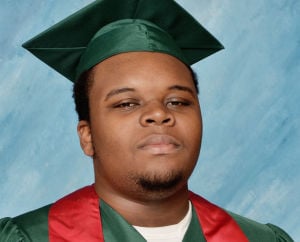
Michael Brown / Photo via St. Louis Post-Dispatch
The latest on Michael Brown indicates he may NOT have been in a "surrender position." We'll see if the third autopsy, when released, has anything to say about this. That said, while not excusing past racial problems in Ferguson, it's a reminder not to let facts be overrun by a "narrative."

Yes, there are "bad cops." I've written about a lesser-level bad cop at one of my newspapers. And, I've blogged about grand juries being too credulous about cops, and being coached on that by prosecutors.

There are also criminals. And, there are people who, even though not pre-meditated criminals, who are "intoxicated" or "under the influence," whether alcohol, cocaine, or even ... yes, even marijuana, who attack cops. I've written about them, too.


Part 1: He was shot at least once at close range, it seems:

The St. Louis medical examiner, Dr. Michael Graham, who is not part of the official investigation, reviewed the autopsy report for the newspaper. He said Tuesday that it “does support that there was a significant altercation at the car.” 
Graham said the examination indicated a shot traveled from the tip of Brown’s right thumb toward his wrist. The official report notes an absence of stippling, powder burns around a wound that indicate a shot fired at relatively short range. 
But Graham said, “Sometimes when it’s really close, such as within an inch or so, there is no stipple, just smoke.” 
The report on a supplemental microscopic exam of tissue from the thumb wound showed foreign matter “consistent with products that are discharged from the barrel of a firearm.”
Note that this is for St. Louis metro in its entirety. This is not a city of Ferguson medical examiner. It's the same type of ME as in other large metropolitan areas.

Second, note that his review is being further reviewed from outside, and one part of the "narrative," as I called it above, may be wrong.
Dr. Judy Melinek, a forensic pathologist in San Francisco, said the autopsy “supports the fact that this guy is reaching for the gun, if he has gunpowder particulate material in the wound.” She added, “If he has his hand near the gun when it goes off, he’s going for the officer’s gun.” 
Sources told the Post-Dispatch that Brown’s blood had been found on Wilson’s gun.
Melinek also said the autopsy did not support witnesses who have claimed Brown was shot while running away from Wilson, or with his hands up.
 
She said Brown was facing Wilson when Brown took a shot to the forehead, two shots to the chest and a shot to the upper right arm. The wound to the top of Brown’s head would indicate he was falling forward or in a lunging position toward the shooter; the shot was instantly fatal. 
A sixth shot that hit the forearm traveled from the back of the arm to the inner arm, which means Brown’s palms could not have been facing Wilson, as some witnesses have said, Melinek said. That trajectory shows Brown probably was not taking a standard surrender position with arms above the shoulders and palms out when he was hit, she said.
Unfortunately, the narrative has long been crafted. And, it's not easy to "uncraft" even for people who are partially open-minded.

I've blogged before about how neither "side" is totally right and how there's more than two "sides" here anyway.

For the two most prominent sides, though?

For people who want to believe in narratives rather than facts, like "Social Justice Warriors" of the second hashtag on one side, this news will be filed under "the authorities said" or similar and ignored.

For those people, I'd suggest looking at Dr. Melinik's CV. She's consulted for both plaintiffs and defense in both criminal and civil cases. And, she started her training in NYC at the time of 9/11. She's unbiased and expert.

Unfortunately, judging by Facebook reaction to just the top, Post-Dispatch link, the SJW side of the "narrative" isn't changing. I've had a friend of a friend flip me off, and an actual friend, not just a "Facebook friend," bring out "Reefer Madness" stereotypes as a reason to claim marijuana doesn't matter.

On the other hand, there are people from full-out racists to "no cop is a bad cop" types who will now use these findings to support their narratives, which are also wrong.

For those people, I'd suggest ...

A mirror. The city of Ferguson's racism-tinted history is well documented.

And, whichever side ultimately comes closer to the truth with their narrative, I'd suggest ...

You stop gloating. You only become more a part of the problem.

Behind all of this is a good argument for police to wear body-mounted video cameras. When they are being good cops, it protects them, too.