SocraticGadfly: Great Britain
Showing posts with label Great Britain. Show all posts

September 09, 2022

Royals envy: Societal class-based penis envy in America

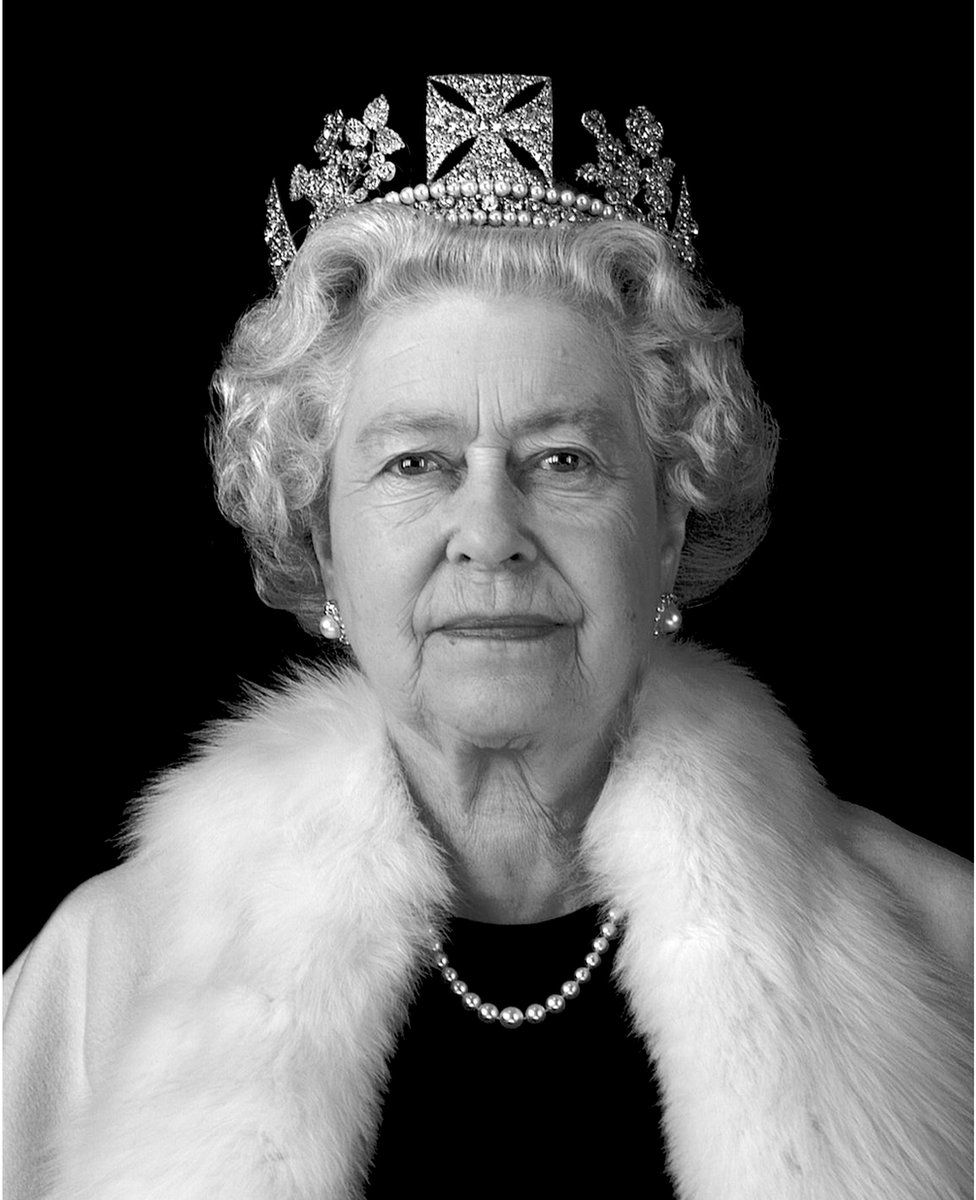
Going by Twitter, a fair number of British people (probably greater in Northern Ireland and Scotland than England) and lots of "Black Twitter" no matter the country, said "good bye and good riddance" yesterday when Elizabeth II died.

America? Not so much. There's probably some US residents that greeted it with a yawn, but, I venture that, of people who had an "emotional opinion" of some strength on the queen's death, the percentage saddened or whatever was higher here in the States than in the UK, and probably much higher than in other outposts of the British Commonwealth.

Some political scientists have said that most Americans' veneration for, nay, semi-worship of, the US flag is a substitute for not having a monarch. 

If true, it's apparently not enough of a substitute, given yesterday's outpouring.

Didn't we secede from a distant ancestor of hers? Yes.

Aren't we supposedly egalitarian? Supposedly, yes; actually, no.

And, maybe THAT is part of the issue.

Study after study has shown that, at least since the time of Shrub Bush's Defense Secretary Donald Rumsfeld castigating "old Europe" for not backing the US on the Iraq War, that "old Europe" has higher economic class mobility than the US. Even with the UK having less class mobility than continental Europe, it's likely still ahead of the US.

So, maybe that's it. Royals envy is part and parcel of a class-based society that the US denies it has. I mean, I don't think "working class" White folk, let alone minorities, have this. It's a middle class and upper middle class and beyond issue.

As for Elizabeth? I've already done two semi-takedown obits in a week. No need for another.

I will note that when I dropped this Tweet:

Into a "Monty Python" group on Hucksterman, the only people who liked it were British. (Hatred was from both Americans and British, even though the Beeb mentions the reality of George V's euthanasia in talking about the "London Bridge is Down" transition plan.

So, I noted that I regretted this Tweet, also posted there:

Didn't get the same vitriol and I was sad. (A full roundup of my Twitter snark is here.)

More seriously, and yeah, we're going to go halfway into obit land, with that.

Elizabeth wasn't "as racist" as Philip. (Or as the late Queen Mother.) But, could she have done more re the former Meghan Markle? Yes. It might be one thing to visit Oceania or sub-Saharan African portions of the Commonwealth as its sovereign or its non-sovereign leader, but the "color line" in the royal family? Not so much. And, let's not even get started on Charles' brother, Andrew, and Jeffrey Epstein. Oops, I guess we just did. Yes, she stripped him of titles just a month or so ago, but, this has been festering for a long time.

Otherwise, if you want "class," there's no need to look across the pond. The Windsors are as declassé as the ... well, as the Trumps.

That said, even though she reigned without ruling, Elizabeth did "nudge" here and there. It will be fun seeing King Charles III dealing with the twat of a new Tory PM Liv Truss and her climate-hating government. With their succession to their respective roles separated by only two days, there's bound to be head-on conflict, and given the degree to which Charles has long seemed to have been champing at the bit, I'm sure he's full ready for this.

Speaking of, per Unherd, if British democracy is so fragile, and crappy, today that you're worried about its post-Elizabethan future, isn't that another argument to junk the crown and take a full plunge? Or, to put it more bluntly, in Monty Python terms: If the death of some watery tart with a sword makes you fear for the future of your democracy, then per Samwise Gamgee, you never had much democracy in the first place, did you?

(UnHerd got even worse in its Saturday email blast. Good fricking doorknob, for a bunch of allegedly outside-the-box thinkers, their British contingent is a bunch of royal hand-wringers.)

Sidebar back to the Monty Python folks ... seriously, it's a Monty Python group, not a BBC newsreaders group. You could spoof the death of any living ex-president, or if a serving president stroked out (assassination different) and I'd be OK with it.

==

Update: It's not just Americans, though. Punker Johnny Rotten reincarnated as a royalist ass-kisser. Part of a great takedown.

December 26, 2020

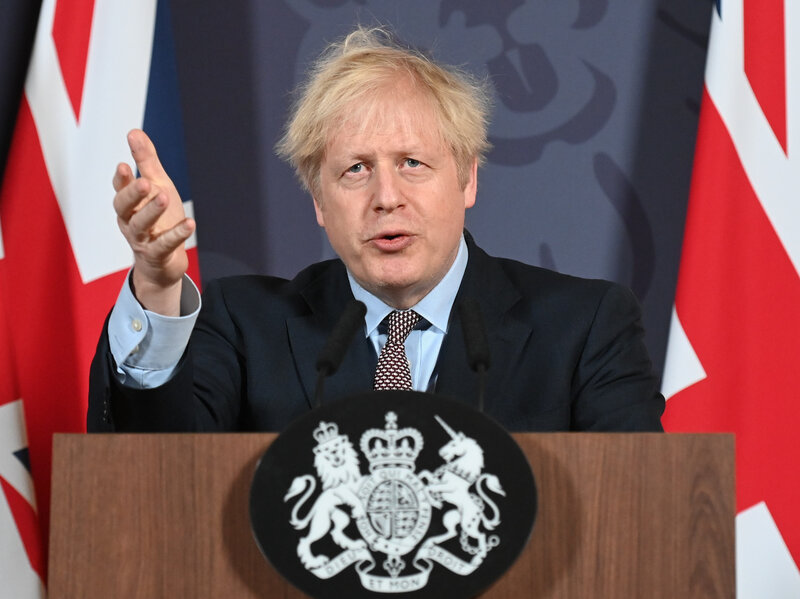
Brexit deal: No, Boris, you didn't win

A "Brexit deal" between the UK and EU is now here. Ireland-Northern Ireland appear the big winner overall. The UK is the bigger winner on fisheries issues, but the bigger loser on most other regulatory issues, and a number of things were punted down the road, which means Boris Johnson is lying (shock me) when he says "we have taken control." And, it was symbolic bullshit, as fishing is less than 1 percent of the British economy. Also per that NPR link, the claim that Britain will get some special deal in new trade negotiations with the US or elsewhere? Any new deal with the US will be one that will not harm US-EU relationships.

And, US banksters, knowing the UK is now cut off from the Continent that way, may push to further undercut The City of London's financial power. That — the details of Britain's financial services relationship to the EU — was one of the punts.

There's also still the question of whether Scottish nationalists will plump for another independence vote, and if Johnson would attempt to fight that.

Also contra Boris, the long-term game is much more in the EU's hands than the UK's. The leverage over Britain no longer being in the EU's financial services market is one reason. The European Central Bank and EU member state banks, plus major private banking firms, especially in Germany, will throw new weight around.

Ditto if, on the punted regulatory issues, Johnson or a successor tries to get hardcore on Ireland. Here in the US, a President Biden is ardent about the Good Friday accord, and if Johnson appears to be doing anything to hurt that? Related to Ireland? As Patrick Cockburn notes, there, the EU-UK border was agreed by Boris to shift to the middle of the Irish Sea, not between the 22 and the 6.

December 12, 2019

Goodbye to all that, Jezza Corbyn

Were the antisemitic smears against Labour Party leader Jeremy Corbyn real? Hell yes. I just blogged about the disgust of Bomis founder, and creator of this W-thing, Jimmy Wales, pushing them.

But sorry, US pergressuves, while the antisemitic and other smears were real, as was media bias, they weren't the only reasons Corbyn lost. Corbyn refused to take a firm stand either way on #Brexit, whether #Leave or #remain, and refused to accept this was the center of the campaign.

The same was true with Corbyn in 2016, even though the Parliamentary Labour Party and the unions both took a strong #Remain stance. Corbyn only timidly spoke for Remain the last weekend of the #Brexit referendum.

A caucus vote, as I see British parliamentary politics, on an issue like #Brexit, is like a triple-line-whip vote in the Commons. If Corbyn couldn't ardently support #Remain in 2016, he should have stepped down as party leader back then, no matter his desire to reform Labour.

And, this is nothing new from me. I said all this at the time of the referendum. Three and a half years ago, I called him a British Tom Mulcair, and if anybody knows what I thought about Canada's then-New Democratic Party leader, they know that's a slam indeed.

In this way, and not just on #Brexit / #Remain / #Leave, the New Statesman may be half right about Corbyn. Beneath the surface, perhaps he's a trimmer on some issues. Even Just.Another.Politician.™

And, yes, I’m serious. Frankly, I think Corbyn himself has been, and remained, a closet Leaver. In 2016, he said just enough pro-Remain at the end of the campaign to keep from getting turfed as party leader.

But, then, in the 2017 election, and in the just ended election, while he had no problem calling out Tory lies on other issues, he never would  call out — at least not ardently and as a full laundry list — the laundry list of Tory lies about Brexit.

And that would make him Just.Another.Politician.™

In turn, it would make the campaign to defend his conduct as party leader another example of twosiderism. And regular readers of this blog know I loathe that.

I also, to some degree, love seeing it, because it gives me an easy opening to be a deliberate contrarian, at which I’m damned good.

Anyway, it’s already out there. Some Berners are touting this.

Someone who definitely knows better, the allegedly outside the box steno Aaron Maté, is also already pushing this line.

Why not just admit that part — not all, but part, and not a small part — of the problem with Jeremy Corbyn was Jeremy Corbyn, and his stance on Brexit?

Maybe some part of it was Corbyn the campaigner. That said, per Zoe Williams' description of this issue, I think it folds up into Corbyn the closet Leaver. (More here, linked off that article, with some Labour losing candidates in that election calling out leadership, if not Corbyn by name, for "facing two ways" on Brexit.)

There’s one other issue.

In refusing to accept the 2016 PLP vote on Remain, Corbyn comes off as trying to make the parliamentary election system more like the American presidential-focused process.

Just like Corbyn’s Labour BFF stood accused of doing.

Congrats, Jeremy. You’ve finally caught up with Tony Blair on something.

In the nonce, per the title, and Robert Graves, let's see how bitter the parting is.

So, I don't feel sorry for Corbyn as ex-party leader.

I do feel sorry for British Labour, which is now going to have New Labour say that it's right after all, and unionism wondering if it's going to become almost as dead as its American version.

 I feel sorry for the British people, who are now going to be governed for five years by an uncouth elitist-populist toff and yob who will have an ironclad majority to do whatever he wants to the NHS that he and Farange lied about and many other things. I feel doubly sorry because your economy is likely to crap out.

I feel sorry for Scotland, where its Remainers from its independence vote of a few years ago will surely now have buyers' remorse, even as Johnson blocks any attempt at a second referendum.

I feel sorry for Northern Ireland / Ulster, which is going to get royally screwed simply because Johnson will continue to not accept that he can't force the EU to do what the EU doesn't want to do. Since the DUP lost seats, it's weakened anyway, even more so with Johnson in a strong majority, not a coalition.
 
==
 
Four and a half years on from this, Labour is finally in power again, led by Keir Der Starmer, the man who shivved Corbyn. Corbyn's still in parliament, as an independent. And, with the margin of Labour's victory, arguably even more marginalized than he was a month earlier.

March 01, 2019

An American analogy to Israel and Palestine

Let us say that the United States Government admitted the error of its ways on the Black Hills.

Let us ALSO say, though, that it knew the Sioux were no newer to the Black Hills than Lewis and Clark going up the Missouri.

So, it gave joint custody to the Sioux (Lakota, Dakota) and the Crow.

Let us say that the US Government kept a form of trusteeship for a few years of transition.

Let us then say that this was not acceptable to the Sioux. That Sioux leader Crazy Bull, considered a terrorist by the US Government, put a bomb in the Roosevelt Inn. The government expedited its pullout.

After the Sioux attacked the Crow, let us say that the Arapaho, Shoshone and Pawnee rallied to the side of the Crow. And that the, say, Arapaho eventually annexed the Crow land.

Twenty years later, the Arapaho, after first thinking better, joined the Shoshone, Pawnee and Winnebagos in a new war against the Sioux. And lost the Crow lands to the Sioux.

Fifty years later, the Crow were fighting for their independence from the Sioux.

Let us then say that some Sioux accused all non-Sioux and non-Crow of Crow-splaining.

That's where we're at.

For those who don't get it, substitute Great Britain and League of Nations Palestine mandate for the US and work forward.

May 08, 2015

A few thoughts on the UK election blowout

With the Tories, per exit polls which appear to be accurate, gaining seats and apparently an outright majority, Labour becoming non-existent in Scotland, Liberal Democrats almost nonexistent everywhere, and the UK Independence Party underperforming, here's a few hot take initial thoughts by me.

Which now include, per results in one seat, my riff on an old British riddler poem, at left.

1. Even if it turns out that Nick Clegg has won re-election for his seat, he has to resign as LDP leader immediately, doesn't he? Even more so if David Cameron has gained enough seats to coalition with Northern Ireland's Democratic Unionists. And, he has, both held on to his seat and resigned his leadership.

2. And, what about Ed Miliband? If Labour turns out to finish as badly as projected, doesn't he have to resign as party leader? Losing every seat in Scotland, losing seats overall, and, if the prime ministership were a direct vote, being var less popular than Cameron, to me makes me think he has to go. Here's three people who have gotten talk as possible replacements before. And, some Labour muckety-mucks are already whispering. Ed has gone, too.

More seriously, does the party shift back to a New Labour focus of Milliband is turfed, or does it chalk up the loss to Milliband personally more than his ideas?

3. Cameron's 2017 EU referendum will go forward. Exactly what it will be about will probably not be discussed in detail for 3-6 months, but will get a crafting after that. The UKIP will get a respectful listening, then ignored.

4. Was the SNP's results a one-off, a result of the failed independence vote, or is this more permanent?

5. Even with the LDP's decline, and with the Tories largely quashing the UKIP, is Britain, even without Clegg getting instant runoff voting in 2011, headed toward a continental-style true multiparty system?

I think not. Eventually the SNP will fall back somewhat at it realizes that any way it comes to power is only in conjunction with Labour. The LDPs have seemingly crested and will look for new direction with Clegg out. UKIP will remain quashed.

And, if the SNP thinks another independence referendum is "inevitable," I'd invite it to think again. A Conservative government will never allow it. A would-be Labour government would never allow it as the price of coalition, certainly not for at least a generation.

6. That said, the Tories — and their American cousins — will use this as a rallying point for budget austerity.

September 17, 2014

#England vs. #Scotland — a 9-point overview and more

Tomorrow, the vast majority of eligible voters in Scotland head to the polls to vote on whether to become independent from the rest of the United Kingdom or not.

So, what's all at stake? Besides North Sea oil and gas reserves?

Pride. Resentments. Related psychological issues The Tories, the Conservative Party. Actual, and perceived, economic issues with London.

And, North Sea oil and gas reserves.

Those are the biggies. Any lesser issues connect with one or another of the big ones.

First, the funny version, from John Oliver, who is great with this.


That said, the serious version.

First, the economics.

I don't know how much Scotland feels "stiffed" by England. The per capita GDP? Scotland at $44,378 vs England at $50,566. Actually, if income differentials are a cause for secession, Wales, at $30,546, has more right to want to leave the UK. (That said, per the Beeb, how North Sea oil and gas revenue is divided could affect the Scotland/England difference.)

At the same time, while England may not be as liberal as, say, Sweden, it's more liberal than the US. I presume that that includes being more liberal overall in progressive taxation. That income differential may hurt.

Ditto on language. Welsh is spoken by about 20 percent of Wales, and 15 percent read and write it with proficiency. In Scotland? Only 1 percent speak Scottish Gaelic; yes, 20 percent speak Scots, but, it's been affected enough by standard British English that one could halfway argue Scots is an English dialect and not a separate language.

That addresses non-economic pride and resentment issues to some degree. Scotland may not be so united if resentment against London (primarily against Conservatives, but somewhat against Labour) is discounted.

Natural resources distribution, per what I said above? A chart on Oliver's video tells the truth. By 2040, North Sea oil production will be about one-quarter of what it is today. Indeed, in less than a decade, production is likely to be less than a quarter of the 1999 peak.

More economics. Per this good 9-point overview from the Washington Post, I don't see how an independent Scotland can continue to keep the pound as its currency; certainly not as its official currency:
An independent Scotland would keep the British pound as its currency, the SNP says. No, they would not, the British government replies. 
It's a clear divide between the "yes" and "no" camps. For what it's worth, Salmond has argued that it doesn't really matter what London thinks. "No one can stop us from using" it, he told Sky News this week. 
He's not wrong, but there may be complications. The independence movement has suggested that it would seek a currency union with the United Kingdom, but the powers in London would have to agree to that. Should they refuse, Scotland could unofficially use the pound anyway, in the manner that Ecuador uses the U.S. dollar. 
Both options present risks. A recent article in the Economist explained how a "sterling zone" created by a currency union might end up looking like the euro zone, "with Scotland in the part of Greece." The New York Times' Paul Krugman wrote last week: "If Scottish voters really believe that it’s safe to become a country without a currency, they have been badly misled." 
Scotland could, of course, create its own currency, though the independence campaign hasn't suggested that yet. There's also another complication: If Scotland is required to join the European Union as a new state, it may be compelled to join the euro zone. Scotland doesn't want that, for obvious reasons.

I've seen people favoring independence bash Krugman. Well, any idiot knows he's right about the eurozone. Sorry, folks.

And, the yes folks are showing naivete or hubris on other issues related to this First Minister Alex Salmond et al claim that Scotland could join the European Union via renegotiation of treaties. The EU, per a CNN overview, has already said no. 

In that case, it appears Scottish adoption of the euro would be part of the price of membership. 

The Wall Street Journal further discusses pros and cons of five different monetary options.

That said, if there's a yes vote, for oil and gas reasons alone (even if they are already in decline), this would be a blow indeed to the remnant UK.

So, why? I think the Telegraph has it right. Starting with the Thatcherite mistreatment, while the economy is an issue, it's ultimately psychological.  That said, the Telegraph's also right that, setting aside Thatcherite-related resentment, the West continues to generally move, for now, toward a post-industrial world. What can Scotland offer to that world besides oil?

As for the outside world?

If North Sea oil and gas weren't involved, the international business world probably wouldn't pay half as much attention.

Per John Oliver, if not for Mel Gibson in "Braveheart," and a love-hate relationship with haggis and bagpipes, the average American probably wouldn't pay one-quarter as much attention. Just wait and see the yawns and ignorance that greet any Catalan independence movement.

So, if you do like bagpipes, crank up "Scotland the Brave."


And, if you're really interested, it may take 3-5 years after a yes vote to find out if, or if not, "Scotland the Brave" was also "Scotland the Dumb."

To Americanize this, it would be like if Austin wanted to secede from the rest of Texas.

March 01, 2014

Read how Edward VII helped create modern Britain and a modern monarchy

The Heir Apparent: A Life of Edward VII, the Playboy PrinceThe Heir Apparent: A Life of Edward VII, the Playboy Prince by Jane Ridley

My rating: 5 of 5 stars


Fantastic bio of King Ed, normally known as "Bertie" to his intimates, after his given first name, Albert. I learned a number of things about him, beyond having known about some of his "wastrel" background, that he was the impetus for a cigar brand, and he had a tumultuous relationship with his mother. Let's start with that given name and mother, Queen Victoria.

Somehow, somewhere, long ago, I had heard that Victoria, as a deathbed codicil to a personal will or something, had asked that no future king be called or styled Albert. Actually, she had wanted Bertie to name his eldest Albert and perpetuate an eternal line of King Albert, such was the quasi-narcissistic nature of her mourning for her husband. (Bertie and Queen Alexander named their oldest Edward, and Bertie told his mom her idea was dead on arrival.)

The philandering? Perhaps platonic, perhaps more, it continued even after he assumed the throne in 1901.

The maternal relationship? Stormy, especially before the ascendancy of Wilhelm II in Germany in 1888 then Victoria's diamond jubilee in 1897. She thought him unintelligent, cut him out of information about cabinet meetings, and disagreed on "sides" in the Schleswig-Holstein war of the early 1860s, which led to Prussia's rise under Bismarck, then the founding of the German Empire.

That said, by insisting on a public procession and more for both her golden jubilee in 1887 and the diamond, Bertie did as much as anybody, arguably, to save the monarchy, as tides of Republicanism were on the rise, and Victoria, by her perpetual mourning, including refusal to open Parliament and more in many years, was arguably failing her constitutional duties.

Ridley also shows how Edward, in his last years as prince and early ones as king, was key to the Entente Cordiale between Britain and France, yet worked to keep a hand out, unsuccessfully, to Wilhelm.


View all my reviews

December 09, 2011

The UK must choose

It's clear that a 30-year period of reckoning for Great Britain vis-a-vis the EU has finally come due. Britain must choose whether to be part of a more financially integrated EU, even if it stays out of the Eurozone, or decide what it wants to do outside of that.

And, of course, this is all complicated by politics within the UK.

Assuming that financial services is that much a part of the British economy, I think Tories have to ask whether it will shrink more as part of the new EU or outside of it.

Frankly, a tighter monetary EU will, eventually, boost the Continent's role in finances, especially if any directives from Brussels are ultimately influenced by glances at Berlin. So, if Prime Minister David Cameron wants to walk around in EU purgatory, or even, as Tory backbenchers clearly want, leave the Union entirely, I think he's an idiot.

Sign on. Britain's financial sector will take some sort of hit, true. But, not immediately, and not in a way that Cameron, if he has any brains (questionable) can't actually fulfill his talk about leading a new type of Conservative Party.

The option of playing at the EU edges? Assuming Merkel and Sarkozy can pull something off, that's not a long-term option.

Cameron's stiff upper lip talk otherwise, larger EU-27 institutions will lose relative power if the narrower eurozone gets new financial strength, new financial regulations strength and, above all, is less unwieldy and more open to easier reform of governance. Eventually, the other "outsiders," even those already given tentative eurozone approval, will have to sign off on the bottom line, too. So, unless Britain can convince a minority of "outsider 10" to follow it, a two-tiered EU just doesn't sound that plausible.

So, ditching the EU entirely? Unhelpful. Despite new openness on banking, Switzerland's tight world would make it equal to an independent UK as an EU counterweight. The rest of the Commonwealth? Canada's tied to the US. Australia is largely independent. Other countries matter less.

Labour would, albeit reluctantly, surely take the plunge, also liking more of Brussels' regulatory powers and ideas.

Per Indiana Jones and the Holy Grail, choose wisely, Mr. Cameron. You may not get a second chance.

And, per U.S. conservatives, don't root for Cameron to choose to opt out. The "special relationship" will only be diminished if Britain itself is.

At least not at the head of a government.

That said, if this leads to a referendum, Labour won't be able to do any "straddling" itself.

And, whoever leads the country, if Britain winds up in financial outer darkness, does it wind up as more a "lapdog of the US"? Thoughts for all British political leaders.

It's not the choice of the EU vs. a more independent UK. That ultimate 30-year reckoning on alignment may be coming due.

Roger Cohen agrees about that and about Cameron's short-sighted stupidity.


July 28, 2011

Who's the UK's biggest political toady?

It would seem the two finalists are prime minister and Conservative Party leader David Cameron and junior coalition partner and Liberal Democratic leader Nick Clegg.

As ever more of the Murdoch empire shenanigans come to light, and more and more questions arise about what Rupert and son Janes knew and when, here's where I pretty much think we're at.

Cameron basically faces Rupert Murdoch having just crapped in a commode, with Rupert then asking him, how long are you willing to stick in your head, and how deep.

Clegg, now that he knows how low Cameron has gone, yet stays in coalition, faces Cameron having just crapped in a commode, with Cameron then asking him, how long are you willing to stick in your head, and how deep.

However, these two may not be alone.

Labour leader Ed Miliband may have at least licked the rim of Murdoch's commode, it seems.

And, in the retired politician division, Tony the Pony Blair probably drank about as deep as Cameron did.

But, for my money, Clegg is the biggest toady. The alternative voting referendum failed, with Cameron doing nothing to promote it. Then, Cameron made his "let's privatize everything" comments. When News of the World melted down, Clegg had the perfect excuse to get on the moral high horse and leave the coalition.

Unless he's been drinking from Murdoch's crapper as well as Cameron's.

October 22, 2010

Britain 1931, Krugman-style

No, isn't it Britain 2010 right now?

Paul Krugman, in dissecting the British coalition goverment's likely-to-fail austerity fad, says, it may be 2010 now, but the clock could move backward soon enough.

He starts with what brought Britain to this pass:
Over-reliance on the financial industry largely explains why Britain, which came into the crisis with relatively low public debt, has seen its budget deficit soar to 11 percent of G.D.P. — slightly worse than the U.S. deficit.

And, what's behind this all:
Why is the British government doing this? The real reason has a lot to do with ideology: the Tories are using the deficit as an excuse to downsize the welfare state. But the official rationale is that there is no alternative.

Indeed, there has been a noticeable change in the rhetoric of the government of Prime Minister David Cameron over the past few weeks — a shift from hope to fear. In his speech announcing the budget plan, George Osborne, the chancellor of the Exchequer, seemed to have given up on the confidence fairy — that is, on claims that the plan would have positive effects on employment and growth.

And, what's likely to result:
What happens now? Maybe Britain will get lucky, and something will come along to rescue the economy. But the best guess is that Britain in 2011 will look like Britain in 1931, or the United States in 1937, or Japan in 1997. That is, premature fiscal austerity will lead to a renewed economic slump. As always, those who refuse to learn from the past are doomed to repeat it.

If Britain 2012 looks even close to Britain 1931, the Liberal Democratic party faithful are going to demand Nick Clegg's head for bringing them into coalition with the Conservatives.

September 03, 2010

Rupert Murdoch: Spying on Her Majesty's secret sons

In case you missed it, News of the World, a Murdoch tabloid, hacked Prince William's and Harry's cell phones. At question is not only that, but Scotland Yard's investigation. Or, lack thereof to remain cozy with the sleazy Chez Murdoch British media empire, as the NYT Magazine amply documents:
“There was simply no enthusiasm among Scotland Yard to go beyond the cases involving Mulcaire and Goodman,” said John Whittingdale, the chairman of a parliamentary committee that has twice investigated the phone hacking. “To start exposing widespread tawdry practices in that newsroom was a heavy stone that they didn’t want to try to lift.” Several investigators said in interviews that Scotland Yard was reluctant to conduct a wider inquiry in part because of its close relationship with News of the World.

How serious is this?

Murdoch has already paid $1.6M on settling suits on this.

All while fighting to keep the settlements secret.

And, News of the World's chief lying about the whole affair, as The Guardian continues to smack down the Murdoch empire.

So, what is Fox News doing in the US?

April 25, 2010

Lib Dems continue to creep upward in UK

Between that and Tory leader David Cameron now refusing to rule out electoral reform as part of the price of coalition, I'd set the odds of a hung parliament in Great Britain after the May 8 election at 50-50.

April 22, 2010

Cameron up, Clegg flat, and Gordo?

Well if Tory leader David Cameron came out "up" in snap polls after the second British prime minister candidate debate, and Lib Dem leader Nick Clegg held his own, then Labour leader and Prime Minister Gordon Brown is in more trouble, right?

And, Clegg was more than flat:
Mr. Clegg – standing between Mr. Cameron and Prime Minister Gordon Brown – put up a strong fight in response to attacks from both sides. He was pronounced the victor in one poll, and came in second, after Cameron,in another.
Looks like Gordo is in trouble indeed, as noted yesterday.

Meanwhile, back to Clegg:
After winning the first debate last week, expectations had been raised for Clegg, explains Andrew Russell, a lecturer in politics at Manchester University. “Clegg withstood the pressure and did a great job, which means Britain is all that much closer to getting a hung parliament.”
Cameron, especially, attacked him as anti-American. No, he's more pro-EU than the Tories, and more open about it than Labour.

The Telegraph has details on how all three answered the top questions.

For more on the election possibilities, go here.

April 19, 2010

Could Lib Dems win UK?

After Britain's historic first-ever television debate between prime ministerial candidates, it's certainly possible, with the Liberal Democrats moving into a polling lead.

But, with thinness on the ground, and other factors, Nick Clegg's party could finish first in total votes amassed but second or even third in number of parliamentary seats won. For possible MP breakouts, here's a good interactive page.

That said, the "surge" by Clegg, after what is widely considered him having a solid win in the debate last Thursday (the first of two) has put both Prime Minister Gordon Brown's Labour and David Cameron's Tories on the attack against Clegg.

Meanwhile, the debate and post-debate Lib Dem surge seem to reflect a few things:

1. Both "incumbent/mainstream" parties still have significant loathing over the expenses scandal.
2. The Lib Dem opposition to the Iraq War isn't useless with British withdrawal there; there's still Afghanistan, and broader foreign policy issues.
3. If Clegg can finesse Eurozone issues in the second debate, the Tories' bashing of him will boomerang, and the party's "old" and "new" wings will glare at each other.
4. If the Lib Dems can take half of those still "undecided," the party could have a clean win. If not, it's coalition time.

But, with whom?

I really can't see a Lib Dem-Tory mix. The Conservatives, in such a case, will be splitting more and more into "old" and "new" factions, and the "old" faction might not want to stay in coalition very long.

Lib Dem-Labour is more likely, but with more serious wrangling over portfolios, the amount of "reform" and more. Given that current election inequities most favor Labour, this could also be a sticky wicket.

That leaves two possibilities.

One is a minority government. However, in contradistinction to Canada, for example, I don't see that happening in Britain.

The other? A la Germany, a "grand coalition" of Labour and Tories, cutting the Lib Dems out.

Don't laugh. Cameron is almost alcoholically thirsty for something he can call a win, even if Brown gets to stay as PM. Brown wants a win in his own right. Simple enough.

November 23, 2009

Rogue cops not limited to US – look at UK

Supposedly, British cops have been arresting people just to add their DNA to national database. Orwell is turning over in his grave.

October 30, 2009

Tony the Pony NOT a lock as EU prez

Former British Prime Minister Tony Blair is finding his shot at the European Union presidency taking a sudden swan dive, primarily due to lack of support from French President Nicolas Sarkozy and German Chancellor Angela Merkel.

Why? Politics. The two want a leader from one of Europe’s center-right parties, like themselves.

Also hurting Blair’s candidacy — Britain being outside the Eurozone. What puzzles m e is why this hasn’t been held against him all along. Especially since he never did hold up his promise to push this.

Interestingly, parties of the center-left in Europe have kind of written off the presidency already, and are focusing on the EU foreign ministry. Read the full Guardian article for more such details.

October 26, 2009

British myth and ethos take two blows

First, new historical research says that Henry V’s big victory over the French at Agincourt wasn’t an upset at all, contra British royal and national mythology.

Second, could Pope Benedict XVI’s wide-open arms to Anglicans shatter the myth of the Church of England actually being that? I didn’t know that Catholics already outnumber Anglicans in the UK.

In any case, A.N. Wilson thinks it would be nothing but good news if the Church of England were, in fact, disestablished.

October 23, 2009

October 13, 2009

Bloggers, papers foil British govt gag order

Earlier today, I blogged about how the British government slapped a gag order on the Guardian.

But, at least one political blog ran full details about what the government was trying to suppress. And, although technically illegal, so did one large mainstream paper, the Spectator.

That said, contra BoraZ on Twitter, I wouldn’t ascribe all the reasons for ignoring the gag order to Twitter. Back in the “old” days of “just” e-mail, this likely would have gotten enough publicity for the same result. Maybe even in pre e-mail, “just” telephone days.

That said, WHAT was the House of Commons so worried about? Per the Spectator, it was a cover-up of oil pollution in Africa by Trafigura. The Guardian has more.

If the Gordon Brown government hasn’t been tragicomic enough, this is ridiculous.

Bloggers, papers foil British govt gag order

Earliier today, I blogged about how the British government slapped a gag order on the Guardian.

But, at least one political blog ran full details about what the government was trying to suppress. And, although technically illegal, so did one large mainstream paper, the Spectator.

That said, contra BoraZ on Twitter, I wouldn’t ascribe all the reasons for ignoring the gag order to Twitter. Back in the “old” days of “just” e-mail, this likely would have gotten enough publicity for the same result. Maybe even in pre e-mail, “just” telephone days.