SocraticGadfly: Geithner (Tim)
Showing posts with label Geithner (Tim). Show all posts

December 03, 2016

Maybe Trump will tie both parties, and #neoliberals, into knots on #freetrade (updated)

Most people have heard about the keeping of 1,000 850 Carrier jobs in the US, with the flip side of approximately $7 million in incentives for Carrier's parent company, United Technologies. (It should be noted that the deal doesn't save as many jobs in the US as Trump first claimed, but, does require Carrier to make new investments in the Indiana plant.)

Setting aside issues of the military-industrial complex, it seems the biggest mouth-foamers on this one (Kevin Drum was the first I saw) are majority neoliberals, follow by people who, whether neoliberal or not, would be identified as Democratic Party apparatchiks above all.

Well, Trumpy ain't done yet.

First, he's targeted another company, Rexnord, that has announced plans to move jobs to Mexico. This one, like Carrier, is headquartered in Indiana, which makes one wonder how much power to cut deals like the Carrier one Trump will have after Jan. 20, 2017, when Mike Pence becomes vice president and stops being governor of Indiana. No matter. That bridge will be crossed then.

Second, and in clear disagreement with Speaker of the House Paul Ryan, Trump has openly espoused a "buy American" requirement for iron and steel in water infrastructure projects. Yes, per the story, he's arguably hypocritical, as his skyscrapers have used imported steel.

So what? If he wins this battle, it will send out shock waves. First, by the number of Congressional Democrats that are already supporting him, Trump may force those Party apparatchiks to do what they don't want to do on their own — accept non-free trader, non-hardcore neolibertarians into party leadership, and apropos the just finished presidential primaries, to accept them as candidates, as well.

As the likes of Matt Stoller have already said on Twitter, Trump may well actually deliver more on jobs protection than Obama promised.

And, on cost savings from federal contractors, too.

It remains to be seen how it pans out, but, The Donald bashing Boeing over estimated costs for a new Air Force One is refreshing. (And, contra Politico, on paper at least, more robust than Presidents Obama or Clinton on the Democratic side.)

And, even St. Bernard of Sanders is wrong on this one, and I presume acting as Democratic (because he really is a Democrat) apparatchik first, labor backer second.

As Stoller has also noted, as have others, in the case of Carrier, presidential administrations both Democrat and Republican have given trade preferences to defense-related industries. And (although I disagree with them) states and municipalities have long had economic incentive grants. Bet you did as Burlington mayor, Bernie.

Survey says?

Per this piece, Mayor Bernie supported a bond issue that helped benefit a high-end development. When it didn't get a two-thirds majority, he used an eminent-domain lawsuit in conjunction with the state. Per The Nation (which mentions part of the Lake Champlain development but "overlooks" the suit) Bernie provided seed money for start-up businesses. The Nation also says he "helped" other businesses, not just start-ups, but again, no details, except in one case where it says he "provided capital." This was all part of the Community and Economic Development Office that Sanders created as mayor.

Yes, Bernie did help nonprofits, help get affordable housing, and more, but! He gave already established businesses money — possibly after hints they'd move elsewhere or something.

And we haven't even mentioned Senator Sanders voting to increase federal handouts to Big Ag dairy farmers, and Rep. and Sen. Sanders lusting after F-35s.

Of course, when other people are having buyer's regret over voting for a man whose Treasury Secretary-designee foreclosed on their houses during the Great Recession (setting aside that the woman in question induced her own moral hazard by buying the property in the SoCal bubble market for rental income), things will be very fluid politically for some time. That itself is generally good.

And, even there, blame Obama's Treasury Secretary, Tim Geither, and Obama himself, for setting up an alleged "bailout" plan for homebuyers that was really a way to launder more money to banksters. Trump is replacing an incrementalist and knocked off another; again, the fluidity is generally good, IMO.

And, Trump might upend the GOP as well. Paul Ryan's Wisconsin district has a fair amount of blue-collar workers. If he opposes Trump on issues like this repeatedly, I would in no way be surprised if Trump tried to get Ryan "primaried" in 2018.

December 04, 2014

#Obamacare: If Chuck Schumer is a 2016 Democrat, I'm more Green than ever (updated)

So, Sen. Chuck Schumer (D-Wall Street) is saying that Democrats in 2008 didn't have a mandate to pass Obamacare?

Really? I could have sworn that I heard both Barack Obama and Hillary Clinton discuss national health care ideas of some sort or another in multiple Democratic debates and their campaigns in general. I could have sworn I heard Obama mention something about it in the general election.

As for not tackling the recession? Hey, Chucky boy, did you push Obama to keep his stimulus package below $1 trillion? Yes, as the survey shows. Even worse, we know you pushed Obama to name one of the chief architects of the recession, Tim Geithner, as his Treasury Secretary.

Either admit that you, like Obama, didn't take the Great Recession as seriously as you should have, or shut up.

Right now, you're blaming a non-issue as part of the cause of a problem which you helped cause.

===

Update, Dec. 4: Michael Hiltzik answers Schumer, his inside-the-Beltway supporters, and, indirectly, other Senate Democrats.

He says the problem isn't with Obamacare, but with Senate Democrats who ran away from it and let the GOP define it.

Fair enough, as far as it goes, Michael.

But, some of that criticism needs to attach to The Not So Great Communicator himself, Dear Leader.

This is Hiltzik's second column on this issue since Schumer spoke out.

In his first, he gave Schumer a paddling for "spinelessness."

He adds that O-care benefits the middle class as well as the poor.

Then, there's this.
(L)eaving aside that Congress and the White House should be able to walk and chew gum at the same time, the notion that the pursuit of healthcare reform resulted in the abandonment of economic growth policy is bizarre.

True that. On the other hand, since his first six months in office, at least on major issues, sometimes it does seem that this is the case. 

Hiltzik does also remind us that Schumer apparently lost his 2009 legislative calendar somewhere:
As Brian Beutler and Scott Lemieux cogently observe, President Obama had already gotten the Recovery Act through Congress before work began on the healthcare law, and he wasn't going to get more stimulus from the GOP on Capitol Hill no matter how hard he tried.
Charles Schumer, pandering idiot.

Doorknob help us if this is the opening salvo in challenging Harry Reid as Senate Democratic leader. (I suspect it is.) 

October 13, 2014

#Krugman guzzles #Obamiac Kool-Aid, the full party jug, gets an F for #fail

Paul Krugman is "doowwwn" with his Obama bromance!
Paul Krugman, possibly the best of the New York Times' op-ed columnists (of course, that could be seen as similar to the best bagel in Bismarck, North Dakota, and besides, overall, Gail Collins is better), once an Obama critic for the president having the Teddy Roosevelt-quipped "backbone of a chocolate eclair," now calls him "one of the most consequential, and yes, successful, presidents in American history."

Man, Krugman could't do much better, or rather, worse, if he were paid White House PR flak. And, if he were paid, it would be by the soft bigotry of low expectations count, because that's what ultimately drives twaddle like this.

Here's Krugman's tout list:

His health reform is imperfect but still a huge step forward – and it's working better than anyone expected. Financial reform fell far short of what should have happened, but it's much more effective than you'd think. Economic management has been half-crippled by Republican obstruction, but has nonetheless been much better than in other advanced countries. And environmental policy is starting to look like it could be a major legacy.
I'll go through that in detail in a minute.

First, Krugman dismisses the likes of Cornel West, who call him a fake progressive. Actually, I'd dismiss West by calling him a fake whiner; the reality of Obama's neoliberalism on fiscal issues, sellout on civil liberties issues, and other things, were all visible before the 2008 general election — a general election in which West avidly supported Dear Leader.

On health care, Krugman ignores that Obamacare was:
1. Written by AHIP and Mod Max Baucus;
3. Dilatory to the nth degree in its passage — whatever Dear Leader wanted should have been passed long, long before Scott Brown was elected to the Senate from Massachusetts
3. Based on Dear Leader lying all along about his stance on single-payer.

But, that's all pre-passage stuff.

Let's look at post-passage stuff.
1. More and more information that the most neoliberal parts of Obamacare, like electronic patient records, are nowhere near what they were cracked up to be
2. A horrible rollout (hey, Krugman, per Mike Dukakis, the fish rots at the top, especially on a "signature achievement")
3. Relatively modest proof so far of restraint of medical inflation rates.

Specific to that link on EPRs? From that story:
Frustrated medical professionals across the country told The Dallas Morning News that the expensive systems — the technology used by Texas Health Presbyterian Hospital Dallas, part of a $200 million investment by its parent company — are often unwieldy and problematic.
 (Experts) have documented cases where patient histories and other information have seemingly vanished from software or ended up in the wrong place.
 And researchers have found that emergency room doctors are more frenzied in keeping up with data demands because of the complicated systems, even hiring personal scribes to input information for them on the fly.

That said, per the story, EPRs were actually fobbed off on the American public by Shrub Bush. But Obama gleefully embraced them.

Krugman touts a drop of about 10 million people without health insurance. Nice, but far short of the 25-30 million mentioned not too many years ago.

Krugman then claims single-payer wasn't politically feasible. I'd argue it was before Scott Brown was elected, at least. But, because it was never in the playbook of a man who, during the 2008 primaries, didn't "get" the need for the individual mandate, or else was lying on that issue too, what else can you say?

Financial reform? Here's Krugman:
You often hear Dodd- Frank, the financial-reform bill that Obama signed into law in 2010, dismissed as toothless and meaningless. It isn't. It may not prevent the next financial crisis, but there's a good chance that it will at least make future crises less severe and easier to deal with.
Well, if that ain't praising with faint damns, what is? I'll skip past the rest of this section, because it's that bad. It's ugly. It's doubly bad in that Krugman doesn't even mention Tim Geithner's hiring by name. It's triply bad because Krugman brings out the "soft bigotry of low expectations" card by comparing US recovery from the Great Recession to that of the European Union.

(Of course, Obama's whole presidency, when discussed by Kool-Aid drinkers, whether regular ones or Johnny-come-latelys, benefits from the "soft bigotry of low expectations" compared to Shrub.)

Krugman then dismisses with a light shrug Obama's approach to war crimes, etc., not even mentioning Dear Leaders "we tortured some folks" phrase.

And, the violations of civil liberties that got EXPANDED by Dear Leader?

Krugman mentions them not at all.

Hell, David Frum could have written something just like this from the other side of the aisle about Shrub.

Seriously, while Obama may not be in the bottom 10 of US presidents so far, he's closer to that than to the top 10.

 And,  two other asides.

First, I guess Krugman is OK with surrendering his civil liberties.

Second, we have two-plus years of encomia like this? Oy.

January 08, 2013

Stop it with the #Krugman for Treasury nonsense, please

First, the neoliberal president who appointed the Catfood Commission and who 10 days ago made Social Security cuts part of "fiscal cliff" talks is not going to nominate Paul Krugman to be his next Treasury Secretary to replace Little Timmy Geithner. In fact, Beltway rumor  is solidifying that the Compromiser in Chief will nominate his chief of staff, Jack Lew.

Second, Krugman wouldn't take it if offered. Besides leaving both academia and the New York Times, he knows that Obama would geld him somehow, like by moving the real action to the Council of Economic Advisors, plus nominating Geithner to replace Ben Bernanke at the Fed next year.

Yeah, yeah, Obama said almost four full years ago that he wanted to be pressured from the left. Don't tell me you still actually believe that.

This is just the surface of the issue.

Unless I'm in full idealism mode, I prefer online petition drives that are:
1. Relatively realistic;
2. Not in some way connected to fundraising efforts.

The Krugman petition does, as far as I know (especially if it's a White House site one) theoretically cross the second bar. But, it doesn't cross the first.

That's why I don't do global warming petitions to Obama. They're unrealistic, not just because of Mitch McConnell and John Boehner, but also because of Barack Obama. And, they're usually connected to fundraising, especially by Gang Green enviros.

December 17, 2012

I'll personally kick Obama in the nads if ...

If this rumor/speculation is true and Tim Geithner is his choice to replace Ben Bernanke to run the Fed.

Incompetence, Peter Principle, arrogance, ego, elitism, etc., etc ... dammit, I'm running out of adjectives to describe Geithner.

But, William D. Cohan lays out a strong inside-the-Beltway case for Little Timmy both wanting, and probably getting, the job:
The usual list of highly qualified candidates to replace Bernanke -- including Lawrence Summers, the former Treasury secretary and Harvard University president; Janet Yellen, a current vice chairman of the Fed; and Alan Krueger, the precocious chairman of the White House Council of Economic Advisers -- misses the person who probably wants it the most and continues to have Obama’s ear on a regular basis: Geithner.

Last spring, Geithner told Obama he wanted to leave Treasury as soon as possible and return to New York so that he could rejoin his family, while his youngest child was still in high school. But Obama prevailed on Geithner to stick around until after the election. And he remains in Washington to help Obama negotiate a deal on spending and taxes with Congress. 

Had Geithner been serious about wanting to leave town, he probably would have thrown his hat into the ring to become president of Dartmouth College, his alma mater. But that position went to Philip Hanlon, the provost of the University of Michigan, without Geithner’s name being mentioned. Expect Geithner to seek a short-term sinecure at a liberal think-tank, such as the Brookings Institution, or to return to the Council on Foreign Relations, or to cash in as an adviser to a hedge fund (as Summers did at D.E. Shaw & Co. after he left Treasury) while he awaits the possibility of getting nominated as Fed chairman. 
Doorknob help us all ... the Fed will be cutting all sorts of backdoor deals with the banksters. Even more so if Jaime Dimon is named Geithner's replacement at Treasury.

That said, be honest. Even if you're an off-the-boards Obamiac, would such a move really surprise you?

The only possible condolence is that he might be better at the job than Summers. But, you know? I'm not even sure about that.

July 25, 2012

Reason 10,100 to vote Green - Geithner, Fed, Libor, criminality

Tim Geithner
Looks like Dear Leader, by extension, is even dirtier in relation to the banksters than we might even have dreamed, up to this point.

Seems like the New York Federal Reserve, helmed at the time by Preznit Kumbaya's current, and original, Secretary of the Treasury, Tim Geithner, already knew in 2008 that Barclay's, at least, was fudging on Libor rates.

Here's the start of the information about Timmy G. and gang apparently turning a deliberately blind eye toward London Interbank Offered Rate interest-rate manipulations by Barclays, manipulations which have already made hot news across the pond in Great Britain, but have yet to register here in the U.S. Maybe this will register:
Although the New York Fed conferred with Britain and American regulators about the problems and recommended reforms, it failed to stop the illegal activity, which persisted through 2009.

British regulators have said that they did not have explicit proof then of wrongdoing by banks. But the Fed’s documents, which were released at the request of lawmakers, appear to undermine those claims.
And, oops, the NYT kind of buried the lede. Timmy G. and gang already had some "knowing" in 2007:
The New York Fed learned about concerns over the integrity of Libor in summer 2007, when a Barclays employee e-mailed a New York Fed official, saying, “Draw your own conclusions about why people are going for unrealistically low” rates. Barclays wrote in a September report, “Our feeling is that Libors are again becoming rather unrealistic and do not reflect the true cost of borrowing.”
Uhh, in the real world, this would be called criminal malfeasance.  But, not in the world of Timmy G.

Instead, it gets labeled "market chatter" and swept under the rug.

Plus, the 2007 date also undercuts the NY Fed's claim that it had too much other stuff on its hands in 2008 to worry about this issue.

Here's more on that 2007 "knowing":
When the New York Fed raised concerns in 2008, Barclays has been trying to manipulate the interest rate for nearly three years, and the practice continued until 2009.
Emphasis added on those "nearly three years." So this goes back to early 2006, or even 2005. And, little Timmy G. was NY Fed president already back in 2003.

And, to spin things out further. If Mitt Romney's a perjurer for making a false statement to the SEC, then what is Geithner, whose blind eye, to be charitable, on this issue, helped the Bain Capitals of the world make even more money on financial manipulation years later?

So, Timmy G. was abetting apparently criminal activity by at least one big bankster three full years before he became Secretary of the Treasury. (Actually, it appears there were two separate manipulation plans, but ... Barclays got a non-prosecution deal ... from Team Obama. And a pretty weak one. That said, how do we know it's living up to terms of the deal?)

(Update, July 25 — Unfortunately, Geithner's House testimony on the issue turned partisan, with Democrats feeling they had to cover his back. And, no wonder why:
“We took the initiative to bring those concerns to the broader regulatory community,” Mr. Geithner said, referring to the Commodity Futures Trading Commission and Securities and Exchange Commission. “I believe we did the necessary and appropriate thing very early in the process,” he said.

But Mr. Geithner on Wednesday also acknowledged that he did not alert federal prosecutors to the wrongdoing.
Oops.

Now, House Dems claim Geithner deserves kudos for championing Libor reforms. Excuse me, but where are those reforms?)


And ... do you really expect this administration to lay the hammer down on other banksters as a result of any information Barclays squirts out?

Meanwhile, Geithner's boss has a "checking" account worth at least $500,000 with the biggest bankster of them all. And, speaking of that, it looks like the losses are higher than first reported on Jaime Dimon's botched trades.

Supposedly, the NY Fed is "examining the valuation of the trades." Yeah, right. It's either Keystone Kops incompetence, or Richard J. Daley-type Chicago police, investigating with an "open hand."

Meanwhile, former TARP Inspector General Neil Barofsky's "Bailout" is out, and Yves Smith explains that it shows even more what a hack Geithner was. (And is, I'll add.)

Explain to me again (picture that Gene Wilder photo with Photoshopped lettering that you may see on Facebook) just how liberal Team Obama is.

Meanwhile, this makes David Brooks' recent column about why today's elites behave as they do kind of interesting. He calls the Barclays types (though writing too early to include Dimon, if would do that) "brats." So, does that make Timmy G. an even bigger brat? The brat-fox "guarding" the brathouse?

Some election-related thoughts below the fold.

July 17, 2012

Why the media and pundit silence on Geithner?

Mitt Romney's alleged misstatement to the Securities and Exchange Commission about when he left Bain Capital (1999 or 2002? or maybe later?) is getting plenty of airplay, including his own fun attempts to explain it away.

But Treasury Secretary Tim Geithner's alleged blind eye to Barclays' manipulation of interest rates from 2005-2009 while he was president of the New York Federal Reserve, which I blogged about last week? Almost crickets, relatively.

And, I have a theory about that.

Republicans, and conservative pundits, haven't attacked Geithner for a specific reason. They know he helped their rich, bankster-type allies, very, very much over those years. They know that he was in their corner.

And, they know that to bring attention to any of this would bring that dirty, messy corner back to light.

Now, that means Obama, other top Democrats and Geithner himself are getting a bit of a pass from conservative flaks right now. (For example, Rush Limbaugh could attack Geithner, but all he can do is say Obama hates America and similar nonsense.)

Now, what about the liberal punditry side? Naked Capitalism has talked about the Barclays-Libor issue somewhat, but with a broader focus than just Geithner.

To name a name, who is knowledgeable about economic issues and a heavyweight among mainstream liberals, what will Paul Krugman write and when?

July 15, 2012

Your Romney-Obama criminality photo of the day

I saw another version of this photo on Facebook, and I fixed the second caption so it's correct.


Just a friendly reminder, in this blog post, of just what that second caption, on Geithner, is all about.

October 19, 2011

But we still won't break up Citigroup

A $285 million fine for fraud claims? Chump change. Every real progressive knows that because of its bloat, its financial ill-health, and its scheming, even though Citi and its predecessors have been bailed out at least once a decade, it's time to change that now.

And, every real progressive knows we won't. Treasury Secretary Tim Geitner, who ultimately does President Obama's bidding, has refused in every way possible to do this.

Again, that's why the one-third or more of Occupy Wall Street who think Obama is the answer are idiots.

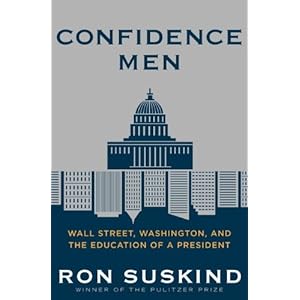
More seriously, I'm reading Ron Suskind's "Confidence Men" right now. We had a great chance to either nationalize or break up Citigroup just before Timmy G. announced his vaunted "stress tests," and he did exactly as I noted ... he ignored  Christina Romer and others, who seemed to have at least a partial ear of Obama's on this issue, and refused to countenance doing anything to the bloated bank.

Joe Nocera's review of "Confidence Men" provides more details on this incident.
The most explosive allegation in “Confidence Men” concerns one such instance, early in the Obama presidency, when several top White House advisers, including Summers, wanted to “wind down” and restructure Citigroup, the most troubled of the too-big-to-fail banks. Obama liked the idea; it would show, he thought, that the government was willing to tackle the predicament of the banks and their toxic assets head on, and would set the proper tone for the way his administration planned to treat the banks. But Geithner, Suskind writes, strongly opposed the idea, so he just waited for the moment to pass — and for the president to forget about it. Suskind flatly labels Geithner’s action a “fireable offense.” 
But, he wasn't fired. As far as we know, he wasn't even given that severe of a dressing down. Or any. And, in Suskind's level of detail, if Geithner had been called on the rug, we'd know about it.

September 26, 2011

Obama the incompetent and Democrats the incompetent

That's takeaway No. 1 I get from Ron Suskind's new book, per an AP review piece. That's an overall takeaway

Takeaway No. 2? Related to that: Obama doesn't have executive management skills, and he couldn't, or wouldn't, find someone to do that for him, even in the face of insubordination.
The book states Geithner and the Treasury Department ignored a March 2009 order to consider dissolving banking giant Citigroup while continuing stress tests on banks.

The Citbank incident (where Tim Geithner basically ignored Obama, see below), and others like it, reflected a more pernicious and personal dilemma emerging from inside the administration: that the young president's authority was being systematically undermined or hedged by his seasoned advisers," Suskind writes.
I thought Rahm Emanuel was supposed to do that for him, the management, the head knocking and more. But, I guess not! He wasn't even the initial choice:
The book says one of Obama's top advisers, former chief of staff Rahm Emanuel, was not the president's first choice for the position. According to Suskind, Emanuel's name was not even on the initial short list, which included White House aide Pete Rouse.
 So, did Rahmbo have some digital pictures (updated from "negatives") of Obama, or what?

And, per a review on Amazon:
As the nation’s crises deepened, Obama’s deputies often ignored the president’s decisions—“to protect him from himself”—while they fought to seize control of a rudderless White House. Bitter disputes—between men and women, policy and politics—ruled the day. The result was an administration that found itself overtaken by events as, year to year, Obama struggled to grow into the world’s toughest job and, in desperation, take control of his own administration.
 Back to the AP story, for more on the incompetence:
Suskind states that Obama accepts the blame for mismanagement in his administration while noting that restructuring the financial system was complicated and could have resulted in deeper financial harm. One of the major complaints about Obama's administration is that it was too easy on major financial institutions, including Citi. The president had wanted Treasury officials to focus on a proposal to dissolve the bank, but no plan was ever created, the book states.
And Rahm, or a better chief of staff, couldn't knock heads on the financial side while also doing other things? The fact is that the administration is still too easy on major financial institutions, and Geithner et al continue to be insubordinate. If nothing else, Obama's whiney fake mea culpa makes him look worse yet.

UPDATE 2: Salon's Jacob Weisberg argues that the "misquote" complaints by Larry Summers and others probably should be taken seriously, and Suskind himself should not be. I'll admit that Suskind's idea narrative appeals to me; maybe that's why I haven't been more critically thinking about it. That said, having read also Brad DeLong's take on the book at Huff Post (sorry, no link) where he says Orzag was the biggest person to lead Obama astray, I think he and Weisberg are both, in different ways, "covering" for Summers and Geitner. Weisberg blames Orzag for Suskind getting it wrong; DeLong blames Orzag for Obama getting it wrong.

The deal? Orzag is the biggest financier not in the government. So, he's the person who's going to get kicked. DeLong is definitely a semi-insider; not sure about Weisberg, but, for argument's sake I'll say the same. DeLong laughingly claimed Geithner can't be a Wall Street tool because he never worked on the Street. Brad ignores the Vernon Jordan parade of Obama before Wall Streeters way back in 2003, or else he's that clueless.

UPDATE: The NYT story on the book offers much more fodder, including women insiders complaining about gender inequality at the White House (largely caused by Larry Summers), Summers claiming that Suskind misquoted him and more:
“The administration’s domestic policy was fast becoming a debate society run by Larry Summers,” Ms. Suskind writes. “Obama would sit on high, trying to judge if there was any shared ground between the competing debate teams that might coalesce into a policy.” Mr. Suskind asks whether this was “a model for sound decision making, a crutch to delay, or avoid, the decisions only a president can make, or a recipe for producing half-measures — a pinch of this matched with a scoop of that — masquerading as solutions.”
The NYT wonders how this squares with Obama's decisiveness in ordering the operation to kill bin Laden? Simple. Obama had committed to being "tough on terror" back in the 2008 presidential debates. Besides that, every president think he is an expert on foreign policy, as well as reveling in the degree of independence and freedom of action it offers.

That said, the NYT notes that Suskind wonders why Obama turned away from more liberal economic advisers such as Joe Stiglitz. Well, I guess even Suskind didn't do all of his homework, mainly on Democratic National Procurer Vernon Jordan parading Obama before Wall Streeters in 2003.

Update No. 2: Joan Walsh has a long take on this book, and a generally good one, despite being a mild Obamiac herself.

Just this one takeway, which says a lot about Dear Leader:
Suskind frequently stops mid-narrative to grapple with the central question of his book: Was the problem mainly with Obama's staff, which can be corrected by a staff shakeup, and with the president's early inexperienced leadership, which can be ameliorated by experience? Or is there something missing in Obama himself, in his vision and values, that led to the lack of bold action to solve the nation's biggest problems?
However, Walsh is too willing to see Obama's current faux populism as the real deal.

More below the fold, as I reflect on a man whose competence level, along with "eloquence" and other things, only got to be touted because of the "soft bigotry of low expectations" of comparison to George W. Bush.

June 30, 2011

Obama cluelessness behind debt gridlock

Paul Krugman nails it: President Obama never expected that the current GOP would play this level of hardball with debt-ceiling issues. That's why he was too dumb to link a debt-ceiling rise to his extension of the Bush Obama tax cuts.
Bear in mind that G.O.P. leaders don’t actually care about the level of debt. Instead, they’re using the threat of a debt crisis to impose an ideological agenda. ...

And the reason Republicans are doing this is because they must believe that it will work: Mr. Obama caved in over tax cuts, and they expect him to cave again. They believe that they have the upper hand, because the public will blame the president for the economic crisis they’re threatening to create. In fact, it’s hard to avoid the suspicion that G.O.P. leaders actually want the economy to perform badly.
That said, there's a possible silver lining. Tim Geithner may leave the Treasury after a deal is reached. OTOH, Obama could replace him with ... Larry Summers. Or, almost as bad, Gene Sperling.

The Post lists other Clintonista retreads who could also be in the running:
In the past, analysts have discussed Roger Altman, an investment banker and deputy Treasury secretary in the Clinton administration, and Erskine Bowles, a former Clinton chief of staff who co-chaired Obama’s deficit reduction commission, as possible candidates for the top Treasury post. Another Democratic economist popular with business is Laura Tyson, a business school professor at the University of California at Berkeley who served as chairman of the Council of Economic Advisers under Clinton.

Inside the Obama administration, budget director Jacob J. Lew or chief of staff William M. Daley could be viewed as qualified for the job, but the appointment of either would leave another big hole to fill. Gary Gensler, the chairman of the Commodity Futures Trading Commission, could also emerge as a candidate. Sheila Bair, the outgoing chairman of the Federal Deposit Insurance Corp., would be a dark-horse candidate.
Bair would be a dark horse because she's not a full-blown neolib. She'd get some sort of support from me.

June 28, 2011

Schadenfreude for #GoddamSachs outsourcing?

If Think Progress is right about how high up the food chain some of these folks may be .... to be honest, I'm feeling a bit of schadenfreude. They probably defended globalization and the government bailout both.

On the "food chain level," TP cites Business Insider as saying these are primarily “high-paying, skilled positions in sales and investment banking.”

Business Insider adds:
The layoffs come at an interesting time. Banks are fighting tough regulations like capital requirements that they say will stem growth. Preparation for the regulations require banks to free up capital -- like the $1 billion Goldman plans to slash in the coming year. ...

So this news of the adverse effects that capital requirements will have on employment at Goldman Sachs should help the bankers' as they argue against the requirements in coming months. That's why this looks like a political move to discourage Washington from adding capital requirements above the 7% that Basel III regulations will enforce.
On that side, I'm a bit more saddened for those who will lose their jobs, to be pawns in a political game, but GS, and other megabanks, have done this in various ways for years.

Besides, since he's been Goddam Sachs' elfin toady, it would be fun to see a Congressional mix of libertarians, tea partiers and true liberals put Tim Geithner in the hot seat over this. Both for teh layoffs themselves AND for teh attempt to stiff the government.

June 10, 2011

Polishing Geithner's apple, counting the lies

I just got around to reading the Post's suck-up piece on Tim Geithner.

Beyond being disgusted at him calling stimulus spending "sugar," the way others in the administration polish his apple is simply ridiculous.

That said, WHO the polishers are is no surprise:

Gene Sperling, talking about Timmy's experience in managing crisis.
Bill Daley, talking about how great he is in general.

Clintonista neoliberal retreads talking up a former Republican, than an independent, and the story doesn't say whether he's a registered Democrat today. (Of course, it's not like being a "registered Democrat" actually means anything.)

June 09, 2011

Foxes, henhouses, banksters, Obama and Dems

So, a former high-level honcho at Capital One, NOT Elizabeth Warren, could be Preznit Kumbaya's choice to head the consumer financial protection agency? Will everybody currently at Capital One know what's in our wallets? Will they all have to contribute to Obama's billion-dollar re-election? Will a former supremo at one of the more egregious companies for credit cards to high risk people actually regulate anything?

As for Date's nomination "tapping down controversy," no, the only "controversy" is over GOPers of the ilk of Bloomberg readers (the link); GOPers who don't like Elizabeth Warren.

Considering that Wall Street's best friend, Tim Geithner, is the man who told Kumbaya to stop worrying about the unemployed, probably not.

Meanwhile, Obama's neolib pea in a pod, former Indiana Sen. Evan Bayh, is now working for Obama's arch-nemesis, the U.S. Chamber of Commerce.

February 16, 2011

This is your Geithner on drugs

The New Republic has a long profile on Treasury Secretary Tim Geithner. Most of the article shows us he has inside-the-Beltway political chops unimaginable two years ago.

The last page shows he's inside-the-Beltway in other ways.

This is your Treasury Secretary on D.C. Village drugs, the drugs of self-infatuation:
Geithner hunched his shoulders, pressed his knees together, and lifted his heels up off the ground—an almost childlike expression of glee. “We’re going, like, existential,” he said. He told me he subscribes to the view that the world is on the cusp of a major “financial deepening”: As developing economies in the most populous countries mature, they will demand more and increasingly sophisticated financial services, the same way they demand cars for their growing middle classes and information technology for their corporations. If that’s true, then we should want U.S. banks positioned to compete abroad.

“I don’t have any enthusiasm for ... trying to shrink the relative importance of the financial system in our economy as a test of reform, because we have to think about the fact that we operate in the broader world,” he said. “It’s the same thing for Microsoft or anything else. We want U.S. firms to benefit from that.” He continued: “Now financial firms are different because of the risk, but you can contain that through regulation.” This was the purpose of the recent financial reform, he said. In effect, Geithner was arguing that we should be as comfortable linking the fate of our economy to Wall Street as to automakers or Silicon Valley.

One can disagree with this substantively. Financial reform is a good start, with its stricter rules and new authority for regulators. But whether Wall Street can be made to behave like a normal industry rather than a source of economy-wide instability remains very much open to debate.
Ugh.

Sounds like Little Timmy G. has gone a mix of New Age and messianic guru there.

Even inside the Village, there's limits on reading your own press clippings, dude.

September 18, 2010

If Dems lose midterms, it's Obama's fault

Likewise, if he loses in 2012. No, seriously. Don't blame GOP obstructionism, of which Prez Kumbaya should have been more cognizant from the get-go. Blame the man staring back at President Barack Obama in the mirror.

If he loses, it's his own fault.

But, the person who slugged the URl is wrong. Obama didn't get "rolled by Wall Street." Geither, Summers et al were willingly chosen as economic advisers precisely because of their Goldman Sachs/Robert Rubin "bloodline"; others were willingly excluded.
Yet those who were most aligned with the “progressive” side of the Wall Street reform issue remained, for the most part, on the outside of the administration looking in. Among them were Brooksley Born, the former chairwoman of the Commodity Futures Trading Commission, and Nobel-winning economist Joseph Stiglitz. Summers and Geithner, by contrast, had been acolytes of Bob Rubin, the former Clinton Treasury secretary who, along with then–Fed chairman Alan Greenspan, had presided over many of the key deregulatory changes in the ’90s. And they convinced Obama that the financial system they themselves had done so much to nurture was, on the whole, fine.

That relates to a failure of will:
(T)he leadership question can’t be ignored. Financial and economic reform just never seemed to be a subject that kindled Obama’s passions, his critics say. ...There was so much passion and ambition in Obama’s words about fixing the economy, and so much dispassion and caution in his policy choices. Early in the Democratic primaries, in January 2008, Obama had stunned many of his supporters by praising Reagan as a transformational president—a contrast to the eight years of Bill Clinton, Obama added cuttingly. Reagan, Obama said, “put us on a fundamentally different path because the country was ready for it.” Yet at what would seem to be a similar historical inflection point—what should have been the end of Reaganism, or deregulatory fervor—President Obama seemed unprepared to address the deeper ills of the financial system and the economy. ... The Obama administration also did little to use its bully pulpit to reorient pay packages at the big financial houses, where bonuses still often run in the tens of millions of dollars. Critics make the case that changing this pay structure would do more than punish those who helped spur the meltdown. It might also encourage some of America’s greatest minds to stay away from financial engineering, which contributes little of substance to the economy, and instead consider real engineering.


Meanwhile, rather than acting like FDR or LBJ, Obama seems more and more like the second coming of Jimmy Carter. No, not every president is an LBJ, an FDR, a Wilson, or even a Reagan, at handling Congress. But, the more successful presidents improve their skills.

Another reason it's his fault if Dems lose big in midterms, or he loses in 2012?

This.

Obama again mocked the "professional left," this time while sucking up to the rich in Greenwich, Conn., many of whom he protected from real financial regulation with his pseudo-reform bill.

It's clear that he's a flat-out liar about wanting to be "pushed" by the left. It's clear he's both a worse, and more unskilled, liar about it than Bill Clinton was on the same subject.

September 16, 2010

Geithner fiddles while senators burn at China

The Senate is raking Treasury Secretary Lil Timmy Geithner over the coals, and rightfully so, for not doing more about Chinese currency issues. At the same time, Chris Dodd, D-Pompous, while noting that every administration from Reagan on has kowtowed to China, ignores that every Congress in same said time frame has willingly swallowed presidential administration lies about "action."

Meanwhile, the administration is taking action on two lesser issues; but, that's not enough. In that story, an economic analyst notes that getting China to revalue its currency could create 500K jobs here and cut our trade deficit in half.

April 11, 2010

EU readies lifeline for Greece

It's not officially been accepted yet, but a financial backstop of more than 30 million Euros is now available. At the same time, it's carefully structures as to not a "bailout." Too bad folks like Big Ben Bernanke and Little Timmy Geithner weren't that smart, eh?

January 31, 2010

Paul Volcker actually gets to speak?

Hmm, maybe for a moment right now, President Obama is serious about a harder line on financial system reform than the Bobbsey Twins of Geithner and Summers have been. Paul Volcker doesn't go into too many details, but trumpets the general case for new regulation.

January 27, 2010

When will Obama fire Geithner?

As more and more details leak about how he handled various bailouts in the financial meltdown in 2008, above all the AIG bailout, the popular drumbeat for Tim Geithner's head should become ever louder.

If Obama were a real faux populist, he'd heed it. If he were to become a real populist, he'd heed it and make a good choice to replace Timmeh G.