SocraticGadfly: Peak Copper
Showing posts with label Peak Copper. Show all posts

May 18, 2011

Michael Shermer — pseudoskeptical doorknob

Any alleged skeptic who lumps real concerns about the fear of degree of effect of anthropogenic global warming with Harold Camping's rapture nuttery is clearly no real skeptic, and is beyond Penn and Teller, even.

But, that's what he does!

Let's take a further look at Shermer's secular end of days that, for whatever likely nonskeptical reasons, he lumped with Harold Camping and other Xn millenialists:
There are also secular end of days, from Karl Marx’s end of capitalism and Francis Fukuyama’s end of history, to natural and man-made doomsdays brought about by overpopulation, pollution, nuclear winter, genetically engineered viruses, Y2K, solar flares, rogue planets, black holes, cosmic collisions, polar shifts, super volcanoes, resource depletion, runaway nanotechnology, and most notably, global warming. In his book Our Final Hour, the British Astronomer Royal Sir Martin Rees put our chances of surviving the 21st century at 50 percent. Last year Stephen Hawking famously warned humanity that contact with aliens could result in our enslavement or extinction.
Marx was unscientific, and his followers even more so. Everybody this side of Pyongyang knows that. Beyond that, contra Shermer, Chicago Schoolers, etc., economics (except for behavioral economics) is less scientific than sociology or psychology, even. Fukuyama was making a political statement, and has since backed off it himself. So, just scratch these from being lumped with scientific "apocalypses."

Nuclear winter? Modelers who were worried about that scientifically looked again at their calculations and admitted they'd overstated it.

Pollution? Still a problem. But, less so, with nonlibertarian regulatory schemes in the US and other advanced nations. If Shermer thinks pollution isn't a problem in general, I've got some Beijing air I'll pump into his house.

Overpopulation? If all of the upwardly-estimated 9 billion ppl on planet Earth at 2100 want to live like Shermer likely does, and other "average Americans," it will probably be a big problem in terms of AGW, degree of effects of AGW, resource depletion, etc.

Ditto for resource depletion to hit that one. Shermer apparently hasn't heard of Peak Oil, Peak Copper and more. (Paul Ehrlich just picked the wrong time frame for his bet with Julian Simon on copper, chromium, nickel, tin, and tungsten.)

Wikipedia, talking of their bet, notes that Simon declined a more expansive follow-up bet.

Solar flares, rogue planets, black holes, cosmic collisions? Fringe science at best, and it's been known as such all along. More intellectual dishonesty to lump them with legitimate "scientific apocalypses."

Shifting magnetic poles, if that's what Shermer meant? Unknown what damage that might do; that said, the highest alarmists don't seem to have too much evidence.

Nanotechnology? Luddites aside, who knows what might happen as a result of that. Given the rising police state within the United States, maybe we should be alarmed about the possibility of nano-spying. Very alarmed. Ditto for libertarian-beloved big corporations getting ideas in that area.

Hawking on aliens? Well, if they had hostile intent, and the capability for interstellar travel, he's 120 percent right, Shermer. You're a doorknob for mocking a prediction like that.

Surviving the century? While I've not seen anybody besides Rees put odds on it, I have seen other people worry about whether Homo technologus, at least, will survive in current form.

Who knows how close India and Pakistan may be to nuclear war right now, for example?

This all said, Live Science also gives a realistic presentation of scientific apocalypses.

It evenincludes Shermer's pseudoscientific "heaven" - the Singularity!

Speaking of, that's the single biggest reason to not take Shermer seriously on this. As long as he's fellating Ray Kurzweil, we know he's a ....

Crackpot. Not a religious one like Camping, but a crackpot nonetheless.

Michael Shermer ... crackpot, at least at times.

April 28, 2011

Peak Oil, Peak Commodities, China

Even if you just skim this long post at The Oil Drum, at least do that.

The post-Egypt, in-medias-res-Libya oil spikes, combined with slow, but semi-sustainable economic recovery in the U.S. and Western Europe, plus the continuously surging (on paper) Chinese juggernaut, has brought Peak Oil back to people's lips.

But, should we really be talking about "Peak Commodities"? Possibly. Copper prices, and thefts, are rising again. Even if only a small portion of U.S. agricultural problems are due to climate change, that's more than zero.

And, as Japan definitely knows, China has a few commodities in its possession and can squeeze the taps.


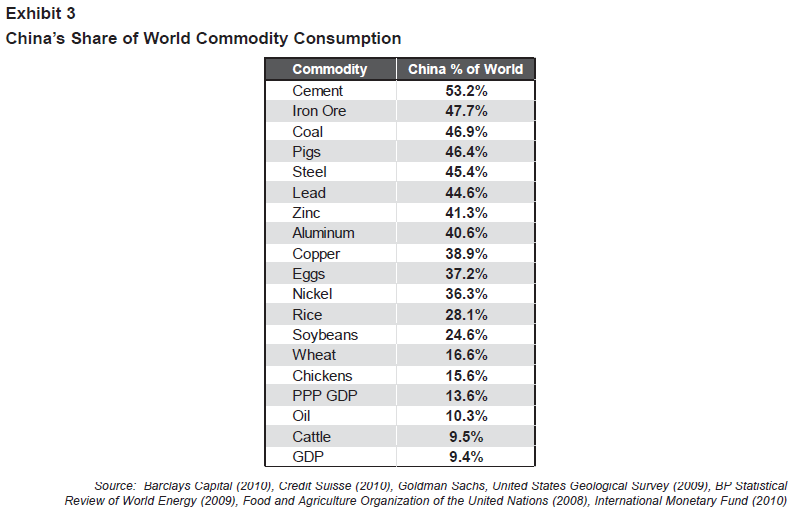
Beyond that, Beijing is voracious with many items, perhaps due in part to inefficiencies.

And, those inefficiences mean that, if China stumbles, we can see international price bubbles:
Quite separately, several of my smart colleagues agree with Jim Chanos that China’s structural imbalances will cause at least one wheel to come off of their economy within the next 12 months. This is painful when traveling at warp speed – 10% a year in GDP growth. The litany of problems is as follows:

a) An unprecedented rise in wages has reduced China’s competitive strength.

b) The remarkable 50% of GDP going into capital spending was partly the result of a heroic and desperate effort to keep the ship afloat as the Western banking system collapsed. It cannot be sustained, and much of the spending is likely to have been wasted: unnecessary airports, roads, and railroads and unoccupied high-rise apartments.

c) Debt levels have grown much too fast.

d) House prices are deep into bubble territory and there is an unknown, though likely large, quantity of bad loans.

You have heard it all better and in more detail from both Edward Chancellor and Jim Chanos. The significance here is that given China’s overwhelming influence on so many commodities, especially in terms of the percentage China represents of new growth in global demand, any general economic stutter in China can mean very big declines in some of their prices.
The wage inflation, if combined with even more surge in oil prices, won't mean new manufacturing jobs in the U.S., at least not many.

It will, though, as I've said before, mean many new manufacturing jobs in Mexico. That could help its economy and stabilize the U.S.-Mexico border ... if ...

If Mexico can get reasonable oil supplies of its own.

May 03, 2008

The economics of scarcity

Jim Jubak provides an in-depth analysis of why prices are skyrocketing on food, oil and about anything else you can name. It’s called scarcity economics, he says.

However, a better name might be Peak Product economics,, based on things like Peak Oil, Peak Copper and Peak Natural Gas. Or “Peak Economics” for short.

Jubak does note that some of his “scarcity economics” is based on Peak Product economics, like Peak Copper:
Scarcity markets aren't created overnight. Potential buyers need to be bloodied by repeated experience on both the supply and demand side. Consumers of copper know that for each of the past six years, the copper industry has failed to deliver projected increases in supply.

In 2008 and 2009, according to UBS AG, the industry will fall short again. The bank projects production a shortfall of 800,000 metric tons over those two years.

But, it’s not just oil or certain metals. It’s fertilizers that may be Peaking, too, and, surprisingly, not because of the expected arrival of Peak Natural Gas in 25 years or so.
You can see scarcity economics at work in today's fertilizer market, for example. Potash of Saskatchewan produces potash and nitrogen fertilizers. But with the world short 1.2 million metric tons of potash in 2008 and desperate for nitrogen fertilizer, Potash is seeing its already high margins soar to astounding heights. In announcing its first-quarter earnings, the company projected that margins in 2008 will be roughly 3.5 times as high as in 2007.

Think that’s insane? As long as scarcity economics rules the fertilizer market, there’s a good chance Potash will get its price, and other fertilizer makers will go along for the ride. The global scarcity has made high-cost, government-subsidized producers in India the price setters in the market: If you’ve got to have supply, you'll pay any price, right? That price and not Potash’s production costs are now setting the market price.

Supply contracts for potash for the second half of 2008 are up for negotiation in Japan and India. Japan paid just $120 a ton for potash in its contract for the first half of 2008. China recently signed a long-term contract for $576 a ton. That was a $456-per-ton price jump. And even with that increase, the Chinese didn’t get all the potash they wanted. The country is now looking at a shortfall that some experts peg as high as 40 percent, just when China is trying to increase food production to cut inflation in domestic food prices.

Did you just hear the sound of rice, corn and wheat prices soaring even higher?

As for Peak Oil, he notes what I’ve blogged elsewhere, that Russian production is slipping and Mexican production is slumping.

Fasten your seat belts for America’s sled ride downhill.

April 01, 2008

No copper, only PVC – houses worth more as spare parts

Owners, or mortgage-holders of some homes in foreclosure, are resorting to that “No copper, only PVC” phrase as signs on the houses to try to prevent looting.

And, the prospect of refinancing homes that may not be altogether there, due to looting of copper, brass and aluminum, is scaring off even more banks that are already getting tighter with credit.
”f the appraiser spots something that is not right, like copper tubing lying on the floor or something missing a lot of wiring, that's a red flag to the buyer's bank. That will essentially melt down any transaction you've got,” real estate broker Jonathan Osman said.

“They don’t want to make a $200,000 loan on a house that has serious problems in case the buyer defaults and they are stuck with it,” he said in a telephone interview. “It stinks for the banks that have foreclosed on the property because they now have a house that they really can’t sell. They have nothing to do but auction it off for whatever they can get for it.”

With scrap copper running at $3.50 a pound, vs. 70 cents just a few years ago, boarded-up houses are a tempting target for low-level thieves.

I say “low-level” because ripping 50 pounds of copper out of a house — if you can find one with that much — would net you a whole $175.

And, guess where it’s all going? That’s right, the giant sucking sound across the Pacific.

A full 80 percent of stolen scrap copper is estimated to wind up in either China or India.

This has several fallouts, beyond the obvious one of essentially making the vandalized home unsellable.

First, it drives up crime in the area.

Second, especially if it’s aluminum siding being ripped off an exterior, it uglifies not just that house, but the surrounding neighborhood.

Both, of course, further drive down prices on remaining houses that may be up for foreclosure. The bank or other note-holder, if it’s stubborn, sits on the house longer, leaving it a more tempting, longer-lasting target for the same vandalism.