SocraticGadfly: Big Insurance
Showing posts with label Big Insurance. Show all posts

July 27, 2017

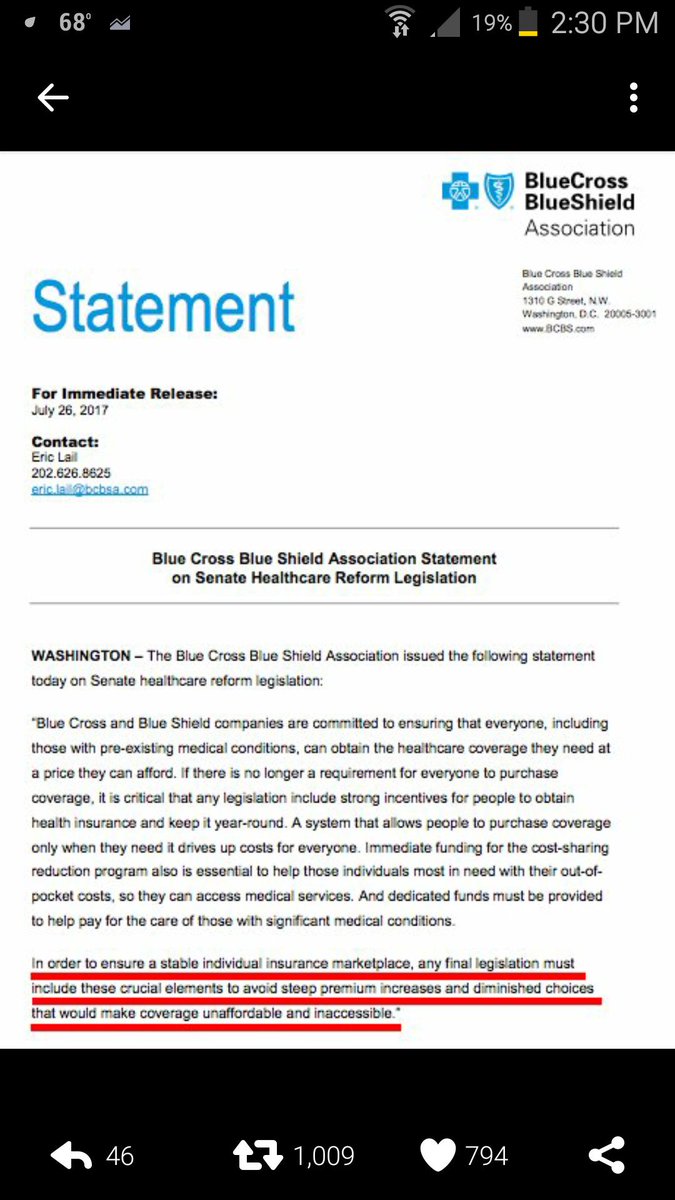
Insurers get self-righteous on #Trumpcare vs #Obamacare

The likes of Blue Cross / Blue Shield, Delta, Cigna, etc., are making me vomit in their mouths over Mitch McConnell's ongoing attempt to repeal Obamacare, whether "repeal and replace" or "repeal now, replace later" or simply "replace."

The "statement" by the Blues shows why.

Self-righteousness over a veneer of hypocrisy usually gets under my skin.

They're really committed to insuring those with pre-existing conditions because Obamacare requires it, while giving them money to do so. Pre-Obamacare, they told people with pre-existing conditions to fuck off and die just like most Senate Republicans want to do right now.

A system that doesn't require people to PURCHASE coverage is what's truly needed, of course, but what we will never get supported by these folks.

I'd be fine, per my call-out for at least a partial version of a British-style NHS, if the Blues et al still had some modicum of existence selling the equivalent of Medigap plans to those under 65. They could otherwise disappear.

As for their employees finding future employment under such a change, well, maybe they'd start supporting a guaranteed basic income or universal income.

Remember, folks, often, the enemy of my enemy is NOT my friend, but just a temporary ally of convenience. Accept the Blues' help on fighting Trumpcare.

But stop settling for Obamacare.

Vote Green. Vote SPUSA. Stop voting Democrat. Stop being a sucker for neoliberals who wanted to reward bloodsucking leeches by giving them more reward money. You know, like Cory Booker, a B-grade neoliberal on the Democratic neoliberal second team. A shadow Obama. An even bigger shill for Big Pharma.

Remember, national health care would transform the whole employment world, too. You wouldn't be chained to a crappy boss. You could work part time if you didn't have to work a minimum number of hours for health insurance. You could freelance. Etc., etc.

That's why American neoliberals hate single-payer. And why they despise something like a British National Health System, which is what America really needs.

March 19, 2010

Obamacare lacks cost containment

And that's one of the biggest issues I have with this legislation. I think the government's subsidies for lower-income families to buy private health insurance will more than offset any Medicare savings.

And, why is this lacking? Lack of Congressional will and lack of presidential push. Here's more:
It was a bold response to skyrocketing health insurance premiums. President Barack Obama would give federal authorities the power to block unreasonable rate hikes.

Yet when Democrats unveiled the final, incarnation of their health care bill this week, the proposal was nowhere to be found. ...

In the cases of the insurance rate authority, the Republican ideas and the special deals, it came down to Obama making promises that Congress didn't keep. He can propose whatever he wants, but it's up to Congress to enshrine it into law.

Arguably, the president could have foreseen that outcome, and was making a low-risk p.r. move by floating proposals — dismissed by critics as insubstantial anyway — whose demise he couldn't be blamed for.

While the White House worked hard to trumpet Obama's plans for the rate authority, his embrace of bipartisanship and his opposition to special deals, the administration hardly advertised the lack of follow-through. Understandable, certainly, but perhaps not the new way of doing business that Obama promised to bring to Washington.

That's why I have decried: the lack of a federal insurance regulation agency; the lack of cost controls on medications, whether through allowing reimportation from Canada or other means; the backdoor deals with Big Pharma; and more.

That said, if Obama would actually create a new federal agency, maybe it could be included under reconciliation. But he hasn't. Nor has he promised, yet, to address that in the future.

That's why I don't count the CBO's chickens in this area. The eggs are nowhere near hatched.

September 10, 2009

Big Ag ‘vs’ Big Insurance and healthcare

Michael Pollan has some good thoughts on how lowering healthcare costs will ultimately involve changing America’s eating habits, and therefore changing how Washington subsidizes Big Ag.

Here’s the nut graf:
We’re spending $147 billion to treat obesity, $116 billion to treat diabetes, and hundreds of billions more to treat cardiovascular disease and the many types of cancer that have been linked to the so-called Western diet. One recent study estimated that 30 percent of the increase in health care spending over the past 20 years could be attributed to the soaring rate of obesity, a condition that now accounts for nearly a tenth of all spending on health care.

If we can cut one-third of that cost through dietary changes and farm subsidy cuts and/or changes, we’ve paid for the nominal costs of national healthcare right there.

But that’s only a starter:
To put it more bluntly, the government is putting itself in the uncomfortable position of subsidizing both the costs of treating Type 2 diabetes and the consumption of high-fructose corn syrup. … Why the disconnect? Probably because reforming the food system is politically even more difficult than reforming the health care system. … Cheap food is going to be popular as long as the social and environmental costs of that food are charged to the future. There’s lots of money to be made selling fast food and then treating the diseases that fast food causes. … As things stand, the health care industry finds it more profitable to treat chronic diseases than to prevent them.

What about insurers? Well, they don’t get off lightly, either:
As for the insurers, you would think preventing chronic diseases would be good business, but, at least under the current rules, it’s much better business simply to keep patients at risk for chronic disease out of your pool of customers, whether through lifetime caps on coverage or rules against pre-existing conditions or by figuring out ways to toss patients overboard when they become ill.

That’s all just from the first webpage of Pollan’s column. Read the full thing. Pollan is hopeful this will change, but I think he underestimates the power of the Senate Agriculture Committee and ADM.
-END-

June 23, 2009

NYT on healthcare – Krugman and Douthat duel

They’re not totally “dueling” on healthcare reform, at least not until you get to a single-payer type publicly run option for healthcare. At that point, Paul Krugman is certainly on a different page from Russ Douthat.

That said, though, while I think we need a single-payer option, I don’t disagree with everything Douthat said.

First, though, that single-payer option’s necessity. For business-based, business-mentality-based reasons, a German-style voucher system simply wouldn’t work here. I used to think it had a chance, but I’m firmly convinced that the American health insurance industry would find any and every way it could to either gut it, or else scam it. (That’s another reason Obama’s refusal to call for a federal insurance regulation bureau in his proposed financial regulation reform bill upset me.)

Back to our dueling columnists.

Krugman has the cannons of his ire trained on the sellout Senate Democrats like Ben Nelson, who had flatly opposed single-payer until he got ads run against him back in Nebraska, and Kent Conrad, who had this idea of insurance co-ops that Big Insurance was sure to game.

Krugman also says the cost doesn’t concern him a lot.

Well, it does concern Douthat; in fact, that’s the focus of his column.

And, I agree with him that, while it might not be quite like Great Britain or Canada (the degree of actual rationing they have, not the conservative bloviosphere’s healthcare urban legends), that Americans either need to be prepared to wait more, or to shell out more in taxes. He even raises the dark specter of California when liberals and conservatives fail to “square a circle” everybody thinks they will.
This dynamic is particularly pronounced in health care, but it holds true across almost every domestic policy debate. Voters demand low taxes and generous services, and neither party has found a way to say no and stay politically viable while saying it.

That said, despite Obama’s neoliberal tendency to over-tout the “waste, fraud and abuse” money savings angle, there is something to be said with that, on things such as standardized paperwork forms, etc.