SocraticGadfly: secular humanism
Showing posts with label secular humanism. Show all posts

July 23, 2025

The REAL footprints in the sand

Whether you're actually a secularist or not, you may, like me, be tired of the old "footprints in the sand" saying. I'd call it a poem, but to use the word "poem" for such writing does violence to the word "poem."

So, about two months ago, hiking a freshwater beach area at my nearby national wildlife refuge, when I stumbled upon a series of shoreline footprints due to a great blue heron, I knew what I had to do.

And, that is what you see below.


(It definitely embiggens when you click.)

This is not quite William Henley's "Invictus," with which I don't totally agree. (And, to the degree Invictus is a kind of lodestar for Gnu Atheists, that's part of why I disagree with them.)

That said, this is a good place for me to quote the self-invented secular Shahada:

"There is no god and I am his prophet."

May 26, 2023

"Good god-fearing people" rural red-state bullshit

I don't know if any graduation speakers at local graduations tonight will spout this shite, but, let's do a quick breakdown, since I heard this phrase from a new local principal early this month upon his hiring.

By their own lights, Shi'ite ayatollahs in Iran, Zionists in a settlement in Occupied Palestine, Upper Castes of Hindus in India who heavily back the BJP, and 969 Movement fundamentalist Buddhist monks in Burma are all "good god-fearing people."

So, too, here in the US, were the followers of David Koresh. And, before David Koresh became a follower of himself, he probably was a good god-fearing person, too.

It's like Religious Right wingnuts wanting to bring back public, coercive school prayer. WHOSE? What if a Catholic says a Hail Mary while fingering their beads? Or, for that matter, a Shi'ite cries "Allahu akbar" while fingering THEIR beads, and they're leading a public, coercive prayer?

Spare me your bullshit, which also presumes the godless aren't good.

April 24, 2023

Another name for "American Indian" is "person"

I've long said here, and even more on my other blog, that being an atheist is no guarantor of moral or intellectual superiority to the rest of humankind, and occasionally said the same about being a scientific skeptic.

Well, the same is true of being an American Indian. From potlatch tribes of the US Pacific Northwest killing slaves on the flames as part of potlatch destruction events, through Aztecs ripping out bleeding human hearts, and on to today's Ute's not only drilling for but refining oil, being an American Indian is no guarantor of being humanistic or environmentalist.

Latest proof on not being humanist? A tribe in Wisconsin, in a case before the Supreme Court, loan-sharking people with higher interest rates (and apparently tougher dunning) than the state of Wisconsin allows, and wanting exemption from Wisconsin laws as a sovereign nation. Update: SCOTUS'  hearing is here.

November 03, 2021

Updating Chris Stedman, because

 Material at top taken from a LONG blog post about Chris Stedman's "Faitheist" book, his marketing of it, and even more of himself, and how he was likely full of crap and marketing crap way back then, and still is today.
 
If you’re not familiar with that name, it appears to have been something  largely developed by Chris Stedman, now the recently published author of a book by that name, which is what this blog post is all about.

First, some personal identification by me.

Regular readers of this blog, or at least the part of it that deals with religion, philosophy and metaphysics, know that I normally don’t have a lot of use for the New Atheist, or Gnu Atheist, “movement.” I've written about my issues with Gnus on many occasions, most recently here. I consider them too confrontational, for one thing. I consider them too … fundamentalist, to be wry, secondly. Third, unlike them, I have no desire to “evangelize” the religious, let alone conduct an intellectual browbeating quasi-jihad.

A brief 2017 update from the original: Stedman is no longer doing the secularist chaplaincy work at Harvard, per his Twitter. To complete the rebranding cycle, this fall, he'll be ....

TEACHING AT AUGSBURG!

So, OK, he won't be a Buddhist in two years. He'll be an ELCA Lutheran.

And now, the new. Looking at this 20 months after my last comment at my original post? First, I'm wondering if Chris' dad was an abuser, and that's why he's largely written out of Chris' story. Would explain a LOT on Chris' psychology.
 
Second, I looked up Chris' new book that came out last year. Teaching at Augsburg, and thus, even within the liberal wing of Lutheranism and Minnesota nice, almost certainly NOT an atheist, per what I ventured above. The "about" on his own website also doesn't mention the Big A. He doesn't identify as such on the bio for his new book at Amazon, which sounds like Minnesota nice dreck about how to be nice on the Internet, mixed with a steaming pile of Jungian psychology-related bullshit, which sounds just about right for Stedman.
 
Even if he DID call himself an atheist, I would not consider him one. Since atheism is not a "faith" or a "religion," it's an oxymoron at minimum to for himself to peddle himself as an "interfaith activist" if he does, elsewhere, call himself an atheist. 

In addition, that gets back to atheist critiques at the time he wrote "Faitheist" and earlier — he softpedals what atheism is. But, for him? It's also surely all about the "brand."

That said, a full decade ago, Stedman was peddling misleading claims about the parallels between interfaith movements and atheism.

As for me? If you asked me to participate in a "humanist movement" meeting with religious as well as secular humanists involved? I'd be there. But not an interfaith movement. And, this in turn means that Stedman probably needs to read some Gilbert Ryle. Ditto for Jesse Galef and others he name-dropped. If they're conflating "interfaith" and "humanism," they made a big-assed category mistake. And that is another reason not to want to play ball on their field. 

And, as Stedman either knows and ignores, or else doesn't know and is not trustable intellectually, names do mean something. Per ordinary language analysis, it is a "game" as to what name we use, because it does frame what the conversations will be about.

Third, he has a podcast (but of course) listed by Mashable (but of course) at No. 18 on its best new podcasts list. Surely some branding going on there, too. Next, we will find out that Chris is either "trans" (without the suffixed adjective, but surely "-gender" not "-sexual") or else that he's straight.

Fourth, for laughs, read the reviews at Goodreads, especially the one-star ones. As I told a reviewer that is identified as "Augsburg University," I doubt the atheism part.

All in all? A tribute to the Peter Principle, maybe. And, if somebody accuses me of envy, I'll freely cop to that. I'll still insist that, at the same time, the diagnosis is true.

Update, Sept. 5, 2022: But of course Stedman had a puff piece interview over her mysticism claims with the late Barbara Ehrenreich, with both interview and her claims discussed in my eventual takedown obit.

April 29, 2021

Status Quo Joe serves a heaping helping of American exceptionalism

Even though I'm in the media biz, I long ago stopped watching State of the Union addresses (which is what his really is), let alone pandering efforts like "100 days" stuff. That died long ago, and FDR had a tidal wave in Congress behind him, which Biden doesn't.

The infrastructure stuff? Good.

The more taxes to pay for it? You may have to bribe Joe Manchin, but something more subtle than the Cornhusker Kickback, please.

That said? Not much on health care.

Not much on his just-completed climate change summit.

BUT?

"America is the most unique idea in history."

Not.Even.Close.

Historians and cultural anthropologists might argue over what ideas surpass it, but I'll give you my list.

(Sidebar: This is bad grammar, as "unique" is an absolute adjective and one thing cannot be "more unique" than another.) 

First is the idea that literally gave us history, that is, the invention of writing.

Second would be the invention of agriculture, especially if it includes animal domestication.

Third, and yes, I'm a post-capitalist of some sort, but I'll go with the invention of money.

"America" is like at AA baseball level (didn't Scranton, Pa., used to have one of those, Joe?) compared to what I just mentioned.

===

As for the full speech? Some other notes?

1. You've got a 6% growth rate because Trump fucked up, wouldn't do a hard shutdown at first, and left too much in the hands of governors. That said, had he done more earlier on, you might not be giving this speech.

2. While the power grid in Texas may need improving, its structure didn't cause the Abbott Blackout. Its lack of connection to the rest of the US did. Nothing else on the Green New Deal double-lite or whatever.

3. It was good for him to call for a $15/minimum ... IF it's phased in, and even then, I'd like to see the US do like Oregon and have different levels for rural, suburban and urban areas.

4. Oh, fucking doorknob, the "war on cancer." Stop.

5. Obamacare-plus the only other healthcare item? Sure.

6. Good on calling out the Trump Tax Cut.

7. No mention of Israel violating Palestinian human rights. Of course not.

8. Good on guns.

9. Bad on HR 1, unless you explicitly call on Congress to strip out anti-third party provisions.

10. I wasn't created in the image of god. I wasn't created in anybody's image.

July 13, 2019

Kumbaya humanism may trip itself up


About a year or a little more ago, I noticed that blog and Twitter friend, and fellow Massimo Pigliucci reader Shem the Penman was regularly commenting on a blog called Another White Atheist in Columbia.

I wound up adding it to my blogroll. But, in the last three-four months or so, M.L. Clark’s thoughts have become more “miss” than “hit” to me.

And, the most recent post, The Secular-Humanist Danger of “Proof, or It Didn’t Happen,” is definitely the most disconcerting.

I see basically two main issues with it. One is that Clark, in criticizing non-humanist atheists for having too many easy hot takes on religious fundamentalists and encouraging non-polarity actions, is herself setting up a new polarity. The other is that the post has a general incoherence throughout its fairly long length. And, as I write this out further, I’m thinking that was part of the problem she has with previous posts. They’re too long, and not so much too long per se, but too long while losing a focus or a central train of thought.

With that, let’s dig in.

She first claims to have divined “the reason” behind the fundamentalist or conservative evangelical type saying they know god is speaking to them, and feels no reason to dismiss this ultimate reason.
I don’t tend to go to that extreme, though, because I find it much easier to address the underlying concern of people who ask this question. What they’re really asking, after all, is far more humanistic: Don’t you believe me? Don’t you believe my experience of the cosmos? Don’t you find value in what I perceive to be the state of our shared reality?"
IMO, the fundamentalist version of a believer, at least, is NOT asking that.
To which I say that’s not the case, or it’s certainly not always the case.

They are asking: "Don't you believe me and my experience of the cosmos which I know is true because an omnipotent, omniscient being told me?"

That’s MUCH different.

And, no, I don’t believe you because of your stated or implied reasons for why you’re saying this.

And per the last rhetorical question? No, not even when they're family. Which they are, since unlike her, I'm not a "born atheist."

I'm not a Gnu Atheist and in part because of them, don't normally use the word "atheist" to describe myself. But, I'm not a Kumbaya type of secular humanist, either. I have no need to go out of my way to denigrate religious beliefs. AND I have no need to go out of my way to turd-polish such beliefs either. (That's a riff on President Kumbaya, also known to me as Dear Leader, the previous occupant of the White House.)

I can, as necessary, compartmentalize how I interact with such others. That means not sharing that part of their reality, so your last rhetorical question simply doesn't fly with me. I have no need to call it a "figment of their imagination" to simply not accept it. 

==

Then this:
But when we say that, we’re being disingenuous: treating divinity as an invisible friend, when the neuroscience says something much more fascinating. If “God” is a tool that can enhance our inner convictions–give us a bolt of courage, or clarity, when it comes to our instincts–then there are good reasons for its persistence in our species.
Well .... first, neuroscience says all sorts of things. Doesn't mean they're true. In fact, lots of stuff currently peddled with a "neuro-" prefix is pseudoscience. Ditto for evolutionary psychology and its application to the growth of religious believe across the developmental history of Homo sapiens. And it ain't just me who says so.

I think you're using that "if" as a rhetorical device. I think it's better used as an actual "if." Much better used. We will never know or even come close to knowing exactly how and why religious belief developed. Even if the big picture of its start is right, internalizing a combination of agency imputation and pattern detection, that's far shy of God being a tool to enhance our inner convictions.

After all, many prayers are not for courage, or other emotional or moral gifts. They're for success in the hunt, a new job, and other quite materialistic issues.

==

Then this:
However, we secular humanists also have to recognize that we give this ammo away when we, too, practise a complete dismissal of other human beings’ subject-positions.
That, and your phrasing of the two-part option that follows doesn't recognize that you yourself may be setting up and holding to a similar two-part option.

As for how you apply this to politics-based social justice here in Merika, since I'm not a member of either duopoly party, that doesn't apply to me. Tis true that few Merikuns operate outside the polarities of the duopoly box, but some do. (Beyond that, I already know that women can, have, and do lie about sexual abuse claims. And, when it comes to sexual abuse of one adult by another, and even more, child sexual abuse? Women can be abusers just like men. Gays and lesbians can be abusers just like straights.)

Beyond that, I think it's in a sense weak tea to transition from this broad "we give this ammo away" to such a narrowly focused follow up.

Tying this back to your two-part option? I am going to situationally assess fundamentalist / conservative evangelical claims different from others' claims as a starter. And no, that doesn't mean I'm playing on his or her turf. Basically, you're coming close to your own two-option polarity by seeming to indicate that there's only one way of not playing on their turf.

Wrong in spades, overall.

Rather than engaging in repeated battle, I can have a one-off conversation with a fundy. If it's online rather than meatspace, if they don't appear amenable to pouring their Humean passions into the filter of reason, then I move on. Including muting, blocking or whatever. See, that's a third way right there. Or I can go a second step down the road if I see a crack, but then cut things off whenever needed. 

All of this applies to general political discussion with the far right. And many other things.

Finally, a lot of good psychological research says that empathy isn't the blanket good that you seem to postulate it is. And, that ties back to my “Kumbaya humanist” comment above.

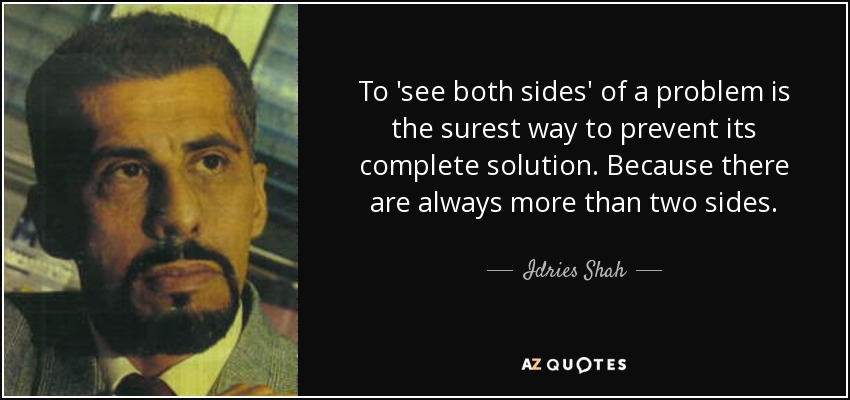
At this point, it's time to close with old friend Idries Shah:


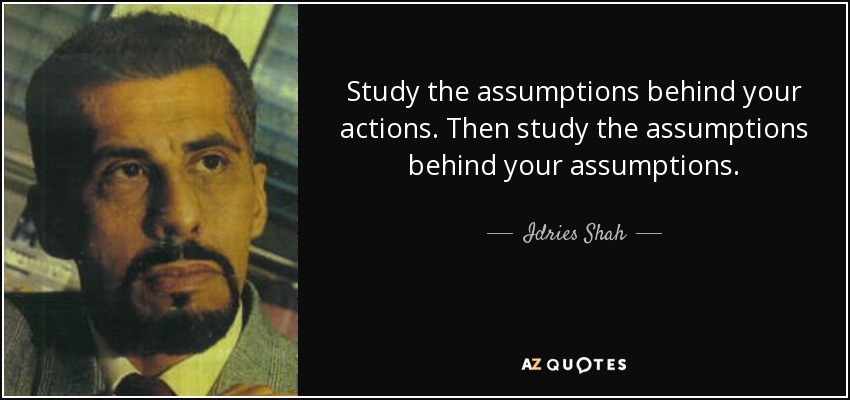
And this one from Shah is good, too. I am working to apply it more and more to myself.


October 13, 2015

#RaiseYourVoice in blogging for #BAD15

Friend Perry commented about this in a group email, and I thought, what the heck.

So, I joined Blog Action Day, per the second hashtag, which is short for Blog Action Day 2015.

The first hashtag is the theme this year.

As a newspaper editor, I won't say that blogging, or new media in general, has replaced traditional media but, whether conducted by members of the traditional media or others, it is an important adjunct.

And, it's a voice that, even in the democratic "West," let alone elsewhere, needs to be encouraged. And, in a variety of subjects.

Politics, culture, environmental issues, philosophy, sociology all need a variety of thoughtful, articulate voices. At the same time, it needs less in the way of irrational, fear-mongering ones.

Per the theme, issues important to me include:
1. Environmentalism, including defending climate change science;
2. Secularism, defending it both against anti-First Amendment attacks from the Religious Right in the US and also defending it against the caricatures generated by New Atheism;
3. Reforming US politics, especially getting outside the two-party Republican/Democrat box;
4. Philosophy and speculative thought;
5. The arts and their need in modern society;
6. Futurism that isn't, in some way, shape or form, whether by New Ageism or salvific technologism like Ray Kurzweil, pie in the sky.

What ideas matter to you?

August 21, 2014

Convert or pay a tax! Muslims ding Christians in Iraq, or .... Amerika?

Sounds horrible, doesn't it? ISIS telling Christians in Iraq that they must either convert to Islam or pay a tax.

A few counterpoints.

First, this is nothing new. Islamic states have done this since the Umayyad Caliphate.

Second, late medieval Christian states that allowed Muslims to remain, and to stay unconverted, had burdens of their own.

Third, and per the last part of the post?

Not to go too much Gnu Atheist, but tax deductions for religious groups, from state sales and property tax ones to all religious contributions, not just for their actual charitable work, being deductible from federal income taxes, could be considered a tax of sorts on secularists, could it not?

Survey says ... yes.

You can Google elsewhere for the totals, or I can tell you that it's $71 billion with a b in religious tax deductions per year.

And, while, theoretically, making that up elsewhere falls on us all, it really falls on secularists who are almost as small a minority in the US as Christians are in Iraq.
"The issue of religious tax preferment is especially relevant now because the number of Americans living outside any religious tradition continues to grow," said Tom Flynn, Free Inquiry's editor. "That underscores the unfairness of taxing all Americans to subsidize religious institutions that only some Americans utilize."

The most ridiculous part of that money is the $41 billion for capital gains exemptions.

Also, given the way the Catholic Church has worked to shelter its assets behind various walls, including tax-related ones, to try to avoid paying out money in sexual abuse lawsuits, besides dinging us secularists, there's a fair chunk of ethics issues involved.

So, secularlists?  Convert, or pay the tax that's not being paid by the religious.

Of course, as this ginned-up lawsuit over bald eagle feathers shows, wingnuts within Christianity always believe the First Amendment doesn't really apply to them.

March 02, 2014

No, Obama is not a humanist

Bill Nye, President Barack Obama, Neil de Grasse Tyson
And he's certainly not a secular humanist.

That's despite the attempt of folks like the American Humanist Association to imply he is one, by showing this picture of Obama with Bill Nye and Neil de Grasse Tyson at a recent White House event, a student film festival honors which had nothing to do with humanism, especially with secular humanism.

Here's the intro on the AHA Facebook page:
President Obama met two AHA awardees today, and took a selfie to memorialize it! He's will (sic) Bill Nye, AHA's Humanist of the Year 2010, and Neil deGrasse Tyson, AHA's 2009 Isaac Asimov Science Award recipient.
But, implication and reality are different things.

As I said on the AHA Facebook page:
Why are you picturing the man who **increased and expanded** President Bush's office of faith-based initiatives? That's not to mention drone warfare, warrantless wiretapping and other anti-humanist actions.
Period and end of story. More on that here. David Hoelscher writes that, at all of its various levels, governments in the U.S. give more than $70 billion a year to religious agencies.

And, per Hoelscher's essay, it's arguable that the AHA posted this, and posted it as it did, for classist reasons.

Also, there's an elemental logical fallacy here.

I would consider this a visual version of a false appeal to authority, trying to use President Obama's mug as a claim to the value of humanism. And, knowing how some people I know online love, and others "love," my pointing out of philosophical issues, it's important to do just that.

And, most commenters there are committing the fallacy of the undistributed middle, as AHA may be. In this case, it's the idea that every non-Bushie Republican is a humanist. 

And, per people who claim Obama is unprecedented among presidents in recognizing people of unbelief, er ... NOT! Per Wikipedia, I present his predecessor:
George W. Bush acknowledged those who do not worship during a November 3, 2004 press conference when he said "I will be your president regardless of your faith... And if they choose not to worship, they're just as patriotic as your neighbor.
So much, once again, for the soft bigotry of low expectations, eh? More here in the opening paragraph on this page of the press conference from which this was transcribed.

Were this a political ad and I were PolitiFact or similar, it would definitely be a 3-Pinocchio rating.

And, another reason why I'm not part of organized humanist, especially secular humanist, movements. Or Gnu Atheist ones. 

And, that leads me to reiterate the point in the opening paragraph.

The American Humanist Association is ultimately about secular humanism, not humanism in general. The drone warfare and other things excludes him from being a humanist in general in my book; his support for "civic religion" via the White House's faith-based services office, of continuing to proclaim National Day of Prayer, etc. certainly excludes him from being a secular humanist, or a secularist, in the First Amendment understanding of the word at its best, in general.

And, all those O-bots on AHA's Facebook page are, as is normal with O-bots, or Obamiacs, burying their heads in the sand if they try to pretend otherwise. 

Ditto for people on Facebook groups who think I'm imagining something, or reading something into nothing.

April 16, 2013

Secularists, American tragedies, civil religion

Once again, just about everybody from the President on down the political food chain, through sports and political journalists, and everywhere else, is saying that Boston Marathon explosions require our "thoughts and prayers" or similar.

Now, I'm no Gnu Atheist. I have no desire to mock people who sincerely and deeply think this.

But, I do want to challenge them, and even more challenge those who mindlessly repeat phrases like this as some sort of mantra.

It requires neither (I'm not just going after prayer.)

It certainly, for an America that has a First Amendment, actually requires elected officials to be more mindful of we the non-religious.

That's we the non-religious who likely were among the wounded in the attack. That's we the non-religious Pat Tillman, killed by friendly fire in Afghanistan, and whose family was agog not just at the Pentagon cover-up of that, but the way in which "civil religion" made him a hero invoked with "god and country," and not just "country," in mind.

So, this moment does not "require" prayer. But, given that President Obama has actually expanded on Bush's faith-based initiative program, it's no surprise for him to invoke this.

As for "thoughts"? Thoughts about what? Buddhist mindful meditation? This has to be about the tritest thing onc could say.

The combined phrase isn't full-blown narcissism, but it's a mix of narcissism and perceived helplessness. Top journalists think they're supposed to have some sort of power to "steer a narrative," so they try, even when they should shut up.

That said, another note on journalists.

I don't think it's wrong for newspapers to post to Facebook or Tweet, "Do any of our readers have experience with running in Boston" or similar? It's a lot easier than going to the circulation department and saying, "Hey, can you give me phone numbers of subscribers to dial?" It's only lazy when there's no follow-up.

But, if someone responds, leaves contact information, and says he or she would like to talk further, then it's very much an appropriate tool.

That said, contra a shallow-thinking Scientific American blogger (and indirectly, his blog editor./PR promoter Bora Zivkovic), social media proved little of its value during the explosions' aftermath. For every good thing the post touts, I can point to inanity by Sarah Gellar, Alex Jones and worse.

October 23, 2012

A moment of silence for #PaulKurtz


Secularists, please take a moment of silence for Paul Kurtz.

If one could finger one person as a “founder” of modern, post-World War II secular humanism in the United States, it would be Kurtz, the creator of Humanist Manifesto II and an energizer of a more activist, more engaged secular humanism. Beyond that, he founded Prometheus Books to give secular humanism its own “voice.”

Well, he died today.

Sadly, in a power struggle and a philosophy struggle, the Council on Secular Humanism booted him from his leadership posts two years ago. Kurtz had opposed the rise of “New Atheism” or “Gnu Atheism” if you will, due to a confrontationalist psychology it espoused, which I have previously argued was and is a “tar baby” mirror of Christian fundamentalism’s evangelism style.

No, Kurtz wasn’t perfect, and perhaps could have been a better financial manager of CFI.

That said, Wikipedia’s entry well sums up Kurtz’s philosophy in one short paragraph:
Kurtz believed that the nonreligious members of the community should take a positive view on life. Religious skepticism, according to Paul Kurtz, is only one aspect of the secular humanistic outlook.
Indeed. And, vis a vis Gnu Atheism, Kurtz wanted to look at positive ways to collaborate with religious people of faith, positive ways to present what secular humanism is about and more.

I don’t know who will be the primary leader of his new (of 2009) institution, Institute for Science and Human Values. But, let’s hope that there’s a centralized voice for carrying on his vision about secular humanism.

For more about Kurtz, see his website

And, despite issues he had with CFI, it does him right with its obit

Prometheus Books has a good obit, too. 

Among mainstream media, Reuters' was decent. AP's was crappy, mainly by being short enough to not be much more than a death notice. Shockingly and disgustingly, the New York Times didn't have an obit of its own, and just ran the AP version. Even more disgusting, the Buffalo News ... this is where he lived, all those years of building secular humanism ... has had NOTHING so far.

Email NYTimes Public Editor Margaret Sullivan at public@nytimes.com and in Buffalo, contact Interim Editor Brian Connelly at editor@buffnews.com. With the News, you can also visit its Facebook page

Meanwhile, while Kurtz was not a "Gnu Atheist," he also wasn't a "religious humanist." And, having seen at least one religious humanist on Facebook trying to downplay his significance, this is why labels are important at times. 

Update, Oct. 23: The AP finally has a real obit, including interviewing an online friend of mine, Nathan Bupp, who was close to Kurtz. And the Buffalo News also finally got on the stick. The New York Times finally has its obit up ... squeaky wheels!

And a great tribute at CFI's website by John Shook, who identifies Kurtz as being, in part, a philosopher. And, an even better, in-depth one from Michael Shermer. Shermer notes Kurtz's work to "reach" people who aren't hard-core skeptics, but don't totally believe New Ageism, alleged paranormal actions, etc.

Finally, a personal comment. I never met Kurtz. But, after graduating from seminary (divinity school) and trying to figure out just where I stood theologically and philosophically, and specifically, metaphysically (or naturalistically) since metaphysics transcends both disciplines, Free Inquiry and The Humanist helped me through the transition, and with some comfort level the first year or two after I felt I was a confirmed secularist.

October 19, 2012

Gratitude without god

When I first heard of this idea, a decade or more ago, I was in a psychological place where I was learning more and more about the idea of gratitude.

But, at the same time, I was pretty well down the road to my secularist, contra-metaphysical philosophical naturalist stance of today. I had tried “working with” ideas of “spirituality” but found what I was seeing promoted under that guise was New Agey-type metaphysics that, even if technically not religious, was indeed metaphysical and impossible to square with my re-emerging philosophical naturalism.

But, I was still trying to wrestle with this issue.

Having heard the phrase “an attitude of gratitude” in both New Age-type settings and from traditional ministers, and it being, for various reasons, an idea that I agreed with, I was trying to figure out how to be grateful if there wasn’t anyone to whom to be grateful.

Finally, I realized that I was mentally enshackled by the New Agey “present situations” that I had recently been in, plus my childhood religious preacher’s kid background.

Instead, why couldn’t I simply have an “attitude of gratitude” without a personal object for my gratitude?

And, so I do today. Little mental tools such as reminding myself of three good things that have happened for/to me today, especially if I had an active part in any of them, help this process.

The new job I have is reason to be grateful. I don’t have to listen to a boss asking me to resign (and himself not being grateful for me not doing so, since another person did leave a week after I would have completed my 30 days notice), threaten to “forget” my paycheck, or other things. I have work that’s fairly easy, still OK on pay, and fairly non-stressful while leaving open a growth curve.

I have the possibility of thinking about new work-creative outlets with the “timing” of the economy continuing to improve, as seems likely, albeit still slowly.

I have a life free from debt, the ability to live frugally without living stingily. That includes being a smart grocery shopper and knowing how to cook healthily while on a budget.

I’m grateful for modern medicine, including psychological counseling and medications as needed. Being a methodological and philosophical naturalist, I’m grateful for the scientific mindset behind it.

I’m grateful for the Internet. I’m grateful for the skeptical, critical thinking ability to recognize the dark side of the Internet itself, as well as seeing through most all of the spam, urban legends and such to which the Internet has given impetus.

Anyway, I don’t need to show you all my “gratitude list,” though I do believe journaling like this is a helpful psychological tool.

Let’s get back to my main point. Just as one can be moral without god, religion or metaphysically-oriented spirituality (karma is just as evil a “stick” as hell), one can be grateful as a state of being without needing a good to whom to tell that.

August 21, 2012

Autonomy, humanism and a sleep like unto death

Trust me, I'll tie all of this together in just a few paragraphs.

Secular humanism is, among other things, about human autonomy and choice (to the degree there's an "I" which has a conscious choice, which is by no means likely to be the case, but that's a whole nother issue).

And, where are two cases where such autonomy comes most clearly to mind? And, brings in other issues of secular humanism, namely, social justice and equality?

Assisted suicide and sleep patterns.

Dr. Richard Wesley/New York Times
The New York Times shows that, despite fear-mongering that largely was driven by religious conservatives, the assisted suicide laws in Oregon and then Washington state have not seen their use primarily by poor, often minority poor, who might be getting pushed into a final decision by relatives who couldn't afford their care, either financially or timewise.

Rather, it's largely white, upper middle class folks who are opting to take the final step into their own hands.

Including, in Washington, a physician who pushed for its law.
Dr. Wesley is emblematic of those who have taken advantage of the law. They are overwhelmingly white, well educated and financially comfortable. And they are making the choice not because they are in pain but because they want to have the same control over their deaths that they have had over their lives. 
And, it's also not about fear of one big issue related to dying.
Dr. Linda Ganzini, a professor of psychiatry at Oregon Health and Science University, published a study in 2009 of 56 Oregonians who were in the process of requesting physician-aided dying. 

“Everybody thought this was going to be about pain,” Dr. Ganzini said. “It turns out pain is kind of irrelevant.” 
A proposed similar bill in Massachusetts may be attracting some conservative support. Meanwhile, the AMA opposes such ideas, while many individual doctors, the ones who have shed the Superman idealism, favor them. That too makes it clear this is an issue of autonomy.

So, too, is sleep comfort — at least if you're a minority.

Moleendo Steward, sleep-challenged./New York Times
I think this issue is almost certainly nurture-driven. I simply cannot imagine any great evolutionary environmental pressure, or even the likelihood of evolutionary drift that got selected for, that would say why black Americans such as Moleendo Stewart have more trouble sleeping than their white counterparts. 

I deliberately don't say "peers" because of the higher poverty rates, which often mean housing situations less adequate for quality sleeping. Beyond that, the story notes that minorities often have less structured bedtime patterns for children, another environmental effect.

Of course, there's an easy way to study this. Take two or three relative "primitive" groups, from different ethnic backgrounds, such as the San! people of the Kalahari's edges and Siberian reindeer herders, and compare their sleep patterns.

Ultimately, the different socioeconomic groups in America have different degrees of autonomy.

And, true secular humanism still has its work cut out there. That includes "friendly fire" from confrontationalist Gnu Atheists, or Center for Inquiry suck-ups like Ron Lindsay, unworried about high income inequality, which directly undercuts autonomy.

The second story, in addition, is a reminder of how little we still really know about sleep, and why it, or its lack, has the effects it does.

April 19, 2012

#CFI is going to the Gnu Atheist dogs

So, John Shook of Center for Inquiry thinks humanists (and he doesn't even use the phrase "secular humanist") who are also atheists, metaphysically, need to self-identify with atheists to promote a "humanist agenda"? Really?

TOTALLY disagree with the main premise, expressed at the end. For those of us leery enough of Gnus to prefer the label “secular humanist,” we don’t WANT to advance an “atheist agenda.”

I know Shook talked about a "humanist agenda." But, given that he thinks humanists' best option for that is identifying with Gnus, I deliberately switched. I'm just taking his bait-and-switch plea to its logical conclusion.

Second, contra the larger tenor of his column, for Gnu Atheists, "atheist" is indeed becoming, or has become, a sociological word  first and a philosophical word second. That gets back to the "atheist agenda" issue. Shook himself adds to that by continually capitalizing "atheist" and "atheism" throughout the blog post.

Shook struck me as being halfway reasonable in the post-Paul Kurtz era at CFI. Maybe he still is, at least in light of what CFI in general is becoming.

With that thought, I'll say ... "I'm all Shook up."


January 06, 2012

R. Joseph Hoffmann — #frenemy of modern secular humanism

R. Joseph Hoffmann, religious scholar, former chair of the Committee for the Scientific Examination of Religion, and former associate editor of the journal Free Inquiry is a good secular humanist in many ways.

He’s insightful enough about the realities of religion, and knowledgeable enough about the history of secular humanism, that Gnu Atheists can’t refute most of his claims against their atheist evangelism and the concepts on which it is built.

But, in a blog post like this, “Complacency and Excess,” he earns the title above: “frenemy of modern secular humanism.” I’m not a fan of neologisims that are Internet or entertainment derived, but I make an exception in this case.

I’ve said before that Hoffmann’s brand of humanism is an Enlightenment-era humanism, one from the era when scientists were still “natural philosophers.” I don’t know if Free Inquiry founder Paul Kurtz was quite as much that way as Hoffmann is, but Hoffmann is definitely that way.

For example, in a blog post of about a month or two ago, which I blogged about without linking to, sadly, he went beyond criticizing overblown claims some neuroscientists make for what tools like fMRIs of today show about brain functioning to, at least as I saw it, criticizing the entire idea of daring to make too much scientific investigation of what the mind is.

The “frenemy” part, and related concerns, starts here:
Let me stay with that last point for a minute–the belief that only science can answer all of our questions.
While it’s true that many Gnus believe that, not all do. More to the point of my previous critique, successors to fMRIs, CT scans, single-emission positron scans, etc., may just reveal much more of the brain’s working, on a smaller scale, and in something nearer to “real time.”

Next comes a “huh” comment like this:
Can the numinous collapsing of all empirical religious traditions into the word “religion” (equivalent to the equally mystical collapsing of all scientific inquiry into the word “science”) be justified on the basis of a prior assumption–because that’s what it is–that gods don’t exist?
I agree with the idea behind the first half of the quote. Liberal Episcopaleanism is nothing like the Church of Christ, for example. But, the part in parenthesis is a head-scratcher, at the least.
First of all, when did “collapsing” become “mystical” in this instance? Second, is Hoffmann confounding “science” with “scientism”? Take away “mystical” and I’d agree with his parenthetical observation IF that is the case. But, IF that is the case, then Hoffmann’s engaging in either sloppy verbiage or goalpost shifting.

And there's more that to come, if you'll look below the fold.
Next, there’s this:
(D)oes “subject matter” mean a certain kind of theology? Or does it mean (I think is often does in new atheist harangues) apologetics–which is unknown in many religious traditions?
Well, it IS known outside of Christianity. Islam certainly has an apologetic tradition, albeit less than Christianity. Judaism does to a degree, also. Polytheistic traditions are less likely to do so, perhaps. But, even they do to a degree. And, as their face-to-face contact with Western empiricism grows, their apologetics will, too.

Hoffmann knows his Greek, and knows that an “apologia” is simply a “defense.” Whether it’s a more “active” defense, as shown above all in American Christianity, and somewhat in the rest of the Anglo-Saxon world, or a more passive defense like Buddhism’s moving target about what constitutes the “life force” that is reincarnated, well, that’s still apologetics.

But, let’s get to the next wrong quote:
Predictably, I am going to say that the best theologians–those who still mistakenly think they have a “subject matter”–are aware of the sovereignty of science over theology in terms of explaining everything from the cosmos to human origins and nature. And they have seen it this way for a long time.
Nonsense. 

I think everybody would call the Dalai Lama a theologian in a metaphorical sense, while allowing for him not believing in a personal divinity, a personal theos (unless he believes in the old, old Tibetan pantheon of gods and demons).

Anyway, the Dalai Lama, allegedly a great ground-mover in reconciling science and religion, is on record as saying more than once if science presents evidence it strongly claims clearly shows the nonexistence of either karma or reincarnation, science goes out the door.

In the Christian world, I’ve no doubt the Archbishop of Canterbury, for example, still believes in some sort of immaterial, metaphysical “soul” and, in the case of things like teratomas, brain-conjoined Siamese twins, etc., rejects inferences from science about the nonexistence of souls, i.e., does the “bit of human” teratoma have a “bit of soul” inside the full human “host”?

Next comes this fun one, where Hoffmann shows not much more political insight than P.Z. Myers:
Atheists, as usual, weren’t quite sure what to do (about the Iraq War) because while many hated George W. Bush they hated Islam more and so–like Christopher Hitchens–they backed the wars. They were, in a phrase, paralyzed and morally invisible.
Tosh, or bull, or, per an above comment of mine, sloppy.

Is he saying all atheists weren’t sure what to do, not just Gnus? He’s very wrong there, as I can personally attest. And, speaking of P.Z., I don’t think he ever supported the war. I don’t know about a Dan Dennett, a Vic Stenger or other leading Gnus, other than to say most of them weren’t focused on this, perhaps.

Finally, Hoffmann makes a simply unsubstantiated claim that a scholar of religion, or at least of the sociology of religion, shouldn’t have:
Complacency is what killed European Christianity. The fruits and comforts of the industrial revolution killed it. Not education and science; not curiosity; not Darwin’s dangerous idea. Just the creeping rot of not really giving a damn about anything.
Nonsense. Western Europe had pretty high church attendance rates, fairly high “religiosity,” etc., until World War II. Nazism, the Holocaust, and the realization that in many countries, especially Catholic ones, religious leaders were at least partially acquiescent in Nazism’s rise, is what killed Christianity in Europe as much as anything.

As for his paean to Stephen Jay Gould and his “nonoverlapping magisterial,” plenty of non-Gnu Atheists find it wanting. It’s really just a science-based riff on the old “god of the gaps,” retitled as “religion of the gaps.” Again, for Hoffmann to not see that as being what it is leads me to raise an eyebrow.

And why, between this and his seeming Enlightenment-era gravitas, he is indeed a frenemy of modern secular humanism. And, why I hope that some of my online friends see that while he can be a useful A-list ally, he's not close to a fantastic one.

 UPDATE: On his latest blog post, he spells "favoUrite" the British way, too. For a native American to do this is a bit of pretentiousness, in my book.

And, per this column, he appears to pull his punches on the question of the historicity of Jesus AND the worthiness of study of whether he existed and who he was, if he did.

Elsewhere, Hoffman has claimed the Toledoth Yeshu is more historical than the Christian gospels. In reality, per this extensive critical commentary, it was a "book" that relied on oral tradition as much as the Mishna if not the Talmud, and even after something close to its final state was put in book form, was extensively added to by Christians and Jews both.  

December 02, 2011

Humanism doesn't have to be opposed to science

That's true whether it's an unlabeled humanism, a "secular" humanism, a "Christian" humanism or something else.

I enjoy reading the often-insighful, almost-always-stimulating long-form blogging of R.Joseph Hoffmann.

With his background, per his Wikipedia link, he's well positioned to comment on Gnu Atheism, the academic study of religion and issues of humanism and philosophy in general.

I largely agree with his take on Gnu Atheism, especially concerns over its combativeness, narrowness of focus and evangelistic propensities.

On larger humanistic issues, I agree with concerns about "scientism," especially but not only found in some Gnu Atheists, and beyond that, a move beyond the classical and Renaissance devotion to the arts.

But, at times, he seems to come close to a false dilemma, positing that one must focus more on the arts and less on science -- science, not "scientism."

Let's take one matter where science, philosophy and overarching humanist principles meet: consciousness.

A good neuroscientist, informed by as well as informing of, philosophy, knows that MRIs don't directly measure consciousness or even close to that, and that they're not (yet) that accurate.

BUT ... a good philosopher who is informed by as well as informing of neuroscience knows that those MRIs are measuring some brain activity, brain activity happening at roughly the same time as mental activity and in parts of the brain we have tentatively identified by other research as being associated with certain types of mental activity.

So, a good philosopher of mind will welcome good scientific research that helps him or her posit further questions on the nature of mind, of consciousness and of free will, including scientific research that then helps him or her help neuroscientists.

But Hoffmann seems to fear, to some degree, actual science, not a philosophy of "scientism." He seems to fear methodological naturalism. He seems to fear a "mechanistic" take on life that undercuts its wonder and mystery.

Well, even an ascerbic existentialist phyisicist like Steven Weinberg still seems to have some degree of appreciation for some sort of magic in life, Mr. Hoffmann.

I may be overstating what I perceive his issues to be, but I don't think by too much.

Then, there are people, including some of his regular readers, who wonder why we have to specify "secular" humanism vs. just humanism.

Because, as Hoffmann notes from even a less "materialistic" era, already by the Enlightenment, non-Christian forms of humanism were arising, even if an open split was not being voiced. And, today, getting back to that neuroscience, and what it tells us about consciousness ... and things like a "soul" and its existence or likely nonexistence, Christian humanism and secular humanism will split on some metaphysical issues of major import, that in turn will affect their understanding of what issues, angles and points of view are most important within humanism.

August 23, 2011

Michael Lind, secular humanism and straw men

Up until about three months ago, Salon columnist Michael Lind was pretty much can't-miss in my book on his choice of column topics and the angle he took. Then, he minimized, or worse, Peak Oil issues while also flirting with global warming denialism, and when challenged by a fellow Salon columnist, refused to pull in his horns.

Since then, I have read him more skeptically, and with good reason.

The latest? He takes Paul Kurtz as "The" representative of modern secular humanism, twists to some degree Kurtz's thoughts, and produces a straw man. The subhead for the column says it all:
As fundamentalism gets stronger, post-religious liberalism offers a naive and sentimental creed.
Actually, Lind undercuts himself starting right there. How can a movement that is so reason-heavy and emotion-light as Lind claims be "sentinmental"?

Second, claiming that Kurtz violates David Hume's hoary "is doesn't mean ought" probably stretches things.

Third, the idea that Kurtz, when you have a variety of Gnu Atheists (who would fit Lind's stereotype better), old atheists, agnostics, undefined humanist, etc. out there, is, as someone who is 80-plus and removed from his original base at the Center for Inquiry, "the" representative of secular humanism today is ridiculous and ill-informed.

But, that's not all. Lind then clearly shows his biases by descending into sneering like this:
If the secular humanist creed lasts a millennium, it may well generate more manifestos than the pope has encyclicals.
Lind later admits Kurtz isn't "the" representative, and that Kurtz's utilitarianism isn't "the" moral stance of modern humanism, but that's three-quarters the way down a 1,500-word column.

After that, then, Lind, in saying evolutionary biology offers little hope to secular humanism, commits the EXACT is-ought fallacy he condemns in Kurtz.

He does that in defense of a good question. What about humanists who, unlike Kurtz or P.Z. Myers, are political conservatives, libertarians or even Randians? However, there are much better ways of getting to his issue, and to saying that secular humanism, if it has a broad tent, can make only limited political claims, than the way he actually takes.

Even beyond his Peak Oil/global warming errors, this is easily Lind's worst column I've ever read.

August 06, 2011

Frank Bruni, secularly clueless

Frank Bruni, with the red herring false lead of Rick Perry's "The Promise' (certainly not a rose garden), then jumps to the real subject of his column: the claim that secularists have their own degrees of magical thinking.

I may have found somebody dumber than Teapot Tommy Friedman AND Mojo Dowd on the Sunday NYT op-eds, at least for this week. Bruni erects a straw man and calls it "secularism," showing he clearly knows no such thing of real secularist thought. Here's his entree into wrongness:
But if we stick with this honesty thing, don’t we also have to admit that to varying degrees and with varying stakes, there’s magical thinking in secular life, and that it springs from a similar yearning for easy, all-encompassing answers? Didn’t the debt-ceiling showdown show us that?
No, it did not, and ergo, no, we don't have to admit any such thing. First, there's only one avowed secularlist in Congress, Pete Stark. Second, the debt talks didn't involve "secularism" in any way, shape or form, other than some tea party types perhaps claiming divine backing for their stances.

This blather comes next.
We all have our religions, all of which exert a special pull — and draw special fervor — when apprehension runs high and confusion deep, as they do now.
Wrong again. Many of us accept that life simply doesn't have absolutes. Not all of us are existentialist about that, but some of us are. (I, like Camus' Mersault, sometimes open my arms to the empty starlit sky.)

Then, there's the allegation that secularism is somehow gullible in some way:
“The minute you decide to buy the Toyota, your evaluation of it goes up,” said Jon A. Krosnick, a social psychologist at Stanford University who studies attitude formation. “You overly romanticize it.”

The same goes for religious creeds, political theories or, for that matter, management philosophies.
Oh, some secularists may be. But, the educated, skeptically-minded (in its right sense) secularists are aware of just how irrational human behavior can be at times, and wisely make no exception for ourselves. We may still engage at times in irrational behaviors at first, but we next engage in some form of self-examination.

May 24, 2011

Doing skepticism and secular humanism right

Daniel Loxton makes Skepticblog a place still worth visiting, with a very good post urging a degree of kindness and nuance to people deluded by Harold Camping's rapture predictions.

The bulk of my comment:
Many people don’t give up old ideas, and, of those who do, it’s often a secular “leap of faith” from inside them as much as anything.

As Steve Gould noted in many ways and forms, life is massively contingent. Nowhere is that more true than inside the individual human psyche, in my opinion.

That then said, though, we never know how we will impinge on another’s internal contingencies and, the soft word is more likely to have an impact. It’s like nuclear fission — too energetic a neutron just bounces off the nucleus; a kind word may have the right “capture cross section.”
That said, how long before P.Z. or Jerry Coyne rip into this?

March 25, 2011

Why do secularists make "just war" arguments?

For example, take Massimo Pigliucci's argument for bombing Libya. It's a "just war" argument.

I raise this for several reasons.

First, most notably, the idea of "just war" arose from Christian dogmatic theology, namely starting with St. Augustine. From Thomas Aquinas, and onward, it got wrung through a sophistic wringer, and not just by Catholics, once the Protestant Reformation arrived.

Now, could one argue for something similar to a "just war" from a secularist point of view and with secularist bolstering?

One could try, I'll certainly concede, using tools such as evolutionary psychology. And please, only the real thing, not Pop Ev Psych.

But, a philosopher like Pigliucci ought to know that the idea of "justice" is philosophically iffy on utilitarian and other grounds.

First, can we even talk about "justice" in the abstract, whether retributive or distributive?

With Walter Kaufmann, I say no. I specifically refer to his hugely thought-provoking book "Without Guilt and Justice," which pretty thoroughly eviscerates John Rawls like an eight-inch herring.

To put it simply, neither form of justice, in the abstract, can be universally applied in the concrete. To execute what seems "just" to some, even many, will always or nearly so be unjust to somebody.

So, should we let a utilitarian hedonistic calculus apply?

But, that leads me to the old Chinese or pseudo-Chinese parable, with the ongoing refrain of "could be good, could be bad."

What seems "just" to and/or for the majority now may not five months, five years or five decades from now. Maybe not even five days from now.

So, no, we shouldn't.

So, what CAN philosophy tell us in situations like this.

First of all, looking elsewhere in the East, something like Taoism can tell us all decisions are fraught with uncertainties and shades of gray.

Second, we can move on to Iranian philosopher Idries Shah, who uttered the aphorism, "There are never just two sides to an issue." While that itself is a bit too black-and-white for me, it nonetheless has a large kernel of truth.

Take the air strikes against Libya.

There is:
1. The tribal rebels' side (or sides, depending on how much or how little coherence they have;
2. The U.S. side;
3. The Franco-British side;
4. The Turkish side;
5. The Arab League side;
6. Gadhafi's side;
7. The Russian side;
8. And, though we've not heard from Beijing yet, surely, the Chinese side.

Even if we narrow the issue of "justice" here, rather than play realpolitik, at least the first three, if not the first five, are all legitimate "sides." And, all with different definitions, at least in narrow particulars if not major strands, as to what might be "just."

And, also, since "just war" ultimately has religious roots, shouldn't we be careful about it for that reason, too? Monotheistic religions deal in black and white; I prefer my philosophy with more nuance. And, my secularism in general.