SocraticGadfly: Arctic
Showing posts with label Arctic. Show all posts

October 27, 2021

Climate change issues in the news

Boston Review has a great piece on how nuclear power is a part of a successful transition from fossil fuels, but one that looks legitimate science and public health concerns square in the eye. That includes noting that uranium-based fission is itself NOT a long-term answer, and that thorium, like fusion, remains a will-o-the-wisp. Also looked at is how well, or not, long-term waste storage is working in places like Finland.

Once again, clearcutting, over-thinning and other US Forest Service "active fuel management" claims, recently repeated with the Dixie and Bootleg fires, does NOTHING to prevent them, and climate change will only underscore that.

Call it methane, not natural gas. That may help people reframe methane leaks in terms of climate science.

Much of Russia, especially the Far North, stands to benefit from climate change, at least in the short term. The Northeast Passage for global shipping is getting more use, and that means dying Russian Arctic cities may get new life, as shown in one case.

Not strictly climate change news, but ... California has started the process (but NOT complete or THAT near to it) of adopting the nation's most stringent setback rule on oil wells from residential areas.

December 20, 2017

Environmental news roundup — #climatechange and #bucketlist problems

1. Climate change has become entrenched enough, and in northern latitudes, starting to produce feedback enough, that the Arctic of the last several thousands of years may be permanently gone. This, in turn, will have yet more feedback. Ocean shipping will put more big ships on the Northwest Passage and Northeast Passage. Their diesels will drop sooty pollution on remaining icecaps and glaciers, further speeding the melting.

Sadly, speaking of petrochemicals, per this piece, natives in the region are contributing their own feedback loops. And, by now, probably 80 percent of Inuit have either lost the skills, or abandoned the temperament, to run dogs rather than a snow machine.

2. Yellowstone's grizz may get re-protected under the Endangered Species Act. A bit of good news for the park and its wildlife in the middle of three red states with much of the population having a high animus toward grizzly, and wolves.
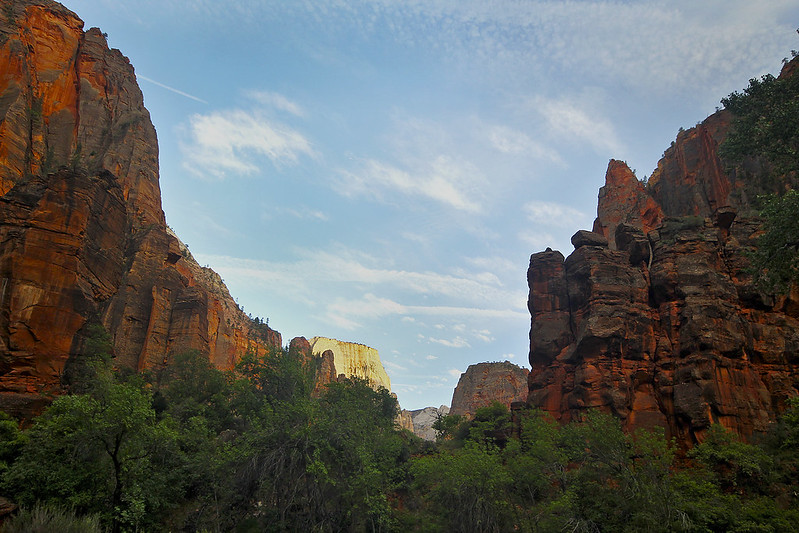
Temple of Sinawava 1

The Temple of Sinawava at the being-visited-to-death Zion National Park. More photos in this album.

3. Even as Utahans like Congresscritter Rob Bishop applaud President Trump for whacking away most of Bears Ears National Monument, thanks to the state of Utah's official promotional efforts and other things, visitation at national parks in the state continues to break records. The situation is worst (yes, worst, not best) at Zion. Rejecting Interior Dept. grifter-in-chief Ryan Zinke's plans for use-level pricing, I think Zion does need a reservation system. And, if that decreases visitation, not just controls it, fine. Nearly 5 million visitors a year would be tough enough for a park twice its size WITH most sections of the park visited equally.

But, given that the Kolob Canyons get almost no visitation, and even within the main section of Zion, 80 percent of its visitation is in Zion Canyon, something has to be done. Sadly, many richer bucket-listers won't be affected.

What COULD help, and immensely, is charging a surcharge for RVs, and making it by the length. Say a $5 minimum, then say another $5 for being over 32 feet. When campgrounds are being reconfigured to accommodate an RV flood, they need to pay for it. Not just at Zion, but all parks.

And if the Park Service is going to preserve mega-parks for the long-term future, it needs
1. Zion-like shuttles at more parks
2. Said shuttles to be electric (Zion's are propane, and I believe Yosemite's are too), for global warming, for cutting local air pollution, and for cutting local noise pollution
3. They need to have better scheduling than Yellowstone's does.
4. Fines need to be higher for visitor non-compliance on entry restrictions and bus use, and other things.
5. Here's another. Ban smoking on all trails in national parks.

4. Grist notes that people should avoid touting China's new carbon market trading program before it actually rolls out. Among other things? It's been in the pipeline a decade but is only being rolled out now, and it will only have simulated trading its first two years. I agree with that, as well as noting that Chinese municipal-level corruption is reason enough not to trust a capitalist system like this.

5. The GOPTaxScam includes opening a portion of the Arctic National Wildlife Refuge to oil drilling. If ANWR in general, and the 1002 Area in particular, are so environmentally important (and I know they are, I'm being rhetorical), why did neither the Slickster nor Dear Leader make it a national monument, especially one inside the park service?

Answers? "Triangulation" and "all of the above energy strategy."

Beyond that, Jimmy Carter was arguably the last real environmentalist Democratic president. At a minimum, he knew how the Corps of Engineers lied about claims for dam benefits and he probably suspected BuRec did the same. He strikes me as more of an outdoorsman in general than either of his successors.

November 29, 2012

Arctic: Area larger than US melted

That’s right, this summer’s record-setting melt of Arctic sea ice eventually killed off anarea larger than the United States. Yet the US continues to drag its feet at Doha, Qatar just as much as anybody else.

That’s even as the alarm bells continue to sound:
The dire climate news — following on the heels of a report Tuesday that found melting permafrost could significantly amplify global warming — comes as delegates from nearly 200 countries struggled for a third day to lay the groundwork for a deal that would cut emissions in an attempt to ensure that temperatures don't rise more than 2 degrees C (3.6 degrees F) over what they were in preindustrial times. Temperatures have already risen about 0.8 degrees C (1.4 degrees F), according to the latest report by the IPCC.
And as the Antarctic melt is increasing, too.

And, assuming they don’t get a deal? As I have blogged before, temperatures are likely to hit a rise of at least 4C overall. And, that’s overall, including the water of the world’s oceans, which warms more slowly. We could see temperatures at least 6C, or 11F, higher than preindustrial times by the end of this century.

Which means droughts like this year’s, now intensifying again, will be “the new normal.”

And, not just for the US. China, ahead of us on carbon emissions though still far lower on per-capita emissions, would probably lose one-third of its agricultural output. An 11F rise would certainly nuke much of the Himalayan glacier field on which its, and India’s, rivers depend, as well as causing massive changes to India’s monsoon.

So, yes, the US is at fault for diddling away under Team Obama. So, too, is China for insisting “rich countries” pay more. Chinese leaders, look into your Mahayana Buddhism past: We’re all on the one “big raft” together.

July 25, 2011

Global warming is releasing 'The Dirty Dozen'

Things like DDT and other persistent organic pollutants have been trending downward, in terms of worldwide residues, for years. Advanced nations have cleaned up emissions of many of these from manufacturing processes, or in the case of things like DDT, greatly reduced their use.

Now, though, there's a problem. Arctic ice melting. (With industry concentrated in the Northern Hemisphere, the problem is greater here than in the Antarctic.)

The melting Arctic ice, driven by global warming, is starting to release more and more stored quantities of these pollutants.

Especially since these pollutants concentrate at the top end of the food chain (which is why DDT was so harmful to bald eagles) environmentalists rightly note that this news is grim.

It's probably grimmest for polar bears, being both at the top of the food chain and threatened as a species due to diminution of ice floes.

Exactly how grim it is remains to be seen. Especially if we ask if an ever-industrializing, and dirtily-industrializing, China adds to the POPs even as less sea ice is around to temporarily absorb them.

May 03, 2011

Global warming Arctic melt — 5-foot sea rise?

That's the latest word from researchers — the Arctic and Greenland ice is melting faster that previously thought, and we could see a 5-foot rise in sea levels by the end of this century.
The melting of Arctic glaciers and ice caps, including Greenland's massive ice sheet, is projected to help raise global sea levels by 35 to 63 inches (90 to 160 centimeters) by 2100, AMAP said, although it noted that estimate was highly uncertain.

That's up from the 2007 projection of 7 to 23 inches (19 to 59 centimeters) by the U.N. panel.
Note that this is a BIG revision upward in just a few years.

To translate into how this would hit the U.S.? Big in red(ish) states, not just blue ones.

Much of New Orleans inundated. Much of South Florida underwater. Much of Houston underwater. Most of North Carolina's Outer Banks underwater.

And, much of Manhattan underwater.

Not to mention many Pacific islands and much of Bangladesh.

That said, a bone to pick with this and other MSM climate stories. It mentions the numbers are uncertain, but we're not given standard deviations, sigmas, or other information to tell us how uncertain — or, really, how CERTAIN — this information is.

I'm assuming that range, of 19 to 59 centimeters, is at least 95 percent likely.

In other words, you denialists, by the end of the century, the sea level will rise a minimum of 8 inches with 95 percent certainty on that. Period. End of story.

November 24, 2010

Polar bears would lose competition with grizz

As melting ice pushes them deeper onshore, and forces them into more of a grizzly-type diet, facial structure studies show they won't be as efficient at eating vegetable matter as grizz.

Of course, the story is missing one thing - the interbreedability of the two subspecies. (No, biologists haven't made that reclassification, but, they can interbreed, and their geographic isolation is being dimished, so, aren't they?

August 23, 2010

How Arctic warming's effects are spilling elsewhere

Jet stream changes. Icebergs moving further south, too. That's all part of the fallout of global-warming induced changes in the Arctic. Among other things, as more big icebergs break off Greenland, they're going to get pushed deeper into the Atlantic by new wind patterns.

And, yet, the U.S. fiddles while Baffin Island roasts.

Canadian Thomas Homer-Dixon notes:
(W)e’ll almost certainly need some kind of devastating climate shock to get effective climate policy. That’s the key lesson of the recent financial crisis: when powerful special interests have convinced much of the public that what they’re doing isn’t dangerous, only a disaster that discredits those interests will provide an opportunity.

The shock?

Maybe, if a couple of North Atlantic offshore oil platforms get damaged by a big-enough Greenland berg, Big Oil will tell the GOP to wise up, but not likely

June 27, 2010

Salazar sux, part deux

Via Frank Rich, I am reminded that in addition to taking down Gen. Stanley McChrystal, Rolling Stone also, in the same issue, has a second installment of all that's rotten in the Department of the Interior.

Everything that was wrong, in advance, with Deepwater Horizon in the way of over-aggressive drilling and lack of advance preparations for serious problems, is wrong in spades with proposed new drilling in the Arctic:
The closest Coast Guard station is on Kodiak Island, some 1,000 miles away. The nearest cache of boom to help contain a spill is in Seattle — a distance of 2,000 miles. ... Relief equipment can realistically be brought to the region only by boat — and then only seasonally. The Arctic is encased in ice for more than half the year, and even icebreakers can't assure access in the dark of winter. "If it's this hard to clean this up in the relatively benign conditions of the Gulf of Mexico," Sen. Sheldon Whitehouse cautioned Salazar at a hearing after the BP spill, "good luck trying to implement this sort of a cleanup in the Arctic."

Shell, in fact, has never conducted an offshore-response drill in the Chukchi Sea. Perhaps that's because there's no proven technology for cleaning up oil in icy water, which can render skimming boats useless — much less to cope with a gusher under the ice. In the worst-case scenario, according to marine scientists, a blowout that takes place in the fall, when the seas are freezing over, could flow unabated until relief wells could be drilled the following summer. In the interim, oil could spread under the sea ice, marring the coastlines of Russia and Canada, and possibly reaching as far as Norway and Greenland. "It could realistically be a circumpolar event," says Steiner.

This is the new frontiers of Arctic drilling for which Secretary of the Interior Kenny Boy Salazar is pushing so hard.

Meanwhile, even as the Rolling Stone piece was being penned, and despite the six-month moratorium on deepwater drilling in the Gulf of Mexico, Minerals Management Service was still accepting new deepwater tract bids.

Hey, Obamiacs: As long as The One stays with Kenny Boy, it's a sign he supports his position. Perhaps, as with Wall Street, "New Democrats" would like more campaign money from Old Big Oil?

August 10, 2009

Arctic ice cap may break 2007 record low

It’s too early to tell for sure, yet but this year’s ice cap retreat may be worse than 2007.

Just another thing to tell the global warming deniers.
-END-

May 01, 2009

Norway: Share the wealth in Arctic

Norway is calling for its fellow Arctic-bordering countries to increase cooperation on oil and gas exploration work and other natural resources development issues.

April 07, 2009

Smithsonian publishing pseudohistory again – Peary & Cook at Pole

It’s to the point that when a new issue of Smithsonian magazine comes out (I have a gift subscription), I expect a major error of either fact or interpretation in a major story.

And, I also expect the magazine not to do anything about it.

April’s entry? Excerpts from Bruce Henderson’s book, “Who Discovered the North Pole,” insinuating Frederick Cook beat Commodore Robert Peary to the North Pole.

Henderson, both in the excerpts and the full book, stacks the deck in favor of Cook, without explicitly saying he beat Peary.

That said, he willfully ignores the painstaking work done by people BESIDES Peary backers showing that, four years before his claimed trek to the Pole, he faked the alleged first ascent of Mout McKinley, and faked it by more than 10,000 feet of altitude.

That said, do I think Peary got to the Pole 100 years ago this month?

Not likely. Probably neither one did. Neither did Admiral Byrd in his plane from Spitzbergen in 1926, per his own mechanic. And, since the Peary and Byrd had eliminated further claimants to going North 90 those two ways, at least until further handicapping like solo voyages, voyages without dogs, etc., probably the first person or people to visit the North Pole, if not from 20,000 leagues deep, in all likelihood popped up from below …

The USS Nautilus in 1958.

However, if it’s the battle of the two by-land claimants for first there, Peary is much more likely than Cook. And, albeit with modern synthetic clothing, gear, etc., his 1909 per-day mileage claims have been met and even exceeded in recent years.

Peary’s claim is plausible. (So, too is fraud; having announced this would be his last journey, he had good motive for fraud.)

Then again, so did Cook; it seems to have been part and parcel of his personality, something that Henderson also ignored.

April 03, 2009

October 22, 2008

New Arctic exploration to check on warming

What may be the most detailed Arctic global warming exploration ever will take 10 million Arctic ice measurements over late winter and early spring next year to determine more accurately the rate of ice melt.

Sidebar note — the next issue of Nature, on PBS, is about Ellesmere Island.

October 18, 2008

Arctic temperatures continue to soar

In another indicator of global warming, this year’s Arctic fall temperatures have been 9 degrees above normal.

October 10, 2008

Arctic melts and gets stormier

First, the melting: A new book by the U.S. Geological Survey says most Alaskan glaciers are thinning, retreating, or both. That includes “significant retreat” in the last two decades of the 20th century.

Next, the storminess: Supposedly, it’s gotten much worse in the last 50 years. That, in turn, has increased sea ice drift, which affects shipping.

Both fall within the prediction parameters of global warming computer modeling.

September 05, 2008

Ancient Canadian Arctic ice sheets go bye-bye

Arctic ice sheets as old as 4,000 years old are disappearing. Researchers say Canada’s portion of the Arctic lost one-quarter of its ice this summer:
The entire Markham ice shelf broke away in early August and is now adrift in the Arctic Ocean, carving away 50 square kilometres. Two large sections of the Serson ice shelf also broke off, shrinking it by 122 square kilometres or about 60 per cent. The Ward Hunt ice shelf lost 22 square kilometres.

These ice shelves in the area of Ellesmere Island are are up to 4,500 years old, and as much as 40 metres thick. So, that’s a significant “heat sink” loss.
“These substantial calving events underscore the rapidity of changes taking place in the Arctic,” said Dr. Derek Mueller, who has been studying the shelves at Trent University, in a statement. “These changes are irreversible under the present climate and indicate that the environmental conditions that have kept these ice shelves in balance for thousands of years are no longer present… .”

“The extent of their loss this season is significant,” said Dr. Warwick Vincent, director of Laval University's Centre for Northern Studies, who collaborated on the study. "Unique ecosystems that depend on this ice are on the brink of extinction.”

Oh, and for the global warming denialists, the famed “hockey stick” is back, better and more accurate than ever.

August 29, 2008

Arctic about to become unbearable.


Literally, as the NYT pic above illustrates.

We’re likely to break last year’s recorded record for smallest end-of-summer Arctic ice minimum. And, that’s likely to become a sentence we utter every year at about this time.
“We could very well be in that quick slide downward in terms of passing a tipping point,” said Mark Serreze, a senior scientist at the (National Snow and Ice Data Center), in Boulder, Colo. “It’s tipping now. We’re seeing it happen now.”

Read the full story for just how stressed polar bears are getting.

And, with well-timed insensitivity, five national business groups are fighting back against the Interior Department’s decision earlier this summer to list polar bears as a threatened species.

That includes the American Petroleum Institute, National Association of Manufacturers, U.S. Chamber of Commerce, etc.

July 25, 2008

I call ‘lies’ on USGS claims on oil in Arctic

The United States Geological Survey is claiming the Arctic could contain as much as one-fifth the world’s remaining oil and gas reserves.

Given that the Bush Administration has already proven itself the most anti-scientific in modern history, and is determined to leave a George W. Bush “legacy” of a final, countdown orgy of antiscience and politicization of science executive orders and bureau and agency rule makings that will make the previous 7.5 years look like a piker’s effort, why the hell should we believe the USGS on this?

May 03, 2008

Ozone hole slowed Antarctic warming but will change

A former climate change and global warming skeptic says the Antarctic should join the Arctic in seeing more global warming effects in the future.

Why? The Montreal Protocol that got developed nations to start phasing out freons and put worldwide regulations on them in place, is starting to close the ozone hole over the Antarctic.

James Overland, who admits that he used to be a skeptic, called the projected Antarctic changes “startling.”

Meanwhile, preliminary predictions are that this year’s end-of-summer minimum on Arctic sea ice will be as bad or worse than last year’s.