SocraticGadfly: religion
Showing posts with label religion. Show all posts

April 19, 2021

The rise of the nones and politics as the new religion

The rise of the "Nones" in America doesn't mean a decline in belief, per this from the Atlantic:
"(W)hat was once religious belief has now been channeled into political belief."
That said, there is no "god-shaped hole." There IS, rather, a "god-belief-shaped hole." The idea of a "god-shaped hole" is Augustinian bullshit.

The "nones" may indeed, per the SJW division of liberals (who are NOT leftists) may act in ways the second link states. But, with people acting like there is one, that may happen.

On the right, as the Religious Right had made the church politics in a way that the Black church really had not (and, in some ways, was forced to), with tied with the rise of Trumpism. So, they're already prepared for that.

What this will mean for the future? SJWs versus a more secularized version of the Religious Right, or the Religious White? A (non-lethal, we hope?) version of the Thirty Years War?
 
What the Atlantic really misses is that politics and religion in America both smack too much of tribalism in many cases, and that the Nones are just bringing a liberal tribalism to the political table. 

It also misses, per this great Politico piece about political activism in the Gilded Age, that politics as ersatz religion ain't necessarily new.

November 15, 2019

The rise of the Nones: First Amendment implications

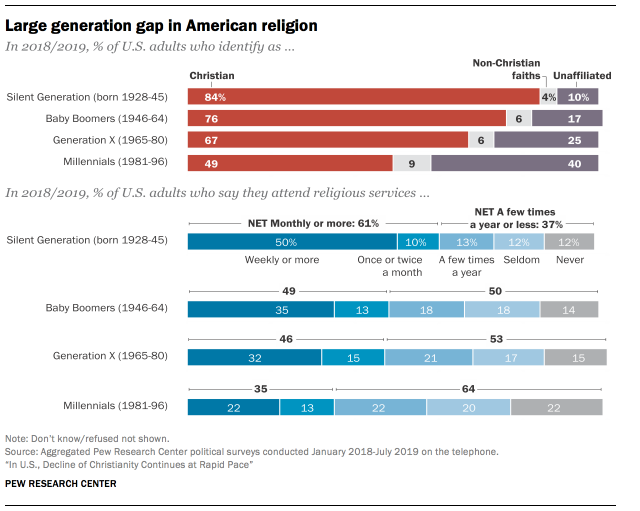
Per the latest Pew Research Center data on religion and American life, there will surely be some sort of "freedom of religion" clause implications within a generation, if not less.

The biggest takeaway from all this latest data? Millennials (yeah, those slackers, despite adults calling the younger generation slackers as far back as Aristotle) are a LOT less religious than their parents. A LOT less.

"Nones," the common word for those with no religious affiliation or identity, plus non-Christians, have as great an identity among Millennials as all Christian groups combined. No, really.


Now, this is a lot broader group than atheists or agnostics, despite Gnu Atheists talk of an "atheist surge," which has been going on for a decade or more now. (The talk, not any surge.) That said, self-identified atheists and agnostics have more than doubled over the 12-year range of the data, from 4 percent in 2007 to 9 percent in 2019.

It should be noted that "nones" may well have metaphysical beliefs. That's another reason for Gnus to stop poaching and crowing. Looking back 15 years or so, a woman on Match.com who originally wanted to meet me said "no" when she found out that "atheist" meant just that and NOT "spiritual but not religious" or Wiccan light or whatever. (It should also be noted, which Gnus don't, that millions of Buddhists around the world, mainly in the Theravada tradition, are both atheist and religious — and believe in metaphysical ideas, just not a personal god.)

That said, Nones are voting with their feet, not just their brains. In 2014, people who attend religious services just a few times a year first exceeded those who worship monthly or more. Among Millennials, it's just one-third who go to services once a month or more.

Among Americans overall, that growth is driven by a surge in those who NEVER attend, by self reporting. That's up to 17 percent.

Yes, one-sixth of Americans, even if they have some metaphysical beliefs (astrology, luck, Kabbalah or whatever) lurking somewhere, say they NEVER attend religious services. Related? Among those who say they attend once a month or more, the most ardent, the weekly attenders (or more) lost six percentage points, down to 31 percent. (If even that is correct; time and motion studies have shown that decades-old self-reported religious attendance surveys were consistently too high.)

Pew notes that the National Opinion Research Center, with different questions and framing, shows a similar number of Nones. It's at 22 percent for all ages vs 26 percent from Pew, even with somewhat different framing and questioning.

Will this "stick"? My answer is that it will, at least to some degree. More slowly, America is becoming less religious, like Europe after WWII. (Before then, and certainly before the Depression, Europe and America didn't track that differently.

It's probably kind of like cigarette smoking. If the Nones who truly don't go to church at all continue that through age 30, they'll likely never be there. And, with that, contra the fakery of Supreme Court backtracking in rulings like Town of Greece, at some point, the First Amendment's freedom of religion meaning true freedom from government propping up religion in any way will maybe start to be realized. Beyond totally banning pre-meetings prayers, etc., I'm talking about things like churches not getting any tax breaks beyond those extended to nonprofit entities in general and things like that.

Even in places like smaller towns in Texas, if they're anywhere closer to the East Texas metros, in 20 years, if not less, less vocal Nones will realize they're not alone. And they're going to start challenging the city council, the school board and the commissioners court about opening meetings with invocations. And, if Democratic (or Green? Socialist? even Libertarian?) presidents are listening, they'll be appointing judges who know that "freedom of religion" includes that the government can do NOTHING in terms of an establishment of religion — any religion as no specific religion is mentioned — that the First Amendment is the most federalized one in the constitution, and that the mealy-mouthed Town of Greece ruling is wrong.

Democrats who don't recognize this are going to find that "non-Republican votes" aren't necessarily "Democratic votes."

BRING.IT.ON.

==

Update, with some related stats? In 2019, 23 percent of Americans went to church every week. Sounds fairly devoted, right, every week? But 29 percent never went once. Texas, Bible Belt stereotypes aside, is no exception. This site says that it was less than 20 percent, and they're a religious website.

December 14, 2018

Andrew Sullivan hits new pseudointellectual low

In what I see as possibly his greatest feat of anti-intellectualism since denoting an entire issue of The New Republic to touting the pseudoscientific insights of The Bell Curve, Sully is now hoisting high the old canard that atheists are really religious, too.

I have myself said that Gnu Atheists, in some sociology-type ways, show a mindset similar to fundamentalist-type Christians, and have thus called them atheist fundamentalists. But, I've never claimed that they, let alone non-Gnus, are religious.

He then followed with teh stupidz of claiming religion is in our genes.

Neither one is close to true, in reality. The fact that Sully is arguably a very good representative of the Peter Principle in mainstream media, especially thought and opinion media, on the other hand, is almost ironclad as an argument now.

But, I couldn't let such arrogant, arrant nonsense go unchecked.

Here's a few thoughts I posted on Twitter, with interspersed comment:
In short, per his Bell Curve love, on B, Sully seems to be doubling down on the pseudoscience of Ev Psych. A Scott Atran or Pascal Boyer will easily steer clear of this while offering much more plausible theories about the origins of what eventually became religious belief mindsets.
From there, it's off to the land of false analogies, refuted by this:
The real problem is Sully's willful ignorance on a fair amount of philosophy. I note that here
and here:
Finally, Sullivan shows his misunderstanding of the political movement he claims to represent.
Tosh. Both here and in Europe (and the Anglosphere across the world), many politicians and political thinkers are both classical liberals and irreligious.

August 10, 2018

Where are all these Texas atheists?

Near the end of its latest poll on the Beto O'Rourke-Ted Cruz Senate Race, Lyceum reports on the background of respondents, as most in-depth polls do.

There's this, on page 11: NINE percent claim to be atheist or agnostic. That's more than twice as many as who reported as Muslim. Throw out the 13 percent who were either "didn't know" (really?) or "refused," and you're at a little over 10 percent.

Really?

That said, counting 22 percent as either unaligned or third party, Lyceum claimed respondents were otherwise split, 39 percent each on Doinks and Rethugs.

Really?

But, let's get back to those atheists and agnostics.

I'm quite familiar with people misusing these terms to really mean "spiritual but not religious," or "irreligious vis-a-vis organized religion."

Let's say half our 10 percent falls there.

That's still 5 percent atheist or agnostic.

Let's say that 8 percentage points of the 13 percent refusniks are "nones," as are all 9 percent, in the original number, of alleged atheists or agnostics. Then, one-sixth of Texans are "nones."

That leads me to a piece by Psy Post. Until Friday, it seemed to me to be a pretty good psychology popularization blog and website. John Horgan is among its Twitter followers.

But then it blared: You live longer if you're religious.

Without saying that all we have on that is statistical correlation, not causal correlation, and without, in the western tradition, comparing today's US to today's Europe on that. (Well, it did kind of say that, but after the "blaring.")

Given that the power of intercessory prayer has been disproven by double blinded studies, in fact, we can say that almost certainly, it is NOT a causal correlation.

Add to that the fact that, especially in small towns, "church" and non-church general religious affiliation adds a degree of "community" to life for many people, especially in a place like red-state Texas. Also note that, especially in smaller communities, for those in need, many food banks and other forms of charitable outreach are church-based, or if not so explicit, at least religiously themed.

The only way to do a halfway scientific version of such a survey would be to look at churched vs unchurched people who are both also members of other organizations, like Rotary, Kiwanis, etc. And, you'd have to use more than obits. You'd have to use longitudinal time management research to confirm how often said people actually attended both churches and their social clubs.

And, there's been plenty of empirical research on the reality of a god already.

Speaking of empirical matters, we do also know that, by percentage of respective ethnic groups, more of those atheists are white than black or hispanic, but we also know that young blacks are consciously starting to catch up on leaving church, in part because African-Americans are finding more "secular" leaders willing to speak on "spiritual" issues. Like LeBron. Or Kaepernick. This is even as Congressional Black Caucus leader Jim Clyburn will suck up to Trump as much as those black ministers, to avoid churches paying new taxes.

==

Update, with some related stats? In 2019, 23 percent of Americans went to church every week. Sounds fairly devoted, right, every week? But 29 percent never went once. Texas, Bible Belt stereotypes aside, is no exception. This site says that it was less than 20 percent, and they're a religious website.

November 27, 2017

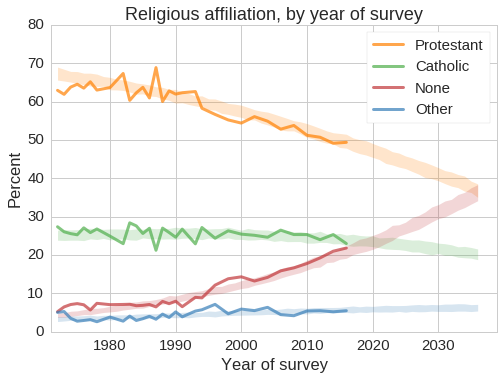
US Nones to pass Catholics by 2020?

Riffing on an old rock anthem, per Scientific American, by 2020, self-identified "Nones" in the United States of America will equal self-identified Catholics.

This is indeed big news on the American religious landscape.

Don't be so smug, you Baptists and Church of Christers, either.

By 2035, Nones will catch you, too.

And, you should, in fact, be even less smug, per this image:


That comes from the author's own blog, linked at the bottom of the SciAm piece.

In other words, the liberal wing of Lutherans, Methodists, Presbyterians and Episcopalians has already caught you Baptists, etc.

Sure, they may go to church less — setting aside the fact that time and motion studies show that most of you don't go to church as much as you claim — but they don't feel the guilt-tripped NEED to go to church.

This reminds me of other studies that show voters in a Congressional district are not as conservative as their representative assumes, and that the false assumption is done by both Democrats and Republicans.

It's why, here in Tejas, Dems like Wendy Davis chase the mythical moderate.

Update, with some related stats? In 2019, 23 percent of Americans went to church every week. Sounds fairly devoted, right, every week? But 29 percent never went once. Texas, Bible Belt stereotypes aside, is no exception. This site says that it was less than 20 percent, and they're a religious website.

October 27, 2015

Are chimpanzees religious? Bad science meets New Age thought

A very interesting suggestion, limned out here, largely based on the fact that chimpanzees show even more reverence for the dead than do elephants. Well, more than that

It's also based on Jane Goodall's high level of anthropomorphizing chimps, on New Age old philosopher favorite Rudolf Otto, and personalized definitions that would probably get flunked out of a class in either philosophy of religion or ethology, and probably in anthropology of religion, too, which is what James Harrod claims is his ... yes, I'll go there, his "ground of being."

My caveats to Harrod's claims, in specific.

One is that it presumes fear of death is at the core of human religion, and at the core of the start of human religion. The first half of that seems true, but is not proven. The second half? The caves at Altamira, etc., shed no light.

The problem is that, just as with evolutionary psychology, let alone Pop Ev Psych, even if human brains fossilized more than they do, human behavior doesn't. Also, the rate of genetic change isn't constant, and we can't readily tell when it "hiccups." This all, also, ignores environmental influences as well as the lesser, but not nonexistent, influence of epigenetics and other para-genetic issues.

The second is that, if the second half of the above opening statement by Harrod is true, it also presumes that the last common ancestor of humans and chimps had such fear, and it passed to chimps. Definitely unproven, just as we have no sense about the background of the elephants' above-mentioned reverence for their dead.

The third is that Harrod's dialetical-like pairing of opposing behaviors as a theoretical foundation seems tenuous.

The fourth is that he shifts from "fear of death" to Rudolf Otto's idea of the numinous, the mysterium tremendum and mysterium fascinans. (And, no, the "holy" etc., will not be capitalized on this site.)

We don't know whether or not a fear of death became "numinous" even if Otto's ideas hold a lot of water. Nor, per my comments above, do we know whether or not, even if a fear of death became numinous to early humans, it was the most numinous idea in their metaphysical constellation.

Harrod wrestles not one iota with any of these issues.

The fourth is that he relies heavily on Jane Goodall, including ingesting wholesale her degree of anthropomorphism, along with other things for which she has been criticized.

Related to this is that the author doesn't do much of an explainer as to where he got his "trans-specific definition of religion" from, or why. An initial glance of his list on pages 24-25, though, suggests extensive cribbing from Rudolf Otto and "The Idea of the Holy." Well, that's Harrod's own cribbing, then. I don't know what exists within the world of philosophy of religion in terms of discussion of "trans-specific definition of religion," but I'm pretty sure Rudolf Otto isn't the starting point. Certainly, "awe" is not a specifically religious emotion. And, Harrod admits near the end that this is pretty much a personalized definition, based largely on Goodall, who apparently has swallowed Rudolf Otto wholesale.

The fifth is that what may or may not constitute religion under a working definition of anthropology of religion is very latitudinarian. Going by this, rather than the properly done evolutionary psychology of Pascal Boyer or Scott Atran, is like trying to nail Jell-O to a wall.

The sixth is that, due to the language barrier, we can't make perfect assessments of what's with chimp communication. Do chimps have at least a proto-culture? I'll accept that. But, without knowing their communication in more detail, we have no idea what they're saying. And, since even Harrod admits that whatever theory of mind they have is only "first-order," it's probably not too abstract.

The seventh, getting back to the anthropomorphizing, is that "religious" carries connotative baggage along with denotative description. He either does, or should, know that.

But wait, that's not all!

Nine? This gets to the New Age in the header. Harrod gets more mystical yet, even looking for the classical four elements of earth, air, water and fire that chimps venerate. So, actually, he's mashing up Otto, Goodall, and Thales, Empedocles, Heraclitus and Anaximander of pre-Socratic fame.

So, in short, pass. Totally pass, at least on Harrod.

That said, per the story, I would accept that chimps might be "proto-religious," making allowance for their seemingly having a partial theory of mind. But, it would be for reasons entirely different than Harrod. And it would certainly be for better grounded reasons.


September 15, 2014

We all would like special powers or miraculous helpers

I admit that I'm generalizing, and it's technically a fallacy, as there are a few contented people outside the "all," I'll bet.

But, just as Texas gubernatorial candidate Wendy Davis gets comfort from this:
I’ve long believed in angels on earth, in a higher power, in moments when someone or something comes into your life out of the blue and saves you from the dangerous path you’re on.
As do many other "spiritual but not religious" types,

And, just as Albert Einstein went to see, and believed in the powers of (yes, really) a psychic, so I think most people in the world would like to have some sort of "special powers," whether we technically call them "supernatural" or not. (I still don't think Einstein believed in a personal deity, but, per his famous "dice" quotes, it is interesting to think that this opens new cans of worms as to just what sort of God = Nature of Benedict Spinoza Einstein did believe in, as for how "active" this capital-N Nature might be, etc.)

Athletes want to believe God is on their side. Taken to an extreme, an Adrian Peterson wants to believe God is OK with him abusing his own son. (Last paragraph of story.)

Per my admitting this is a generalization, yet, in informal versions of classic logic, still "inductively valid," I include a lot of people who might even be atheists. Even Gnu Atheists.

If we peeled beneath their surface objections, I suspect many a naturalist would admit they'd like special powers, or another shot at life, or similar.

I know I would.

Even though I see very good evidence that such things aren't possible.

Throwing aside the attempt to self-justify one's behaviors, as with Adrian Peterson, or the trivializing of god, common with athletes in general, and there's still this will to believe?

Is it a mix of our old evolutionary history as pattern detectors plus agency imputers, that most people, even intelligent ones, can't shrug off, especially here in the U.S.?

Or is it more or different? With a Wendy Davis, are most people simply unable, or perhaps more unwilling than unable, to accept major fear-inducing events in a naturalistic and existential way? (I once got lost, way in the backcountry of the redrock desert of Canyonlands National Park, start of August. Ran out of water, before remembering that there was some back down the trail in a tinaja. I recited, almost by rote, the names of several deities, before calming down a bit, then accepting that life "is," existentially, period, then remembering the tinaja and getting water.)

I'm still not sure what explains an Einstein. First, I'm doubtful Spinoza would have believed in psychics. But Einstein, from the link, it seems clearly wanted to believe.
According to Upton Sinclair, Professor Einstein has long been concerned with psychic matters and has done some investigation in the field.
The story doesn't say what type of investigation, but it very clearly seems this was not Harry Houdini (or James Randi) skeptical, scientific investigation. (I wonder if there's any stories about him seeing other psychics?)

This was 1932; Germany was stormy, but Hitler was not yet in power. Einstein arguably had no huge fears he faced, no existential crisis.

Back to the main point. His, or Davis', beliefs aside, both engaged in selective perception.

Why didn't Davis' "higher power" give her a healthy baby in the first place?

Why didn't Einstein's psychic foretell the Holocaust, World War II and atomic weapons?

Because, there was no real higher power nor any real psychic foresight, of course.

I had briefly wished for the same, in Canyonlands.

But then, I "accepted."

Now, many us might like the miraculous helpers or special powers on less onerous terms than fundamentalist Christianity or Salafist Islam requires. Hence, Wendy Davis with her higher power (and similar "fuzzy Christianity" or outright New Age beliefs). Hence, still shockingly, Einstein with his psychic. (Knowing the future's a pretty big special power, and, from a psychic, on relatively easy terms other than, perhaps, for your wallet.) Others might think such special gifts only via mental gymnastics such as the "submission" that is Islam's name, or the "believe because it's absurd" of traditional Christianity.

But, neither an easy way, via the power of belief itself, or the hard way of mental sacrifice, makes this real.

As for the "all"? Yes, I think even many a Gnu Atheist, after becoming or accepting that he or she was an atheist, has still wished for "something" on occasion. Maybe the thought, even under duress like mine, was fleeting.

I certainly would consider Ray Kurzweil's singularity in particular, and transhumanism in general, to be just such a wish.

September 20, 2013

Chimerism causes problems for souls, life forces and other metaphysics

I had originally titled this post, pre-publication, as "How many individuals are inside each of us?" But, as I later expanded it more, I decided I wanted the change, especially when I, like one of the few good things Christopher Hitchens did as a Gnu Atheist, took Eastern as well as Western religion into my gunsights.

That first sentence? That's a rhetorical question, as regular readers of this blog might guess. But, it's one based on hard science, and this time, it's not based on neuroscience or philosophy ideas of Dan Dennett.

Carl Zimmer's latest science piece in the New York Times is simply fascinating. It appears that many more humans than previously recognized are chimeras.

That is, whether you were part of a twin birth or not, you were part of a twin conception, and you either absorbed some cells from your twin or, in many cases, you absorbed the entire twin.

Or, some of us may be a mosaic, just like the mosaic cats you see with two halves of their faces with definitely different colors. In humans, it seems the mosaic patterns don't show up in outward appearance; rather, more insidiously, they may be behind the formation of some cancers.

A mosaic is not a blend of two different persons' DNA, as one twin absorbing another. Per this new piece by Zimmer, rather, a mozaic is when one zygote undergoes mutations early in cell division, before any differentiation, and both (or three or more!) cell versions are preserved. Result? Part of the cells of a heart may be defective, but not all.

As regular readers of this blog know, I'm also an atheist. And, not just an atheist in the way the Dalai Lama is, or some New Agers claim to be. Rather, I'm also an anti-metaphysician.

And, while I'm not a Gnu Atheist, generally poking fun at Christians liberal and fundamentalist alike just because they're Christians, nonetheless, to anybody who believes in an immaterial, metaphysical soul, the fact of chimerism (and other issues of human conception behind it) present stark challenges to your belief. As they do to religious-based prolife stances. (What a Nat Hentoff does with information like this, I have no idea, but he may "elide" it too.)

My answer to the rhetorical question is that there's quite posssibly more than "one" inside of me, if we're talking about DNA. It's also that, Dennett's multiple-drafts theory of consciousness, and ideas of subselves, aside, that there's only one inside of me if we're talking about core personalities. That's because I have only one brain, and only one body to embody the consciousness that's inside me, and zero souls, no matter whether my DNA is from one fertilized zygote or two, representing that consciousness. 

This is why that, though my move from conservative-to-fundamentalist Lutheranism to eventually land in atheism, or secular humanism, began over psychological and philosophical issues related to the problem of evil, as well as doing intellectual judo on my religious upbringing from my own religious graduate school training, eventually, science issues also came into mind.

Now, liberal versions of Christianity can find themselves perfectly compatible with, say, evolution. But, any religion that believes in an individualized, metaphysical soul? I simply don't see how you reconcile these scientific findings with your beliefs. And, under "individualized, metaphysical soul" I include the likes of the Dalai Lama and millions of other Buddhists who believe that some individualized life force is reincarnated. If it's an item tied to an individual person and it's metaphysical, it fits the bill here.

Many people claim that the Dalai Lama has said that he'll accept whatever science says.

However, I have read (sorry, I never did bookmark it) that he has elsewhere said that if it is science vs. one of two core Buddhist principles — karma and reincarnation — then science goes and Buddhism stays. 

And I don't doubt that its true.

In other words, chimerism simply wrecks the idea of a soul being created at conception, unless one is prepared to stand by an even darker god than John Calvin was.  If you're of the ilk of Hobby Lobby,  or Catholics, then, in the case of chimeras, you have to quadruple down on the biblical myth of Jacob and Esau in the womb, and believe that one of two fraternal twins, in many births, is a cannibalistic soul-devourer. Or else, it's a physical cannibal with two souls "attached" to what on the outside seems to be one body, with one brain.

Chimerism also has other connections to the abortion debate, especially within the Western monotheistic/monotritheistic tradition.

It's another variant on the old problem of evil. How can a deity purportedly both all-powerful and all-good let human reproduction be such a minefield of problems? Beyond all the chimeras (which, to be most blunt, from the fundamentalist point of view, must be considered versions of tiny infant cannibalism) to the fact that as many as one in four, maybe even one in three, human conceptions is spontaneously aborted, it is not even close to being anything but an evolutionary minimum of success, it would seem. And, aside from the fundamentalist problems I just lined out already, it's also a vast waste of putative divine economy.

If any fundamentalist tries to do the old hand-waving about how god's ways aren't are ways and vice versa, and god is inscrutable, etc., therefore there's surely an ultimate good behind this, I answer twice.

The first is that a god who is all-powerful and all-good not only can but morally should make his plans scrutable to any sentient beings he creates. Therefore, this is just the problem of evil squred.

Second is that said god is illogical, and unless one wants to be Martin Luther and talk about "that whore, reason," not all-good and therefore self-refuting.

To any fundamentalist who says "original sin," I reply three ways.

First and second, the two answers above.

Third, that you believe in a monster who isn't even close to all-good. (And, yes, like Ken Ham, some Xns actually will attribute the cause of anything wrong in our world to original sin.)

And, speaking of "souls," maybe chimerism explains why identical twins aren't so identical, even in their brains. (Of course, this would require parental cells/DNA, or else a third, fraternal twin.)

Update, May 2, 2021: Fascinating Smithsonian piece here. If you're familiar with what chimeras are, namely a human fetus that has absorbed another in the womb, the discovery that moms can become chimeras from their fetuses is ... fascinating.

November 26, 2012

A theological-philosophical mashup can’t save god

A Jewish scholar, Yoram Hazony, tries to make the claim that the Christian Old Testament/Jewish Tanakh doesn’t support the idea of a god who is both omnipotent and omnibevolent.

He tries to do this with an old angle … claiming the “omnis” all come from Greek philosophy, and they’re not supported by the Old Testament.

Simply not true that they all come from Plato et al, and simply not true that they’re not biblical.

The second issue first.

“Second Isaiah” is probably the clearest Old Testament example of the omnipotence of the biblical god. Isaiah 45:7 NIV:
I form the light and create darkness, I bring prosperity and create disaster; I, the LORD, do all these things.
Second Isaiah has numerous other passages like this.

As for the provenance of omnipotency, etc., in early Judaism, after the return from exile? That came from the Persians that liberated the exiles, namely from their Zoroastrianism that gave us, as well, cosmic dualism, heaven and hell, etc.


That’s why Second Isaiah has passages like this. Ditto for Zechariah and some other late books.

Beyond that, Hazony is wrong in another way.

Daniel, of course WAS written long after Jews had had extensive contact with Greek philosophical thought. Depending on where you butter your bread on the date of this book, Ecclesiastes may reflect Greek philosophical influence, too.

And, the rabbis by the time of Rome certainly did.

A "more plausible" idea of god might exist, but it's not in the Tanakh.

Second, what is this "more plausible" idea? Is it a "god of the gaps"? Is it a magic-god of Arthur C. Clarke's famous dictum, wielding advanced enough technology to seem divine to at least a few?

Finally, the idea that the Hebrew imperfect is best translated in this case as “I will be what I will be,” rather than “I am what I am,” in god’s burning bush appearance to Moses, is a weak reed. In English, both tenses can be seen, to some degree, as implying continuity, not a one-time event, or as implying an ongoing status. In either case, the Yahwist author of that portion of Exodus wrote about 450 years before Second Isaiah. If Hazony is going to give us an ounce of exegesis, please give us the whole pound.

And, he should also tell us that modern scholarship thinks the name of Yahweh is yet another botched pun, whose roots are actually in the verb HaWaH, to storm or blow. In short, Yahweh was a Midianite Zeus, with Sinai, like Olympus, an old volcano.

March 21, 2012

Catholics might not want to Mormon-bash too much

I just got to thinking about this issue last night.

Regular followers of the news know that Mormons have been in dutch recently for some particularly egregious practicing of their doctrine of baptism for the dead, namely, living Mormons being baptized for Anne Frank and other dead Jewish Holocaust victims. (That said, with Mormon temples around the world, and splinter Mormon sects to boot, it's surely still being done somewhere.)

That said, if Mormons are getting attacked not just for what seems a tad morally repugnant, but for the entire dogma of baptism for the dead, others might not want to pick up stones.

Rick Santorum's Catholic church, for example, believes in prayers, to saints as well as to God himself, on behalf of those in purgatory. Jack Kennedy, in 1960, had concerns raised over whether he might put the pope and the Vatican ahead of the U.S. Interestingly, though, nobody asked him about weird dogmas like this.

And trust me, I can find others in other religions, but the Catholic one stood out because it too is for the dead.

March 05, 2012

What about God and the first tornado, ma'am?

I'm no Gnu Atheist, and I know at bottom line people in general are creatures of emotion, and desire for psychological comfort first, then rationality second.

Nonetheless, I can't help but point out this line from a survivor of the Harrisburg, Ill., tornado, in light of the possibility that a new round of severe weather could bring more twisters to the area:
"You just keep thinking, 'God, please don't let there be another tornado.'"
Sorry, Ms. Wise, but the god you believe in, under your belief system, already let one happen there. Why not another?

UPDATE: Apparently no God, or karma-reliever, for this 14-month-old tornado victim, either.

IF religious people were willing to drop either omnipotence or omnibenevolence from belief systems, then non-Gnu Atheists like me would dialogue more on more issues. And, this is primarily an  issue of western monotheisms.

But ...  

Or course,. as I've said before, karma is in some ways  worse than hell, so I'm not letting Buddhism or Hinduism off the hook.

In eitherr caser, at some point, when the emotoinal and psychological burdens get to be enough, don't the shells crumble? Now, for non-Gnu Atheist, I recognize that until those shells DO crumble, the psychological value they offer isn't to be sniffed at. But, large swaths of the ancient west knew better, that religions less overarching, with fewer, less absolute emotional shells, often were better in the long run.

It's called "acceptance," without invoking an omnipotent-and-omnibenevolent deity who, as "a lover of life but player of pawns," will ultimately tie you in emotional, not just intellectual, knots.

December 19, 2011

#Tebow - an anti-Catholic?

Frankly, I was glad for the New England Patriots' takedown of Tim Tebow and his Denver Broncos yesterday. And, it happened as I and millions of other NFL fans knew it would: The opponent got far ahead of the Tebowites and forced him to come from well behind by passing.

That said, in light of that, over at ESPN's Grantland, Charles P. Pierce has a great take on Tebow's religiosity, and how he's not "a Christian" but a specific, narrow slice of Christian. And, if Timmeh is like his old man and his old man's "ministry," he is, per the title, an anti-Catholic:
Let us be quite clear — Tim Tebow adheres to a particular form of American Protestantism. He belongs to — and proselytizes for — a splinter of a splinter, no more or less than Mitt Romney once did. This particular splinter has a long record in America of fostering anti-Enlightenment thought, retrograde social policies, and, more discreetly, religious bigotry. To call Tim Tebow a "Christian," and to leave it at that — as though there were one definition of what a "Christian" is — is to say nothing and everything at once. Roman Catholics are Christians. So are Lutherans, Episcopalians, Melkites, Maronites, and members of the Greek and Russian Orthodox faiths. You can see how insidious this is when discussion turns to the missionary work that Tebow's family has done in the Philippines. This is from the Five Priorities of the Bob Tebow ministries, regarding its work overseas:
It is the goal of the Bob Tebow Evangelistic Association to preach the gospel to every person who has never had an opportunity to hear the good news of eternal life in Jesus Christ. Most of the world's population has never once had the opportunity to hear the only true message of forgiveness of sins by faith alone, in Jesus Christ alone.
It so happens that 95 percent of the population of the Philippines is Roman Catholic. Catholic doctrine just happens to be in conflict with what Bob Tebow and his son preach in regard to personal salvation. ... Bob Tebow's goal is not to convert unbelievers. It is to supplant an existing form of Christianity. So who's the actual Christian here? This is not an idle point to be made. Down through history, millions of people have died in conflicts over what a "Christian" really is, which is what so exercised (James) Madison, and also what brought down a lot of Hitchens' wrath upon religion in general. History says that as soon as you start talking about "the only true message" in this regard, you guarantee that, eventually, people will get slaughtered in the town square.
A long quote from the article, but well worth it, in part to show that, like Rick Reilly, there's a few thoughtful sportswriters out there who can put sports into a larger context. Any sports writer who knows his or her religion enough to reference John Chrysostom deserves a kudo and a long quote. And, most red-state types whom Pierce excoriates in his book or over at Esquire are probably clueless about who Chrysostom is.

And, Pierce is right, Tebow's religion is fair game in the public square, just as is Christopher Hitchens' political hypocrisy, even more than his atheism. As Pierce notes earlier in the column, a Christian can always pray on the other side of a metaphorical or literal lake in another metaphorical or literal village. (Or, in his closet, as Jesus himself says. Funny how the Tebows of the world overlook that one.)

December 11, 2011

One "None" doesn't speak for all "apatheists"

An apatheist is the semi-technical term for someone too apathetic to care about atheism or theism.

A common nontechnical phrase is "nones" in vernacular sociological discourse.

Not being a Gnu Atheist, I therefore looked forward to a New York Times column written by a None.

However, to put it bluntly, Eric Weiner is NOT a "None." Selections from the column clearly show that:
We Nones may not believe in God, but we hope to one day. We have a dog in this hunt. 
Really? Who's the "we" you claim to represent by such a blanket statement.
Nones don’t get hung up on whether a religion is “true” or not, and instead subscribe to William James’s maxim that “truth is what works.” 
Again, since Nones by definition have no religion, many of them don't even have that much focus on religion.
God is not an exclamation point, though. He is, at his best, a semicolon, connecting people, and generating what Aldous Huxley called “human grace.” 
So, you're actually a theist of sorts, of the Paul Tillich "ground of being" school of Protestant theology that still has antirational, anti-analytic-philosophy, anti-linguistic roots at places like Harvard Divinity School.

And, if those snippets aren't stupid and barf-inducing enough, the closing paragraph certainly is:
We need a Steve Jobs of religion. Someone (or ones) who can invent not a new religion but, rather, a new way of being religious. Like Mr. Jobs’s creations, this new way would be straightforward and unencumbered and absolutely intuitive. Most important, it would be highly interactive. I imagine a religious space that celebrates doubt, encourages experimentation and allows one to utter the word God without embarrassment. A religious operating system for the Nones among us. And for all of us. 
No, honest religious seekers don't need a capitalist mass marketer as the person to lead them down the road of "wherever." That said, I don't think Eric Weiner would know intellectual honesty if it bit him in the ass.

But, knowing what he's written and reported before, he exemplifies the Peter Principle in action at public radio's Nice Polite Republicans.

November 27, 2011

Are atheists more charitable? Maybe, maybe not

I was kind of sorry to see Skeptic's Dictionary author/editor Bob Carroll to post a link to a site that made that claim on less-than-rigorous evidence.
Atheists, non-believers, secular humanists, skeptics—the whole gamut of the godless have emerged in recent years as inarguably the most generous benefactors on the globe. 
Inarguable, eh? It would be one thing, and possibly bad enough, to say that was an arguable claim. But, to say it's inarguable is even worse. The site goes on.
The current most charitable individuals in the United States, based on “Estimated Lifetime Giving,” are:
1) Warren Buffett (atheist, donated $40.785 billion to “health, education, humanitarian causes”) 2) Bill & Melinda Gates (atheists, donated $27.602 billion to “global health and development, education”) 3) George Soros (atheist, donated $6.936 billion to “open and democratic societies”)
A century ago, one of the USA’s leading philanthropists was Andrew Carnegie, atheist.
Sorry, but, this sounds like cherry-picking. Picking out the top couple of individuals, and noting their religious belief, is different than general research polling. Gates and Buffett are the two richest people in America, as well as being atheists. (If they are. Many "famous atheist" websites either don't have them or list them as agnostic.) Beyond that, and also per the post, there are relatively few "secular" aid charities, so a place like Kiva will likely attract a higher concentration of secularists. It's no big deal for secularists to outraise Christians there. Similar might be true at a place like The Heifer Project.

Arthur Brooks, at Hoover, claims the religious are more charitable even to non-religious charities. However, Ilya Somin at the Volokh Conspiracy shoots down his methodology.

Some people like Brooks claim that the religious invest more time in charities, too. Well, religious, or non-religious but moral-based charities (like pro-life groups) expect that. Certainly, explicitly religious groups do.

This all said, the little I can find on this question to "settle" it one way or the other.

Of course, that gets back to the link Bob Carroll posted. Since there is little evidence one way or the other, it's an unsupported claim. And, per the comment below, and knowing that Bob Carroll IS a good skeptic and is NOT a Gnu Atheist, I don't know why he posted this link in the first place.

UPDATE, Dec. 12: Moneybombing one particular charity is another reason we should be wary of claiming atheists are more charitable than the religious. From networked atheists deciding whom to moneybomb, an unscientific poll, being selective about charities, follows like clockwork.

If moneybombs really meant anything, Ron Paul would have been elected President three years ago. And, per the story being reposted on Facebook, I'm surprised to see that even non-Gnu atheists who also identify themselves as skeptics "liked" the post.

November 26, 2011

Our media: Dumb enough to worship stray sunbeams

While not applying it to myself, of course, I've long extended in my mind the old cliche that says, "Those who can't do, teach," to add, "And those who can't teach become journalists." Add to that the fact that the media industry could be Example A of the Peter Principle and it's no wonder that the mainstream media rightfully at times gets challenged.

This absolute mindless saccharine dreck from ABC illustrates that point to a T:


It was an overcast day in Newport, N.H., when a simple “20/20″ shoot turned into something that made me wonder about life after death.

I was filming soldier Justin Rollin’s parents Skip and Rhonda playing with their dog Hero, whose rescue from the Iraq War zone where Justin died was nothing short of a miracle.

Sometimes when Rhonda hugged Hero she would softly pet her face and coo, “Justin, are you in there?”  It was Rhonda’s gentle way of remembering their son and his last living connection to Hero. At one point, Hero wandered off and took a stroll in the backyard. All of a sudden, the clouds broke and a light began to solidify in a beam directly down on Hero — a kind of vertical halo.

As this dramatic ray of light was shining on Hero she turned to look at me, and it was all I could do to hold the camera steady and not drop it in astonishment. It was an unforgettable moment, and made me wonder if in fact Justin was in there. Then the light vanished.

I couldn’t wait to check my camera’s playback to see if it caught the stunning beam. When I saw that it did, I was so happy that I burst out dancing. It was a great moment to share with Justin’s parents. We all laughed together, and wondered if perhaps this had been a sign from Justin.
 All that's missing is a Valley Girl-type "like, you know." Is Kimberly Launier 16 years old?

First, beyond the "miracle" tripe, the family's name is Rollins. The possessive form is Rollins'. If you can't use apostrophes correctly, then STFU.

Second, there was no "miracle" to the dog's survival when Justin was killed.

Third, if there WERE a "miracle," to riff on the standard secularist rejoinder in such cases, then why didn't gOd save Justin as well as the dog? Ooopssss ....

Fourth, in both her drivel about the sunbeam and the original main story, Ms. Launier has shown herself incapable of rising behind the most cliched fluff in describing such stories.

June 18, 2011

#PZMyers and the #Pharyngulacs: religious idiots too

Earlier this week, partly in response to blogger P.Z. Myers, aka Pharyngula, laughably claiming that Sam Harris, author of "The IMmoral Landscape," was not a conservative, I wrote a post calling him a political idiot.

Well, he has a new post up attacking the idea of atheists working with interfaith groups, which show there's religious idiocy in the air too.

What started it all? An attack on non-Gnu Atheist Chris Steadman, specifically a blog post of his on working with interfaith groups, including the pejorative that he was a "faithiest."

Well, one Pharyngulac, early on, claimed to see crosses all over Chris' blog page.

The reality? As I posted on Pharyngula:
What's funny/paranoid ... Chris' rows of plus signs breaking up posts, or subthoughts within posts, being called "crosses." Some of you people see what you want to see.

++++++++++++++++++++++++++++++++++++++++

Ohh, I'm typing "crosses." I must be a "faithiest."
But, apparently sarcasm is OK only when you're dishing it out in-group.

I followed with a more serious comment:
More seriously, folks like PZ and his (self-?)brainwashed "cadre" seem to to think that a member of the wingnut fundamentalist Church of Christ can be lumped in the same gropuing as a member of the semi-unitarian United Church of Christ.

Of course, that's totally wrong.

OTOH, many nonatheists would do the same with atheism, trying to lump all secular humanists with deliberately combative Gnus.

That's why I tend to use the word atheist less and less these days.
And at least one Pharyngulacs got more than a bit touchy.

Ahh, yes, the descent to four-letter words and pejoratives. It's self-perpetuating.

In a follow-up, to tie in with the politics angle, I noted that Sam Harris lumps all Muslims together in the same way, which gets back to the post I linked up top, about Myers' political idiocy.

The "idiot" part is where he claims Sam Harris isn't a conservative, not even on his Islamophobia. Well since he quotes a prominent "dhimmitude" neocon and apparent Zionist and references her more than one in "The IMmoral Landscape," you're flat wrong, P.Z.

The author I'm referring to is Bat Ye'or (that's a pseudonym for "Daughter of the Nile"), author of "Eurabia." (Sidebar: Bat Ye'Or blaming Egypt for the problems of Jews in Cairo after the Suez war is disingenuous at least in part. One scholar of her work, Joel Beinin gets it right with saying: "Bat Ye'or exemplifies the 'neo-lachrymose' perspective on Egyptian Jewish history."

So, on mixing religion and politics and getting both wrong, Harris cites as support for his Islamophobia a Zionist neocon.

Finally, while I do not believe atheism is a religion, Gnu Atheists of P.Z. and the Pharyngulac ilk certainly act like the Tar Baby equivalents of religious fundamentalists.

Here's a checklist:
1. Black-and-white thinking;
2. Rigid in-group vs. out-group;
3. Doctrine/dogma ... as exemplified in the post linked above, on how to think about "faithiests," "accomodationists" and others;
4. A concept of "heresy," arguably ... people like those in point 3 aren't real atheists; ditto on the political side, where P.Z. hints that he believes political conservatives aren't real atheists.

====

That said, the Gnus DO have a partial point. Right now I am reading "The World as It Is" by Chris Hedges. I 110 percent agree politically/socially with Chris, a truly liberal, as in third-party supporting liberal, person. (P.Z., you need to be listening!) He's also religiously liberal, and a Harvard Divinity grad.

BUT! ... He has vehemently excoriated atheists in previous writings. As in egregiously so. I'm not saying he's highly representative of liberal Xns or liberal ppl of faith in general ... but I don't think he's a total outlier, either. And, I don't think his stereotyping is primarily due to Gnu Atheists.

On the third hand, though, some of Hedges mischaracterizations/straw men, at least when applied to Gnu Atheists, aren't totally disconnected from reality.

I think Hedges, in part, in his book, conflated atheism and Kurzweil-type futurism. Blame a Michael Shermer for that.

OTOH, if one looks at Sam Harris, rabid in his Islamophobia and "informed" by neocons, one could argue that Harris is also influenced by Pop Evolutionary Psychology to some degree.

Second, not all atheists are "Gnu Atheists." Gnu Atheism does, speaking as a non-gnu who rarely uses the word atheist in part due to them, have quasi-religious aspects at times — not "beliefs," but "praxis" and organization. I think Hedges' debate with Hitchens, plus the mindset of many Pharyngulacs, Coyneheads (Jerry Coyne), etc., show that same "sociology of religion" stamp of a secularist fundamentalism.

That said, even the most strident Gnus, like P.Z., aren't the straw man Hedges makes out.

And, certainly, non-gnus aren't. And, Hedges, possessor of a Harvard Div degree, was intellectually lazy in not making better distinctions.

At the same time, Hedges' beliefs are so mushy — even more, the real-world application of whatever he may believe religiously — that I don't know why he calls himself religious.

As for his debate with Hitchens ... he is right on the

May 22, 2011

Lying for the sake of New Atheism

"Atheists have better sex!"

Sounds like a great recruitment tool, especially for a Gnu Atheist like P.Z. Myers trying to recruit cadres of shock troops to fight the evil religionists.

So, when a survey notes such a fact, or apparently does, Greta Christina writes it up at AlterNet and PZ then blogs about it.

But, not so fast, Mr. Cadre Recruiter.

First, the survey says nothing about sex being better for the irreligious, just that they're less guilty about it. Arguably, that means it's more satisfying, but for someone like a Penitente, or a masochist, guilt may be part of the fun, and I mean that seriously.

And, PZ lied, or at least pulled an advertising fudge of incomplete comparisons, anyway. Atheism doesn't top all religions on sexual satisfaction. Per the bottom of the story — Jews and Unitarians are even more comfortable. Per Twain or whomever, never let the facts stand in the way of a good story. But many Gnus, including PZ, like to lump all religions together.

That then points up yet another issue where this survey is unscientific and badly so.

Jews and Unitarians are known, if even stereotyped, for their political liberalism. The majority of Jews are in the U.S. are either Conservative or Reform, and so, along with Unitarians, are also religiously liberal and nonliteralist.

Mormons, who topped the sexual guilt list, are just the opposite. Ditto in general for Baptists. But, folks like Catholics, Lutherans or Methodists run a gamut of religious and political liberalism.

However, the survey didn't appear to do any differentiation with respondents.

So, what we appear to have is a more liberal attitude on life in general being reflected in sexual guilt or lack thereof.

Finally, by being self-reported, it comes close to some of the Pop Ev Psych that PZ rightly deplores.

So, to sum up, the survey is pretty much crap, as is the trumpeting of it.

Beyond that, in terms of percentage of college graduates, or percentage of people making more than $75,000 a year, secularists, perhaps somewhat more broad a term than atheists, are only right around average. I don't P.Z. wil be trumpeting that one any time soon.

April 17, 2011

Old? I won't be seeing you in church

Not that I would have been there anyway, but, increased longevity is statistically associated with lower church attendance.
Ten extra years of life expectancy correlated to an 8.4 percent drop in people's likelihood to call themselves religious.

Similarly, an increase of 10 years of life expectancy was linked to a decrease in religious service attendance of between 15 percent to 17 percent. These numbers held true even after controlling for income, past communism (which tends to decrease religiosity), prevalence of Catholicism and Islam in the country, and variations on religious beliefs about God, heaven and hell.
Whether or not there are atheists in foxholes, there should be more and more at retirement villages and nursing homes, eh?

March 20, 2011

Karma — as offensive as hell

This extended CNN blog, with broadly multifaith comments on "why suffering" in the wake of the Fukushima nuclear worries, following the Japanese tsunami and eaerthquake, makes the case well for me.

Is it any worse for a fundamentalist Christian to say:
1. God is inscrutable;
2. Original sin brought on this disaster for you;
3. It's God's prerogative to damn some people to hell.

Or a hardcore Buddhist to say:
1. Karma is inscrutable;
2. Your past life that you can't even remember brought on this disaster for you;
3. It's a cyclical universe's "prerogative" to damn some people to recurring rounds of bad karma.
(The Buddhist version is more offensive than the Hindu version because it claims that not even a person or personality, but just a "life force" is reincarnated and the "self" [nonexistent as it allegedly is] is STILL punished in a new life.)

I know of people who are skeptics, and atheists, even, in the sense of not believing in a western monotheist divinity, that still believe in the metaphysics of karma. Well, sorry, but, karma's as offensive as the heaven-hell of western monotheism.

Beyond that, both western and eastern religion offer the same pablum when confronted with the problem of evil.

And, a "shout out" to "it's not a religion" Buddhist Sam Harris — what say you now?

January 26, 2011

Mortgage crunch hits churches

Many of the churches involved share one of two characteristics.

1. They're nondenominational churches, so they're on their own when the mortgage becomes past due.
2. Like subprime home buyers, they had exotic mortgages either thrust on them, or dangled before them. (And, like many subprime buyers, they didn't read the fine print when they should have.)