Sadly, speaking of petrochemicals, per this piece, natives in the region are contributing their own feedback loops. And, by now, probably 80 percent of Inuit have either lost the skills, or abandoned the temperament, to run dogs rather than a snow machine.
2. Yellowstone's grizz may get re-protected under the Endangered Species Act. A bit of good news for the park and its wildlife in the middle of three red states with much of the population having a high animus toward grizzly, and wolves.
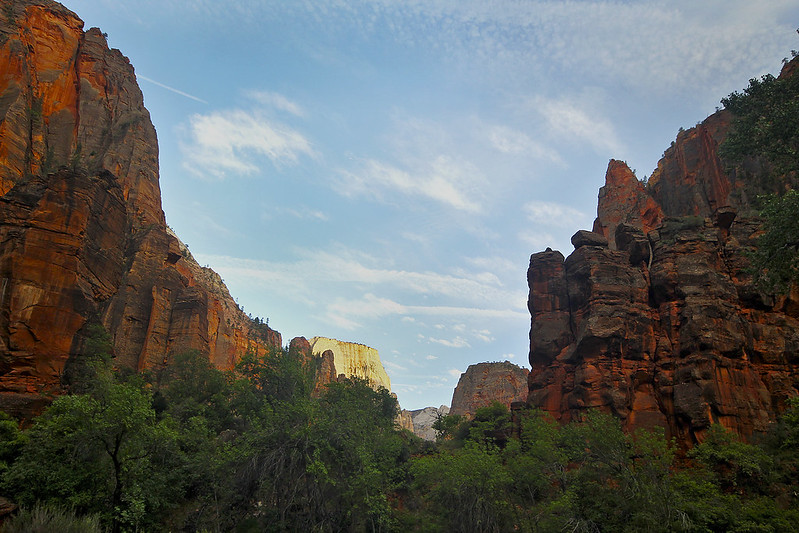
The Temple of Sinawava at the being-visited-to-death Zion National Park. More photos in this album.
3. Even as Utahans like Congresscritter Rob Bishop applaud President Trump for whacking away most of Bears Ears National Monument, thanks to the state of Utah's official promotional efforts and other things, visitation at national parks in the state continues to break records. The situation is worst (yes, worst, not best) at Zion. Rejecting Interior Dept. grifter-in-chief Ryan Zinke's plans for use-level pricing, I think Zion does need a reservation system. And, if that decreases visitation, not just controls it, fine. Nearly 5 million visitors a year would be tough enough for a park twice its size WITH most sections of the park visited equally.
But, given that the Kolob Canyons get almost no visitation, and even within the main section of Zion, 80 percent of its visitation is in Zion Canyon, something has to be done. Sadly, many richer bucket-listers won't be affected.
What COULD help, and immensely, is charging a surcharge for RVs, and making it by the length. Say a $5 minimum, then say another $5 for being over 32 feet. When campgrounds are being reconfigured to accommodate an RV flood, they need to pay for it. Not just at Zion, but all parks.
And if the Park Service is going to preserve mega-parks for the long-term future, it needs
1. Zion-like shuttles at more parks
2. Said shuttles to be electric (Zion's are propane, and I believe Yosemite's are too), for global warming, for cutting local air pollution, and for cutting local noise pollution
3. They need to have better scheduling than Yellowstone's does.
4. Fines need to be higher for visitor non-compliance on entry restrictions and bus use, and other things.
5. Here's another. Ban smoking on all trails in national parks.
4. Grist notes that people should avoid touting China's new carbon market trading program before it actually rolls out. Among other things? It's been in the pipeline a decade but is only being rolled out now, and it will only have simulated trading its first two years. I agree with that, as well as noting that Chinese municipal-level corruption is reason enough not to trust a capitalist system like this.
5. The GOPTaxScam includes opening a portion of the Arctic National Wildlife Refuge to oil drilling. If ANWR in general, and the 1002 Area in particular, are so environmentally important (and I know they are, I'm being rhetorical), why did neither the Slickster nor Dear Leader make it a national monument, especially one inside the park service?
Answers? "Triangulation" and "all of the above energy strategy."
Beyond that, Jimmy Carter was arguably the last real environmentalist Democratic president. At a minimum, he knew how the Corps of Engineers lied about claims for dam benefits and he probably suspected BuRec did the same. He strikes me as more of an outdoorsman in general than either of his successors.

