SocraticGadfly: Constitution of the United States
Showing posts with label Constitution of the United States. Show all posts

July 03, 2026

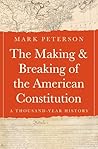
"The Making and Breaking of the American Constitution"

The Making and Breaking of the American Constitution: A Thousand-Year HistoryThe Making and Breaking of the American Constitution: A Thousand-Year History by Mark Peterson
My rating: 4 of 5 stars

4.5 stars rounded down. The first 2/3 were absolutely 5 star, the big framing issue followed by the actual US Constitution up to 1890. The latter 1/3, though, would probably do only 3.5 stars at best.

This is a long review, even more so with expansion off the Goodreads version. 

This is a magisterial and thought-provoking book that argues the US Constitution was at its core, a land-acquisition, land-development, and land-management tool, along the lines of one of the three written documents that form the core of the British constitution. That said, I don’t totally agree with all of his thought, especially near the end of the book, and am expounding on that part further here.

First, that word. “Constitution.” Peterson notes that the US "Founding Fathers" used it for a system as much or more than a single written document, not only under the Articles of Confederation but in the first years after 1789.

Otherwise, Peterson is serious in this framing, complete to using land and realty terms like "allodial" and "cadastral." 

First, those three documents? Many fairly serious history buffs recognize two of them — the 1689 Bill of Rights and Magna Carta.

The third? William the Conquerer's 1086 Domesday Book.

No, the US Constitution is not an appraisal district book. But? Peterson notes it establishes a decadal census, that the "enumeration of the populace" already in the 1790 Census included more questions than "how many people live here," and that those questions expanded over time, and that part of the purpose of this was for federal government direct taxation. (Until the 16th Amendment, the US government could only tax directly in proportion to a state's population, thought this was ignored in the Civil War, with taxes levied directly on income regardless of state of residence AND having a multi-tier progressive style of taxation. Weirdly, just about zero Civil War histories discuss how it was unconstitutional.)

In addition, Peterson doesn't directly mention it, but Article III, about the US Supreme Court and inferior courts, talks about its powers in all cases of "law and equity." That's not equity in the 21st century version. That's land.

Peterson explains how, while Britain has an “unwritten” constitution, it has written elements — the 1087 Domesday Book, Magna Carta, original form in 1215 but reissued in rewritten forms at various times (tho not explicitly mentioned by him) and the 1689 Bill of Rights.

And, the US, though backboned by a “written” constitution, has unwritten elements — legal jurisprudence, what might be called constitutional common law and more. That’s contra “originalists” or “strict constructionalists.” He references these and other theories, all of which he considers as overlapping highly, near the end. Just as different interpretations of the British constitution wound up unconstrainable by the 1770s without some sort of major action, he notes already by 1990 and 200 years of the US written version, we were facing the same thing.
“No written document can ever completely define, let alone create, a governmental system and the fundamental principals that shape its nature.”

From there, starting with a parallel track, he talks about the Confederation creating the Northwest Ordinance, because Virginia and other states had competing land claims north of the Ohio that they surrendered, but no Southwest Ordinance, because the land claims to the Mississippi south of the Ohio were non-competing and thus not surrendered. From there, he notes that Georgia ratified the Constitution so quickly because it had zero money or troops to fight Indians, and how the Constitution reserved Indian land issues to the federal government.

From there? He excoriates Chief Justice John Marshall for validating the Yazoo land deals, for fetishizing "sanctity of contracts" even in the face of clear fraud, and for also using these cases to put Indian land claims on a lesser tier. (Peterson doesn't explicitly ponder if Marshall would have fetishized "sanctity of contracts" had the issue been something other than lang.)

Re the 1770s, he notes that the British constitutional system had evolved for a land-poor, and (relatively) people-heavy situation, while the US colonies faced exactly the opposite, as part of the situation, even problem.

Peterson notes the rhetoric of “permanence” in all written documents. Notes Madison, Federalist 48 and “parchment barriers.”

He notes “revolution,” pre-1776, per etymology, originally meant “restoration — a turn of the wheel back to an earlier condition.”

“Neither the state constitutions begun in 1776 nor the Philadelphia Convention of 1787 was a stroke of originary genius.

That pull quote, plus the non-pull quote above it, will get further thought below.
 

==

Chapter 1

Part of the Stamp Act’s problem was that it demanded payment in sterling, which Parliament expressly forbade colonies to coin, under the 1764 Currency Act, killing off Connecticut’s nutmeg shilling, etc. Ben Franklin added that, since it was to pay for troops, even if not all the coin went to Britain, much would go to Quebec and the Floridas, the new colonies. Before that, Peterson notes that as “new colonies,” the trio were not considered to be ready for representative government at that time.

He says the Articles of Confederation were “a treaty organization for mutual defense.” And not much else, and without the ability to tax to pay for much of a national army, they weren't even much of that. (That's something to keep in mind in light of Tad Stoermer's "McResistance" book, which is being reviewed tomorrow.)

==

Chapter 7: The President who failed to bark

I had never before read in detail Jefferson’s constitutional concerns not only about the Louisiana Purchase itself, but, looking forward, over the admission of states from that land, given that he believed the constitution and definitely its state-making process applied only to land east of the Mississippi, the US created by the Treaty of Paris, this was generally eye-opening.

He thought a constitutional amendment was needed, as part of his strict constructionalism, but Republican allies said no, and he agrees not to raise this in public. That's the "failed to bark."

Opponents of Louisiana’s admission, like Sens. Josiah Quincey of Massachusetts and Rep. Samuel Dana of Connecticut raised just that issue on the Congressional Dana even introducing such a proposed amendment requiring each of the original states to consent. Jefferson was the dog that did not bark in 1812. And Peterson fairly excoriates him.

As part of this, he also notes the Article IV provisions for how states were to be created. This is one area where I really had trouble with his line of thought, especially when I looked up the full Article IV, and went specifically to Section 3, about the admission of new states beyond the original 13:

New States may be admitted by the Congress into this Union; but no new States shall be formed or erected within the Jurisdiction of any other State; nor any State be formed by the Junction of two or more States, or parts of States, without the Consent of the Legislatures of the States concerned as well as of the Congress.

Well, there are several issues, whether it's more with the thinking of Thomas Jefferson and the strictest of strict constructionalists, Peterson's analysis, or both.

I see nothing in that language that precludes creating states from lands outside the Treaty of Paris borders of the US. Yes, there could be an implicit understanding that "this union" meant the 1783 borders, but, to hoist strict constructionalists by their own petard, does it say that? No.

For one thing, the treaty-makers in Paris gave half a shot at trying to get East and West Florida from Britain. Although they failed, they weren't giving up. Also, although the War of 1812 invasion of Canada was more about general antagonism to Britain compounded with pursuing northern Indians across the border, nonetheless, the Revolutionary War dream of incorporating parts of Canada surely hadn't died. So, the Founders and those immediately in the next generation were surely mentally prepared for new states outside of the original Constitutional boundaries. As for Jefferson's cited worries about the foreign-ness of New Orleans, that hadn't prevented Congress itself from trying to detach French-background Quebec from British control, nor from angling to try to get Spanish-background, but British-controlled since 1763, Floridas.

Peterson doesn't do the best job on this, nor does he cite how many people disagreed with Jefferson, nor note that Federalist opposition in Congress was mainly politicized opposition trying to hoist Jefferson by his own petard. 

Let's also not forget that Jefferson had been planning the Lewis and Clark expedition even before proposing the buying of New Orleans, let alone the acquisition of the whole Louisiana territory.

Essentially, Jefferson strikes me as a pseudo-Hamlet, a fake ditherer, and for whatever reason, Peterson — wrongly in my book — takes him too seriously. 

Heading back to Peterson, if the U.S. Constitution really were a land-acquisition, land-organizing, and state-organizing machine, and were largely intended as such by the Founders, they would have been thinking of land acquisition beyond Treaty of Paris boundaries, and of treating such land, for purposes of potential statehood, just like land inside Treaty of Paris boundaries but outside the 13 original colonies/states, after the Northwest Ordinance in the northwest, and after eventual individual state land surrenders in the "Old Southwest."

So, either his tacit support of Jefferson's interpretation is wrong, or his grand theory's legs aren't quite as strong as he thinks. 

 Chapter 8 The Machine Runs Amok: Expansion, Slavery and the Civil War

Peterson talks about the Domesday Machine continuing to the Civil War. The admission of Missouri, Jefferson’s “fire bell,” is next. The Boon’s Lick (as he has it spelled) area was one-third its population then. Next, Texas, and Americans moving there to force eventual union with the US.

Chapter 9 The Machinery Stalls Out: The Challenge of the Arid West

OK, during the Civil War, as many buffs know, Nevada clearly came in unconstitutionally, but Peterson really picks it up in this chapter. As part of this, he discusses John Wesley Powell and his western drainage basins, and Henry George and his single land tax. After that, it was politics. Republicans split one Dakota Territory into two states and rebuff a Democratic compromise to admit New Mexico. (It already then had more population; remember, Mexican citizens were granted US citizenship by the Treaty of Guadalupe Hidalgo.) Although the constitutional population is 60,000, the informal rule was that a would-be state should have at least as many people as the smallest current state. Wyoming fell far short in 1890, and until the admission of Alaska, remained short. Eventually, Alaska passed it, and it went back to the smallest US state.

OK, that's the end of Part 1. He's mentioned what the Constitution was FOR, in his opinion. What happens when its original purpose is largely gone? What replaces that? That's theoretically what Part 2 is about.

Chapter 10 is about three distinct sub-nations — North, South and West. Really, the Old Northwest felt this way pre-Civil War, but Peterson picks this up as the first chapter of his Part 3, with the start of the second century of the US Constitution, the immigration to the Old Northwest and its industrialization in Chicago, Milwaukee, etc. But Peterson misses Turner’s “close of the frontier” thesis, which would have tied in here. (See how this book is thought-provoking, but yet has a miss here and there? It will have more misses in the future.) I mean, the original "for" is done because .... the frontier is gone! And, missing this put my skeptical antennae up.

I took side notes here about various US Censuses both before and after 1890, re my note above.

1790 asked over/under 16 years of age by number, male/female by number (for military reasons) and any slaves.

By 1820, the age breakdown was under 10, 10-16, 16-26, 26-45 and over 45, male and female, less granular age breaks for both slaves and free blacks, and also foreigners not naturalized.

By 1840, it was 5 year increments up to age 20, then 10 year up to 100. Then, you were asked your employment, not by individual company, but by seven broad classes of commerce, like agriculture, mining, trade, shipping, etc. Educational levels were first asked about on this census. Today's census wingnuts would have been erupting already then.

By 1860, the censed were being asked yet more detailed economic conditions. Remembering that farming was still the big occupation, you were asked what types of crops you were growing, and their estimated yield. Just like a county appraisal office today. By 1840, and expanding by this time, the Census was also moving beyond individual enumeration. Washington was gathering information on how many libraries, schools and such each county had. Here's the Census Bureau's official link for 1860. Mortality issues began to be asked at this time.

1870 saw the elimination of stats about slaves, of course. As the economy changed, more economic questions were asked about manufacturing.

By or before 1900, questions about marital status, number of children of each adult, whether currently living or not, whether currently at home or not, years of residence for the non-natives whether naturalized or not, whether a home was owned or rented and more, were all on the census. The wingnuts would really be apeshit. Anyway, the Census questions are moving beyond agriculture, mining, forestry and related.

Near the end of Chapter 10, on 243-44 he falters, in my opinion, claiming the Sixteenth and Seventeenth Amendments undermined the Philadelphia compromise. I can halfway buy that about the Sixteenth, even though Peterson ignores that the Civil War income tax was unconstitutional for not being levied in proportion to state population itself. (Again, why do either Constitutional or Civil War scholars not pick up on this?) Later on, I started thinking, he is a bit like a more modernized Walter Karp in some ways.

The Seventeenth? I totally reject his thesis here. The only thing changed was going to direct popular election. The equality of states in the Senate was preserved. Frankly, his discussion on page 245 seems to misunderstand what was most at concern in the "New Jersey plan," and that was equal state representation, not indirect election. But, the idea of an indirectly elected Senate was was readily accepted in the "Great Compromise." The "Virginia Plan" also had a bicameral legislature, also with indirect election for the upper house. In its case, state legislatures nominated candidates and the U.S. House elected them.

He is right about how the US more and more has the "virtual representation" that the Founders rejected. Yes, I know that at the time of Philadelphia, it was thought that election by state legislatures would bind states more firmly to the Constitution, but that was 130 years ago as of the time of the amendment and the Civil War was 50 years ago. And, the Philadelphians explicitly rejected any "unit rule" idea for Senate voting, which partially weakened the direct state ties. Also, the first potential amendment to this end was proposed way back in 1826, which Peterson doesn't mention.

Chapter 11: The Great Transformation

Primarily about the rise of regulatory agencies, which of course started with Theodore Roosevelt but really took off with the New Deal. Not much special here.

One side note here: The Federal Housing Authority encouraged banks et al to punish mortgagees that did not install AC. Even "Cadillac Desert" didn't mention this.

Chapter 12: The Long Crisis of the Constitution

This starts with a partial overlap with chapter 11.

His first plaint is the Supreme Court's "insular cases" distinguishing "incorporated" from "unincorporated" territories. It's why there's subminimum wages in Guam et al today. To put it more bluntly, the rulings were racist for Caribbean and Pacific islands that were non-white. (Hawaii, with its white sugar plantation owners overthrowing the kingdom, was "incorporated."

It's "Brains Trust" as a plural. Surprised Peterson missed that.

He notes the post-WWII national security state was alien to the spirit of 1787. He notes the "War on ... X" mentality. Militarization of the US. Takes Ike’s comment about the military-industrial complex at face value, ignoring that, in exchange, Ike substituted the spying-snooping-overthrowing complex. (He's not alone on this; lots of people give Ike an unwarrented pass.)

A short epilogue "Toward 2090" notes the US has been "constitutionally adrift" since the end of the Cold War. Peterson wonders what the country and Constitution will be "for" in 2090. He cites a 1974 book by Rexford Tugwell et al that notes the founders (and others around the Euro-American world) cited "natural rights" but not "natural duties." Tugwell called for a Bill of Responsibilities, and further empowering the House.

The epilogue concludes with a bit of turd-polishing the Founders. It was, in reality, as he notes in the beginning in discussing "revolution" etymologically, a conservative re-turning in 1787. (Interestingly, Shay’s Rebellion as a partial cause of the Constitutional Convention is never mentioned.) Plus, as he notes, there was not "originary genius" at Philadelphia.

As for replacing today’s constitution, just as the Founders replaced the Articles of Confederation? With the amount of wingnuttery running around America, I’m far less sanguine of a good result from that than Peterson is.

That’s where I really thought of him as a new Walter Karp and falling to 4.5 moved downward.

Karp?

The first book of his that I read was great, for his exposure of the Machiavellian hypocrisy of William McKinley on things like the Philippines (all new to me at the time) and the posturing of Woodrow Wilson (generally not new). The second book? Middling, in part because Karp seemed to fetishize the Constitution too much. The third book? Pretty bad, between a mix of guzzling Jeffersonian Kool-Aid to being a sociological version of a constitutional originalist, and other things.

With all of this, if Peterson publishes another book and I see it at my library, I'm certain to read, but won't expect genius.

View all my reviews

December 13, 2024

America as failing state: Once again, it starts with the US Constitution

Having read Daniel Lazare's "The Frozen Republic" when it came out many moons ago, with bits of my Goodreads review excerpted below, I've long known that in many ways, the US Constitution is broken. The electoral college and its modern winner-take-all aspects mean its broken for third parties, too. 

And, speaking of, per this NYT book review, it's nice that Erwin Chemerinsky thinks so, too. Given today's United States, no, I don't want an Article V Convention, unlike him. I'm afraid it would send us back to the Stone Age, hijacked by the remnants of the Koch empire, winger tech dudebros and more. Today, the people who want a "Convention of States" are the types of people who want to get rid of the 17th and 19th Amendments, so that state legislatures even more easily bought than Congress can be bought off to elect US Senators, and so that women know their place of being barefoot, pregnant and voiceless.

Secession? Interesting. Rare indeed that a "blue state" person will be open about that. As someone who lives in a "red state," what would I do if that happened, especially if, to pun away, such a secession succeeded? I mean, would the remnant US honor Social Security payments to people in Chemerinsky's "Pacifica"? If not, it would laugh at lawsuits to compel payment, even if that affected "the full faith and credit" in various ways.

That said? Chemerinsky is 20 years behind the Lazare curve:

The Frozen Republic: How the Constitution Is Paralyzing DemocracyThe Frozen Republic: How the Constitution Is Paralyzing Democracy by Daniel Lazare
My rating: 5 of 5 stars

A must-read laundry list of how anachronistic the US Constitution really is, and why, with Lazare making a strong argument for junking the whole thing (not counting the amendments that give us our rights) and starting over ... with an eye to a non checks-and-balances gridlock parliamentary government instead of our current nonsense.

This is a book I have re-read more than once.

And, in what is arguably a bit of serendipitous timing, Lazare starts the book with a threat of secession by the state of California, in conjunction with the 2020 election.

Beyond this, readers should look for other books about the realities of the Constitutional Convention. Sheldon Wolin is one good one.

View all my reviews

The piece at top links to a 2023 column by Ryan Dorfler and Samuel Moyn, the latter of whom I've read elsewhere. Let's start with their thesis:

The real need is not to reclaim the Constitution, as many would have it, but instead to reclaim America from constitutionalism.
The idea of constitutionalism is that there needs to be some higher law that is more difficult to change than the rest of the legal order. Having a constitution is about setting more sacrosanct rules than the ones the legislature can pass day to day.

Simple and basic enough.

Here are excerpts from how they think that should play out:

It is a breath of fresh air to witness progressives offering bold new proposals to reform courts and shift power to elected officials. But even such proposals raise the question: Why justify our politics by the Constitution or by calls for some renovated constitutional tradition? It has exacted a terrible price in distortion and distraction to transform our national life into a contest over reinterpreting our founding charter consistently with what majorities believe now.
No matter how openly political it may purport to be, reclaiming the Constitution remains a kind of antipolitics. ...
It’s difficult to find a constitutional basis for abortion or labor unions in a document written by largely affluent men more than two centuries ago. It would be far better if liberal legislators could simply make a case for abortion and labor rights on their own merits without having to bother with the Constitution.
By leaving democracy hostage to constraints that are harder to change than the rest of the legal order, constitutionalism of any sort demands extraordinary consensus for meaningful progress. It conditions democracy in which majority rule always must matter most on surviving vetoes from powerful minorities that invoke the constitutional past to obstruct a new future.

Doable? Probably not. Not by liberals. Maybe by leftists. The idea, for example, that Congress itself would vote to make the U.S. Senate even partially like the Canadian Senate is ... laughable.

Within present limits, the best options are for a leftist president to govern by executive order and getting a Supreme Court that, contra Ted Cruz, knows the most overlooked amendment is the Ninth not the Tenth and makes all sorts of "people power" constitutionality rulings.

Finally, a friendly reminder that this leftist, contra librulz, does NOT "venerate" the Constitution or anything similar.

April 08, 2024

Top blogging of March

These are the most read posts in March. Posts not from last month will be so indicated.

No. 10? Dental care as health care. Important globally, not just in the US.

No. 9? My critical analysis of Genocide Joe's State of the Union.

NO. 8? A blast in the past from 2017, my longform/total takedown, to which I make occasional small new notes and edits, of the late "Actual Flatticus" / "Alan Smithee" / IRL Chris Chopin.

No. 7? No, I don't "revere" the Constitution. A leftist reply to typical librul thought.

No. 6? A blast from WAY in the past, back in 2006, and yes, Tim Treadwell WAS really fricking nuts (and as a result, really fricking dead). Sidebar: Having read Herzog's memoir recently, going beyond what I said in the original about him pulling punches, he may also have been a bit manipulative, or certainly a bit novelistic. That said, Treadwell was really fricking nuts without Herzog's framing.

No. 5? Actually posted April 1, but it's already trending that much. An April Fool's Day, sadly all too real, presidential election news roundup.

No. 4? My thoughts on Guernica magazine's scrub of "From the Edges of a Broken World."

No. 3? Posted even later than April 1, but trending that much that quickly? My schadenfreude about the Libertarian Party going broke and imploding.

No. 2? My mocking of the stupidity of a Green Party candidate on Twitter.

No. 1? It turned out to be dated, but my thought on the first two rumored candidates to be Robert F. Kennedy Jr.'s Veep — Aaron Rodgers and Jesse the Body Ventura.

March 19, 2024

No I don't 'revere' the Constitution and here's a bit of why

In my post a week and a half ago about the Supreme Court's Trump v Anderson ruling on ballot access, in his second comment, at one point, Cruxdaemon said:

In the Constitution that we all revere, federal elections are actually state elections.

Oh, no, as I told him back:

And, no, I don't "revere" the Constitution. I'm a leftist, not a liberal. I "accept" the Constitution. THAT is something entirely different.

And, here's a bit more detail on why.

First, directly related to that issue? Article III of the Constitution, on qualifications of judges? There's no minimum age to be a Supreme Court justice or inferior court federal judge. There's no minimum number of years of U.S. citizenship. There's no U.S. citizenship requirement at all!

I noted that in my "Swiftian modest proposal" piece on Substack, where I doubled down on the Alabama Supreme Court ruling that IVF eggs are humans, and said that if I were elected president, I'd be the ultimate pro-lifer by appointing such an egg to the U.S. Supreme Court.

Next, to go back to another originalist issue. And, that's the "three-fifths compromise" and other things in the Constitution dealing with "other persons," "such persons," or "person held to Service or Labor." The word "slave" is nowhere in the Constitution, and "slavery" not until the Thirteenth Amendment, abolishing it (except in prison incarceration).

That's why William Lloyd Garrison called it:

"A covenant with death ... and an agreement with hell."

And he was right, excepting that this secularist knows hell doesn't exist. And, per the Thirteenth Amendment not calling incarceration "slavery," that's one more reason not to "revere" the Constitution.

In addition, I said, in my discussion of oral argument in the case a month ago, that the Constitution is in many ways a "clusterfuck."

I venture that Cruxdaemon smokes some Constitutional Law Scholar president hopium, or thinks Akil Reed Amar is a genius of modern constitutional interpretation. He's not:

The Constitution Today: Timeless Lessons for the Issues of Our Era

The Constitution Today: Timeless Lessons for the Issues of Our Era by Akhil Reed Amar
My rating: 2 of 5 stars

How Amar got to be a constitutional law prof at Yale writing dreck like he does, I don't know. This book is just the latest example, starting from the header.

Only dyed-in-the-wool originalists would talk about "timeless lessons" from the Constitution with a straight face and no nuance.

There are plenty of other howlers just in the introduction. Let's look:

"Between 1804, when the Constitution was amended to downgrade the vice presidency ..." (page 12)

Erm, the 12th Amendment did no such thing. The body of the Constitution clearly, with the amount of powers it specified for each office, showed how the VP was clearly "downgraded." If the words of the Constitution's body aren't clear enough, the comment of our first Veep, John Adams, writing well before the 12th Amendment, should be.

ALL the 12th Amendment did was create separate electoral colleges and electoral voting for the two offices. Period.

Then, on page 15, he buys into the money = speech argument on campaign finance, further showing where his interpretive bread is buttered. Long before Citizens United was wrongly adjudicated, Buckley was also wrongly adjudicated.

On page 17, he supports the National Popular Vote project without telling you that it would not survive a constitutional challenge.

Beyond his constitutional nuttery is this, in a footnote already on page 4:

"Slate makes a point of recording the precise minute that an item is published," as if this were special, even quasi-unique.

Erm, Amar, the semiweekly newspaper I edit does that. He sounds like Poppy Bush gushing in awe over a supermarket scanner.

I had been quite underwhelmed by a previous book of Amar's. I decided to give him another chance. He failed long before I read through the various actual essays in most chapters. (I did read the introductory summaries of several chapters, lest I be accused of not reading at all past the introduction. Besides, even if I had stopped at the introduction, per the above, I'd read more than enough.)

View all my reviews

And again, he's not, per that "earlier book" reference:

America's Unwritten Constitution: The Precedents and Principles We Live ByAmerica's Unwritten Constitution: The Precedents and Principles We Live By by Akhil Reed Amar
My rating: 3 of 5 stars

Good, but not nearly as good as all the fluffing reviews crack it up to be. And, it's got a couple of specific problems.

It's perhaps a 3.5 star, but, I'm moving down rather than up a half star.

Among its problems?

Amar claims that the Constitution enshrines 2-party government. No it doesn't, not even after the 12th Amendment. Even taking into account his definition of an unwritten Constitution, it doesn't, not from where I sit. Things like the requirement for members of the Federal Election Commission, etc., are sub-constitutional.

Second is his quirky interpretation of the Second Amendment being written to enshrine local militia vis-a-vis a standing national army. That would surely be news to George Washington and probably to at least a few others of the Founders, as well as many Constitutional scholars past and present. Rather, it was surely written to make sure that local militias would be well-organized when, as necessary, they would be called into national service; i.e., seeing militias as adjuncts, not in opposition.

Third is the naivete in the last chapter about future Constitutional amendments. With the tea partiers of today, at least some of them, wanting to throw out the 17th Amendment and its direct election of senators, Amar's political acumen must seriously be questioned.

Finally, per one other reviewer, these are the biggest, but not the only ways, in which Amar offers unsubstantiated opinion.

The only outstandingly good part was his discussion of the rights of jurors, including not just nullification, but the right to convict of a lesser charge than the one in front of them and more.

Well, I'd heard of him for some time. And now I've read him. No need to read him further.

View all my reviews

February 09, 2024

America as failed state: Colorado v Trump

Caught snatches of the live argumentation in front of the Supreme Court on NPR. Here's one of the stories from Thursday. SCOTUSBlog has more.

A few thoughts, with an intro before that.

First, not only poor countries "out there" can be failed states, i.e. Afghanistan. The tail end of Weimar Germany was quite arguably a failed state even before Hitler took the oath of office as chancellor.

Second and related? If not a failed state, the USofA, aka Merikkka, is a failing state. Period and end of story, especially to backers of both duopoly parties.

OK, to the story itself.

First, this is obviously a reason to get rid of the electoral college. That's what, reason No. 412 or something?

Second, this is a good reason to move beyond that and officially make the election for president a national, not a "federal," election. If that meant different rules on absentee ballots, etc., than currently more restrictive states, so be it. Arguments by various justices in the SCOTUSBlog piece underscore that.

Third, it's also a good argument to, if possible, truly overhaul our government into a parliamentary system. It's harder to do the Hillary Clinton attempt at controlled opposition when a prime ministerial candidate is already leader of the opposition and depends on coming to power on nationwide vote for MPs. Arguments by various justices in the SCOTUSBlog piece underscore that, too.

That said?

A. Parliamentary systems are no guarantee against becoming a failed or failing nation. On the former, see Weimer Germany, above. On the latter, see post-Brexit Britain. 

B. The mechanics are partly at issue. Westminster-type systems with first past the post single-member districts tend to squeeze out third parties. Systems that are purely proportional and don't have modern Germany's 5 percent hurdle let in all the nutters.

Fourth, and related, we'll likely have more and more Russiagate-type bullshit claims in the future. After all, the NYT tried to revive it for the 2022 midterms. Note also former Speaker of the House Nancy Pelosi, not content with anti-Republican smears, claiming that Russia and president Vladimir Putin are behind pro-Palestinian protestors. (Code Pink and founder Medea Benjamin recently confronted her on this.)

Fifth, it's funny how people can always shape shift on federalism = states as "laboratory of democracy" when their ox is being gored. That includes, per the top link, a possible majority of the black-robed Kourt Klan Konklave thinking Colorado can't do what it did.

As for the black-robed KKK trying to reason its way to keeping Trumpy safe?

The only reason I would agree is "ripeness" grounds. Trump hasn't been directly charged with insurrection, or aiding and abetting. Blame Jack Smith, #BlueAnon. Trump's attorney, Jonathan Miller, tried to put a spin on this by differentiating between an election and actually serving. (Not that he thinks Trump should be disqualified should he be re-elected, of course.)

Otherwise? John Roberts et al seem to have a semi-novel interpretation of the 14th Amendment being written to rein in state powers.

If he, Slammin Sammy Alito et al are worried about different states reaching different conclusions, see the top of this piece. Colorado's attorney, Jason Murray, addressed much of his objections, and his fellow travelers, per SCOTUSBlog. Besides, there's that old Gorsuch ruling.

I will actually credit Alito for discussing what all might count as "insurrection." This gets much deeper, really, and beyond both duopoly parties, to things like undeclared wars and "cold wars."

There's also the issue of general deference to political parties on primary election ballots vs general election ballots. That said, given that Trump's going to win, it would be stupid to put him on a GOP primary ballot, if the Colorado plaintiffs are right about the 14th Amendment in general.

Sixth, doesn't this ultimately show what a clusterfuck the Constitution of the United States is? And, that gets us back to America as failed state.

December 19, 2019

Greg AtLast is back on impeachment, 25thAmendment
and Aaron Paté, Matt Snidely and other OTB stenos

Yes, he's back. Greg AtLast, still doing his best black hat work:


Per what friend Greg has said, here's my take on the 25th Amendment vis-a-vis Trump.

Here's one of my takes on the alleged outside the box stenos. And another.

And here's my take on Putin being too smart to collude with Trump.

As for the Trump Train riders who claim every previous impeachment has been on criminal charges?

Not even close. The Tenure of Office Act was entirely civil. So was every other "not doing your job" (the way we want you to) charge brought against Andrew Johnson.

Of course, what friend Greg didn't mention is that this is really yet another argument for moving at least closer to parliamentary government.

Also beyond Greg, there are other items that are more solid impeachment grounds than Ukraine. Such as spending money without Congressional appropriation for his wall.

December 24, 2018

Ocasio-Cortez has another unforced error:
This time, she botches government shutdown info

Alexandria-Ocasio Cortez, red rose Congressional queen of the House of Lancaster, I mean, the Democratic Socialists of America, has had several unforced errors since beating Joe Crowley to essentially win election to her 14th Congressional District.

First and most notable for people like me who bat outside the duopoly on foreign as well as domestic policy, was her retreat from words of support for BDS.

Second and related was her gushing over the Schmuck Talk Express™,  John McCain, when he died.

Well, now, she's shown that she should tweet less, research more, including knowing some basic constitutional facts, on the government shutdown.

AOC has a set of tweets that The Hill "reported" into a story, and oh, there's so much wrong.

First, she says Congresscritters should have salary cut off, after decrying partisan nature of shutdown (yet being already bipartisan enough to not call out Freedom Fries Caucus head Jim Jordan by name).

Second, she ignores a problem (which The Hill itself gets wrong as to the "why"). You can't cut Congressional salaries.

That relates to her not even mentioning the president's salary during the shutdown. Which, yes, also falls under the same rubric as that of Congresscritters, which The Hill got wrong.

It's not just illegal, which The Hill claims; it is unconstitutional, which is an entirely different kettle of fish. Explicitly so with the president. And for good reason. Although the president wound up much stronger than most members of Team Philadelphia 1787 not named Hamilton intended, the founders didn't want Congress forcing a president to their will by hacking his pay. (Of course, they objected when George III tried to insulate colonial governors from colonial legislative control, so, and far from the only time in America's founding, hypocrisy was at play.)

As for Congress, per the same link, in the current Congress, it's illegal to cut their pay, explicitly, by the 27th Amendment, which The Hill also gets wrong. When the new Congress starts, AOC could push a bill on the first day of the session that they don't get paid until the shutdown ends. She could also ask for it to be part of the standing rules in House and Senate. If I am engaging in correct constitutional interpretation, that could pass muster. But, short of an amendment, she still can't do anything about the president's salary.

Finally, if we're going to criticize Beltway stenos for "reporting" on Trump's tweets, should we not hold the stenos to the same standard re Ocasio-Cortez? I say yes. That piece had no actual reporting and was inaccurate. I've already Tweeted to the particular Beltway steno who "reported" this, specifically on the error, and got no response.

Update, Feb. 20, 2018: She's had other unforced errors, like throwing Rep. Omar halfway under the bus on Israel-Palestine issues.

September 10, 2018

The Ninth Amendment vs the Tenth Amendment

In the Brett Kavanaugh hearings with the Senate Judiciary Committee, Rafael Cruz once again peddled his "federalism" states rights schtick. As part of that, he once again claimed or insinuated that the Tenth Amendment to the Constitution is the most overlooked one in the whole list.

Hogwash.

If anything, the one immediately before it, and also part of the original Bill of Rights, is the most overlooked, including being repeatedly and constantly overlooked by Can't Be TrusTed Cruz.

Here's what they both say. First, the Ninth:

The enumeration in the Constitution, of certain rights, shall not be construed to deny or disparage others retained by the people.
Then, the Tenth.

The powers not delegated to the United States by the Constitution, nor prohibited by it to the States, are reserved to the States respectively, or to the people.
Several notes.

First of all, the Ninth Amendment says: "The enumeration in the Constitution, of certain rights ..." and does not add "to the federal government." In other words, this was a form of "incorporation."

AND, anybody who knows Madison's thought, knows he wanted to "incorporate" at least part, if not all, of the Bill of Rights at that time, something that, after World War II, courts have done, albeit imperfectly and incompletely.

And, alleged constitutional law scholar Rafael Cruz knows this, too.

And, to undercut the likes of Can't Be TrusTed, the Ninth Amendment, from the list of possible Bill of Rights amendments first crafted under the lead of James Madison and approved by the House, then approved in modified form by the Senate, the approved in final form in conference to be sent to the states, ALWAYS was before the Tenth, per Wiki.

Second and a sidebar: Re Griswold v Connecticut, that provided the ultimate background for Roe v Wade that's the backstop to the Kavanaugh hearings, Arthur Goldberg, in his concurrence with William O. Douglas' opinion, actually had the correct legal stance. Rather than chasing after "penumbras" and "emanations," he went right to the Ninth Amendment. (Arguably, Whizzer White and John Marshall Harlan, in their concurrence citing the Due Process clause of the Fourteenth Amendment, were on better ground than Douglas, too, although maybe not as firm as Goldberg.) Hell, for that matter, Douglas' penumbras were better groundable on the Fourth Amendment than the Fifth. Griswold, in short, though the right ruling, had some of the worst jurisprudence of any major Constitutional ruling that was a good ruling in the 20th century.

I have no idea why Bill Douglas wouldn't modify his ruling, or even join either of the concurrences, outside of plain stubbornness, of which he had plenty.

At the same time, Hugo Black's dissent, where he specifically rejected both the Goldberg and Harlan concurrence reasoning and tried to claim that privacy needed to be an explicit right, marked HIS decline on the Court as well; actually, it marked the "outing" of his textualism.

And, sadly, this was Goldberg's last major case before LBJ booted him out to the UN Ambassadorship just to make room for his crony Abe Fortas, with that ultimately backfiring three years later.

That, in turn, beyond cronyism, at least made clear the politicization of Supreme Court nominations.

March 28, 2018

Repeal the Second Amendment? Why not? #2A

For wingers in general and 2Aers in particular frothing in their mouth-breathing on Twitter that amendments can't be repealed, of course they can.

The 21st Amendment specifically by word repealed the 18th:

Section 1. The eighteenth article of amendment to the Constitution of the United States is hereby repealed.
Nothing clearer than that.

Second, another person, who's a 2A mouth-breather, or semi-so, and a friend of Brains to boot, claims all of the Bill of Rights is about individual rights.

Not so. Contra pseudo-originalists like Nino Scalia, and apostates like Laurence Tribe (for whatever reason), the Second Amendment, with the "well-regulated militia" being the controlling clause, had a corporatist angle. Also, I don't know about 1790, but in 1775, only 10 percent of Americans, by estimates, even owned guns.

Beyond that, the Tenth Amendment talks about right of states, who aren't individuals.

Third, to turn back to point No. 1, amendments 12-17, while not repealing previous amendments, did partially (14th) or fully "repeal" specific items of the body of the Constitution rather than create new rights.

The mouth-breathers, in their claims to originalism or other things, rather stake a claim to historical ignorance. And interpretive ignorance.

Now, it may be highly idealistic to repeal the amendment. But, that's a different story. It has historic precedent. That said, the original Eighteenth Amendment was even more idealistic.

June 21, 2017

The Emoluments Clause does indeed apply to presidents

I love used to love me some Alan Smithee (make sure you click that link for the right one I removed the link because he blocked me after I challenged his command of facts one too many times for his taste) on Twitter. Sharp, smart, a demon for fighting dark and soft money in the political process. Hates neoliberalism. Doesn’t yet vote third-party, I think, and a bit harsher on Stein, and a bit more harsher on the Green Party as a whole, than I am.

But, those are minor quibbles.

A big error?

He’s simply wrong when he claims the Emoluments Clause doesn’t apply to the president.

Per Wiki, here’s the actual language, first of all.
No title of nobility shall be granted by the United States: and no person holding any office of profit or trust under them, shall, without the consent of the Congress, accept of any present, emolument, office, or title, of any kind whatever, from any king, prince, or foreign state.
Seems pretty clear to me. And to tens of thousands of constitutional law scholar lawyers and academics, and thousands of U.S. judges down through history.

Offices, of course, being normally executive offices, as constitutionally, the executive conducts foreign policy, and is most liable to being “emoled.”

But not to Smithee. He cites a Northwestern law prof. Seth Tillman, whoclaims that “office” in this case is only appointed offices.

Balderdash! And laughable in a great degree if not coming from him. It reads like a TrumpTrain claim. In fact, I stopped reading at that point, because I did start laughing!

Back to Wiki, and some background:
The prohibition against officers receiving a present or emolument is essentially an antibribery rule to prevent influence by a foreign power. At the Virginia Ratifying Convention, Edmund Randolph, a delegate to the Constitutional Convention, identified the Clause as a key "provision against the danger . . . of the president receiving emoluments from foreign powers." 
The Department of Justice Office of Legal Counsel has held
The language of the Emoluments Clause is both sweeping and unqualified. See 49 Comp. Gen. 819, 821 (1970) (the “drafters [of the Clause] intended the prohibition to have the broadest possible scope and applicability”). It prohibits those holding offices of profit or trust under the United States from accepting “any present, Emolument, Office, or Title, of any kind whatever” from “any . . . foreign State” unless Congress consents. U.S. Const, art. I, § 9, cl. 8 (emphasis added). . . . The decision whether to permit exceptions that qualify the Clause’s absolute prohibition or that temper any harshness it may cause is textually committed to Congress, which may give consent to the acceptance of offices or emoluments otherwise barred by the Clause.
The word "emolument" has a broad meaning. At the time of the Founding, it meant "profit," "benefit," or "advantage" of any kind. Because of the "sweeping and unqualified" nature of the constitutional prohibition, and in light of the more sophisticated understanding of conflicts of interest that developed after the Richard Nixon presidency, modern presidents have chosen to eliminate any risk of conflict of interest that may arise by choosing to vest their assets into a blind trust. As the Office of Legal Counsel has held, the Constitution is violated when the holder of an Office of Profit or Trust, like the President, receives money from a partnership or similar entity in which he has a stake, and the amount he receives is "a function of the amount paid to the [entity] by the foreign government."
Broad and sweeping. Indeed.

Next, the historical interpretation:
Foreign states often present the President of the United States with gifts. In order to comply with the Clause's prohibition on accepting presents from foreign governments, the President of the United States has traditionally sought permission from Congress to keep the present himself. Absent permission, the President will deposit the present with the Department of State. For example, Andrew Jackson sought permission from Congress to keep a gold medal presented by Simon Bolivar; Congress refused to grant consent, and so Jackson deposited the medal with the Department of State. Martin Van Buren and John Tyler received gifts from the Imam of Muscat, for which they received congressional authorization either to transfer them to the United States Government or to auction them with proceeds vesting to the United States Treasury. 
While President, George Washington received a present from the Marquis de Lafayette, who considered Washington to be his "adoptive father." and kept the gift without obtaining congressional consent. There is no indication in the historical record that Lafayette was presenting the gift on behalf of the French government. To the contrary, the letter that Lafayette sent to accompany the gift stated that it was "a tribute Which I owe as A Son to My Adoptive father." Because the gift did not come from a "foreign state," it did not violate the Clause. George Washington also took home to Mount Vernon a portrait of a then-guillotined French King that he had received from the then-monarchy while President.
I mean, even Andrew Jackson, who ignored the Supreme Court on Indian removal, followed the will of Congress. It’s clear that both Congresses and Presidents have historically understood it as applying above all to Presidents. Mother Jones, in a new piece about emoluments-based suits against Trump, notes that JFK turned down an honorary Irish citizenship over concerns.

The fact, per Prof. Tillman, that Hamilton gave members of Congress a list of “office holders” that included appointed officials only proves nothing. Later history, per Jackson, et al, shows that Presidents and Congresses alike didn’t think that held on the Emoluments Clause, if they even knew it existed. Plus, Hamilton, the man who once proposed a president for life, had every reason to be Cheney-like here.

In short, absent a specific judicial ruling — a specific Constitutional ruling that would ultimately come from the Supreme Court — to the contrary, we have what we might have Constitutional common law on this issue.

Smithee then goes on to cite that last-mentioned action of George Washington as proof for his interpretation.

Bullshit.

What happened is that Washington acted unconstitutionally, as Louis XVI held the throne at the time of the gift, which would legally be considered the controlling time. He then split hairs trying to justify his unconstitutional action and got away with it because Congressional Federalists weren’t about to call him out, and only the more radical Republicans (not yet Democratic-Republicans!) would have attacked “The Father of the Country.” Smithee himself once said, in essence, the only good presidents were dead presidents. Weird for him to cite this as a proof action.

Zephyr Teachout, to whom Tillman is responding, suggests the same as one possible interpretation.

And, not all of them are needed, as far as her different possible interpretations.

The only other one I’d entertain is that Washington claimed it was a “personal” gift. That, in turn, is a distinction the Emoluments Clause doesn’t recognize, in its clear language, therefore it’s really, ultimately, a subset of him acting — and deciding to act — unconstitutionally. *

Tillman then claims he’s refuted what I note about Jackson, Van Buren, etc., claiming that she hasn’t proven these are more “controlling” than Hamilton.

Actually, Tillman, my “constitutional common law” has proven exactly that. YOU are the one who’s proven nothing.

The Blount impeachment? Red herring by Tillman. Has nothing to do with the Emoluments Clause, therefore irrelevant to its definition of “office.”

I ignore their back and forth over state officials, as the constitution did not begin to be federalized until 1868, and that’s an incomplete process today.

I now, instead, break from Tillman and go back to history.

Modern history.

The US interaction with foreign powers increased after World War I and greatly after World War II.

Something else started then — presidential libraries.

Do you actually go to such a place as a library? NO! You visit it as a museum.

A museum where the president of library naming has donated all the tchotchkes he got while president, rather than handing them over to Congress at the end of his term.

The PRESIDENT can’t keep them, but the library can. And they know it.

Otherwise, presidential grifters would have Saudi swords and other shite hanging on the walls of their homes.

Finally, once more, unto what I said about “constitutional common law.”

Tillman doesn’t cite a judicial ruling supporting his interpretation. He can’t. Neither can Smithee.

This isn't a pissing match with him. But, given that he has a lot of followers, they need to know that — even though he tells them to check everything he posts — he's not always right. And, Tweeting it with a callout to him may help a few.

(I mean, I first blogged about this last November.)

==

* If you're shocked by the idea that George Washington would act unconstitutionally, either wake up or grow up. Probably half our presidents violated the letter of the Constitution they swore to uphold at least once, and all have violated its spirit, I'll bet I can show.

=====

Update, Sept. 17: Derek Cressman has a good take on specific emoluments issues Trump faces.

Update, Dec. 4, 2018: Per Norm Eisen and a bunch of state AGs, we're about to find out just how wrong Flatty is, I think:


I'll take Norm Eisen's legal brains over Flatty's at any time.

This also adds to my suspicion that Flatty, like ShirtLost DumbShit Zach Haller and H.A. Goodman, was some sort of "double agent" all along.

February 12, 2017

#txlege looks at punishing "faithless electors," and also at blocking third parties

Ballot Access News has the details.

My take, as expanded from a comment there.

They're all unconstitutional, all four bills. Article II, Section 2, Clause 3, as amended by the Twelfth Amendment, specifies that electors shall do certain things. Otherwise, the idea of the founders (pardon me for sounding like an originalist) seems to be that electors should otherwise be "unbound." Yes, that was before the rise of political parties, and the myth that the founders had no reason to anticipate such.

Now, in my opinion, HB 771 and HB 1391 point the way to something that might be constitutional. That is if a state political party requires an elector to sign an agreement to remain faithful on pain of removal from service.

As compared to criminal law, certainly, and even compared to fines, unconstitutionality doesn't carry the same weight in torts, as far as I can tell based on my high-level for a layperson knowledge of criminal law and medium-level knowledge of civil standards. But, requiring a political party to undertake a certain action related to the electoral college might itself be iffy, which the latter two bills still do.

So, the latter two bills point the way toward suggested, or possible, or constitutionally viable, action.

And, unfortunately, we've still not had a so-called "faithless elector" in a state that has some sort of punishments for them pursue legal remedies to the Supreme Court to get a final determination on the constitutionality.

==

Update, Feb. 12: More voting-related unconstitutionality now being peddled in the Lege, to force registration by party, then block party-registered voters from signing access petitions for independents or, especially, for third parties.. Rethugs will certainly support it in the hopes Libertarians can be held below the 5 percent margin in state races and the Constitution Party would never be able to get the signatures necessary for ballot access. Now that Dems successfully recruited a state Criminal Court of Appeals candidate last year to block Greens' 5 percent push, I'm sure they'd back it too. But, it's all unconstitutional.

Texas is already one of the most independent-unfriendly and third-party unfriendly states in the country. We don't need more.

January 27, 2017

The real national tragedy? The #duopoly

The real United States of America’s national tragedy of Nov. 8, 2016, is NOT the election of Donald J. Trump as president.

The national tragedy is ultimately the American electoral system, and above all, the American presidential election system, that pushes America more than any other democracy in the world toward a two-party system. The two mainstream parties then foist on us a craptacular, but inspiring in some ways, candidate in Trump, and a weak, and uninspiring, candidate in Clinton.

Were I to try to amend the body of the US Constitution, which BADLY needs it, if not being thrown out, it would be:

1. Increasing the size of the House by 50 percent, with the additional members elected off a national list (I would also, outside the constitutional issue, increase single-member districts to 500, then the 50 percent addition);
2. Ditto for the Senate, and I believe using a national list would survive the constitutional issue of not depriving a state of its equal vote without its consent;
3. Banning the Senate from amending money bills (this was actually in earlier versions of the Constitution);
4. Changing terms to three years for House members and one-half the Senate every three years rather than one-third every two years, to get us away from the permanent campaign.
5. Changing the presidency to a three-year term with three terms, not two. This “alignment” would move us toward semi-parliamentary government;
6. Placing term limits on judges. A total of 30 years of service, and no more than 18 at one level (ie, district, appellate or Supreme Court).

For more on what’s wrong with the Constitution, and why it’s wrong, I strongly recommend “The Frozen Republic,” per my Goodreads review.

My rating: 5 of 5 stars
A must-read laundry list of how anachronistic the US Constitution really is, and why, with Lazare making a strong argument for junking the whole thing (not counting the amendments that give us our rights) and starting over ... with an eye to a non checks-and-balances gridlock parliamentary government instead of our current nonsense.

This is a book I have re-read more than once.

And, in what is arguably a bit of serendipitous timing, Lazare starts the book with a threat of secession by the state of California, in conjunction with the 2020 election.

Beyond this, readers should look for other books about the realities of the Constitutional Convention. Sheldon Wolin is one good one.


December 21, 2016

No, the Electoral College was NOT all about slavery

In the wake of Monday's electors gathering in various states to officially vote for Donald Trump, Hillary Clinton, Colin Powell, Bernie Sanders, Ron Paul, John Kasich, and Faith Spotted Eagle, we've seen a new round of liberals (and even a leftist like Doug Henwood) claiming the Electoral College is a vestige of compromises with slavery.

Erm, not quite. To the degree that it is so, it's only indirectly so. In other words, people like Michael Moore, in points 3 and 4 of this Facebook post, are a mix of simplistic and flat wrong. In this case, it IS Michael Moore. Are you surprised?

And today, the New York Times, though less egregiously than the likes of Moore, also gets it wrong with its own historical (and intellectual?) shortcuts.

Unfortunately, as the "I blame Putin" whiff of the vapors continues, many Clintonista types relish such simplistic ideas. Unfortunately, on this particular issue, a few Greens do, too, I think.

(I'm setting aside the issue that all state laws that ban, on paper, "faithless electors" are unconstitutional and one of them needs to be take to the Supreme Court for a clear ruling as such. That, in turn, would get Greens, Dems and others who are concerned to realize the only sure-fire way of getting rid of the Electoral College is, per John Roberts, to get rid of it. By amendment.)

We need to start with the three-fifths compromise. The Wiki article at that link is pretty good.

Not all about slavery, but very much about conservative elite control.
"Scene at the Signing of the Constitution of the United States." (Wikipedia)

The compromise, at the Constitution, was not to count slaves as three-fifths of a person for voting purposes only, but also for property taxation as property. Which, of course, they were. That is, of course, disgusting, but it is the nature of slavery, whether race-based or not.

This compromise, as Wiki notes, carried over from a Northern attempt under the Articles of Confederation government to count them as whole persons, for taxation purposes first. It must be remembered that, under the Constitution,  until the 16th Amendment, federal income taxes were supposed to be assessed on a state-by-state basis relative to a state's population.

(And, per delinking the three-fifths compromise from the Electoral College, it must be remembered that the Articles of Confederation government, without a president, had no Electoral College.)

In 1783, the Confederation government tried to move in that direction. The three-fifths ratio, once the South rejected a whole-person definition, was put forth for amendment. But, under the unanimity needed then, the amendment failed by two states.

The same idea was revised in 1787 Philadelphia. Since small states, primarily in New England at that time, had their vote power boosted over direct population ratios by the Connecticut Compromise and equal voting in a Senate, they signed off on the three-fifths compromise with little dissent. Indeed, the two proponents of the issue were both northerners.

Let's also not forget that slavery was legal in all 13 original states, not just "the South," and Philadelphia-including Pennsylvania (though already working toward abolition), New York and New Jersey had substantial numbers.

Now, and only now, can we talk about the United States' Electoral College system, since this method of electing presidents was adopted after, and separately from, the three-fifths compromise.

First, Congress batted around several ideas for the presidency, including a plural executive similar to the dual consuls of Rome, before settling on a single person.

Then, not wanting direct popular election because of fears of "the mob," it considered various options to select a president

One was election by Members of Congress, or more specifically, the House. But, that was seen as voiding the vaunted separation of powers.

The other two methods originally proposed were direct popular vote, quickly dismissed, and election by state legislatures. And that method would either have had to have a one-state, one-vote system similar to the Articles of Confederation Congress, or something else. (Hold on to that thought.)

So, eventually, an Electoral College system was adopted — even though many founders thought that, after Washington, most elections would wind up going to the House anyway, as per the adopted constitutional procedure. (Note: As Wiki observes, though the Constitution talks about "electors," it never uses the phrase "Electoral College." In fact, because the founders stipulated each state's electors had to meet separately, they likely would reject such an idea.)

Discussion over the Electoral College never made explicit references to slavery, nor did Northern delegates express great opposition to it over this reason.

Beyond what Wikipedia says, good books on the Constitutional Convention will tell you that, while there were bits of friction over slavery, there was nothing huge, overall. Things like the 20-year period for legal slave importation weren't contentious at all. And, while the musical "1776" does go over the top at times, New Englanders were running slaver ships. And, due to that and other things, they dealt with the Deep South on the 20-year period for importation, after the three-fifths rule was accepted, in exchange for not creating a two-thirds rule on Congress passing navigation laws and other things favorable. (I.e., tariffs, per today's Trump trade wars and Congress surrendering most of its trade power to the president after WWII.)

In turn, the Upper South, namely Virginia, would have to wait 20 years before profiting off the sale of surplus slaves.

(This is also why Abraham Lincoln said exactly what he did on March 4, 1865, about not judging. He knew the North's own past degree of involvement and more.)

Oh, that "something else"? The Constitution doesn't specify that electors must be chosen by direct popular vote. Until the Civil War, South Carolina had theirs chosen ...

By the state legislature.

The degree of federal power, the degree of presidential power, and large-state/small-state issues were all more serious bones of contention.

As for elections? Gary Wills and others may be right that Jefferson beat Adams in 1800 because of the three-fifths compromise. But, Wills ignores the Connecticut Compromise. And, Wiki says Jefferson was a massive popular vote winner. So, all "liberty loving" historians doing ax-grinding over the three-fifths compromise while not also complaining about the electoral college in general are rank hypocrites, rank idiots or both. Per Wiki's link above about the election of 1800, it's no shock that Akil Reed Amar is among them. (Corey Robin identifies Amar, along with Larry Tribe and Jack Balkin, as "liberal originalists." That explains enough about his idiocy.)

With the possible exception of 1848, where Taylor had only a plurality in the popular vote — but, as a Whig, more of his support came from the North — the three-fifths compromise when connected with the Electoral College never influenced a pre-1860 election. Other than the 1824 runoff, where nobody had a majority of either popular or electoral votes, but Adams was second in both, every plurality or majority winner of the popular vote was elected president.

It DID influence that one, 1860, with the note that Lincoln was the plurality winner of the popular vote. Without the Electoral College, a popular vote runoff would likely have gone to Stephen F. Douglas over Abe Lincoln; ditto if we kept the constitutional provision of sending a no-majority election to the House.

So, stop it, people. Stop making untrue claims about the Constitution. Read first. And also, per my review of The Frozen Republic, learn just how many problems the body of our Constitution has.

This is also probably another reason I call myself a left-liberal. (That said, I'm not ready to call myself a straight-out leftist.)

Finally, Trump is NOT the worst popular-vote loser to win the Electoral College. By percentages, not raw numbers, Quincy Adams in 1824 and Rutherford B. Hayes in 1876 were both bigger popular vote losers. And this one will get mentioned again in another blog post.

This also ignores that pre-TR, the United States, with the exception of Jackson and Lincoln, was largely a nation of Congressional government. The presidency just wasn't that big a deal.

That said, a case can indeed be made that the 3/5 clause highly influenced Congress, at least the House. When Democrats were in the ascendancy, they couldn't elect a Speaker and make committee assignments without Southern concurrence.

As for the Presidency? When the Jacksonian Democracy adopted the 2/3 rule for presidential nominations, for the presidency, that had far more influence than the 3/5 Compromise. Van Buren was blocked in 1844 because of it, as was, of course, Douglas in 1860 until, in this case, Northern Democrats refused to lay down for the South any more and the party split.

It gave Southern Democrats a veto of sorts after the war, though, until it was finally abolished in 1936.

==

Various other updates to the original:

First, while Paul Finkelman is generally right (with some quibbling) that the Second Amendment was not done to protect slavery, he's generally wrong in claiming the EC was created for that reason, especially with the word "explicitly" in the header. And I don't care if he wrote a law review journal piece to this end, he's still wrong. (Lots of people write law review journal pieces that are wrong, of course.)

The part about governors electing the president? Kind of a red herring. It and similar one-state, one-vote ideas had little traction, relatively little discussion. The claim to be able to read the inner mind of Charles Pinckney? Poor historiography. Semi-laughable.

And, like Wills, Finkelman ignores that the three-fifths compromise was at least partially offset by the Connecticut Compromise. And, he doesn't even discuss the Articles of Confederation background. Other errors of his, too, are basically covered in my original post.

It's interesting how someone can be half right or more about the one issue, but certainly more than half wrong about the other.

September 14, 2015

TX Progressives talk elections, Constitution, health, more

The Texas Progressive Alliance knows that no one has a constitutional right to be a County Clerk, and that Christian scriptures say their resistance is wrong, as it brings you this week's roundup.

Off the Kuff takes a look at the very high stakes of the voter ID appeal.

Libby Shaw at Texas Kaos and contributing to Daily Kos asks why the U.S. cannot have high speed rail that is common in Europe and Asia?  Why? The do-nothing GOP, of course.  Republican Are Why We Can't Have Nice Things.

Socratic Gadfly, linking to the first piece he has written for an in-depth philosophy and social sciences webzine, explores the parallels between Constitutional originalism and religious fundamentalism.

The best debate in the Houston mayoral contest happened last Thursday night, and PDiddie at Brains and Eggs blogged about it.

Texas Leftist agrees with President Obama... the economic future of the United States may soon be inextricably linked to the world's next great power player. Here's why it's time for Texas to take a new look at Africa. Plus some coverage as the Houston Unites Campaign kicks into high gear.

From WCNews at Eye on Williamson. The Texas GOP has a problem with health care.  They hate it and it shows, Common Sense Conservatism Is Bad For Your Health.

Neil at All People Have Value was glad to see outreach by the Harris County Green Party on Labor Day. APHV is part of NeilAquino.com.

==================

And here are some posts of interest from other Texas blogs.

Juanita unloads on Houston Mayoral candidate Ben Hall.

Grits for Breakfast calls out Dan Patrick for misleading and incendiary rhetoric about crime and the police.

The TSTA Blog rebuts a Wall Street Journal op-ed on the recent SCOTUS charter school ruling.

Liz Goulding looks back on three years of being a one-car household.

The Bloggess celebrated World Suicide Prevention Day.

Fascist Dyke Motors has a Jeopardy moment.