SocraticGadfly: The Great Recession
Showing posts with label The Great Recession. Show all posts

May 18, 2020

Republican depressions, Democratic capitulations

In the past century, we have had:

1. The Great Depression, caused largely by Treasury Secretary Andrew Mellon along with tensions between the Fed and the New York Fed, and exacerbated by the Smoot-Hawley Tariff, officially hit the fan under Herbert Hoover, but stock speculation plus farm belt recession was already entrenched under Calvin Coolidge.

FDR did do a fair amount to alleviate it, aided by Marriner Eccles at the Fed, Harry Hopkins and Harold Ickes with relief efforts, and Henry Wallace at Ag. But, he himself, as shown by his 1932 campaign against Hoover, was at heart a fiscal conservative in many ways, and turning off the pump-priming in 1937 led to another dip. In addition, with delayed payments on the Social Security system and other things, the system wasn't fixed that well.


Result? Per that chart, unemployment remained above 14 percent the entire decade. That's contra an implication by Ted Rall that the 25 percent peak was kind of a blip and thus OHMYGOD the coronavirus is worse. Yes, he does say that for "most of the Depression the unemployment rate averaged around 15 percent." That still sells it short. Because, in reality, for ALL of the Depression and even into alleged recovery times, it averaged about 15 percent. In reality, per these year-by-year numbers in text, beyond that, for all of 1931-36, five years straight, it averaged above 16 percent. And for four straight years, 1932-35, it averaged above 20 percent. And it went back to 19 percent in 1938, plus, after steady to strong growth in the GDP from 1934 on, the economy contracted again that year.

(It's not the first time I've questioned Rall's use of economics numbers.)

2. The Great Recession, caused largely by Shrub Bush, along with Fed head Alan Greenspan, who never should have been running the Fed in general, let alone 20 years straight, goosing the economy too much after 9/11 and then not restraining it quicker.

Barack Obama famously did the first post-presidential compromising the compromise away in advance in public when he pegged the stimulus at below $1 trillion. He also caved in by silence when (shades of the first paragraph) New York Fed head Lil Timmy Geithner refused to take direct action against some of the larger banks' grifting.

3. And now, we have what could be the Trump Depression and will surely be the Trump Recession. (The first quarter will likely have an economic contraction, if we haven't already determined that, and the second quarter surely will, thus meeting the official recession definition.)

Assuming Joseph R. Biden is elected (and yes, Dems, shut up, that's an assumption; look back to 2016), does anybody think he'll do even as well as Obama, let alone as well as FDR?

==

Side note — for anybody wondering whether or not the Great Recession was worse than the Carter-Reagan double-dip? It's arguable that, although income inequality wasn't as bad, the mix of the high inflation in the Carter half, plus the Paul Volcker pain in the Reagan half, means it was still worse. And I remember it.

Side note No. 2 —Look at the Panic of 1893 period. Note that the high unemployment actually covered not only all of Grover Cleveland's second presidency but most of William McKinley's first term. Arguably this was the second-greatest economic catastrophe in American history.

Side note No. 3 — the unemployment info doesn't go back to the Panic of 1873 or its aftermath. That said, I don't think it was as acutely bad as any of these others, but it did have the pains of drawn-out deflation.

April 20, 2020

The Saudis milk Arizona for all it's worth,
but state woes were at least partially preventable

I hope Arizonans like growing alfalfa for Saudi Arabia even as their own towns and counties that aren't getting Central Arizona Project or other Colorado River moisture dry up. And cave in. No, literally, per that link. The silver lining, to the degree there is one? After enough of the state literally implodes enough from ground subsidence, maybe more of them will move back to Iowa, Illinois or Minnesota. You know, where the water is.

IMO, Obama, as part of the Great Recession bailout, should have bought out free and clear people in Phoenix and Vegas who were underwater (reverse pun recognized) on mortgages — but with a legally binding stipulation they didn't move back to anywhere in the Colorado River Basin for 20 years. And, since the bailout would ultimately benefit banks, they'd have to sign off on not "replacing" these people.

Now, I'm not a lawyer, nor do I play one on teevee. But I'm sure this would have been doable, in one or another way, shape or form.

If banks squawked on the "no replacement homeowners," a real prez simply would have given cash equal to the base payment value of what was left on the mortgage (base payment, as in no interest portion) and then required the same deal out of these folks. In exchange, if the banks kept squawking, a real prez would have offered a wink and a nod to these migrating homeowners about what federal law, at least, would not do to them. If the banks squawked further, some FDIC audits might have been a wake-up call.

Unfortunately, Dear Leader, compromising the compromise away in advance, and putting Lil Timmy Geithner in charge of most financial elements, wasn't a real prez.

June 24, 2019

The TrumpTrain "economic miracle" is about to jump the tracks


Is the economy worse now than Jan. 20, 2019? Via Zero Hedge, unemployment stats say yes.
Wouldn’t it be horrible if the number of Americans without a job was higher today than it was during the Great Recession of 2008 and 2009?  Well, that is actually true.
Paging the #TrumpTrain — economic cleanup on Aisle 5; toxic spill is spreading! Michael Snyder adds that, because states have continued to tighten unemployment eligibility, the spike in filings mean that it's really a BIG problem.


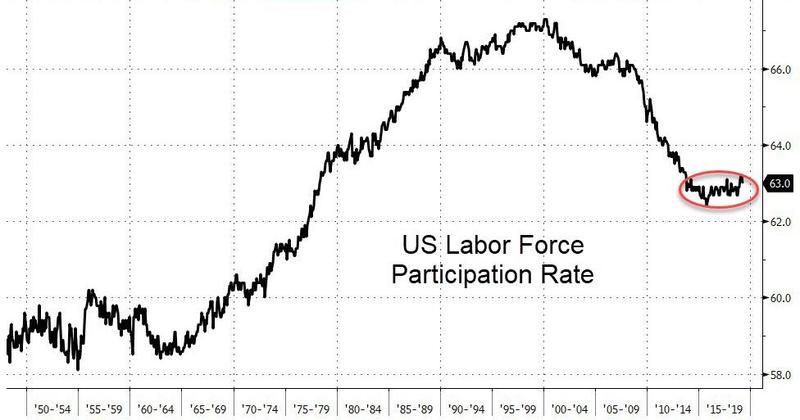
Related? The workforce participation rate remains at 63 percent. Per the graph at left, it hasn't budged more than half a percentage point or two one way or the other for almost seven years.

The conclusion seems right. Many people still aren't that financially ready to beat another recession, which odds indicate are likely to happen soon. Worse? Trump, other than wanting to fire Powell as Fed head, is likely to pull a 1920s and double down on tariffs.

The coming recession, without that, probably won't be that bad. But, Trump's volatility will make it worse. How that plays out, and is played, in the 2020 election will be interesting indeed.

The larger problems are structural and, as they have been for 40 years, caused in various degrees by both duopoly parties. Eric Levitz from the NY Mag says but "prime age" labor participation rate is up, without asking why this is the case, if true. Maybe more 20somethings can't afford college? Maybe more mothers are now working mothers? 

Nor does he try to square this with the overall participation rate still being stagnant.

June 29, 2018

Is a #recession ahead?

Quite possibly, according to some new news from short- and long-term bond yield convergence, which, as the story notes, is a strong sign of a recession likely ahead.

Now, some economists in the piece caution that, due to the Fed's quantitative easing, an eventual inverted curve between short-term and long-term rates means less today than it did in the past. But, even they aren't claiming it means nothing.

Already back in 2016, I took note of economists, and the signals they were seeing, to wonder if we would have another recession; back then, I even wondered if there might be a second Great Recession.

In a postmortem on the Democratic Party for the 2016 elections, I said I expected a recession by the 2018 midterms had a good probability.

And fifteen months ago, I said that the top-heaviness of Obama's stimulus still kept that possibility likely.

And, now, of course, we have a looming and likely trade war. This is an issue I really don't expect Trump to back off of.

GM has now warned that Trump's tariffs could lead to "less investment, fewer jobs and lower wages." Will Trump tell GM "don't get cute" like he did Harley-Davidson?

Meanwhile, the Trump tax scam and other matters have debt, inflation-adjusted, headed to its highest level since WWII. The percentages, per the L.A. Times, of debt to GDP, could eventually be higher than those that have led the European Union to issue warnings, and threats at least, of austerity, to member nations like Italy. Republicans will, of course, start trashing the "unreliable" Congressional Budget Office.

==

Chris Tomlinson thinks a recession is coming too, but not til 2020.

March 28, 2017

Recession ahead?

Now, first let me caveat that the Peterson Institute is largely "Hooverite" in its stance on fiscal issues. Nonetheless, it's nice to see that someone like Adam Posen agrees with me that a recession is likely by the time of the 2018 midterm elections.

He's saying so for the same basic reasons I have — bubblish growth, which was already starting to be the case the last two years of the Obama Administration, will continue for another year plus before a normal business correction takes place.

But, will it be "normal"? After all, none of the Obama Administration's "recovery" trickled down (I see what I did there, neoliberal Democrats, with your neoliberal president who said he loved Reagan) below the top 5 percent of Americans and a fair amount of that stayed with the top 1 percent. "Heterodox" economist Michael Hudson, in this long piece, discusses this rentier recovery. (And much more.)

Can the lower 95-99 percent stand more of a crunch? Will they have that bad of a crunch, less than in past recessions, or worse than past recessions, precisely because of the uneven recovery after the Great Recession even by recent standards.

That said, Republicans, including Donald Trump, his populist hand-waving aside, tilt very much 1 percent, and national-level neolib Democrats pretty much do.

But, as with the failed Ryancare / Trumpcare, before at least Jan. 3, 2019, this recession will be entirely a GOP baby. And, yes, they'll force the 95-99 percent to eat a shit sandwich. That includes YOU, TrumpTrain riders.

In a sense, stepping back inside the duopoly's framework, it will be "nice" to see the GOP deal with a recession on its own watch.

That said, other than head fakes to the 95-99 percent for electoral purposes on Nov. 6, 2018, Democrats won't try to fight the next recession with much more than a "kinder, gentler shit sandwich." (I see what I did there, even if Obama didn't offer express admiration for Poppy Bush.)

August 26, 2015

Of #oilprices, recessions, Saudi Arabia and China

They tie together, as ships and rings and sealing wax and kings, etc.

First, the oil side. A good piece here wonders how long the Saudis can flood the market, even as they dip into their own cash reserves. That said, since the U.S. rig count actually went up two last week, it seems that many private American oil drillers still aren't ready to cry "uncle."

Add into it that the looming likelihood of recession in China will dampen oil demand. Sometimes, the smaller the bone, the more two dogs fight over it. Shrinking demand is certainly a smaller bone.

Those fears, meanwhile, are stoking fears of recession elsewhere, as the WSJ notes.

This ties back to the first piece. Cheap oil is crippling Russia, hamstringing Nigeria, and obliterating Venezuela.

The journal piece notes that cheap oil may also destabilize the Middle East. Iran, even coming back out from sanctions, will have little money to throw around. Iraq has less money to battle ISIS. The Saudis have less money to control other portions of the Middle East. (On the other hand, to the degree ISIS or other terrorist groups have oil connections, they now have less money, too.)

As for America being affected by China, this once again illustrates the gap between Wall Street and Main Street.

The American economy is doing well, despite employees still getting stiffed on wages. China's Potemkin villages and Potemkin market shouldn't affect America; Japan's early 1990s bubble didn't, after all. Unfortunately, Wall Street, by kowtowing to Beijing has fueled both bubbles even as it knew better. (Of course, China's done plenty of internal bubble inflating, too.) Sounds familiar, no?

So, if we do have another recession, even if not as bad as the Great Recession, the first unofficially official sign, before rearview hindsight of two quarters of economic retraction, will be the boo-hooing of banksters.

December 04, 2014

#Obamacare: If Chuck Schumer is a 2016 Democrat, I'm more Green than ever (updated)

So, Sen. Chuck Schumer (D-Wall Street) is saying that Democrats in 2008 didn't have a mandate to pass Obamacare?

Really? I could have sworn that I heard both Barack Obama and Hillary Clinton discuss national health care ideas of some sort or another in multiple Democratic debates and their campaigns in general. I could have sworn I heard Obama mention something about it in the general election.

As for not tackling the recession? Hey, Chucky boy, did you push Obama to keep his stimulus package below $1 trillion? Yes, as the survey shows. Even worse, we know you pushed Obama to name one of the chief architects of the recession, Tim Geithner, as his Treasury Secretary.

Either admit that you, like Obama, didn't take the Great Recession as seriously as you should have, or shut up.

Right now, you're blaming a non-issue as part of the cause of a problem which you helped cause.

===

Update, Dec. 4: Michael Hiltzik answers Schumer, his inside-the-Beltway supporters, and, indirectly, other Senate Democrats.

He says the problem isn't with Obamacare, but with Senate Democrats who ran away from it and let the GOP define it.

Fair enough, as far as it goes, Michael.

But, some of that criticism needs to attach to The Not So Great Communicator himself, Dear Leader.

This is Hiltzik's second column on this issue since Schumer spoke out.

In his first, he gave Schumer a paddling for "spinelessness."

He adds that O-care benefits the middle class as well as the poor.

Then, there's this.
(L)eaving aside that Congress and the White House should be able to walk and chew gum at the same time, the notion that the pursuit of healthcare reform resulted in the abandonment of economic growth policy is bizarre.

True that. On the other hand, since his first six months in office, at least on major issues, sometimes it does seem that this is the case. 

Hiltzik does also remind us that Schumer apparently lost his 2009 legislative calendar somewhere:
As Brian Beutler and Scott Lemieux cogently observe, President Obama had already gotten the Recovery Act through Congress before work began on the healthcare law, and he wasn't going to get more stimulus from the GOP on Capitol Hill no matter how hard he tried.
Charles Schumer, pandering idiot.

Doorknob help us if this is the opening salvo in challenging Harry Reid as Senate Democratic leader. (I suspect it is.) 

September 07, 2014

Thomas Piketty: Allergic to the word "union"

I had read others' reviews of Piketty's "Capital in the Twenty-First Century," and so I knew in advance that he had ignored the possible work of unions in trying to reverse the increase in income inequality in the last 40 years. Indeed, based on those other reviews, especially one by Thomas Frank, I had previously blogged about this issue.

And, now, having gotten a copy of the book from the nearest larger-sized library, I can see that in person.

Basically, it's because he ignores the past role of unions in reducing income inequality.

Piketty could have mentioned the word "union" as early in the book as page 9.

At the bottom of that page, he says:
In the last third of the nineteenth century, wages finally began to increase: the improvement in the purchasing power of workers spread everywhere.
And continuing in that same paragraph, on page 10:
Like his predecessors, Marx totally neglected the possibility of durable technological processes and steadily increasing productivity, which is a force that can to some extent serve as a counterweight to the process of accumulation and concentration of private capital.
Gee, wouldn't that be a good place to discuss the role of unions?

Nooooooo.

Instead, we're told that technocracy plus good old macroeconomics of productivity explains all.

But, we're not told WHY the owners of the means of production, to go back to the original "Capital," would share that increasing productivity's monetary benefits.

Gee, wouldn't that be a good place to discuss the role of unions?

Nooooooo.

It gets worse. I jumped ahead, after the Introduction in which that all appeared, and the word "union" did not, to Chapter 9, in Part Two, which is about "The Structure of Inequality."

Its title? "Inequality of Labor Income."

Gee, wouldn't that be a good place to discuss the role of unions?

Nooooooo.

I saw the word "union" mentioned once in the entire chapter.

So, I skipped ahead to Part Four: "Regulating Capital in the Twenty-First Century."

Chapter 13 is "A Social State for the 21st Century."

Gee, wouldn't that be a good place to discuss the role of unions? Wouldn't it be a good place to discuss the possibility of established unions trying to revitalize themselves by looking to do more organizing work in white- and gray-collar occupations?

Nooooooo.

In fact, the U-word is again not mentioned in this chapter.

It's worse at the very end, in the index.

The word "union" has no entry.

Wow.

Beyond that, Piketty also ignores the third leg of the traditional "land, labor, capital" stool.

In the introduction, he briefly talks about how David Ricardo looked at the price of land, as a parallel to Thomas Malthus' overpopulation, as something that might produce a scarcity with economic effects. He notes that Ricardo was talking about farmland, and Piketty says the idea could apply to urban real estate today.

And then stops there.

When there's so much relevance of that to today.

Can the Green Revolution of the 1970s be sustained, or brought to a new level? Even for those of us who don't fear GMOs, but at the same time, like Norman Borlaug said the Green Revolution was just a one-generation fix, and reject the ideas that GMOs are the "cavalry riding over the hilll," or as I call it, an example of "salvific technologism," there's worries here.

And, things like Peak Oil or other diminishing mineral reserves could also be discussed in depth under the "land" leg of the stool.

But Piketty doesn't.

So, this is essentially a left-neoliberal technocrat writing a very incomplete book about how to fix the economy of the 21st century. And, one who's doing a cheap ripoff of Marx, and in his own way, arguably no more scientific than Marx.

So, true liberal friends, beyond my original blog post, I've now read enough of this book that you don't have to.

Plus, he's not that good of an economist in some of his theorizing. Indeed, that link explains exactly why he doesn't mention unions hardly at all:

Let me return to Piketty’s theoretical paradigm (the “neo-classical” paradigm). According to this theoretical paradigm all persistent unemployment must be explained as the result of wages being “too high”, i.e. as the product of trade union action. It is not accidental that Robert Solow whose “neo-classical” growth model Piketty invokes is a votary of “labour market flexibility”, which means in effect smashing trade unions through “free hire and fire”. Smashing trade unions on the plea that this would raise employment is currently on the agenda of corporate capital everywhere in the world including India. It is a pity that Piketty, despite his concern with wealth inequality, adopts a theory that provides sustenance to this corporate agenda.
Bingo.

June 22, 2013

Metroplex memories renewed

METROPLEX MEMORIES RENEWED

Four full years.
That’s how long it’s been
Since I last visited the Metroplex
Of my own design and on my own.
In all the time of my exile
Elsewhere in Texas
I had never gone back
Until now.

And?
It’s still booming, no doubt of that.
The freeway construction in Fort Worth
Looked like Houston!
Still-unconnected ramps heading everywhere
To connections unsure in my mind,
Gone too long to completely visualize the plan.
And the Kimbell?
A jewel originally,
I hope the expansion leaves it
As still a jewel, albeit larger.
The Amon Carter?
Still featuring great Americana art.
Speaking of, why did the Botanical Garden
Have to be closed for an artist’s party?
Que sera, I guess.
And, hey, Ron Snider?
Was that you I saw at the Fort Worth Central Market?
It’s been nearly five years
Since I sat in the Choral Terrace seats at the Meyerson,
And you look a lot different without your timpani in front,
But it sure looked like you.

Why couldn’t I find other work in Dallas,
Or Fort Worth,
When my newspaper company closed?
Why did greedy banksters and greedy housing bubblers
Have to wreck our economy
And force me to act in fear
And become a vagabond?

Why can’t my personal connections
And acquaintances, and social networks
Get me back to the place I once belonged
To what was home?

June 22, 2013

August 24, 2012

Incomes continue to decline as 'Lost Decade' looks more real

Median household incomes, when adjusted for inflation, have declined 5.2 percent during the past three years. That's worse than during the Great Recession itself.

It's more solid evidence that, like Japan, we may well be facing a "lost decade" of stagnation. With Obama's work to deal with the detritus of the housing bubble generally tepid, when not opposed by the GOP, this part of the economy is going to continue to struggle for some time.

Think about all that this involves. It includes carpenters, plumbers, electricians, cement companies, residential contractors, realtors and more.

I say halfway, but only halfway, in jest that maybe we need a national version of 1970s Cleveland, where officially "tolerated" arson fires in residential areas were seen as an "acceptable" way to open doors for gentrification and redevelopment.

More seriously yet, a "new CCC," besides repairing our national parks, could become a giant, oversized Habitat for Humanity-type organization, repairing a number of foreclosed-upon houses. Or heck, maybe we can get Jimmy Carter to get Habitat for Humanity directly involved.

And you over-65 tea partiers? Get on your knees and thank FDR for Social Security. By age group, you're the only demographic not to have your income decline.

Meanwhile, this has arguably been a "recovery of the rich." Why? In part, Ben Bernanke's quantitative easing. Once the GOP reads this story, it may stop opposing him, and instead begging for Round 3.

April 01, 2012

The jail bubble bursts in Texas

The Great Recession never saw a huge housing bubble burst in Texas, unlike most Sunbelt states. But, what it IS showing, now, is the bursting of a huge bubble of jail construction, a bubble that, as documented here, threatens to hobble, even crush, finances of a lot of small, rural counties across the state.

And, for Texas GOPers and others who tout privatization, let's not forget that much of the push for building more of these jails was driven by private jail companies like CCA.

I feel sorry for these local counties, but NOT for the all-GOP governments that bought off on the tough-on-crime, big-on-jobs Faustian bargain that drove such construction in the first place.

And, as the story notes, the privatizers are pulling out of these "Jail to Nowhere" places too. So, I don't feel sorry for county governments, or the state, for not getting some ironclad guarantees from the likes of CCA. That said, I'd like to see a few counties sue the state, even if it would go nowhere constitutionally.

I'd also like to see the Democratic Party make more of an issue of this, as well as get tough on its own members, whatever level of government, who have supported prison privatization.

Of course, none of this will actually happen.

February 28, 2012

Learning economics, being rich, makes you greedy

It should be no surprise that, on average, the richer you are, the more likely you are to lie and cheat. Here's an interesting sidebar to that:
In the research reported yesterday, the experiments suggest at least some wealthier people “perceive greed as positive and beneficial,” probably as a result of education, personal independence and the resources they have to deal with potentially negative consequences, the authors wrote....

Previous research has shown that students who take economics classes are more likely to describe greed as good.  
Were Shakespeare alive today, he'd say: "The first thing we do is kill all the economists." You know, those folks who justified everything leading up to 2008.

Back to the main thread. The story notes that the rich were ready to cheat for relatively minor sums, too. Sums that would, in real life, benefit them almost nothing.

Were Lord Acton around today, he'd say, "Too much money corrupts, and the more you're over the 'too much line,' the more likely you are to be more corrupt."

Arthur Caplan notes how this is the baseline problem with capitalism:
“Support for free-market capitalism will collapse if those who do well don’t do good. Rapacious, intolerant, nonempathetic capitalism that says lie, cheat, steal, it’s only the bottom line that matters -- aside from being morally repugnant, it’s got a dim future.” 
Well, actually, with social Darwinism and the "success gospel" propping it up, it may not have a dim future at all, unless "What's the Matter with Kansas" sheeple get a clue.

January 25, 2012

Bernanke continues to put incremental stamp on Fed

First, with inflation hawks like Richard Fisher now off the Federal Reserve's policy board, Fed Chairman Ben Bernanke can stop worrying about their hyperfears about nonexistent hyperinflation.

So, he can also say interest rates will stay near zero, albeit indicating he expects recovery to be slow.

More importantly, in a sense, is this increased transparency:
In a separate set of statements, the Fed said that 11 of the 17 members of the committee expected that the Fed would raise interest rates at the end of that period. It noted that the committee expects growth to accelerate over the next three years, from a maximum pace of 2.7 percent this year to a maximum pace of 3.2 percent next year and up to 4 percent in 2014. 
Alan Greenspan never would have even considered making such an announcement.

Instead, he would have kept inner workings of the Fed secret, mumbled some shit-in-one-hand, St. Alan of Greenspan oracularity to Congress on the other and pretended he knew what he meant.

Of course, Bernanke has prodded Congress to do more for the economy than it has. That's not happening, at the earliest, before most Congressional GOP primary races are out of the way, and even after that, is likely to still have a fair degree of GOP BS, only a shade or two lighter on tea party dogma.

But, without getting specific, Big Ben said the Fed will consider more stimulus moves if necessary. Again, having the likes of Fisher out of the way  helps.

But, not so good news from the Fed for Dear Leader. The unemployment rate is only expected to drop to 8.2 percent during the year. I'm sure Obama would feel better, even with Richie Rich Romney or Newt-bar Gingrich as his opponent, if it were below 8.0.

December 16, 2011

The Depression VS Keynesianism

The title above isn't meant to be 100 percent literal. And, I haven't jumped on any conservative bandwagon.

It IS, though, to signify I largely agree with Paul Stiglitz's new essay, that anti-Keynesian monetary contraction may well not have been the primary cause, or even primary exacerbator of, the Depression.

Rather, as in today's economy, it was ultimately an employment issue.

Just as Henry Blodgett noted a week ago that consumers create jobs more than anybody else, Stiglitz notes taht if we can't consume, to put it crudely, job creation is in trouble.

Read the whole thing. He says the same issues apply to the Great Recession, too.

As does, to the degree it worked more than deficit spending in particular or monetarism in general, Stiglitz' solution. It's the other half of the New Deal: A direct federal jobs program, or more than one.

Unfortunately, Obama the neolib ain't a bold experimenter, unlike FDR, so we ain't getting any such thing. Instead, it's "college for all" even as we already face a "higher education bubble."

October 02, 2011

The hollowing out of the 'creative class' - including by new media

Working at a newspaper, I can of course attest to this personally. But, it's artists, musicians and others, too, as this excellent Salon column notes. I hadn't don't a blog post in my "dark side of the Internet" series recently, and this piece (h/t Leo Lincourt) makes a good foundation for that.

The reality of this hollowing out?
Some of these employees are young people killing time behind a counter; it’s hard for them, but they will live to fight again. But education, talent and experience — criteria that help define (Richard) Florida’s creative class, making these supposedly valued workers the equivalent of testosterone injections for cities — does not guarantee that a “knowledge worker” can make a real living these days.
“It’s sort of like job growth in Texas,” says Joe Donnelly, a former deputy editor at L.A. Weekly, laid off in 2008 and now pouring savings and the money he made from a home sale into a literary magazine. “Gov. Perry created thousands of jobs, but they’re all at McDonald’s. Now everyone has a chance to make 15 cents. People are just pecking, hunting, scratching the dirt for freelance work. Living week to week, month to month.”
Now, I don't think Florida, or New Urbanism, is/are the antichrist. But, I do think a fair amount of people who buy into his ideas are the same white, Volvo-driving, latte-sipping, Meyer-lemons-for-lemonade-squeezing white liberals who bought into Barack Obama, too.

Here's the nut grafs of this hollowing out:
Optimists like Florida are undoubtedly right about something: This country doesn’t make things anymore and never will. What the United States produces now is culture and ideas. Trouble is, making a living doing this has never been harder.
Wait a minute, says Allison Glock, a magazine journalist and writer who’s just returned to her native South because she and her novelist husband could no longer afford life in New York. “Wasn’t the Internet supposed to bring this class into being?”
Well, yes, theoretically. However, non-Chicago School non-Randian non-economics libertarians underestimated the power of big biz. AOL, though, should have been a wake-up call. But, because blogs offered us all a sliver of "idea space," and the hope of not working for the corporate media man, we "bit."

Problem with that? As Bill Gates notes when saying he thinks we need larger inheritance taxes, a lot of life, for both individuals and movements, is about luck. And timing. And ... per modern terminology ... about bandwidth. (More on that below.)


So, yes, we do need a new Dorothea Lange.


And, no, new media isn't the answer, contra the blogging PR chief for a certain science magazine. After all, Scientific American's parent, Nature Publishing is itself part of an international, monstrous conglomerate that owns Holt, Rinehart, Winston; McMillan; Farrar, Straus & Giroux; and major German publisher S. Fischer, among other things. So, sorry, Bora Zivkovic; working for a multinational corporation that is determined, like similar other multinationals, to use digital rights management laws and other things to extend its dominance from the $3 billion or more in annual sales worldwide isn't exactly "new" from the capitalism side.

More below the fold.


September 08, 2011

50-50 chance of double-dip recession?

So says David Leonhardt, with this "tell" that should further inspire true progressives to jump off the sinking Obama ship and look at the Green Party.

Perhaps the best sign of how difficult it is to know the economy’s direction is that, as a group, the nation’s professional forecasters have failed to predict all the recessions since the 1970s, according to data kept by the Philadelphia Fed. In the last 30 years, the average probability they put on the economy lapsing into recession has never risen above 50 percent — until the economy was already in a recession.

The forecasters, on Wall Street and elsewhere, are not blind to economic change; they just tend to underestimate its severity.
Given that Team Obama is listening to those professional forecasters, and even has many of them ensconced inside the White House, that's why he "doesn't feel your pain." Neither your short-term pain over a looming second dip, nor your and my longer-term pain of wondering when our current job will be downsized or outsourced.

September 01, 2011

The best of August here

By viewership, top blog post was my  extended takedown of New Media fluffers.

Second was a rebuke of conservative Christians claiming red algae in a San Angelo, Texas lake was  “semi-Orwellianism by Gnu Atheist P.Z. Myers.”


Fourth was my take on what slowing economies in BRIC countries  may mean for a double-dip recession.


Then we get to Rick Perry land, with my post about  the “Texas miracle” and the reality of schools at the start of a new school year getting the next most reads.

Both this, of course, the “RickPerry’sTexasMiracle,” and the New Media post are parts of ongoing series. Stay tuned.

I must say I like Blogger’s new dashboard in its ease in helping do this.

August 05, 2011

PIGS, BRIC, AAA and douple dips

It seems like nobody can do math, at least in the financial world. Definitely, nobody can do history, it seems.

Standard & Poor is going to kick the United States off the AAA ratings bandwagon. The Treasury Department says it's bad math on S&P's part that's leading to this possible decision.
After two hours of analysis, Treasury officials discovered that S&P officials had miscalculated future deficit projections by close to $2 trillion. It immediately notified the company of the mistakes.

S&P officials later called administration officials back to say they agreed about the mistakes, though they didn't say whether it would affect the rating. White House officials remained waiting Friday evening to see what the company would do.
Answer, per the top link? S&P said it was acting anyway.

The kicker, per the first link? S&P threatens further downgrades. That all said, this is in the face of everybody saying the debt deal is going to hurt the short-term economy.

Oh, and Obama? Maybe you're more financially naive than Bill Clinton and his hypocritical comment (he knew better) about being held hostage by the bond market. That said, with the Wall Street insiders in your administration, that petard you hear cranking is your own.

You have no room for economic populism, and it would sound phony if you tried.

That said, what does this all mean?

It wouldn't hurt most domestic investors; as long as at least one ratings agency has the U.S. at AAA, they can hold Treasurys, etc.

Internationally? Another story. The Swiss franc is probably going to go through the roof. The renmimbi in China could come under inflationary pressures too tough for that regime to totally resist. (More on that below.) And, supposedly, rumor of S&P's possible move was part of what was behind Friday's wild stock gyrations.

Basically, "austerity" risks becoming the new "Smoot-Hawley tariff," the Great (double-dip) Recession's answer to Great Depression stupidity.

Meanwhile, speaking of Europe and markets?

The "PIGS" of Portugal, Italy, Greece and Spain have a new "most sickly" member, perhaps. Italy's chance of default on its debt is reportedly now at 50 percent. Yes, American analysts may claim it's not as big a deal as our own 2008 implosion, but, with the southern half of the Eurozone struggling in general, it might not be minor.

But, it's not just PIGS stressing the global economy.

BRIC nations may have their own woes. Brazil has joined China in battling inflation; another reason behind the Dow's swirling was worries over both their economies.

Yet, while still lethargic, U.S. job growth in July reportedly was at least better than anemic.

So, are we still facing a double-dip recession?

I'd put the odds still around 50 percent, but it could be with a trough more than a deep plunge, and with no more than two quarters of technical recession. That said, it's clearly a muddle.

There's a spate of other could be good/could be bad news out there. Italy says it will balance its budget by 2013 - but will include a balanced budget amendment to its constitution. Consumers increased their borrowing in July, but whether out of economic confidence or economic need is still unclear.

And understanding this muddle depends in part on whether or not S&P pulls its horns back in.

That said, what if it doesn't, the U.S. economy and investments therein stay no worse than now, and Moody's and Fitch's stay at U.S.-AAA? How much of a ding does S&P take?

And, given the Debtmageddon crap we just saw, what happens between Obama and Congress next month? How much more intransigent do Congressional tea partiers get? How much more backbone does Obama lose?

July 19, 2011

Is David Leonhardt still thinking in too small a box?

Last week, in a NYT op-ed, Leonhardt said today's consumer-economy bubbles, beginning with but by no means limited to housing, were going to stick around a while.

He cites a variety of statistics to back this up:
The auto industry is on pace to sell 28 percent fewer new vehicles this year than it did 10 years ago — and 10 years ago was 2001, when the country was in recession. Sales of ovens and stoves are on pace to be at their lowest level since 1992. Home sales over the past year have fallen back to their lowest point since the crisis began. And big-ticket items are hardly the only problem.

The Federal Reserve Bank of New York recently published a jarring report on what it calls discretionary service spending, a category that excludes housing, food and health care and includes restaurant meals, entertainment, education and even insurance. Going back decades, such spending had never fallen more than 3 percent per capita in a recession. In this slump, it is down almost 7 percent, and still has not really begun to recover.
And then reminds us of more liberal means that businesses are only, in light of this, acting rationally in not hiring more people:
If you’re looking for one overarching explanation for the still-terrible job market, it is this great consumer bust. Business executives are only rational to hold back on hiring if they do not know when their customers will fully return. Consumers, for their part, are coping with a sharp loss of wealth and an uncertain future (and many have discovered that they don’t need to buy a new car or stove every few years). Both consumers and executives are easily frightened by the latest economic problem, be it rising gas prices or the debt-ceiling impasse.
So, maybe Krugman is right in calling the current times the "Little Depression" now instead of the "Great Recession."

And it may stick around a while, Leonhardt says:
Sure, house and car sales will eventually surpass their old highs, as the economy slowly recovers and the population continues expanding. But consumer spending will not soon return to the growth rates of the 1980s and ’90s. They depended on income people didn’t have.
His solution? Tax cuts, but ones targeted to businesses who hire, and more stimulus, but targeted to industries of the future.

In short, Leonhardt is saying, don't abandon Keynesian ideas, but get smarter about how to use them.

However, this all seems to be pretty weak tea. Keynesianism was only one tool that Roosevelt used. Direct labor policy was at least as large of a tool, and even Krugman didn't initially push this one. We could certainly use a new WPA to fix trails, roads, buildings and more in today's national parks. But, not just that.

Everybody talks about how crappy our infrastructure is, but Obama didn't do anything about it. I'm not talking about "shovel ready" NEW construction, I'm talking about repairs to bridges, dams, etc. Unemployed carpenters and other construction industry workers wouldn't need too much retraining for this.

And more. Part of rehabilitation for low-level drug offenders could be not just probation, but WPA-type work. We might still want to keep them "segregated" from other employees, but, it would get them into work again, and teach some actual skills, like running a road grader, not just a shovel.

Last but not least, when Dems took control of Congress in 2007, I said they not only needed to up the minimum wage, but they needed to build a COLA into it. I stand by that today.

As for people not buying anything, part of it is quality has improved, too. Beyond that, maybe we need to go to a 35-hour work week, get Americans from CEOs through new high school grads to drop some of the materialism, and socially reinvent America. (But NOT in a wingnut/Xn right/tea party way!)

Beyond that, Leonhardt, Obama and others also need to be thinking about how to reinvent work, the workplace and similar issues. A good primer on that is right here, ranging from new ideas in post-cubicle workplaces to play in the office and on to job retraining.

July 16, 2011

A bubble DECADES in the making

That's the bottom line on today's anemic economic bottom line in America, from Dave Leonhardt.

He cites a variety of statistics to back this up:
The auto industry is on pace to sell 28 percent fewer new vehicles this year than it did 10 years ago — and 10 years ago was 2001, when the country was in recession. Sales of ovens and stoves are on pace to be at their lowest level since 1992. Home sales over the past year have fallen back to their lowest point since the crisis began. And big-ticket items are hardly the only problem.

The Federal Reserve Bank of New York recently published a jarring report on what it calls discretionary service spending, a category that excludes housing, food and health care and includes restaurant meals, entertainment, education and even insurance. Going back decades, such spending had never fallen more than 3 percent per capita in a recession. In this slump, it is down almost 7 percent, and still has not really begun to recover.
And then reminds us of more liberal means that businesses are only, in light of this, acting rationally in not hiring more people:
If you’re looking for one overarching explanation for the still-terrible job market, it is this great consumer bust. Business executives are only rational to hold back on hiring if they do not know when their customers will fully return. Consumers, for their part, are coping with a sharp loss of wealth and an uncertain future (and many have discovered that they don’t need to buy a new car or stove every few years). Both consumers and executives are easily frightened by the latest economic problem, be it rising gas prices or the debt-ceiling impasse.
So, maybe Krugman is right in calling the current times the "Little Depression" now instead of the "Great Recession."

And it may stick around a while, Leonhardt says:
Sure, house and car sales will eventually surpass their old highs, as the economy slowly recovers and the population continues expanding. But consumer spending will not soon return to the growth rates of the 1980s and ’90s. They depended on income people didn’t have.
His solution? Tax cuts, but ones targeted to businesses who hire, and more stimulus, but targeted to industries of the future.

In short, Leonhardt is saying, don't abandon Keynesian ideas, but get smarter about how to use them.