|
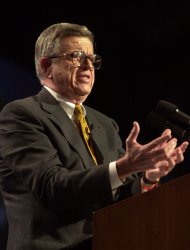
University of Virginia law professor Douglas Laycock
took part in a moot
court session Monday in preparation
for oral arguments in
Town of Greece v. Galloway
at the U.S. Supreme Court./Photo via U.Va. |
Update: Galloway lost, Greece won, on a 5-4 vote; Wikipedia has a good overview. Per my comments below, plaintiff attorney Doug Laycock couldn't get a "count" up to 5 Justices in what was a tough case, beyond Gnu Atheist kibbitzing as to strategy. I disagree with the ruling; I would have accepted Breyer's more narrow concurring dissent rather than Kagan's somewhat broader one, but certainly would not have said no to Kagan.
Now that Galloway vs Town of Greece is at the Supreme Court, we may get more clarity on an issue the Nine in Black have long dodged, and often deliberately. Or, we may not. And, from a secularist's perspective, we may get clarity we don't want.
The question at hand, based on how the grievance was filed, has two different possible legal approaches.
One is that, the whole idea of government-backed prayer, like invocations before city or town council meetings, as in the case of Greece, is religiously coercive.
The other is that prayer itself is not necessarily coercive, but the content of it, and to the degree it can be defined, the intent of it, is, or something along those lines.
And, even though one of the two plaintiffs is an atheist, the plaintiff's lawyer, University of Virginia law professor Douglas Laycock, appears to opt for Strategy No. 2, not No. 1. And, per my warning at the end of the first paragraph, and contra some wringing of hands and gnashing of teeth in the last 36-48 hours from some Gnu Atheists, pursuing Strategy 2 is almost surely the right one, and throwing the plaintiffs' lawyer under the bus for so doing is ridiculous.
That said, as shown in the recent Proposition 8 and DOMA cases, in a situation like this, a lawyer has to count to "five," with one of those five being Justice Anthony Kennedy.That's how you win, and last I checked, a lawyer is supposed to win the case for his or her client, whether it's criminal or civil. Even if it's constitutional law.
Center for Inquiry Executive Director Ron Lindsay, a lawyer himself,
has a piece that's good in some ways in lining out the case, but with bits of Gnu Atheist tone-snarking, enough for non-Gnu friends of mine to note that this is exactly the type of stuff that feeds into stereotypes of atheists. And, per what I said, basically accuses Laycock of throwing atheists under the bus. No quotes. Sorry. The more I think about it, the more I'm upset about the tone, and about him as a lawyer who knows better not writing better.
I find it pandering to Gnu Atheists, and this is nothing new, either in his doing so or in my noting that. The fact is that Laycock was the plaintiffs' lawyer from at least the time
they responded to Greece's request to the Supreme Court to grant certiatori. Indeed, that response makes clear that it was about "sectarian prayers," and that's a quote from the response, and not about prayer vs. no prayer. The idea that CFI and Lindsay should know this, too, is doubly true since CFI was among groups filing amicus briefs.
So, A, this "Strategy No. 2" can't come out of the blue. B. Lindsay himself,
as a lawyer, knows that in civil as well as criminal law, the lawyer's
ultimate job is to win the case, even if the win is an ugly one at
times. It's called legal strategy,
per U.Va's PR explainer, and that piece
makes that clear. That piece also makes clear Laycock's considerable experience in this area:
Laycock is best known for defending the free exercise rights of
churches, having argued three cases before the Supreme Court on behalf
of a Lutheran church, the Catholic archbishop of San Antonio and an
Afro-Caribbean religious group. (Hosanna-Tabor Evangelical Church and School v. EEOC; City of Boerne v. Flores; and Church of the Lukumi Babalu Aye, Inc. v. City of Hialeah, respectively.)
Yet he also wrote the briefs on behalf of the plaintiffs in Santa Fe
Independent School Dist. v. Doe, a case involving high school football
prayers.
Ergo,
C as a subset of A. The plaintiffs, and the variety of groups filing
amicus briefs, including Lindsay's own CFI, Laycock addresses the
applicability of Marsh, or not, and more, too.
Fellow U.Va. law prof Micah Schwartzmann, who helped Laycock prep, also weighs in:
“In Town of Greece, the Supreme Court has the opportunity to clarify
the limits of legislative prayer, especially as it is practiced by local
governments,” he said. “Legislative prayer is constitutionally
anomalous. Usually the government is not allowed to assert religious
views. When it does so in a sectarian manner and in a context in which
citizens are likely to feel pressure to conform, we should be concerned
about that.”
Schwartzman added that he does not think anyone has expressed that concern more forcefully than Laycock.
“The respondents in Town of Greece are very fortunate to have him representing their views in the Supreme Court,” he said.
So,
Ron Lindsay or Doug Haycock? I know which one I think probably is smart
on how to actually plead this case. In short, this isn't as simple as
Lindsay would have it. Nor, per the other blogger, does it seem that
higher-grade legal talent, per my rhetorical questions, saw a chance to
overthrow Marsh or this case to be the vehicle for that.
Meanwhile,
the Gnus are trying to undermine Laycock's credibility by noting he was
a plaintiff for the church denomination defendant in this case.
That said, the ones snickering at Laycock and my defense of him
conveniently ignored that SCOTUS ruled unanimously in that case. They
also ignore that Laycock's years of expertise on the First Amendment in
general mean that he doesn't necessarily agree with them. And, the fact
that SCOTUS ruled unanimously, is arguably a testimony to Laycock's
skills.
Related to that, Policy Mic
has a piece that claims trying to overthrow the town's stance entirely was the intent of co-plaintiff Stephens. It, in turn, has its own bit of snarkiness, and somewhat ignores the whole issue of whether the
Marsh v Chambers case's precedent should or shouldn't be overturned. It even more, like Lindsay, ignores whether Marsh can be overturned, either in front of this Court in general or with this case as a particular vehicle.
Greece misses a chance to clarify precedent set by 1983's Marsh v. Chambers. In that case, the Court recognized
"legislative prayer" (specifically, the public salary of a legislative
chaplain) as legal so long as it was primarily ceremonial, traditional,
and didn't "proselytize [or disparage] any one … faith or belief."
But as Justice William Brennan noted in his dissent,
that answer didn't address the important question: should religion
belong in the town hall, taxpayer-funded or not, at all? "The Court is
carving out an exception to the Establishment Clause, rather than
reshaping Establishment Clause doctrine …. If the Court were to judge
legislative prayer through the unsentimental eye of our settled
doctrine, it would have to strike it down as a clear violation of the
Establishment Clause."
So, the question indirectly raised by this author is, was the intent of Stephens at least, to overthrow Marsh, at least once she understood what Marsh was?
He says in his next graf:
In other words, on the matter of legislative prayer, we still don't know
the Court's opinion on whether the First Amendment's instruction that
"Congress shall make no law respecting an establishment of religion"
refers to government not establishing one particular religion or,
as Justice Brennan argued, a prohibition on establishing the specter of
religion itself. Unfortunately, that decision will have to wait.
He's probably right. However, Lenny DiFranco, who has the excuse of not being a lawyer, unlike Lindsay, but no other excuse, started this piece off with a bit of muddle-headedness that would be worth of St. Ron of Gnuness:
The two petitioners, Susan Galloway and Linda Stephens, brought their
legal action as part of an activist campaign to assert, and then
entrench and fortify, the line between church and state. This righteous
goal would have been well served had their case's central question
addressed the legality of a town board soliciting religious prayer,
which is a question the Supreme Court has, to date, skirted.
I'm convinced they acted out of this motivation, but for some reason
they built their case around a nonsense claim of being offended at the
explicit Christianity of the prayers.
Note how much is fact-free here?
"I'm convinced." By what? "Righteous" goal? Assuming DiFranco is some sort of Gnu himself, doesn't this kind of illustrate how Gnus can adopt not only the posture, but the actual language of those they claim to despise? "For some reason they built their case around a nonsense claim." Again, really? The response to cert indicates this strategy is not de novo. Laycock's background indicates this is not a nonsense claim.
Back to the explicit claim by DeFranco, and the implicit one by Lindsay, that this case was "originally" about overthrowing Marsh. Set aside the fact they have no proof for any sudden bait and switch. That said, given the current make-up of the court, now is probably not the time to raise that issue anyway, and Laycock, beyond narrow legal grounds, knows that. Let's not forget that, to America at large, atheists are more vile than gays, and we just got DOMA narrowly decided in a theoretically pro-gay way. And, that said, he also appears ignorant of the fact that Laycock's been the plaintiffs' attorney for some time.
In
light of that, it was Breyer and not Kennedy who invited Laycock, when
he appeared to founder on whether any prayer might fit the non-coercive
bill, to
consider a different line of thought. As on Prop. 8 and DOMA, Breyer
doesn't matter; Kennedy does. Oh, and I know Lindsay knows all of this.
That said,
as Dahlia Lithwick notes at Slate, whether through how the complaint was filed, or the strategy of plaintiffs' lawyer Douglas Laycock, Marsh will likely remain in place.
That's even though Kennedy might appear poised to at least narrow it, per Lithwick:
Kennedy stops (defense lawyer Thomas Hungar again: “The essence of the argument is we've always
done it this way, which has some force to it. But it seems to me that
your argument begins and ends there.”
Kennedy adds, this “involves the state very heavily in the censorship and the approval or disapproval of prayers."
And, Kennedy appears to be ready to modify, at least, and potentially reject, the history as precedent idea that Hungar argued, and that was part of the basis of Marsh. That said, any good SCOTUS watcher knows not to read too much into oral argument posturing in general, and very much so with Kennedy
For a further understanding of that, you need to go to
an excellent analysis at ScotusBlog. And, the Economist has a good
straight news story.
An even worse problem, for me, and one should be indefensible for Obamiacs, is that Dear Leader filed an amicus brief — on the side of the Town of Greece.
OK, from here, let's look more at that Marsh decision and the dead weight of the historical background that Kennedy raised.
OK, from here on out, below the fold, I want to address two issues. One
is my take on Marsh. Related to that is my generic take on how I'd like
this issue to go, versus current issues of reality.