SocraticGadfly: Wilson (Woodrow)
Showing posts with label Wilson (Woodrow). Show all posts

September 14, 2023

William Jennings Bryan — the original Bernie Sanders

A Godly Hero: The Life of William Jennings Bryan

A Godly Hero: The Life of William Jennings Bryan by Michael Kazin
My rating: 3 of 5 stars

I was on about page 120, the run-up to the 1904 Democratic convention, when the light bulb turned on:

William Jennings Bryan was the 120-years-earlier predecessor to Bernie Sanders, on the legend even more than the reality, and related to that, the degree to which many peddled the Kool-aid or drank it for themselves, often long after the reality differed clearly. This includes the two protagonists. (Kazin may not like that comparison; for more on why, see the end of this extended review. See also my new Substack looking more explicitly at the sheepdogging angle.)

That said, this is one of those books that is both provocative and problematic at times. And, as is the norm with such books, I’ll have a greatly extended review on my blog. What I have here is the basics of what I learned new about Bryan as well as a basic-level critique.

Trying to rate it is also problematic. I do think this is well researched (Kazin also notes former recent, as of the 2007 date, biographers), but not necessarily well analyzed.

I don’t think I had read before about Bryan volunteering to serve in the Spanish-American War. Even if he saw no combat, it did look hypocritical next to previous anti-American statements.

That said, Kaplan gets some Spanish Empire wrong. The Philippines as well as Cuba and Puerto Rico were still a part. So was Spanish Morocco and Spanish Sahara. Bioko and Rio Muni, later united as Spanish Guinea, were held in equatorial west Africa.

As for his service, as a volunteer, why didn’t he resign before the 1898 midterms? Bryan obviously doesn’t tell us, but it’s another spanner in the spokes of his bicycle.

And, supporting the treaty? Wow. And, the Senate approved it by just 2 votes to spare. Bryan said, in essence, that we should follow Kipling’s adage and adopt the white man’s burden but shuck it quickly.

Then, after 1900, buying a rural mansion that in today’s terms would run at least $500K? Multiple guest rooms. Dining room that seated 24. Servants. (Peak Bryan was making $2K/week on the Chautauqua circuit and more besides. Bureau of Labor Statistics’ inflation calculator says $2K, in 1913, its earliest year, would be $62K today. Per week. Just for a dozen weeks of summer, $750,000 a year in today’s terms..)

1904? Not endorsing Hearst. Sure, Hearst’s womanizing was already known, but Bryan had shown himself a semi-hypocrite on imperialism already. Hearst probably wouldn’t have blocked Parker, by the 2/3 rule still in effect then, anyway, but maybe? Before people shifted votes after initial first ballot tallies, Parker was just short; Francis Cockrell, Bryan’s endorsee, was third. That said, all the shifts were Hearst defectors.

LaFollette had a newsletter, like Bryan’s The Commoner, but it didn’t explicitly promote him. Battling Bob missed a turn there, but, given his speaking style, what I’ve read about that, and other things, not a surprise.

Kazin believes the legend of Taft as conservative, which is only half true. For example, he doesn’t mention that, rather than “trimming” on the tariff, Taft traded tariff reform for getting the 16th Amendment out of the Senate. Nor does he mention that TR never tried tariff reform and that he didn’t push the 16th Amendment, either. As part of that, he’s also wrong about Gifford Pinchot. Doris Kearns Goodwin’s book on Taft and TR has a more nuanced portrayal. He also could have learned something about Nellie Taft, while there, per a bio of her . (Kazin’s book came out a full year later, and while Kearns wrote later than him, the door had long been open for revisionist Taft studies.)

That said, supporting the 1898 treaty foreshadows Bryan carrying Wilson’s water in Mexico before resigning over the Lusitania. And, carry that water he did.

There are other vignettes here, such as just how conservative TR was, claiming Bryan had “socialistic and communistic tendencies” in 1900. The claim, and the demagoguery, surprise nobody who knows the reality of Brownsville 1906.

Bryan was coopted by acceptance of Secretary of State. Wilson knew that.

Bryan's first big oops was not on Mexico but Federal Reserve. He did get Wilson to accept government oversight, but, with individual banks controlling the regional feds, especially the NY Fed, that was hollow. And, he was told that at the time. The remaining Populists and rising Progressives wanted something like the original, not watered down, Bank of North Dakota on lending requirements for the Fed, board of directors, etc.

Mexico/Caribbean? Bryan shared Wilson's paternalism. And, such it was, even if it shed the worst of GOP dollar diplomacy. It was the same paternalism Bryan showed in the Philippines.

WWI? Wilson hoped Bryan would resign already by end of 1914, reportedly. Kazin doesn’t tell us if Bryan had heard about that.

That said, Kazin misses the mark on Wilson as fake neutral, and being a fake neutral not a real one relatively early after the start of the war. He talks briefly about submarines not doing cruiser warfare as violating international law but says nothing about the same for blockade by extension and food as blockade weapon, even with his admiration for British law in general. Kazin notes later that the Lusitania was carrying munitions as well as passengers, but not that it was armed with guns more than big enough to sink a submarine if it surfaced. He lost a star right there. (He doesn't ask if Wilson knew either one at the time.)

Would siding with Bryan "have prompted a political rebellion"? Questionable. I don't know about Republicans, but most non-Southern Democrats west of the Mississippi in 1915 were still isolationist. He then claims the NY World spoke "for most of the American press" when it called German response to Wilson's diplomatic note "the answer of an outlaw." The World War I coverage in this book doesn't speak well for Kazin's handle on WWI in general, despite him writing a book about pre-US entry peace issues.

I had suspected Kazin would land here when, in his chapter on the 1912 convention, he indicated that Bryan plumping for Wilson instead of Champ Clark was a good thing. Yes, Clark was more parochial than Wilson, but he was opposed to WWI. (As Speaker, he didn't vote on the declaration, but his opposition was known. His son was an isolationist senator in the run-up to WWII.)

In Kazin's "War Against War," long review here he partially redeems himself — but not totally.

Sadly, as Kazin notes a bit in his Bryan bio and may cover more there, antiwar Congresscritters were ill-organized. A bill to block traveling on British ships wasn't introduced until 1916, and then, Thomas Gore et al had no answer to Wilson alleging they were making foreign policy on the fly.

Kazin redeems himself more fully at the end of the chapter: "In retrospect, he was quite right to oppose American entry into the Great War. It was not a conflict that history has justified."

But NOT totally fully. See what I said above about his thoughts on Bryan plumping for Clark as well as Wilson. And, going beyond what he said about “not justified,” it not only wasn’t justified for the world, it wasn’t justified for the US, even if Germany had still decided to smuggle Lenin into Russia.

Back to Wilson on the war. The reality is that, before the Luisitania, Wilson had, essentially, willingly made the US a “non-combatant co-belligerent.”

(I recognize I've gone a fair bit into Wilsonism, but, this is a very serious issue. Both as a matter of ethics, and even more, as a matter of governance and the American future, more than Vietnam, more than the Mexican War, overall, more than Iraq, too, this was the biggest foreign policy error in American history. And, it semi-directly set the stage for Iraq.)

As for history and alt-history, Bryan's unwillingness to either battle Wilson's renomination (with the two-thirds rule in effect, he might have succeeded in blocking it albeit without his own nomination) or run as a TR-type independent reinforced that he had nothing to offer but platitudes. And, John Reed type mocking aside, hadn't this long been true? (Some Progressives pushed to nominate Bryan after TR said no, but ultimately, they had only a Veep nominee.)

Re the 1916 campaign? This is the first time I've seen the claim that Debs passed on the Socialist nomination due to health. If true, he wouldn't have run for a Congressional seat, either, would he have? His later imprisonment did wreck his health, but he still stood for the 1920 nomination from his cell. Of course, he would have been in the cell anyway, but, it seems that he stepped aside in 1916 for other reasons.

On Scopes? Kazin claims his violation of the Tennessee law was UNintentional. Really? Sidebar: He grew up in Bryan's hometown of Salem, Illinois. Per Wiki, Bryan spoke at his HS graduation, and claims that Scopes was laughing. Per Wiki, the truth on the case may be not that it was an unintentional violation but that there was NONE — as in Scopes may not have taught any evolution that day. (If you're going to challenge legend, you should do it right.)

The big issue is how much Bryan was motivated by opposition to evolution by natural selection, ie, Darwinian theory, and how much by social Darwinism, and how much or how little he distinguished the two. Kazin never really addresses that how much/how little issue. And, while a fair chunk of touters of evolution also touted social Darwinism, even in the natural sciences, many did not. The same is likely true, to a lesser degree, of upper-class conservative politics. And, it's certainly true of liberal Christians. This is another less than total coverage by Kazin.

Was Bryan a fundamentalist? In the fullest sense of the book "The Fundamentals," no, but in a narrow sense, yes. In a vaguer sense, just like the members of the conservative wing of Lutheranism in which I grew up? Yes. Bryan might not preach hellfire to or about Catholics in public, but who knows what he thought in private. He was a biblical literalist. So, Kazin's "no" must be taken as a split verdict. The problem is, that Kazin doesn’t note the difficulty with analyzing Bryan as a fundamentalist today apples in a self-referential way. Just as Bryan didn’t have the politics of today’s fundamentalists, the fundamentalists 100 years ago. The lynchpin of “The Fundamentals” was not politics, but German-based higher criticism. Though we don’t have layman Bryan on record about higher criticism, he surely rejected it.

To wrap up, it seems that Kazin has a soft spot for Bryan — and enough of one that, on fundamentalism, and a few other things, he gave him a bit of a pass. (Other critics here have said that he does that with Bryan's racism, too. One or two other critics argue the other way, but even an occasional Southern politician explicitly denounced the Second Klan, for example.) Bryan leading the effort to BLOCK Klan condemnation in the 1924 Democratic platform does get mentioned, as does his undercount of Second Klan membership, but? "Mention" is all it gets. 

Here's another way of presenting it, and why I don't think this charge against Kazin is too harsh.

To look at a direct political contemporary? Eugene Debs evolved on many things, including race. (His original union, the American Railway Union, was segregated at first.) In prison — the WWI-related imprisonment, not his early one — he had his eyes opened about racial sentencing disparity — and talked about it.

Bryan never evolved.

Beyond the review, for today?

Kazin is a DSA Rosey, and per his Wiki bio, I am assuming some sort of sheepdogger against non-duopoly leftists. Given that, it's no wonder he doesn't want to compare Bryan to Debs more.  And, related to that, I forgot that he had a less-than-stellar essay in Myth America. This Slate piece has more. And, that is why I suspect that Kazin wouldn't like the light bulb of this non-duopoly leftist seeing William Jennings Bryan, and his legend vs. reality, closely paralleling that of St. Bernard of Sanders. And, his latest book, of last year, "What it Took to Win," appears to be sheepdogging writ large across party history, per at least one 3-star review. Per others, it seems like, per Dolly Parton, he tried to pack 10 pounds of potatoes in a 5-pound sack.

Beyond the review in general, thoughts that I had stimulated?

One thing I don’t get is why Sanders hasn’t pulled a Bryan and left the Senate and hit the rubber chicken circuit long ago. He, and even more I think, wife Jane, with the multiple houses and other things, like them some money. And, especially if he had done it before now, and very especially if he hadn’t fallen on his sword in 2020 for “his good friend Joe Biden,” Bernie probably could make half as much a speech as ex-presidents do. He would easily rake $500K a year if he wanted to.

Alt-history: Had Debs run again in 1916, he probably would have gotten enough additional votes in California and North Dakota alone to tip those states and the election to Hughes.

On the Great War? With a President Clark, he probably would have protested both British and German violations of international naval law. Britain would have decided the blockade with risk of sub warfare was better. (Germany had relatively few subs in 1915.) In response? Clark might have done like Washington and Adams in the 1790s, or Roosevelt in the 1930s, and issued a neutrality proclamation, then worked to get Congress to do even more, especially before the Lusitania. That would have specified no Americans on British ships. It would have specified no US government guarantees of “credits” by House of Morgan to Britain. With that, the British and French might have crumpled before Germany felt the need to smuggle Lenin. Hard to say.  

Anyway, that gets back to the review. If you really think WWI in general was that bad, and also think the US shouldn't have gotten involved (something that Kazin does NOT expressly say, so I'm not sure of his stance) then you can't let Bryan tilting the 1912 Democratic nomination pass in silence. (Nor can you let his susceptibility to Wilsonian flattery pass in semi-silence.) 

Update: Historians who know better, like Lawrence Goodwyn, would also like a word with Kazin about 1896 and the Populists.

View all my reviews

November 10, 2014

The myth of Teddy Roosevelt, part deaux

A few months ago, I blogged about the start of Ken Burns' latest PBS American whoregasm, "The Roosevelts," wondering what he'd get wrong about Teddy. (Answer: A decent amount, but not quite a huge amount. Click the link.)

Now, via a Facebook friend, we have the laughable wonder of TR calling Woodrow Wilson laissez-faire, in a 1912 campaign speech.

Really?

The man who refused to cut the tariff, did't push to get Congress to pass the 16th Amendment on income tax, and, even after the Panic of 1907 and his failure to push for something like the Federal Reserve, calls Wilson laissez-faire? Well, that's a chuckle.

It's true indeed that Wilson, a unreconstructed Southerner who, if he had pushed for Obamacare today, would have found a way even more than today's red states are doing to restrict its benefits to white folks, was saying that only keeping government power was coherent with protecting individual liberties.  That said, per the paragraph above, TR wasn't in much place to critique Wilson, and that's my critique. Beyond that, contra later parts of that TR speech, Wilson strengthened antitrust laws with the Clayton Antitrust Act, created the Federal Trade Commission, and battled to cut child labor, before legislation he pushed Congress to pass was declared unconstitutional.

In the speech, Roosevelt also lies about the accomplishments of Taft, some of which were more progressive — and more legally grounded — than TR's. See my first link.

Teddy Roosevelt would be a hoot for today. We'd have twice as many dams in the West as we actually do, we'd have czars for everything, TR would himself be talking to Kurzweil about putting his engrams in a computer, and he'd be dropping nuclear bombs in ISIS in the name of vigorous Christianist nationalism.

Burns did somewhat get this right. An activist government, for Teddy Roosevelt, boiled down to one thing: An activist Teddy Roosevelt. It's also was "Battling Bob" La Follette disliked TR forming his Bull Moose party and disrupting the growth of broader progressivism.

With a population four times that of his U.S., I thank doorknobs that, for some of his attractiveness, he's not president today. Had he been president when Truman was, he probably would have tried to shoot Congress before it could pass the 22nd Amendment. He almost certainly would have nuked North Korea, and maybe China, too, during the Korean War.

In short, he would be a hypercaffeinated (he bespoke Maxwell House's slogan), jingoistic Just.Another.Politician.™ Were he president today, he'd scare the hell out of me.

And, even a pre-modern TR would have been bad enough.

Had he been able to pull off the 1912 third-term win, and an assassination in Sarajevo in 1914 had happened as in reality?

He would have gotten us into World War I two full years before Wilson, in all likelihood.

He might then have used that as an excuse to run for a fourth term in 1916.

As for presidential rankings? We know why he's on Mount Rushmore. In actuality, for all of his good on environmentalism, and for his trust-busting for partially selfish reasons, he's not one of our top five presidents. He's probably not in the top 10.

That said, other than that the game of ranking presidents requires 10 of them to be in the top 10, we don't really have a 10 best presidents list.

August 04, 2014

WWI — the height of folly, repeated today; above all, the folly of Woodrow Wilson

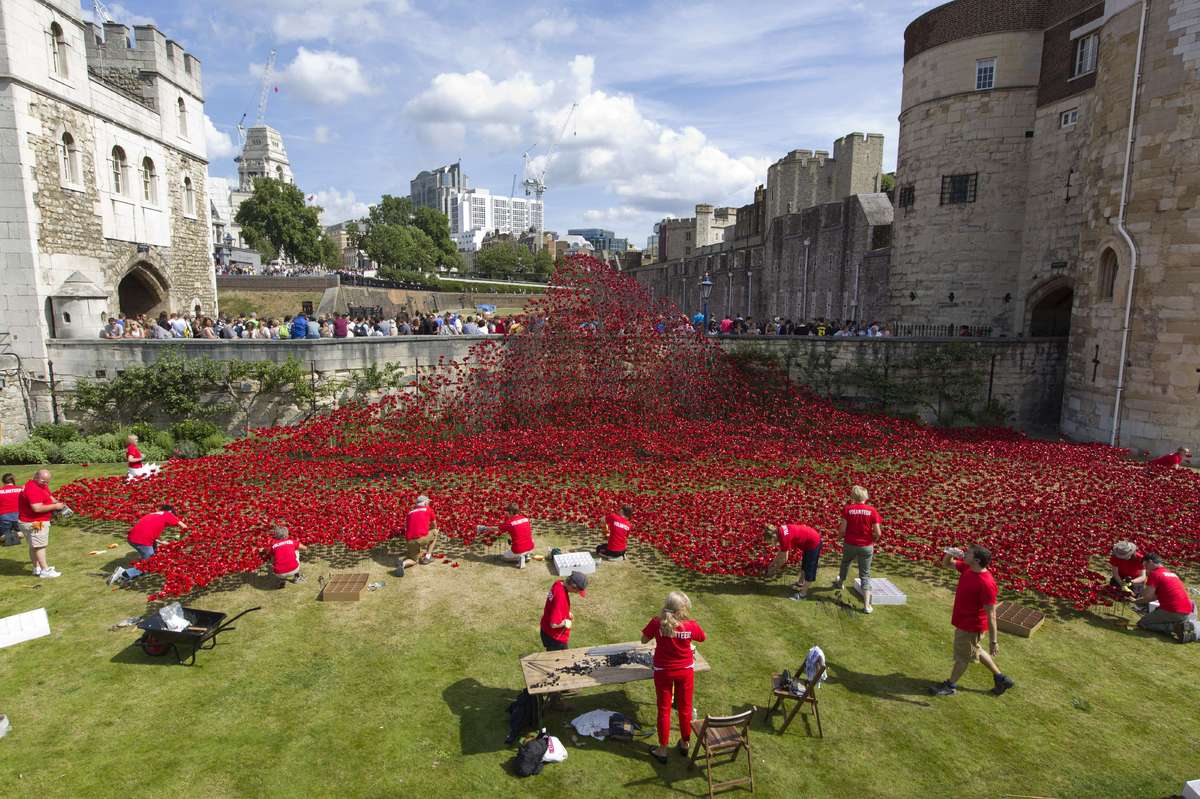
The senselessly romanticized Tower of London.
You can romanticize it with red poppies, either in the poem "In Flanders Field" or, as shown in the picture, by stringing up ceramic poppies on trellises at the Tower of London.

Or you can, on a romantic peace-making celebration of its anniversary, bury your head in the sand to reality like David Cameron and call it a noble cause, pretending that Wilhelmine Germany, for all its faults, was an evil empire just like the Nazis a generation later, in contradistinction to those who call it senseless slaughter. Here's Britain's more articulate answer to George W. Bush:
"That is wrong. These men signed up to prevent the domination of a continent, to preserve the principles of freedom and sovereignty that we cherish today," he said, only dozens of footsteps away from the headstones of Roy and Dietrich and 241 other Commonwealth and 288 German casualties.

Tosh, to use a good old British word.

First, let's debunk the romanticism.

As for the poppies? I have had friends on Facebook like the whole thing.

Not me, especially knowing those are ceramic fakes, rather than horticulturists doing some hard work with real poppies. Besides, if anybody knows the actual history of "In Flanders Fields," it was a pro-war poem used as a recruiting tool by the British, with their volunteer army.


I prefer the "war is hell" quote from William T. Sherman, which reads in full:
There is many a boy here today who looks on war as all glory, but, boys, it is all hell.
And, writing a poem about poppies, or putting fakes on the Tower of London, changes that not one whit, per Omar Khayyam.
And, now, let's look at the likely outcome had we simply not gotten involved.

First, it's unlikely Germany would have dominated Europe. Without Hitlerian lightning seizures of Denmark and Norway, with much more limited submarine warfare, despite Woodrow Wilson's one-sided trembling over that (more in a minute on that), and with WWI Germany generals actually looking askance at tanks, no chance that Ludendorff, his puppet Hindenburg, and their joint puppet Wilhelm II dominate Europe. Let alone the whole world.

Oh, yes, back to Woody Wilson and his crusade to make the world safe for Anglophilia.  That's what he really wanted, as anybody who knows of his intellectual love affair with Walter Bagehot can attest. Every time, from the sinking of the munitions-carrying, 4-inch-gun armed Lusitania on, when Wilson pretended to be "neutral," he took another step closer to Britain.

The best example is agreeing with Britain that submarine warfare was illegal while disagreeing with Germany that Britain's blockade by extension was illegal. (Germany also did a poor job of rounding up support from sympathetic neutrals, above all, the Netherlands and Denmark, who stood most to gain from a traditional blockade.)

This knowledge is so rare even among educated Americans that I'm presuming I need to explain a blockade by extension.

A traditional blockade is like the US did to its own rebellious Confederate states in the Civil War. A blockade by extension would have been to also blockade Mexico, because the French, in addition to sending arms to Emperor Maximilian there, were sending further arms, or food, or whatever, through Mexico to the Confederacy.

And, this is what Britain did to European neutrals, namely to the Netherlands and Denmark above all, and also to Norway and Sweden.

If Denmark imported, say, a total of 100,000 pounds of wheat a year, on average, from, say 1900-1913, then in 1915, that's all Britain allowed. It couldn't import an additional 500,000 pounds, with the presumable intent of then exporting the surplus to Germany.

And, until World War I, it was illegal to do that under international law. It was part of the freedom of the seas for which we went to war against Britain in the War of 1812.

In other words, if a secular hell existed, Wilson should be rotting in it.

We should have insisted on the fact that blockade by extension was just as illegal under international law as submarine warfare (the British would have maintained the blockade and worked on better anti-sub work against a relatively small number of subs), and let Europe beat itself senseless. Which it would have.

Had everything else played out, including the Germans slipping Lenin into Russia, with the same result, etc., here's what things would have looked like by November 1918.

On the Western Front, Germany knocking on the doors of Paris, but not quite breaking in. Its army half-starved, but fighting on. The French Army as mutinous as the Germany Navy turned out to be. The British Army close. Defeatism in all three. That said, the British and French would have held the line by pulling troops from their joint front in the Balkans, British troops from the Middle East and scattered troops from colonial Africa.

So, in the Middle East, Turkey tottering, but perhaps not exiting the war, as it actually did in October 1918. In the Balkans, the Dual Monarchy only moderately threatened, not nearly as much as in reality, due to the removal of British and French troops to the Western Front. (In reality, the Allied breakthrough in the Balkans didn't happen until September 1918.) Austria-Hungary, in turn, able to shift troops to the Italian Front, destabilizes that country.

I blogged more here, on the centennial of Gavrilo Princip's assassination of Franz Ferdinand in Sarajevo, about an alternative history of WWI.

Europe would have ended up bloodier if the US hadn't intervened, and at more threat of Lenin exporting the Communist revolution.

Or, it could have come to its senses while a truly neutral American was an honest peace broker.

As for the poppies? I have had friends on Facebook like the whole thing.

Not me, especially knowing those are ceramic fakes, rather than horticulturists doing some hard work with real poppies. Besides, if anybody knows the actual history of "In Flanders Fields," it was a pro-war poem used as a recruiting tool by the British, with their volunteer army.

I prefer the "war is hell" quote from William T. Sherman, which reads in full:
There is many a boy here today who looks on war as all glory, but, boys, it is all hell.
And, writing a poem about poppies, or putting fakes on the Tower of London, changes that not one whit, per Omar Khayyam.

Theodore Roosevelt: Who was this "progressive" president?

I'm sure you're familiar with all of this:

1. Busted more trusts than any other president.
2. Conserved more lands for environmental needs, and with strong legal protections, than anybody before him, and more than his immediate successors.
3. Fought to lower the high tariff on imported goods, which was strongly supported by big-business Republicans.
4. Got Congress to pass the 16th amendment and send it to the states, which allowed the federal government to base income tax on individual incomes, not on state populations, which obviously favored the likes of New York.
5. Showed more commitment to racial tolerance than some previous members of his own party by inviting Booker T. Washington to the White House.
6. Addressed the nation's banking problems, after multiple predecessors had been held hostage during financial crises by J.P. Morgan.

That's our man! Teddy, the first progressive president! Only, he did none of those things.

If I had added "by creating the Federal Reserve System" to the end of No. 6, knowledgeable people would have guessed Woodrow Wilson on that, wondered if Wilson did the previous stuff, but then scratched their heads at No. 5.

The reality is that TR wasn't that enlightened on race relations, and William Howard Taft did 1-4.

Yes. On No. 2, not just counting efforts started by Roosevelt, but only on efforts on his own, Taft busted more trusts than TR. That's in part due to Teddy's philosophy, that big wasn't necessarily bad, but what TR said was bad, was bad. Hence the appropriate title of Edmund Morris' volume of biography, "Theodore Rex."

That, in turn, leads directly to No. 2.

Many historically knowledgeable people know that TR broke with Taft due to his firing of Gifford Pinchot as the country's direct of forests. They may not know why.

Pinchot got in a tussle with Taft's Interior secretary. Then, as today, the forests were under USDA (another non-fix of TR), so there was a turf war. The big issue at stake was how, late in his administration, TR and Pinchot set aside land within forest preserves for hydrological protection. Taft and Interior Secretary Richard Ballinger were convinced that the TR-Pinchot methodology wouldn't withstand legal scrutiny. After releasing some lands back to private control, they went through the process again, and wound up protecting even more land in the end than the TR-Pinchot work.

No. 3? TR explicitly said during his tenure that he had no plans on taking on the tariff and advised Taft to do the same. Sadly, Taft got excoriated by TR worshipers for doing exactly that and not getting as much as they wanted.

That's even though, as part of what he did get, he got No. 4, Congress passing the 16th Amendment and sending it to the states, something that "progressive" TR didn't even try.

No. 5? When Southerners protested in horror about the first non-servant black man in the White House since Frederick Douglass during Lincoln's presidency (I'm unaware of Grant inviting any, and know that nobody after him did), he recoiled, especially when they mentioned that his mother was a Southerner. He even started cutting back on hiring blacks for Post Office jobs in the south. And, those that know TR know that the 1906 Brownsville affair was one of the blackest blots on his record.

No. 6? TR had had a run-in with J.P. Morgan over his work to break up Morgan-controlled Northern Securities in 1904. This was when Morgan famously said (not exact to the letter, you can Google it): "Send your man to my man and they can fix things up." And, TR knew about Grover Cleveland having to go to Morgan during the Panic of 1893 and a run on the nation's gold supply and beg for help, including being forced to meet Morgan personally. Yet, TR was short-sighted enough, limited in sight enough, or simply not progressive enough to not do anything to fix the nation's banking apparatus.

Then, along came the Panic of 1907, and TR having to kowtow to Morgan. Wilson's Federal Reserve, at the level of the regional Feds, may have left too much power in bankers' hands, but it was a big improvement beyond what we had.

As the Ken Burns series on the Roosevelts -- TR, FDR, and Eleanor -- comes on this fall, keep all of this in mind.

It's arguable that TR is the nation's most overrated president before GOP hagiography of Ronald Reagan.

June 27, 2014

100 years ago today, madness began at #Sarajevo for #WWI

Most world history or western civilization books will date the death of the "ancien regime" to Jan. 21, 1793, the date of the execution of Louis XVI of France.

And, they'd be wrong.

Twenty-one years later, his brother was on the throne as Louis XVIII. All the other crowned heads of Europe, with exception of a few minor princelings in Germany and Italy, were also back, and not only back, but stronger than ever.

Was it 1848, then? Non! Four years later, France had another emperor and nothing had changed elsewhere.

It wasn't the whistle of a guillotine on the Place de la Concorde on a gray day in wintry Paris that spelled finis for old Europe. Rather, it was a whiff of gunpower on a street corner in a backwater of the Balkans, Sarajavo, annexed Bosnian territory, Austria-Hungary.

Franz Ferdinand, not a rock band yet, but just the heir to the throne of the autocratic Dual Monarchy, lay dying in his automobile along with his wife, courtesy of the lucky gunshots of Gavrilo Princip after the Grand Duke's chauffeur missed a turn.

On such bits of fate do the wheels of world history sometimes turn.

To compare 1914 to 1793? France was not permanently a republic until 1871, with allowance for the Vichy years. A crumbling, non-imperial Holy Roman Empire had been replaced by a shiny autocratic German Empire, with that area, even in part, not permanently seeing democratic government until 1949.

The Hapsburgs were forced to split power within their realms between Austrians and Hungarians after the 1867 revolution that followed the Seven Weeks War, hence the Dual Monarchy. However, on the exterior, at least, it was as autocratic as ever. On the inside? The Hapsburg predilection for schlamperei, really, like schadenfreude, not having a single-word English equivalent, but, in Austrian German, meaning something like "insouciant inefficiency," was on the rise.

The Romanovs and Russia, despite a nominal parliament, were as autocratic as in 1793, albeit with emancipated serfs, and more powerful as a country. The Ottoman sultans had lost most of the Balkans and North Africa, but still held autocratic power in their homeland. One of the minor Italian houses, Savoy, had unified Italy into a kingdom.

No, other than with the post-Prussian French republic, and some democratization in Britain, the ancien regime was still in place in 1914.

That said, Gavrilo Princip didn't just help topple the ancien regime.

With the help of one Thomas Woodrow Wilson, the ancien United States crumbled, too.

I've said time and again, and people who read my reviews of WWI related books on Goodreads or Amazon know this to be the case, that we the USofA had no dammed business getting involved in the not-so-Great War.

First, Britain's blockade by extension was just as illegal under international law as German submarine warfare was. But, Wilson never really  protested the former, and Germany, in usual Wilhelmine fumbling, failed to adequately organize neutral powers on the issue. (Don't forget, the Netherlands and Denmark, both bordering Germany, were uninvaded neutrals during WWI.)

With the alternative history of either 1912 Speaker of the House Champ Clark getting the Democratic presidential nomination, or the 1870s federal government listening to an ancillary idea from Horace Greeley of "Go west, young man" fame and moving the national capital to St. Louis, we either would have had a truly neutral president or else the capital removed from the Eastern establishment with Midwestern isolationists regularly protesting Wilson.

But, we didn't. Wilson, myths aside, tilted pro-British from the start. He was enamored of the British parliamentary system, and his book, "Congressional Government," was based on the work of British political scientist Walter Bagehot. Beyond Wilson, Teddy Roosevelt and others of the Eastern Establishment (and yes, there was such a thing back then, already) hankered for war with Germany.

Just as Wilson wasn't truly neutral, the Lusitania wasn't an innocent passenger ship. It was carrying ammunition and other military munitions for the Allies, and it was armed with 4-inch guns, big enough to easily sink a surfaced submarine. (WWI subs had far shorter travel distances underwater than did WWII models. They had to surface frequently to recharge batteries. Also, torpedoes of that era were less accurate, and sub commanders liked to use their own surface guns when possible, instead.)

Was Germany innocent? No ... it did invade neutral Belgium. (Whether Britain would have entered the war without that is an interesting question. The Conservatives very much favored that, but they were on the outside; the ruling Liberals, before Belgium gave them a casus belli, leaned against the idea.)

What would have happened, had the US not entered?

On the Eastern Front, things would have played out just as they did, except that Germany, knowing the US wasn't coming, would have leaned harder on the new Red government in early 1918, as far as peace term severity.

In the West? Let's assume that British, recognizing their blockade by extension hurt Germany more than German subs hurt them, in the face of a truly neutral American president, would have kept up the blockade. A truly neutral president would have allowed loans to both sides, as actually happened, but would have made sure not even the appearance of government backing of the loans happened. British loan rates would have gone higher.

With all that in mind, the 1918 Kaiserschlacht would have faced a worn-down France, and a tiring Britain, even as all three countries neared bankruptcy, too.

Maybe Germany still would have had the Kiel naval mutiny. But, Paris would have been under threat in November 1918 in this scenario, but probably not besieged, rather than the German army under retreat. Maybe German mutiny might have spread to front-line Army troops ... and then to French, maybe even British ones.

A Leninist dream would have seen in the verge of realization ... red Europe.

What next? Would Germany, Britain and France come to their collective senses and negotiated a quick treaty that called for no changes in borders in the west ... a status ante quem, like that of the Seven Years War?

It's hard to say. But, if something like that happened, Hitler wouldn't have. Wilhelm might still have had to abdicate in favor of his son, and the Social Democrats might have insisted on constitutional reform. With massive new territories in the East, Germany would have dominated a Mitteleuropa. Probably, the Dual Monarchy would have shattered anyway. Some Germans might have talked about absorbing Austria, and today's Czech Republic lands, as a state of the German Empire, just like Prussia, Bavaria or Baden. Emperor Karl would be Archduke Karl, if he could hold on to that; if not, the Austrian province would have other government within the Second Reich.

With the price of unsecured loans coming due, the British and French colonial empires would have become iffy even without a second world war. Britain, France and Italy might have formed a Triple Alliance, warning Germany that, as long as it looked east only, and kept a lid on the Soviet Union, it could have peace. Shades of 1814 Paris, the triple allies might even have tried to put a Romanov back in power in Russia.

As for Sarajevo, Bosnia, Serbia, Yugoslavia, etc.? Could the results have been any worse for most of their residents in this counterfactual history than in reality? Probably not.

May 04, 2014

Teddy Roosevelt - the bully behind 'bully'

I just got done reading The Bully Pulpit, Doris Kearns Goodwin's new mix of dual biography of Theodore Roosevelt and William Howard Taft, mixed with looking at muckraking journalism in what was the cornerstone of investigative reporting, as started by S.S. McClure of McClure's magazine, with Lincoln Steffens, Ida Tarbell and Ray Stannard Baker as its leading lights.

The Bully Pulpit: Theodore Roosevelt, William Howard Taft, and the Golden Age of JournalismThe Bully Pulpit: Theodore Roosevelt, William Howard Taft, and the Golden Age of Journalism by Doris Kearns Goodwin

My rating: 4 of 5 stars


It's not bad overall, for being a Goodwin book. Hey, have to be honest. She's not that great, even with allowance for her being a "popular" and not an academic historian. "Team of Rivals" missed the main points of why Lincoln named all those "rivals" to his cabinet. Anyway, back to this book.

I learned more about Taft than TR in this book. Of course, Roosevelt, arguably  the initiator of the modern presidency, for both better and worse, has been a far, far more covered person.


On Taft?
The main thing is that I didn't realize that he had explicitly pushed for Congress to pass the 16th Amendment to send to states, along with starting the federal corporate income tax, in exchange for accepting the flawed "lowering" of tariff rates in the Payne-Aldrich tariff bill. Willingness to tackle the tariff, let alone get this much out of it, makes him more progressive (and more courageous) than TR in some ways right there.

Second major thing I learned was more about the details behind Taft's sacking of Gifford Pinchot. Taft partially caused this by not keeping John Garfield as holdover Interior Secretary, being dithering in making this decision and not telling Garfield exactly why.

That said, most of the actual precipitating events, from Pinchot's conflicts with Garfield's replacement, Richard Ballinger, indirectly proved part of Taft's reasoning right and also show that Pinchot largely shot himself in the foot. Pinchot's replacement, plus Ballinger, actually eventually and with better legal footing, "reserved" more forest lands from private development than did TR/Pinchot/Garfield.

In essence, forest reserve issues are one of the clearest issues of TR's arbitrary nature as president. We should be glad he didn't run for a second elected term in 1908, let alone get elected in 1912. When WWI started, he probably would have become more dictatorial in waging war than Woodrow Wilson ever was. And I sincerely believe that, and though not any facts involved, Goodwin's book was a trigger for that thought.


I think TR would have done everything he could to have us in the war by 1915. Then, I think he would have tried, with Germa
n-Americans, as his cousin did one war later with Japanese-Americans, doing preventative detention concentration camps. I have no doubt he would have hired a George Creel or worse for pro-war, pro-Allied propaganda.

That said, the book lacks focus. That's in part because Goodwin's trying to do too much and spread herself too thin. Having read a bio of Lincoln Steffens and other books about the muckrakers, I know that she tried to cram in too much about them.


View all my reviews
 

December 27, 2013

"Wilson" review: Wrong from the start — too much hagiography, not enough analysis

WilsonWilson by A. Scott Berg

My rating: 1 of 5 stars


At the end of this book, Scott Berg describes what propelled him to undertake this biography. He says he had read a number of biographies, and none of them captured Wilson's essence.

Well, now we can add one more to that list.

Berg has written, but not quite crafted, a tome that is clearly hagiographic, and in being such, also clearly lacks analysis and depth, despite some 750 pages of body text.

I found myself by the end of the first chapter questioning Berg's claims about the depth of Wilson's support for women's suffrage, and simply shaking my head at Berg's conceit that Wilson alleged wrestled all his life with issues of race.

And, it is on that subject, throughout the book, that Berg's hagiography is most apparent. While mentioning that Wilson grew up in the South, and that his father was briefly a Confederate Army chaplain, he nowhere explicitly talks about his father owning slaves.

He does mention that his Presidential cabinet was almost all Southerners, most of them unreconstructed, but doesn't mention how unreconstructed they were.

He tries to downplay Wilson's official segregation of Washington. And fails.

On women's suffrage, the proper analytical dots aren't connected. He doesn't ask if Wilson's refusal to support woman's suffrage on the federal level isn't due to his worry that this would make his failure to support black suffrage on the federal level — black suffrage already in the 15th Amendment — all the more hypocritical.

There's plenty of evidence Wilson was a racist by enlightened standards of his day, let alone ours. No, Scott Berg, not nearly every white person made "darkie" jokes, thought blacks were lazy, etc. And never did Wilson seriously "wrestle" with issues of race.

But, the lack of analysis doesn't stop there.

Wilson believed, overtly, he had been directly called to his office by god in a way no other president afterward did until George W. Bush. Berg, despite giving each chapter of his book a Biblical title like "Sinai" or "Gethsamane" (titles eyebrow-raising in and of themselves) never asks how this affected Wilson's domestic record. And, even when connecting it to World War I and Versailles and the League of Nations, he still doesn't go into a lot of detail.

Given that Wilson's religious background was not like Bush's, but was a traditional Calvinism theoretically including double predestination, unlike Bush's psycho-therapeutic evangelical Protestantism, I certainly would, and do, wonder: After the Senate defeat of the League, rather than pour out ire at Sen. Henry Cabot Lodge, etc., did Wilson just once, for a moment, wonder if this meant he had been negatively predestined on this issue? Berg never asks.

More to the point, and also related to Wilson's belief he had been messianically chosen — why was Wilson such a "hater"? And, it's more than in modern social media buzzspeak. Once he started hating somebody, he kept on hating them. He cut his successor as Princeton president and Col. House, among others, permanently out of his loop after he started hating them. Berg doesn't take a look at the "why" of this at all.

And, the hagiography, combined with errors of omission, also doesn't stop there.

Berg almost totally glosses over Wilson's massive amount of interventionism in Central America. Oh, sure, several pages are devoted to Mexico. But the Caribbean? A couple of mentions, no more than a paragraph's worth.

He nowhere wrestles with the reality of Wilson's quote: "I am going to teach the South American republics to elect good men."

His discussion of the formation of the Federal Reserve is superficial. As part of that superficiality, Berg doesn't ask whether the Federal Reserve, as a solution to U.S. banking needs, really was that progressive. (The 2008 meltdown and the actions, or non-actions, of the New York Federal Reserve tell us "no.")

But, the hagiography is just warming up!

On page 328, he claims that Wilson's 1913 record of accomplishments, including the Federal Reserve, Clayton Anti-Trust Act, creation of the Federal Trade Commission, a new tariff and other things, was the greatest legislative outburst since the foundation of the Republic!

Wrong!

I'll take Lincoln's 1862 over that — Homestead Act, Morrill Act for land-grant colleges, transcontinental railroad legislation, first and second Confiscation Acts that were slowly setting the country on the road to emancipation in the Civil War, and the preliminary Emancipation Proclamation itself.

Wouldn't you?

But, we haven't gotten to the outright errors of fact yet! There's several related to World War 1.

First, no, Japan was NOT "forced" to declare war because of its treaty with Great Britain. Rather, said treaty gave Japan the legal cover to declare war and not be an aggressor. How Berg got this wrong is totally beyond me, and frankly, I don't even want to try to figure it out.

Second, on page 395, the torpedoing of the Sussex, as a ship traveling between two belligerents and not a belligerent and a neutral, had nothing to do with the United States needing to consider entering the war.

Which now leads us from errors of fact back to hagiography.

Berg talks about his hero worship of Walter Bagehot (along with William Gladstone), and his wanting to graft British parliamentary government onto the American tripartate system.

He never asks how this might have made Wilson un-neutral not just in heart, but how his heart expressed itself, from the start of the war. (Author Walter Karp details how it did.) For example, why did Wilson never protest Britain's blockade by extension, just as illegal under international law as the German submarine zones?

The Bagehot issue leads us back to analysis of Wilson as public policy intellectual. Why, if these ideas are so brilliant, have none of them been adopted? Even LBJ, for all his effort to be like a prime minister in some ways, didn't go that far.

Was it in part, in the early years after Wilson's presidency, the fact that he was seen as such a hater? Had that alone made these ideas that toxic?

We're not done with the errors of fact yet, though!

Why, if Wilson wanted "no part" of invading Russia, was the U.S. in Russia as long as all the other Western countries? Actually, Wilson overrode the Department of War to approve the Archangel campaign. That said, Berg also gets issues of Polish involvement, Versailles and post-Versailles (it was a Polish nationalist fight) and Japanese involvement wrong, too. Add to that something not strictly a factual error, like calling the Czech Legion "freedom fighters," and you can see how bad this section of the book is.

As for his coverage of Versailles? Margaret MacMillan's "Paris 1919" is far better.

The only interesting thing to the good is Berg covering Wilson's health and his apparently suffering several mini-strokes during Versailles and after, up to his major stroke in Pueblo. But, given that Wikipedia notes Wilson's first stroke may have been in 1895, I'm sure any good bio of Wilson does similar.

I had planned on two-starring this book when I started writing my review from my notes. But I can't. It's that bad, and needs a serious one-star review.


View all my reviews

June 23, 2010

A missed shot at the League of Nations?

Just what did Woodrow Wilson's massive stroke, along with the cover-up of it by his wife and WH staff, cost the country? A shot at entering the League of Nations with the Lodge amendments, perhaps? There's more here.

November 05, 2008

Obama and McCain speech thoughts and highlights

Poignancy in Chicago; graciousness in Phoenix

Stylistically, Obama struck a perfect balance a near-perfect balance between loftier flights of rhetoric and a focus on reality.

The focus on reality:
The road ahead will be long. Our climb will be steep. We may not get there in one year or even in one term.


Throw in his riffs on Lincoln, including the direct quote:
As Lincoln said to a nation far more divided than ours, we are not enemies but friends. Though passion may have strained, it must not break our bonds of affection.

Don’t you just know that he’s looking forward to returning to Springfield, Ill. Feb. 12, 2009?

Add the comment on his grandmother’s death, and you have a very poignant, poignant speech on the emotional side.

That said, back to the realism side — specifically, to the the “we” he spoke about again.

All those e-mail addresses he has? Will he use them as a cyber-bully pulpit? A Woodrow Wilson for the early 21st century?


I will agree with him on condemning cynicism. But, President-elect Obama, left-liberal skepticism will remain alive and well in this and a few other, albeit small for now, corners of the blogosphere and punditry.

Overall grade? A/A-minus.

The McCain speech? He touched on the historic occasion with his Booker T. Washington reference, referenced Obama’s family loss, and indicated his willingness to help in any way.

With the allowance of having to wait for hindsight to see how much help he offers, McCain’s speech gets a solid B/B-plus.