SocraticGadfly: quantum mechanics
Showing posts with label quantum mechanics. Show all posts

July 10, 2025

Happy 100th birthday to quantum mechanics!


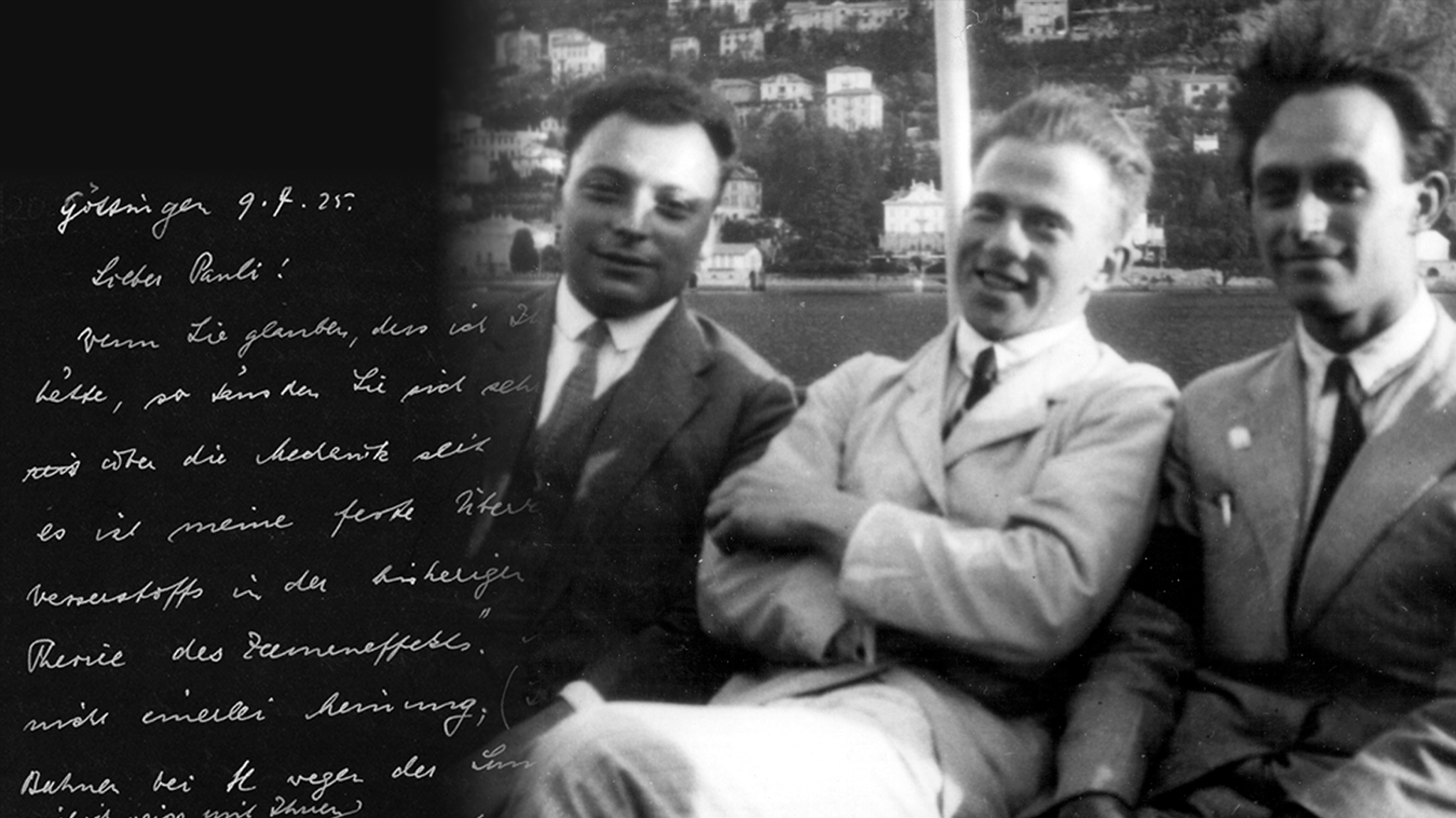
Left: The first lines of the letter sent by Werner Heisenberg to Wolfgang Pauli on 9 July 1925, explaining his efforts to interpret quantum physics differently. (Copyright: Heisenberg Society) Right: Wolfgang Pauli, Werner Heisenberg and Enrico Fermi take a break by Lake Como during the 1927 International Congress of Physicists, where the new quantum mechanics was discussed in depth. (Image: Wolfgang Pauli Archive, CERN) 

I'm a day late, but, via Joe Costello, redeeming himself, July 9, 1925, per CERN, is when Werner Heisenberg officially told Wolfgang Pauli that he was going to get rid of this whole nonsense of "orbits" (that unfortunately is still taught in many places in Merikkka at the elementary level and even beyond).

Note I said quantum mechanics, not quantum theory. That, of course, without him fully realizing what he was doing at the time, and instead postulating to evidence, was 125 years ago, when Max Planck simply couldn't solve black-body problems in terms of classical physics and so proposed the "quantum" as an indivisible, granular unit of energy.

From that, among many other things, arose Niels Bohr's "planetary" model of atoms, with electrons rotating atomic nuclei (neutrons still unknown) in orbits. Despite Bohr being his mentor, Heisenberg vowed to kill this.

CERN quotes from his letter to Pauli:

“All of my pitiful efforts are directed at completely killing off the concept of orbits – which, after all, cannot be observed—and replacing it with something more suitable.”

And, per Pauli's famous bon mot, which has spread far beyond modern physics, Heisenberg was far from being Not.Even.Wrong.

Eventually, his matrix mechanics were shown to be inferior in SOME WAYS to Erwin Schrödinger's wave mechanics.

But, Heisbenberg was still king of the hill, as he showed two years later when, in response to Einstein himself at the famous 1927 Solway conference, he articulated the Uncertainty Principle, which remains the "one ring to bind them all," not just of quantum mechanics, but also of gravity and Einstein's special theory of relativity. 

Einstein's reaction was itself wrong on the reaction, but right on the insight of what Heisenberg meant. 

"God does not play dice with the universe."

There is no god, not even in the sense of him and Spinoza, since physical "laws" are empirically based and Einstein's own rejection of a cosmological constant turned out to be a bad move — based on empirical data. 

And, to the degree this phrase is seen as confirming Einstein as a physical and also a philosophical determinist, he was wrong there — as wrong as little Bobby Sapolsky, whom I just murdered recently. (Figuratively!)

Contra both these? I quote Julius Caesar:

"Alea jacta."

That's the bottom line. 

Einstein was right to see how the principle, as articulated by Heisenberg, meant the universe had a fundamental "graininess," which translated into a fundamental indeterminency. That, in turn was not something in either Special or General Relativity. 

And, speaking of wrong? Schrödinger was wrong about his infamous cat. 

And, Kurt Gödel refuted Einstein even more, along with Alfred Tarski

July 22, 2013

Why Schroedinger was wrong about his cat

Simple statistical mechanics.

He stacks the deck from his Hindu infatuation with his “superposition of eigenstates.”

NOTHING is being “superimposed.” It’s all classical statistical mechanics, from the way I see it.

And, there is no such thing as an “eigenstate” involved.

Let me up the ante on Schrödinger.

Put a cat in a closed box.

Restrain it, because I’m using guillotines, in the plural, rather than poison gas, in the singular.

Give me three radioactive elements with half-lives of X, 2X and 4X.

Give me three guillotines, attached to the cat’s tail, a paw, and its neck respectively.

At X, you have 50 percent chance the cat has lost its tail, 25 percent it has lost its paw and 12.5 percent chance it is dead.

At 2X, probabilities are 75, 50 and 25 percent, respectively.

At 4X, they’re 87.5, 75 and 50 percent.

NO “superposition of eigenstates.” I hope this thought experiment makes the whole idea look ludicrous.

When the lid is lifted of the box, ALL we are doing is checking which of the probabilities is the actuality. Nothing else is being done. The quantum events have happened independently of any observer.

What if a neo-Schrödinger says, lifting the box is itself an observation.

Well, first of all, that’s a “Newtonian” level observation, not a quantum-level one. Unless you try to nano-scale shrink box, cat and guillotines.

Second, I’ll accept the challenge and one-up it.

Give me radioactive element No. 4 with half-life of 8X. It controls a circuit that raises the lid on the box.

OK.

At 8X, we have 93.75 percent chance the cat has no tail, 87.5 that it’s lost a paw, 75 percent that it’s dead, and …

A 50 percent chance that we can see inside the box to determine these probabilities.

Again, all statistical probabilities.

In fact, like the turtles of Schrödinger's beloved Hinduism, it’s statistics all the way down.

Am I arguing there’s nothing “mysterious,” – as long as you append scare quotes – about quantum mechanics? No, of course not. The two-slit experiment with light rays is proof enough of that.

I AM arguing, though, that quantum mechanics is NOT “metaphysically mysterious.” Or anything on those lines.

I am suggesting that Erwin Schrödinger bears a certain amount of the blame for the rise of today’s Deepak Chopras of the world.

And, albeit for different reasons than Einstein, while I don’t believe that some “naïve realism” interpretation of quantum mechanics will win out, should the Holy Grain of a UFT ever be achieved, I do think there will be something more quasi-realistic than the consensus of today.

I think, per Wiki's article on Schrödinger and his damned cat, that the ensemble interpretation of quantum mechanics, while not the ending point, is a good starting point and certainly the best starting point we have right now. It's the one that, I think, does the best job of clearing the decks of mystical and semi-mystical mumbo-jumbo that have accumulated to many interpretations of quantum mechanics like barnacles. It offers the least confusion between physics and philosophy in cases where they define the same concept differently. And, it certainly seems to properly address Occam's Razor. On the probabilities and statistics issues, it squares exactly with what I've said all along. I just didn't realize there was an official theory for my version of understanding QM.

Part of the problem, related to this, is that full-on Copenhagians, or QM schools of thought in their vicinity, at least, seem to like their undiluted shot — or three — of mysticism.

I know that Schrödinger himself was, essentially, trying to "spoof" Copenhagianism. However, because of his own Hindu influences, I think he failed to see how his thought experiment would be co-opted. (That said, somebody else would surely have come up with a similar one.)

Schrödinger reportedly said, decades later, that he wished he had never "met" his cat. Again, interesting that it took him that long to see that.

And, he apparently never explained the "why" behind that. Was it because had lost control of "his" thought experiment?

After writing the original version of this post, I came upon a great book, "The Quantum Story: A History in 40 Moments." From it, I became more convinced than ever that what "collapses" is not any "superposition of eigenstates" but a "superposition" of multiple states of partial or obscured knowledge.

Per Richard Buller and others, I'm also more convinced than ever that things like Schrödinger's Cat show the need that scientists have for philosophers of science.

Or, to quote Stephen Hawking: "When I hear of Schrödinger's cat, I reach for my pistol."

And now, here's a good piece from the Stone, the New York Times' op-ed series about issues philosophical, that covers some of the same ground, about the mystical misuse of quantum mechanics. However, I'd qualify it a bit.
If anybody's to blame, it's Schrödinger and his damned cat, even more than Bohr, let alone Heisenberg, for the mystical misuse of quantum theory and mechanics. Schrödinger with his immersion in Hinduism. That said, as noted above, the cat was ... er, catnip! for the Copenhagians.

Anybody who buys into non-mystical versions of quantum mechanics knows 
Schrödinger's cat's all about probabilities and nothing else. A simple thought experiment, with multiple radioactive substances and guillotines attached to various appendages of the cat, underscores that.
Update, 2026: Let's go further to cut Schrödinger off at the quantum pass. It's not a black box, it is a glass one. And, we have staggered shift workers, so that somebody is seeing inside the glass all the time. No obscured box, and no lid to be lifted.