SocraticGadfly: drought
Showing posts with label drought. Show all posts

December 27, 2022

Colorado River sound and fury, symbolizing nothing, in Las Vegas

Plenty of talk from state-level and lower-level water folks 10 days ago, from all seven member states of the Colorado River Compact, in Las Vegas, but no action.

Upper Basin states still want Lower Basin states to take more of a water haircut. Lower Basin states, like wingnut Aridzona, continue flooding land for alfalfa — for Chinese and Arab owned dairying, among other things, but Aridzona by god will give Xi Jinping himself a fucking hug rather than cut one acre-foot of water, especially if the Californicators in California stand to benefit.

And BuRec? Plenty of hand-wringing:

“I can feel the anxiety and the uncertainty in this room and in the basin,” said Camille Calimlim Touton, commissioner of the Bureau of Reclamation.

But not much else.

This Pro Publica piece makes that clear. That starts with Touton, though "feeling the pain," refusing to comment further about it.

Will she actually do anything by Jan. 31? Or will it be another head fake, like last summer?

She won't do anything because, per her Wiki, she's a political hack. (Congresscritter staffer for years, starting with Harry Reid. Nuff ced.)

And, per the first link, she shot herself in the foot with last summer's head fake:

Some state officials here blame the Biden administration. When it became clear this summer that the federal government wasn’t ready to impose unilateral cuts, the urgency for a deal evaporated, they said.

So, in Vegas, nobody's showing their hole card.

And, much of the low-hanging fruit's already been harvested. As a reader told High Country News editor Jonathan Thompson on his Substack:

Finally, it is true that we in Las Vegas were able to reduce water use while almost doubling our population over 20 years. However, this involved a one-time rebuilding of the entire valley’s wash system to capture and recycle all the water we used to let runoff. Now that it is done, we can’t repeat this feat for the next population increase. It is easy to cut back the first time (when starting with a wasteful system), but is progressively harder as system develops more efficiency 
Sascha Horowitz Las Vegas, Nevada

Very true.

That said, as I've noted before, Thompson himself is as much problem as solution.

Finally, as the Post story notes, there WILL BE a potential "nature bats last" fix for the Lower Basin.

In recent years, the worry of "dead pool" has been more at Lake Powell. Well, if it hits dead pool, and in an unmanaged way, hoe long before Mead hits dead pool?

And, all of this shows how laughable New Mexico neolib environmental journalist John Fleck is.

September 20, 2022

It's still the economy, stupid!

Warmonger Joe Biden may be touting inflation being on hold in July, and will surely soon tout falling gas prices in August.

Not so fast, starting with the fact that the Consumer Price Index went up last month, even if only a small tick, when it was expected to drop.

Last week, in my area, gas prices went back up 30 cents a gallon, first. (That may be related to the Saudis and Mohammad bin Salman telling Warmonger Joe to go fuck himself, with a small CUT in oil production. This NYT story has that and more about MBS et al working with Putin on the latest round of OPEC+ activity.)

Second, inflation is more than gas prices. When the ounce-less-than-a-pint size of Shedd's Spread Country Crock is costing $2.49 and that's not in San Francisco or New York, you know food prices are a problem. Indeed, according to this story, in the past year, margarine has the second-highest price hike, just a tad behind eggs but a lot more than butter in No. 3.

(Sidebar: Feel free to hit the polls at right.)

The why on that particular item?

I'm guessing it's a mix of a couple of things.

One is that sunflower oil may be one of the oils used in Shedd's and other margarines. And, there's this certain country in southeastern Europe that is a major grower of sunflowers and exporter of sunflower products.

If not sunflower oil, corn oil is another constituent of many margarine-type products. Guess what country is a major grower of, and exporter of, corn?

I am not condoning Putin's invasion, and it's possible it still would have happened had NATO barked less, to use Pope Francis' phrase, at Russia. But, by the number and level of sophistication of weaponry Warmonger Joe has agreed to send or has already sent Ukraine, plus his statements on Putin, he is exacerbating the war. And, between Zelenskyy's corruption and both sides breaking the Minsk Agreements, for starters, we shouldn't be exacerbating the war. (And, not to go too much in the direction of Cucker Tarlson and Glenn Greenwald, but doesn't some of this make you wonder about Hunter Biden's laptop?)

Meanwhile, back here in Merika, drought has put a mild damper on the Midwestern harvest, though much less than like it has and did down here in Tex-ass. And, guess where you find soybean oil?

In some margarines, including ... Country Crock.

Meanwhile, Warmonger Joe should probably be glad Thanksgiving Day is after Election Day.

In my column for last week, I wrote about a pending turkey shortage. The local grocery store, which started as a German meat market, has traditionally done "turkey marks" during the fall. It's a punchcard system, where, after you buy enough groceries to get it totally punched up, you're eligible for a discounted whole turkey.

Not doing them this year. Can't get a guaranteed turkey supply.

So, I goggled. And, Minnesota, the nation's No. 1 turkey state, had a spring outbreak of avian flu and is fearing more this fall. Unmentioned was drought making the price of turkey feed cost more than chicken scratch. I'm sure it is. Per that story about the five biggest food hikes? Spiraling feed costs is what has driven up the price of eggs. That means, I would think, that if you do get a turkey, it's going to cost more in two ways, or else producers just aren't going to fatten them up as much.

Meanwhile, the problems behind the averted for now potential railroad strike show that high gas prices and Chinese lockdowns of port cities aren't the only things affecting product delivery and thus leading to inflation. And, if Amtrak Joe's fig-leaf settlement isn't accepted by railway workers, getting tubs of Country Crock or frozen Butterballs to your grocer will be even harder.

August 24, 2022

Texas Progressives talk election harassment, puberty blockers

Off the Kuff comments on the resignations of Gillespie County's elections staff and the shameful silence of the Republicans whose words and deeds are the root cause of the problem. 

SocraticGadfly talks about the FDA's decision last month to put "black box" warnings on puberty blockers and the sad lack of overall media coverage.

Slim Pickens is not just a rodeo rider, stuntman and iconic actor. Per Texas Monthly, it's also the first Black-owned outdoors retail store. But, it's more than a retailer. Owner Jamaicah Dawes strives to diversify those experiencing the outdoors. At the same time, his dreams are still surrounded by struggles. It's a long read but interesting.

Hemp is the future. The Monthly has another "just around the corner" story, like nuclear fusion power and "strong" artificial intelligence. Call me back when Texas changes its cannabis laws and other things.

Wingnuts in the Lege posture macho, but are scaredy-cats when asked to define details of what it means for a woman's life to be in danger under anti-abortion law.

It's also "nice" that the Lege isn't even bothering to phone it in on its contempt for church-state separation ideas of the First Amendment.

Congresscritter Vicente Gonzales and his wife, tax chiselers, or just SEVEN years of bad memory? You know, by where the hyperlink is, where I stand.

Last week, the SA Express-Snooze profiled people leaving Tex-ass. Now, the Trib looks specifically at Black Texans thinking about a Texodus.

The Trib also profiles Gohmert Pyle, aka Louie Gohmert, starting with him passing just one law in his 17 years as a Congresscritter.

Mexico and Texas have fought about water issues for years. Now, with drought on the south side of the Rio Grande as well as north, that's intensified. In reality, like with the Valley of the Sun in Aridzona, people need to move out — or BE MOVED OUT — of the Rio Grande Valley.

Paul Burka, long-time editor of the Monthly, has died at 80. Mimi Swartz and other past colleagues reminisce .

Good ConservaDem Kuff ignores the fossil fuel handouts of the Inflation Reduction Act.

Sean Pendergast grades Deshaun Watson's "apology".  

Space City Weather provides another update on the tropics. 

The TSTA Blog is not impressed by Chuck Norris as an answer to school shootings.  

Mean Green Cougar Red ponders why commercial aircraft don't have parachutes.

July 25, 2022

Aridzona still refuses to face water reality


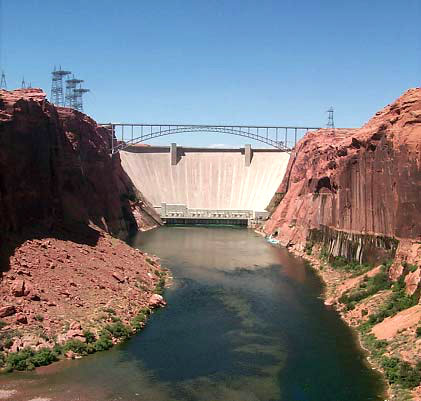
A year ago, I blogged about the first water cuts the Bureau of Reclamation announced for the Lower Colorado River states of Arizona, Nevada and California — and on this first round, mainly Aridzona, somewhat Nevada and not really California. Above, a drying Lake Powell, surrounded by summer-angry redrock, sits behind Glen Canyon Dam. That was about a decade ago, and the "bathtub ring" both there and at Lake Mead behind Hoover Dam have only gotten worse since then.

At that time, the feds announced that Lake Mead had fallen below the level to trigger the first round of water usage cuts next year. Within the three Lower Basin states (Google, and/or click the Wiki link, if you don't understand the Colorado River Compact), for a variety of reasons, the cuts hit Aridzona much more than Nevada. They don't hit California at all, though the next round, if triggered, will hit all three states. 

Meanwhile? Early predictions for US winter weather said that drought would remain and that the lower half of the West will also have dry weather, and these have panned out. Those 2023 cuts WILL happen. BuRec all but said so last month. I blogged about that here.

(Update: BuRec has indeed now dropped what I called a "semi-hammer." But, it's not a full hammer, or even that close. The question is, here, should it have been a full hammer? Will Aridzona continue to be scofflaws, so to speak? Will not dropping a full hammer make their intransigence even worse as the clock ticks to the 2026 expiration of the Compact?)

The first cuts looked to hit ag first.

But, what about urban water? The Aridzona Lege, several years ago, required new residential developments to prove they had a 100-year sustainable water supply. But, the language is loophole-ridden and is as much Jell-O as the Paris climate accords (which were similarly deliberately made so by Dear Leader and Xi Jinping). But, what about water banking? Well, Nevada (I think) is claiming that it's OK in part due to water banking. But, what if, in reality, such an account is already overdrawn? This is not like the federal government budget deficit, where you ignore it, or print more simollians if you have to. There is no more water to "print."

In addition, as of a couple of years ago, at least, it seems Aridzona did not have any withdrawal structure for water banked from the CAP. Since some of that water was banked for the state of Nevada? Erm, see above! In addition, per this piece, water banking was started for two reasons: one, as is true with most things Aridzona and water, as a reaction to those damned water-greedy Californians. Second, it was foisted as an idea for interstate water-banking and resale, as in, "we'll give those water-greedy Californians water if they pay us enough." But, it's hard to do that one, too, if you don't have a good mechanism for withdrawing water from the bank. See above! (The Wiki link also has thumbnail information on Aridzona's history of water animosity toward California.)
 
Robert Glennon, the University of Arizona prof who wrote the Conversation piece, agrees with me that cities and developers likely aren't yet going to smell the coffee.

More proof? This piece from the New Yorker, about Rio Verde Foothills, which bills itself as "North Scottsdale." It's sad and disgusting and schadenfreude all three.

  • People drilling 1,000-foot water wells — and hitting dry holes.
  • Others, who have been getting water delivered to underground cisterns, getting cut off. The city of Phoenix cut off deliveries to New River in 2018. And Scottsdale is cutting off Rio Verde Foothills next year.
  • Meanwhile, MOAR HOUSES are being built. One loophole in that 100-year requirement? Applies to developments of five or more houses. So, developers submit four-house systems, get them approved by county commission, and do the same two weeks later, lather, rinse, repeat.
  • Some homeowners want to start a Domestic Water Improvement District. To others? That's GUMMINT! Might TAX US! So, they want to have an upgraded agreement with a private water hauler. One problem? Only a water district, not a private hauler, can buy "second tier" water.
  • Meanwhile, MOAR HOUSES are being built. 
 
Per Ed Abbey's "growth for growth sake is the theology of the cancer cell"? On the other side of Phoenix, Maricopa, now an exurb of upper-middle-class white flight (Pinal County was about 55-45 Dem in the late 1990s, now 55-45 Republican) is 70,000 and mushrooming. Didn't even exist 20 years ago. 
 
==
 
For an excellent in-depth look at the long-term problem and possible "solutions" (which will NOT revert us back to pre-2000 status), and which take into account the full Law of the River, see this Science mag study. (Hell will freeze over or Ed Abbey will rise from the dead before that much in the way of cuts happens without heavy federal intervention, likely coupled with massive state-vs-state lawsuits, launched by the Aridzona whose obstructiveness put it behind the Colorado River 8-ball decades ago in the first place.)

May 16, 2015

Water, California, Jerry Brown and courts

First, California Gov. Jerry Brown is about as liberal as Hillary Clinton.

Second, it's clear that come hell or high water (climatologically, the functional metaphorical equivalent of the former is MUCH more likely than even a literal installment of the latter on a regular basis), Jerry Brown wants a chunk of his daddy's legacy by getting what he surely thinks should be called the Edmund G. Brown Jr. Peripheral Delta Canal pushed through. That's even as it looks about as environmentally unfriendly as any other California big water project.

As for the intensifying drought that's negating the likelihood of that high water?

His state's own Supreme Court, shortly after his first go-round as governor ended, said that water use fell under the public use doctrine and courts could control it in emergencies.

I agree: it's time to bring a court case, because we know Jerry Brown never will.

March 21, 2015

Get rid of those damned dams — and BuRec!

Glen Canyon Dam/Wikipedia photo
Daniel Beard, a former chief of BuRec (that's the U.S. Bureau of Reclamation to you non-Westerners) talks about "deadbeat dams" and other ideas for dealing with Western drought in an interview with High Country News.

The interview is based on his new book of that same name, "Deadbeat Dams," which just came out last month and which sounds like a must read.

Beard is not playing around.

He wants to get rid of the Bureau of Reclamation, and as far as all the "deadbeat dams" costing us money, misuse of precious Western water and more, replace it with a dam decommissioning commission similar to the military base closure commission, so as to remove removal of dams from politics and Congress.

The biggest, beyond the "deadbeat" dams, is selling, or rather, "selling" water at subsidized rates, just pennies on the dollar.

The Western farmer is possibly America's biggest socialist, followed by the American rancher and his below-market grazing fees. Next on the list is the Western politician who decries socialism while protecting this.

Example Numero Uno? Modern conservative legend Barry Goldwater.

He repeatedly called for abolishing the Tennessee Valley Authority in 1964. But, was there ever a peep from him about abolishing the Bureau of Reclamation? About not building Glen Canyon Dam?

Absolutely not.

Just like his pale successor, Schmuck Talk Expresser John McCain, Barry Goldwater was a Grade A hypocrite on such issues who got a pass at the time from conservatives and later from the national press.

Beyond that, as drought looks to intensify another year in the West, as some states clamp down on groundwater pumping because of that and more, like a possible 30-year drought cycle in the southern Plains/Southwest, or a 200-year cycle in California, our broken water system, like our broken hydrocarbon use system, needs to be acknowledged as broken.

And, the Archdruid of Reclamation, Floyd Dominy, would be turning over in his grave if he could. John McPhee, who wrote a book partially about him as among his many Western and naturalism books, is still alive ... maybe kicking enough to do a follow-up of sorts. Sadly, Marc Reisner is not alive to update "Cadillac Desert."

June 29, 2014

Dear Texans: Don't count your chickens yet on El Niño (updated)


There continues to be more hints that an El Niño system may be in the process of developing in the Pacific. Such systems normally bring more rain to Texas, and definitely more rain to the Southwest.

But, as of now, it's pretty clear that any such El Niño won't come until after the end of summer.

(Update, June 17: John Nielsen-Gammon, the Texas state climatologist, agrees with my header:
In early May, NASA predicted a very strong El Niño, Nielsen-Gammon said. NASA based the prediction on satellite images showing patterns of temperature and ocean height that were similar to those of May 1997, a year of one of the strongest El Niño oscillations of the 20th century.

“But the recent computer model forecasts are not so enthusiastic,” Nielsen-Gammon said. “More likely, we’ll end up with a weak to moderately strong El Niño.”

This means much of Texas could still have a wetter than normal late fall and winter, just not as wet as it might be with a very strong El Niño, he said.
More here on other climatologists agreeing with Nielsen-Gammon; the expected El Niño looks like it's dying out. Back to your regular climate programming.)

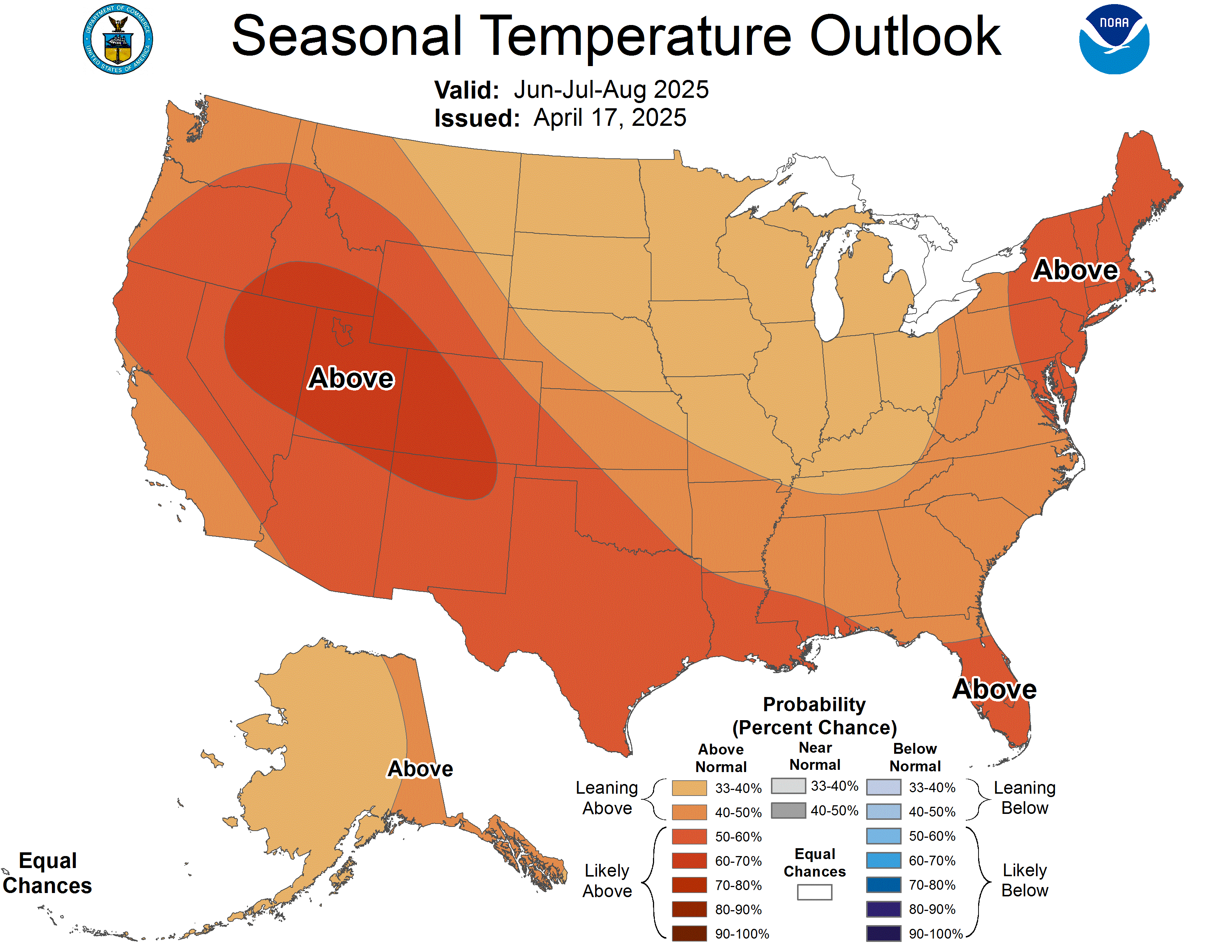
First, note the temperature map for July-September. It ain't gonna be a cool summer, is it?

In fact, that 40 percent chance of above normal temperatures covers the whole state in June, and the eastern two-thirds in October, as well.

So, again, no temperature relief until fall.

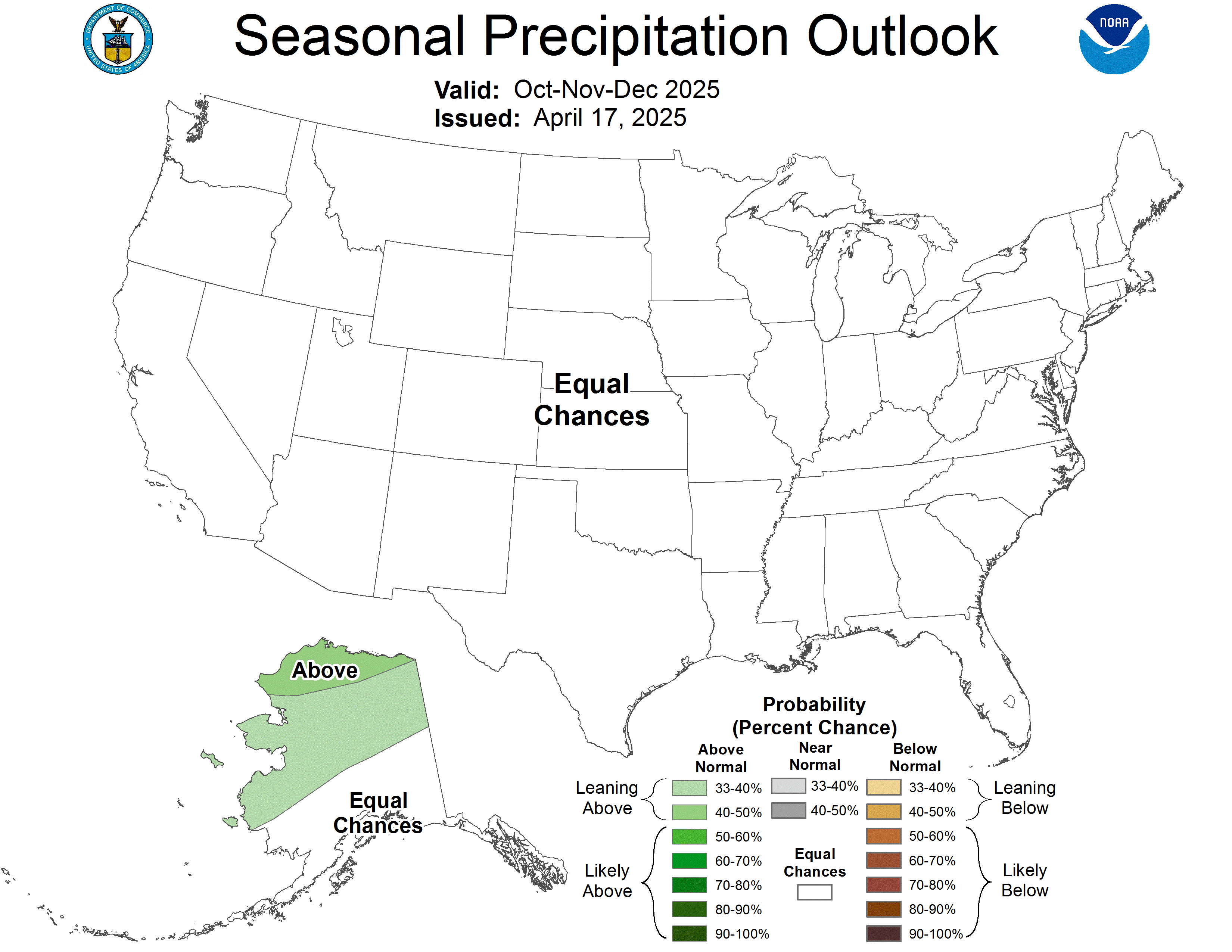
Precipitation?


No significant part of Texas moves into the 40 percent change of above normal precip until November, per the map at left.

And, that's about as good as it gets. Chances of above average rain and below average temperature disappear by early spring.

And, not just Texans should be cautioned.

That precipitation map is also about as good as it gets for California.

Now, that's several months out. Nonetheless, don't expect the next El Niño to be a major game-changer.

That's you, global warming denialists in Texas, I'm talking to above all.

March 31, 2014

Adaptation not necessarily bright spot in #IPCC latest #climatechange report

We're going to need all the work we can get on adaptation to changes in our planet due to climate change, whether they're higher tides, more acidified oceans, changing ocean currents, desertification or whatever.

But, just from that incomplete laundry list, the New York Times, with its claim that there's a bright spot in the latest report on climate change issues from the UN's Intergovernmental Panel on Climate Change should be treated with a skeptical eye. And, I'm not even counting the non-adapting stance of the four types of climate change deniers, most common in the US, but not invisible elsewhere. Given that the BBC reports that some of the IPCC's own scientists consider some of the report to be "alarmist," the idea that short-sighted, short-terming national governments would actually take full account of what climate change will cause, and take full account of adaption and mitigation efforts and costs, is pretty laughable.

If we said, "there's a less dark spot," that might be more true. I'm no James Kunstler, building a backyard bunker that's strategically resistant to 130-degree temperatures and Bay of Fundy tides. But, "adaption" and "mitigation" ain't cheap. Although the cost of ignoring it could be.

The Times' own piece says that:
The poorest people in the world, who have had virtually nothing to do with causing global warming, will be high on the list of victims as climatic disruptions intensify, the report said. It cited a World Bank estimate that poor countries need as much as $100 billion a year to try to offset the effects of climate change; they are now getting, at best, a few billion dollars a year in such aid from rich countries.

The $100 billion figure, though included in the 2,500-page main report, was removed from a 48-page executive summary to be read by the world’s top political leaders. It was among the most significant changes made as the summary underwent final review during an editing session of several days in Yokohama.
And, that's just "poor countries." The developed world may be more resilient, or it may not. And it certainly has a lot of pricey infrastructure in coastal areas that developing countries don't.

Related to that is the "why" of these edits:
The edit came after several rich countries, including the United States, raised questions about the language, according to several people who were in the room at the time but did not wish to be identified because the negotiations were private.
Again, NYT, your idea that there's some "bright spot" is undercut by your own reporting.

But, given the structure of the US government, especially the states' equal representation in the Senate, there's slim hope that just maybe, the likely ongoing drought in Plains states might finally wake up Senatorial eyeballs. And, today's drought will be tomorrow's normal, on agriculture in that area.

On the other hand, who am I kidding? I live in a state that, whether in reality or in snark, John Cornyn parrots everything Ted Cruz says.

March 18, 2014

The future of water, and drought, in Texas

As rice farmers on the lower Colorado of Texas know, even if the drought situation is worse in West Texas, its effects continue to be felt in East Texas.

And, it's not just water itself, it's who's got the rights to what water is still available, as this in-depth NYT piece points out. As it notes, and is problematic in all parts of the state, beyond senior vs. junior rights on surface water, unlimited groundwater pumping is an even bigger issue. Indeed for all of Texas' bitching about New Mexico's sometime failures to deliver enough downstream water from the Pecos and Rio Grande, Texans on the Llano Estacado, with their unlimited pumping of the Ogallala Aquifer, which should be covered by the Interstate Streams Commission but isn't, have their own water-hogging faults.

We're going to have more wrangling over water in the future, especially as water threatens endangered species, or threatens currently legally "threatened" species with being bumped  up to officially being "endangered," unless they get more water.

We can have a shiny new water development loan fund, loopholes and all, but until groundwater districts actually get more power to regulate groundwater, whether with rural ranchers or Greg Abbott drilling wells in his Austin backyard, we're playing Sisyphus with Jack and Jill water buckets.

Meanwhile, scientists are trying to figure out how to get the word out better.

August 27, 2013

Old man drought keeps on rolling?

Unfortunately, in addition to being denialists of global warming and climate change, the folks at Texas Farm Bureau seem to think The Old Farmer's Almanac is the be-all and end-all of long-term weather forecasts. Unfortunately, they're not alone; the folks at Nice Polite Republicans repeat the claim that it's going to be generally cooler and wetter than normal this winter, not just in Texas but across most the nation.

Sadly, the National Weather Service strongly disagrees with the idea Texas will have a cool, wet winter. And, contra NPR with the Almanac, I don't "believe" what's a legitimate scientific forecasting model; I "accept" it within the bounds of probability the NWS stipulates.

That said, for the three months of winter, on average, December-February, the NWS predicts almost all the nation is likely to see above average temperatures, and a fair chunk of it, including about all of Texas and most the south central and Southwest, is very likely to see above average temps. On precipitation, most the nation is likely to see average.

That's exactly what winter Texas had this year. And, above average temps, even in winter, here in Texas, mean more evaporation.

Before that, northeast Texas has a slight to moderate chance of above-average precipitation in mid-fall, but the whole state's supposed to continue to have above-average temperatures.

And, looking beyond winter, models for early spring predict a hot one, not just an above-normal one, for much of the Southwest.

In short, don't expect any drought relief.

At the same time, don't expect any climate denial relief from the usual suspects, either.

Beyond that, the NWS' research, paid by your and my tax dollars, is free. As well as better.


July 30, 2012

Get used to this summer? A century of drought?

Per LiveScience.com, that's the gist of a new study.

I hope not, but it seems plausible. Between additional warming releasing carbon dioxide and methane from Arctic tundra, and drought right now killing off plants, especially in lower middle latitudes, feedback loops could exacerbate droughts in areas already starting to have them.

And, the many, many damned lakes in those areas will evaporate and shrink rapidly, between lessened rainfall and higher heat. Especially the shallower lakes.

Basically, anywhere in the U.S. west of the 96th meridian and south of the 41st parallel or so (that's the rough coordinates for Lincoln, Neb. is certainly got some likelihood of longer-term "iffiness" on good farming and ranching climate. Anywhere west of about the 98th merdian and south of the 39th parallel (Ellsworth, Kan.) is very likely to face "iffinessness" and somewhat likely to face at least semiregular drought, I'll venture.

And anybody west of the 100th meridian and south of the 37th parallel (Meade, Kan., just south of Dodge City) is more than likely to be facing drought, if this is all true.

The first point is in the heart of America's corn belt. The second is in the heart of the wheat belt. The third is in the heart of America's irrigated farming (on the Plains) belt and the cattle belt.

Food for thought, pun intended.

That not to mention water supplies for 6.5 million people in metropolitan Dallas-Fort Worth, 1 million in metro Austin, 2 million in metro San Antonio, etc.

July 20, 2012

#Drought — Obama should call red states out on climate change

He's got leverage in this huge drought, which has led the federal government to declare one-third of the nation's counties disaster areas and therefore eligible for relief of some sort.

We've already gotten statistical research indicating global warming made last year's Texas drought more likely, and we're learning more and more about details of climatic tipping points.

Add in that much of the area affected by drought is at least "reddish" in American political terms, and President Barack Obama has his opportunity.

No big federal disaster relief for all these counties until red-state Congressmen and Senators get real about global warming.

Of course, even if this weren't an election year, Dear Leader wouldn't do that. But, he should.

Because, as Bill McKibben has noted in his hard-hitting new piece in Rolling Stone, the clock is REALLY ticking. The 2-degree Celsius change that climate scientists were hoping to avoid? Sorry, that's already cooked in the bag. Even 3C probably is. The worry now is that we might have a 5-6 degree change, or 10 degrees Fahrenheit, by the end of the century.

That said, McKibben notes that, especially since the midterm elections, Dear Leader has been more of the problem than the solution.

This would be a golden opportunity for a truly liberal president to have some cojones, and do the political equivalent of a Thomas Kuhn scientific paradigm change. There's so much to fight — fossil fuels, A/C electric use feedback from the heat, and more.

And, it's not being fought.

Meanwhile, can "nudges" work to change people's thinking, and inertia? Possibly, argues one columnist, though we should note this only applies to people with some inertia on the issue, not denialists.

David Leonhardt, meanwhile, says we should be optimistic about not just the U.S., but the world, adequately addressing these issues. I often agree with his columns, but, to be honest, I think he's smoking something this time.

The amount of electric power to get us using more full electric vehicles, or at least plug-in hybrids, is going to be massive. Even more so for China and India as more people want cars. And, while that cuts down on oil drilling, it increases mining for materials for the batteries.

More thoughts of mine on red-state farmers, drought and global warming here.

July 05, 2012

Drought, farmers, red states and global warming


Stunted corn in Indiana/NY Times photo
So, how many of the Midwest’s reddish-state corn farmers are willing to admit that any of their problems this year, if not “caused” by global warming, might at least be exacerbated by it, or linked to it?

Ditto on the very red state farmers of the Texas (and Oklahoma) Panhandle, who last year lowered the Ogallala Aquifer as much as 25 feet?

Slim, I’ll bet, though perhaps not the “none” of senators like John Cornyn, Tom Coburn and Jim Inhofe.

And yet, later this year, these senators,  and these farmers, who bemoan the big federal government, and who bemoan “welfare,” will be seeking federal disaster relief. And, while still refusing to admit that they’re part of the problem, a self-inflicted disaster. (A disaster that, to some degree, now officially covers more than half the 48 continguous states.)

For the farmers of the Panhandle, first, I have two words: “dryland farming.”

Yes, dryland wheat doesn’t pay the same as irrigated corn, especially when corn in the Midwest (St. Louis pushed 105 today) is shriveling.

But, it’s still a big water, and water bill, savings.

Not to mention that eventually, you’re going to start pumping sand … and who knows, even as clean as the Ogallala is, minerals, too.

Meanwhile, things won’t change, in reality, even if Dear Leader is re-elected and even gets a Democratic House.

There won’t be a cap-and-trade bill, which we don’t need anyway. Chris Mooney, the science writer who almost plays at being a scientist, is behind the curve.

There certainly won’t be a carbon tax bill.

And, really, that’s exactly what we need, and it needs to be coupled the with big drought disaster relief handout. Period.

Of course, there’s no way Dear Leader does that.

But he, or somebody, needs to, and needs to get in front of red state Congresscritters on framing the bill, and on “attaching” it to a bailout.

September 08, 2011

#RickPerry'sTexasMiracle: Criminal prayer #fail

Most Texans have already seen this news, I know. But, if you haven't, the Lone Star State turned in the hottest three-month period ever of any state in the nation.


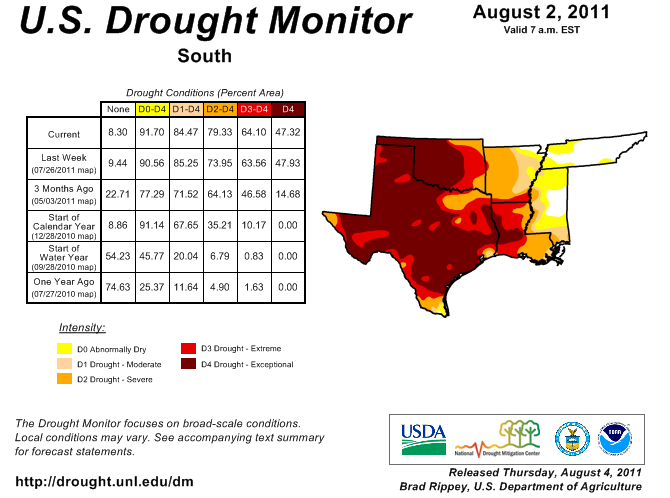
But, it's not just the heat. Let's look at the latest issue of the state's drought monitor map:


Just about all the state is in the worst category of drought. All of the state has at least some level of drought.

And, we're at almost five months and counting since Rick Perry's three-day call for rain.

"Science will not be mocked," to riff on an old biblical statement. And, the combination of La Niña and human-caused climate change both have plenty of scientific documentation.

"Finances will not be mocked" either. Cutting the Texas Forest Service budget was foolish at least, hypocritical at most, especially as Tricky Ricky and his GOP wingmen wingnuts in the Texas Lege now are dependent on a federal firefighting bailout.

As you can see, more than 80 percent of the state is in the worst state of drought. With La Niña expected back (did "she" ever leave?) shortly, that budget-cutting by Perry and gang will turn out to be not just foolish, not just hypocritical, but criminal. And, the refusal of these folks to fix the franchise tax, the refusal that guarantees Texas' budget will continue to implode, is also now approaching criminal.

People have already died in the Bastrop area. There's no guarantee that a better-funded Texas Forest Service could have prevented that, but it's possible.

It will go into full-blown criminal if Perry refuses to come home from presidential debates and call a special session of the Legislature to address this. Let's see the arson commission investigate that.

September 01, 2011

Texas - how hot is it?

How hot has it been in Texas? Go to this chart and look at all the "first" rankings Texas cities have for most consecutive and most total 100-degree days this year.

And, that heat explains this drought:


The latest AP story on Texas' drought is out, and, as the graphic shows, it's even uglier than ever.

That graphic isn't ugly enough? Try this one, which shows how the current drought compares to past ones:


That said, rain over the last 12 months is its lowest ever. But, this is still, at this point, "just" a one-year drought, as the story just linked notes. But, hopes for potential Hurricane Lee aside, La Nina is expected back later this year and into next. And, that spells more trouble. Without serious rain soon, fall planting of Texas and Oklahoma winter wheat will simply have to be put on hold, intensifying the agricultural fallout. (Besides that, that storm is just an "invest," not even a tropical storm yet, and the heat dome looks like it will block it from every entering Texas.)

And, this just in. Both Texas and Oklahoma have set all-time records for hottest June-August periods. And, Texas has set both 10- and 12-month records for driest periods ever.

August 06, 2011

#RickPerry: Where's the rain "Response"?

It's been almost four full months since Texas Gov. Rick Perry issued an official governor's proclamation that April 22-24 were Days of Prayer for Rain in the State of Texas.

Well, Gov. Helmethair, didn't work.

Perry had "The Response" going on today, but, somehow, decided not to talk about how the drought has only gotten worse - much worse, even - in the nearly four months since his call to prayer.


You know, the drought that's now the worst one-year drought in state history. The drought that may get even worse next year. The drought that's likely exacerbated by the global warming you both deny and you abet with lax pollution standards and enforcement.

I suggested a couple of weeks ago he take a page from Elijah's confrontation with the prophets of Baal, only playing their role, not Elijah's:
1 Kings 18:21-38
New International Version (NIV)
21 Elijah went before the people and said, “How long will you waver between two opinions? If the LORD is God, follow him; but if Baal is God, follow him.”

But the people said nothing.

22 Then Elijah said to them, “I am the only one of the LORD’s prophets left, but Baal has four hundred and fifty prophets. 23 Get two bulls for us. Let Baal’s prophets choose one for themselves, and let them cut it into pieces and put it on the wood but not set fire to it. I will prepare the other bull and put it on the wood but not set fire to it. 24 Then you call on the name of your god, and I will call on the name of the LORD. The god who answers by fire—he is God.”

Then all the people said, “What you say is good.”

25 Elijah said to the prophets of Baal, “Choose one of the bulls and prepare it first, since there are so many of you. Call on the name of your god, but do not light the fire.” 26 So they took the bull given them and prepared it.

Then they called on the name of Baal from morning till noon. “Baal, answer us!” they shouted. But there was no response; no one answered. And they danced around the altar they had made.

27 At noon Elijah began to taunt them. “Shout louder!” he said. “Surely he is a god! Perhaps he is deep in thought, or busy, or traveling. Maybe he is sleeping and must be awakened.” 28 So they shouted louder and slashed themselves with swords and spears, as was their custom, until their blood flowed. 29 Midday passed, and they continued their frantic prophesying until the time for the evening sacrifice. But there was no response, no one answered, no one paid attention.

30 Then Elijah said to all the people, “Come here to me.” They came to him, and he repaired the altar of the LORD, which had been torn down. 31 Elijah took twelve stones, one for each of the tribes descended from Jacob, to whom the word of the LORD had come, saying, “Your name shall be Israel.” 32 With the stones he built an altar in the name of the LORD, and he dug a trench around it large enough to hold two seahs[a] of seed. 33 He arranged the wood, cut the bull into pieces and laid it on the wood. Then he said to them, “Fill four large jars with water and pour it on the offering and on the wood.”

34 “Do it again,” he said, and they did it again.

“Do it a third time,” he ordered, and they did it the third time. 35 The water ran down around the altar and even filled the trench.

36 At the time of sacrifice, the prophet Elijah stepped forward and prayed: “LORD, the God of Abraham, Isaac and Israel, let it be known today that you are God in Israel and that I am your servant and have done all these things at your command. 37 Answer me, LORD, answer me, so these people will know that you, LORD, are God, and that you are turning their hearts back again.”

38 Then the fire of the LORD fell and burned up the sacrifice, the wood, the stones and the soil, and also licked up the water in the trench.
Rick, you should have started cutting yourself with a knife in Reliant Stadium and see if you can get us some rain! Or, to modernize, start shooting yourself in the toes, one by one, with your coyote-killer sidearm.

April 30, 2011

Rick Perry: West Texas is still waiting for rain

Yes, rain showers might have slowed the Possum Kingdom Lake fire. But, the even bigger fires in West Texas' Davis Mountains continue to burn, despite Texas Gov. Rick Perry's call for three days of prayer and attempts to defend him.

January 26, 2009

Get ready for more food sticker shock

Ongoing drought in California's Central Valley and elsewhere means lettuce, almonds and melons are among produce itself set to start a price climb. Federally-ordered, environmentally-driven, cutbacks of water going south from California's Sacramento Delta, are adding to the problem, while federal reservoirs in the area are at their lowest in nearly 20 years.

And, early weather forecasts call for a dry spring.

June 11, 2008

On the coffee table – ‘The Great Warming,’ by Brian Fagan

In “The Great Warming: Climate Change and the Rise and Fall of Civilizations,” Brian Fagan does an excellent job, with the knowledge we have today, of illustrating what lights paleoclimatology may be able to shine on today’s global warming, with sufficient warnings for the humans that are causing it.

Specifically, the flight to the Sunbelt, especially the Desert Southwest, with its low-density sprawl and little mass transit, on the one hand, and demand for air conditioning, on the other, continuing to fuel anthropogenic global warming, Fagan would be excused if he didn’t serve up a whole plateful of Schadenfreude crow for the largely conservative denizens of this part of the U.S. to digest.

He didn’t, but he could. Why?

Based on paleoclimatology, it appears likely that this part of the country will experience the same long-term drought that wracked the Anasazi at Chaco Canyon, then later at Mesa Verde. Of course, the nearly 20 million of Southern California’s Southland, the almost 5 million of the blot called Phoenix and the moving toward 1.5 million inexplicably in the Las Vegas area are a lot more thirsty for water than the Anasazi were.

But, move beyond the U.S. to sub-Saharan Africa … (see my complete review as part of my Amazon book reviews for more.)

May 16, 2007

Why Arizona is going to dry up and blow away

Even outside the desert parts of the state, water is getting scarcer and scarcer.

Take Prescott, where my sister lives. In 40 years, its greater area could be 540,000, compared to about 100,000 today. Yet already today, people in the area on individual wells are having to have them redrilled as much as 300 feet deeper at a cost of as much as $12,000.

And, Arizona apparently doesn’t have a state engineer or other “water czar,” at least not one with a lot of power, unlike most western states. The fact that a lot of diversion ditches off the Verde River have no state regulation shows that. And, as I detail beneath a few quotes from the High Country News story, that river is about to be sucked dry, if the city of Prescott and some “growth for growth’s sake” wingnuts have their way.

Here’s how bad the current water situation is:
In the Prescott area, water levels have dropped at least half a foot each year going all the way back to 1982, and more quickly since 1994 — anywhere from 1.5 to 4 feet a year. Today, the area is pumping its groundwater supplies almost twice as fast as they’re being replenished.

Throw in global warming and drought, and the Prescott area is ripe to blow away well before it gets to 540,000 people.

And that’s even with the efforts of wingnuts like former state legislator and current county supervisor (commissioner) Carol Springer, who could definitely stand a few Ed Abbey quotes, specifically about “growth for growth’s sake being the theology of the cancer cell.”
But in 1992, she pushed a bill through the Legislature authorizing the Prescott pipeline, which now stands to cost sponsoring cities $192 million — not counting interest. Her bill authorized Prescott to tap water from the Big Chino sub-basin, which lies north of the Little Chino sub-basin where the city has historically sunk its wells. Twelve years later, Prescott paid $23 million to buy a ranch in the Big Chino to obtain its water rights.

Springer’s bill created the only exception anywhere in Arizona to a previously approved ban on inter-basin water transfers — a law aimed at preventing one region from stripping another of its water resources, Chinatown-style. Her explanation for the need for the transfer is that a community must “grow or die.”

“If we can’t grow at all in the future, because we lose our right to pump groundwater, we will cease to exist,” Springer said. “There is no such thing as a static kind of a situation in terms of a community. You can’t not grow at all and survive. We have to have some element of growth.”

The Big Chino transfer bill wasn’t Springer’s only political effort relating to water supplies in the Verde Basin. Just last year, she chaired the group behind a successful statewide “takings” initiative that requires compensation of any landowner who can prove a new regulation reduces his property value. Some say the initiative could make it harder for the state to regulate development in rural areas with inadequate water supplies.

Unfortunately, she’ll likely be dead long before the catastrophic shit of her actions hits the fan.

The biggest crapola? Prescott’s plan to drill new wells into the Big Chino Basin, estimated to be 86 percent of the water source of the upper Verde River. The Verde flows south through central Arizona, basically from along the western edge of the Mogollon Rim down to mid-altitude desert before hitting the Salt River. Still undammed, it’s home to a great variety of birds and other wildlife, including bald eagles.

And, because it eventually flows into the Salt River Project, administrators of that project, and the Phoenix economic interests behind them, are also concerned. (Of course, there’s probably already too damned many people in Phoenix, but that’s another story.) Since about 40 percent of the SRP’s water comes from the Verde, this is a high-stakes issue. Of course, the SRP isn’t much more forward-thinking than the Prescott folks a lot of times, anyway.

Note: This post has been corrected to reflect that the 86 percent stat is for the upper Verde only. Also, the blogger's sister lives in Prescott; he knows first-hand about some of the issues.