SocraticGadfly: 10/26/25 - 11/2/25

October 31, 2025

There are no magic silver bullets on agriculture and climate change

Unfortunately, of two recent reads, one gets that right, but then gets one issue wrong and others partially wrong, while the other, allegedly informed by the "protagonist" in the first book, isn't informed enough.

I'm going to mash together versions of both Goodreads reviews with additional comment, the second being shortened.

We Are Eating the Earth: The Race to Fix Our Food System and Save Our Climate

We Are Eating the Earth: The Race to Fix Our Food System and Save Our Climate by Michael Grunwald
My rating: 4 of 5 stars

Low-till and no-till will save us, right? Wrong.

A raft of new plants, like Kernza, a perennial-plant riff on wheat, will save us, right? Mostly wrong.

Veggie burgers will save us, right? Wrong as currently entailed, though with some missing information.

Lab meat will save us, right? Wrong totally, but also with some missing information.

GMOs could save us, right? He doesn’t get explicit, but seems to have “yes with caveats” as his answer. I offer a bigger yes with more caveats.

And, he has one good point at the end — we should bring back individual shaming, as well as stop looking for magical silver bullets. You bought the SUV. YOU bought the 1/3 pound hamburger.

Grunwald uses Timothy Searchinger as, well, the nonfiction equivalent of a protagonist for much of this book, though he also has other skeptics of the silver bullets above as well. (This is the muse cited by "Sea of Grass," below, for helping straighten them out on biofuels, though apparently they didn't read closely enough.) Overall, the book is somewhere between good and very good. I hit on 3.75 stars rounded up, because most of the 3-starrers wrongly in my opinion thought it too long, and it needed to be this detailed.

He does a generally good job, but not perfect, especially later in the book.

No spoiler alerts on what he gets right, above. So, we'll tackle what's less than fully correct.

Grunwald ignores that Impossible Burger actually has as much saturated fat, and more sodium, than conventional food. Fake cheese, at least mainline commercial varieties, do have less saturated fat than the real deal, but do have more sodium, as I have discussed in some depth. It's also pretty highly processed.

Also, Grunwald got "golden rice" wrong. Wrong. Its problem was not the "mean greenies" opposing it as much as, even after it cleared that hurdle, for basically another decade, it had lower yields than conventional rice.

Heralded on the cover of Time magazine in 2000 as a genetically modified (GMO) crop with the potential to save millions of lives in the Third World, Golden Rice is still years away from field introduction and even then, may fall short of lofty health benefits still cited regularly by GMO advocates, suggests a new study from Washington University in St. Louis.  
Golden Rice is still not ready for the market, but we find little support for the common claim that environmental activists are responsible for stalling its introduction. GMO opponents have not been the problem,” said lead author Glenn Stone, professor of anthropology and environmental studies in Arts & Sciences.
I told you more than a decade, did I not? Stone goes on to explicitly refute the idea that "mean greenies" inhibited golden rice's adoption. And, he has supported GMO crops in general.

On this issue, Grunwald comes close to believing, by non-condemnation, in GMOs as a silver bullet. 

On lab meat? He doesn’t delve enough into the energy inputs it will need to scale up, let alone the need for computer chipmaking type clean room sterility. Grunwald should have, if he didn’t want to voice it himself, gotten a true skeptic for more comment on this. Indeed, he should have looked at the energy inputs for scaling up Impossible Burger type foods.

The book is otherwise pretty good and almost very good until around 250. Frank Mitloehner claims there’s no more “stooping labor” with today’s Big Ag animal farms. Really? There is. It’s called “illegal immigrants.” (I don’t know if the new round of people from the Levant and Africa get pushed into the same in Europe or not.) But, no, there's still plenty of “stoop labor” in US agriculture. And, while that's not the focus of the book, we need to do more than one-shot ethics in the world of modern ag.

As for Ethiopians with stunted growth because of lack of animal protein? It may in part being stunted due to lack of protein period during Ethiopia’s famines.

The highly touted ranch in Brazil's Cerrado? Grunwald rightly notes that Brazil's tropical latitude means this can't be done well in the US. That said, he also has it looking as good as it does in part by comparing it to rundown neighboring ranches. I'm sure a 1920s or 1930s US ranch would come off just about as badly.

Animal cruelty? Grunwald mentions modern poultry occasionally breaking legs. Doesn’t mention cows with what are likely painful udders. Or young bullocks-to-be castrated into steers. He does mention California’s “free roaming” pigs laws and says Searchinger is OK with them, if they don’t cut hog production too much. Well, that’s nice. Or "nice." Am I somewhat of a hypocrite? Yes, I still eat real cheese. That said, it's all minimum of Cabot or Tillamook. Hopefully they don't use quite as bloated of cows along with not using bovine growth hormones in specific.

Grunwald touches a bit on the water issue, but not as much as he could. The Ogallala Aquifer that waters all the High Plains farms that provide feed for all the High Plains feedlots, or the Big Ag High Plains beef rancher that has his own feedlot? Never mentioned, and when I checked the index when I was up to about page 280, and noticed that, that became the tipping point to drop from 5 stars to 4. This book could have used a good dosage of “Cadillac Desert.” Yes, GMOs let alone CRISPR may increase dryland yields even more (see "Sea of Grass") but they'll still be less than Ogallala-watered corn, milo and beans. So, the issue of water is indeed indirectly, even semi-directly, related to the issue of climate change and agriculture.

Finally, I can’t totally buy a key sub-thesis. I think not only is transitioning beef eating to chicken good, but lessening beef eating beyond that, and chicken eating as well is even better. It's another way of reducing Big Ag, animal division's stress on the land. (Grunwald didn’t mention recent outbreaks of avian flu, as a reason to cut chicken raising and worry about chicken, and egg, costs.) He also comes off as too sanguine about how much, and how cleanly, factory fish farming can scale up. I’m not saying we need to have the entire world go vegetarian, let alone vegan. But, the whole Western world could eat less of all meats, and all dairy products. If you do that, people might have less of a hankering for meat substitutes, which have the health issues noted above, and even with veggie burgers, not to mention lab meat, the energy input issues and more. 

I confess to being somewhat of a hypocrite on these issues. But, I have eaten vegetarian for stretches of three months or more at a time. And vegetarian, not just beef-omitting like Grunwald. Per the individual shaming that he mentions, we can all do better.

That said, vegetarianism will leave you B12 deficient without eating fortified foods and veganism even more so. Plants do not have B12, and mushrooms and other fungi have very little. See here. Now, yes, this is the naturalistic fallacy, but our ancestors, since or before the last common ancestor with bonobos and chimpanzees, ate insect and grub meat, at a minimum, in all likelihood. Besides, it's fun to hoist people like this with the naturalism petard.

But, we can all do better. If, on average, Americans ate no more than 1.5 ounces of ALL types of meat per day, the planet would be much better off.

View all my reviews


Sea of Grass: The Conquest, Ruin, and Redemption of Nature on the American PrairieSea of Grass: The Conquest, Ruin, and Redemption of Nature on the American Prairie by Dave Hage
My rating: 3 of 5 stars

This book is somewhere between 2.75 to 4.25 stars, depending on how much knowledge one brings to the issue already, per a guide I use more and more in my own reading of nonfiction books.

For me, there were two main things I learned.

One was the use of tile drains in the boggy Midwest. Via Marc Reisner's "Cadillac Desert," I have long been familiar with them in irrigated areas of the desert Southwest, to reduce salinity in the soil water level beneath roots and carry off the salts in the West's alkaline water. The broad principles are the same.

The second was the development of new corn and soybean seed types for the northern high plains. This is problematic, per Grunwald above noting land is not free. The reason this is being done is for more corn and beans for biofuels, a climate-wrecker.

That said, the authors appear to pull some punches, and to miss some things.

One pulled punch? Bison in Yellowstone National Park almost certainly do NOT transmit brucellosis to cattle. That said, elk on the adjacent National Elk Range, fed hay in winter as if they were cattle, almost certainly DO, but ranchers and hunters in Montana and Wyoming don't like to talk about that.

Second and related, and also tied to a 2-star reviewer here? The degree of animus from ranchers toward bison, though mentioned, seemed downplayed.

Third, the degree to which it's not an either or of conventional big ag or people in West Virginia or New Delhi starving is underplayed.

Fourth, the degree to which Big Ag lobbyists control discussion on any possible changes to farm legislation, from expanding the conservation reserve program through expanding the types of crops eligible for insurance to sliding scales on insurance coverage. The authors here, especially, come off as "Minnesota nice."

There's lesser pulled punches here and there in the book.

One, partially but not totally beyond this book? Just how "hollowed out" much of the plains is, not only from larger farm and ranch size, but consolidation in the agribusiness world, especially in things like meatpacking.

So, if you don't know what a local soil conservation district is, you might learn a fair amount. If you do? Not so much.

Speaking of, the authors don't discuss the thousands of SCD check dams across the country, backing up large ponds or small lakes, many of them constructed during the Depression and at the end of their estimated or expected life spans.

I thought about giving this a starless review but ended at 3 stars.

View all my reviews

October 30, 2025

Venezuela — between the devil and the deep blue sea

What prompts this post is an AP story, seen via The Dissident, about how a Homeland Security agent, Edwin Lopez, tried to get one of the pilots who flies Venezuelan President Nicolás Maduro to commandeer his plane and kidnap him into US hands:

The plot was hatched when a tipster showed up at the U.S. Embassy in the Dominican Republic on April 24, 2024, when Joe Biden was president. The informant purported to have information about Maduro’s planes, according to three of the officials familiar with the matter.

There's that.

More background:

A wiry former U.S. Army Ranger from Puerto Rico, Lopez was leading the agency’s investigations into transnational criminal networks with a presence in the Caribbean, after a storied career taking down drug gangs, money launderers and fraudsters. His work dismantling an illicit money-changing operation in Miami even earned him a public rebuke in 2010 from Hugo Chávez, Maduro’s predecessor. The embassy assignment was to be his last before retirement. 
The embassy was closed, although Lopez was still at his desk. He was handed a 3x5 index card with the tipster’s name and phone number. When he called, the tipster claimed that two planes used by Maduro were in the Dominican Republic undergoing costly repairs.

And, that's that.

This clearly was not a rogue operation.

We first know that per whom the AP interviewed:

Details of the ultimately unsuccessful plan were drawn from interviews with three current and former U.S. officials, as well as one of Maduro’s opponents. All spoke on the condition of anonymity because they were either not authorized to discuss the effort or feared retribution for disclosing it. The Associated Press also reviewed — and authenticated — text exchanges between Lopez and the pilot.

Followed by how this idea was "cleared":

Lopez had an epiphany, according to the current and former officials familiar with the operation: What if he could persuade the pilot to fly Maduro to a place where the U.S. could arrest him? 
Maduro had been indicted in 2020 on federal narco-terrorism charges accusing him of flooding the U.S. with cocaine. 
The DHS agent secured permission from his superiors and Dominican authorities to question the pilots, overcoming the officials’ concerns about creating a diplomatic rift with Venezuela.

OK. So, with Maduro in power now for a dozen years, the foreign policy, aka Nat-Sec Nutsacks™, portion of the "deep state" has become institutionalized.

Between the devil and the deep blue sea?

First, Maduro's predecessor, Hugo Chavez, failed the Venezuelan people by not diversifying its economy more. He should have established oilfield engineering programs, or improved those that already existed, in Venezuela. This would let native workers extract and refine the "dirty" oil from the Orinoco basin.

He could have invested other oil money in coastal resorts, including gaming. He could have done all of this while keeping Cuba's Fidel Castro and Bolivia's Evo Morales propped up at 50 cents on the dollar. (My skeptical take on Morales is here. And here.) 

And didn't. And so, was already unpopular by 2002, and a coup attempt then. Indeed, part of the run-up to that coup attempt was that Chavez was basically trying to gut Petroleos de Venezuela, in part because of its workers' independence. (Side note: Non-skeptical leftists don't really like to talk about that.) While the US had advance knowledge, and swiftly recognized the coup's front man as president, there is no indication it ever gave it any assistance.

Then came the Great Recession and the plunge in oil prices. They were then kept down by the expansion of fracking in the US. 

Then Chavez died and henchman Maduro took over. I wrote my semi-takedown obit of Chavez here. (Wiki's page on Chavez has allegations that he actually died in December 2012, after re-election but before his new term started in 2013.) And, while Chavez maintained a veneer of electoral authenticity, it's arguable Maduro hasn't done that. Yes, Juan Guaidó has been a US flunky; that doesn't mean that Maduro didn't set the stage for a Guaidó to arise in the first place.

And, the 2024 election was almost certainly fraudulent. 

Hence, the devil and deep blue sea, part one.

Part two is that sanctions against Venezuela have had their bite worsened by Chavez's failure to diversify the economy, and Maduro not even trying. More on Venezuela's economy here. More on non-skeptical leftists or pseudo-leftists cutting blank checks to Maduro here.

Meanwhile, the US continues sanctions against Venezuela, except continuing to buy its oil, albeit with restrictions and surcharges, cuz Merikkka. 

Maduro is likely to live another 10 years minimum if not 20. A kidnapping rumor, along with Trump authorizing CIA covert operations which will surely fail and likely be comical, will only backfire.

As in many such cases, the US and "country X" become Brer Rabbit and Tar Baby to each other. 

As for drug-dealing allegations? Likely true. And, those drugs are being used by people in the US, including Trump supporters. See the paragraph above. 

Texas Progressives talk school takeovers, more

Off the Kuff produced the Q3 campaign finance reports for Texas Democratic candidates for Congress and the Senate.

SocraticGadfly noted that free speech is under attack at UNT .

It's "interesting" (repeat 11 or whatever times) that Gavin Newsom is waiting until after midterms to declare his expected presidential candidacy. Democratic midterm primaries are long done, so Zionism in the party can't be the excuse; maybe that's tied to the general, though. 

Long rumored and now official — TEA is taking over Fort Worth ISD. Another urban ISD where an Abbott flunky controls instruction. And, another big old fail on an article by the Trib, not even mentioning Marlin ISD among districts taken over by TEA in the past.

Cy-Fair has parents fighting back against the Christofascist Tim Dunn and Steve Hotze-backed wingnuts running its school board, who don't even allow textbooks. Contrast that to Solar Prep in Dallas

Abbott essentially admitted pushing an ideological purge in public universities. Per the piece, will this result in lawsuits? 

Kudos to Dr. Brett Cooper, deciding to stand up to Kenny Boy Paxton in a way that Dr. Mary Lau apparently decided not to. At the same time, a reminder to many liberals and many leftists that puberty blockers can indeed by overprescribed, per the May Clinic.

Neil at the Houston Democracy Project says the big peaceful October 18 No Kings protest in Downtown Houston was over-policed. The real criminals are the people running the state & running the country.   

The Barbed Wire notes the drop in attendance at the State Fair.

Texas Rail Advocates examines the first ever Statewide Multimodal Transit Plan for Texas.

Steve Vladeck and Law Dork wade into all of the National Guard litigation. 

The Texas Signal reports on an effort to defeat State Proposition 15.  

The Bloggess provides some education on various scams.

And, per this piece of mine yesterday, re Ana Marie Cox being removed from the feed? I again remind you that Charles Kuffner, aka Off the Kuff, loves No Kings protests and hates pro-Palestinian ones. 

October 29, 2025

Antifascist vs antifa

The most recent No Kings protest, and Ana Marie Cox reporting from New Braunfels, is reason to wade in again on the difference. And, yes, there is.

Here's Cox:

One older gentleman held a simple sign: “I am anti-fascist,” handwritten in large letters and “Not Antifa” in parentheses at the bottom. Another gracious senior told me, “I don’t even know what antifa is.” His wife added, “We don’t belong to any organization. We’re just against what they’re doing. We’re anti-fascist.” Another guy wore a homemade frog getup paired with an assertion I saw elsewhere on social media: “I don’t even have an “Aunt Tifa.” 
I can almost hear folks who do identify as “antifa” grinding their teeth at the naïve rejection of the label; antifa is shorthand for a point of view, not an organization, that’s the point.

OK, here's me.

First, a number of left-liberal sites, like her own New Republic, IIRC, have reported how in places like Portland, Black-owned businesses just want these people to go away, rather than destroying their Black-owned businesses; this goes back to 2020 George Floyd protests. Some White and Black residents, like this one White person, support the movement in general but don't like the protests in their back yard.

Second, there's pretty much a straight line from the 1998 Black Bloc destructive, anti-property marches in Seattle to today's antifa. It had various stops on the way, like Occupy Wall Street and all of its legend vs reality, part of why I opposed it. I said this eight years ago at the start of Trump 1.0 and nothing has changed my mind. Two-plus years ago, I called out the anarchism nature of much of the so-called "antifa" and got in a Twitter tussle.

Third, the name itself comes off as pretentious. 

So, as a point of view, it's one I see as generally counterproductive, per point one, and also reject. 

Second, contra the likes of her and Ken Klippenstein, while it's not Proud Boys, I wouldn't consider it totally unorganized, either. 

Third, back to the first point and my new tag? It's cosplay, in many cases. To put it another way? These are the US equivalent of British yobs out wilding.

Pass. And, this is yet another reason I call myself a skeptical leftist. 

Finally? Cox's piece was submitted as part of the weekly Texas Progressives roundup. I removed it from the feed. Why? I again remind you that Charles Kuffner, aka Off the Kuff, loves No Kings protests and hates pro-Palestinian ones.  

October 28, 2025

Texas High Plains farmers and ranchers are wrong on Proposition 4

I'm talking about people like Suzanne Bellsnyder.

I've previously discussed how it's an economic boondoggle and antienvironmental. Now, we're pivoting directly to Texas' High Plains and Panhandle, places like Sherman and Hansford counties where Ms. Bellsnyder is.

The biggie of the 17 constitutional amendments on the Nov. 4 ballot is Proposition 4. Vote NO, NO, and NO. Any librul or alleged leftist organization telling you to vote yes is full of it. I covered this a month ago, and specifically called out Lone Star "Left" for saying vote yes. It's a boondoggle fiscally AND, even worse, for anybody truly to the left? It's horribly antienvironmental. Since then, I noted something worse: The state doesn't even know how much water these "data centers" will use, and it has basically no regulations to that end.

Lone Star "Left," per Cactus Ed Abbey, seems to believe in growth for growth's sake without admitting that's the theology of the cancer cell.

Now note to likes of Suzanne Bellsnyder: Agricultural wells are declining because of over-appropriation and climate change on the high plains, like your Texas Panhandle. Marc Reisner wrote about the former 40 years ago in "Cadillac Desert." I saw that in action 25-plus years ago in eastern New Mexico, as far as the Ogallala Aquifer.

See this piece for details:

Much of this water used for farming is actually wasted; flood or furrow irrigation, the most widely used irrigation technique involving running water through small trenches in crop fields [9], loses about 50% of its water to evaporation and runoff [8]. According to the USGS, 23,000 acres of cropland were irrigated with flood techniques in 2015, using about 43.3 billion gallons of water per day — and wasting half of that [9]. 
Despite its known wastefulness, western farming still relies heavily on flooding irrigation because of its low cost. Government subsidies encourage farmers to purchase more land to produce more crops, requiring larger irrigation equipment — all of which costs money. To try to break even, farmers are forced to turn to fast and reliable irrigation techniques. This cycle is running the aquifer dry.

In fact, the Okie state Extension service says that, because of people like you, Ms. Bellsnyder, parts of the Ogallala could run dry in 30 years. 

In other words, rewarding bad behavior is what Prop 4 is all about, in addition to being anti-environmental etc. 

Per that piece, especially at the federal level but also the state level, there's all sorts of policies we could undertake to preserve the Ogallala. Like this, from that piece above:

Economically, farmers can use lowering groundwater levels as a tax write off on equipment. Replacing tax write offs with tax credits for conserving groundwater could be a compelling incentive to monitor and save more water

There you go.

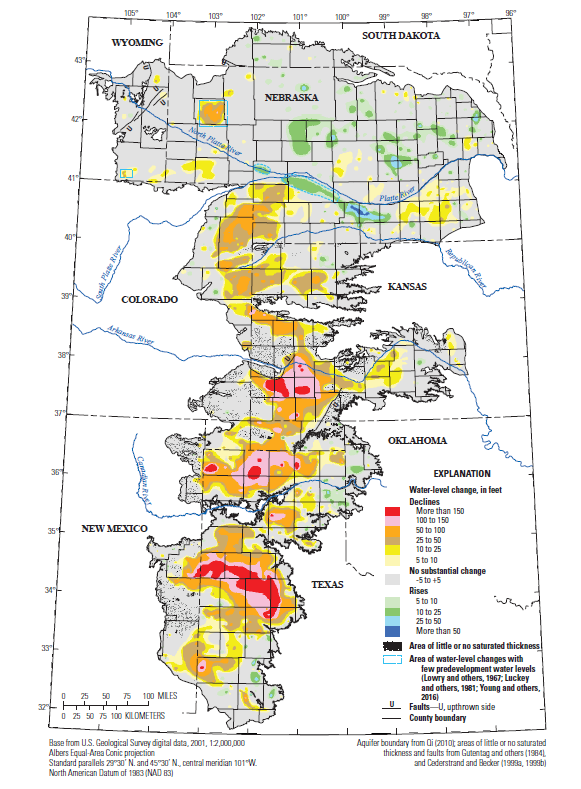
Meanwhile, yes, people in Ms Bellsnyder's counties, second from left and middle at the top row of the Texas Panhandle, are indeed drawing down water. In some cases, 50-100 feet as of 2001, per the image. Think of how much more it's dropped today.

It's not all farmers. Reportedly, Nebraska is somewhat better, Colorado modestly better, and Tex-ass and Kansas the worst. And, there's the issue of drought likely to continue in the Southwest for the rest of this century due to climate change. (I browsed pieces on Bellsnyder's Substack, and didn't find that phrase, "climate change.") That's the facts. Per this piece, the Ogallala is likely to go pretty much full-on belly-up in 20 years. Part of it is lack of cooperation between states. Part of it is Tex-ass having purely voluntary laws for water conservation.

Until that's fixed, that's another reason to vote NO on Prop. 4. 

Charles Perry, bring the public some water conservation issues with teeth in them, before anything else. 

Sadly, per Ballotpedia, all Democraps in both House and Senate supported it. (Twelve House Rethuglicans were opposed.) Also, sadly, no non-Gang Green environmental org, like Center for Biological Diversity, registered official opposition, whether or not speaking to that end. 

And, a follow-up note to Bellsnyder in general. No, contra your unwarranted assumptions (which you as a newspaper publisher, and a former Texas Lege staffer, should know better than to make) not everybody in rural Tex-ass is Rethuglican. Nor are they all "people of faith." Gack. And barf.

October 27, 2025

'Forget the Alamo' and eff Dan Patrick

Having read friend Chris Tomlinson's "Forget the Alamo," I wish Kate Rogers had fought to stay on as executive director of the Alamo Trust rather than resigning. It's all part of larger battles over Texas history and culture inside and outside of academia.

The TSTA Blog wants the full story of the Alamo to be told. And this is why Rogers had legal standing to fight:

At present, the state General Land Office is custodian of the Alamo site, but it is operated by a nonprofit, the Alamo Trust, through a contract. An agreement between the Land Office, the Alamo Trust and the city of San Antonio calls for the new Alamo project to include Indigenous, Mexican, Tejano and Black perspectives, but state Land Commissioner Dawn Buckingham seems to have lost her copy of the deal.

There you go. 

I know that's not easy, but per that second link, not fighting is what got us to this point. 

Update, Nov. 20: Rogers is suing Patrick and Buckingham, per Chris Tomlinson, because they killed her severance pay deal after she talked to Texas Monthly. And, the suit is in federal court, not state. Tomlinson also calls out Buckingham for a steaming shitload of hypocrisy.