SocraticGadfly: Hegar (Glenn)
Showing posts with label Hegar (Glenn). Show all posts

September 14, 2022

Texas Progressives: Guns and Visa, Beto-Bob, more

Elizabeth Warren asked for it, then got called out as "fascist" for the request, but Visa will start tracking gun sales as a particular category. It should make it easier to track down suspicious sales, which was her whole intent. And, since Visa is the biggest, let us hope, per the story, that it indeed pressures MasterCard and Amex to follow.

We'll also see if Second Amendment absolutist Delilah Barrios, running for gov for the Green Party, says anything about this.

==

Off the Kuff analyzes the latest poll of Texas and Harris County. (Note: See my gov, House and Senate polls at right.)

==

SocraticGadfly said Beto O'Rourke needs to fire himself as chief campaign strategist.

Related, from Twitter:

==

I have no idea who Coulda Been Worse is run by. Let's just hope that any new anti-Abbott ads don't engage in child exploitation, unlike Moms Against Greg Abbott. Their first ad is here on Twitter, via Patrick Switek. Not bad, but not great in presentation. The "Coulda Been Worse" needs to be cut in more than just once at the end. A second voice in voiceover, preferably female, should be there.

==

DPS head Steve McCraw told CNN he'd resign if it was found that his troopers had any culpability in a delayed response to the Uvalde shooting. He's bullshitting, of course, starting with that he'd set his own parameters on "any culpability."

==

Shock me that two North Texas small-town police chiefs belong(ed?) to Oath Keepers. Of course, they, like others statewide and compadres nationally, have spouted the usual bullshit lines like, "I didn't know who they were," or "they changed their mission" or "someone else signed me up."

==

Gohmert Pyle reached a new low even for him.

==

Per this Tweet:

Glenn Hegar reached a new low, even for him.

== 

Danny Goeb is in a pissing match, per his news releases, with the authors of a Texas Monthly semi-gotcha piece that's nonetheless good gotcha. Knowing something about Russell Gold and Dan Soloman's writing for the Monthly (and elsewhere from Gold), I was worried Patrick may be at least half right. I shouldn't have been. An updated version of the article notes Patrick's claims, and does further gotcha on the date of passage of SB 13 vs the date of his BlackRock divestiture. Plus, like Ralph Nader (who I didn't vote for in 2000 cuz I knew this, probably due to Al Gore oppo research) and Jill Stein (who I learned about too late in 2016 cuz Hillary Clinton oppo research forgot to allow for early voting) Patrick and his wife also owned Black Rock mutual funds. (Nader and Stein owned oil and gas, defense and tobacco stocks via mutual funds.)

==

MANNUUUUU.

==

A restart on the Iran nuclear deal looks to be officially on the rocks. That's from the German Foreign Ministry.

Texas 2036 warns that the water crisis in Jackson, Mississippi, could happen here.

The Texas Living Waters Project released a study showing how much water we lose in this state due to old infrastructure. Texas Monthly gives a fond final farewell to Paul Burka.

The Texas Signal reports on the first day of school in Uvalde.

The TSTA Blog argues that it's the disrespect for democracy that disqualifies so many Texas Republicans from holding office.

The Dallas Observer notes the Cards Against Humanity protest against anti-abortion laws.

Federal coronavirus bailout money for cities and counties went to ... cops and courts.

April 21, 2020

Glenn Hegar bemoans the oil price catastrophe;
still no Abbott call for a special session


For years, I've bemoaned one of Texas' quieter GOP lying sacks o shit, Comptroller Glenn Hegar. He's been basically a one-note liar, and that lie has been that the Texas economy is not oil-dependent. And, to the degree many Dems in Texas have played along, this is a duopoly lie.

Well, Monday evening, after the May futures contract for West Texas Intermediate went negative and punched him in the face, Glenn's lying chickens came home to roost and he pumped out this presser:
(AUSTIN) — “Today’s market activity was unprecedented and likely indicative of very limited storage capacity. May contracts traded well into negative territory as the market prepares to shift focus to June contracts. While down somewhat, June contracts traded in a relatively stable range. While this unprecedented volatility is concerning, the greater impact to Texas will come if demand remains historically low for a prolonged period of time and supply gluts continue to strain storage capacity.
“Severance tax reductions would primarily affect the state’s Rainy Day Fund and State Highway Fund, and to a lesser extent general revenue available to meet budget needs. Contraction in the energy industry also will affect other sources of tax revenue, including sales and franchise taxes.
“The Texas budget is based on the average price of oil in each year of the biennium, thus daily market activity doesn’t significantly affect revenues, which are forecast based on average prices rather than spot prices or prices for specific futures contracts. That being said, given the historic nature of today’s market moves, we are carefully monitoring trading as June contracts come into focus. Should prices remain depressed over a long period of time, we anticipate the impact will be reflected in a reduction in the revenue forecast we'll be releasing in July." 
OK, let's look under the hood.

The first sentence is a "no shit Sherlock."

The last sentence of the first paragraph is the start of hand-waving. That is because traders, as well as the general public, weren't looking at June futures. It's hand-waving in another way. As I blogged six whole weeks ago, already seeing the oil economy blowing up from both the early coronavirus news AND the OPEC+ disintegration — disintegration happening in part due to a global oil surplus, the surplus is going to get bigger. Already a month ago, OilPrice.com, per that blog post, predicted 3 million barrels a day by the end of June.

At that same link, I called you out as a lying sack o shite then for claiming "the fundamentals of the Texas economy remain strong."

And, the fundamentals were weak then and abysmal now.

First, the OPEC+ cuts. They've already been at least partially priced in the market, per this piece. It also notes that OPEC, Russia and Mexico can no more achieve a 20 percent cut in a matter of days than the US can. It will take weeks to safely shut down that many wells. Also per that piece, the 20 percent cut includes previously pledged cuts and other things.

Reality? The global trim will be 1/3 the projections.

First, part 2. That same piece notes that producers right here in my and Glenn Hegar's Tex-ass are refusing to budge on making big cuts today, tomorrow or weeks from now. That's because the independents have their backs against the wall and even small cuts on marginal wells, on either fracked or conventional oil, will kill them. (Also, per the "hot oil" days of the 1930s, I do agree that it would be "interesting" to see the Railroad Commission try to enforce any cuts.

Third, you have the "energy independence" bullshitters like this retired Army colonel who should know better.

Second paragraph? Standard government presser pablum. But, here in Tex-ass, it's also being used as a "marker" for next time Democrats in the Lege want to tap the Rainy Day Fund.

Third paragraph.

May futures contract prices as of end
of day, Monday, April 20.
Average prices? Many people are predicting the spot market will regularly have $15 oil next month. I expect June futures to be below $20 well before the late-May call. And, Chicago Merc has July and August futures below $30. Indeed, as of noon Tuesday, the June futures had dropped below $15.

And worse yet as the day wore on. By the end of day Tuesday, the June crude oil option was $13 and change and ALL 2020 MONTHLY OPTIONS were below $30.

Dude? You need to release an updated revenue forecast before the end of May, NOT July. Look west to New Mexico.

Speaking of, Gov. Strangeabbott needs to look west, too, and call a special session of the Texas Legislature. With the two-year budget cycle, no off-year short session unlike NM, and with the Lege not having the constitutional power to call itself into session, there WILL be blood for oil — blood of the people who will be most hurt when the Lege whacks away in 2021.

Meanwhile, a bigger bag of wind, and a big bigot, Railroad Commission Chairman Wayne Christian (name fits as in Religious Right wingnut, hates #TehGay, etc.) has appointed a capitalized Blue Ribbon Task Force for Oil Economic Recovery. It's an entirely industry-led group. It will surely refuse to address the main problems with drilling even before the coronavirus, namely, as reported here before, that many wells:
1. Are producing something closer to condensate than oil;
2. Are cannibalizing other wells;
3. Have an increasing water cut.

But, it's not just oil. As Wall Street on Parade notes, commodities futures of all sorts are collapsing. Notably, ag prices. I've read about Californians plowing under lettuce. Now Floridians are plowing under truck farm crops. Which means that Texans surely are.

July 15, 2015

Iran, #oilprices and the Texas budget

Now that the US and partners have finally gotten Iran to sign off on a nuclear energy non-proliferation deal, a big question in Texas is: "What does this mean for oil prices?" A related question, for those knowledgeable, is "What might this mean for the Texas budget?"

Consumers everywhere, of course, wonder about gas prices, so to that first.

Tom Kloza of OPIS is predicting the return of $2 gas by the end of the year. If he's right about that — and I'll give 2-1 odds in his favor — West Texas Intermediate oil will  be at or below $60. It's not just any Iranian oil that will come on market this year, as not a lot is projected to do so before 2016. It's that any additional oil, on top of continued overproduction and a Chinese slowdown, will drive down prices. Beyond that, the Iran deal means more stability in the Middle East, itself worth a couple of dollars a barrel.

And, thus, we've covered oil prices as well as gas prices.

As for next year?

More oil from Iran WILL come online in 2016 and beyond. In turn, that means WTI probably doesn't get above $60 on a regular basis next year.

So, add the Texas budget to the list of "losers," even as this is yet another argument for an every-year legislature in the Pointy Abandoned Object State. An every-year legislature could, even with a two-year budgeting cycle, still meet on a shorter session to tweak the state's budget.

But, this is Texas. Who are we kidding about having an actually efficient government?

Beyond that Comptroller Glenn Hegar is surely still wearing rose-colored glasses about the state budget.

As he should not be doing at all.

At the Houston Chronicle, Chris Tomlinson reports that major players in the oil patch are engaging in major write-downs, and minor players are trying — not always successfully — to avoid bankruptcy.

March 31, 2015

2nd-qtr #oilprices — up, down, flat? Texas effects? #Txlege actions?

Glenn Hegar, Clueless Comptroller
I blogged earlier today about some specific issues in the Middle East that could drive second-quarter prices higher.

That said I don't think they will, at least not significantly. I provided some explainer there and I'll add a bit here.

I don't expect Iran to get much more involved in Yemen. If Iran does torpedo the nuclear fuel deal, it's already under sanctions; additional sanctions won't drive oil prices much higher. And, ISIS will probably peak before the second quarter is done.

And, there's more proof of that on April 1, with no jokes attached. As a result, oil prices have sagged again.

(Update, April 2: It appears "movement" has happened on Iran nuclear talks. That's probably worth a $1/bbl cut right there. At a minimum, sanctions against Iran won't get any stiffer. And, if progress continues in advance of the June 30 final deadline, the P5+1 might slightly relax, at least, some of the sanctions. And, as Chris Tomlinson notes, Iran-Saudi Arabia tussles could lead the Saudis to pump even more.)

So, with foreign disturbances likely to be of little import, what happens? Probably they stay flat, or trade in a narrow range. If you agree, or disagree, you can let me and readers know with your vote in the poll at right.

I'm not so much a catastrophist to think they fall below $40/bbl, though I do offer that as a voting option in my poll at right, and offer more options, and narrower ranges, than I did in my first quarter poll. I do also think that the "narrow range" will be, in general $40-$50/bbl, and that, barring me being wrong on foreign policy predictions, West Texas Intermediate ends the second quarter at or below $50/bbl.

Now, what's that mean for Texas?

Not good news.

New Comptroller Glenn Hegar, aka Scrooge McOilDuck here and Jethro Bodine at friend Perry's site, has yet to create fake environmental protection plans, unlike his predecessor, Susan Combs, but he seems just as wedded to the oil patch as her, combined with being even less willing to face reality.

First, his budget revenue estimate given at the start of the legislative session, which he has refused to revise since then, in the face of plenty of evidence to the contrary of his ideas, thinks that WTI will hit $65/bbl in fiscal 2016.  That link is also very good as an explainer of how state money from the oil patch gets distributed into different pockets. Click it and get a look-see.

Meanwhile, back to Scrooge McOilDuck and his Reaganesque "rosy scenario."

Even in calendar year 2016, which starts next January, that wouldn't be likely. Given that for Texas, like the federal government, fiscal 2016 actually starts in October of this year, it's very, very unlikely. And, given that $60/bbl is, seemingly, the magic production cost number for shale drillers to start new wells, rather than complete and cap for later supply wells already underway, that means little new drilling in fiscal 2016.

In short, per that link just above, Hegar's likely to be half a billion dollars short in his estimates.

I don't know whether he's just clueless, unconsciously delusional, willfully self-delusional, a believer in a state level of trickle-down economics (possible indeed), or a Kloset Kommie Keynesian economics believer (state budgets have to be balanced, Glenn, Keynesianism doesn't work here), but the state of Texas will be hurting indeed, between Dan Patrick's slash-and-burn tax cuts and Hegar's misestimating oil revenues.

And, per Twitter, I'm not alone in concerns. Even at least one member of the Lege is asking questions:

But Otto's level of concern apparently isn't strong enough for all:

Stand by for news!

As identifiers, Otto is chair of House Appropriations; Schaefer is a member of Defense/Veterans and Urban Affairs.

And, it's not just oil revenues themselves, as this piece makes clear. A sustained dropoff in drilling affects other businesses, and many of them in, or associated with, the oil patch, expect this slump to last six months or longer. That means fewer truck drivers in the fields, at least a few. It means fewer sales by fishing tools companies and their like, fewer drilling rig leases, fewer semi sales, fewer pickup sales and more.

The link near the top, about a renewed sag, also notes that oil companies in Texas have announced new layoffs; it also notes that part of the manufacturing decline in the state is due to fewer O&G orders. Meanwhile, Moody's agrees that demand for oilfield services will continue to drop.

One should also take note that, per that piece, a few oil-related bidnessmen ARE more catastrophic than I am, and expect the $40 floor to be broken.

It's arguable that if oil commodities speculators are placing massive bad bets, and storage fills to the brim, sub-$40 oil could arrive. But, sub-$35? I doubt it. If nothing else, some speculators will dump sooner rather than later, due to leverage issues. Anyway, feel free to cast your vote in the poll at right. (Given that the Bloomberg author in question probably has never been near an oilfield in his life, and said that fracking was specifically part of horizontal drilling in another piece, I'm taking his $20/bbl claims with a grain or four of salt.)

In either case, on fiscal issues, just like on teh gay and other social issues, it's clear that several dozen clown cars drove up to the Texas Capitol in January, all fully loaded.

I can't wait for the 2016 special session their idiocy will almost surely foist upon us. (Sidebar: This is why, even if Texans are so allergic to government as to oppose a full-time legislature for a state of more than 25 million people,it should at a minimum have its part-time lege meet every year.)

March 27, 2015

#Oilprices poll — 1st quarter poll dead center

At right, for a few more days, still, you can see the poll I have up about where oil prices will be at the end of the first quarter.

Averaging the input has the "call" at about right at $50/bbl. Oil broke $51/bbl yesterday because of the outbreak of fighting in Yemen. I expect that to settle back down a bit soon enough. Meanwhile, settling of fighting in northern Iraq, or a nuclear deal with Iran, would drive prices even lower.

Meanwhile, don't look for things to get better in the near future. Chris Tomlinson notes that US shale oil (and gas) drillers are probably full of bluster more than reality in talking about finding efficiencies in shale drilling costs. He notes that for US shale oil and gas:
The full cost of producing oil and natural gas at a representative sample of U.S. companies, including capital spent to build the company and buy assets, is about $80 per barrel of oil equivalent, according to a new study from the Bureau of Economic Geology's Center for Energy Economics at the University of Texas. The analysis of 2014 corporate financial data from 15 of the top publicly traded producers, which I got an exclusive look at before it's published next week, determined that companies will have a hard time recovering the capital spent that year and maintaining production unless prices rise above $80 a barrel.
Now, things aren’t total doom and gloom, at least not at already-producing wells, as Tomlinson explains:
Low prices, though, won't mean that producers will shut in existing wells. Many of these same companies can keep pumping to keep cash coming into the company and they can still collect a 10 percent return above the well's operating costs at $50 a barrel of oil. They just won't make enough money to invest in new wells or recover the capital already spent.
That leaves this as the bottom line:
This harsh reality of what it will take to keep the shale revolution going shows how vulnerable it is to competition from cheap overseas oil.
Of course, the “shale revolution” is a lot more bubbly than a lot of  its proponents want to publicly admit.


As I have blogged previously, before the bursting of the latest oil bubble, the Eagle Ford play in Texas was expected to peak in 2016, as analyzed by an outside expert. The bubble surely shoved that back to 2017 and most likely to 2018, but it’s still a sobering thought.

Anyway, on prices? I'd take the Saudi guesstimates as solid — oil won't hit $100/bbl again for five years. There's flat demand and ready supply cooked into the books for years ahead.

Texas Comptroller Glenn Hegar, are you paying attention? Probably not; it's hard to extract one's head from being buried in a hole in the sand, ostrich-like.

Chris goes on to note an extended shale oil drilling slump will also affect natural gas prices because many shale oil wells are "wet gas" wells, producing various hydrocarbon condensates. Dry gas wells will be the worst off in the new environment.

March 19, 2015

Replace the Texas franchise tax ... with what, #txlege?

Houston Chronicle business columnist Chris Tomlinson wrote earlier this week that it's time for the state of Texas to get rid of its state franchise tax on businesses.

I respectfully agree, as I Tweeted him back, because he said "get rid of" instead of "replace." (The same holds true for the inventory tax, as loophole-ridden and as badly designed as it is.)

The answer is: A state income tax. Well, that's the obvious answer in a state that's not as tax-phobic as Texas, even as schools struggle for money and roads fall apart under current funding.

Unless the Texas Legislature can craft a corporate income tax to replace the above state taxes, getting rid of those above taxes will mean even more suckitude in state services (except to lobbyists), yet higher sales taxes, or both.

This reminds me of President Lincoln. Radical Republicans in Congress demanded that he replace George McClellan as commander of the Army of the Potomac well before Lincoln puled that trigger.

"With whom?" he asked.

"Why anybody," Ben Wade said.

"I must have somebody," he responded. Change "somebody" to "something," and that's where we are now. We need to have columnists propose, and legislators adopt, a "something" to replace these taxes.

As for raising the state sales tax? Scrooge McOilDuck, otherwise known as The Comptroller Who Can't Understand Commodities Trends, Glenn Hegar, want to let businesses with less than $5 million in revenues pay no sales tax.

And, I'm sure Scrooge McOilDuck and the GOPers in the Lege have not put pencil to paper, or fingers to calculator, to figure out just how much money this would cost the state.

Actually, they probably figured supply-side economics would turn this into a magical new bonanza for the state.

In reality, if the Wingnuts of Wingnuts steamroll stuff like this, Texas will be the new Louisiana.

Texas: Heading to hell in a handbasket, but now, maybe twice as fast.

And that reminds me of another Civil War hero: Phil Sheridan, who famously said:
“If I owned Texas and Hell, I would rent out Texas and live in Hell.” 
He would surely still live in hell first, but might find fewer and fewer out-of-state takers wanting to rent out Texas.

February 03, 2015

Glenn Hegar vs #TxLege on oil prices, tax cuts, more

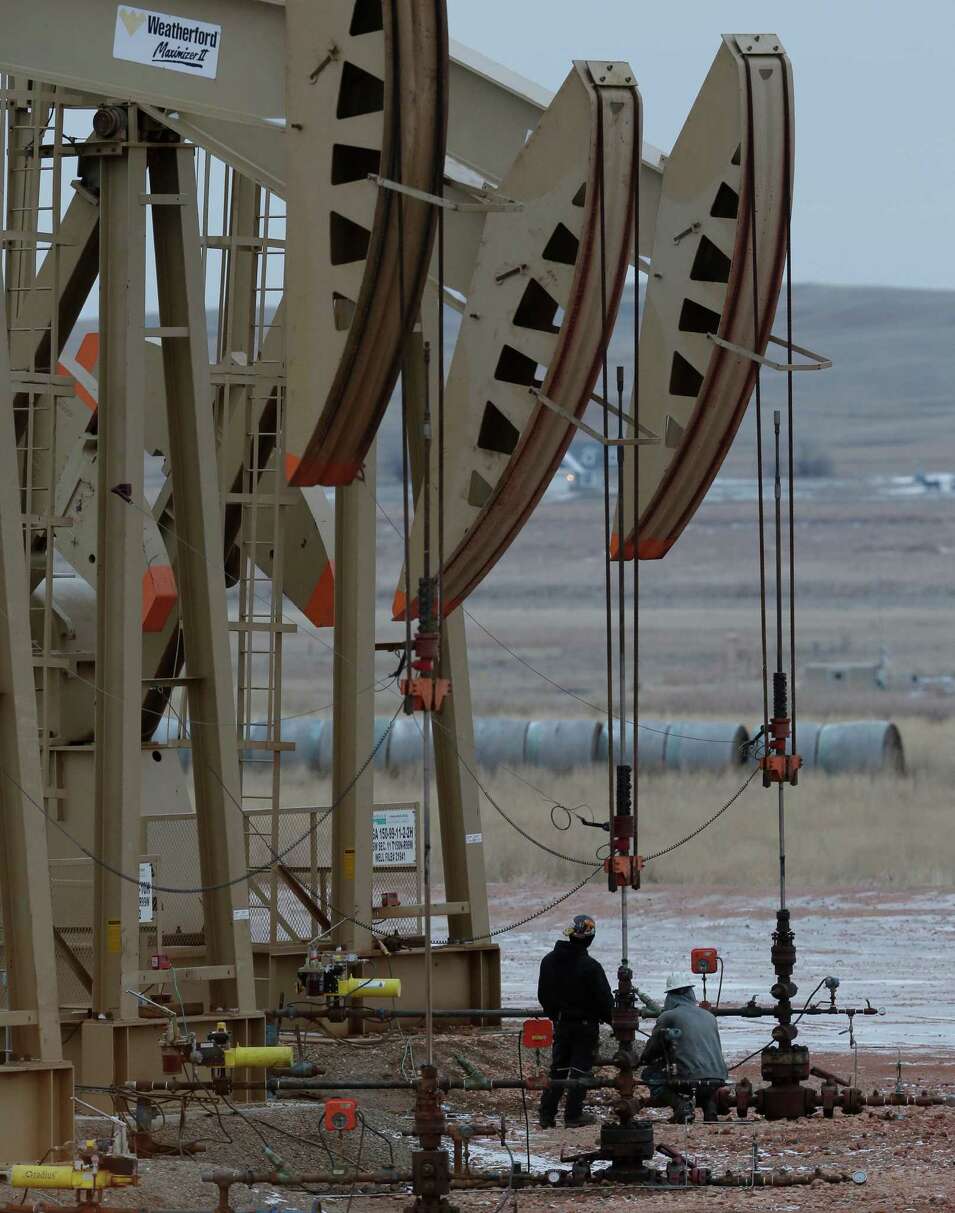
Pumpjacks near Watford City, North Dakota
AP/Eric Gray via Houston Chronicle
A few members of the Texas Senate aren't ready to pull the trigger on major new tax cuts.

And, they shouldn't be.

If Texas is going to lose 300,000 oil and oil-related jobs before the current oil price slump is over, the state's going to lose a lot of oil and gas revenue, plus sales tax money from people spending less, plus new unemployment claims and more. As the story notes, 8.5 percent of all Texas jobs added since the Great Recession are directly in the oil business.
"I think it's safe to say the Eagle Ford and the Permian are about to get clobbered," (economist Karr) Ingham said, referring to areas in South and West Texas that boomed as technological advances have driven a five-year surge in production from dense shale rock.

Unfortunately, that sounds about right. 

Ingham goes on to say that he doesn't expect a permanent rebound any time soon. In fact, he expect it to take a full year for US production to cut enough to soak up all the current surplus.

So, Chris Tomlinson's right, too. Don't expect the current brief uptick in oil prices to signal something permanent.

That, in turn, gets back to those tax cuts.

All of the "concerneds" are mentioning spending priorities, not revenue concerns related to the oil patch. But, they should be looking at that.

Per Tomlinson's link, even if the oil industry is lucky to hit the higher side and average $60/bbl this year, that's still seemingly below what new Comptroller Glenn Hegar is using for his revenue estimates, which I've critiqued, time, and time, and time again.

Beyond possible additional road spending, Kevin Eltife is right for a Republican — the state's likely going to need more money for public schools, assuming it eventually loses its appeal of John Dietz's ruling on the unconstitutionality of current school finance.