SocraticGadfly: Plato
Showing posts with label Plato. Show all posts

September 10, 2015

A Game with Words: We must run Wittgenstein through Hume

Philosopher friend Dan Kaufman surely would or will disagree if or when he sees this, but I shall explain that header.

On Ludwig Wittgenstein, he does have a lot of insight, but, I don’t ennoble him like Dan does. (Dan might object a bit to the word "ennoble," but ... I'll stand by its sentiment.)

In part, that’s because one can go “meta” on Wittgenstein’s language games idea. I think Walter Kaufmann, with his somewhat contrarian rejection of “guilt” and “justice” as universals or quasi-universals kind of gets at that.

But, there are other issues. And, expanding on a comment I left on a post at Massimo Pigliucci's blog, here are a few of them.

1. Are we talking about descriptive or prescriptive use of a particular word, or words in general?

2. Can we even agree on what “prescriptive” and “descriptive” mean, either in general or with a particular word?

3. How do we make such judgments?

These are just a few of many ideas related to this issue.           

In short, Wittgenstein’s idea on language games, in the real world, must be run through …

Wait for it, those of you know one of my favorite philosophers …

Wittgenstein must in some way be run through Ye Olde Philter of Induction, courtesy David Hume.

January 22, 2015

Mu to Camus on meanininglessness

Albert Camus famously or infamously said in "The Myth of Sisyphus" (summary and Wikipedia) that there is one ultimate issue in philosophy:
There is but one truly serious philosophical problem and that is suicide.
Of course, that relates to, and cornerstones, issues in his absurdist philosophy, and in the related existentialism of Jean-Paul Sartre and others.

Theists, especially Christian apologists, have used this as a cudgel, whacking secular existentialists over the head with the idea that they, or we, claim that life is "meaningless" and that there is therefore no recourse at end but suicide.

Well, a new essay at Massimo Pigliucci's Scientia Salon, by John G. Messerly, deals with this issue in part. And, it's stimulated me to yet further thought, reflected in part, and starting with, my second comment on the essay.

That said, let's unpack this issue a bit further. I'll then get to the second half of that second comment and go from there.

Camus, of course, said suicide was not the answer — revolt was. Which might be true.

Modern humanistic psychologists of a secularist mindset say that meaning is what we bring to the table.

But, beyond that, what if "meaningless(ness)" as traditionally defined in philosophy and psychology isn't exactly the issue?

And now, to that comment.
I think Camus was asking the wrong question. 
 Life is neither meaningful nor meaningless, if we take “meaningless” to be the opposite of “meaningful.” 
 If we instead, talk about “without meaning” or “meaning-less” (sic) we can hopefully understand this not as an opposition to “meaningful” but simply that the issue of “meaning” is, if not a category mistake, one of those issues about which we should be silent, or even more, per logical positivism, a question that is itself … without meaning! 
 It’s true that, as part of our attempts to control our surroundings, we probably have “meaning seekers” as well as “pattern detectors” and “agency imputers” halfway hardwired into our brains. 
 But, per Hume’s is ≠ ought, that doesn’t mean that we have to follow them in falsely looking for agency — or falsely imputing meaning where it doesn’t exist, or falsely looking for it when it’s not part of the issue.
Let's go a bit further.

"Meaning" and "meaninglessness" also seems to be one of those polarities, like "free will" vs. "determinism," that's wrong in other ways.

First, it's presuming that a polarity should exist.

Second, it assumes that one should, in some degree at least, "reduce" to the other, rather than both be "unified" in a larger theory, just like general relativity and quantum theory will surely "unify" rather than having one reduce to the other.

Third, like the free will half of that first duality, a desire for meaning — or, a desire to frame ordering one's life around meaning, and trying to justify how to frame it without meaning — seems based in part on religion. I've said that this seems true to some degree of many secular defenders of classical free will, on religion and guilt connecting to free will.

Indeed, the Sparknotes summary, on the first link, puts this in is vs. ought terms, as far as how Camus treats Sisyphus:
As his starting point, Camus takes up the question of whether, on the one hand, we are free agents with souls and values, or if, on the other hand, we are just matter that moves about with mindless regularity. 
 Camus is interested in finding a third alternative. Can we acknowledge that life is meaningless without committing suicide? Do we have to at least hope that life has a meaning in order to live? Can we have values if we acknowledge that values are meaningless? Essentially, Camus is asking if the second of the two worldviews sketched above is livable.
But, just as I have repeatedly, most  notably here and in my own essay for Pigliucci, said that we should say “mu” to the traditional “free will versus determinism” polarity, I think we need to similarly “unask” Camus here.  (And Monty Python.)

So, per my pull quote from my comment at Massimo's, if life should not be viewed though a "meaning versus meaningless" filter, what should we then do?

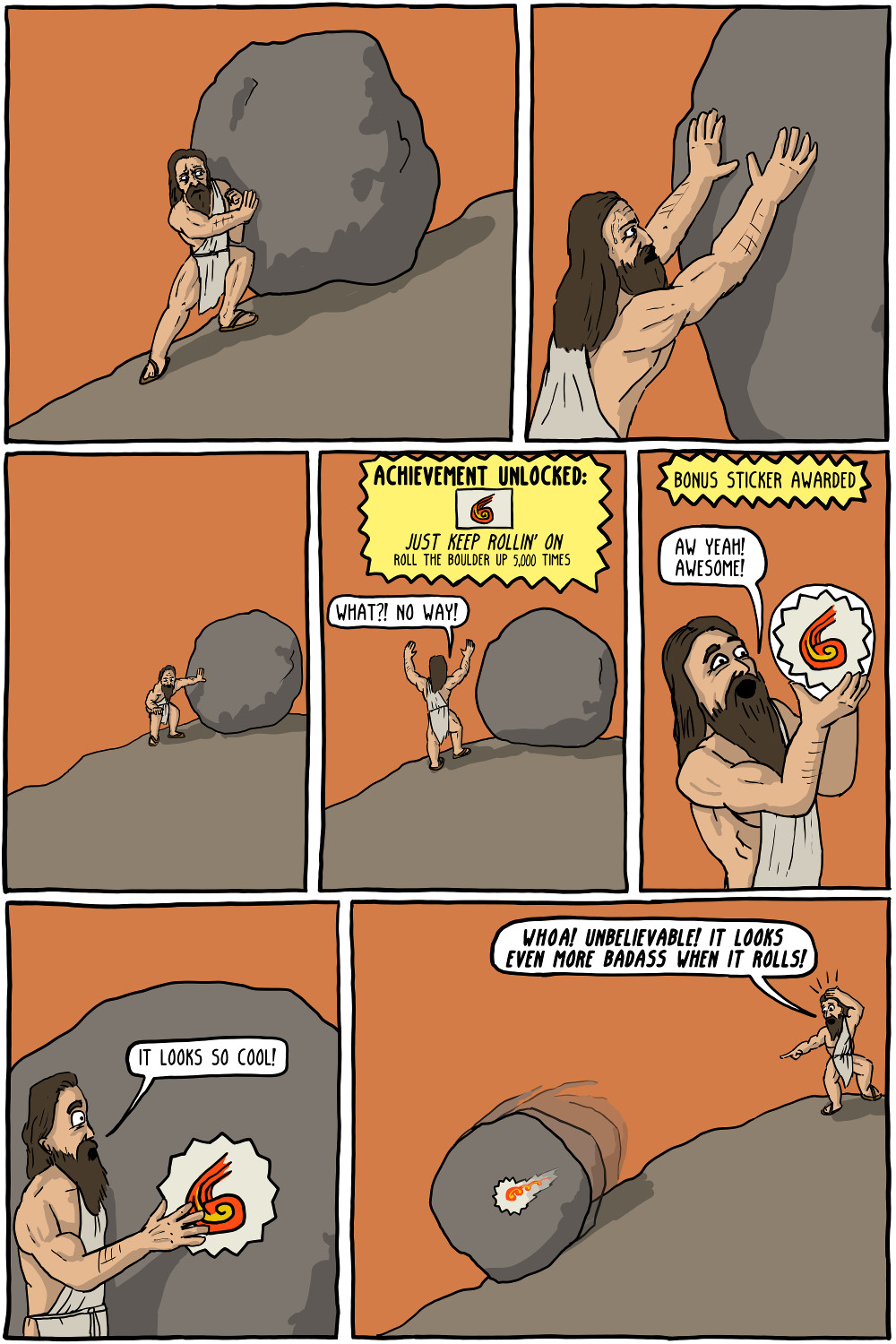
Comic by URL link from Existential Comics
Well, the reference to Farmville, Candy Crush and other Facebook games aside, in this issue of Existentialist Comics, keeping an intelligent Sisyphus happy is probably harder than this. That's especially true for those like Camus and other professional and amateur philosophers who wrestle with these questions. We are "cursed" with intelligence, and speculative intelligence in general.

That said, where do we go from here, to find a better, more authentic contentment than Sisyphus?

To me, the original existentialism, or the Zen of the east from which I get my "mu" to Camus' question, is our starting point.

Recognizing that life simply "is," not in the scientific sense, but in a philosophical and a psychological sense, is the lodestar.

From there, finding contentment comes next. Contentment, to me, is both "deeper" psychologically and less ephemeral than "happiness."

And,, it's not necessarily based on old ideas of how we "have to" find meaning, or create meaning, to be happy.

Second, per the essay that I linked that sparked these comments, as one other commenter noted, "progress" is usually defined in teleological terms. People often define meaning in the same way, which of course is another problem, and one recognized in part by existentialist and absurdist philosophers.

If your meaning is defined from achieving a goal, then you are doomed to frustration in never achieving it, or, like Sisyphus, having your "achievement clock" reset, or new layers added to it, or whatever.

And, what if you do achieve a goal of teleologically-based progress? What then? In the modern West, often, "emptiness," followed by chasing after some new goal.

So, how do we break free?

That was Camus' $64,000 question. But, if we're saying "mu" to his original dichotomy, we may need to say "mu" to his answer, too.

"Revolt" might be one way of achieving this. But, I think it needs to be somewhat more comprehensive, maybe even somewhat more Cynical, as I discuss in calling for a neo-Cynicism, than Camus realized. The revolt has to include a revolt against teleology.

At the same time (heads up, Black Bloc!) it means questioning the idea of "revolt for revolt's sake" (sorry, any hyper-Camuseans) or any other "X for X's sake."

Even "authenticity" must be put under our Cynical microscope. Too often, "authenticity" is seen in a quasi-Platonic sense, as in "There's some ideal Me out there, and that's what I want to be."

Well, no there's not.

Each one of us is the result of massive contingency in a materialist universe. There's no way any ideal Me or You exists. Therefore, any authenticity based on chasing what is even more ephemeral than a Platonic shadow isn't going to work. Besides, without the Platonic equivalent of divine revelation, how do you know what "Me" is anyway?

So, what is "authenticity"?

Authenticity, in part, means rejecting the strictures of society that don't agree with deeper layers of our selves — before they become part of those deeper layers.

In other words, it's about "congruence."

I'm not a process theologian, or anything close.

But, I will call myself a sort of "process psychologist."

As such, meaning is created, not found. And, it's created on an ongoing, not a static basis. It's part of a dialogue between a changing self, a current moment, and a current moment that is part of a larger stream of time.

And thus, meaning changes throughout life. Why wouldn't it?

June 28, 2014

#Plato sells his soul to #Google at the Googleplex

Plato at the Googleplex: Why Philosophy Won't Go AwayPlato at the Googleplex: Why Philosophy Won't Go Away by Rebecca Goldstein

My rating: 2 of 5 stars


I finally went with a 2-star rating for this book. I will note that Goldstein did stimulate my thought at times, albeit half the time to take notes on how she was wrong, and did get me to modify somewhat the harsh take I’ve had on Socrates since reading Izzy Stone, but, the book is still not that good.

First, a couple of overarching issues.

I am discomfited by a professional philosopher diving into the tank of commercial toutery. Plato can’t just have a laptop, he has to have a Chromebook. He can’t just like the Internet, he has to like Google for searches rather than using a generic term for Internet search. He has to like Google’s cloud-based services. He has to like Google so much that, per one chapter that gives the book its title, he does indeed visit Google’s Googleplex, where much of the chapter’s dialogue is taken up by a Google PR flak.

Frankly, it made me want to vomit. Strangely, even among “negative” reviewers, I’m seemingly the first to hit that much on this issue.
The second overarching issue, is despite all the puffery on the blurbs and on some five-star reviews, Goldstein is not that good of a writer in my opinion. The book lacks some coherence, including exactly how she’s trying to make Plato relevant for today and why. Plus, some specific writing tricks do not float my boat.

On page 192, she says in a footnote: “I’m not sure whether Plato is just managing Munitz here or is really implying that she’s guardian material.” Bulls***. Don’t go Stanley Fish on me. You know full well what your conscious intention was with the passage you footnoted.
I'm skipping around a bit, in part to get more feel for the book, and in part because it hasn't floated my boat that much so far, despite all the advance touts it's gotten.

First, Goldstein, while noting Whitehead's observation about all later philosophy being but footnotes to Plato and Aristotle, then noting many modern philosophers disagree, doesn't explain why she, essentially, comes down on the side of Whitehead. And, as a philosopher, she knows that for a philosopher not to “argumentatively” justify one’s decision or stance on something like this is …. Unphilosophical!

Second, some of her specific stances related to Platonism are ones that are also contentious. The idea that there’s no single character in Plato’s dialogues that truly represents him? I know that’s nowhere unanimous. One need not believe that Socrates is Plato’s sole voice to nonetheless believe that he is his primary one, and certainly so in his early and middle dialogues.

Third, she buys wholeheartedly and blindly into Plato’s description of who the Sophists were. Plenty a critic of this position has noted that the elitists like Socrates, and arguably, Plato, disliked the Sophists not because they proposed to teach “sophistry” in its modern English terms, but because they proposed to, relatively inexpensively, teach the basics of rhetorical tools that would help level the social and legal playing field between the rich and the non-rich.

Related to that, even if Plato's description of Socrates isn't the be-all and end-all of who Socrates was, she certainly seems to take at face value Plato's presentation of Socrates as a straight shooter, never engaging in sophistry himself. Nor does she ever entertain the idea that, if Plato is a mouthpiece or tool of Socrates at times, in turn, his "opponents" are just straw men for positions they never actually held.

Fourth, she’s not proven at best, possibly wrong at worse, on the background of “Ivriim,” which may be the root the Hebrew word for “Hebrew.” Yes, it does mean “pass over,” or “pass through,” in its verbal root, but, that doesn’t necessarily mean that the Hebrews applied it to themselves as “over the Jordan.” First, no ancient people are likely to define themselves this way, in terms of another culture or nation’s geographic point of view. Nor are the Jews likely to have said this about themselves because their mythical ancestor came from Transjordan and beyond. And, her interpretation starts with the noun form.

Better understandings of the root of this word are that as people “passing through,” it can mean immigrants, without geographic reference. Again, though, would a people likely refer to themselves that way? Interestingly, the verb is used in Genesis 15, where the torches pass between the cuts of meat during the Abrahamic covenant ceremony. That is one possible alternative etymology.

Another? “Hebrews” may well instead be a patronymic from alleged ancestor Eber (same consonantal Hebrew). And, the older attempts to connect them to the Egyptian “Hapiru,” while left by the wayside today, may not be totally dead.

Anyway, the fact that Goldstein, in a book about Plato, feels the need not just to talk about “Hebrews,” but the Hebrew etymology more than once, and possibly getting it wrong each and every time, is also disconcerting.

That’s from the first chapter.

On talking about the Republic, she made me realize that, of course, Plato’s ideas for youth education founder on Piaget’s stages of development. Pre-adolescents wouldn’t have been ready for his program. Surely, somebody else has mentioned that somewhere. But, she doesn’t.

Related?

I just realized that Plato's Allegory of the Cave has two holes in it as an analogy. First, if all we see our shadows, each of us has to be in our own cave; we can't be in one common cave because, of course, other people have to be shadows, too. Of course, to write it that way would wreck some of its force. Second, Plato talks about one person being freed then compelled to re-see things. Plato doesn't mention a personal agent, but the language sure implies one. And, of course, no other person can compel new knowledge. Even if an agent is not intended, the passivity of the allegory, the "being freed," is just wrong.

Also, one need not agree with Izzy Stone’s attributing Socrates’ death entirely to legitimate politics to nonetheless say that it was part of it.

What I got from all of this is a Goldstein who largely believes in the largely idealized picture of Socrates that Plato has handed us.

So, I guess she stimulated my mind to reject the Whitehead idea that the rest of philosophy is but footnotes to Plato and Aristotle.

Besides the Googleplex chapter, one other one rings very false. That’s the one about Plato appearing on a would-be Fox News with an ersatz Bill O’Reilly.

It all adds up to the fact that she is NOT a skilled writer, period and end of story, despite the fluffy touts from A.C. Grayling and many another. She needed an editor with a good understanding of both philosophy and classics, and a firm and heavy hand, and got none. (Sic semper the decline of the modern book industry.)

Finally, from all this, no matter my interest in philosophy, I won’t be reading another book of hers.

I'm not sure which bothers me most — the commercialism itself, the commercialism without warrant (philosophical or otherwise), the failure to defend the modern relevance of Plato before jumping in to chapters, or the failure to justify her interpretation of Plato.

In any case, it's a failure. There's also, in a Gertrude Stein sense, no "there" there. There's not a lot of unification between chapters.

Update: Now I know more of why it's bad: Goldstein is Steve Pinker's wife.


View all my reviews

August 28, 2013

Socrates is overrated (updated and expanded)

Yeah, given my blog name and handle, it sounds ironic for me to say that, no?

Of course, some people might accuse me of being hypocritical, if I do think he's overrated. That said, my blog name trades on the myth of Socrates, which we shall now call into account ... by using some Socratic-like questioning!

Questions
1. If he really were ignorant of so much, how could he always be right in his dialogues -- especially since he proves his opponents wrong in every one of them and therefore he couldn't have learned from them?

2. If he really were so ignorant, and knew that he were, then why didn't he follow Wittgenstein and remain silent about what he did not know?

3. If he really were so ignorant, then how can we believe he understood the Sophists' teachings so well?

Answers
The baseline answer to all of these individual questions and more is that Socrates, that is, the Socrates who is a Platonic mouthpiece (and, an ideal one for Plato, pun intended!) makes straw men out of Sophists and their thought, opposes the democratization (for money) of knowledge that they offer because it upsets his classist views and more.

But, specifically:

1A. The Platonic wordsmith hoists him by his own petard, not to mention, especially in the Cave analogy, also getting hoist on the petard of ineffability.

2A. Because it does that, Plato's Socrates only mimicked the idea of being ignorant.

3A. This builds on the "baseline" answer. In a sense, Socrates, to the degree we can really guess at who he was, DOES know the ideas of the Sophists well — and fears their democratizing strain.

Beyond that, while I don't buy into every argument Izzy Stone made in "The Death of Socrates," I do think he was anti-democratic and an elitist. Rather than the crime of affronting the gods of the polis, what he really was guilty of, in modern American legal terminology, arguably, was treason. So, contra Aristotle, mourn not his death as being in the nature of a crime against philosophy.

Besides that, from Xenophon and Aristophanes, especially the latter, we have a somewhat different version of Socrates. Indeed, Aristophanes calls Socrates, not any opponents of his (not mentioned in "The Birds") a Sophist.

Some additional thoughts:
Unfortunately, philosophical smarts, just like atheism (especially Gnu Atheism) and Professional Skepticism(TM) are no guarantors of being good secular humanists.

Both Socrates and Plato were anti-democratic elitists.

David Hume, despite all his other common sense, and being one of my favorite philosophers, was a racist. (And, Nov. 27, 2020, update, per David Harris' 2015 bio, which I've now read, in many of his Essays Moral and Political, distressingly shallow, as if le bon David followed Addison too much and acted like he was writing for the 1750s British equivalent of New Yorker readers at best.)

But, speaking of skepticism, and as a philosophy, not an investigative movement, Diogenes was, well, Diogenes! Maybe not a humanist in every way, but, he certainly was true to himself.

And here's more thoughts of mine on overrated and underrated philosophers in general.

And, this means that Plato is also overrated, for erecting such a blatant straw man in Socrates.