SocraticGadfly: Wilsonian idealism
Showing posts with label Wilsonian idealism. Show all posts

September 14, 2023

William Jennings Bryan — the original Bernie Sanders

A Godly Hero: The Life of William Jennings Bryan

A Godly Hero: The Life of William Jennings Bryan by Michael Kazin
My rating: 3 of 5 stars

I was on about page 120, the run-up to the 1904 Democratic convention, when the light bulb turned on:

William Jennings Bryan was the 120-years-earlier predecessor to Bernie Sanders, on the legend even more than the reality, and related to that, the degree to which many peddled the Kool-aid or drank it for themselves, often long after the reality differed clearly. This includes the two protagonists. (Kazin may not like that comparison; for more on why, see the end of this extended review. See also my new Substack looking more explicitly at the sheepdogging angle.)

That said, this is one of those books that is both provocative and problematic at times. And, as is the norm with such books, I’ll have a greatly extended review on my blog. What I have here is the basics of what I learned new about Bryan as well as a basic-level critique.

Trying to rate it is also problematic. I do think this is well researched (Kazin also notes former recent, as of the 2007 date, biographers), but not necessarily well analyzed.

I don’t think I had read before about Bryan volunteering to serve in the Spanish-American War. Even if he saw no combat, it did look hypocritical next to previous anti-American statements.

That said, Kaplan gets some Spanish Empire wrong. The Philippines as well as Cuba and Puerto Rico were still a part. So was Spanish Morocco and Spanish Sahara. Bioko and Rio Muni, later united as Spanish Guinea, were held in equatorial west Africa.

As for his service, as a volunteer, why didn’t he resign before the 1898 midterms? Bryan obviously doesn’t tell us, but it’s another spanner in the spokes of his bicycle.

And, supporting the treaty? Wow. And, the Senate approved it by just 2 votes to spare. Bryan said, in essence, that we should follow Kipling’s adage and adopt the white man’s burden but shuck it quickly.

Then, after 1900, buying a rural mansion that in today’s terms would run at least $500K? Multiple guest rooms. Dining room that seated 24. Servants. (Peak Bryan was making $2K/week on the Chautauqua circuit and more besides. Bureau of Labor Statistics’ inflation calculator says $2K, in 1913, its earliest year, would be $62K today. Per week. Just for a dozen weeks of summer, $750,000 a year in today’s terms..)

1904? Not endorsing Hearst. Sure, Hearst’s womanizing was already known, but Bryan had shown himself a semi-hypocrite on imperialism already. Hearst probably wouldn’t have blocked Parker, by the 2/3 rule still in effect then, anyway, but maybe? Before people shifted votes after initial first ballot tallies, Parker was just short; Francis Cockrell, Bryan’s endorsee, was third. That said, all the shifts were Hearst defectors.

LaFollette had a newsletter, like Bryan’s The Commoner, but it didn’t explicitly promote him. Battling Bob missed a turn there, but, given his speaking style, what I’ve read about that, and other things, not a surprise.

Kazin believes the legend of Taft as conservative, which is only half true. For example, he doesn’t mention that, rather than “trimming” on the tariff, Taft traded tariff reform for getting the 16th Amendment out of the Senate. Nor does he mention that TR never tried tariff reform and that he didn’t push the 16th Amendment, either. As part of that, he’s also wrong about Gifford Pinchot. Doris Kearns Goodwin’s book on Taft and TR has a more nuanced portrayal. He also could have learned something about Nellie Taft, while there, per a bio of her . (Kazin’s book came out a full year later, and while Kearns wrote later than him, the door had long been open for revisionist Taft studies.)

That said, supporting the 1898 treaty foreshadows Bryan carrying Wilson’s water in Mexico before resigning over the Lusitania. And, carry that water he did.

There are other vignettes here, such as just how conservative TR was, claiming Bryan had “socialistic and communistic tendencies” in 1900. The claim, and the demagoguery, surprise nobody who knows the reality of Brownsville 1906.

Bryan was coopted by acceptance of Secretary of State. Wilson knew that.

Bryan's first big oops was not on Mexico but Federal Reserve. He did get Wilson to accept government oversight, but, with individual banks controlling the regional feds, especially the NY Fed, that was hollow. And, he was told that at the time. The remaining Populists and rising Progressives wanted something like the original, not watered down, Bank of North Dakota on lending requirements for the Fed, board of directors, etc.

Mexico/Caribbean? Bryan shared Wilson's paternalism. And, such it was, even if it shed the worst of GOP dollar diplomacy. It was the same paternalism Bryan showed in the Philippines.

WWI? Wilson hoped Bryan would resign already by end of 1914, reportedly. Kazin doesn’t tell us if Bryan had heard about that.

That said, Kazin misses the mark on Wilson as fake neutral, and being a fake neutral not a real one relatively early after the start of the war. He talks briefly about submarines not doing cruiser warfare as violating international law but says nothing about the same for blockade by extension and food as blockade weapon, even with his admiration for British law in general. Kazin notes later that the Lusitania was carrying munitions as well as passengers, but not that it was armed with guns more than big enough to sink a submarine if it surfaced. He lost a star right there. (He doesn't ask if Wilson knew either one at the time.)

Would siding with Bryan "have prompted a political rebellion"? Questionable. I don't know about Republicans, but most non-Southern Democrats west of the Mississippi in 1915 were still isolationist. He then claims the NY World spoke "for most of the American press" when it called German response to Wilson's diplomatic note "the answer of an outlaw." The World War I coverage in this book doesn't speak well for Kazin's handle on WWI in general, despite him writing a book about pre-US entry peace issues.

I had suspected Kazin would land here when, in his chapter on the 1912 convention, he indicated that Bryan plumping for Wilson instead of Champ Clark was a good thing. Yes, Clark was more parochial than Wilson, but he was opposed to WWI. (As Speaker, he didn't vote on the declaration, but his opposition was known. His son was an isolationist senator in the run-up to WWII.)

In Kazin's "War Against War," long review here he partially redeems himself — but not totally.

Sadly, as Kazin notes a bit in his Bryan bio and may cover more there, antiwar Congresscritters were ill-organized. A bill to block traveling on British ships wasn't introduced until 1916, and then, Thomas Gore et al had no answer to Wilson alleging they were making foreign policy on the fly.

Kazin redeems himself more fully at the end of the chapter: "In retrospect, he was quite right to oppose American entry into the Great War. It was not a conflict that history has justified."

But NOT totally fully. See what I said above about his thoughts on Bryan plumping for Clark as well as Wilson. And, going beyond what he said about “not justified,” it not only wasn’t justified for the world, it wasn’t justified for the US, even if Germany had still decided to smuggle Lenin into Russia.

Back to Wilson on the war. The reality is that, before the Luisitania, Wilson had, essentially, willingly made the US a “non-combatant co-belligerent.”

(I recognize I've gone a fair bit into Wilsonism, but, this is a very serious issue. Both as a matter of ethics, and even more, as a matter of governance and the American future, more than Vietnam, more than the Mexican War, overall, more than Iraq, too, this was the biggest foreign policy error in American history. And, it semi-directly set the stage for Iraq.)

As for history and alt-history, Bryan's unwillingness to either battle Wilson's renomination (with the two-thirds rule in effect, he might have succeeded in blocking it albeit without his own nomination) or run as a TR-type independent reinforced that he had nothing to offer but platitudes. And, John Reed type mocking aside, hadn't this long been true? (Some Progressives pushed to nominate Bryan after TR said no, but ultimately, they had only a Veep nominee.)

Re the 1916 campaign? This is the first time I've seen the claim that Debs passed on the Socialist nomination due to health. If true, he wouldn't have run for a Congressional seat, either, would he have? His later imprisonment did wreck his health, but he still stood for the 1920 nomination from his cell. Of course, he would have been in the cell anyway, but, it seems that he stepped aside in 1916 for other reasons.

On Scopes? Kazin claims his violation of the Tennessee law was UNintentional. Really? Sidebar: He grew up in Bryan's hometown of Salem, Illinois. Per Wiki, Bryan spoke at his HS graduation, and claims that Scopes was laughing. Per Wiki, the truth on the case may be not that it was an unintentional violation but that there was NONE — as in Scopes may not have taught any evolution that day. (If you're going to challenge legend, you should do it right.)

The big issue is how much Bryan was motivated by opposition to evolution by natural selection, ie, Darwinian theory, and how much by social Darwinism, and how much or how little he distinguished the two. Kazin never really addresses that how much/how little issue. And, while a fair chunk of touters of evolution also touted social Darwinism, even in the natural sciences, many did not. The same is likely true, to a lesser degree, of upper-class conservative politics. And, it's certainly true of liberal Christians. This is another less than total coverage by Kazin.

Was Bryan a fundamentalist? In the fullest sense of the book "The Fundamentals," no, but in a narrow sense, yes. In a vaguer sense, just like the members of the conservative wing of Lutheranism in which I grew up? Yes. Bryan might not preach hellfire to or about Catholics in public, but who knows what he thought in private. He was a biblical literalist. So, Kazin's "no" must be taken as a split verdict. The problem is, that Kazin doesn’t note the difficulty with analyzing Bryan as a fundamentalist today apples in a self-referential way. Just as Bryan didn’t have the politics of today’s fundamentalists, the fundamentalists 100 years ago. The lynchpin of “The Fundamentals” was not politics, but German-based higher criticism. Though we don’t have layman Bryan on record about higher criticism, he surely rejected it.

To wrap up, it seems that Kazin has a soft spot for Bryan — and enough of one that, on fundamentalism, and a few other things, he gave him a bit of a pass. (Other critics here have said that he does that with Bryan's racism, too. One or two other critics argue the other way, but even an occasional Southern politician explicitly denounced the Second Klan, for example.) Bryan leading the effort to BLOCK Klan condemnation in the 1924 Democratic platform does get mentioned, as does his undercount of Second Klan membership, but? "Mention" is all it gets. 

Here's another way of presenting it, and why I don't think this charge against Kazin is too harsh.

To look at a direct political contemporary? Eugene Debs evolved on many things, including race. (His original union, the American Railway Union, was segregated at first.) In prison — the WWI-related imprisonment, not his early one — he had his eyes opened about racial sentencing disparity — and talked about it.

Bryan never evolved.

Beyond the review, for today?

Kazin is a DSA Rosey, and per his Wiki bio, I am assuming some sort of sheepdogger against non-duopoly leftists. Given that, it's no wonder he doesn't want to compare Bryan to Debs more.  And, related to that, I forgot that he had a less-than-stellar essay in Myth America. This Slate piece has more. And, that is why I suspect that Kazin wouldn't like the light bulb of this non-duopoly leftist seeing William Jennings Bryan, and his legend vs. reality, closely paralleling that of St. Bernard of Sanders. And, his latest book, of last year, "What it Took to Win," appears to be sheepdogging writ large across party history, per at least one 3-star review. Per others, it seems like, per Dolly Parton, he tried to pack 10 pounds of potatoes in a 5-pound sack.

Beyond the review in general, thoughts that I had stimulated?

One thing I don’t get is why Sanders hasn’t pulled a Bryan and left the Senate and hit the rubber chicken circuit long ago. He, and even more I think, wife Jane, with the multiple houses and other things, like them some money. And, especially if he had done it before now, and very especially if he hadn’t fallen on his sword in 2020 for “his good friend Joe Biden,” Bernie probably could make half as much a speech as ex-presidents do. He would easily rake $500K a year if he wanted to.

Alt-history: Had Debs run again in 1916, he probably would have gotten enough additional votes in California and North Dakota alone to tip those states and the election to Hughes.

On the Great War? With a President Clark, he probably would have protested both British and German violations of international naval law. Britain would have decided the blockade with risk of sub warfare was better. (Germany had relatively few subs in 1915.) In response? Clark might have done like Washington and Adams in the 1790s, or Roosevelt in the 1930s, and issued a neutrality proclamation, then worked to get Congress to do even more, especially before the Lusitania. That would have specified no Americans on British ships. It would have specified no US government guarantees of “credits” by House of Morgan to Britain. With that, the British and French might have crumpled before Germany felt the need to smuggle Lenin. Hard to say.  

Anyway, that gets back to the review. If you really think WWI in general was that bad, and also think the US shouldn't have gotten involved (something that Kazin does NOT expressly say, so I'm not sure of his stance) then you can't let Bryan tilting the 1912 Democratic nomination pass in silence. (Nor can you let his susceptibility to Wilsonian flattery pass in semi-silence.) 

Update: Historians who know better, like Lawrence Goodwyn, would also like a word with Kazin about 1896 and the Populists.

View all my reviews

February 21, 2022

Notes on Ukraine for Wilsonian interventionists and Putin-haters: history, Minsk Agreements, more

(Note: I eventually broke out some of the bottom half of this piece, and added specific new material, for a second blog post focused on the Minsk Agreements. Note 2: I have now written up a massive longform piece about all the intellectual and plain old dishonesty of twosiders — and even beyond twosiders — over this war.)

Ukrainian President Zelensky spoke in Munich at the start of the week. Of course he did. Symbolism pitch! That said, re Munich, has he discussed how his own government remains at least partially co-opted by neo-Nazis, including militias like the Azov Force allegedly part of the state guard, but in reality having co-opted it? Of course he hasn't. Let's not forget, per what happened at the Maidan in 2014, arguably a coup, that the Azov Battalion isn't alone as a neo-Nazi type group. The Nation has more.

The easy place to start would be James Baker's pledge (not actually Poppy Bush's) to Mikhail Gorbachev not to expand NATO eastward, a formal pledge tied to German reunification, since West Germany was a NATO member, and besides, Helmut Kohl was ambiguous about staying in NATO. That said, Poppy himself never rejected Baker's "not one inch eastward," and all NATO foreign minsters in 1990 signed off. George Washington University has a long read about the full backstory. The backstory has been reported elsewhere besides that Guardian piece linked first, like at mainstream political blogs such as Washington Monthly.

Brookings, "shockingly," spins the hell out of this and cites Gorby in a legalistic fashion. It doesn't tell you that, even if taken at face value, things like stationing missiles in Poland has violated even the "no NATO military force moved eastward," let alone a broader "no NATO membership moved eastward." And, Gorby's successor, Putin, understood the broad meaning, per the Guardian. Besides, what Steven Pifer won't tell you at Brookings is that we the US as leader of NATO, with the Shrub Bush-crafted NATO missile defense agreements, violated even that narrow Gorby version. Beyond that, the fact that each new NATO member has armed forces that have participated in NATO exercises, etc., show just how much the likes of a Pifer are spinning. (The one and only good thing in this Beeb piece is showing the number of such troops in post-1997 NATO countries.)

Update: MUCH more on the NATO expansion issue, and the lies of the lies of Anne Applebaum, at Boston Review.

Update: Per Covert Action, Biden's Defense Secretary Lloyd Austin told Zelensky just last fall that the US still officially backed its joining NATO.

But, really, you need to go back to pre-1918.

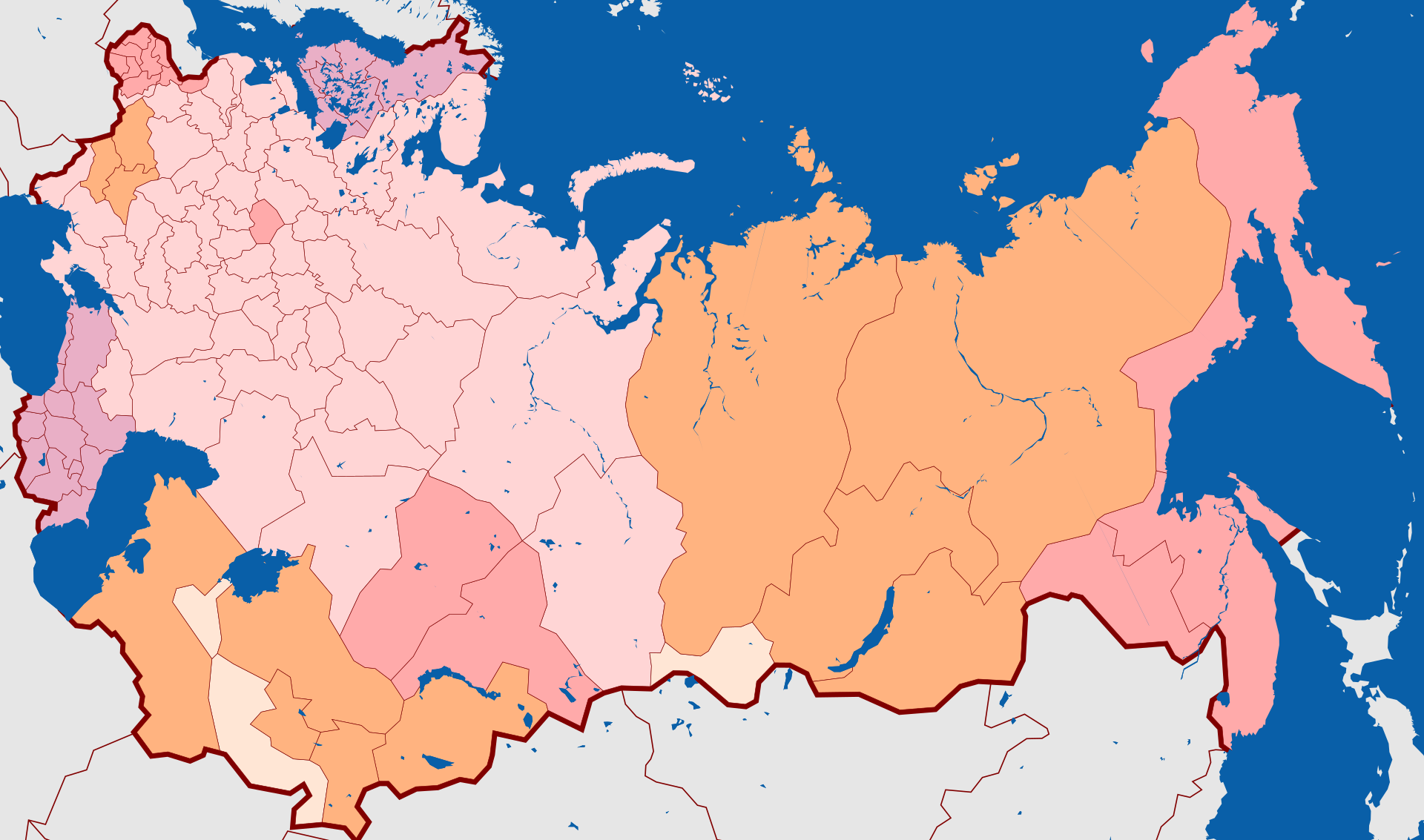
Czarist Russia was a traditional empire, and, other than the late addition of the largely Turkic-language Central Asian lands being administered separately, it did not have separate ethnic or linguistically based administrative divisions. It DID have internal lower-level administrative divisions, but not ethnic or linguistic ones, unlike the USSR.

Indeed, a map of 1914 Czarist Russia at Wikipedia shows that except for Poland (a separate kingdom ruled by the czars before 1864 — it was really Russian internal territory after that, legal fictions aside) and Finland (a separate grand duchy), governates, the main administrative division below the imperial whole, did not follow ethnic or linguistic boundaries at all.


As for Ukraine? No such country existed at the time its current lands were acquired, in a series of wars and other actions, by Moscow. In general, the Crimea and chunks of eastern Ukraine, the "Wild Fields," were held by khanates that were fragmentary descendants of Genghis Khan's Mongol world, along with various free-roaming Cossack groups. Northwestern Ukraine was part of the Poland-Lithuania commonwealth. Bits of southern Ukraine belonged to the Ottomans. (And other parts of it, for at least part of this period, were the Khanate of the Crimea, which was often under some degree of Ottoman supervision.) And, as shown above, no such region called "Ukraine" existed afterward.

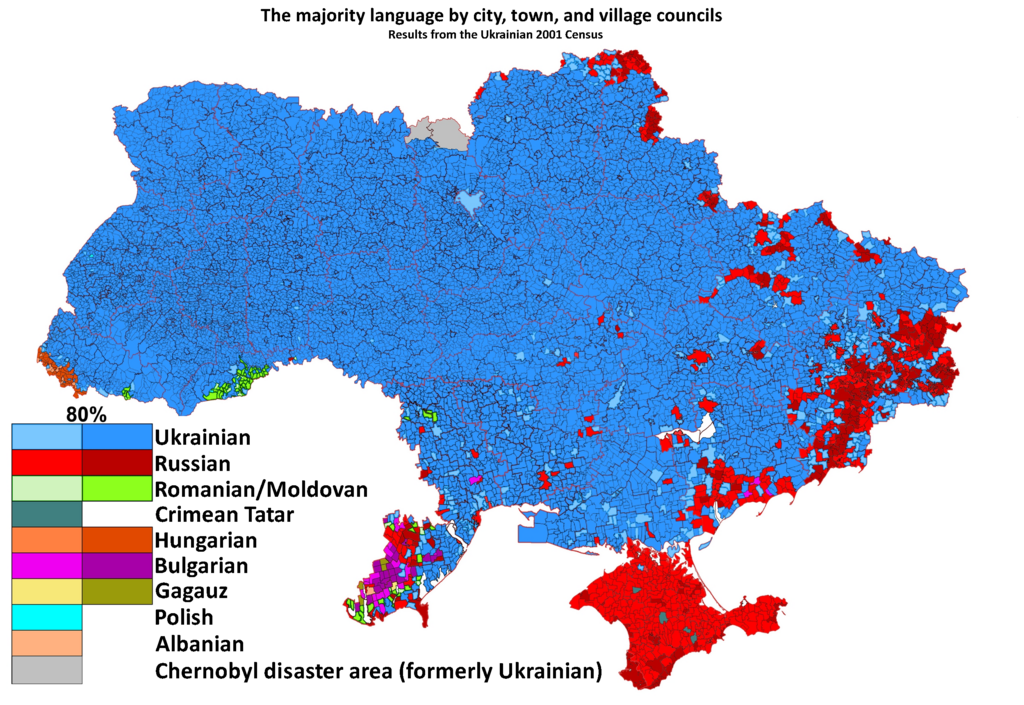
As far as ethnic and linguistic boundaries, or linguistic ones? Much of the northeastern portion of today's Ukraine was Russian-majority pre-1918. Russian emigration to "left-bank Ukraine" started in the 1800s. So, tankies and western imperialists alike can blame Commissar of Nationalities Uncle Joe Stalin for drawing bad borders. They can also blame Nikita Khrushchev for adding Crimea to Ukraine when he was premier. (That said, the Donbas area, with its two small separatist "republics" just recognized by Putin, has had a plurality, if not a majority, of Ukrainians by ethnicity, but a Russian majority by language. For example, Mariupol is split almost exactly even on ethnicity, though a large Russian majority by language. And, to riff on a Counterpunch piece, said recognition by Putin would seem to be an anti-confidence building measure.)

Don't believe me? See this map from Moon of Alabama about the expansion of Ukraine, including left-bank Ukraine.


Oh, read the post, too.

Here's a good map of language pluralities in Ukraine's regions, from Wikipedia's article about that:


In short, there hadn't been a Slav-led (or quasi) "Ukraine" as an independent country between the last days of the old Kievan Rus and the breakup of the USSR. And, even Kievan Rus only extended to a limited area of today's left-bank Ukraine, most of which at that time was non-Slavic, plus, until its breakup, even if they spoke Slavic first, they were still Vikings by descent. Where we're at, in one sense, is something halfway akin to Sarajevo 1914.

Re the neo-Nazis? Let's not forget that during the Russian Civil War, the then-area of Ukraine was a hotbed of Whites. World War II saw the Vlasov Army and other things, of course.

And, neo-Nazis aside, as this actually good story from the Pittsburgh Post-Gazette testifies, Ukraine, like Russia, has its share of corrupt oligarchs.

(Of course, a Hahhhvahd like Kimberly St. Julian-Varnon will blithely ignore the NATO meddling issue, and also pretend that ethnic or linguistic Russians in Ukraine don't exist, and not even look at larger framing issues, after claiming in a tweet that this was never about NATO. I quote-tweeted to say that I'd accept it never was SOLELY about NATO, but never about NATO period? Wrroonnnggg. 

And, try this analogy on:

You can thank me later.

You also won't be told that Ukraine was supposed to write a new constitution as part of the Minsk agreements, officially recognizing decentralization and Donbas rights. In reality, it's still running on its 1996 Constitution with early 2000s pre-Minsk amendments. Reuters notes "violations by both sides," which Julian-Varnon, Noah Smith etc won't tell you. Full text in English here.)

At the same time, contra Mark Ames, Yasha Levine, Max Blumenthal, Aaron Maté and the other allegedly outside the box stenos who actually come off in many ways Putin-stanners, Putin himself, before invading Crimea, did pledge not to violate Ukraine's territorial integrity. That one's in writing, too, albeit pre-Putin, of course. And, that pre-Putin? 1994 was also pre-NATO expansion, both in terms of expanded membership and definitely the narrower planned or actual troop presence. So, Putin, with that agreement theoretically being tied to larger Eastern European security issues, can argue the US and UK broke it first. Or, he can argue that the US has broken that Budapest Accord via economic bullying, also specifically verboten.

Steven Pifer either knows all this and is duplicitous, or he doesn't and he's an idiot above his pay grade.

Many people are quoting Biden's CIA head, William Burns, a former ambassador to Russia in the BushCo era, for what he told his boss, Condi Rice. I'm linking to a particular Substack:

Ukrainian entry into NATO is the brightest of all red lines for the Russian elite (not just Putin). In more than two and a half years of conversations with key Russian players, from knuckle-draggers in the dark recesses of the Kremlin to Putin’s sharpest liberal critics, I have yet to find anyone who views Ukraine in NATO as anything other than a direct challenge to Russian interests.
I link there for two reasons. One, Nonzero calls out the Munich bullshit, started in this case by Zelensky himself quite willfully speaking there. Two, he links to Peter Beinart, who has more insight, including noting that Burns wasn't alone in his thought. And, in a petard moment, Beinart notes that ... Steven Pifer called Bush's statement that Ukraine would eventually join NATO "a real mistake." Bonus: A commenter at Nonzero notes that even Teapot Tommy Friedman says the US and NATO "aren't innocent bystanders."


Now history doesn't actually rhyme, whether as farce or tragedy. It's also neither cyclical nor determinist. So, because Ukraine has barely existed in the past doesn't mean it shouldn't exist today. But, it does mean that the issue of what Ukraine is, is not so cut and dried as most Americans may think.

At the third time, because history is often overdetermined, though not deterministic, Russia does have a history of meddling in Ukraine. Remember the poisoning of Viktor Yushchenko? On the second hand, that happened after the first expansion of NATO, in 1999, and after its second expansion, earlier in 2004. That's not to "justify" Putin, as I don't in general. But, it IS to offer background.

December 27, 2013

"Wilson" review: Wrong from the start — too much hagiography, not enough analysis

WilsonWilson by A. Scott Berg

My rating: 1 of 5 stars


At the end of this book, Scott Berg describes what propelled him to undertake this biography. He says he had read a number of biographies, and none of them captured Wilson's essence.

Well, now we can add one more to that list.

Berg has written, but not quite crafted, a tome that is clearly hagiographic, and in being such, also clearly lacks analysis and depth, despite some 750 pages of body text.

I found myself by the end of the first chapter questioning Berg's claims about the depth of Wilson's support for women's suffrage, and simply shaking my head at Berg's conceit that Wilson alleged wrestled all his life with issues of race.

And, it is on that subject, throughout the book, that Berg's hagiography is most apparent. While mentioning that Wilson grew up in the South, and that his father was briefly a Confederate Army chaplain, he nowhere explicitly talks about his father owning slaves.

He does mention that his Presidential cabinet was almost all Southerners, most of them unreconstructed, but doesn't mention how unreconstructed they were.

He tries to downplay Wilson's official segregation of Washington. And fails.

On women's suffrage, the proper analytical dots aren't connected. He doesn't ask if Wilson's refusal to support woman's suffrage on the federal level isn't due to his worry that this would make his failure to support black suffrage on the federal level — black suffrage already in the 15th Amendment — all the more hypocritical.

There's plenty of evidence Wilson was a racist by enlightened standards of his day, let alone ours. No, Scott Berg, not nearly every white person made "darkie" jokes, thought blacks were lazy, etc. And never did Wilson seriously "wrestle" with issues of race.

But, the lack of analysis doesn't stop there.

Wilson believed, overtly, he had been directly called to his office by god in a way no other president afterward did until George W. Bush. Berg, despite giving each chapter of his book a Biblical title like "Sinai" or "Gethsamane" (titles eyebrow-raising in and of themselves) never asks how this affected Wilson's domestic record. And, even when connecting it to World War I and Versailles and the League of Nations, he still doesn't go into a lot of detail.

Given that Wilson's religious background was not like Bush's, but was a traditional Calvinism theoretically including double predestination, unlike Bush's psycho-therapeutic evangelical Protestantism, I certainly would, and do, wonder: After the Senate defeat of the League, rather than pour out ire at Sen. Henry Cabot Lodge, etc., did Wilson just once, for a moment, wonder if this meant he had been negatively predestined on this issue? Berg never asks.

More to the point, and also related to Wilson's belief he had been messianically chosen — why was Wilson such a "hater"? And, it's more than in modern social media buzzspeak. Once he started hating somebody, he kept on hating them. He cut his successor as Princeton president and Col. House, among others, permanently out of his loop after he started hating them. Berg doesn't take a look at the "why" of this at all.

And, the hagiography, combined with errors of omission, also doesn't stop there.

Berg almost totally glosses over Wilson's massive amount of interventionism in Central America. Oh, sure, several pages are devoted to Mexico. But the Caribbean? A couple of mentions, no more than a paragraph's worth.

He nowhere wrestles with the reality of Wilson's quote: "I am going to teach the South American republics to elect good men."

His discussion of the formation of the Federal Reserve is superficial. As part of that superficiality, Berg doesn't ask whether the Federal Reserve, as a solution to U.S. banking needs, really was that progressive. (The 2008 meltdown and the actions, or non-actions, of the New York Federal Reserve tell us "no.")

But, the hagiography is just warming up!

On page 328, he claims that Wilson's 1913 record of accomplishments, including the Federal Reserve, Clayton Anti-Trust Act, creation of the Federal Trade Commission, a new tariff and other things, was the greatest legislative outburst since the foundation of the Republic!

Wrong!

I'll take Lincoln's 1862 over that — Homestead Act, Morrill Act for land-grant colleges, transcontinental railroad legislation, first and second Confiscation Acts that were slowly setting the country on the road to emancipation in the Civil War, and the preliminary Emancipation Proclamation itself.

Wouldn't you?

But, we haven't gotten to the outright errors of fact yet! There's several related to World War 1.

First, no, Japan was NOT "forced" to declare war because of its treaty with Great Britain. Rather, said treaty gave Japan the legal cover to declare war and not be an aggressor. How Berg got this wrong is totally beyond me, and frankly, I don't even want to try to figure it out.

Second, on page 395, the torpedoing of the Sussex, as a ship traveling between two belligerents and not a belligerent and a neutral, had nothing to do with the United States needing to consider entering the war.

Which now leads us from errors of fact back to hagiography.

Berg talks about his hero worship of Walter Bagehot (along with William Gladstone), and his wanting to graft British parliamentary government onto the American tripartate system.

He never asks how this might have made Wilson un-neutral not just in heart, but how his heart expressed itself, from the start of the war. (Author Walter Karp details how it did.) For example, why did Wilson never protest Britain's blockade by extension, just as illegal under international law as the German submarine zones?

The Bagehot issue leads us back to analysis of Wilson as public policy intellectual. Why, if these ideas are so brilliant, have none of them been adopted? Even LBJ, for all his effort to be like a prime minister in some ways, didn't go that far.

Was it in part, in the early years after Wilson's presidency, the fact that he was seen as such a hater? Had that alone made these ideas that toxic?

We're not done with the errors of fact yet, though!

Why, if Wilson wanted "no part" of invading Russia, was the U.S. in Russia as long as all the other Western countries? Actually, Wilson overrode the Department of War to approve the Archangel campaign. That said, Berg also gets issues of Polish involvement, Versailles and post-Versailles (it was a Polish nationalist fight) and Japanese involvement wrong, too. Add to that something not strictly a factual error, like calling the Czech Legion "freedom fighters," and you can see how bad this section of the book is.

As for his coverage of Versailles? Margaret MacMillan's "Paris 1919" is far better.

The only interesting thing to the good is Berg covering Wilson's health and his apparently suffering several mini-strokes during Versailles and after, up to his major stroke in Pueblo. But, given that Wikipedia notes Wilson's first stroke may have been in 1895, I'm sure any good bio of Wilson does similar.

I had planned on two-starring this book when I started writing my review from my notes. But I can't. It's that bad, and needs a serious one-star review.


View all my reviews

April 26, 2011

Libya - the 'rough beast'

Former Lt. Gen. Robert Dubik has both advice and hindsight on Libya for President Obama. Among the best hindsight, that Juan Cole and other liberal interventionists need to heed, comes from Bosnia, per Dubik, but could also come from Afghanistan or even, to some degree, Iraq, and that is — air power doesn't "win" anything. Libya once again shows that, if not boots, tanks and Bradleys on the ground are necessary.

The advice? If we're not going to pull out or just "avoid losing," then we have to do more, he says:
To give (rebels) a fighting chance, NATO must put military advisers and combat air controllers on the ground — not just British, French and Italian, but also a small number of American ones.
Try selling that to Congress and the American public, Mr. Nobel Peace Prize. Actually, no, let war hawks Lindsey Graham and John McCain go on the sales line first.

Then, let's see the Juan Coles of the world are still so gung-ho about interventionism.

The "rough beast"? Riffing on W.B. Yeats, Libya is part of the Arab gyre of Roger Cohen's focus. And, Bethlehems in the Middle East as birthplaces for world-transforming events are few and far between. The actual site is the birthplace, if anything, to riff on the Arab world, of Israeli perfidy, Palestinian Authority ineptness, corruption and weakness and ... a Hamas threatening to be born with more virulence than ever.

With that in mind, Preznit Kumbaya had better be damned sure he gets different rebels in Libya straightened out before further intervening.

April 04, 2011

Sam Power as next Sec'y of State? Ugh

Oh, she's a smart mind, indeed. And, I won't question her moral dedication. But, the U.S. can't get involved in every bit of every foreign nation's internal unrest, first of all. So, the idea of her becoming Obama's next Secretary of State, or National Security Adviser? Pass.


Second of all, who decides when it's just "unrest" and when it's "genocide"? Take former Syrian President Hafez Assad. Were his actions against his own people "just" putting down unrest, or something more? And, beyond racial or ethnic lines, how many groups will ask for a redefinition of what all constitutes genocide?

I do know, from what I've read about here that, smart as she is, she's not wrestled with those questions.

Beyond that, she's either a hypocrite, clueless, or a big suck-up, even by Beltway standards, if she thinks President Obama has "waged" a two-year campaign of elevating human rights issues, and that that led to intervention in Libya.

The reality?

1. First and foremost, just a month ago, we vetoed a UN Security Council resolution on Israel and West Bank settlements, arguably a human rights violation itself.
2. Right now, we've been quiet on Bahrain squashing and quashing Shi'ite dissent.
3. A year ago, Obama had Hillary Clinton kissing Hosni Mubarak's ass.

March 30, 2011

The unbearable Libya lightness of Juan Cole

Cole is someone for whom I, like Glenn Greenwald, had a lot of respect for on issues related to Iraq and Afghanistan. But, with a breezy, one-paragraph defense of the Libya incursion, based largely on the fig leaf of UN blessing (a fig leaf that at least Secretary of State Hillary Clinton thinks is selective, and not blocking the U.S. from selling arms to the rebels), it's really hard to take him seriously on his defense.

I left a comment on his one-paragraph blog post, asking if he agrees with Clinton, that we have the right to arm the rebels now.

We'll see what his answer is, and we'll see how this shows how little or how much the two magic letters "UN" are a shibboleth for him.

Here's Greenwald's open letter to Cole.

Or, Juan, what do we do if, say, the UN Security Council calls for members to act in the Ivory Coast?

Or, what do we do when the other 14 Security Council members condemn Israeli settlements? Well, we just found out the answer to that one.

The "liberal" half of America's ruling class will exploit "UN" in whatever ways it wants. And you're dumb enough to tag along and provide "cover."

Beyond that, his father's years of service in the Army Signal Corps (per Cole's Wiki page) and his admission that he sometimes does consulting work for the military (details, Juan?) might mean we need to raise an eyebrow at just how liberal he actually is.

Libya no-fly zones don't create no-fight Gadhafi — what next?

First, it's clear that pro-government forces in Libya have plenty of fight left.

So, what's next?

For the Nobel Peace Prize Preznit Kumbaya, it's yet more mission creep, apparently.

That includes now using A-10 close-level attack planes on Gadhafi's ground artillery and urban defenses. (And getting the U.S. mainstream media to not immediately report advance discussion of this for "patriotic" reasons.)

That includes possibly arming rebels in spite of UN prohibition. (Guess that UN fig leaf is a selective one for liberal interventionists.) And, I left a semi-snarky comment for Juan Cole, asking him to address that within his defense of the Libya incursion.

It's also a problem the U.S. is considering arming the rebels despite still not knowing them well.

Obama practicing "universalism lite"

Couldn't agree more with this observation.

That said, beyond a "lite" version of Wilsonian interventionism, isn't everything Obama does a "lite" version of something substantive?

March 29, 2011

Neocon vs neolib Wilsonian interventionists

Per Glenn Greenwald, Stephen Walt totally nails this issue.

The only difference between a Juan Cole and a Bill Kristol is whether or not the UN (or maybe, NATO) OKs an international intervention. That said, Cole may actually be a bit of a paleolib on domestic policy, but, it's a convenient shorthand.

Here's Walt, delivering the smackdown to liberal interventionalist Howard Dean:
During (a)Q & A, I talked about the narrowness of foreign policy debate in Washington and the close political kinship between the liberal interventionists of the Democratic Party and the neoconservatives that dominate the GOP. At one point, I said that "liberal interventionists are just ‘kinder, gentler' neocons, and neocons are just liberal interventionists on steroids."

Dean challenged me rather forcefully on this point, declaring that there was simply no similarity whatsoever between a smart and sensible person like U.N. Ambassador Susan Rice and a "crazy guy" like Paul Wolfowitz. (I didn't write down Dean's exact words, but I am certain that he portrayed Wolfowitz in more-or-less those terms). I responded by listing all the similarites between the two schools of thought, and the discussion went on from there.

I mention this anecdote because I wonder what Dean would say now. In case you hadn't noticed, over the weekend President Obama took the nation to war against Libya, largely on the advice of liberal interventionists like Ambassador Rice, Secretary of State Hillary Clinton, and NSC aides Samantha Power and Michael McFaul.
That's really the only difference on how the two sides split on the issue of American exceptionalism, too - how nicely we "package" exceptionalist claims for the outside world to see.

Walt goes on to worry about mission creep, the degree of continued involvement and related issues. All spot on.

He closes with this worrisome line:
And who's the big winner here? Back in Beijing, China's leaders must be smiling as they watch Washington walk open-eyed into another potential quagmire.
I can't argue.

March 26, 2011

A question for Wilsonian idealists

Samantha Power is a strong Wilsonian interventionist within the Obama administration. VERY strong:

Per this story, she's apparently so powerful, and perhaps so worrisome to Team Obama's PR on interventionism, that she wasn't made available for an interview for the story, as this indicates:
Precisely what parts of the unfolding policy (in Libya) Power advocated or opposed aren't clear. She declined a request for an interview, and White House officials declined to comment on her role.
On the political fallout issue, here's her POV:
Power has long argued that politicians shy away from humanitarian intervention because they see too much domestic political risk with little payoff for saving foreign lives. ...

The prevailing political theory in the United States, Power said, is that "you don't get any extra credit for doing the right thing," that U.S. casualties for the sake of humanitarianism cost politicians power and support. "It's up to us on the outside" to change that calculus, she said.
Beyond the domestic political risk, let's take a look at a nut graf:
After the publication of "A Problem From Hell," Power said in a wide-ranging 2002 discussion with Boston interviewer Robert Birnbaum that she believes "there is a moral obligation to do something about gross human rights violations" even if they don't meet the definition of genocide.
But, to do WHAT? And, by what moral calculus do we judge what to do?

Why Bosnia but not Uganda, back in Clinton Administration days? Was it white and European vs. nonwhite and African?

Why Libya and not Yemen today? Is it oil or the lack thereof? Or, with Bahrain, the fact that we have such a military presence there already as to be semi-intimidating without further effort?

Along those lines, if any intervention is done in the name of "international stability," first thing I am going to do is check how much oil that country produces.

And, sorry, Ms. Power, but the U.S. checkbook isn't unlimited. Are you going to dun the rest of the UN every time you decide the U.S. should intervene somewhere? Are you, per a Bob Herbert, going to try to sell the American public on every price tag? Or, like Bush with his two wars, will you not only not ask Congress for declarations of war, but will you try to run every intervention "off budget"?

Remember, the French Revolution started not just because of bad harvests, but because Comte de Vergennes had bankrupted France ... by intervention, intervention in the American Revolution.

Beyond the finances, what about human lives, especially when it becomes clear that air power may make a Roman-style, if temporary, "desert" out of mini-Carthages, but, it won't quell unrest on the ground. Will you try to sell that cost to the American public?

And, again, on what utilitarian calculus? Libya's level of unrest IS just about the same as Yemen's. So, why are we there?

How great a level of civil unrest is "permitted"? Is an "Obama doctrine" forthcoming?

March 25, 2011

The dangers of our Libya involvement

First, as I have noted before, there always were mliitary-related issues, such as mission creep, command and control, etc. And, those issues are raising their head right now, as allies continue to disagree on what the final goal of our work in Libya should be. Air power alone won't depose Gadhafi, unless ramped up to a point to offend Turkey and the Arab League, which really aren't on board with deposing him anyway.

For example, France has extended diplomatic recognition to the rebels. So, it's definitely going to have different strategy and aims.

As for that, those rebels, watch out what you ask for.

Both the Atlantic and the Wall Street Journal (h/t Salon) point out that the opposition to Gadhafi is not fully organized, but to the degree it IS organized, contains known Islamists, some of them of the same stripe that fought U.S. forces in Iraq.

Beyond Islamism, there's tribalism and other matters that reflect on the lack of organization, and lack of true national representation, in the Gadhafi opposition. More on that from McClatchy. That, in turn, means this current group could then devolve into civil war itself if it deposes Gadhafi.

And, Massimo Pigliucci, that's another reason you and other Wilsonian interventionists are wrong, and short-sighted to boot.