SocraticGadfly: Reconstruction (Civil War)
Showing posts with label Reconstruction (Civil War). Show all posts

March 17, 2023

Yet another case of Lincoln legend vs reality

The Fall of the House of Dixie: The Civil War and the Social Revolution That Transformed the South

The Fall of the House of Dixie: The Civil War and the Social Revolution That Transformed the South by Bruce Levine
My rating: 5 of 5 stars

Add this to your Civil War reading list. I'm going to give a long review, but one that nonetheless still just gives the backbone of the book.

Lincoln once said that “somehow” the war was about slavery, even though most the North, including him, denied it at the start.

Most of the 11 Confederate states’ ordinances of secession admitted it, though. So, too, did the Confederate Constitution.

So, Bruce Levine starts there, in “The Fall of the House of Dixie.” (You know this book is good, beyond that, when Eric Foner is among those named in the Acknowledgements.)

As in, starts right there on page 4, with states from the 1860 US Census. But, we're putting that at the end of this expanded and edited version of my Goodreads review to get the problematic Lincoln legend, of the likes of mainstream Civil War authors and auteurs like Steven Spielberg, versus the reality, up top.

Details of Census numbers on slave ownership will be at the bottom.

Of the many other things in this excellent book, one more needs to be cited. And, that's the one we're going to move up top.

And, that is Levine’s documentation of Lincoln’s war-long reticence over land redistribution. Reconstruction would of course have gone better with him still alive. He would have reacted to the Klan, Knights of the White Camelia etc. much more rapidly than Andy Johnson. Example? The Second Confiscation Act of 1862 gave him the formal right to seize not only slaves of disloyal owners, but their other property. However, and as Levine notes, AT LINCOLN’S INSISTENCE, on the death of said rebels, all property except their slaves would revert to their heirs. Rich Northern whites might pay to rent it under such terms; poor blacks couldn’t afford to touch it.

In a related matter, in the reconstruction of Louisiana’s beginnings, Lincoln ignored Salmon Chase’s cries not to allow its new state government to pass “as a temporary arrangement” special laws governing the newly freed slaves as a “laboring, landless and homeless class.”

Levine doesn’t tackle the colonization issue, but the two paragraphs above should refute the likes of David Reynolds and James Oakes about just how high-minded Lincoln was, or was not, about the future of freed slaves after Jan. 1, 1863. Was he continuing to evolve? Yes. Might have continued to evolve further, had he lived? Yes. Did he also, as I have noted to those two gentlemen, likely discuss the colonization issue with Spoons Butler the day before his assassination? Yes.

So, Lincoln's "rosewater," already being implemented in Louisiana (and West Virginia, and bits of remnant Virginia) before he died, if carried over into Reconstruction, probably would have left freed slaves almost as high and dry as did Andy Johnson.

Yes, Lincoln would have given them more physical protection. But, in all likelihood, he would have offered them little more satisfaction on land. After all, Grant didn't do anything after he succeeded Johnson. And, to the degree he faced the issue as president, or jokingly in a militia unit during the Black Hawk War, Lincoln never really showed an understanding — or rather, never really showed a willingness to look behind the white stance — on American Indian land issues, either.

Was Lincoln our nation's greatest president? Yes. Was he 5-star? Only if we're grading on a curve.

One lesser thing to note. Levine also shows how racist Sherman was, up to the end of the war. Grant, and many other non-McClellan Northern generals, had at least moderated racism they had in 1861. Not Unc' Billy.

And now, back to the other main part of the book's original, and where Levine started: The 1860 US Census and slave ownership.

In all 15 slave states, 1 in 4 whites were slaveowners. (Levine later notes that in the 11 seceding states it was 1 in 3, so adjust the below accordingly.)

The typical master owned 4-6 slaves, he says. But, that was just the bottom rung of the highly capitalistic slaveowning South.

One in eight Southern masters had 20 or more slaves, and thus officially counted as “planters” according to the Census. The math says that’s 3 percent of Southern whites. In the seceding states, about 5 percent.

Next tier? The “ten thousand families” that owned 50 or more slaves, and now it gets more fun because Levine starts naming names. Allegedly “good master” Robert E. Lee and his wife were here; he and Mary Fitzhugh Custis Lee inherited 60 slaves with their Arlington mansion from her father, George Washington Parke Custis. (And that name should remind you of Lee’s connections.) As for the truth on Lee's brutality level toward slaves, it's not just modern research that shows this; one of his own freed slaves "gave testimony" in 1866, information used by modern researchers. Edmund Ruffin is in this group. So are two couples cited extensively in this book.

Next tier? The 1 in 15 planter families who owned 100 or more slaves, or 3,000 families. Jeff Davis and Robert Toombs were among this small group.

The semifinal cut for Levine? Those owning 250 or more slaves. Davis’ brother Joseph is here. So is Howell Cobb. So is the vile James Henry Hammond and the incendiary Robert Barnwell Rhett Sr. As is James Chesnut Sr., father-in-law of noted Confederate diarist Mary Boykin Chesnut.

The final cut? 500. Here, the father of the wife of one couple in the 50-plus class is here.

Add in, on the photo plates pages, the 1860 Census map of slave ownership percentages by county, and we’re good to go with the basic story.

Levine, lumping 1861 and 1862 together, does a yearly overview of the North’s military progress combined with the South’s reaction, much of it from people named in the various levels of slave ownership above. “Poor whites,” whether slaveless or the 4-6 class are also cited in detail. So are the two most states-rightists governors, Joseph E. Brown and Zebulon Vance, along with others noting the Confederacy’s internal contradictions.

Those contradictions culminate when Davis pushes a version of Patrick Cleburne’s proposal to arm slaves in exchange for (limited) freedom. Besides the argument that this would shatter the Confederacy’s basic operating principle, Levine notes that some planters still rejected the idea that slaves could fight. Others, on the other hand, thought they would — and for the Union, as soon as you gave them a Southern gun.


View all my reviews

August 19, 2020

Socialism don't mean what you think, nor rewriting history nor rewriting current events over Black Lives Matter


In what is best described as an act of Kabuki theater, the Cooke County Commissioners Court considered voting Aug. 17 for pretending to put the future of a Confederate statue and memorial on its courthouse lawn in the hands of voters.

Finding a loophole in Texas law, County Judge Jason Brinkley called a special meeting of the court to vote on a nonbinding referendum on the matter. Texas law allows counties of under 40,000 to do so.

Matthew McGee got to the point of the referendum, among speakers in public forum.

 “I would like to remind people the referendum is non-binding. It’s still 100 percent up to the commissioners to act,” he said, making a reference to a “poll on racism.”

“It’s still the only county doing such a poll. It’s going to be national news and it’s going to be embarrassing,” he said.

Turns out Cooke County won't make the teevee screens. The Commissioners Court's four commissioners ignored Brinkley and voted 4-1 to reject the referendum idea and do nothing.

Surprised? No. Disheartened? Yes. No so disheartened as to hope that protestors are serious and stay out there.

As for the speakers?

Most supporters of keeping the statue ignored that Texas seceded over slavery.

Rachel Moore talked about a historic 1913 gathering of CSA and US troops at Gettysburg as healing. She either was unaware, or chose to ignore, that black US troops were excluded.

And, of course, people like this call youth protestors "socialists" as a pejorative, ignoring the meeting of that word, while accusing the protestors of rewriting history, when history was being rewritten even before Rutherford Hayes agreed to end Reconstruction.

Ignorance was not confined to past history, nor to speakers.

“I question Black Lives Matter. Is it exclusive by definition? Has Black Lives Matter produced any results?” Precinct 1 Commissioner Gary Hollowell asked.

The truth is that, just a week ago, the city of Austin voted to cut one-third of the bloat from its police budget and that it also made police actions reviewable by moving "internal affairs division" outside the department. BLM protests led a heretofore relatively conservative Austin City Council to take this bold step forward. (More from Grits here on how George Floyd and a local shooting by cop were the fuse for long-standing ideas to cross the finish line.)

Precinct 4 Commissioner Leon Klement seemed to indicate, in lines with Hollowell, that the "problem" was only one one side.

“If that rock causes you to hate somebody, that’s on you,” he said. As with Hollowell, it seemed the comment was directed only toward anti-statue protestors.

Precinct 3 Commissioner John Klement reference slavery having a global history, and slaves in the North, but didn't mention the race-based history of slavery in the U.S. He, like cousin Leon, noted his family had come from Germany after the Civil War but the statue was part of their history.

Yes? And yours truly wrote a column noting that Bismarck's Kulturkampf against German Catholics was part of your history, too, and suggesting you analogize from that. And you did not.

Precinct 2 Commissioner Jason Snuggs added that some people told him they could see the statue being moved, but not under this pressure.

So no, Bob Smith, Vince Rippy and other members of the self-styled Cooke County Activists for Truth in Society, the commissioners court did NOT display "exceptional courage." If not craven cowardice, they were closer to that than what you claim. The "Exceptional courage" was displayed a month ago by Gainesville Mayor Jim Goldsworthy and the rest of the Gainesville City Council when it voted to move the city's statue in the face of opposition from people like you.

Also of note? Mr. Young Republicans PR Tucker Craft (see here on earlier meetings and background) was not at this meeting.

I think part of what's lying behind less reactionary members of the county court, and others, is something that I've seen on Twitter, the idea that social changes happen by magic, without protest. I of course cited Martin Luther King back to the first few people who pulled that. I think a minority of people sincerely believe that, but for the majority, it's just another "talk to the back of the hand" stance.

Otherwise, it's clear that entrenched beliefs don't change, even when presented with plenty of evidence to create cognitive dissonance. Despite protestors repeatedly saying in commissioners court meetings that they're from Gainesville, opponents continue to claim they're all agitators from Denton. If people don't have the "exceptional courage" to critically examine their own belief systems, they're going to be poor judges of who else displays "exceptional courage." But, it's also easier to pretend that issues aren't real when you pretend that people in your own back yard aren't the ones raising the issue.

This all reminds me of Max Planck cracking wise about how what was really needed for a new scientific theory to become accepted was to have enough old scientists die off.

June 25, 2015

The #LostCause, the #ConfederateFlag, and myth-making

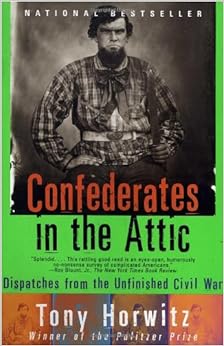
Tony Horwitz, award-winning author of Confederates in the Attic, a great book, brings these threads all together.

Although it's not at the top of the piece, he blows to smithereens the idea that the Civil War was about states' rights. Sadly (but by no means unexpectedly), I have family members who still believe this.

I've referenced the CSA constitution, and Confederate state articles of secession, before. He goes beyond that to quote CSA Vice President Alexander Stephens' in his Cornerstone speech, between Lincoln's inauguration and Fort Sumter:
The evidence is overwhelming that Southern states seceded and fought to maintain slavery. Don’t believe me; believe the words of secessionists and Confederate leaders. Among the most often cited is Confederate vice-president Alexander Stephens who in 1861 declared the Founders “fundamentally wrong” in judging all humans equal. “Our new government is founded upon exactly the opposite idea; its cornerstone rests upon the great truth, that the negro is not equal to the white man; that slavery—the subordination to the superior race—is his natural and normal condition.”

 I want to go a bit further than Horwitz’s quote, per Wiki’s further quote of the speech:
Many governments have been founded upon the principle of the subordination and serfdom of certain classes of the same race; such were and are in violation of the laws of nature. Our system commits no such violation of nature's laws.
Of course, this is not true.

In his own day, “poor whites,” if not actually called “white trash” per a previous blog post of mine, were called that. Or “mudsills” of Stephens' own day, a term applied to the likes of Andrew Johnson, who was just as racist as Alexander Stephens.

Horwitz next agrees with me that the likes of South Carolina Gov. Nikki Haley and senior Senator and Presidential candidate Lindsey Graham, aka Huckleberry J. Butchmeup, are engaged in head fakes, messaging control, and ultimately, downright turd-polishing:
I’m not very optimistic that the debate over South Carolina’s flag will bring a deeper reckoning. Furling the statehouse flag may bring temporary relief to South Carolinians, but what we truly need to bury is the gauzy fiction that the antebellum South was in any way benign, or that slavery and white supremacy weren’t the cornerstone of the Confederacy. Only then, perhaps, will we be able to say that the murdered in Charleston didn’t die in vain, and that the Lost Cause, at last, is well and truly lost.
He’s right. If we can’t stop them from polishing turds, we can at least make sure that true scratch-and-sniff smells start emanating from those turds during their polishing.

From there, he gets to the last bastion of the Lost Cause, which is important since the Confederate (battle) flag at the South Carolina Capitol actually flies over a war memorial.

And, that’s the issue of “valor.”

Horwitz notes:
Most flag defenders, however, are sincere when they say they cherish the banner as a symbol of their ancestors’ valor. About 20 percent of white Southern males of military age died in the Civil War. In South Carolina the toll was even higher, and thousands more were left maimed, their farms and homes in ruins. For many descendants of Southern soldiers, the rebel flag recalls that sacrifice, and taking it down dishonors those who fought under the banner. No one wants to be asked to spit on their ancestors’ graves.
I don’t doubt their sincerity. Nor am I asking them to spit on their ancestors’ graves.

However, and to put it directly, with a blunt analogy?

Many Germans in the 1950s probably said the same about their dads and older brothers, not just the ones in the Wehrmacht, but those in the Waffen SS, too.

So, I’m not asking you to spit on your ancestors’ graves. I am asking you to be realistic about just what great-great-grandpa Clem fought for.

And, it wasn’t “states’ rights.”

As for the winning the war, but losing the narrative?

It didn't help that America was led by the worst president in its history from 1865-69. Sorry, modern Democrats, or other liberals, but Shrub Bush is not the bottom No. 1; he's not even in the bottom five in my ranking. Old Buck, James Buchanan, is the only real competitor to Andy Johnson. It didn't help much more that Johnson was followed by Useless Grant, along with his "let us have peace" campaign theme, who looked like a good Reconstruction president only by the light of the soft bigotry of low expectations.

But, part of this narrative could have been fixed, at least under Grant, per a bon mot I've uttered before.

If we had had 200,000 Bluecoats in the South for a generation, rather than 20,000 for a decade, Reconstruction might have been different. It couldn't have been a lot worse, could it?

(If you're looking for books on Reconstruction, Eric Foner's volume by that name is your starting point.)

June 24, 2015

#Slavery, the #ConfederateFlag, and symbols of racism

The severe whipping at left is, of course, a symbol of racism. So, too, is the whip at right, used to inflict wounds on the slave pictured at left.

Why pretend otherwise?

This was the reality of race-based slavery in the U.S. and elsewhere in the New World for centuries.


The iron mask and collar, at left, was also an image of slavery. It's an image of control, of a master's power over even a slave's voice.

And, if, per the above picture, a whip was not deemed sufficient to control slaves, something almost medieval, like this adaptation of a cotton screw press, was another instrument of punishment, and an image and symbol of slavery.

But there are more.

I suggest going to this page of images from the University of Virginia for more "enlightenment" on images related to slavery. Since U.S. slavery was race-based, and from there went on to a belief in the mental inferiority of an invented "race" called black, these are all also symbols of racism.
But, they're not the only ones.

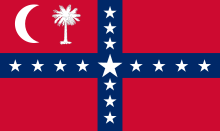
This, too, is a symbol of slavery — the original Confederate battle flag at left. And, it didn't really appear out of nowhere — note its broad similarity to South Carolina's flag of secession, at right, and the rectangular version was proposed as a CSA flag.

The "St. Andrews Cross" or battle flag has 13 stars, for the 11 seceding states plus the attempts in Missouri and Kentucky; South Carolina's 15 are for all 1861 slave states.

This shows, first, that the Confederate battle flag, while created for battlefield visibility, and for more distinction from "Old Glory" than the original Confederate governmental flag, the "Stars and Bars," that it was already being adapted to politics early on. And, when it was decided to move on from the Stars and Bars, for a more Confederate-looking flag?

This, "The Stainless Banner," incorporating the battle flag, became a symbol of racism on May 1, 1863. It was followed by "The Blood-Stained Banner" on March 4, 1865.  (The Stainless Banner is an all-white union, if  it's hard to tell.)

Given that the constitution of the CSA, as well as documents of secession of several Confederate states (including Texas), explicitly mention slavery as a prime reason for secession, there you are.

And, that is seemingly that, is it not?

Well, if you're the likes of William Lloyd Garrison, there were other symbols of racism. Ditto if you're a critic of some Supreme Court cases, like Plessy v. Ferguson. Or, of certain presidents, like Woodrow Wilson.

One of those images of racism, at least for some, whether today or in the past, is at left. The other, whose text begins with "We The People," and then called people enslaved by race "three fifths of all other persons" for census and apportionment purposes, nothing more, and most of the First Peoples as "Indians not otherwise taxed" and excluded from citizenship, is at right.

Indeed, Garrison called that symbol at right "a covenant with death" and "an agreement with hell." While hyperbolic, he's at least partially right, and it's not just the constitution itself. As Lincoln knew, and as this book and others document, the North had its own share of racism, and its own share of profit off Southern slavery.

None of this is to "excuse" the Confederate flag, in any of its forms. Or the racism behind it.

It is, though, to invite us to reflect on Lincoln's Second Inaugural Address, and his growth in recognizing that black people were people, even as he still had room to grow before his assassination.

Namely, this, reflecting on his version of "Divine Providence" affecting both sides in the Civil War. One need not be a theist to accept the broad outlines in this.
He now wills to remove, and that He gives to both North and South this terrible war as the woe due to those by whom the offense came, shall we discern therein any departure from those divine attributes which the believers in a living God always ascribe to Him? Fondly do we hope, fervently do we pray, that this mighty scourge of war may speedily pass away. Yet, if God wills that it continue until all the wealth piled by the bondsman's two hundred and fifty years of unrequited toil shall be sunk, and until every drop of blood drawn with the lash shall be paid by another drawn with the sword.
Just as Booker T. Washington called his autobiography "Up from Slavery," an "autobiography" of the US must be the same.

Speaking of such issues, whether Lincoln would have done THAT much better than Andrew Johnson on Reconstruction, I don't know. I do know it would have been impossible for him to do worse.

May 25, 2015

#MemorialDay, aka the #TeaParty national day of distortion

As you think about Iraq War or Gulf War veterans, especially those who were killed in combat, today, let's not forget how and why Memorial Day started.

It was created to honor the nearly 400,000 Union dead from the Civil War.

You know, the war that had the ultimately result of ending slavery.

The war that was fought over the right to slavery in the first place, an issue tea partiers will deny until they turn red in the face.

That’s despite the Confederate constitution mentioning the actual words “slave” or “slavery” several times.

Like this, from Article I:
Section 9
No bill of attainder, ex post facto law, or law denying or impairing the right of property in negro slaves shall be passed.
For one.

And this, from Article IV:
Section 2.
1. The citizens of each state shall be entitled to all the privileges and immunities of citizens in the several states, and shall have the right of transit and sojourn in any state of this Confederacy, with their slaves and other property: and the right of property in said slaves shall not be thereby impaired. …
 3. No slave or other person held to service or labor in any state or territory of the Confederate States, under the laws thereof, escaping or lawfully carried into another, shall, in consequence of any law or regulation therein, be discharged from such service or labor: but shall be delivered up on claim of the party to whom such slave belongs, or to whom such service or labor may be due.
For another.

And this:
Section 3.
3. The Confederate States may acquire new territory; and Congress shall have power to legislate and provide governments for the inhabitants of all territory belonging to the Confederate States, lying without the limits of the several states; and may permit them, at such times, and in such manner as it may by law provide, to form states to be admitted into the Confederacy. In all such territory, the institution of negro slavery as it now exists in the Confederate States, shall be recognized and protected by Congress, and by the territorial government: and the inhabitants of the several Confederate States and Territories, shall have the right to take to such territory any slaves lawfully held by them in any of the states or territories of the Confederate states.
For a third.

That's despite the declarations of secession of Georgia, Mississippi:
Our position is thoroughly identified with the institution of slavery-- the greatest material interest of the world.
South Carolina:

The slaveholding States will no longer have the power of self-government, or self-protection, and the Federal Government will have become their enemy. 
Texas:
The controlling majority of the Federal Government, under various pretences and disguises, has so administered the (laws, etc.) as to exclude the citizens of the Southern States, unless under odious and unconstitutional restrictions, from all the immense territory owned in common by all the States on the Pacific Ocean, for the avowed purpose of acquiring sufficient power in the common government to use it as a means of destroying the institutions of Texas and her sister slaveholding States …
 based upon an unnatural feeling of hostility to these Southern States and their beneficent and patriarchal system of African slavery, proclaiming the debasing doctrine of equality of all men, irrespective of race or color
And Virginia, all mentioning slavery, often a dozen or more times. More here. And here.

The reality of Memorial Day?
  

First, the Thirteenth Amendment, ending slavery:
Section 1. Neither slavery nor involuntary servitude, except as a punishment for crime whereof the party shall have been duly convicted, shall exist within the United States, or any place subject to their jurisdiction.
Section 2. Congress shall have power to enforce this article by appropriate legislation.
The first time the U.S. Constitution used the actual word, rather than euphemisms to shield thin Southern skins.

Then the Fourteenth, for civil rights for all: 
Section 1. All persons born or naturalized in the United States, and subject to the jurisdiction thereof, are citizens of the United States and of the State wherein they reside. No State shall make or enforce any law which shall abridge the privileges or immunities of citizens of the United States; nor shall any State deprive any person of life, liberty, or property, without due process of law; nor deny to any person within its jurisdiction the equal protection of the laws.
THAT's what Memorial Day is about. 

The real problem is tea party "Lost Cause" types don't want to admit that the South — and its ideology — lost, period. And, too many Northerners were too indulgent of them too soon after April 9, 1865, part of why we need a national Appomattox Day.

This is why it matters when we talk about who started Memorial Day and why — including black Southerners reburying Union dead with honor.

April 14, 2015

In memoriam: Abraham Lincoln; and, what if?

Semi-regular readers of this blog know that I’m a big Civil War buff. I’ve been on two vacations where a fair amount of the focus was Civil War battlefields and historic sites. My college minor was in history. And, it’s always been an interest of mine.

And, as the sesquicentennial of the Civil War wraps up, today is, of course, the 150th anniversary of what was arguably the most tragic day in American history — the assassination of President Abraham Lincoln. There's no other word for it, given that he was followed by Andrew Johnson, the man many historians consider the worst president in U.S. history.

Here's how papers covered the assassination. The Newseum has a special on the coverage by the New York Herald.

Another interest of mine is alternative history, best exemplified by three books whose titles start with the phrase “What If.” That is, what if “X had happened instead of Y?” Or, as in events like April 14, 1865, “What if X had never happened?”

I’ve discussed this a bit in previous Lincoln posts, such as my recent one calling for a National Appomattox Day, or my second, morecritical critique of the Spielberg’s Lincoln movie.

Namely, it’s the idea that, while Lincoln would have been a better Reconstruction president than Andrew Johnson, he might not have been that great, an arguable issue. He might have stuck with his “rosewater” Reconstruction too long. He might have had some tangles with Congressional Radicals himself — and they might have done, as with Andrew Johnson, and refused to seat Congressional Southerners until the approval of the 14th and 15th amendments.

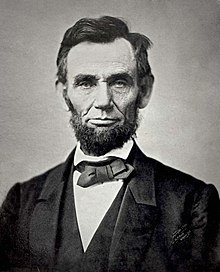
Lincoln in the famous Gardiner
photograph of Feb. 5, 1865.
Library of Congress 
Would Lincoln have reacted more swiftly, with Army troops, to the rise of the Klan than did Johnson? Although Radicals pushed Johnson, and this was part of the motive for the Tenure in Office Act, designed to keep Secretary of War Stanton in his job, the president is commander in chief of the armed forces, not any member of Congress. So, there was only so much the Radicals could do — or could have done if Lincoln were president and dragging his own feet. It’s an open question.

Johnson’s version of Reconstruction was to make his pre-war Southern “betters” kiss his hand asking for pardons, then, when that was done, be even more racist than many of them. Lincoln, with less regard for social niceties, and living in the North, wouldn’t have had that motive, but he might have somewhat naively believed, for too long, that many upper-class Southerners were more benighted than reality showed.

I discussed this briefly about Lee in my Appomattox piece, noting that he stood idly by at the Battle of the Crater in 1864 when wounded, thirsty black Union soldiers were shot to death. I noted this (linked there) in my review of Michael Korda’s pseudohistorical biography of Lee, that he wasn’t as kind a pre-war slaveowner as Korda would have us believe. Speaking of the Klan, I’ve noted in various blog posts that Lee was the first person to be offered its headship. Only when he said no was Nathan Bedford Forrest contacted.

So, like John F. Kennedy and the Jackie-constructed Camelot myth, Lincoln was probably lucky  to die when he did, especially with Stanton’s epitaph of “Now he belongs to the ages.”

I think he would have been slow to pivot on his Reconstruction plan. I think he would have done little more to help freed black than Johnson did, and certainly would not have extended Gen. Sherman’s “40 acres and a mule” for Sea Island blacks, or anything similar, to the larger population of newly freed slaves.

He might have tried to make economic Reconstruction of the South more orderly than the actual mix of carpetbaggers, scalawags, redeemers and others, and might or might not have succeeded.

The tragic part, besides his own death, his martyrdom, and his apotheosis, is that the wrong Johnson was his vice president, to extend the Kennedy analogy. Lyndon Johnson could have given a fine start to Reconstruction indeed, had he been president 100 years earlier.


Lincoln is arguably our greatest president, but, although not as much dependent on mythos as JFK, he was perhaps, in the historical sense, lucky to have died when he did.

Meanwhile, Lincoln has been commemorated in various ways in the arts, starting with two great poems by Walt Whitman. Here is my follow-up "in memoriam" about that.

April 09, 2015

Needed: "Appomattox Day," or better, "You Lost Day"

The New Republic sums the case up well, on the 150th anniversary of Robert E. Lee surrendering to Ulysses S. Grant at Appomattox.

First, given that a racist president susceptible to flattery via pretended groveling from his pre-war Southern "betters," Andrew Johnson, took Abraham Lincoln's already mild "rosewater policy" and gutted it, and then that the Supreme Court gutted the intent of the 14th Amendment from the 1870s through Plessy v. Ferguson, it's hard to believe at times that the South did, in fact, lose the Civil War. (Would Lincoln have done as much better with Reconstruction as some thing? I ask that in Part 1 of my sesquicentennial tribute to his death.)

But it did. And Brian Beutler is right. It should be a federal holiday, though there's less than zero chance of the current Congress making that so.

Per Beutler and a New York Times article he links, yes, we also ought to rename military installations named for Confederate generals, like Fort Hood here in Texas.

And, contra Tony Kushner and Steven Spielberg and their Lincoln movie, Lincoln was wrong. Maybe the Wade-Davis Act was too harsh, but Lincoln was too mild, and he refused to negotiate with Congress on this issue after his pocket veto of Wade-Davis. Would he, in the face of the rise of the Klan in 1866, gotten tougher? Well, he would have been tougher than Johnson, but would he have stopped downsizing the Army or even asked for more troops? Possibly not, and maybe, probably not.

For good alliteration of sorts, I've long said that Reconstruction might have worked with 200,000 bluecoats in the South for a generation rather than 20,000 for a decade.

Really, the U.S. South, without a little bit of an "iron heel," essentially promulgated its version of something like the Dolchstosslegende a half-century before General Ludendorff, Adolf Hitler and other right-wing nuts did in Weimer Germany. Beyond denying that the Civil War had been about slavery, the "Lost Cause" idea claimed that, due to various factors, it hadn't been a fair fight.

Anyway, Lee wasn't such a five-star general as the Lost Cause makes him out to be, despite even a Brit fawning over him in an awful book. He was often a poor strategist who refused to implement a semi-modern general staff for the Army of Northern Virginia. Nor was Stonewall Jackson Paul to Lee's Jesus, despite a Texas historian who isn't worth his reputation trying to claim that. (As for long marches, the Union Fifth Corps once marched 25 miles in a day to get in place for the start of Gettysburg.)

As far as Southern pre-war boasts of licking five Yankees?

Well, the US Census was conducted, per the Constitution, in 1860. You knew how much you were outnumbered. Well, you were wrong, even if you try to hide that fact in Lost Cause mythos and trailing clouds of glory.

Anyway, just like Hitler, et al, Southern leaders might have accepted the reality of "you lost" more had their been a bit more pain, as well as a bit more Reconstruction in general.

That said, the Congressional Radicals all needed to view freed slaves as human beings first, political tools second, or third. Some did have this view, but others did not. At the same time, non-Radicals in the GOP needed to get a bit more Radical. Also, outside of New England, blacks were still not just second-class citizens, but only semi-citizens in much of the North, and New England then (versus, say, South Boston today) was seemingly more enlightened precisely because there were so few blacks.

So, that part of Lincoln's Second Inaugural, lauded by me here, was partially correct. The North had its share of blame in the perpetuation of slavery — and the perpetuation of its profits, and even the push for increasing "efficiency," just like in Northern factories, as detailed in this book.

That said, Lincoln didn't go far enough. While the Second Inaugural wasn't meant to be a policy speech, nowhere before his death did he go beyond it to indicate that fair chunks of the North would need their own quasi-Reconstruction. Of course, some Radicals, and some modern historians, argue that part of that quasi-Reconstruction still may have needed to start at 1600 Pennsylvania, had Lincoln lived.

Yes, Lincoln had gotten past his colonization schemes. Yes, after listening to Frederick Douglass, he finally realized that the United States, not an African kingdom or another, was home for African-Americans. He even accepted that some of them had American ancestries older than his.

But, he still didn't understand — despite facts such as tiny, almost slave-free, Delaware having rejected graduated emancipation and Stephen Douglas' racism in 1858 — that many people in the Border States and the Old Northwest (not to mention the Irish of New York), hadn't evolved like he had over the previous four years.

And so, the failure to insist on a thoroughgoing Reconstruction — maybe not punitive, but more than "rosewater" — before his death wound up failing North and South alike.

This, though, is the bottom line. Much of what was "rosewater" was like giving an inch and the South taking a mile:

That lack of consensus was an ineluctable consequence of concerted postbellum efforts to sand down the seams reuniting the states. There was a real but inadequate constituency for crushing the Southern establishment after the Civil War, and reintegrating the country under an entirely different paradigm. Instead, the North enabled the South by giving it unusual influence over shaping the official mythology of the war. Yes, the South surrendered. The states ratified the 13th Amendment. The Union survived. These facts couldn’t be altered. But memorializing the rebellion as a tragedy of circumstance, or a bravely fought battle of principle—those narratives were adopted in part for the unspoken purpose of making the reunion stick. "You lost, we won, and we're all living in the USA," Talking Point Memo's Josh Marshall once wrote. "But we'll let you win in the battle of memory and valor and nostalgia."
Really, the U.S. South, with the "Lost Cause," was just living up to the "honor tradition" that led it to vapidly ingest the narratives of "Ivanhoe" and other Walter Scott novels, and otherwise claim to be Cavaliers, etc. These narratives were ready at hand to the South. (And, speaking of honor, and that book about the profits of slave capitalism? Southern "honor culture" hates nothing more than Southern-born whites writing about these things.)

Beyond that, as far as Southern "nobility"? It's easy to point a finger at Nathan Bedford Forrest and the slaughter of surrendered black soldiers at Fort Pillow in 1864. And, Southerners today probably wouldn't try to defend him. But, it's also easy to point a finger at Lee, watching wounded black soldiers at the end of the Battle of the Crater, during the 1864 Petersburg campaign, be bayoneted while he refused to intervene.

Beutler is right that a federal holiday for April 9 is unrealistic today.

But, we can rename those 10 forts, Fort Hood and others. "Fort Colin Powell" immediately comes to mind. We can stop federal dollars going to Confederate monuments. And, the rest of the nation in general can stoop kowtowing to Southern attitudes.

Beutler is kind enough to suggest "New Birth of Freedom Day" rather than either my straightforward or hard-core realism alternatives. But, I stand by his ideas — except, a bit, for making this part and parcel of American exceptionalism, which he hints at near the end.

And, while I've saluted Lincoln's Second Inaugural for questioning American exceptionalism, nascent at his time, and given an overall salute to the Lincoln movie, I stand by my caveats to that movie, too. Indeed, Lincoln was perhaps, like John Kennedy, lucky he died when he did. Unfortunately, he had the wrong Johnson as his vice president.

May 26, 2014

Can we remove an asterisk from Memorial Day?

Maybe even a couple?

But, definitely one.

I am officially still not a fan of the idea, after the events of Sept. 11, 2001, of adding "first responders" to those honored on Memorial Day. After World War I, when Memorial Day became a day to honor the dead of all wars, it was for war dead. The honoring of first responders runs the risk of marking 9/11 as part of the "Global War on Terror." Given how much police departments have militarized since that time, in part due to the "War on Terra," and in larger part in reaction to, and with money generated from, the "War on Drugs," this is kind of slippery slope territory.

That's the big asterisk.

Second one?

Per what I said above, I'd be OK with moving Memorial Day back to honoring Civil War dead, since they still make up half our war dead, and by weighted percentage of population, much more. (Imagine 3.5 million Americans dying in World War II, which is still far short of USSR war deaths, and you get the idea.)

I'd favor this idea in part due to the rise of the Tea Party and associated states rightsism. Since Gen. John A. Logan of the Grand Army of the Republic started the idea of commemoration of Union war dead, it would remind various nutbars of who won that war.

That said, per Abraham Lincoln's words at Gettysburg, we need to be rededicated to that issue.
It is for us the living, rather, to be dedicated here to the unfinished work which they who fought here have thus far so nobly advanced. It is rather for us to be here dedicated to the great task remaining before us—that from these honored dead we take increased devotion to that cause for which they gave the last full measure of devotion—that we here highly resolve that these dead shall not have died in vain—that this nation shall have a new birth of freedom—and that government of the people, by the people, for the people, shall not perish from the earth.

And, part of that is erasing the 125 years or so of Northern appeasement and amnesia, from about 1880 on, over why the war was fought, and the rise of the Klan and other Southern reaction to Reconstruction. (Sic on the text, for some people who note two missing words.)

Third asterisk? Especially in small towns of America, can we remove the religious steepings of the day? There's obvious First Amendment issues for me and other secularists. Beyond that, though. I am again reminded of Lincoln, this time in his Second Inaugural Address:
"Both read the same Bible and pray to the same God, and each invokes His aid against the other. It may seem strange that any men should dare to ask a just God's assistance in wringing their bread from the sweat of other men's faces, but let us judge not, that we be not judged. The prayers of both could not be answered. That of neither has been answered fully.
Bingo. Invoking god in the picture often runs hand in hand with American exceptionalism. And, given that the Mexican War and Spanish-American War were both wars of imperialism, and that we really had no business in World War I, a little less American exceptionalism would be good. 

And, distantly related to that? Did anybody from the CIA die in the overthrow of Mossadegh or Arbenz, like we know died in Libya? If we're going to be honest about American wars and American imperialism (these covert operations are also the flip side of Eisenhower's warning about the "military-industry complex," his development of the "covert-underhanded complex) maybe we ought to be saluting the CIA and waving a CIA flag along with military service flags.

That said, since it was a Yankee abolitionist song, if we are going to keep religious elements at Memorial Day events, I'm all for singing every verse of "Battle Hymn of the Republic."

Finally, a related asterisk.

If it takes you more than 2 minutes to sing the national anthem, off you go into a penalty box.

July 04, 2013

An extra special Fourth of July this year

150 years ago today, "The Father of the Waters once again flowed unvexed to the sea."

If you're a Civil War buff, you know the quote, the author, and its significance. If not, go use teh Google.

Unfortunately, Vicksburg and the eventual end of the Civil War weren't followed with an adequate Reconstruction, namely due to the worst president in American history. Yes, fellow libs, Shrub is bad, and in my bottom five, but Andrew Johnson, and James Buchanan, bookending the Civil War, are the bottom two.

Whether Lincoln in Reconstruction would have remained as "rosewater" as Spielberg tried to paint him in his movie is open to debate. About anything he did, though, would have been far better than the obstinate inaction of a racist alcoholic who believed (like Bush) that he had been divinely chosen for his position.

Certainly, when the Klan arose in early 1866, Lincoln would not have remained idle, and would have had federal troops act. And, in light of something like that, might have been less rosewater than Spielberg presents.

And, that's why April 14, 1865, far, far more than Nov. 22, 1963, is arguably the most tragic day in American history. We arguably had a decent chance to actually reconstruct the country. Lincoln would have held the worst of Radical Republicanism at bay, but with him rather than Andy Johnson in charge, the worst never would have arisen. And, contra Spielberg, Lincoln would have been tougher. He would have accepted that, per the Constitution, the Republicans had a right to refuse to seat Democratic Congressmen and Senators until they met certain preconditions.

Vicksburg was arguably more important than Gettysburg in several ways, too.

First, it was a total victory.

Second, it boosted Grant's reputation to a new level, setting him on what would soon be an inevitable military trajectory, then political one.

Third, it was the first hint at a more total war that the North would wage, a message that should and could have been, in a veiled way, carried over into Reconstruction.

As an example of the intransigence that the North faced, post-Reconstruction, and that ties directly to this history? Vickburg refused to officially celebrate the Fourth of July again until 1945.

January 13, 2013

#Lincoln — #Reconstruction, rosewater, Tony Kushner (updated)


Image via Bartleby's Second Inaugural page
As I said in a previous blog post, there’s one thing wrong with the new Lincoln movie. (Actually, with further reflection, there's more than one thing that, if not wrong, could have been done better; see poll at right to cast your own vote on the movie's historicity.)

Tony Kushner recently, on NPR’s Fresh Air, was claiming that the “lost cause,” the rise of the Klan, etc., were due to nobody in the North listening to Lincoln's “Malice for none.” WRONG!

Reality? The Klan arose during the first half of Andrew Johnson's administration, precisely because Johnson was too soft. And, as partial illustration? The Klan's leadership was first offered to Robert E. Lee, before Nathan Bedford Forrest. Lee turned it down but not on moral principles. Rather, it appears he thought such type of work was beneath him and his position in the Southern social hierarchy and caste.

Reality? Kushner needs to read Eric Foner’s “Reconstruction.” As do a lot of Americans. Or Gabor Borritt’s “The Gettysburg Gospel.”

I don’t put Lincoln on too much of a pedestal myself, but, I think April 14, 1865 was clearly the most tragic single day in American history. (That said, see my full review here.) As for Kushner’s thoughts, Lincoln probably would have toughened up his “rosewater” reconstruction plans when he saw the rise of the Klan, while yet extending carrots to smart-minded Southerners. He would have put down the Klan and related groups immediately, unlike Andrew Johnson, that’s for sure. And, from 1869 on, he would have been a Republican elder statesman to guide President Grant.

But, the real problem is that Kushner seems to be committing the same error that was deliberately done by white Northerners and Southerners on the Gettysburg Address no more than 20 years after Lincoln spoke it, as Boritt points out so well.

And that is, he’s assuming the “Malice toward none and charity for all” were to apply to Southern white folks only.

Rather, both at Gettysburg and at Washington, D.C., on March 4, 1865, Lincoln clearly includes blacks in the “all” who should get charity and the “none” who should not suffer malice.

After all, soon after this inaugural, Lincoln was postulating extending the vote to at least some freed slaves and, as John Wilkes Booth knew, “that means nigger citizenship,” as he surely spoke for many a white Southerner.

Let’s look at the full last paragraph of the Second Inaugural:
With malice toward none, with charity for all, with firmness in the right as God gives us to see the right, let us strive on to finish the work we are in, to bind up the nation's wounds, to care for him who shall have borne the battle and for his widow and his orphan, to do all which may achieve and cherish a just and lasting peace among ourselves and with all nations.
We’ve already talking about the first two clauses. Now, let’s look at a few more.

1. “(W)ith firmness in the right as God gives us to see the right.” Lincoln’s views on black Americans had evolved and grown throughout the war. He had abandoned the idea of colonization. He had now ventured the idea of black voting. He was seeing more — and surely would also have supported the 14th Amendment as well as the 15th — as “the right.” And, per the language of the 14th Amendment, would have taken necessary action in Reconstruction against the Klan and other white power groups.

After all, this was a president who had once suspended habeas corpus across the entire Union, and had had no problem using military tribunals to avoid civilian courts when he deemed it necessary. Yes, he expressed his hope that a Jefferson Davis might just flee the country, but, confronted with a Nathan Bedford Forrest who, rather than flee the country, sought to repress newly-freed black Americans, Lincoln would have been resolute.

He would have offered an olive branch with his rosewater. But, for the Forrests who refused his proffered cocktail?
The Almighty has His own purposes. Woe unto the world because of offenses; for it must needs be that offenses come, but woe to that man by whom the offense cometh.
Or, per a Psalm: “Woe unto that man. Better for him had he never been born.”

2. “(L)et us strive on to finish the work we are in, to bind up the nation's wounds …” Those wounds weren’t just white Southerners or white Northerners. Remember, Lincoln had just said:
Yet, if God wills that it continue until all the wealth piled by the bondsman's two hundred and fifty years of unrequited toil shall be sunk, and until every drop of blood drawn with the lash shall be paid by another drawn with the sword, as was said three thousand years ago, so still it must be said ‘the judgments of the Lord are true and righteous altogether.’
Binding up the wounds of “two hundred and fifty years of unrequited toil” would be part of Reconstruction as he saw it. And woe to those who would derail such work.

Lincoln would have supported a Freedman’s Bureau at least as much as Radical Republicans, and might have eventually seen an even broader mandate for it.

In short, Kushner’s reading of Lincoln’s Second Inaugural is superficial. And, sadly, although the movie does decently overall with Lincoln’s relationship to black Americans, one wonders if Kushner’s ideas didn’t harm the screenplay just a little bit. I will have to keep that in mind with my next viewing. 

And, while the movie was already 2:30, I partially agree with this NYT critic that a more forceful black American could have had more airtime. Fred Douglass was initially turned away from the inaugural soiree, before Lincoln personally intervened with gala security, then talked with him. That scene could have been inserted before the scene about Lincoln and the black vote. 

And, far beyond a relatively young Northwestern professor, let's look at the man arguably the dean of modern Civil War scholars. Eric Foner also says the movie has a limited view, namely that Lincoln didn't start the push for emanicipation in general or the 13th Amendment in particular.

In a video interview with CNN, Foner also says the movie overdramatizes things. True, the next Congress was not set for regular session until December, but Lincoln had pledged to call it into special session in March if necessary.

But, to nuance Foner, Lee surrendered April 9, and Lincoln had no idea if an event like that might happen earlier. So, I'd have to criticize that criticism of his. And, per Lincoln not jumping on the "amendment bandwagon" until the middle of 1864, Foner himself writes enough about Lincoln's political skills, and evolution on slavery in general, in his latest book, that one could honestly wonder if, although not to the degree an Amazon reviewer claimed, that there's not a small bit of sour grapes at work. 

At the same time, Foner defends Lincoln well from the claims he was a racist slave supporter. He's right that Bennett is overwrought and "cannot take yes for an answer." 
Which was the real Lincoln — the racist or the opponent of slavery. The unavoidable answer is: both. Bennett cannot accept that it was possible in nineteenth-century America to share the racial prejudices of the time, and yet simultaneously believe that believe that slavery was a crime that ought to be abolished.
Foner goes on to note that the Emancipation Proclamation was a turning point for both Lincoln and the country. After it, he more openly accepted blacks serving in the Army and also let go of his earlier colonization schemes, Foner claims.

However, Foner is wrong, at least on colonization. He mentioned it on Dec. 1, 1862, in his second State of the Union. And, he continued to push it at least in the early part of 1863. Sebastian Page lists what's well known to Civil War historians less exalted than Foner. Indeed, Lincoln didn't write finis to the Haitian scheme until 1864.

In light of that, including the overly generous assessment of Foner, it is clear Lincoln was grasping for how black and white would live side by side in postwar America. Perhaps he was even recognizing that blacks would theoretically be free to move North, bluntly confronting states with "black codes" like his own Illinois. And, that's why Corey Robin's words about Thomas Jefferson allegedly looking to that end are much more applicable to Lincoln, as I have blogged.

So, while the movie may be somewhat hagiographic, it perhaps as much as it could be. And, it's not a documentary. Do we want Ken Burns to do a sequel to the Civil War, with eight episodes on Lincoln? If so, no Bennett and no Thomas diLorenzo. Fortunately, Shelby Foote is dead.

That said, Lincoln's ongoing interest in colonization, not just in 1864 but even 1865, possibly, also means that Foner may also be wrong for criticizing someone like Donald Miller who claims Lincoln was too passive, too often. On colonization, at least, in the face of continued support for it by the more clearly racist types, Lincoln may just have been too passive.

Update, Jan. 13, 2013: Speaking of Foner, per his "The Fiery Trial," the movie does have at least one historical inaccuracy. In the opening sequence, when the more outspoken of the two black soldiers mentions pay inequality? Congress fixed that in the middle of 1864. Also, having now read that book, I feel more confidence in my thought that Lincoln would eventually have had a sterner Reconstruction plan than what Andrew Johnson thought, or projected, Lincoln had.

First, Lincoln would have recognized the way the north in general and his party in particular were headed.

Second, postwar activities, above all the start of the Klan, would have disabused him of much of his remaining thought about likely degrees of cooperation among white southerners. 

That said, I think he still would have worked for a more in-depth solution than the Radicals had in mind, while recognizing the power of the legislative branch.