I know that in some corners of conservative Christianity, that's the rhetorical argument du jour against the Supreme Court's legalization of gay marriage nationally last week. (That's if they've not already stooped to the ridiculous and claim bestiality or child marriage is next.)
First, especially for conservative Christians who always like that "Judeo" fig leaf on "Judeo-Christian values," er, your past religious heritage shoots you in the foot.
Many of the "heroes" of the Christian Old Testament/Jewish Tanakh had multiple wives. (Yes, technically that's polygyny, not polygamy, which cuts both ways and could also include multiple gay or lesbian marriages at once, but, usually, polygamy winds up as one man and several wives. So, we use polygamy throughout.)
But, Jesus said!
Erm, no he didn't, and claims that his comments disallowing divorce prove either that he was anti-polygamy or that polygamy no longer existed at his time simply aren't true. The actual Paul may have been anti-polygamy, and the pseudo-Paul who wrote the Pastoral Letters certainly was, but that's a different story.
However, while Greeks and Romans were one-spouse folks (not counting mistresses, of course), some sects of Judaism still allowed polygamy at the time of the New Testament.
As for today? There's religious freedom grounds for it, primarily for Islam, but also for the Fundamentalist LDS. And, while Ashkenazi have officially banned it for a millennium, Sephardi still accept it, and Orthodox among them still argue for it today. And, to really screw with fundy Christians, a "Messianic Jewish" rabbi practices it in London. And, although legally banned, it's also practiced in Israel.
So, why shouldn't polygamy be legally protected? Fredrick de Boer offers an in-depth argument in support.
I agree. First, per my comment about mistresses, he says polyamory's been around as long as the "nuclear family." Beyond "mistresses," polyamory as all multiple relationships, none of them "legalized" by marriage, has been gaining steam.
Second, the legalization of same-sex marriage has refuted the old "for having kids" argument. Of course, older straights getting married has always been Argument No. 1 against that.
deBoer then notes that traditional marriages, like polygamous ones, can be havens of abuse. Duggar Family Values, anybody?
I would go beyond deBoer, at least what he explicitly mentions.
I would require a man or a woman wanting to enter a second or additional marriage to publicly disclose he's married to another person already. As it already generally is considered with no polygamy today, such failure to disclose would be legally considered fraud — and should be considered felony-level fraud
==
For commenters or others who think this is "snark," it's not.
To go beyond my comment response to Joshuaism, most of the comment is red herring.
First, consent is "manufactured" in single marriages. Don't tell me you haven't heard of Indian-Americans still marrying the spouses their parents have arranged for them.
Second, the consent issue has nothing to do with incest, which I'll tackle separately.
Third, to elaborate on my comment about Macedo's Slate article, of course there can be one-to-one meeting on each marital partner in a plural marriage. Maybe there can't be one-to-one 100 percent meeting, but if you're expecting that, then you've got a definitely naive, possibly harmful "absolute soulmate" view of marriage in general. No marital partner should be, or should be expected to be, the 100 percent match, complement, "meeting" or whatever of another marital partner.
This expands on what I noted was of concern in Kennedy's ruling — the over-uplifting of marriage as more than it really is, or really should be expected to be.
For both him and possibly Katy, beyond the public health angle, I think the state can make a plausible, even compelling, public mental health angle against incestuous marriage. While questioning the over-uplifting of marriage, I don't want to over-devaluate it, either. And, yes, especially with kids, the whole wrecking of the normal plot of extended family relations that an incestuous marriage would cause would be a public mental health concern.
Showing posts with label Christian origins. Show all posts
Showing posts with label Christian origins. Show all posts
July 01, 2015


January 22, 2015
Marcus Borg and the sometimes theological wrongness of liberal Christianity
I can agree with a liberal critical scholar of Christianity like the just-deceased Marcus Borg, when he, or others like him, note that early Christianity (by early, I mean, before 200 CE) had nowhere near one agreed-upon reason as for why Jesus was crucified. And, beyond that, of course, had no one agreed-upon understanding of Jesus' metaphysical relationship to god, and how such relationship connected to his crucifixion.
However, sometimes, the likes of Borg doth critically protest too much. Like this:
Really?
Although it does not have a line-for-line spelling out, I'd argue that, say, the Niceno-Constantinopolitan Creed does:
Ahh, process or depth theology. Shouldn't it be capitalized as "Decisive Disclosure," like "Ground of Being"? What does that even mean?
In reality, not a lot.
This is also why, in both critical and conservative Christianity, systematic theology is supposed to be a separate field from exegesis.
None of this is to deny that Borg was among scholars who has pushed for reinterpreting Jesus as a crusader for social reform, and just what he was challenging, including looking at Jesus' parables and sayings in a new, fresh light.
In that sense, yes, maybe he did get a lot of people to look at Jesus again for the first time, as noted here.
But, he never explained how the Jesus as perhaps accurately construed by the Jesus Seminar got trumped by Jesus the dying-rising Savior God.
That said, this is not the first time I've talked about liberal Christianity's wrongness. In the past, I mentioned that liberal Christianity, as well as even secularists, were wrong in claiming there's nothing outrightly anti-gay in the Old Testament, and making an even stronger claim to that end about the New Testament.
Final note. For anybody who claims there's one "pure" version of any or all of the great global religions, this blog post shows just how wrong you are about Christianity.
For Islam, considering the Sunni-Shi'ite split pretty much hardened by 75 years after Muhammad's death, you're wrong there.
And in Buddhism, assuming a historical Siddhartha Gautama, the forerunner of the Theravada-Mahayana split had started within a century of his death.
However, sometimes, the likes of Borg doth critically protest too much. Like this:
“The notion of Jesus’ death as a substitute for our sins was not found in the first 1000 years of Christianity.”
he was crucified for us under Pontius Pilate
Now, it's true that, technically, it doesn't say why he was crucified.
In that point of the Creed, that is.
It makes it pretty clear, earlier on:
who for us men, and for our salvation, came down from heaven
Our salvation from "what"? Erm, sin?
And, how? Crucifixion.
OK, there, we're at least at the point of having to discuss theories of why he was crucified. And, I think any reasonably neutral mind, knowing the Tanakh/Old Testament sacrificial system, would think that the idea of a penalty-paying death, an "atonement," is a reasonable interpretation of the theology of that creed.
And, of course, that's long before the end of the first 1,000 years of Christianity.
The only question is, who was holding the theological bank ledger of guilt? To whom was this penalty-paying death due/
Now, one could read that as being described by the "ransom" theory of atonement, discussed here at Wikipedia with other atonement theories, and call Borg technically right, in noting that it wasn't until Anselm that a full-blown atonement theory was articulated.
However, as far as the "why Jesus had to die," there's no significant difference between the "ransom" and "substitute" theories. Certainly not, for the average Christian layperson.
As Wikipedia notes, both theories are grounded on the idea of human sinfulness causing collective human indebtedness; the only difference is, is that difference owed to Yahweh or Satan? And, the "ransom" view goes back to Irenaeus, who technically is pre-200.
No, actually, it goes back to two of the three Synoptics. Here's Matthew 20:28, which is paralleled by Mark 10:45:
No, actually, it goes back to two of the three Synoptics. Here's Matthew 20:28, which is paralleled by Mark 10:45:
Just as the Son of Man did not come to be served, but to serve, and to give his life as a ransom for many.
Again, the Gospeler doesn't say to whom Jesus' life was a ransom, but he does say that it was a ransom, right down to the word!
So Borg is half right — if read narrowly, and with a connotative understanding of "substitute" only.
But, in reality, he's wrong.
Things like this were key to why, when I was leaving the conservative wing of Lutheranism, I realized I couldn't stop at the liberal wing.
Sure, the Borgs of the world may be right, even if we don't go all the way to John Crossan territory, in that Jesus was "actually" a Jewish social reform leader, and maybe even a social resistance leader.
But, a guy named Paul "hijacked" that idea, if you want to put it bluntly. And, by the time of Irenaeus, the majority of Christians was trying to work out what Jesus death meant in light of Paul first, Synoptic Gospels second, and Gospel of John third (albeit, perhaps it first in certain threads of what became Eastern Orthodoxy).
By Constantinople, the idea of Jesus' death as a penalty payment of some sort, and worth infinite value because he was also infinite God, was the "orthodox" view. So, it was seen as a payment to Satan rather than to God; it was still a payment.
And, when people think, as Christian laypeople, about "substitution" or "atonement," they're thinking first about the payment. It's only much lower, if at all, if they're asking the "to whom" question.
Recognizing that liberal Christianity couldn't fully deal with the rise of Christianity if Jesus were just a social reform leader, and that it didn't deal so well with the Pauline "hijacking," either, is part of why I moved on past liberal Christianity.
To take Acts 15 as representative of movements, not individuals: Why did Paul win (with a sidebar from John), Peter wind up semi-incorporated into Paul, and James and his Ebionites sidelined? We know that latter happened, and we suspect (rogue interpretations of the Dead Sea Scrolls aside) that it happened because of the rise of Paul, and even more a second rise along with the Pastoral Epistles.
But, why that second rise? There have been, after all, a lot more "failed" religions than "successful" ones.
If Jesus as social crusader was that successful, why did Paul feel the need to hijack this idea of Christianity? And, if it were not, why did he think this was the best budding away from the rootstock of Judaism into which to graft (punning on Romans) his take on Jesus?
If Jesus as social crusader was that successful, why did Paul feel the need to hijack this idea of Christianity? And, if it were not, why did he think this was the best budding away from the rootstock of Judaism into which to graft (punning on Romans) his take on Jesus?
Liberal Christianity, in its academic version, it seems tries to tap-dance around the Pauline success at times, and thus tap-dance around his basic doctrines, and then their interpretations from Irenaeus on to the Council of Constantinople.
It wasn't the only reason, but it was a reason.
Another?
This statement by Borg, from that same link:
Jesus matters for Christians because he was for us the decisive disclosure of God.
October 22, 2013
Jesus reality and Jesus mythicism — moved back a century
Seeing how uncritically accepting many Gnu Atheists are of Joseph Atwill's claim, recently doubled down on with this non-academic press release,
that the Flavian dynasty of Roman emperors invented Jesus and
Christianity, I decided to throw my semi-academic hat (see near the
bottom for how I make that claim) about the Jesus of history or the
Jesus of mythicism here.
That said, let's jump in.
Despite what the new round of mythicists like Robert M. Price and Richard Carrier say, I can't accept mythicism, though, per Wikipedia, I do support those like R. Joseph Hoffmann who say it deserves academic discussion. Bart Ehrman, insightful as he may be otherwise, is simply wrong here.
The earthly Jesus of Paul
On Price, I believe he's wrong when he says Paul didn't believe in an earthly Jesus. The "born of a woman" in Galatians 4:4 contradicts him and others. I take this as a straightforward passage. Yes, his larger thrust is the Law as a curse, as in "born under the Law." But, within that context, its clear that he is talking about a normal human being whom he understands to have had a normal birth and life.
But, at least for some other mythicists, it ain't. For example, Earl Doherty engages in seeming verbal flim-flammery here, to try to talk around the passage. Some of it is just laughable, like claiming, based on the Old Testament, that "exapostello" can only be used for sending forth "spiritual beings." I don't know that Price has even tried to do that much ersatz heavy lifting.
The only way I see for true mythicists to get around this is to claim that Paul was either accidentally mistaken, wrong, or telling a mythmaking lie in the name of an anti-Docetic stance.
None of those seem likely. On Docetic or anti-Docetic issues, Paul splits the difference in 1 Corinthians with his "spiritual body." Plain wrong? If you're a mythicist and you believe the mythic Jesus began with Paul, then "wrong" isn't an option; you have to fall back on "mythmaking lie," as I see it. Accidentally mistaken? Assuming there was a Jerusalem community of James, Peter and others, how do you mistake them talking about a physical human being? (You could mistake when they said he lived, but that's a different story.) I suppose mythicists could punt "mythmaking lie" back on James and/or Peter. However, in the case of James, I then contend that you have to believe that about everything Josephus writes about him is also part of the mythmaking.
What about James?
And, the mythicists also, by and large, don't seem to me to address Josephus' discussion of lynching of James the brother of Jesus. James (Ya'akov) was a hugely common Jewish name, of course, but so was Jesus (Yeshua). So, Josephus seems to recognize that this James needed to be identified. He does so by calling him the brother of Jesus. But, that presumes that this Jesus is so well-known as to not need identifying. (Note; I do not see this as a Christian interpolation, certainly not the "brother of Jesus"; I am still undecided on the "who was called Christ.")
Carrier does address this, saying this was the brother of a Jesus who was high priest in the year 63. But, to follow Carrier, you have to hold the "who was called Christ" as an interpolation. You also have to assume an audience 30 years later was familiar enough with THAT Jesus for Josephus to not need to identify him further, and I'm not ready to commit to that. Per Wikipedia, Josephus' audience was Gentiles; unless you narrowly restrict that audience to "friends of the Flavian imperial dynasty," they probably wouldn't know who this Jesus was.
So, I stand by some sort of non-mythical Jesus. And, I'll deal with Josephus myself, below.
Early Christian growth rates: One view
This leads to Christianist sociologist Rodney Stark. (I use that moniker because, like Samuel Huntington, he believes in a "clash of civilizations," but he's not a religious Christian, though he is a nutter in other ways.)
Stark postulated that, with a start point of 5,000 believers in the year 50 CE, and a growth rate of 40 percent per decade, we get Christians up to being half the Roman Empire by the time of the Council of Nicea.
I think that end number is too high, and I'm far from alone. I think Christians at that time were higher than a Robin Lane Fox thinks (more below) but not that high.
Anyway, how did Stark get there?
His 40 percent per decade comes from historic growth rates of Moonies and Mormons. However, there's several problems. Moonies moved their base from small South Korea to the US, and the Mormons recruited immigrants, especially in Scandinavia, before they emigrated, for one thing. Also, he fails to allow for Christians outside the empire, who may have been as high as 15 percent of the total by the time of Constantine. And, he doesn't try to fit this growth into a bell curve, especially given that total population in the ancient world remained almost flat, and indeed did so, over longer periods, until about 1700 CE.
All of these issues are problematic for Stark, or, I think, for anybody who believes in either a traditionally-dated historical Jesus or a mythical Jesus who was "hatched" at about the same time, and who believes Christians were more than 5 percent of the Empire at the time of Constantine.
Now: My alternative
So, what if we "move Jesus back"?
Why not? G.R.S. Mead, and others, either entirely on their own, or influenced by the Jesus Pandera tales from pre-Rabbinic Judaism, postulate a Jesus who lived circa 100 BCE, possibly a Jesus who was among the Pharisees executed by Hasmonean king Alexander Jannai. (Here's Mead on this.)
This idea has long appealed to me. Mead and former mythicist G.A. Wells (I consider him to be a recanted mythicist, not a "soft" one) were two major influences on me in my late 20s, beyond modern historical criticism, as I did intellectual judo on what I was being taught in conservative Lutheran divinity school as well as what I had been taught to avoid.
The idea still appeals today, maybe even more so, and for two main reasons.
We get a slower, easier-to-believe growth rate, and a longer period for development of Christian traditions and their move from oral to written forms.
First, my take on the growth rate issue
I see two "hinge points" in the growth of the Jesus movement, later Christianity. (Dating Acts to 115 CE or so, it wasn't "Christianity" before 100 CE.)
The first one is for there to be at least 5,000 Jesus followers by 50 CE. Even with allowing for uneven distribution, the number of Jews in Rome, and the religious inquisitiveness within Rome (the city, not the empire), I think this is the minimum number for a "Jesus community" to be in place for Paul, never having been there, to address in his Epistle to the Romans.
The second? Per the likes of Nassim Nicholas Taleb and other professional and amateur social theorists, is a "tipping point" that led Diocletian to start serious persecution of Christians. (Per my review of Candida Moss' "The Myth of Persecution," I don't think there was serious, imperially-directed persecution of Christians before Diocletian, but there certainly was then.)
Such sociological tipping points are very serious. Urban sociologists have shown that when an all-white, or nearly so, neighborhood, gets X percent African-Americans, the rate of moving out picks up. When it hits Y percent, the rate increases.
I see a similar "tipping point" behind Diocletian. What might it be?
I started playing around on a simple computer-based 10-key calculator. I started with a much earlier time frame, which allowed lower growth rates over a longer period, but also gradually accelerated growth rates as Christianity got larger mass.
And, I came out with approximately 1.25 million Christians in the year 285. If I assume an imperial population of 50 million, and act like Stark and assume all these Christians were inside imperial boundaries, that's 2.5 percent. Given Christianity's strength in the east, maybe 3 percent or a little bit more, counting Italy and Roman Africa (today's Tunisia) as part of the east. And, about 4 percent Empire-wide when Diocletian ramps up the persecution.
And there you go.
Details?
I assume 1,000 "Christians" in the year 70 BCE.
From there, I assume a growth rate of 10 percent per decade until 30 BCE. (Again, I'm assuming flat population rates, in part for simplicity but in larger part because, over the longer term, that's the simple reality of the ancient world.)
That gives us about 1,460 "Christians" in 30 BCE.
For the next six decades, I up the growth rate to 15 percent, starting a bell curve. (The proclivities of Herod, followed by direct Roman control of Judea, are assumed as "stimulators" for this higher growth rate.)
At 30 CE, that gets us to about 3,380 "Christians."
I then ratchet the bell curve up a bit, to 20 percent growth over the next 70 years. Worsening Roman action in Judea and the first revolt, plus the work of a man named Paul, are taken as "stimulators."
That gets us to 12,130 "Christians" (per above on the book of Acts, the scare quotes will be dropped from here on out) at 100 CE.
I next ramp up the bell curve a bit more.
For the next 80 years, I assume 25 percent growth per decade. This gets us to about 72,300 Christians by the death of Marcus Aurelius. Still a tiny minority, not much more than 1/10 of 1 percent of the Empire. The myth of Paul before Felix and Festus aside, we now, with people like Justin Martyr, see the first interactions of Christians with Roman officialdom. Somebody is noticing them. That's a "stimulator" of growth.
But now, the growth rate is going to pick up again. No external stimulator, just a larger semi-critical mass, more publicity in non-Christian circles, and social and economic decay in Rome making some people look more favorably on Christianity. (The movement, also, now has no scare quotes, as first attempts at doctrinal organization begin.)
So, for the next 90 years, I put the growth rate at 30 percent.
That gets us to 453,000 by 250 CE, which would be 3/4 of a percent or more; enough to catch Decius' attention. And 767,000 by 270 CE, comfortably above 1 percent.
So, I turn the bell curve higher. To 35 percent.
That gets us to 1.89 million by 300 (and about 1.25 million in 285, the year after Diocletian assumed the throne).
If I keep that same growth rate for 25 more years, we're at around 4 million by the time of Constantine calling the Council of Nicaea. That's 8 percent of a population of 50 million. (And on tipping points, for Constantine, we're at around 2.75 million Christians, or 5.5 percent of the population, by the time of the Battle of the Milvian Bridge.)
(Ehrman agrees, putting Christians at about 7 percent of the population by the time of Nicaea. However, with a traditional dating for Jesus birth, you have to expect growth rates close to Stark's for much of Christianity's lifespan.)
I don't ever need to go to Stark's 40 percent. And, I don't even see that happening. Due to "backsliding" and the "leisure" of Christianity being legalized, the growth rate probably plateaued until Theodosius made it the state religion of Rome.
That said, I hold that the growth rate issue is another challenge for mythicists if they believe that the myth started at about the time the traditional dating says Jesus lived. That is, if they think Paul started the myth, or somebody no more than one generation before him, they've got trouble.
Now, the development of Christian tradition
Different ideas of Jesus, such as a teacher of wisdom, allegedly reflected by the hypothetical Q document and the Gospel of Thomas, a faith healer/wonder worker with parallels in some Jewish holy men of the era, and a "divine man" of some metaphysical import with possible soteriological import, would all have longer to ferment, and more under any communal "radar screens," with an extra century of development time, and with a slower growth rate to bring less attention to any perceived need for uniformity.
We can postulate brief written bits being put down by the second generation after the death of this Jesus, around 30 BCE, when I see the growth rate tick up a bit, or maybe after 30 CE, when I see the growth rate tick up a bit more.
We can then simply put the first Jewish Revolt against Rome, and the destruction of the Second Temple, on top of this as a motivator to record the first unified "gospel" of Jesus in light of similar gospels of wonder-workers both before and after this time that floated around the Mediterranean world.
More on and from Paul
That still leaves connecting Paul to all of this.
He claims to be a Pharisee himself in Philippians. I accept this as true. I reject that he was a Roman citizen, as he never claims that about himself. He could well have come across the "Jesus movement" as part of a trip to Jerusalem or something.
If his "thorn in the flesh" was temporal lobe epilepsy, or whatever led him to his visions and revelations, his version of Christianity took off from there. And, if he did die in Rome, or nearby, we can perhaps peg the first Gospel, Mark, to there, in part based on the "Latinisms" in its Greek. But, that's aside from the main focus of this argument.
That said, now I, in a different way than Carrier, have a problem with Josephus' statement above. And, I also have a "problem" with the thinking of the likes of Robert Eisenman on the history of Jewish Christianity. And, on the issue of James as a historic person. (That said, Eisenman takes Acts as being WAY too historic. Example: He thinks the phrase that people of the "Way" were first called Christians in Antioch first dates to the 50s CE.)
Paul and James
Of course, Mead potentially founders on this, too. Paul talks about meeting James, and Paul in his own writings, not Luke's "Paul" in Acts. (It's been a long, long time since I read Mead; I don't know how he addressed this issue.)
But there's a way around what Paul says in Galatians 1:
So, let's then go back to Josephus. And, let me one-up Carrier.
Perhaps EVERYTHING after "James" is a Christian interpolation. There may have been an earlier identifier of James, rather than just his bare name, in Josephus' autograph. (I admit I'm unaware of textual variants on this.) But, maybe an early copy got edited for this interpolation. In fact, if Luke borrowed from the Antiquities, he could have made that interpolation himself.
In for a penny, in for a pound on interpolations. But, that's the only one I need to get past the issue of a historic James at the time of Josephus and a historic Jesus of nearly 150 years earlier.
World religious history
I'm going to briefly morph over to other world religions, then.
The late-Victorian England original "surge" in mythicism wasn't about Jesus, alone. As the British Raj expanded in India, the historicity of the Buddha was questioned, too.
There's both similarities and differences. The early Buddhist writings might be compared to the hypothetical early Q strand, if there was a written Q. The Buddha as a teacher of wisdom, occasionally esoteric, just like Jesus in this tradition. The difference is that the idea of the Buddha as a divinity didn't develop until later, so no textual fusions were needed. But, if we push back Jesus, we have about the same gap between his life and the first writings about him as we do the Buddha and the first writings about him.
Islam is a tougher nut, with so little textual criticism so far. But, it's possible we didn't have a finalized version of the Quran until a century after his death or so.
Finally, to tackle one other "hard mythicist" counter-thrust.
Now, I've seen one mythicist (sorry, no link, can't remember where it was) cite the Micronesian cargo cults, specifically noting that in one place, two different deities or whatever were being venerated in less than 20 years.
However, on the typical Micronesian or New Guinean site, the issues that started the cargo cult were HUGELY intrusive. British or American military, occasionally civilians, with modern technology, setting up an outpost out of nowhere just before or during World War II into the middle of a dark-skinned, often Stone Age, society. Occasionally, even , a white man crashing an airplane on an island. And then leaving as soon as the war is done, or the crashed person is rescued.
Whereas, a messianic movement starting in late Second Temple Judaism? With all the other messianic claimant that Josephus documents in his time and others probably earlier? Hardly intrusive at all.
So, contra the one person's who's commented already trying to claim just the opposite? Don't. I'll laugh in your cyberface.
Meanwhile, per a discussion on a blog post by Dan Fincke, I will reiterate what should be obvious. Just because certain events of a person's life are fictitious doesn't mean the person is. (A disputant said the fiction of the Buddha's enlightenment meant the Buddha was mythical.) Honi the Circle Drawer almost surely existed, myths about his rain miracles aside. If mythicist claims here were true? Well, millions of people long believed the Parson Weems myth that George Washington chopped down a cherry tree. Millions still believe myths about his wooden dentures today.
Also, don't be like D.M. Murdock (Acharya) who outdoes even American Gnu Atheists in claiming that religious personages are myths, making puns as bad or worse than those in the Tanakh, and otherwise promoting anti-intellectual stupidity, as I've noted here.
My academic and personal background
Who am I to be laying this scenario out with any presumption to credibility?
I'm a "semi-academic," in case any scholars noted in this post, or friends or followers of theirs, question my presumption.
I have an undergraduate degree in classical languages, part of spending most of my time in a pre-divinity program. (I also read Hebrew as part of that, though not enough to get a biblical languages degree.)
I also have a "professional / terminal" masters, a master of divinity degree. Being at a conservative Lutheran seminary, we weren't taught too much about the critical theological method, but we were taught a little. And, from there, I did a lot of reading on my own, eventually doing intellectual judo to refute what I was being taught there and had been raised to believe.
That said, I had several classes in exegesis of particular biblical books. I audited a class on introductory Aramaic. I took a class on the Greek of the Septuagint and also did readings in patristic Greek. And I took an upper-level graduate course on textual criticism. And, in English, I've read much of the Dead Sea Scrolls, most of the Nag Hammadi finds and more.
And, in the years since graduation, I have kept up with a fair amount of biblical studies on both testaments.
So, I feel comfortable calling myself a semi-academic.
And, I feel quite comfortable, as a semi-academic, and as an atheist who's not a Gnu Atheist, telling the mythicists they're wrong, and how and why.
Anyway, this isn't an overarching redaction criticism of any specific New Testament book, or some other detailed academic exercise. For example, I'm not going to try to tackle how a Mark relocated Jesus 100 years earlier. Suffice it to say that, albeit with a mythical leader, we historically had "early" and "late" dates for the Jewish exodus from Egypt, and the certainly mythical Zoroaster has had floruits dated as much as 1,000 years apart.
Don't make me hang here, either
I'm hoping for some critique. I'll even take some less-than-totally-friendly criticism. This is a serious bit of work and it didn't pop into my head overnight.
Also, just because I think Jesus mythicism doesn't have legs to fully stand on doesn't mean that I don't question the likelihood of literal existence of all ancient religious figures. In fact, with the Tanakh/Old Testament and "minimalists" there, I believe it's quite possible a historic David never existed; at best, I think his "vita" has been overstated at least as much as the historic Jesus.
That said, let's jump in.
Despite what the new round of mythicists like Robert M. Price and Richard Carrier say, I can't accept mythicism, though, per Wikipedia, I do support those like R. Joseph Hoffmann who say it deserves academic discussion. Bart Ehrman, insightful as he may be otherwise, is simply wrong here.
The earthly Jesus of Paul
On Price, I believe he's wrong when he says Paul didn't believe in an earthly Jesus. The "born of a woman" in Galatians 4:4 contradicts him and others. I take this as a straightforward passage. Yes, his larger thrust is the Law as a curse, as in "born under the Law." But, within that context, its clear that he is talking about a normal human being whom he understands to have had a normal birth and life.
But, at least for some other mythicists, it ain't. For example, Earl Doherty engages in seeming verbal flim-flammery here, to try to talk around the passage. Some of it is just laughable, like claiming, based on the Old Testament, that "exapostello" can only be used for sending forth "spiritual beings." I don't know that Price has even tried to do that much ersatz heavy lifting.
The only way I see for true mythicists to get around this is to claim that Paul was either accidentally mistaken, wrong, or telling a mythmaking lie in the name of an anti-Docetic stance.
None of those seem likely. On Docetic or anti-Docetic issues, Paul splits the difference in 1 Corinthians with his "spiritual body." Plain wrong? If you're a mythicist and you believe the mythic Jesus began with Paul, then "wrong" isn't an option; you have to fall back on "mythmaking lie," as I see it. Accidentally mistaken? Assuming there was a Jerusalem community of James, Peter and others, how do you mistake them talking about a physical human being? (You could mistake when they said he lived, but that's a different story.) I suppose mythicists could punt "mythmaking lie" back on James and/or Peter. However, in the case of James, I then contend that you have to believe that about everything Josephus writes about him is also part of the mythmaking.
What about James?
And, the mythicists also, by and large, don't seem to me to address Josephus' discussion of lynching of James the brother of Jesus. James (Ya'akov) was a hugely common Jewish name, of course, but so was Jesus (Yeshua). So, Josephus seems to recognize that this James needed to be identified. He does so by calling him the brother of Jesus. But, that presumes that this Jesus is so well-known as to not need identifying. (Note; I do not see this as a Christian interpolation, certainly not the "brother of Jesus"; I am still undecided on the "who was called Christ.")
Carrier does address this, saying this was the brother of a Jesus who was high priest in the year 63. But, to follow Carrier, you have to hold the "who was called Christ" as an interpolation. You also have to assume an audience 30 years later was familiar enough with THAT Jesus for Josephus to not need to identify him further, and I'm not ready to commit to that. Per Wikipedia, Josephus' audience was Gentiles; unless you narrowly restrict that audience to "friends of the Flavian imperial dynasty," they probably wouldn't know who this Jesus was.
So, I stand by some sort of non-mythical Jesus. And, I'll deal with Josephus myself, below.
Early Christian growth rates: One view
This leads to Christianist sociologist Rodney Stark. (I use that moniker because, like Samuel Huntington, he believes in a "clash of civilizations," but he's not a religious Christian, though he is a nutter in other ways.)
Stark postulated that, with a start point of 5,000 believers in the year 50 CE, and a growth rate of 40 percent per decade, we get Christians up to being half the Roman Empire by the time of the Council of Nicea.
I think that end number is too high, and I'm far from alone. I think Christians at that time were higher than a Robin Lane Fox thinks (more below) but not that high.
Anyway, how did Stark get there?
His 40 percent per decade comes from historic growth rates of Moonies and Mormons. However, there's several problems. Moonies moved their base from small South Korea to the US, and the Mormons recruited immigrants, especially in Scandinavia, before they emigrated, for one thing. Also, he fails to allow for Christians outside the empire, who may have been as high as 15 percent of the total by the time of Constantine. And, he doesn't try to fit this growth into a bell curve, especially given that total population in the ancient world remained almost flat, and indeed did so, over longer periods, until about 1700 CE.
All of these issues are problematic for Stark, or, I think, for anybody who believes in either a traditionally-dated historical Jesus or a mythical Jesus who was "hatched" at about the same time, and who believes Christians were more than 5 percent of the Empire at the time of Constantine.
Now: My alternative
So, what if we "move Jesus back"?
Why not? G.R.S. Mead, and others, either entirely on their own, or influenced by the Jesus Pandera tales from pre-Rabbinic Judaism, postulate a Jesus who lived circa 100 BCE, possibly a Jesus who was among the Pharisees executed by Hasmonean king Alexander Jannai. (Here's Mead on this.)
This idea has long appealed to me. Mead and former mythicist G.A. Wells (I consider him to be a recanted mythicist, not a "soft" one) were two major influences on me in my late 20s, beyond modern historical criticism, as I did intellectual judo on what I was being taught in conservative Lutheran divinity school as well as what I had been taught to avoid.
The idea still appeals today, maybe even more so, and for two main reasons.
We get a slower, easier-to-believe growth rate, and a longer period for development of Christian traditions and their move from oral to written forms.
First, my take on the growth rate issue
I see two "hinge points" in the growth of the Jesus movement, later Christianity. (Dating Acts to 115 CE or so, it wasn't "Christianity" before 100 CE.)
The first one is for there to be at least 5,000 Jesus followers by 50 CE. Even with allowing for uneven distribution, the number of Jews in Rome, and the religious inquisitiveness within Rome (the city, not the empire), I think this is the minimum number for a "Jesus community" to be in place for Paul, never having been there, to address in his Epistle to the Romans.
The second? Per the likes of Nassim Nicholas Taleb and other professional and amateur social theorists, is a "tipping point" that led Diocletian to start serious persecution of Christians. (Per my review of Candida Moss' "The Myth of Persecution," I don't think there was serious, imperially-directed persecution of Christians before Diocletian, but there certainly was then.)
Such sociological tipping points are very serious. Urban sociologists have shown that when an all-white, or nearly so, neighborhood, gets X percent African-Americans, the rate of moving out picks up. When it hits Y percent, the rate increases.
I see a similar "tipping point" behind Diocletian. What might it be?
I started playing around on a simple computer-based 10-key calculator. I started with a much earlier time frame, which allowed lower growth rates over a longer period, but also gradually accelerated growth rates as Christianity got larger mass.
And, I came out with approximately 1.25 million Christians in the year 285. If I assume an imperial population of 50 million, and act like Stark and assume all these Christians were inside imperial boundaries, that's 2.5 percent. Given Christianity's strength in the east, maybe 3 percent or a little bit more, counting Italy and Roman Africa (today's Tunisia) as part of the east. And, about 4 percent Empire-wide when Diocletian ramps up the persecution.
And there you go.
Details?
I assume 1,000 "Christians" in the year 70 BCE.
From there, I assume a growth rate of 10 percent per decade until 30 BCE. (Again, I'm assuming flat population rates, in part for simplicity but in larger part because, over the longer term, that's the simple reality of the ancient world.)
That gives us about 1,460 "Christians" in 30 BCE.
For the next six decades, I up the growth rate to 15 percent, starting a bell curve. (The proclivities of Herod, followed by direct Roman control of Judea, are assumed as "stimulators" for this higher growth rate.)
At 30 CE, that gets us to about 3,380 "Christians."
I then ratchet the bell curve up a bit, to 20 percent growth over the next 70 years. Worsening Roman action in Judea and the first revolt, plus the work of a man named Paul, are taken as "stimulators."
That gets us to 12,130 "Christians" (per above on the book of Acts, the scare quotes will be dropped from here on out) at 100 CE.
I next ramp up the bell curve a bit more.
For the next 80 years, I assume 25 percent growth per decade. This gets us to about 72,300 Christians by the death of Marcus Aurelius. Still a tiny minority, not much more than 1/10 of 1 percent of the Empire. The myth of Paul before Felix and Festus aside, we now, with people like Justin Martyr, see the first interactions of Christians with Roman officialdom. Somebody is noticing them. That's a "stimulator" of growth.
But now, the growth rate is going to pick up again. No external stimulator, just a larger semi-critical mass, more publicity in non-Christian circles, and social and economic decay in Rome making some people look more favorably on Christianity. (The movement, also, now has no scare quotes, as first attempts at doctrinal organization begin.)
So, for the next 90 years, I put the growth rate at 30 percent.
That gets us to 453,000 by 250 CE, which would be 3/4 of a percent or more; enough to catch Decius' attention. And 767,000 by 270 CE, comfortably above 1 percent.
So, I turn the bell curve higher. To 35 percent.
That gets us to 1.89 million by 300 (and about 1.25 million in 285, the year after Diocletian assumed the throne).
If I keep that same growth rate for 25 more years, we're at around 4 million by the time of Constantine calling the Council of Nicaea. That's 8 percent of a population of 50 million. (And on tipping points, for Constantine, we're at around 2.75 million Christians, or 5.5 percent of the population, by the time of the Battle of the Milvian Bridge.)
(Ehrman agrees, putting Christians at about 7 percent of the population by the time of Nicaea. However, with a traditional dating for Jesus birth, you have to expect growth rates close to Stark's for much of Christianity's lifespan.)
I don't ever need to go to Stark's 40 percent. And, I don't even see that happening. Due to "backsliding" and the "leisure" of Christianity being legalized, the growth rate probably plateaued until Theodosius made it the state religion of Rome.
That said, I hold that the growth rate issue is another challenge for mythicists if they believe that the myth started at about the time the traditional dating says Jesus lived. That is, if they think Paul started the myth, or somebody no more than one generation before him, they've got trouble.
Now, the development of Christian tradition
Different ideas of Jesus, such as a teacher of wisdom, allegedly reflected by the hypothetical Q document and the Gospel of Thomas, a faith healer/wonder worker with parallels in some Jewish holy men of the era, and a "divine man" of some metaphysical import with possible soteriological import, would all have longer to ferment, and more under any communal "radar screens," with an extra century of development time, and with a slower growth rate to bring less attention to any perceived need for uniformity.
We can postulate brief written bits being put down by the second generation after the death of this Jesus, around 30 BCE, when I see the growth rate tick up a bit, or maybe after 30 CE, when I see the growth rate tick up a bit more.
We can then simply put the first Jewish Revolt against Rome, and the destruction of the Second Temple, on top of this as a motivator to record the first unified "gospel" of Jesus in light of similar gospels of wonder-workers both before and after this time that floated around the Mediterranean world.
More on and from Paul
That still leaves connecting Paul to all of this.
He claims to be a Pharisee himself in Philippians. I accept this as true. I reject that he was a Roman citizen, as he never claims that about himself. He could well have come across the "Jesus movement" as part of a trip to Jerusalem or something.
If his "thorn in the flesh" was temporal lobe epilepsy, or whatever led him to his visions and revelations, his version of Christianity took off from there. And, if he did die in Rome, or nearby, we can perhaps peg the first Gospel, Mark, to there, in part based on the "Latinisms" in its Greek. But, that's aside from the main focus of this argument.
That said, now I, in a different way than Carrier, have a problem with Josephus' statement above. And, I also have a "problem" with the thinking of the likes of Robert Eisenman on the history of Jewish Christianity. And, on the issue of James as a historic person. (That said, Eisenman takes Acts as being WAY too historic. Example: He thinks the phrase that people of the "Way" were first called Christians in Antioch first dates to the 50s CE.)
Paul and James
Of course, Mead potentially founders on this, too. Paul talks about meeting James, and Paul in his own writings, not Luke's "Paul" in Acts. (It's been a long, long time since I read Mead; I don't know how he addressed this issue.)
But there's a way around what Paul says in Galatians 1:
Then after three years I went up to Jerusalem to see Peter, and abode with him fifteen days. But other of the apostles saw I none, save James the Lord's brother. Now the things which I write unto you, behold, before God, I lie not.Note he says "the Lord," not Jesus. This is usually means the risen Christ, not the earthly Jesus. Hence, not to sound like a Catholic protecting Mary's perpetual virginity, but, there's no reason this has to be read as James being the earthly brother of an earthly Jesus.
So, let's then go back to Josephus. And, let me one-up Carrier.
Perhaps EVERYTHING after "James" is a Christian interpolation. There may have been an earlier identifier of James, rather than just his bare name, in Josephus' autograph. (I admit I'm unaware of textual variants on this.) But, maybe an early copy got edited for this interpolation. In fact, if Luke borrowed from the Antiquities, he could have made that interpolation himself.
In for a penny, in for a pound on interpolations. But, that's the only one I need to get past the issue of a historic James at the time of Josephus and a historic Jesus of nearly 150 years earlier.
World religious history
I'm going to briefly morph over to other world religions, then.
The late-Victorian England original "surge" in mythicism wasn't about Jesus, alone. As the British Raj expanded in India, the historicity of the Buddha was questioned, too.
There's both similarities and differences. The early Buddhist writings might be compared to the hypothetical early Q strand, if there was a written Q. The Buddha as a teacher of wisdom, occasionally esoteric, just like Jesus in this tradition. The difference is that the idea of the Buddha as a divinity didn't develop until later, so no textual fusions were needed. But, if we push back Jesus, we have about the same gap between his life and the first writings about him as we do the Buddha and the first writings about him.
Islam is a tougher nut, with so little textual criticism so far. But, it's possible we didn't have a finalized version of the Quran until a century after his death or so.
Finally, to tackle one other "hard mythicist" counter-thrust.
Now, I've seen one mythicist (sorry, no link, can't remember where it was) cite the Micronesian cargo cults, specifically noting that in one place, two different deities or whatever were being venerated in less than 20 years.
However, on the typical Micronesian or New Guinean site, the issues that started the cargo cult were HUGELY intrusive. British or American military, occasionally civilians, with modern technology, setting up an outpost out of nowhere just before or during World War II into the middle of a dark-skinned, often Stone Age, society. Occasionally, even , a white man crashing an airplane on an island. And then leaving as soon as the war is done, or the crashed person is rescued.
Whereas, a messianic movement starting in late Second Temple Judaism? With all the other messianic claimant that Josephus documents in his time and others probably earlier? Hardly intrusive at all.
So, contra the one person's who's commented already trying to claim just the opposite? Don't. I'll laugh in your cyberface.
Meanwhile, per a discussion on a blog post by Dan Fincke, I will reiterate what should be obvious. Just because certain events of a person's life are fictitious doesn't mean the person is. (A disputant said the fiction of the Buddha's enlightenment meant the Buddha was mythical.) Honi the Circle Drawer almost surely existed, myths about his rain miracles aside. If mythicist claims here were true? Well, millions of people long believed the Parson Weems myth that George Washington chopped down a cherry tree. Millions still believe myths about his wooden dentures today.
Also, don't be like D.M. Murdock (Acharya) who outdoes even American Gnu Atheists in claiming that religious personages are myths, making puns as bad or worse than those in the Tanakh, and otherwise promoting anti-intellectual stupidity, as I've noted here.
My academic and personal background
Who am I to be laying this scenario out with any presumption to credibility?
I'm a "semi-academic," in case any scholars noted in this post, or friends or followers of theirs, question my presumption.
I have an undergraduate degree in classical languages, part of spending most of my time in a pre-divinity program. (I also read Hebrew as part of that, though not enough to get a biblical languages degree.)
I also have a "professional / terminal" masters, a master of divinity degree. Being at a conservative Lutheran seminary, we weren't taught too much about the critical theological method, but we were taught a little. And, from there, I did a lot of reading on my own, eventually doing intellectual judo to refute what I was being taught there and had been raised to believe.
That said, I had several classes in exegesis of particular biblical books. I audited a class on introductory Aramaic. I took a class on the Greek of the Septuagint and also did readings in patristic Greek. And I took an upper-level graduate course on textual criticism. And, in English, I've read much of the Dead Sea Scrolls, most of the Nag Hammadi finds and more.
And, in the years since graduation, I have kept up with a fair amount of biblical studies on both testaments.
So, I feel comfortable calling myself a semi-academic.
And, I feel quite comfortable, as a semi-academic, and as an atheist who's not a Gnu Atheist, telling the mythicists they're wrong, and how and why.
Anyway, this isn't an overarching redaction criticism of any specific New Testament book, or some other detailed academic exercise. For example, I'm not going to try to tackle how a Mark relocated Jesus 100 years earlier. Suffice it to say that, albeit with a mythical leader, we historically had "early" and "late" dates for the Jewish exodus from Egypt, and the certainly mythical Zoroaster has had floruits dated as much as 1,000 years apart.
Don't make me hang here, either
I'm hoping for some critique. I'll even take some less-than-totally-friendly criticism. This is a serious bit of work and it didn't pop into my head overnight.
Also, just because I think Jesus mythicism doesn't have legs to fully stand on doesn't mean that I don't question the likelihood of literal existence of all ancient religious figures. In fact, with the Tanakh/Old Testament and "minimalists" there, I believe it's quite possible a historic David never existed; at best, I think his "vita" has been overstated at least as much as the historic Jesus.
February 28, 2013
Myth vs realilty: Ancient Christianity and #martyrdom
Much of the information is already well-known to me, but this story about Candida Moss' new book, may be enlightening not just to many broader-minded Christians, but even to secularists, even to generally well-informed ones.
In "The Myth of Persecution: How Early Christians Invented a Story of Martyrdom," Moss lays out in detail just exactly what her title says.
And, it's no atheist who's doing this, whether out of mean-spiritedness or other reasons. Per her Amazon bio:
A sampling of what's in this book:
And, as she notes, Christians hauled into courts for other issues deliberately provoked the magistrates:
That said, it did sound insane to some Christians at the time. We have letters from some bishops telling members of their flocks not to do this.
And, judging by the review, Moss, even, may not go back far enough.
This all actually starts with Paul. "Luke" made up the idea that he was a Roman citizen. He may or may not have been martyred himself, and if he was, it was because he was a Jew. The idea that Christians were blamed for the Great Fire in Rome has little historic support.
The reality?
The Roman historian Suetonius' warning about what's often called "Christian disturbances" in Rome in the reign of Claudius should be translated as "Messianic disturbances." To the degree Acts has any historical truth behind it at all, it partially describes what can be found in more detail in Josephus: Messianic-claimant Jews popped up all the time, and not just in Palestine. The fact that Tacitus doesn't use the Greek word "Christos" but a similar one, often used for Apollo, shows how little he knew about Judaism.
Now, back to Paul, alleged martyrdom in Rome for him, and related details.
First, the word "Christian" wasn't even used until well into the second century. That's one of several relevant facts that you can find in Paul Tabor's "Paul and Jesus," reviewed by me here.
Second, as far as we know, the names of Jesus-believers in Paul's letter to the Romans may have been ALL of them in Rome, or nearly so.
Third, Paul likely was NOT a Roman citizen.
Therefore, in Acts 26, his "appeal to Caesar" didn't happen either.
In reality, as Tabor points out, his ongoing, increasing, enmity with James and even Peter may well have reached a boiling point in the late 50s CE. As part of that, Paul may have violated some precept of Torah, even in the Temple court. Or, if not, contra Acts, he may have refused to correct the impression he was telling even Jews not to circumcise.
In any case, some disturbance probably did happen, and the Roman procurator Felix arrested him.
Maybe he was eventually flogged to the degree a non-Roman could be, whether by Felix or his successor Festus, and then told to stay out of Jerusalem on pain of death. From there, he could then have scrounged a trip to Rome on his own. And, quite possibly, died a natural death before the Great Fire of Rome.
Tacitus claims Nero blamed Christians for this. However, he's not a primary source. Suetonius, the only other halfway close Romans to write about early Christians (see above) says nothing about Nero blaming Christians. So, even if Tacitus' statement is not an interpolation, given Tacitus' ax-grinding, it's not likely to be true. Or, as with Josephus' statement about Jesus, it may have a genuine core, but a Christian expansion, in which case, like Suetonius, we should read him as talking about Messianic Jewish disturbances in general.
And, if the Paul of Acts is actually true, especially as interpreted by Tabor, it's as plausible that he would have denied being a Jew, and told Nero, if he had a chance, his "cosmic Christ" had nothing to do with "Jewish self-mutilators."
Of course, there's another possibility for Paul's death.
Maybe followers of James and Peter killed him in Jerusalem after high priest Ananus had killed James. Or even more notably Zealot followers of Jesus did. It's at least as plausible as the tale Luke and early Christian myth spin.
And that myth, of Paul's martyrdom, coupled with the one spelled out in Acts about Stephen, started this whole thing.
It sounds like Moss didn't quite go deep enough. (She could also have mentioned intra-Christian persecution after the Council of Nicaea, where Christian "brotherly love" exceeded anything pre-Diocletian, at least, on the pre-Christian Roman imperial side.
But, this isn't just about the past.
Thoughts for today below the fold:
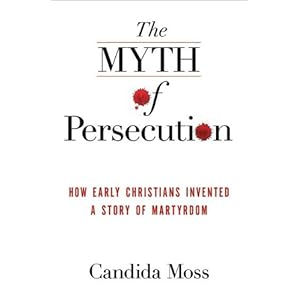
In "The Myth of Persecution: How Early Christians Invented a Story of Martyrdom," Moss lays out in detail just exactly what her title says.
And, it's no atheist who's doing this, whether out of mean-spiritedness or other reasons. Per her Amazon bio:
Candida Moss is Professor of New Testament and Early Christianity at the University of Notre Dame. A graduate of Oxford University, she earned her doctorate from Yale University. Moss has received awards and fellowships from the Woodrow Wilson Foundation, the National Endowment for the Humanities, the Catholic Biblical Association, and the John Templeton Foundation.So, she's a Catholic, teaches at a Catholic University, and has gotten money from a foundation that's even been accused, at times, of trying to get scientists who take its money to bend backward to favor religious thought.
A sampling of what's in this book:
Moss ... challenges some of the most hallowed legends of the religion when she questions what she calls “the Sunday school narrative of a church of martyrs, of Christians huddled in catacombs out of fear, meeting in secret to avoid arrest and mercilessly thrown to lions merely for their religious beliefs.” None of that, she maintains, is true. In the 300 years between the death of Jesus and the conversion of the Emperor Constantine, there were maybe 10 or 12 scattered years during which Christians were singled out for supression by Rome’s imperial authorities, and even then the enforcement of such initiatives was haphazard — lackadaisical in many regions, although harsh in others. “Christians were never,” Moss writes, “the victims of sustained, targeted persecution.”From there, she moves on to a more detailed look at stories of six martyrdoms.
They include Polycarp, a bishop in Smyrna during the second century who was burned at the stake, and Saint Perpetua, a well-born young mother executed in the arena at Carthage with her slave, Felicity, at the beginning of the third century. Moss carefully points out the inconsistencies between these tales and what we know about Roman society, the digs at heresies that didn’t even exist when the martyrs were killed and the references to martyrdom traditions that had yet to be established. There’s surely some kernel of truth to these stories, she explains, as well as to the first substantive history of the church written in 311 by a Palestinian named Eusebius. It’s just that it’s impossible to sort the truth from the colorful inventions, the ax-grinding and the attempts to reinforce the orthodoxies of a later age.She doesn't deny thast some Christians were killed. Thast said, she also, per the story, distinguishes between "persecution and "prosecution."
And, as she notes, Christians hauled into courts for other issues deliberately provoked the magistrates:
Christians wound up in Roman courts for any number of reasons, but when they got there, they were prone to announcing, as a believer named Liberian once did, “that he cannot be respectful to the emperor, that he can be respectful only to Christ.” Moss compares this to “modern defendants who say that they will not recognize the authority of the court or of the government, but recognize only the authority of God. For modern Americans, as for ancient Romans, this sounds either sinister or vaguely insane.”Indeed, that's anything but "persecution." However, contra Alternet, for many of today's Religious Right who perpetuate the myth of persecution, it probably doesn't sound insane at all. Nor does it to some religious cults, whether rooted in Christianity or not.
That said, it did sound insane to some Christians at the time. We have letters from some bishops telling members of their flocks not to do this.
And, judging by the review, Moss, even, may not go back far enough.
This all actually starts with Paul. "Luke" made up the idea that he was a Roman citizen. He may or may not have been martyred himself, and if he was, it was because he was a Jew. The idea that Christians were blamed for the Great Fire in Rome has little historic support.
The reality?
The Roman historian Suetonius' warning about what's often called "Christian disturbances" in Rome in the reign of Claudius should be translated as "Messianic disturbances." To the degree Acts has any historical truth behind it at all, it partially describes what can be found in more detail in Josephus: Messianic-claimant Jews popped up all the time, and not just in Palestine. The fact that Tacitus doesn't use the Greek word "Christos" but a similar one, often used for Apollo, shows how little he knew about Judaism.
Now, back to Paul, alleged martyrdom in Rome for him, and related details.
First, the word "Christian" wasn't even used until well into the second century. That's one of several relevant facts that you can find in Paul Tabor's "Paul and Jesus," reviewed by me here.
Second, as far as we know, the names of Jesus-believers in Paul's letter to the Romans may have been ALL of them in Rome, or nearly so.
Third, Paul likely was NOT a Roman citizen.
Therefore, in Acts 26, his "appeal to Caesar" didn't happen either.
In reality, as Tabor points out, his ongoing, increasing, enmity with James and even Peter may well have reached a boiling point in the late 50s CE. As part of that, Paul may have violated some precept of Torah, even in the Temple court. Or, if not, contra Acts, he may have refused to correct the impression he was telling even Jews not to circumcise.
In any case, some disturbance probably did happen, and the Roman procurator Felix arrested him.
Maybe he was eventually flogged to the degree a non-Roman could be, whether by Felix or his successor Festus, and then told to stay out of Jerusalem on pain of death. From there, he could then have scrounged a trip to Rome on his own. And, quite possibly, died a natural death before the Great Fire of Rome.
Tacitus claims Nero blamed Christians for this. However, he's not a primary source. Suetonius, the only other halfway close Romans to write about early Christians (see above) says nothing about Nero blaming Christians. So, even if Tacitus' statement is not an interpolation, given Tacitus' ax-grinding, it's not likely to be true. Or, as with Josephus' statement about Jesus, it may have a genuine core, but a Christian expansion, in which case, like Suetonius, we should read him as talking about Messianic Jewish disturbances in general.
And, if the Paul of Acts is actually true, especially as interpreted by Tabor, it's as plausible that he would have denied being a Jew, and told Nero, if he had a chance, his "cosmic Christ" had nothing to do with "Jewish self-mutilators."
Of course, there's another possibility for Paul's death.
Maybe followers of James and Peter killed him in Jerusalem after high priest Ananus had killed James. Or even more notably Zealot followers of Jesus did. It's at least as plausible as the tale Luke and early Christian myth spin.
And that myth, of Paul's martyrdom, coupled with the one spelled out in Acts about Stephen, started this whole thing.
It sounds like Moss didn't quite go deep enough. (She could also have mentioned intra-Christian persecution after the Council of Nicaea, where Christian "brotherly love" exceeded anything pre-Diocletian, at least, on the pre-Christian Roman imperial side.
But, this isn't just about the past.
Thoughts for today below the fold:
July 27, 2008
Imagine there was a Jesus born 100 years early
Let’s say there was a “Jesus,” but it was the Yeshua put to death as a Pharisaic religious and political rebel by Hasmonean king Alexandar Jannai in the 70s BCE, per the Jewish historian Josephus.
Huh, you may say, if you’re not familiar with this.
But, if there is any sort of Jesus of history behind both the Christian gospels and rabbinic legends, he may have lived 100 years earlier than claimed. Wiki has a brief synopsis here.
Then, per Rodney Stark’s theory that Christianity, without miracles, and based on the 175-year history of the Mormons, could grow at 40 percent a year, with a starting point of 100 Christians at the time of Jesus the Pharisee’s death, we would have had about 12,000 at the time of the great fire of Rome in 64 CE.
Stark’s book that explains his growth rate idea in more detail is here.
Given that Rome’s population was about 1/50th of the empire, this would have put about 240 Christians in Rome. That would have been 1/5,000th of the city’s population, or 0.05 percent. Would that have been enough to catch Nero’s eye, whether or not they were actually troublemakers?
Per the original view of when Jesus lived, and Stark’s theory of Christian growth, the empire would have had about 1,500 Christians at the time of the fire of Rome. A mere 30 Roman Christians probably wouldn’t have been enough to draw a letter from the apostle Paul. It certainly, as 1/40,000th of the city’s population, would have been below Nero’s notice.
See this June 2008 blog post for thoughts on how a newly-discovered Jordanian building, alleged to be a Christian church and alleged to date from the middle of the first century CE, would support my contention, setting aside obvious Jordanian tourism reasons to stretch the truth here.
Huh, you may say, if you’re not familiar with this.
But, if there is any sort of Jesus of history behind both the Christian gospels and rabbinic legends, he may have lived 100 years earlier than claimed. Wiki has a brief synopsis here.
Then, per Rodney Stark’s theory that Christianity, without miracles, and based on the 175-year history of the Mormons, could grow at 40 percent a year, with a starting point of 100 Christians at the time of Jesus the Pharisee’s death, we would have had about 12,000 at the time of the great fire of Rome in 64 CE.
Stark’s book that explains his growth rate idea in more detail is here.
Given that Rome’s population was about 1/50th of the empire, this would have put about 240 Christians in Rome. That would have been 1/5,000th of the city’s population, or 0.05 percent. Would that have been enough to catch Nero’s eye, whether or not they were actually troublemakers?
Per the original view of when Jesus lived, and Stark’s theory of Christian growth, the empire would have had about 1,500 Christians at the time of the fire of Rome. A mere 30 Roman Christians probably wouldn’t have been enough to draw a letter from the apostle Paul. It certainly, as 1/40,000th of the city’s population, would have been below Nero’s notice.
See this June 2008 blog post for thoughts on how a newly-discovered Jordanian building, alleged to be a Christian church and alleged to date from the middle of the first century CE, would support my contention, setting aside obvious Jordanian tourism reasons to stretch the truth here.
July 06, 2008
Dying-and-rising savior-god an ancient Jewish tenet
 Or so a brief tablet, with 87 lines of Hebrew text, pictured by the New York Times at right, would indicate.
We’re only eight years into the 21st century, but this may last the next 92 as the most significant find in biblical archaeology.
Daniel Boyarin, a professor of Talmudic culture at the University of California at Berkeley, said that the stone was part of a growing body of evidence suggesting that Jesus could be best understood through a close reading of the Jewish history of his day.
“Some Christians will find it shocking — a challenge to the uniqueness of their theology — while others will be comforted by the idea of it being a traditional part of Judaism,” Mr. Boyarin said.
As the story notes, nobody has yet challenged the authenticity of the tablet, dated so far to the late first century BCE. (Why does the NYT use the anachronistic, for academia, and for New York City’s large Jewish population, for that matter, of “BC”?) Chemical analysis, though not yet released, appears to confirm that.
If so, it would be the first pre-Jesus (assuming that such a person as Yeshua bar Yusuf actually existed) text to speak of a dying-and-rising Jewish messianic figure.
As the article notes, modern critical New Testament scholarship assumes that Jesus’ own statements about dying and rising in three days are later additions. Maybe they’re not.
That then said, what’s the provenance of this text, other than starting as some sort of gloss on passages from Zechariah and Daniel? Can it be connected to any particular movement in Second Temple Judaism at that time?
It would seem to fit with scrolls associated with Qumran, as this “Dead Sea scroll on stone,” from what is extant, takes the form of an apocalypse revealed by the angel Gabriel.
Other questions abound, too.
Why was the Simon of this scroll supposed to die? His death, at least from the story, isn’t mentioned as atoning, unlike Jesus claimed for himself.
And, despite the efforts of Jewish leaders from Ezra through the Pharisees, and of course running through the Maccabees, to “purify” Judaism, what does this say about other “outside” ideas running around Judea at this time?
This MSNBC article does a good job of listing all the caveats about this stone, as well as further explicating how a number of “Christian” Messianic ideas (though NOT the dying-and-rising savior god of Judea’s pagan neighbors) have already been documented as being present elsewhere in Judaism.
Subscribe to:
Posts (Atom)