The Kingdom, the Power, and the Glory: American Evangelicals in an Age of Extremism by Tim Alberta
My rating: 3 of 5 stars
This was a HARD book to rate, and so, as I’ve done once or twice before, I’m doing sub-ratings. These come from my dual background as a newspaper editor and a secularist with a graduate theological degree. And, I'm expanding on one issue from my original Goodreads review.
OK, subratings:
1. Conservative evangelicals in bed with Trump? (Note the word “conservative” and see below.) 3.5. The TL/DR answer that Alberta doesn’t expressly note (until the epilogue, spoiler alert)? Conservative evangelicals, or a large chunk of them, want to “own the libs,” like Trump. He says this indirectly, but no more than that, before that one aside in the epilogue. (That said, David French, Russell Moore and others appear to blow this as well, or else maybe they — and maybe Alberta, too — don’t want to admit that the desire to win, which Alberta does discuss, is that simple — and that crude. And, while more inchoate, was held long before Trump.)
Side note: Per my observation about Russell Moore last year, Christianity’s entanglement with politics in the US isn’t totally new either, per things like Teddy Roosevelt’s “Muscular Christianity.” And per that link, I have a more skeptical eye on Russell Moore’s past than Alberta does.
1A. Conservative evangelicals’ other problems, such as their version of the Catholic priests’ sex abuse scandal? 4.5. The interviews with Rachael Denhollander and Julie Roys and their legal and journalistic work, respectively, was very good. So was Denhollander’s speculation that whichever way the Southern Baptist Convention’s Ethics and Religious Life Commission breaks on the sexual abuse database issue, it’s going to cause a denominational schism.
1B. In brief, Alberta's starting with the Reagan era is good, as he shows evangelicals' interest in politics — and per Falwell Sr. being focused on taking down Jimmy Carter — as being an early driver. Could have been explored more, namely, the degree to which evangelicals overlooked Reagan's religious failings, such as divorce, child conceived (tho not born) out of wedlock, consulting astrologers (contra legends, Ronnie, not Nancy, took the initial lead on this long before the presidency) and more, just like with Trump. Let's also not forget that the National Day of Prayer was pushed on Ike by evangelicals, and other related Cold War items. 3.25 for not more explicitly making these ties, especially the pre-Reagan ones. Alberta is sincere in his worries about politics overtaking evangelical Christianity today, but, whether he's actually less sincere, or he just didn't want to go into depth on this, he risks looking less sincere by not having explored these ties more.
Beyond the focus of this book, I suspect that my childhood Missouri Synod Lutheranism, without a formal schism, will have 10 percent of its congregations hive off over the next decade or so and that Matt Harrison will stop being able to even halfway thread the needle over the Lutefash issue.
And, speaking of not exploring ties more? ...
1C. Where’s apocalypticism and where’s Israel? I only thought about that at the end, but .... See point 5 and explication for more. 2.5 as a placeholder, but also lowered the rating on broader political commentary, especially re the issue of Israel. On apocalypticism and eschatology, no, not every evangelical has the same take, but, they’re all generally contra mainline Protestants, and Catholics and Orthodoxy’s, amillenialism. And, hellz yes, this influences their interaction with politics, and especially, in foreign affairs, Israel. (NO 1- or 2-star reviewer picked up on this; 3-star reviews were too many to read but I expect it was missed there, too. I'll expand on this, either here or at my blog sites.)
And, yes, this is the issue that gets expansion.
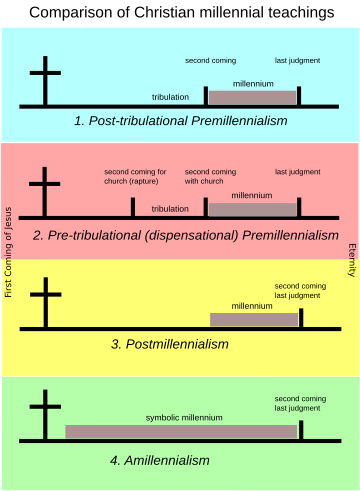
The Wikipedia page on millennialism is a good starter. For more on the three main options within Christianity, go to its pages on premillennialism, postmillennialism and amillennialism.
Premillennialism has two different stripes, one ancient and the other modern. Both, though, believe in a literal millennium, a 1,000-year rule of Jesus on earth. They differ on things like where to place the "Rapture" (scare quote needed) and the "Tribulation" vis a vis the millennium as a whole, but have broad similarities. Overall, historic premillennialism is less literalistic than modern dispensationalist versions, though, and it's those that drive the folks like Tim LaHaye and his "Left Behind" set.
To be complete? Postmillennialism is, per Wiki, more of a catch-all. That said, all varieties believe Jesus' second coming will not happen until AFTER a millennial period, hence the "post-" prefix. How literalistic or not to understand that millennial period itself has a wide variety of stances.
Amillennialism? Anything the bible says about a 1,000-year period is figurative.
As Wiki notes in the main article, some early church fathers were Historical Premillennialist. Others may have been around that. Postmillennialism in any form had no real foothold among the ante-Nicene fathers.
But then Nicaea happened. And everything related to it, like the legalization of Christianity inside the Roman Empire, followed by it being made the official state religion by Theodosius II less than 60 years later. And, no tribulation or any other premillennial verschnizzle had happened. (This is why, in the bible, most scholars think II Thessalonians is apocryphal; it totally ignores Paul's "Man of Lawlessness" of 1 Thessalonians. See here for the difference between that person, the Beast of Revelation and the various antichrists of Johannine epistles.)
Amillennialsts say that there is no literal millennium, and that Revelation is just referencing the time between Jesus' ascension and his return. There will be no reign of the righteous or improvability of the earth before he returns, contra postmillennialism, nor will he return to start a 1,000-year battle with the powers of darkness, let alone look for a rebuilt temple in Jerusalem after a spotless red heifer is found or anything like that.
So, per Alberta's book, who believes what?
Catholics, Eastern Orthodox are strongly amillennial. So is the Lutheranism of my youth. So is traditional Calvinism, including Alberta's Presbyterianism. Ditto on Anglicanism and Episcopalianism. "Fundamentalism" within old mainline Protestantism, as well as more liberal views of theology and interpretation in mainline Protestantism, are at least on paper, still amillennial today.
Baptist groups, and the broader Anabaptist tradition from which they arise? Also generally amillennial.
That said, premillennialism in modern times is not a 19th-20th century American issue. Many Puritans held that, seeing themselves as a "New Israel." And, tying that to the "ingathering" and conversion of all Israel. (Paul may have been speaking literalistically in Romans. But, he was still wrong.) It really exploded among 19th century British evangelicals, where John Nelson Darby essentially launched what became modern dispensationalism, then exploded further here in the U.S. with Cyrus Scofield and his infamous Scofield Reference Bible. Its impact was expanded even more by being printed right before World War I. Although Baptists' history is amillennial, dispensationalism has a strong foothold there. It does as well among charismatic and Pentecostal types.
As for where we're at now? The 1948 establishment of the nation of Israel factors largely into many dispensationalists' thoughts, including, yes, rebuilding a temple and other things.
And, ALL of this, and how it affects modern evangelical or fundagelical politics, versus Catholics, Methodists, Lutherans, and on paper, Alberta's childhood Presbyterians, is ignored by him.
2. Defining “evangelical”? 3 Alberta admits it’s complex, but, without using the word “fundagelical,” takes a pass in one way. See below. Let’s also not forget that “evangelical” arose in part as a “branding” term.
3. Biblical and early Christian interpretation, even within “fundagelical” culture? 2.5.
4. The above, outside that? 2.25
5. Broader political commentary? Rating based in part on overlapping past political coverage with Alberta: 1.75
A weighted average of all of the above, weighting more for the 1 and 1A gives 3.2 stars. An unweighted average is 2.8.
Summary: I think Alberta is sincere in his description — as far as it goes. Why it doesn’t go even further, on evangelical history, and the unmentioned elephant in the room, I don’t know. Get’s a gentleman’s C 3 stars. Because of his sincerity, and because at least one of the 1-star reviews is crap, this is a solid rating. But, if he writes another book just about evangelicalism, figure out his audience and pitch first. If he writes another book about evangelicals’ intersection with politics, and it doesn’t cover that elephant, don’t read it.
Early on, like Bart Ehrman’s Armageddon, Alberta appears to have a Marcionite view of the Old Testament. (Later, he talks about the sweetness of the New Jerusalem in Revelation, but ignores the amount of divine wrath there. He ignores Tertullian’s riff on Lazarus and Dives with Christians taking joy over the torments of the dammed.)
Also early on, Alberta indicates a belief in American exceptionalism, such as talking about America’s “miraculous” victory over Great Britain. Nothing miraculous about it when you recognize that Yorktown was a 75 percent French, 25 percent American, win, which doesn’t appear in Alberta’s narrative.
There’s also problems with biblical interpretation and criticism elsewhere. Contra page 131, no Nero didn’t persecute Christians after the Great Fire and the Tacitus account is almost certainly an interpolation by a minor church father circa 400 CE.
The page before is an error that even a fundagelical should not make. Saul/Paul did NOT “supervise” the stoning of Stephen and the plain text of Acts never says that. What Acts 7:54-58 DOES say:
54 When the members of the Sanhedrin heard this, they were furious and gnashed their teeth at him. 55 But Stephen, full of the Holy Spirit … 57 At this they covered their ears and, yelling at the top of their voices, they all rushed at him, 58 dragged him out of the city and began to stone him. Meanwhile, the witnesses laid their coats at the feet of a young man named Saul.
A few pages later, from that same Wheaton conference? Maybe part of why evangelicals think, wrongly, they’re being persecuted today is even more than conservative Catholics, they’ve swallowed myths of early Christian martyrdom that Candida Moss showed more than a decade ago simply aren’t true.
Much later, on page 386, this howler: “If these women had complied with the Jewish norms of the day, which forbade women from instructing men in public spaces…” then “it’s true that Paul wrote in one letter that women should not teach men.” Alberta never delves into the issue of inerrancy, nor the critical theology knowledge that Paul didn’t write those words in 2 Timothy, but a pseudonynomous author did circa 120 CE.
Yes, I know this is not a book of biblical, and ante-Nicene and post-Nicene Christian church fathers criticism. Nonetheless, with the exception of Saul/Paul and Stephen, getting these issues wrong, and continuing to wrongly hold them, especially combined with American exceptionalism (including as expressed by Alberta) means that evangelicals, whether they continue to try to be highly engaged politically or not, will in some way get their relation to politics wrong.
The idea of dividing the book into three sections, on “The Kingdom, The Power and the Glory,” riffing on the end of the Lord’s Prayer of today (that almost certainly was not part of the original, per textual criticism) was good. But, where was Augustine, specifically, “The City of God,” in the Kingdom section? He’s referenced in passing twice in the Power section by people Alberta interviews, and that’s it. MAJOR failure there.
Also? Not all evangelicals are conservative evangelicals and Alberta makes an error of omission here like many of his theological kin do. For example, Sojourners magazine, the people behind it, and the mag’s average readers? Nowhere mentioned in your book. (I checked the index; the Russian Orthodox Church, which is definitely not a US evangelical church, is mentioned five times, and Sojourners zero.) Per Wiki, the Sojourners Community that founded the mag started at Trinity Evangelical, and I’ll venture Alberta knows this. Alberta isn’t the only person to get this wrong. So does Fred Clark at Patheos, whom I suspect knows better, and who may be loath to identify himself as a “liberal evangelical” if he is one; The New Republic, which doesn’t; and others. Whether “liberal evangelical” is totally the right word for folks like Sojourners, I don’t know, but, at least, “moderate evangelicals.” And, Jimmy Carter still self-identifies as an evangelical, I think. And, what about academics in exegetical theology who accept historical-critical methodology in general but are on the conservative edge of it like a James McGrath? They’re not fundamentalists, not in a narrow sense.
There’s also the question of who’s an evangelical and who’s a fundamentalist? I consider the conservative Presbyterian church in which Alberta grew up, does have “evangelical” in its name, but? After all, “The Fundamentals” arose from within Presbyterianism, at least as far as the Stewart brothers who funded it. And, I consider the conservative wing of Lutheranism, whether the larger Missouri Synod or the smaller Wisconsin Synod (one of the events Alberta attends is at a Wisconsin Synod church) to be fundamentalist too. (These Lutherans, including my Missouri Synod pastor’s wife sister, hate being called fundamentalists, but it’s true, even if their fundamentals aren’t Presbyterian ones.)
There’s also the question of what the core audience is? If it’s conservative evangelicals, maybe it’s not long enough. If the general public? Too long. 450 pages in relatively small font and leading for todays hardbound book world is pretty long. See the top portion of my ratings.
There’s also a bigger background issue, via a question not raised by Alberta. And, Jeopardy style, I’ll provide the answer via Ed Abbey:
“Growth for growth’s sake is the theology of the cancer cell.”
Indeed, per a biblical reference missed by Alberta, in Acts, Gamaliel says that if the movement by Jesus’ disciples is from god, it will succeed and if not it won’t.
Setting aside divine origins, for any organization that is convinced in a non-arrogant way of the rightness of its mission and ideas, focusing on growth for growth’s sake simply shouldn’t happen.
Then, there’s the general politics coverage.
On 298, Alberta repeats the canard (it is, Tim) that national Democrats generally support “abortion on demand.” Once again, he either knows better or decided not to know better.
Many, many Democrats in the House and Senate supported the Hyde Amendment, barring Medicaid funding of abortions, from when Henry Hyde first wrote it. That includes our current president, Joe Biden, while in the Senate.
Related and connected? Biden, as well as Clinton and Obama, failed to ask Congress as the start of their respective administrations, when Democrats controlled both houses, for legislation offering any federal protections for any portion of Roe that could be federally protected. Alberta knows that, too.
Also, at one point in the book, Alberta seems to treat with a half-sneer the idea in the Shrub Bush administration of looking for “moderate Muslims.” If he didn’t mean that, then, he needs to be more careful in how he describes Muslims in America.
Finally, in a BIG old issue that Alberta totally ignores? And that’s of new relevance since Oct. 7, 2023? At least on paper, the mainline Lutheranism of my youth still doesn’t cut blank checks to Israel. This, and apocalyptic thought in general, and how it fuels and festers fear, is an issue for both political coverage and the intersection of religion and politics.
Related? As I said in 2018 (maybe he’s gotten better) Alberta is not a smart / informed political writer, to put it politely, or he’s … well, he’s the same word as he is on Democrats and abortion, to put it somewhat less politely, or an l-word, to put it totally unpolitely, about Beto O’Rourke’s political stances. I interviewed Beto, per the background to that link, and during the 2018 Senate campaign general election race, not the Dem primary. Beto talked about "access for all," and said single payer was "one way to get there," but contra Alberta, that's not single payer. Period. He refused to cosponsor John Conyers' HR 676 in the House. And, he said he didn't like Sanders' similar bill in the Senate. Now, Alberta wasn't alone in drinking the Kool-Aid; so, too, for reasons of her own, did his primary opponent, Sema Hernandez. That still doesn't excuse Alberta.
==
Finally, sidebar observations. One two-star reviewer needs to actually read Alberta with an open mind rather than chastise. She won’t recognize herself in the mirror (nor allow comments). Another in the same vein.
And another:
The craptacular one-star review is by an apparent Gnu Atheist.
View all my reviews