SocraticGadfly: movies
Showing posts with label movies. Show all posts

July 20, 2023

Movies: the next media and music?

Very, very insightful piece from Stratechery about the future of the movie industry in the middle of the SAG/AFTRA strike. (I'm a one-movie-a-year person, at that, myself, pre-COVID; if it wasn't Tom Hanks, I almost certainly wasn't there.)

The two nut grafs are at end:

The broader issue is that the video industry finally seems to be facing what happened to the print and music industry before them: the Internet comes bearing gifts like infinite capacity and free distribution, but those gifts are a poisoned chalice for industries predicated on scarcity. When anyone could publish text, most text-based businesses went from massive profitability to terminal decline; when anyone could distribute music the music industry could only be saved by tech companies like Spotify helping them sell convenience in place of plastic discs.
For the video industry the first step to survival must be to retreat to what they are good at — producing content that isn’t available anywhere else — and getting away from what they are not, i.e. running undifferentiated streaming services with massive direct costs and even larger opportunity ones. Talent, meanwhile, has to realize that they and the studios are not divided by this new paradigm, but jointly threatened: the Internet is bad news for content producers with outsized costs, and long-term sustainability will be that much harder to achieve if the focus is on increasing them.

I'd have to agree with them, and with the background premise of Disney trying to out-Netflix the actual Netflix being stupid.

I would add to Ben Thompson that, given some parallels being from the media industry and some from music, this is a partial double-barrelled "fool me once, shame on you; fool me twice, shame on me" the movie biz faces. He's right that studios' stupidity over streaming isn't the problem for actors and writers, but yet it is. Newspaper publishers and music execs engaged in similar stupidity, too. And, unlike the music biz, you can't take movies on the road for live performances.

The other bottom line is this:

Every person on earth has only 168 hours in a week, during which time they are presumably sleeping and working. Those few remaining hours can now be filled by YouTube, or gaming, or podcasts, or reading this article; every single minute spent doing something other than consuming Hollywood content is a minute lost forever.

Other than me still not liking the word "content," I agree. And, I read enough and summarized it for you.

I only wonder if the studios have a shot at making a gaming franchise out of more and more movies.

June 07, 2014

One word of advice to #graduates — and it's not #plastics


The “plastics” reference, which many of today’s graduates might not even catch, is from dialogue in the movie, “The Graduate,” between Mr. McGuire (Walter Brooke) and Ben (Dustin Hoffman), as also shown in the clip above.
Mr. McGuire: I want to say one word to you. Just one word.
Ben: Yes, sir.
Mr. McGuire Are you listening?
Ben: Yes, I am.
Mr. McGuire: Plastics.
Ben: Just how do you mean that, sir?

I’m not Steve Jobs, Steven Spielberg, or a past or present president of the United States. So, I don’t get a lot of graduation speaking gigs. (If only they knew what they were missing.)

But, in an occasional newspaper column, and occasional blog piece, I’ve written about graduation before. I’ve noted that it’s not a finish line. Related to that, I’ve said that it’s just one step in life; I once compared it to being a rite of passage.

The Jobses and others of the world seem to be dripping with pearls of wisdom. But if not, since this is the Internet era, people make up fake speeches that they think these people, or a Bill Cosby, a George Carlin, or some other comedian or humorist should have given.

Whether in real or fake versions, these speeches try to have an aura of timelessness. That’s also important in today’s Internet era. No speaker, or speaker faker, wants to refer to the latest social media trend and thus produce a speech that may have an 18-month shelf life rather than a potentially timeless one.

So, old proverbs get updated and polished. Religious insights get a more generic spirituality and rebranded. Sports and other competition clichés get trotted out.

Behind all of this, there’s one element that seems to be hovering in the background, and, because of that, another element that’s blocked out.

The background element seems to be that, in some ways, life is relatively simple or predictable. And, that idea tends to shove aside the one that life has a fair element of luck

Now, by “luck,” I don’t mean any metaphysical force. Rather, to trot out two of those old clichés, I mean something like, “That’s the way the ball bounces,” or “That’s the way the cookie crumbles.”

And, sometimes, that’s exactly what happens. And we even have an old saying for that: “There but for the grace of God go I.”

The end of high school, or the end of college, may seem a time of near-invincibility. And, of course, belief in one’s invincibility never wants to let luck enter into the picture.

If I were to be asked to give a few thoughts today, they’d probably touch a lot on luck.

For new high school or college graduates, luck can change a job path, a career path or a study path. It can open one’s mind, if a person is ready for that. It can provide a bit of humbleness, without humiliation, if someone is open to accepting that he or she isn’t in total control. Or, it can provide a little bit of humiliation to anyone who doesn’t want to accept that.

Luck can also provide a degree of connectedness. Per the “There but for the grace of God go I” proverb, luck can tell people the reason they did or did not get a new job, a raise, or a promotion, or a new boyfriend or girlfriend, isn’t always due to rational reasons, but sometimes, due to luck.

In short, as graduates prepare to enter the edges of the adult world, thinking about luck can be a reminder that a new version of Social Darwinism, repeatedly plugged by Tea Party types that seems to be growing stronger in America, that certain material rewards or achievements are “proof” of one’s own skill, especially one’s own inherited, inborn skill, simply aren’t true.

Beyond Social Darwinism, a similar, religiously spit-polished version of this is promoted as the Success Gospel. Here, it’s not what genes you inherited that are behind your success. Rather, this is all a mark of blessing from God.

Well, at spots in the Hebrew Tanakh, and the Christian Bible, God doesn’t like storing up wealth very much. Read Amos, for example, or the Sermon on the Mount. But, at other times, like in Psalms and Proverbs, he’s pretty much “down” with getting rich as a sign of his favor to humans indeed.

As a secularist, I find this as bad as Social Darwinism. I find the New Agey version of the Success Gospel even worse, if anything. Neither the virililty of one's genes, nor the strength of one’s faithful willpower, with NO apologies to either Schopenhauer or Hitler, has a tremendous amount of connection with a lot material success for a lot of people.

Rather, it’s that good, old, non-metaphysical randomness that we call “luck.”

So, 2014 graduates? Take that word with you. For your peace of mind, it’s a lot more valuable than “plastics.” And, with an American population expected to hit 400 million by 2050, and a world population of 9 billion by then, you're going to need a lot of it.

December 01, 2012

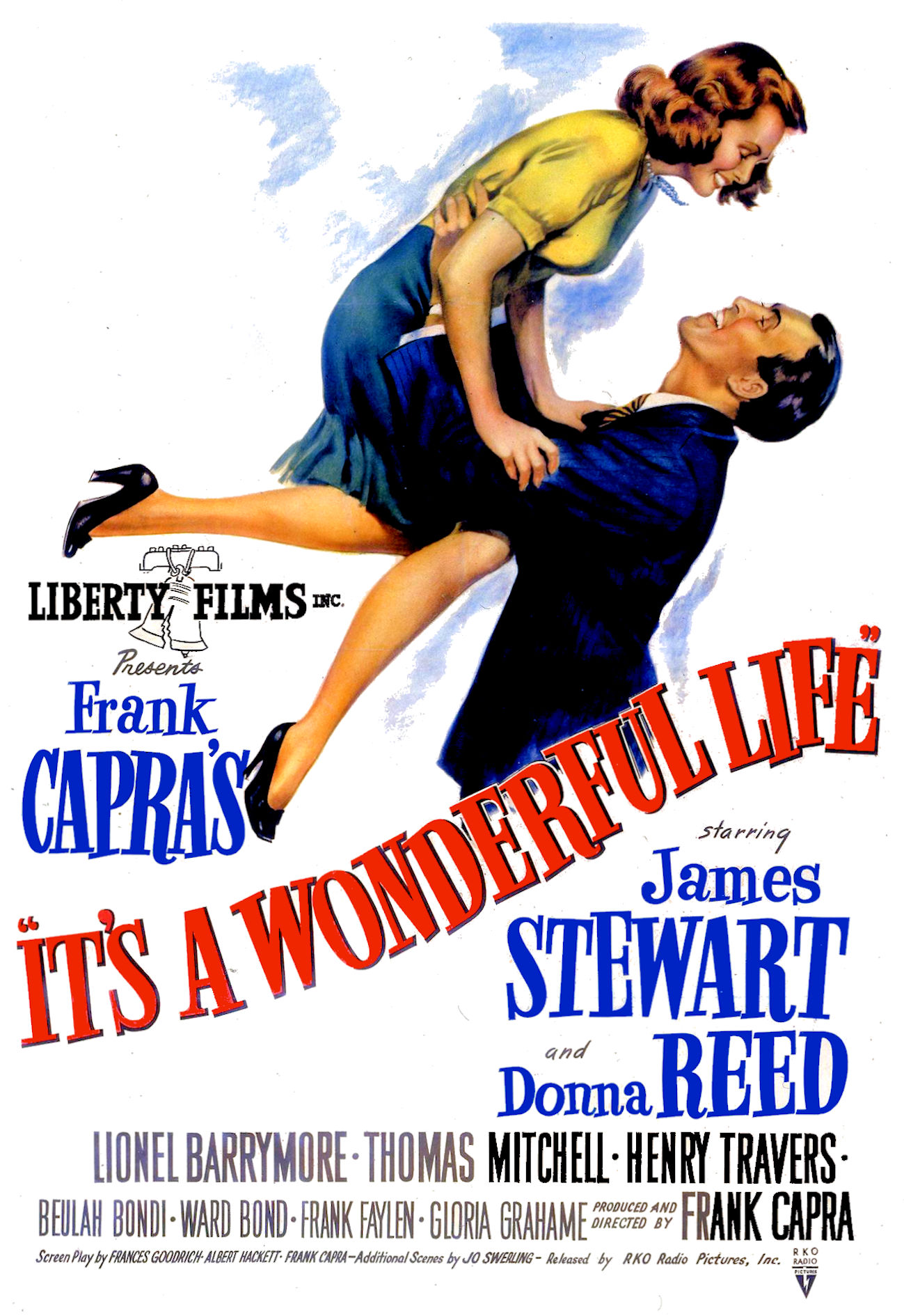
Why I loathe 'It's a Wonderful Life'

Update, Dec. 1, 2012: I've identified even more why I don't like it. See paragraphs at bottom.

A few years ago, I wrote a fairly long blog post about the Frank Capra/Jimmy Stewart chestnut possibly needing a remake, as well as some things that were wrong about this saccharine bit of of sentimentality, and extensively updated it last year at Christmas time. The post incorporated a couple of other bloggers' takes on issues or problems with the movie, which I didn't fully tackle at the time.

Well, now I am.

First, it's not just sentimental, it's, as I said above, saccharine about it. And cheesy. "Fiddler on the Roof," arguably, is sentimental, albeit darkly so. "The Sound of Music" is also sentimental, and overall, sunnily so, while accepting (as based on a true story) that Austria was dead (even as it mythologized Austria). But, "It's a Wonderful Life" has no nuance.

Second, in the actual movie, what's to be so sentimental about? Sure, George Bailey has all these friends helping him out. In fact, he's not only recouped the money Uncle Billy lost, but much more. Beyond that, even a George Bailey as soft-hearted as Capra's would have, at a suitable point in the next year, quietly but firmly pushed Uncle Billy on part-time status while looking for a permanent replacement.

Related to that, after the end of World War II, Bedford Falls would have gotten its own housing boom, even its own small Levittown. Most buyers would have taken loans from Bailey, not Potter. George Bailey might have come into decent money. Or, he might even have gotten rich.

Third, Capra HUGELY stacks the deck with his Clarence.

Clarence shows everything that went wrong by George never being born, but he never shows everything that went RIGHT by George never being born. Indeed, he and Capra never even offer that as a possibility, that some people might have been better off had George Bailey never been born.

It's like people who believe in reincarnation, but "somehow" always remember being a king in a past life, but never the person shoveling the shit out of the king's stables, let alone a dung bettle rolling around in that shit.

Maybe if George hadn't been born, Potter would have taken over the building and loan, then had a massive coronary a month later from overwork. In that case, somebody almost as nice as George Bailey might have replaced both him AND Potter.

Per a 1992 bio of Capra, one director has another idea: George should have actually committed suicide. I could buy into that angle, too. Or, per Rich Cohen, if you don't stop the movie at George's suicide, run it past the actual finish, for a Gnosticized George, if you will.

So, I'm tired of crying sappy saccharine tears of this movie, and over how it makes me recognize my own life hasn't turned out so well in some ways. If I ever see it again in the next few years, I hope I get angry instead.

Update, Dec. 1, 2012: I watched bits and pieces of the whole thing, and all of the last half hour. I had to steel myself once or twice, but didn't come close to a real lump in the throat, let alone more.

And, I recognize even more why I don't like the movie ... it's along the "reincarnation" lines, but even blunter.

It's like when pro-life people say, "Would you have aborted 'Baby X' with a bad childhood? Congratulations. You aborted Leonardo, or Beethoven, or whomever." But pro-choice people can respond with similar counterscenarios, and say, "Congratulations. You kept Hitler alive to perpetuate the Holocaust."

It's that kind of deck-stacking that Capra does.

Does 'It's a Wonderful Life' need a remake?

"It's a Wonderful Life" is on TV again (Updated, Dec. 1, 2012). I am at home tonight, and per the linked follow-up blog post in the third paragraph, if I watch it tonight, it will be, contra past years before 2011, not be such a saccharine tear-jerker as usually has been for me. Indeed, I may turn a strongly critical eye on it, and a more introspective one on my past emotions.

And, I know that it is such a tear-jerker because it leaves me longing, more than just wistful, for a life that I never experienced that much growing up. (Since I didn't experience it, I can't be nostalgic about it.)

(Update, June 2, 2012: I've now come to the conclusion that behind the saccharine and my own tears, I loathe the ideas and philosophy behind it.)

Anyway, let's think of some alternative ideas for this movie, since it's a tear-jerker precisely because Frank Capra pulls  formulaic strings, while actually making it "Bentham’s Panopticon with picket fences," per a link below the fold.

What if Capra had ended the movie 20 minutes early with George Bailey, aka Jimmy Stewart, jumping from the bridge? Or, had run it out another 30 minutes after the tear-jerker ending? Would we see George take a more skeptical look at Bedford Falls? Would he perhaps wonder if a little bit of Potterville actually did lurk beneath the surface?

If you want to get more thought on that line of thought, go here; is IAWL "the most terrifying movie ever"?

Before I saw the Salon story, when I watched it (and, yes, cried again) this year, I thought that the end of what Rich Cohen calls "The Night Journey of George Bailey" had a major-key riff on the melody of the medieval church hymm of the Apocalypse par excellence, the Dies Irae. Cohan makes me wonder more.

The occurrence is just before Bert pulls up and says, "Where have you been, George"?" It just caught my ear. [That said, that's part of why I love Rachmaninoff, and I will hear the Dies Irae wherever it pops up. More on that "aha" here.] Given that Dmitri Tiomkin, who wrote the score, was born in Old Russia 21 years after Rachmaninoff, and studies there under Alexander Glazunov and later, in Berlin, under Ferruccio Busoni, it adds to the possibility. However, the original score was even darker.

Per the link, which talks about George's "resurrection," I think that IS a Dies Irae riff. (More on that thought here.) That said, to riff on some of the ideas in the link ... it would have been interesting if, in the "salvation by friends" scene at the end, the actual Dies Irae had been playing, sotto voce.

Anyway, Cohan says there's a darker meaning underneath the saccharine. I think he overstates his case, but may have something going on here.

So, per Cohan, and my own thoughts, maybe it's time to do a remake? Either cutting it short, or else extending it?

I think you could extend it, by about 15-20 minutes, cut about 4-5 minutes from the original, and do something "interesting." Along Cohan's line, could we make this an "Occupy Main Street" movie for today, taking "Occupy Wall Street" to the local level? Or would we have an "Occupy Shrugs," in which our updated George Bailey is crushed, bribed or otherwise taken out of the picture. Could we "darken" it further? Should we? Or make it more ambiguous in general?

Anyway, more thoughts on a remake, including suggested actors and directors, below the fold: