SocraticGadfly: mainstream sports media
Showing posts with label mainstream sports media. Show all posts

May 31, 2021

Quick thought hot take on Naomi Osaka

I won't say I have zero sympathy for Naomi Osaka's decision to withdraw from the French Open (hold on to that link from Red Satan) but I don't have a lot.

That's in part being a member of the media, who has at the local level, seen in person politicos and businessmen trying to stiff the media, and seeing those same folks — AND athletes and other entertainers — pull the same nationally and globally.
In general, and definitely with Osaka in person, it all boils down to communication, or apparent lack thereof on her part, AND her willing choices made in all of this.

First, let us remember that she won the Australian Open. I don't remember her expressing that much angst during or after matches in Melbourne, or after the whole open were done, about being interviewed. She did admit to being "funny" and "nervous" in the interview after winning the final there. See below.

Second, let us note that if she DID have any such problems that she kept private, she's had nearly 3 1/2 months to communicate with the folks at Roland Garros. 

She chose not to. 

Instead, just days before the start of action, she dropped a bombshell social media statement with a blanket "no interviews." Note that she wouldn't give any interviews about that statement, either.

The folks in Paris said they reached out to her and got crickets, acting on behalf of all four Grand Slams. It was only after that reach-out was snubbed that a further warning was issued saying fines could escalate and that even a disqualification was possible. Given all the above, for Red Satan's author to call this surprising is laughable, naive or worse. The statement within that link says these are normal escalating enforcement provisions within normal Code of Conduct regulations.

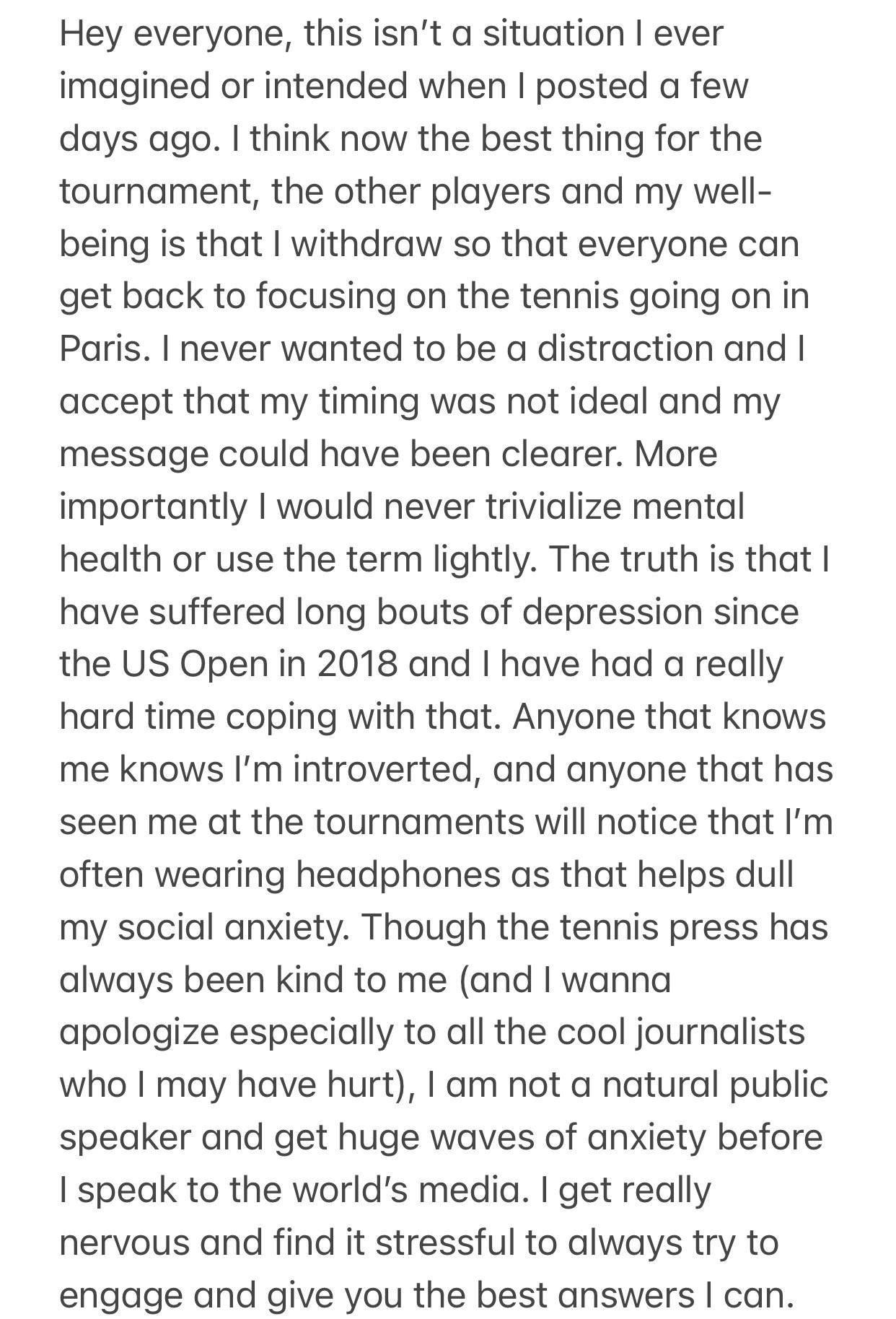
Her personal withdrawal statement was also? Posted on her social media. No interview afterward. No returning of questions by the Associated Press.

She DID claim, hypocritically in my opinion, that she NOW wanted to talk with the Grand Slam organizations. Maybe this was because they'd fully indicated that a conversation, not a set of social media posts, needed to happen, that it would happen as a conversation, and not on unilateral terms.

That's probably part of what she didn't imagine a few days ago.

As for other aspects of her withdrawal statement?

First, introversion is not a mental health issue, and it's insulting of her to call it one. It's also sad if she really believes that about introversion in herself. 

And (see links below) her desire to market herself as a brand? Introversion is not shyness.


And now, to tennis as a business.

The Roland Garros statement notes contractual obligations. That's the bottom line. This is a business, and a big one.

Though, as of 2019, not as big as Osaka's endorsement money.

Someone on Twitter suggested the tradeoff of "no interviews, fewer endorsements." Sounds great in practice, but how do you enforce it in reality? In the US, it would run afoul of the First Amendment, especially on individual sports with no team owners to enforce discipline.

Next, to tie that back to her statement? I'm sure Osaka has done marketing interviews related to some of her endorsements, like this big one for Levi's.

Next, to the sports media she first complained about, but pulled in her horns on her withdrawal statement.

Yes, there's inane questions there. Anybody who's watch the full press day at the Super Bowl knows that, too.

But, there's real questions, too. Like at the PGA, to go to golf, asking Brooks Koepka after Round 4, if anybody did, if he's thought that he's lost some of his "majors aura."

OR, with the interview after the Aussie final, Osaka being asked about different court surfaces for upcoming Grand Slams and other events.


Yes, that interview was long, but normally, before the quarters level at a Slam, press availability time is 5-5 minutes, no more.

Could this be further shortened at the quarters, semis, and finals? Yes? Beyond inanity, does sports media have its version of Jim Acosta? Yes. Plenty of them.

Again, though, Osaka has had 3 1/2 months to raise this. And chose not to.
 
When she actually starts talking with the Slams, she needs to include an on-the-record explanation of why the wait. 

==

Update: Per CJR, some people are saying that under the Americans with Disabilities Act, she's owed a reasonable accommodation. 

Well, there's several things to unpack here.

The French clay of Roland Garros ain't in America, first. Neither is the grass of the All England Tennis Club nor the composite surface of Melbourne, Australia.

Second, even in the US, what would a reasonable accommodation be?
 
Third, what is the line between responsibility and obligation, Jon Allsop asks in that piece. He tangentially touches on business aspects but not too directly.

==

Update, June 7: Osaka has a funny way of wanting to talk to the Grand Slams. She's withdrawn from a "Wimbledon tune-up" tourney in Berlin and her appearance at Wimbledon is doubtful.

Update, June 13: Roland Garros makes clear how they reached out to Osaka, repeatedly, and heard nothing (and apparently continue to hear nothing, per the update above).

January 20, 2014

#MLB & #roiding — are writers who say 'we didn't know' in willful denial?

My answer to that is yes, and I'll get there in just a minute.

Following this year's Baseball Hall of Fame election, Grantland's Bryan Curtis came out with a great piece titled, simply, "The Steroid Hunt."

It's chock full of links to stories from sportswriters going back 20 or more years. Its ground zero is Thomas Boswell, sports columnist for the Washington Post, commenter on Ken Burns' "Baseball" documentary, and for purposes of this blog post, inventor of the phrase "Canseco Milkshake," part ot the colorful contribution to the steroid mess by Jose Canseco when with the Oakland A's.

Boswell knew. But, as a columnist and not a beat writer, especially in a city that didn't have an MLB franchise at that time, there was not a lot he could do, especially when his sports editor whouldn't pick up the cudgels.

And, that's half the problem right there.

Keith Olbermann, at least, in one of the linked pieces, is totally honest about it, when he says "We all knew." He then regrets he didn't tell the story earlier and better.

And, then he talks about the clubhouse culture of all those beat writers and their editors. And, team-focused columnists, too; perhaps Boswell was lucky that the Nationals weren't yet in Washington and nobody from the Baltimore Orioles, well, nobody outside of Brady Anderson, if only for one season, was raising eyebrows.

Like, sadly, the St. Louis Post-Dispatch's Bernie Miklasz, identified in Curtis' piece as running some pretty willing interference for Mark McGwire.
The first of Wilstein's McGwire stories was pure Chevy commercial Americana. ("'Americans love power,' McGwire says. 'Big cars. Big trucks. Big people.'") The second was a preview of the doping journalism that would characterize the next 15 years of baseball writing. It's worth noting that from Wilstein's original question — how'd you get so big? — he was only able to put together a partial answer. But he got further than anyone else.

"I thought it was rock-solid reporting," said T.J. Quinn, who was covering the Mets for the Bergen County Record, "and that [Wilstein] was a victim of a clubhouse mentality that oozed up to the press box." The clubhouse code says that all secrets of the locker room must remain there. La Russa — again coming to his player's defense — tried to ban the AP from the clubhouse.

In an odd twist, several writers joined La Russa's crusade. ...

But the harshest blowback came from the St. Louis media. When the New York Post asked a local photographer to take a picture of McGwire's locker, the Post found that the photographer had ratted out the paper to the Cardinals. Post-Dispatch columnist Bernie Miklasz, also working with the permission of the team, attempted to re-create Wilstein spotting the andro. Miklasz stood several feet from McGwire's locker. With Grassy Knoll precision, he announced in his August 24 column that he had to "intentionally look, and look hard" to read the label.

Wilstein dryly suggested that this was because Miklasz was too short.
I wasn't as skeptically minded about life in general then as today. And McGwire had been big enough when he first started with the A's, long before his Cardinals days. I only regret that Curtis doesn't have a link to the Miklasz column embedded. The Post-Dispatch's website, with the paper owned by a penny-stock company cheap enough to use Town News as its website host, returns zip on searches between Aug. 23 and Aug. 26, 1998.

So, when you see a sportswriter accusing "the rest of us" about being holier than thou over roiding? It's most likely defensiveness.

So, they can bite me.

Buster Olney had better never again bust Murray Chass over "bacne" when he wrote about it himself in 2002.

And Bud Selig needs to stop being self-righteously silent when players were openly talking about juicing, that same year.

And, players and GMs were going on background about it way back in 1995.

If there's a failure, it's of columnist types like Miklasz, who claimed andro was legal in 1998 (yes in baseball, no in football and in the NCAA, which he didn't say), to educate the public. And, maybe in 1995, the Internet was slim pickings, but it wasn't by 1998.

There's also a failure by columnists when they say, "It's no different than greenies," the amphetamine pills of an earlier age.

Olbermann calls bullshit on that, with the help of a man at Ground Zero of that era — Jim Bouton:
And then the bottle of “andro” showed up in McGwire’s locker. I can remember that week hearing the late baseball writer Leonard Koppett tell me on my show that nobody cared, that it wasn’t cheating, that it was nothing worse than vitamins or maybe, maybe, “greenies.” To his eternal credit, the author and former pitcher Jim Bouton not only disagreed, but got it exactly right. Some day, he says in the interview, baseball will have to reckon with years and years of records that will be artificially inflated, distorted beyond all measure, by the effects of a drug that lets you keep working out when the guys next to you – or before you, chronologically – have to drop the barbell.
Bingo.

And Bob Costas, whose judgment I will always respect, says, via Ken Rosenthal, that it's an issue of "authenticity." For those who claim this is just like "greenies," like Jeff Passan and others, again, no. Bob and Ken are, I think, coming from where Bouton is: it's not a cheating issue, it's an issue of how much it made some players inauthentic. And amphetamines, while they may have taken the edge off jet lag (or hangovers) didn't actually increase performance from a baseline level.

There's one related issue, not touched on by Fangraphs' Dave Cameron in a 2014 vote wrap-up piece, where he says that Hall of Fame voting, and possible changes to the system like expanding the ballot, is all about logic. Nope. The old "big Hall" vs "small Hall," which is definitely a matter of opinion, drives a lot of this debate. The issue of not voting for some alleged or actual roiders, and the worries about the "gridlock" it causes, are of less concern for we small Hallers. They're still of some concern, but certainly not the same degree.

So, to big Hallers getting hot under the collar for that reason? Sorry.Especially as I suspect that with some writers, it's not willful denial, it's just an other attempt to get a Big Hall nose under the tent flap.

As for Deadspin? It's opening a HOF vote to fans was pretty good. It's NSFW take on the Cubs mascot was, well, OK; the mascot could have been mocked in other ways, too. Its claim that Anthony Bosch could have, theoretically, been injecting A-Rod with nothing but distilled water? Laughably lame if satire, incredibly stupid if true. I don't buy into everything about how this was handled, but that's .... crap and nothing but. And, yeah, Deadspin has a large posse of contributors, but, I lost respect for it, as far as a repository of serious sports news.

And, as for big Hall writers who worry about the Murray Chass types and what they might be doing with potentially unfounded accusations? Well, a good lawsuit can address that. After Jack Clark ran off his mouth about Albert Pujols, El Hombre sued him. And, judging by his latest response, The Ripper is running scared.

On the plus side? Jon Paul Morosi notes that all the discussion over baseball's hall, and the lack of it for other sports, is a good thing. I generally agree. I'll add that, in the NFL's case, it reflects how unserious Roger Goodell is, and Paul Tagliabue before him, about addressing steroids in that league. It also addresses how unserious NFL-first fans are about that issue. Finally, it addresses problems with the NFL's voting process, where a mandatory minimum number of candidates MUST be elected each year.