SocraticGadfly: TXU
Showing posts with label TXU. Show all posts

April 29, 2014

Goodbye, #TXU, #Luminant, #EFH, whoever the hell you are

Well, the old TXU, or at least the post-deregulation power-generating portion of it, Energy Future Holdings, or EFH, is officially in bankruptcy.

The Wall Street Journal summarizes why, as most of us know — badly gambling wrong on fracking.

That said, that's not the whole story.

Behind that decision stands the separation of the old TXU, and other old electric utilities, into different arms for generation, transmission and other things as part of Texas' electric deregulation.

Even at the time it was being done, it was being questioned.

And, between that and the wrongly-placed bet, this has been a time bomb waiting to detonate, oh, for about four years.
To a large degree, the prospects of Energy Future Holdings hinge on something it and its owners can’t control: the price of natural gas. While it has insulated itself somewhat, through financial hedges that protect it from price swings, it still needs the prices to rise sharply to have any hope of paying off its staggering debt load. 

Indeed, while the company met its roughly $3.6 billion in interest payments on its debt last year, it still faces a $20 billion balloon payment coming due in 2014.
And, the backstory to that is that greed can be a powerful motivator, even to the point of making even a Saint Warren of Buffett wrong, wrong, wrong, on some decision-making:
Investors who bought $40 billion of TXU’s bonds and loans — including legendary wise men like Warren E. Buffett — have seen huge losses as most of the bonds trade between 70 and 80 cents on the dollar. The other $8 billion used to finance the buyout came from the private equity investors themselves, along with banks like JPMorgan and Citigroup and large institutional investors like the Canadian Pension Plan. Several analysts and energy bankers say that this latter stake currently has little value. 
The whole NYT story linked above is worth a good read.

Next question is: what does this mean? The story at top says the restructuring will take about 11 months. But, especially since Oncor, the transmission arm, isn't involved, there's not a lot of jobs to be slashed, as is often the case in such filings. Per federal safety regulations, you have to have X number of people running your power plants, for example. And, given that your wrong bet on natural gas got you in this pickle, you  can't raise rates. Indeed, EFH/TXU has been peddling longer-term contracts up to the last minutes before bankruptcy, including to my place of work.
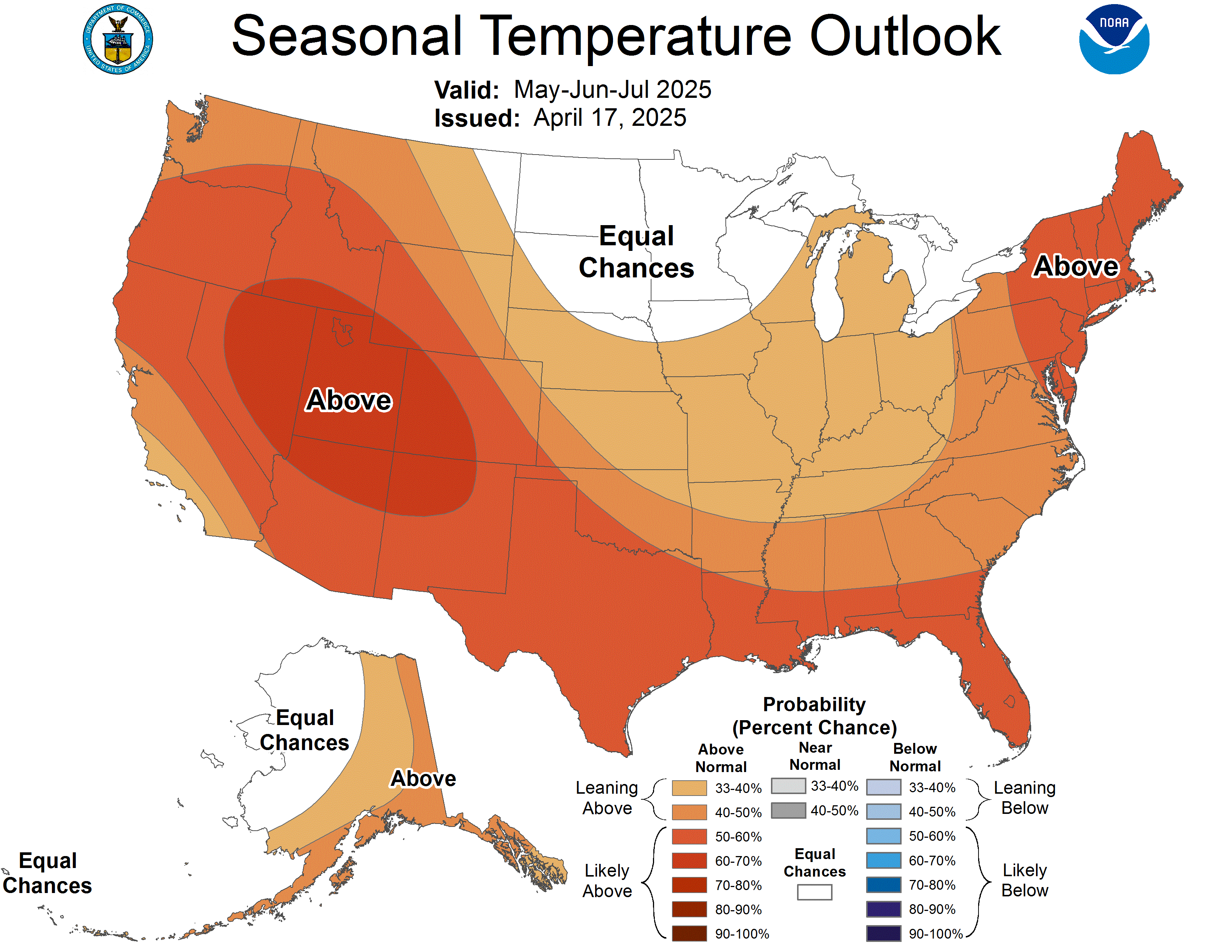
As for transmission issues? The Electric Reliability Council of Texas, or ERCOT, the folks that oversee transmission issues, say there should be no problem. But, we're expecting another hotter-than-normal summer here. (Or, maybe I should say, in light of global warming, we're expecting another "new normal" summer here.) Combine that with any questions about power generation, and how much of that can reasonably done from older coal-fired plants given today's Supreme Court ruling (see below) and I hope ERCOT, while being sanguine for public consumption, is nonetheless doing careful planning in private. That's doubly true since, contra GOP legislative and gubernatorial "geniuses" in Austin, deregulation has given Texas residents higher electric rates than before, ones that are, overall, considered to be above the national average.

At the same time, this could be good news for the environment. Luminant, EFH's electric generation arm, had four of the five worst power plants in the country for mercury emissions as of a couple of years ago. If the bankruptcy finally forces it to finish writing off its older power plants, and its use of much of the dirty lignite from here in the state, there's a benefit right there.

And, they'll probably have to do that write-off. Today's Supreme Court ruling on EPA power plant regulation authority is not good for coal-fired power plants in general, and certainly not for older ones, especially if they use dirtier coal. Besides, since that underscores, if indirectly, EPA authority to regulate carbon dioxide emissions, it's another good reason for Luminant to cut its losses. It will hurt some small towns near some of its power plants, but this is a call that needed to be made at some point anyway.

But, the bankruptcy filing didn't stipulate any plans for that, leaving state-level leaders of environmental groups a bit frustrated:
Tom “Smitty” Smith, director of Public Citizen’s Texas office, said trying to retrofit plants like Big Brown would be like spending thousands of dollars to fix up a junk car, and Luminant would be better off investing in wind and natural gas plants.
To me, it's a no-brainer in light of the SCOTUS ruling. That said, will its creditors buy on? There's other issues in the filing, per the link above, that could have environmental ramifications. And, speaking of "Big Brown"?

No wonder, based on the mercury link above, and its shaky bottom line, that TXU/EFH/Luminant was among the corporations suing the EPA. So, too, of course was our "sue Obama" attorney general, Greg Abbott. Guess what, Greg? You lost. Ain't the first time. Remember last October, when you lost two out of three? No wonder you're our state's top money-waster.

(By the way, does anybody also notice how Abbott gets as quiet as a church mouse whenever he loses as the SCOTUS level?)

As for details of that bankruptcy? It's a bit complicated, as the Dallas Morning News explains. Will it work? Spinning off the competitive, deregulated Texas Competitive Electric Holdings, in essence, what most of us saw as TXU before deregulation, isn't likely to thrill all creditors. And, a lot of junior creditors may get bupkis. I somehow am skeptical of the 11-month timeline to emerge from this bankruptcy. Every other financial claim by EFH in three-plus years has been wrong, at least to some degree. Why should we believe it now?

Also, any chance that some of the financial speculators behind EFH ask for some socialistic relief from the state? Stay tuned on that one. So far, Kohlberg Kravis Roberts, Texas Pacific Group and Goldman Sachs, the three speculative buyers, have resisted spending their own money more than absolutely necessary.

After all, it was bribery lobbying in Austin that let this takeover happen in the first place. Again, per that long NYT piece:
To that end (of getting state OK for the takeover), the K.K.R. group spent at least $17 million on lobbying (including 2,400 breakfast tacos on the Legislature’s opening day and San Antonio Spurs tickets for certain state representatives), according to Texans for Public Justice, a watchdog group. According to the group and others, the lobbying money was used to win over opponents in the Texas Legislature and fend off legislation that would have given regulators power to veto the deal.
Don't you sleep on this idea of Round Two of bribery lobbying in Austin being on the 2015 agenda of the Lege. That's especially true since the original round was bipartisan, including Democrats such as then-Dallas Mayor Ron Kirk. Electric issues had already been popping up at the edges of some primary races earlier this year.

That said, the buyout also personified the ugliness of "greenwashing":
Other advisers for the buyout team approached environmentalists, including the Natural Resources Defense Council and James D. Marston and Fred Krupp, two leaders of the Environmental Defense Fund, to support the deal. The buyout team offered to cut the number of proposed coal-fueled plants to 3 from 11.  
And, that's why I loathe "Gang Green" environmental groups.

March 01, 2010

KKR buyout of TXU is imploding

The tanking investment banks in particular and economy in general have folks like JPMorganChase at the throat of Kohlberg Kravis Roberts and allies who took over Texas utility company TXU in 2007.

And, we ain't seen the worst yet:
The company ... it still faces a $20 billion balloon payment coming due in 2014. To leap that hurdle, the private equity owners have a handful of options: persuade bondholders to swap their debt at a discount for debt that matures later; sell a stake of the company in an I.P.O.; or sell assets.

Since KKR et al bet on natural-gas prices, this is one of the best arguments for commodities speculation regulation I can think of.

Second, it's a great argument for not giving a dime to Gang Green environmentalists like NRDC and Environmental Defense who endorsed the takeover. (EDF is now providing green flak for Walmart, among others.)

Third, it's a call for more regulation of the broader financial industry. You know that KKR, Texas Pacific and Goldman Sachs' investment arm will do anything and everything they can to dodge more losses.

Fourth, it's a call to re-regulate utilities.

December 04, 2008

Texas cities should look former TXU gift horse in mouth

Guaranteed low electric rates for 24 years? Sounds too good to be true, doesn't it?

Well, electric power generator Luminant is presenting what claims to be the real deal, and Cedar Hill, Duncanville and Grand Prairie are among cities that have signed up.

But, the hidden costs of these and other cities getting a minimum of 60 percent of their electricity from coal-burning power plants - hidden costs that could include increased carbon dioxide and mercury emissions - say that maybe this is too good to be true, or at least is a gift horse that needs further examining.

First, the trader of that gift horse needs a closer look. Luminant is what were the electric power plants of the old TXU. That's before leveraged buyout artist Kohlberg Kravis Roberts, profiled in the movie “Barbarians at the Gate,” along with Texas Pacific Group and Goldman Sachs, acquired TXU about two years ago.

Now, TXU wasn't exactly in the charity business even before the leveraged buyout. KKR never has been charitable, as the movie I mentioned documents. And, anybody watching current Treasury Secretary and Goldman Sachs alumnus Henry Paulson in the past month or two knows that he (and his company) are not known for befriending the little guy or paying attention to Main Street instead of Wall Street.

The three cities above, and others, have joined Cities Aggregation Power Project. If enough cities join the deal, CAPP cuts Luminant a check for $465 million. In exchange, they get 60 percent of their electricity at a fixed rate, on a 24-year contract, starting at a cheap $7 a kilowatt-hour.

Luminant needs the money. It has leveraged buyout debt, and anybody who's watched Crazy Uncle Henry Paulson's roller coaster knows that, these days, an antsy debtor can get an itchy trigger finger to call in debt.

In addition, Luminant has three new coal plants coming on line, and debt from them to pay off too.

Luminant gets well more than half of its electric generation from natural-gas plants. But, it's offering cheap (not allowing for any loopholes) power to cities that don't have a problem getting the majority of their electricity from relatively dirty coal.

The rates are cheap enough that it looks almost like bribery-level offerings to get CAPP cities to help Luminant pay off its leveraged buyout debt before some creditor in today's credit-tight world starts calling in notes.

Also on the financial side, the leveraged buyout trio promised to keep rates low through Š wait for it Š the end of 2008. I'm sure Luminant is going to be beating the bushes hard for new city customers for the next four weeks.

If enough cities sign up to launch CAPP, who knows what the price will be down the road on the 40 percent of power that's sold at floating rates?

Beyond that, there's the issues of air quality and global warming.

First, global warming. Coal emits a lot more carbon dioxide, the most common human-generated greenhouse gas, than does natural gas. Many inside-Washington environmental analysts expect some sort of national carbon dioxide emissions cap-and-trade program to come out of the Obama Administration, and relatively soon.

How much that will affect coal-fired electric costs, and how much of that cost Luminant would try to shuffle over to the 40 percent of the electricity it will provide CAPP cities at floating rates, is unknown. But, the fact that this thumb could potentially come down on the price scale means the CAPP deal may not be quite so cheap as billed.

Meanwhile, Luminant's four dirtiest power plants are estimated to be responsible for 5 percent of all mercury pollution in the United States. Luminant says it's working to clean up its plants, but didn't we hear that from the old TXU years ago? Just as pre-buyout TXU wasn't a charity, it wasn't exactly the “greenest” electric power generator.

As far as Metroplex air quality, those three new plants are near Waco, just to the southeast. At least on some days, prevailing winds come here from the south-southeast, and the more electricity from that plant, the more problematic the air quality in or area, already under Environmental Protection Agency non-attainment citation.

Over a 24-year period, stepping up conservation efforts would likely save CAPP cities as much money as TXU's coal-black smokestacks will pump out, and with the benefit of saving electricity in general.

November 25, 2008

Is Luminant, née TXU, selling CAPP cities a bill of CO2 goods?

Coal-fired electricity could clash with green image of cities, and carbon cap-and-trade, and what other rats might be in the bin?

In exchange for locking in electric rates for 24 years with electrical provider Luminant (the generation part of the old TXU and now part of Energy Future Holdings after its buyout by KKR and – lest we forget – Goldman Sachs, ) via the Cities Aggregation Power Project, Cedar Hill (and other participating cities) are getting a minimum of 60 percent coal-fired electricity.

THAT is how the cities avoid the volatility of commercial electric rates priced on natural gas rates.

But, a number of Dallas-Fort Worth cities were members of the Clean Air Coalition. If any of them have signed on to CAPP, how does coal-fired electricity square with this?

And, if President Obama and the incoming Congress pass a carbon cap-and-trade system, coal-fired electric prices are surely going up. Is there an "out" in the contract for Luminant if that happens? Was the possibility even discussed?

It appears that, according to the city of Cedar Hill, and from what I've seen in the CAPP contract (though I haven't looked at it recently), there is no such provision.

All good news on the economic side for Cedar Hill and other cities. But, what if we go beyond cap-and-trade to a full-blown carbon tax? Luminant still appears on the hook... unless it deliberately tries to break the contract.

Luminant has said in the past it's OK with such a system, as long as it did not single out utilities. And, I am sure electric utility lobbyists would take care of that.

Also, Luminant touts its carbon dioxide offsets; if enough cities sign up for CAPP, will it have to build another wind farm to offset all the carbon from its coal-fired plants running nonstop, even if the coal-generated electricity, and its lower price, is only 60 percen t of the total electric delivery?

And, beyond that, neither the old TXU, nor KKR or Goldman Sachs, got rich by either being stupid or by being generous. If they're offering cities like Cedar Hill cheap electricity, there's a catch somewhere.

Getting 2/3 of the money up front does help pay off its LBO debt quickly, but it still seems risky to price even the coal-generated 60 percent of power that cheaply, and unless it gets a LOT of cities to sign up, just the up-front money can't do that much debt-clearing.

Oh, and in case you have forgotten, or did not know, here is a reminder of just how dirty the Luminant coal-fired plants are in terms of mercury emissions – four of their plants produce 5 percent of all mercury pollution in the country.

January 29, 2008

Effed-up business electrical service, thy name is TXU

How you can turn the power off a week before a planned move just because a business wanted it turned on at the new site today, as part of starting the move process, is beyond me.

Then, when it’s your fault, how you can say it will take 24 hours to turn it back on is ridiculous.

September 05, 2007

Moving hassles part 2: electric service

As with phone service, I opted, after browsing online, to go with the company I had in Lancaster. Again, the company shall remain nameless, but once more, I will reveal initials: TXU.

TXU’s customer service rep said she could only start me off with its basic plan, not its floating rate plan based on natural gas prices. She said she would transfer me to another number where somebody else could then have me automatically switched to this plan.

(Sidebar: People of a certain political bent who talk about government bureaucracies have never done an apples-apples comparison to big business bureaucracy, I’ll wager.)
Well, after five minutes of hold time, I got a voice mail and left my info.

I tried, half an hour later, contacting the CSR main number. The first person tried to switch me over, but could not pull up my account info. The person he transferred me listened to my request, then transferred me back to the hang on and wait Gehenna I was in before.

(Sidebar two: Doorknob help us if KKR’s buyout of TXU finally goes through. They’ll probably fire 90 percent of TXU’s CSRs, in order to help pay down the massive debt from the acquisition, and you’ll never get a person to answer the phone.)

Makes you wonder if deregulated services really save you money after you pay for the post-installation call Aleve and Tagamet.

July 20, 2007

More details on how KKR took Environmental Defense for a ride over its TXU purchase

Will ED fess up to being played like a cheap violin? It will if it wants any more of my green money for its green causes

The Dallas Morning News has an excellent three-part series documenting how TXU would have had the same cutback in building coal-fired power plants as KKR has proposed, how the bought-out TXU could be made the cornerstone of a national utility company, an area where thee is no federal regulation to speak of, plus potential to challenge existing state regulations; and will almost certainly lead to higher electric prices starting in 2009.
In short, any “green” intention of KKR was already in the works, for the sake of the green of higher profits, without an ED “greenwash.”

The bottom line comes from the first story, from a private report commissioned by the News:
Our conclusion is that the buyout of TXU provides no inherent benefits to the customer. All of the commitments being made by the buyers could be offered by TXU today — if it had the incentive to do so. …

The buyers are offering the customer what TXU may have been forced to offer by regulators due to concerns over market manipulation and global warming or compelled to offer by the business imperative of stemming customer attrition and repairing reputation. Therefore, there is no net gain for the customer as the deal is currently described. …

The buyer commitment to terminate eight of the 11 planned TXU coal-fired plants was the public relations angle used to launch the buyout. …

There is reason to believe that TXU's high retail customer electricity prices, alleged price manipulation, poor handling of its proposed coal projects, negative environmental positions, flagging reputation, retail customer attrition and apparent CEO excesses would have forced the company to offer most of the same 'concessions' as the buyers are touting.

The complete report is available here, by going to the “see the complete report” link under the DigitalEXTRA header, which will download it as a Word document. It goes on to fault Texas laws and the Texas Legislature:
With a legislature that seems to have stalled in creating the laws that would have tuned-up deregulation and provided further protection against global warming, against high rates and against market power abuses, Texas customers must now rely upon the good faith of the buyers, a belief in market forces, and the ability of the PUCT to monitor and enforce existing laws.

In the third story, on the rate issue, the report said to watch out for bait-and-switch tactics:
TXU has the opportunity in the near term to price low enough to win new customers or, at a minimum, stanch the bleeding of existing customers. Then, in December 2008, when TXU is no longer committed to keeping rates low, they can raise prices again.

And, if you live in North Texas and this deal goes through, you might have more power outages that take longer to be fixed:
Reliability might be affected by the new owner's reticence to make capital expenditures. Private equity funds' principal objectives of providing returns to their owners and investors can pose an inherent conflict with utilities' needs for long-term capital investment as well as innovation to ensure long term resource adequacy.

I have felt for some time that ED got snookered, and that perhaps deal-leader William Riley was trading a bit too much on his name and Bush 41 presidential connections. This confirms it.

Now, the $64,000 question: Will ED own up to being played for KKR’s PR, and repudiate its greenwashing of the deal? I’m not holding my breath, but I am holding future contributions to ED until it fesses up.

May 01, 2007

KKR’s “green” takeover of TXU could take more green from your wallet, too

Hold the phone, there, Nellie. MSN Money’s Jim Jubak has the scoop on how folks like Kohlberg Kravis Roberts see plenty of dinero in deregulated electric utilities.
And, down below, he shows how the Natural Resources Defense Council pretty much got hoodwinked on this deal as a “front” for KKR

First, this sobering reminder from private equity company history:
The last time Wall Street applied its best minds to the electric power industry, they brought us Enron, brownouts and wholesale-price-gouging in California, not to mention higher electric bills.

Now, not even 10 years later, they're at it again: Private-equity buyout funds have set their sights on electric utilities. And the result will be? You guessed it, higher electric bills for you and me. As if inflation and the rising cost of oil and natural gas isn't pushing our bills up fast enough already.

I already warned, in an early blog post on this subject, that KKR would try to recoup the buyout price by canning people. Jubak agrees:
In the short run, making a profit on one of these buyout deals depends, first, on "restructuring" the company so that it's more profitable than it was before the buyout. Most of the time, restructuring involves spinning off money-losing operations and outsourcing some part of operations — and it always involves cutting jobs.

But that’s not all, he says;
That would be bad enough in the case of a utility, since job cuts are likely to mean a decline in utility service.

But you'll wind up paying more for less service because, second, turning those small gains in corporate profits into big profits for buyout investors rests on building the buyout deal so that borrowed money, known as leverage, multiplies those relatively modest improvements in corporate earnings.

Problem A, according to Jubak, is 75 percent of such a buyout is done by selling debt based on the acquired company’s real property, etc.

Well, TXU already has enough debt:
Even before the deal, TXU was carrying a big load of short-term ($1.5 billion) and long-term ($10.6 billion) debt, and paying a sizable interest bill of $784 million in 2006. Adding an additional $33 billion or so in debt will run that interest bill significantly higher. And that additional debt load will put pressure on the company’s credit rating, already a relatively low BB from Standard & Poor’s.

Dang, the school district I covered at my previous paper, in it’s worst days, wasn’t rated that low.

But, that’s still not all:
And that's not the limit of the debt load to be piled on the purchased company's balance sheet. Used to be that buyout funds waited until they dressed up a company and sold it back to public investors before they cashed out. In today's market, buyout funds have added a new wrinkle: While the company is still private, it issues a big cash dividend to the buyout investors, so those investors get part of their cash back in short order. How does the company pay for that dividend? Why, by issuing more debt, of course!

And how’s that debt financed? Just open that TXU envelope every month, in a deregulated market, and you’ll find out.

Jubak also explains that KKR’s promise to not build more power plans is money-green, not enviro-green, indicating the Natural Resources Defense Council, and some of us until now, have been hoodwinked.
The long-run logic of utility buyouts leads to lower investment in power lines that would eliminate price differences like those that cost consumers money in Texas (and California and the Northeast). And it leads to lower investment in new power plants, since spending cash on new, more efficient plants cuts the utility cash flow so necessary to paying all that post-buyout debt.

Nice. KKR and TXU get “green” window dressing for what was going to happen anyway.

April 12, 2007

Smokey Joe Barton: OK, maybe he has a bit of cause to be right on TXU

The Texas Public Utilities Commission hearing on the would-be TXU buyout by Kohlberg Kravis Roberts alleges TXU has used legal barratry to drive awayanother would-be buyer. Given that this is TXU, anything is possible. And, given Joe Barton, even a blind hog finds an acorn once in a while. Of course, given Joe Barton, he might have some connection to Hunt-owned Sharyland Utilities.

April 11, 2007

Smokey Joe Barton: Time, once again, to smell the coffee

Joe, instead of demanding the Texas Public Utilities Commission review the TXU sale, which you probably don’t like because of its “green” edge, why don’t you instead ask yourself why TXU rates are 50 percent higher than those in Oklahoma, as you mention.

Could it be that TXU is gaming the deregulated electric system you got Kid Craddick and state lege buddies to pass?

April 05, 2007

Can TXU be any bigger babies than this?

Threatening to close power plants if they actually get slapped on the hand for manipulating prices is the definition of a corporate crybaby. Hey, all you dereg-favoring politicians in Austin, want to still boast about how dereg has made power so cheap?

April 03, 2007

TWO big environmental victories — one with Texas ramifications

The Supreme Court’s ruling that the Environmental Protection Agency DOES have the power to regulate global-warming inducing carbon dioxide as a pollutant is getting all the press.

And, it should get a great deal of this. The ruling doesn’t force the EPA to do anything, but, it turns the heat up, pun intended, on the Bush Administration’s EPA to do something. Also, carmakers who have sued California in its regulations to control CO2 at the state level had a major prop knocked out with this decision.

But, it’s not the only major Supreme Court decision on global warming-related issues. The High Court also ruled, unanimously on this, that Duke Energy must use the latest pollution controls when upgrading its power plants.
Environmental Defense had sued Duke:
Our suit against Duke Energy, the country's third-largest power company, centered on its costly renovations to 30 coal-fired electric generating units at eight power plants in North Carolina and South Carolina. Many of these facilities had been operated sporadically or not at all and were due to be retired and replaced. Instead, Duke Energy extensively rebuilt them, resulting in significant increases in particulate- and smog-forming pollution, but did not obtain permits nor install pollution control equipment as required by law.

Of course, then the Bush Adminstration tried to weaken these requirements, Duke said, in essence, “Sign us up,” and the suit was necessitated.

Here in Texas? Of HUGE importance if TXU wants to expand output at any of its coal fired plants. Or any other utilities.

March 14, 2007

Nuke plants for Dallas, and the TXU deal in trouble

TXU’s buyout by leveraged buyout giant Kohlberg Kravis Roberts sounds like its in some trouble. The Securities and Exchange Commission has launched an insider-trading lawui

insider trading lawsuit against the deal.

TXU has also announced plans to buy two nuclear reactors from Mitsubishi and erect them in the general vicinity of Dallas.

Now, as long as we address the nuclear wastes issue, I’m OK with nuclear power. The insider trading allegations … hmm, wonder how Environmental Defense, the environmental group that helped broker this deal, is going to deal with this. And, are any of its actions a party to the suit?

March 13, 2007

Smokey Joe Barton worries NOT about TXU buyout itself, but about campaign dinero

Barton sent letters to state and federal regulatory agencies expressing his concerns about whether this was the best for Texas consumers.

Sure, Joe.

Good thing this was TXU and not TXI or we’d have Alberto Gonzales getting some federal district attorneys on the sale, under pain of firing.

February 26, 2007

Who’s KKR going to whack from TXU?

You don’t make promises like this:
As a result of this transaction, TXU Energy will provide more than $300 million in annual savings through a 10 percent price reduction for residential customers in its traditional service area who have not already selected one of TXU Energy’s other lower-priced offers. Customers will begin receiving a 6 percent reduction in approximately 30 days and an additional 4 percent reduction at the close of the transaction. This will strengthen TXU Energy’s position as having the lowest prices among the major providers in their traditional markets.

without doing some major slash-and-burn on jobs.

And KKR has done that before.

More on the TXU buyout

Still some fine points to read

The Gray Lady, the New York Times, reports that Her Honor, Dallas Mayor Laura Miller, still has some concerns. (And why wasn’t this reported in the initial Dallas Morning Snooze story? Answer: It was not even their own story; it came off the AP wire. Maybe the Snooze's Mong and Dechard are right that most people have not a care whose byline is on a story.)

Namely, the Waco plant that’s already drawn heavy opposition, being the closest to Dallas, and also being likely to make Waco itself an Environmental Protection Agency non-attainment zone, is one of the three plants still scheduled to be built. Interestingly, I've not yet seen an official statement from the Coalition of Clean Air Cities.

The Times story was also fascinating in its description of the role environmentalist group Environmental Defense played in the sale. In short, neither KKR nor Texas Pacific, the two private equity funds planning to buy TXU, wants their private lives to be public. So, asked ED to confidentially work on making this deal more acceptable. ED President Fred Krupp then recognized leverage when he saw it, and pushed for yet more changes. (Some of my environmental donation dollars at work!)

However, besides’s Miller’s worries, there are other caveats.

First, this is not a done deal; second, it’s not an exclusive deal. TXU’s board of directors is still free to negotiate elsewhere until April 16. Third, the eight apparently discarded plants weren’t going to be built for years anyway.

Nonetheless, the victory has HUGE symbolic value. TXU blinked. And, when you can get that to happen, you’re winning.

February 25, 2007

TXU to be bought, sans most the new coal-fired plants

Takeover firm Kohlberg Kravis Roberts will buy TXU — with TXU dropping plans for eight of its 11 proposed coal-fired power plants.

And, they might actually clean up TXU’s act:
KKR and Texas Pacific Group agreed over the weekend to drop most of TXU's ambitious plans for building eight new coal-fired power plants, a move designed to win support for the deal from environmentalists and other critics of the company.

The new buyers also agreed to support a mandatory national program to cap emissions of greenhouse gases and pledged not to build coal-fired plants outside Texas.

Sounds good to me. Plus, it, indirectly at least, kicks Rick Perry in the shins, and you can’t beat that.

February 17, 2007

TXU chickens out on debate

After accusing Environmental Defense over misleading ads about its plan for more coal-fired electric power plants, TXU got hoist by its own petard when ED regional head Jim Marston said, in essence, “You’re right.” Sending letters back and forth isn’t too productive, so let’s have a live debate.

TXU said, uhhh, no thanks.

January 25, 2007

Seems like TXU’s pro-coal citizens flak is a bit weak

Compare this list with the dozens of member cities, plus member counties and school districts, in the Coalition of Clean Air Cities.

Hey, I’ve got news for you folks in and around Fairfield. If TXU builds the same, or about the same number, of power plants, only cleaner burning ones, they’ll still be building in your neck of the woods.

As for coal-related jobs, all the coal they’re going to burn will come from Wyoming, anyway, so not one new Texas lignite miner will be hired. Period.

Will the first person inside TXU to actually tell the truth about all of this please raise your hand?

December 19, 2006

The battle against TXU grows

At a Dec. 14 hearing, State Office of Administrative Hearings judges approved giving the Coalition of Clean Air Cities official legal standing in battling against Gov. Rick Perry’s fast-tracking the permit process for TXU coal-fired power plants.

In the one of the central issues of the hearing, the SOAH judges allowed party status to the Clean Air Coalition of Cities, which represents city and county governments from across the state and most recently, independent school districts.

More on this issue in the Dec. 21 issue of Lancaster Today.