SocraticGadfly: religious myths
Showing posts with label religious myths. Show all posts

June 30, 2023

Gay rights, college affirmative action take it in the shorts in favor of "poor, persecuted Christians"

Today, SCOTUS allowed discrimination against gays in the 303 Creative ruling, even with the case almost certainly being based on a fake order, indeed, a fake gay man, for the basis of the complainant's suit. Sotomayor nails it.

In a dissent, Justice Sonia Sotomayor wrote: “Today, the Court, for the first time in its history, grants a business open to the public a constitutional right to refuse to serve members of a protected class.” She was joined by the court’s two other liberals, Justice Elena Kagan and Justice Ketanji Brown Jackson.
Sotomayor said that the decision’s logic “cannot be limited to discrimination on the basis of sexual orientation or gender identity.” A website designer could refuse to create a wedding website for an interracial couple, a stationer could refuse to sell a birth announcement for a disabled couple, and a large retail store could limit its portrait services to “traditional” families, she wrote.

Exactly right, and that leads to yesterday's ruling, basically gutting affirmative action in college admissions.

What's to stop a new Bob Jones University from refusing to admit Blacks period, and saying that past decisions removing it from federal educational funds was wrong? Especially if it's a religious institution?

By the way, all of this, per the first link, show that the tired old meme of "poor, persecuted Christians" is nothing but Religious Right bullshit. But, going beyond the AP piece at top link, this is nothing new. Hobby Lobby winning its contraceptive lawsuit against Dear Leader show this has been a steady current for 15 years now.

That said, per a National Review piece, on colleges, and Sen. Tim Scott? Why don't you end legacy admissions? Per many leftists, this would also, indirectly, address a class issue. Librulz are on the losing end of this if they don't push for it. (And, at the national level, they won't; another reason I'm a leftist.)

Corey Robin claims 303 Creative was NOT about religion. Oh, in a technical sense, he's right. The plaintiff (besides having a fake basis for the suit) cited Freeze Peach, but it was ultimately free speech in the service of religious issues. Wiki gets that right, Corey. And you apparently don't read analysis of past or present Supreme Court decisions. Shit, your own piece has Smith saying she didn't BELIEVE in gay marriage. In a quote-tweeting, Robin stands by his statement. I referenced the immediately above, plus the Hobby Lobby angle, in a reply.

August 09, 2020

New York Times "discovers" today's Religious Right,
wants news "consumers" to know its genius

"Christianity will have power"? Yes, it's a nice phrase, but ... was one line in one speech in Iowa enough to elevate the speech into Donald Trump's version of a Cornerstone Speech vis-a-vis his relationship to the Religious Right?

The New York Times would have you think so, and with throwing in some breathless marketing Tweets, further confirms why I wouldn't pay to subscribe.

First, two of those marketing Tweets and my responses:
Uhh, no. I don't "need" anyone.
There you are, Mr. NYT National Editor Marc Lacey.

Then this:
Sorry, but no translator needed, Ms. Deputy National Editor Yang.

Here you are:
And, since I posted a link to my original Tweet thread in that Tweet, I'll use it as the basic for finishing up this post.

First, per the header, yes, this is typical NYT bullshit, thinking it's discovered something new, when in reality it has not. Related to that is the quasi-bigfooting idea that if anybody else wrote about this in other media before, it didn't count because they weren't the NYT.

Second is the marketing of this geenyus to today's "consumers" (god I hate that word) of news. Trotting out two of your top editors to Tweet away shows that. It's also pretty heavy-handed. Laughably so.

First, before the Twitter thread, one more example of the NYT's alleged brilliance at being Captain Obvious? This:
The Trump era has revealed the complete fusion of evangelical Christianity and conservative politics, even as white evangelical Christianity continues to decline as a share of the national population.
In reality, with data research sites like Pew having written about this for three or four years straight now, the "Rise of the Nones" (which is a broader issue than just the decline of conservative evangelical Xianity, and blogged about me three years ago, as well as last year) is yesterday's news. As for the "complete fusion" issue? Forty years ago, the Religious Right backed for president a man who had expanded abortion access while governor of California, who never went to church and who consulted astrologers. (Ronnie turned Nancy on to that, not the other way around.)

Now, onto my original Twitter thread, with this blogpost being added to the end of it after being finished.

First:
See, that "bully" part is important. Per "The Rise of the Nones" issues, the Religious Right has been losing power for some time. Rather than sidle up to Hillary Clinton and her conservative DC prayer circle warrior background with The Fellowship, though, because she was pro-choice, and ignoring that Trump long had been so, they backed Trump.

The bullying? Bullying and shaming people into expression of religious belief in small town America, even in blue states (Galloway vs Town of Greece) was and still is a real thing. Remember, most members of the Religious Right hate atheists even more than gays, and may hate non-Christians, especially Mooslims, almost as much.

OK, next:
The hypocrisy? Detailed above with Ronnie and Nancy Reagan. The faux-martyrdom goes hand in hand, and parallels, to link back to the "Cornerstone Speech" 1861, the South's faux-martyrdom after Lincoln's election. Fortunately, the Religious Right isn't getting to totally write or rewrite the history of the last 50-60 years of American life as a new Lost Cause, though people like Dias may be helping.

Trump has played the faux-martyr role to a T since HUD sued him and his dad 50 years ago for racism in apartment renting. He knows how to play an audience like a cheap fiddle.

Next:
This is true in conservative Catholic circles as well, something ELSE Dias left on the table. (Per the old phrase "cafeteria Catholics," there are conservative cafeteria Catholics, on the death penalty and gun control, just like there are liberal cafeteria Catholics on reproductive choice.)

And last, one other thing Dias left on the table (well, there's yet more, but this covers the basics):
Remember, Trump's speech was in Iowa, January 2016, before the Iowa caucuses. On paper, Dominionist Ted Cruz and his Seven Mountains daddy were the ideal candidates for the Religious Right to back. So, why didn't they? (Pew notes that, in polling, the most devout among the evangelicals DID tilt Cruz, even though, overall, the Religious Right tilted Trump. Obvious deduction? Lots of these people may be sincere in their belief claims but don't go to church that often!)

And why didn't Dias ask any of the people she interviewed those questions, whether about who they backed in 2016's primary/caucus, or about how regular they were in their churchgoing?

And, National Editor and Deputy National Editor, why didn't her editor catch that?

Also missing? Some local and regional demographics.

Did you know that Sioux Center isn't THAT small? More than 7,000 people and growing quite nicely since 2000, per City-Data. Did you know that, including the college students who claim residency there, it's still better-off than the Iowa average? Did you know it's less than an hour from Sioux City, Iowa, population 80,000 and metro area 180,000, and a flat hour from Sioux Falls, South Dakota, population 185,000 and metro 265K?

And, looking back locally, the college has 1,400 students. So, what, 40 faculty? Even at a small religious college, they're not being paid total peanuts. The typical associate professor there probably makes 10K a year more than a teacher at the public school district with similar experience.

In other words, Sioux Center isn't the Idaho Panhandle or something.

Were I doing this as an Amazon book review? This would be like seeing a new book with five-star touts turning out to be three stars at best.

November 15, 2019

The rise of the Nones: First Amendment implications

Per the latest Pew Research Center data on religion and American life, there will surely be some sort of "freedom of religion" clause implications within a generation, if not less.

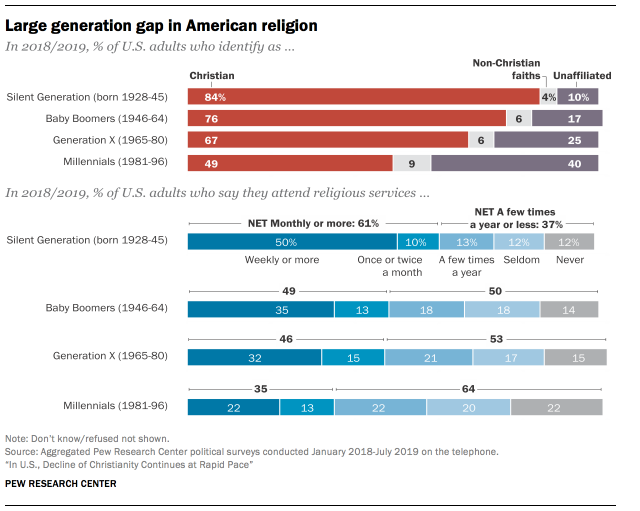
The biggest takeaway from all this latest data? Millennials (yeah, those slackers, despite adults calling the younger generation slackers as far back as Aristotle) are a LOT less religious than their parents. A LOT less.

"Nones," the common word for those with no religious affiliation or identity, plus non-Christians, have as great an identity among Millennials as all Christian groups combined. No, really.


Now, this is a lot broader group than atheists or agnostics, despite Gnu Atheists talk of an "atheist surge," which has been going on for a decade or more now. (The talk, not any surge.) That said, self-identified atheists and agnostics have more than doubled over the 12-year range of the data, from 4 percent in 2007 to 9 percent in 2019.

It should be noted that "nones" may well have metaphysical beliefs. That's another reason for Gnus to stop poaching and crowing. Looking back 15 years or so, a woman on Match.com who originally wanted to meet me said "no" when she found out that "atheist" meant just that and NOT "spiritual but not religious" or Wiccan light or whatever. (It should also be noted, which Gnus don't, that millions of Buddhists around the world, mainly in the Theravada tradition, are both atheist and religious — and believe in metaphysical ideas, just not a personal god.)

That said, Nones are voting with their feet, not just their brains. In 2014, people who attend religious services just a few times a year first exceeded those who worship monthly or more. Among Millennials, it's just one-third who go to services once a month or more.

Among Americans overall, that growth is driven by a surge in those who NEVER attend, by self reporting. That's up to 17 percent.

Yes, one-sixth of Americans, even if they have some metaphysical beliefs (astrology, luck, Kabbalah or whatever) lurking somewhere, say they NEVER attend religious services. Related? Among those who say they attend once a month or more, the most ardent, the weekly attenders (or more) lost six percentage points, down to 31 percent. (If even that is correct; time and motion studies have shown that decades-old self-reported religious attendance surveys were consistently too high.)

Pew notes that the National Opinion Research Center, with different questions and framing, shows a similar number of Nones. It's at 22 percent for all ages vs 26 percent from Pew, even with somewhat different framing and questioning.

Will this "stick"? My answer is that it will, at least to some degree. More slowly, America is becoming less religious, like Europe after WWII. (Before then, and certainly before the Depression, Europe and America didn't track that differently.

It's probably kind of like cigarette smoking. If the Nones who truly don't go to church at all continue that through age 30, they'll likely never be there. And, with that, contra the fakery of Supreme Court backtracking in rulings like Town of Greece, at some point, the First Amendment's freedom of religion meaning true freedom from government propping up religion in any way will maybe start to be realized. Beyond totally banning pre-meetings prayers, etc., I'm talking about things like churches not getting any tax breaks beyond those extended to nonprofit entities in general and things like that.

Even in places like smaller towns in Texas, if they're anywhere closer to the East Texas metros, in 20 years, if not less, less vocal Nones will realize they're not alone. And they're going to start challenging the city council, the school board and the commissioners court about opening meetings with invocations. And, if Democratic (or Green? Socialist? even Libertarian?) presidents are listening, they'll be appointing judges who know that "freedom of religion" includes that the government can do NOTHING in terms of an establishment of religion — any religion as no specific religion is mentioned — that the First Amendment is the most federalized one in the constitution, and that the mealy-mouthed Town of Greece ruling is wrong.

Democrats who don't recognize this are going to find that "non-Republican votes" aren't necessarily "Democratic votes."

BRING.IT.ON.

==

Update, with some related stats? In 2019, 23 percent of Americans went to church every week. Sounds fairly devoted, right, every week? But 29 percent never went once. Texas, Bible Belt stereotypes aside, is no exception. This site says that it was less than 20 percent, and they're a religious website.

December 14, 2018

Andrew Sullivan hits new pseudointellectual low

In what I see as possibly his greatest feat of anti-intellectualism since denoting an entire issue of The New Republic to touting the pseudoscientific insights of The Bell Curve, Sully is now hoisting high the old canard that atheists are really religious, too.

I have myself said that Gnu Atheists, in some sociology-type ways, show a mindset similar to fundamentalist-type Christians, and have thus called them atheist fundamentalists. But, I've never claimed that they, let alone non-Gnus, are religious.

He then followed with teh stupidz of claiming religion is in our genes.

Neither one is close to true, in reality. The fact that Sully is arguably a very good representative of the Peter Principle in mainstream media, especially thought and opinion media, on the other hand, is almost ironclad as an argument now.

But, I couldn't let such arrogant, arrant nonsense go unchecked.

Here's a few thoughts I posted on Twitter, with interspersed comment:
In short, per his Bell Curve love, on B, Sully seems to be doubling down on the pseudoscience of Ev Psych. A Scott Atran or Pascal Boyer will easily steer clear of this while offering much more plausible theories about the origins of what eventually became religious belief mindsets.
From there, it's off to the land of false analogies, refuted by this:
The real problem is Sully's willful ignorance on a fair amount of philosophy. I note that here
and here:
Finally, Sullivan shows his misunderstanding of the political movement he claims to represent.
Tosh. Both here and in Europe (and the Anglosphere across the world), many politicians and political thinkers are both classical liberals and irreligious.

January 15, 2018

Ross Douthat, Tyler Cowen have lightweight religious dialogue

The piece is about six months old, but I only came across it recently, and it's a hoot, while also being a sad illustration of the Peter Principle, especially in Douthat's case, and a warning about false appeals to authority, if anybody thinks Cowen's thoughts on religion are worth crap just because he's a thought-provoking (though not necessarily insightful) economist.

Anyway, here it is — Ross Douthat and Tyler Cowen have a back and forth on religious belief that is laughable.

Among Cowen’s biggest hoots is deploring the lack of Bayesianism in most religious belief. I suppose he thinks Richard Carrier’s Bayesian book-cooking in the name of Jesus mythicism is spot on? Cowen also confirms that his libertarian bona fides are deep and thoroughgoing when he claims to be a Straussian on religious issues. Anyone who invokes Leo Strauss for THAT bears careful watching. (Note to Massimo Pigliucci: Cowen strongly blurbed Harry Frankfurt’s new book, which was the first reason I became highly skeptical of it.)

Straussianism plus Bayesianism brought to putative religious study.

First, miraculously-based religious events, per a Humean definition of miracles, don't have priors, you know what I mean, Vern? Yes, one can crack open "The Golden Bough" and point to something like a virgin birth in places around the world. Whether or not the Frazier-Campbell type approach to comparative religions in myth and ritual is true or not (less true than not, usually), or whether this reflects a quasi-Jungian mindset that Stith-Thompson and the encyclopedias of mythology reference, nonetheless, in the naturalistic, Humean world, such things have no priors, period.

That said, I'm on record multiple times in multiple places in thinking that Bayesian probabilities as used by Gnu Atheists like Carrier is a bucket of warm shit.

And, a Straussian? As in the big noble lie? Well, Paul said "I am all things to all men," and Og Mandino lauded him as the world's greatest salesman, so in that case, Cowen may have more in common with Douthat than he recognizes!

Douthat responds by ignoring that both Blaise Pascal and C.S. Lewis stacked the deck with their wagers on, respectively, the existence of god and the divinity of Jesus.

It's true! For an existentially-thinking secularist, this life, as the only one we have, IS "eternity," if you will. So, Pascal stacks the decks that way. Second, he ignores whether this is the Christian god or some other, though, as a semi-orthodox Catholic with touches of Jansenism, we know where he was placing his bet, and it wasn't on Allah or Yahweh. It may not even have been on the Protestants' version of the Trinity, for that matter.

Cowen then replies that he takes William James seriously. Wow. “Varieties” only shows how deep-seated are the human mental evolutions that have been “hijacked” by the development of religion. Nothing more.

Worse, this is from someone claiming just a few paragraphs earlier to be a religious Straussian? While William James was about many things, I don't think he was about the Straussian big lie. On the other hand, his insistence on interpreting religious experiences by pragmatic value could leave him open to being moshed up with such things.

Rusty then extends that to a “mystical ineffability means its true!” stance. He doesn't question how this might lend itself, or not, to a Straussian take.

Surprisingly, near the end, Douthat lays out his own Bayesian take, and only 45 percent of his total of 100 percent is for classical theism.

That’s called “Cafeteria Catholic,” Rusty, next time you lay that label on the likes of John Kerry or any pro-choice Catholic.


Douthat finishes by invoking Nicholas Taleb’s black swans and saying that, among religions, Christianity is the blackest of all. This is nothing more than a fancy new presentation of Tertullian’s “Credo quia absurdum.”

February 28, 2013

Myth vs realilty: Ancient Christianity and #martyrdom

Much of the information is already well-known to me, but this story about Candida Moss' new book, may be enlightening not just to many broader-minded Christians, but even to secularists, even to generally well-informed ones.

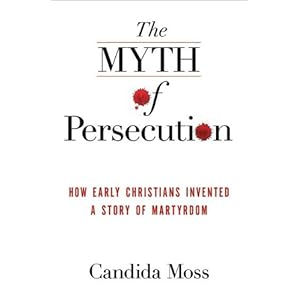
In "The Myth of Persecution: How Early Christians Invented a Story of Martyrdom," Moss lays out in detail just exactly what her title says.

And, it's no atheist who's doing this, whether out of mean-spiritedness or other reasons. Per her Amazon bio:
Candida Moss is Professor of New Testament and Early Christianity at the University of Notre Dame. A graduate of Oxford University, she earned her doctorate from Yale University. Moss has received awards and fellowships from the Woodrow Wilson Foundation, the National Endowment for the Humanities, the Catholic Biblical Association, and the John Templeton Foundation.
So, she's a Catholic, teaches at a Catholic University, and has gotten money from a foundation that's even been accused, at times, of trying to get scientists who take its money to bend backward to favor religious thought.

A sampling of what's in this book:
Moss ... challenges some of the most hallowed legends of the religion when she questions what she calls “the Sunday school narrative of a church of martyrs, of Christians huddled in catacombs out of fear, meeting in secret to avoid arrest and mercilessly thrown to lions merely for their religious beliefs.” None of that, she maintains, is true. In the 300 years between the death of Jesus and the conversion of the Emperor Constantine, there were maybe 10 or 12 scattered years during which Christians were singled out for supression by Rome’s imperial authorities, and even then the enforcement of such initiatives was haphazard — lackadaisical in many regions, although harsh in others. “Christians were never,” Moss writes, “the victims of sustained, targeted persecution.”
From there, she moves on to a more detailed look at stories of six martyrdoms.
They include Polycarp, a bishop in Smyrna during the second century who was burned at the stake, and Saint Perpetua, a well-born young mother executed in the arena at Carthage with her slave, Felicity, at the beginning of the third century. Moss carefully points out the inconsistencies between these tales and what we know about Roman society, the digs at heresies that didn’t even exist when the martyrs were killed and the references to martyrdom traditions that had yet to be established. There’s surely some kernel of truth to these stories, she explains, as well as to the first substantive history of the church written in 311 by a Palestinian named Eusebius. It’s just that it’s impossible to sort the truth from the colorful inventions, the ax-grinding and the attempts to reinforce the orthodoxies of a later age.
She doesn't deny thast some Christians were killed. Thast said, she also, per the story, distinguishes between "persecution and "prosecution."

And, as she notes, Christians hauled into courts for other issues deliberately provoked the magistrates:
Christians wound up in Roman courts for any number of reasons, but when they got there, they were prone to announcing, as a believer named Liberian once did, “that he cannot be respectful to the emperor, that he can be respectful only to Christ.” Moss compares this to “modern defendants who say that they will not recognize the authority of the court or of the government, but recognize only the authority of God. For modern Americans, as for ancient Romans, this sounds either sinister or vaguely insane.”
Indeed, that's anything but "persecution." However, contra Alternet, for many of today's Religious Right who perpetuate the myth of persecution, it probably doesn't sound insane at all. Nor does it to some religious cults, whether rooted in Christianity or not.

That said, it did sound insane to some Christians at the time. We have letters from some bishops telling members of their flocks not to do this.

And, judging by the review, Moss, even, may not go back far enough.

This all actually starts with Paul. "Luke" made up the idea that he was a Roman citizen. He may or may not have been martyred himself, and if he was, it was because he was a Jew. The idea that Christians were blamed for the Great Fire in Rome has little historic support.

The reality?

The Roman historian Suetonius' warning about what's often called "Christian disturbances" in Rome in the reign of Claudius should be translated as "Messianic disturbances." To the degree Acts has any historical truth behind it at all, it partially describes what can be found in more detail in Josephus: Messianic-claimant Jews popped up all the time, and not just in Palestine. The fact that Tacitus doesn't use the Greek word "Christos" but a similar one, often used for Apollo, shows how little he knew about Judaism.

Now, back to Paul, alleged martyrdom in Rome for him, and related details.

First, the word "Christian" wasn't even used until well into the second century. That's one of several relevant facts that you can find in Paul Tabor's "Paul and Jesus," reviewed by me here.

Second, as far as we know, the names of Jesus-believers in Paul's letter to the Romans may have been ALL of them in Rome, or nearly so.

Third, Paul likely was NOT a Roman citizen.

Therefore, in Acts 26, his "appeal to Caesar" didn't happen either.

In reality, as Tabor points out, his ongoing, increasing, enmity with James and even Peter may well have reached a boiling point in the late 50s CE. As part of that, Paul may have violated some precept of Torah, even in the Temple court. Or, if not, contra Acts, he may have refused to correct the impression he was telling even Jews not to circumcise.

In any case, some disturbance probably did happen, and the Roman procurator Felix arrested him.

Maybe he was eventually flogged to the degree a non-Roman could be, whether by Felix or his successor Festus, and then told to stay out of Jerusalem on pain of death. From there, he could then have scrounged a trip to Rome on his own. And, quite possibly, died a natural death before the Great Fire of Rome.

Tacitus claims Nero blamed Christians for this. However, he's not a primary source. Suetonius, the only other halfway close Romans to write about early Christians (see above) says nothing about Nero blaming Christians. So, even if Tacitus' statement is not an interpolation, given Tacitus' ax-grinding, it's not likely  to be true. Or, as with Josephus' statement about Jesus, it may have a genuine core, but a Christian expansion, in which case, like Suetonius, we should read him as talking about Messianic Jewish disturbances in general.

And, if the Paul of Acts is actually true, especially as interpreted by Tabor, it's as plausible that he would have denied being a Jew, and told Nero, if he had a chance, his "cosmic Christ" had nothing to do with "Jewish self-mutilators."

Of course, there's another possibility for Paul's death.

Maybe followers of James and Peter killed him in Jerusalem after high priest Ananus had killed James. Or even more notably Zealot followers of Jesus did. It's at least as plausible as the tale Luke and early Christian myth spin.

And that myth, of Paul's martyrdom, coupled with the one spelled out in Acts about Stephen, started this whole thing.

It sounds like Moss didn't quite go deep enough. (She could also have mentioned intra-Christian persecution after the Council of Nicaea, where Christian "brotherly love" exceeded anything pre-Diocletian, at least, on the pre-Christian Roman imperial side.

But, this isn't just about the past.

Thoughts for today below the fold:

June 18, 2011

#PZMyers and the #Pharyngulacs: religious idiots too

Earlier this week, partly in response to blogger P.Z. Myers, aka Pharyngula, laughably claiming that Sam Harris, author of "The IMmoral Landscape," was not a conservative, I wrote a post calling him a political idiot.

Well, he has a new post up attacking the idea of atheists working with interfaith groups, which show there's religious idiocy in the air too.

What started it all? An attack on non-Gnu Atheist Chris Steadman, specifically a blog post of his on working with interfaith groups, including the pejorative that he was a "faithiest."

Well, one Pharyngulac, early on, claimed to see crosses all over Chris' blog page.

The reality? As I posted on Pharyngula:
What's funny/paranoid ... Chris' rows of plus signs breaking up posts, or subthoughts within posts, being called "crosses." Some of you people see what you want to see.

++++++++++++++++++++++++++++++++++++++++

Ohh, I'm typing "crosses." I must be a "faithiest."
But, apparently sarcasm is OK only when you're dishing it out in-group.

I followed with a more serious comment:
More seriously, folks like PZ and his (self-?)brainwashed "cadre" seem to to think that a member of the wingnut fundamentalist Church of Christ can be lumped in the same gropuing as a member of the semi-unitarian United Church of Christ.

Of course, that's totally wrong.

OTOH, many nonatheists would do the same with atheism, trying to lump all secular humanists with deliberately combative Gnus.

That's why I tend to use the word atheist less and less these days.
And at least one Pharyngulacs got more than a bit touchy.

Ahh, yes, the descent to four-letter words and pejoratives. It's self-perpetuating.

In a follow-up, to tie in with the politics angle, I noted that Sam Harris lumps all Muslims together in the same way, which gets back to the post I linked up top, about Myers' political idiocy.

The "idiot" part is where he claims Sam Harris isn't a conservative, not even on his Islamophobia. Well since he quotes a prominent "dhimmitude" neocon and apparent Zionist and references her more than one in "The IMmoral Landscape," you're flat wrong, P.Z.

The author I'm referring to is Bat Ye'or (that's a pseudonym for "Daughter of the Nile"), author of "Eurabia." (Sidebar: Bat Ye'Or blaming Egypt for the problems of Jews in Cairo after the Suez war is disingenuous at least in part. One scholar of her work, Joel Beinin gets it right with saying: "Bat Ye'or exemplifies the 'neo-lachrymose' perspective on Egyptian Jewish history."

So, on mixing religion and politics and getting both wrong, Harris cites as support for his Islamophobia a Zionist neocon.

Finally, while I do not believe atheism is a religion, Gnu Atheists of P.Z. and the Pharyngulac ilk certainly act like the Tar Baby equivalents of religious fundamentalists.

Here's a checklist:
1. Black-and-white thinking;
2. Rigid in-group vs. out-group;
3. Doctrine/dogma ... as exemplified in the post linked above, on how to think about "faithiests," "accomodationists" and others;
4. A concept of "heresy," arguably ... people like those in point 3 aren't real atheists; ditto on the political side, where P.Z. hints that he believes political conservatives aren't real atheists.

====

That said, the Gnus DO have a partial point. Right now I am reading "The World as It Is" by Chris Hedges. I 110 percent agree politically/socially with Chris, a truly liberal, as in third-party supporting liberal, person. (P.Z., you need to be listening!) He's also religiously liberal, and a Harvard Divinity grad.

BUT! ... He has vehemently excoriated atheists in previous writings. As in egregiously so. I'm not saying he's highly representative of liberal Xns or liberal ppl of faith in general ... but I don't think he's a total outlier, either. And, I don't think his stereotyping is primarily due to Gnu Atheists.

On the third hand, though, some of Hedges mischaracterizations/straw men, at least when applied to Gnu Atheists, aren't totally disconnected from reality.

I think Hedges, in part, in his book, conflated atheism and Kurzweil-type futurism. Blame a Michael Shermer for that.

OTOH, if one looks at Sam Harris, rabid in his Islamophobia and "informed" by neocons, one could argue that Harris is also influenced by Pop Evolutionary Psychology to some degree.

Second, not all atheists are "Gnu Atheists." Gnu Atheism does, speaking as a non-gnu who rarely uses the word atheist in part due to them, have quasi-religious aspects at times — not "beliefs," but "praxis" and organization. I think Hedges' debate with Hitchens, plus the mindset of many Pharyngulacs, Coyneheads (Jerry Coyne), etc., show that same "sociology of religion" stamp of a secularist fundamentalism.

That said, even the most strident Gnus, like P.Z., aren't the straw man Hedges makes out.

And, certainly, non-gnus aren't. And, Hedges, possessor of a Harvard Div degree, was intellectually lazy in not making better distinctions.

At the same time, Hedges' beliefs are so mushy — even more, the real-world application of whatever he may believe religiously — that I don't know why he calls himself religious.

As for his debate with Hitchens ... he is right on the

May 17, 2011

Billy Graham is master of the obvious — and the clueless

Actually, he's more the master of his interpretation of the obvious, when he says people are atheists because "they want to run their own lives." Actually, the fact of the matter is an acknowledgment of running our own lives.

Other than that, he repeats all the fundamentalist-type accusations about atheism — it allegedly can't explain why we exist/where we came from (try the Big Bang, and evolutionary biology, with details of abiogenesis between the two still being worked out); it allegedly leads to despair (a Religious Right wet dream of hell on earth for atheists); it imputes everything to chance (not true, evolutionary events lead to contingencies further down the line of development and chance vs. design is a false dichotomy); atheism allegedly can't tell right from wrong (nonsense, we see a common core of morals, with some moral relativity or situational moralism at the edges — just as fundies engage in relativistic or situational moral beliefs at times), etc., etc.

Of course, Billy Graham has never, I'm sure, had an honest, open dialogue with a real, live atheist.

January 27, 2011

Waiting for the Giffords 'miracle' claims

Now that we hear that Rep. Gabrielle Giffords is recovering at "lightning speed" —

How long before we hear talks of God's miracle, ignoring God's non-miracle of not preventing her being shot in first place?

I offer 50-50 odds we get that by Sunday, and I think I'm being conservative.

And, despite the fact that double-blinded studies have shown that intercessory prayer for others works no better than chance, I'm waiting for those claims to start popping up, too. Again, ignoring that fact that prayers for the safety of elected officials in synagogues and churches the weekend before the shooting availed nothing.

December 29, 2010

No, 42 percent of people do NOT go to church

For decades, poll after poll has said somewhere from 40-43 percent of Americans go to church on the average Sunday. It's actually HALF that, about 20 percent.

Pollsters have long known that on some things, most notably on racial preference issues, people will, well, they'll lie to an anonymous pollster on an anonymity-guaranteeing poll, producing the answer they think they "should" give to society.

So, rather than ask, "did you go to church in the last week," pollsters instead did a more extensive time-use set of questions, starting with pollees' Saturday nights.

And, with that, a lot of people didn't remember a Sunday activity called church.

That said, the Slate author is right that the ultimate question is, WHY is religiosity so tied to American identity, so much that many people lie about it?

I'll start it with Jan. 20, 1981, and Ronald Wilson Reagan and the Religious Right.

If any man lied about his religiosity, it's him. And, the Religious Right abetted this for ultimately nefarious ends, of pushing the idea of America as a Christian nation.

June 20, 2009

Sully insists Islam religion of peace – wrong

Well, Andrew Sullivan got that one wrong in his Iran live-blogging round-up. He gets something else half-right, noting Tweets are provisional, but without saying Tweets can be rumor-mongering, ether unwittingly or wittingly spreading urban legends, etc.

Point is, Islam, Christianity and Judaism, all three are neither “religions of war” or “religions of peace.”

Beyond finding admonitions to both war and peace in the Quran, we can do the same in the other two world religions.

The Tanakh has Isaiah talking about “bending swords into plowshares,” but another prophet later talks about “bending plowshares into swords.” Per a quote by Jesus, the temple is allegedly a “house for all nations,” but, earlier, King Saul is told to till all the Amalekites — men, women, children and even livestock.

In the Christian New Testament, Jesus, in one Gospel, tells Peter to put his sword away at the Garden of Gethsemane, after he cut off the ear of a servant of the high priest. But, earlier in that same account, he asked his disciples how many swords they had.

Elsewhere, he tells his listeners, “I came not to bring peace but division.”

And, as Islam had its jihad, Christianity had its Crusades. And Israel has religious Jews pushing settlements with new vigor, like Avigdor Lieberman.

Bottom line?

The three simply are religions, the youngest of them 1,500 years old, all coming from tribalist roots whose values systems almost make Pop Evolutionary Psychology sound true.

And they, and their Kool-Aid drinkers, label them as “religions of peace” as needed for external public relations, while not-insignificant minorities in all three push the “religions of war” side externally against the other two, or internally about their own “crusades” for “religious corporate communications,” also as needed.

Oh, and you bet your ass I'll be using the fake Photoshopped book cover in the future.