SocraticGadfly: alcoholism
Showing posts with label alcoholism. Show all posts

July 27, 2021

Does NFL great Richard Sherman have the onset of CTE? Or was it the booze talking? (updated and expanded)

I could have sworn that the original linked to Sherman as well as anybody else. Sometimes, it seems, that when you've done the name links already, then you post a player photo, by URL, right next to the link, it deletes the player's link. 

So, not meaning to look like a troll, but, this is being reposted for that reason. And, with updates. (And, according to Pro Football Reference, the original DID have the link as well.) But, I still like the update.

Richard Sherman, former All-Pro corner for the Seahawks at peak Legion of Boom, then on to the 49ers and now looking to maybe come back to Seattle, was recently arrested for DWI and domestic abuse. He has pled not guilty.

At Ken Silverstein's Washington Babylon, Jon Jeter speculates his actions are signs of the onset of chronic traumatic encephalopathy, something affecting ever-more retired NFL players who suffered repeated concussions, and some just-retired players, even.

He notes Vincent Jackson and Phillip Adams, rough peers of Sherman's, committed suicide earlier this year. He also cites Aaron Hernandez, Junior Seau and Dave Duerson as other examples of relatively young players with CTE.

To me? It is "interesting and possible." I would certainly like to see a brain scan, if Sherman's had one.

On the other hand, whether as a one-time or short-term reaction to a  marriage going bad and child custody issues, or a longer-term problem, maybe it's just that Sherman was drunk off his ass. If it's a shorter-term issue, getting past the divorce may help. If not? Maybe he needs help in quitting alcohol. 

I mean, Ken Stabler and other players had booze problems (as well as drugs) while playing. Brett Favre probably washed down his Vicodin with a shot or four. And, let's not even start with Joe Namath. Though not violent, other symptoms of his drunkenness could certainly be seen as similar to CTE. And, looking into the NFL's long-ago past and minority players, from the pre-helmet era? Today, we might say Jim Thorpe had CTE. Or, we might say he was an alcoholic drinker. (Or, we might say he was both and the issue is somewhat chicken and egg.)

And, baseball? Maybe Mickey Mantle wasn't that kind of drunk, but Billy Martin was. Somebody in the days before batting helmets could have argued that one too many beanballs had their effect. Or, on the mound side, look at the antics of Rube Waddell. Or, even more modern, and wearing a batting helmet all the time, how much did booze add to the effect of speedballs on Ken Caminiti, who also eventually committed suicide? Lastly, with the old-timers, don't forget Jim Thorpe may have taken a beanball or two as well as a head-on tackle or two.

After all, pro athletes are as bad as society in general in still not wanting to admit how booze can be, in many ways, the world's most dangerous drug (with possible exception of nicotine). 

I've just scratched the surface, as an article like this shows. Combine booze with roids (I'm not saying Sherman does that, but I'm not saying he doesn't), and you have a potential for going full OC.

And, taint NOTHING new. Some historians theorize that Viking berzerker warriors used a mix of booze and magic mushrooms.

That said, whether Jeter is right or wrong, the whole piece is worth a read.

He comments on other sports issues, including noting Scottie Pippen was right in insinuating Phil Jackson a racist, complete with the goods on Phil, for example. (That still doesn't mean that Pippen wasn't generally full of crap last month, from being butt-hurt about  Michael Jordan to being wrong about Toni Kukoc taking that shot.)

On the larger issue of racism on pro sports? I have no doubt it's still there. At the same time, I also don't doubt that it's getting better.

And, on the larger issue of denialism of alcohol problems, both inside and outside of pro sports? I have no doubt it's still there. And, I don't know that it's necessarily getting better. And, I'm not just talking players. Boorish fan behavior in the past few months is surely fueled in large part by booze.

Does NFL great Richard Sherman have the onset of CTE?

Richard Sherman, former All-Pro corner for the Seahawks at peak Legion of Boom, then on to the 49ers and now looking to maybe come back to Seattle, was recently arrested for DWI and domestic abuse. He has pled not guilty.

At Ken Silverstein's Washington Babylon, Jon Jeter speculates his actions are signs of the onset of chronic traumatic encephalopathy, something affecting ever-more retired NFL players who suffered repeated concussions, and some just-retired players, even.

He notes Vincent Jackson and Phillip Adams, rough peers of Sherman's, committed suicide earlier this year. He also cites Aaron Hernandez, Junior Seau and Dave Duerson as other examples of relatively young players with CTE.

To me? It is "interesting and possible." I would certainly like to see a brain scan, if Sherman's had one.

On the other hand, whether as a one-time or short-term reaction to a  marriage going bad and child custody issues, or a longer-term problem, maybe it's just that Sherman was drunk off his ass. If it's a shorter-term issue, getting past the divorce may help. If not? Maybe he needs help in quitting alcohol. 

After all, pro athletes are as bad as society in general in still not wanting to admit how booze can be, in many ways, the world's most dangerous drug (with possible exception of nicotine).

I'll also confess that I'm not a fan of Marxian analysis in general, as my piece yesterday on Richard Wolff is the latest example of.

That said, whether Jeter is right or wrong, the whole piece is worth a read.

He comments on other sports issues, including noting Scottie Pippen was right in insinuating Phil Jackson a racist, complete with the goods on Phil, for example. (That still doesn't mean that Pippen wasn't generally full of crap last month, from being butt-hurt about  Michael Jordan to being wrong about Toni Kukoc taking that shot.)

On the larger issue of racism on pro sports? I have no doubt it's still there. At the same time, I also don't doubt that it's getting better.

January 19, 2017

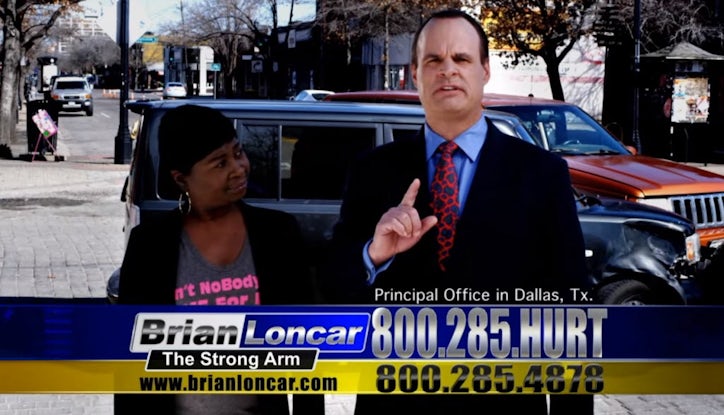
Brian Loncar OD-ed on cocaine, and capitalism — #hypocrisy alert


I was in Dallas nearly a decade ago when the self-billed Strong Arm of the Law caused an accident (I believe legally, not just empirically) with an emergency vehicle in the Oaklawn area.

Already then, he struck me as an "L.A. Law" type attorney, so, the coke up his nose, even if a fallout from his daughter's suicide shortly before that, is no surprise.

And, I'm sure he knew where to get enough coke to be contributory to a fatal heart attack (that's the OD angle) from previous experience. One doesn't just walk down to 7-11 for that. Indeed, another Dallas Snooze story mentions he had long battled addiction to a "gateway drug."

No, not marijuana, you prudes. Alcohol. It and tobacco are the biggest gateway drugs to hard drugs.

He also, if operating legally, was an ethical shyster, it seems.

That's why, per the second link, his talking about his daughter in Jesus' arms gets the hypocrisy flag. For the cocaine, and much more, for possibly screwing poor people, per Matthew 25, if there is a Jesus, he might just not be so generous to you, Brian Loncar.

I don't want to kick him, or his surviving family after facing two deaths, and news about the why of the second death — though surely some of them knew he had a coke problem too — too hard. Frankly, as I said on Twitter, even though he sued the city of Dallas, I wouldn't be surprised if either coke or alcohol was contributory to the 2008 accident.

He was granted the local level right to pursue that suit, but lost his appeal, based on official immunity. (Not just limited, but blanket official immunity.) And, he should have known that would happen at some level. The county court at law should have made that ruling itself, but didn't. Per my first comment about the accident, he was reportedly pushing to beat a yellow light. I assume the fire engine had both lights and sirens on. And, I know exactly where that intersection is.

It's called arrogance, Loncar's stance.

Per the third link, he does seem to have been generous with a fair amount of his money.

Even while pushing and scheming to get even more of it.

He actually died, indirectly, as an addict to capitalism. (The vehicle he totaled in that 2008 wreck was a $180K Bentley.) The blood pressure and heart disease were probably related to that addiction, too. Overworking and overstressing in the name of greed. And, you die before you're 60. If we're going to reference the bible, this reminds me of the wealthy landlord promising to build bigger barns and silos only to be told, per Jesus' words: "Fool! Your soul will be required of you tonight."

On the drug addiction (I presume he quit alcohol?) this just goes to show that addiction is a bitch.

April 19, 2015

Josh Hamilton, divorce and relapse — chicken or egg? And ixnay "divine plans" and AA

Josh Hamilton, neither
'good' nor 'bad" but possible
'ugly' of addiction.
Troubled Los Angeles Angels player and former star outfielder Josh Hamilton and his wife, Katie, are reportedly divorcing, in the latest update related to his alcohol-and-cocaine relapse this February.

The "trigger" for the relapse, reportedly, was a fight between the two.

Chicken or egg? Were they at the point of breakup before his binge a a Super Bowl party, and he decided to try to medicate his sorrows? Or, did he just lose control, and the divorce filing followed? That said, Katie claims she was "blindsided" by his filing. That, in turn leads to ...

At the same time, I sure hope Josh knows what he's doing. Per that story link, it was him, not her, that filed for the divorce.

It seems clearer than ever he needs team support, and not owner Arte Moreno and general manager Jerry Dipoto trying to kick him under the bus, since an arbitrator has ruled Hamilton did not break league drug policy. Teammate C.J. Wilson, who joined the Angels as a free agent a year before Hamilton, and is also the team's union rep, knows that. And, without antagonizing the higher ups, manager Mike Scioscia also does, as he said last week:
It’s a unique situation,” Scioscia said. “As an organization, first and foremost, we want to make sure Josh is getting the help and support he needs. That’s important for Josh to get back to where he needs to be and getting on the field and playing baseball. Things are open-ended, and there’s a natural frustration I think that goes with uncertainty, and that’s kind of what we’re dealing with.”

Indeed. 

That's even truer because the explicitly religious restructuring of Hamilton's life, going beyond the 12-step movement's injections of god to overcome an alleged "powerlessness" that addicts supposedly (but not actually) are inflicted with, is connected with his current father-in-law. So, if he's choosing to "bail" on that, I sure hope he finds some alternatives for support and structure. On the other hand, per the language of the filing, he may have gotten tired of this.

It notes:

“The marriage has become insupportable because of the discord or conflict of personalities … that destroys the legitimate ends of the marriage relationship and prevents any reasonable expectation of reconciliation,”
So, apparently the conflict had been ongoing. Suffocating, maybe? Especially since it seems that Josh's parents, per the story of how he became addicted, may also have been smothering or suffocating? Yet, maybe Hamilton thought he needed some "liquid courage" (or a powdered version) before pulling the trigger on the filing.

And, I'm not going to berate him for that. As noted, this — his wife and even more his father-in-law Michael Dean Chadwick  — were his most basic part of his sobriety support structure.

That said, their Christian-based ideas on this are ... well, as if they've been tooting some of Josh's coke.

Start with this:
“God told me he was going to give Josh baseball back, but it wasn’t going to be for baseball,” Katie Hamilton said in a public talk in 2005. “It was going to be for something much bigger. He was going to give Josh a platform to help others. It’s not by accident that all the things that have happened in our lives have happened.”
So, Katie, God told Josh to relapse so that he would have a bigger platform?

Uhh, you need to read your own bible: 
Shall we go on sinning so that grace may increase? By no means! We are those who have died to sin; how can we live in it any longer? (Romans 6:1-2)
So, no, Josh doesn't need a yet-bigger platform. Beyond that, isn't that self-righteous, and just generally egotistical, to think that Josh Hamilton was somehow specially called, chosen, or anointed?

Survey says yes.

Besides, related to that, Alcoholics Anonymous says, in its "big book" and elsewhere, that "ego deflation" is key to sobriety. (It actually may be for a certain percentage of Type A male alcoholics, like Bill Wilson, but for many people, healthy ego building, not ego deflation, is key to sobriety.)

That said, if you have a god powerful enough to overcome your "powerlessness," then why didn't said deity keep you from being addicted in the first place?

Well, that's because, even though AA sprung from semi-Calvinist background, it doesn't believe in double predestination. Rather, like Lutheranism, it believes in single predestination. If it's good, then it's all god, and god chosen. If it's bad, then it's all your or my fault.

Again, nobody is "powerless" over alcohol or other addictive substances. One may become close enough to powerless after starting addictive use again to never quit for good, but that's why this has more than two sides.

And, Katie Hamilton sounds a bit whack in other ways, with her "dating other teams" as the analogy for Hamilton looking to leave the Rangers in free agency, as he eventually did.

Let me take this as a chance to say that AA and NA, and the 12-step movement in general aren't the best answer for many, and, as we enter into the world of evidence-based medicine, aren't the scientifically proven be-all, on average, for anybody.

There are secular — non-religious but NOT anti-religious — options out there. I recommend one called Lifering Secular Recovery.

As for Hamilton? Besides sobriety itself, he may need to find a balance point, getting support, structure, and perhaps another family in the future, but without being "smothered."

April 16, 2015

Josh Hamilton and the 'disease theory' of addiction

Josh Hamilton, neither
'good' nor 'bad" but possible
'ugly' of addiction.
Now that Los Angeles Angels former star outfielder Josh Hamilton will officially get no suspension for an alcohol and cocaine relapse, both the moral scolds and the "there, there" folks are coming out in force.

The scolds say that Hamilton just needs to "man up" or whatever. The "there, there" types usually talk about addiction as a "disease" where Hamilton just can't help himself.

The moral scolds? They've been a thorn in the side to addicts long before Alcoholic Anonymous as the first 20th-century addiction recovery support. They're generally off base, and often of the type to selectively apply their "man up" ideas.

That said, note that I called AA "20th-century." I did NOT call it "modern."

Second, for the "there there" folks, outside of 12-step circles, the "disease theory" of addiction does not have universal support.

Given that it came from a non-medical organization, and is also decades old, and that things like the "neurotransmitter theory" has been shown to be incomplete at best on depression and serotonin and, more directyl to this issue, on "rewards" and dopamine, we probably should back off on a broad-brush use of the idea, even more so when you add in that we still don't know a lot about consciousness or free will and volition.

(And, if a person on Hardball Talk thinks that his HMO disagrees with me, and that article, for any other reason than money, namely meds being cheaper than talk therapy, they're stupid indeed. Or, at a minimum, simplistic.)

Beyond that, nobody is "powerless over alcohol," nor over an illicit drug. If so, nobody would ever quit.

Of course, the 12-step movement solves this with the injection of god, then adds irrational insult to irrational injury by claiming it's not religious.

This is like the Lutheran "single predestination," one even more illogical than Calvinist double predestination. People get blamed for their addiction, but not credited for stopping it.

Again, nobody is "powerless" over alcohol or other addictive substances. One may become close enough to powerless after starting addictive use again to never quit for good, but that's why this has more than two sides.

Beyond that, "good liberals" should note what this piece says: promulgating the disease theory may be harmful to addicts. Take that with a grain of salt, though; a BIG grain of salt. It's by Stanton Peele, who pushes "moderation" for and to too many people, in my opinion.

That said, a 20-year-old kid with his first DWI shouldn't be force to attend AA; neither should he be forced to attend a secular alternative. In many cases, moderating one's behavior should be the first approach.

And, on both that issue, and understandings of addiction in general, that's why, once again, we need to quote the Iranian philsopher Idries Shah:
“To 'see both sides' of a problem is the surest way to prevent its complete solution. Because there are always more than two sides.”

Exactly.

Often people want to see only one other side not just because it's easier to think in black-and-white than shades of gray, but also because it's easier to "win" an argument if there's only one other "side." Hey, I can still be like that myself.

Now, the situation at hand, since an arbitrator has ruled Hamilton did not break league drug policy?

I'm not looking for MLB to throw the book at Hamilton. Nor am I looking at MLB or the Angels to treat him with kid clubs. I expect both, beyond their business interests and legal restraints, to treat him in the best way possible for him.

Related to the legal angle, I have to disagree with Craig Calcaterra of Hardball Talk. It's possible that at least part of the leaks in all of this were NOT by the Angels, but rather by Hamilton trying to stay ahead of the story. "Goes to motive," as the old legal saying avers — an old legal saying which Calcaterra, a formerly practicing lawyer, knows. And, with Hamilton, I believe he has the mindset to do that.

That said, it's more likely that the Angels were the leakers. I suspect that GM Jerry DiPoto is "venting" anger he'd really like to direct at owner Are Moreno for pushing for the Hamilton signing. DiPoto, let's not forget, at the time Hamilton was a free agent, wanted to resign then-Angel Zack Greinke rather than letting him walk in free agency. Survey shows that would have been a MUCH smarter move. Sabermetrics shows that, outside of one fantastic year in 2010, adjusting for The Ballpark's hitter friendliness, Hamilton was good to very good, but not great, otherwise, with the Rangers. (That said, Greinke, if we compare ERA+ to OPS+, straight up, has been throughout his career what the non-2010 Hamilton was in Texas.)

Steve Howe, with his seven suspensions and still not "learning," shows that, just like Christians talk about "why some and not others" on "being saved," that addiction is a mysterious issue. It also shows that it's not the business of MLB, or the Angels, to, well, to go beyond business. They will help him to the degree it accords with best business practices first, and true sympathy second. They will cut him off at the pass to the degree they can to the degree it accords with best business practices.

(For those who can't remember, Howe died in a one-vehicle rollover where he was the driver, and toxicology reports show he had meth in his system.)

Speaking of, one person has a good perspective on this: Angels manager Mike Scioscia, who played with Howe on the Dodgers.

Of Howe, at his death, Scioscia noted:
"Clearly, he was a kid who never reached his potential, but for a short time he did. The feeling of regret, he never expressed, as far as I know."

That second sentence, especially, is noteworthy.

Of Hamilton, he said last week
“(A)ddiction is a terrible thing, and he’s trying to deal with that.”
 “I don't know if there is any use looking back, whether surprised or relieved or whatever,” Scioscia said. “I could go either way, but most important is for Josh to pick up the pieces and get himself where he needs to be first with these issues and then we'll see where he goes from there as far as getting to baseball activities. So we’ll see.”
Scioscia may not even remember what he said about Howe. But, the idea is important. Hamilton’s not too likely to be going down the same road if he’s regretful.

As for “problems”? Howe, if not “born to be wild,” was certainly determined to be that way.

Hamilton? I think, per his Wiki page, his car accident, a small determination to be a little wild, and perhaps smothering parents that he wanted to escape, are all factors.

One point in common so far? Evangelical Christianity didn't "save" Steve Howe from his addiction; so far, it's not been a magic cure for Hamilton, either. That's not to claim it's all Christianity's failure, but it is to note above that the 12-step movement's "god deal" ain't so totally true, again.

Meanwhile, back to addiction in general.

Alcohol is not that strongly addictive physically. And, even many illicit drugs, without repeated administration on a regular basis, are less physically addictive than the nicotine in cigarettes.

This all gets back to the medieval "cur alii, non alii?" question. In English, that's "why some, not others?" In other words, whether for salvation or overcoming addiction, why do some "get it" but not others.

As for addiction in general? I still lean toward the idea that, if you've crossed some invisible barrier into "abuse," to use the professional phrase, abstinence is almost surely the best option. But, that's not set in stone yet, either.

And, let me take this as a chance to say that AA and NA, and the 12-step movement in general aren't the best answer for many, and, as we enter into the world of evidence-based medicine, aren't the scientifically proven be-all, on average, for anybody.

There are secular — non-religious but NOT anti-religious — options out there. I recommend one called Lifering Secular Recovery.

(Meanwhile, on the baseball-playing front, Commissioner Corleone, aka Rob Manfred, seems determined to risk a repeat of the 1994 lockout.)

May 01, 2014

Minimum wage, $10.10, $15, homelessness and other issues

As the Senate, just in time for May Day, gave President Obama a rejection on bumping the federal minimum wage to $10.10 an hour, and Seattle activists continue to push for $15 an hour there, there are several other related issues.

First, a brief look at both measures.

The federal bill was decent overall. Beyond the actual rise, the 30-month phase in was long enough. And, hiking restaurant servers' minimum, at tipping restaurants, to 70 percent of the regular minimum, is good too. The biggest weakness is not indexing the minimum wage.

The Seattle bill? Socialist activist Kshama Sawant seems to be overreaching. Yes, Seattle is more expensive than the Midwest, but it's not that expensive. And, not including tips as part of that, so there's no separate minimum for servers? Yes, it probably would hurt a fair amount of restaurants. Fake protests aside, there's real concerns too.

And, not every other claim by the pro-$15 side in Seattle totally rings true, either. The biggest is linking the minimum wage hike with homelessness.

Well, social services type folks have generally split the homeless into three groups, with two of them often having some degree of overlap.

The first is those who have some sort of financial mishap. Would a higher minimum wage help them? Maybe, maybe not. Personal bankruptcies leading to homelessness are caused by medical cost burdens more than any other single cause. A higher minimum wage, at the Seattle level, is very likely going to lead to cuts in health care. Workers would have to pay a lot more out of pocket for private plans or else lose private coverage entirely. Beyond medical debt, a number of other financial issues can drive people into either short-term or long-term homelessness.  Right now, housing foreclosure is probably No. 2, especially for older people not working full-time. A higher minimum wage might help that, or it might lead to such people having their hours cut, if the hike is too high. Anyway, it's simplistic at best to connect a higher minimum wage to helping this roughly one-third of the homeless.

Yes, remember, I mentioned that homeless can be divided into three groups. While exact numbers fluctuate, they're roughly equal.

The second third? The mentally ill on our streets. A higher minimum wage won't help them. 

Better insurance may, in some cases. In many cases, though? Only a partial reversal of late-1960s libertarianism on de-institutionalizing some mentally ill may reach them. Short of that, there's not much you, I or society can do for schizophrenics who forget to, or simply refuse to, regularly take their medications. A higher minimum wage has nothing to do with that.

The third group, which overlaps somewhat with the second? Addicts and alcoholics. Again, a higher minimum wage will do nothing to help them.

Homelessness? Would be nice if the solution were so easy.

And, I think at least a few people in Sawant's camp know it's not so simple. Call me back in five years to see how well Obamacare has addressed the insurance-related issue, and also to see if Seattle, or San Francisco, or similar cities, or various states, have addressed how to get the mentally ill on the streets to be medication-compliant and, if necessary, in shelters focused on the mentally ill. Ditto for harm reduction measures for addicts/alcoholics, short of "open use" shelters. I'm divided on the issue of letting addicts or alcoholics have anything on site in a shelter. If they are allowed that, IMO, it should only be under supervision, with supplies kept by the manager. Open, individualized addictive drug or alcohol use shouldn't be allowed in shelters, though. And, without wanting to sound too much like a 12-Stepper talking about people "hitting bottom," however you phrase it, many of the non-mentally ill addicts and alcoholics, even if homeless, aren't (yet?) ready to quit.

And, with their mild climates and drug-friendly stereotypes, Seattle and San Francisco probably attract a fair number of out-of-area addicts/alcoholics. I'll bet Vancouver, B.C., does too.

Homelessness is also affected by housing costs, which in turn are affected by other issues. The same moderate climate that may draw homeless people, when mixed with scenic views, draws people to move there in general and raises housing costs. Is rent control part of the solution? Public housing which targets a wider income range than current, usually stereotyped, public housing? 

So, minimum wage advocates? I agree with the goal, in broad outlines. But, stick to the minimum wage.

That said, I suspect this is advice for deaf ears in Seattle. Seattle, home of the "black bloc" in the 1998 WTO meetings protests. Seattle, just across the border from Vancouver, home to Adbusters, friendly to such ideas. I'm not saying Sawant and the people in her corner are that confrontationalist; however, some degree of "overlap" wouldn't surprise me at all.

My ideal? $10.10, with no subminimum for restaurant servers. Restaurants can then decide whether to keep tipping as a policy or not. Oh, and index the minimum to inflation, please? Seattle's mayor's plan, to hit $15, but with a seven-year phase-in, isn't quite as bad as Sawant's. Still a bit stiff. If Seattle wants to stay ahead of the nation, maybe $12/hour with a six-year roll-in?

March 29, 2014

Race, addiction, science, public policy: Carl Hart writes an oversold book


I just got done reading a pretty new addiction-related book, and no, it's not (yet) that hot new book by Dr. Dodes, profiled on Salon, The Atlantic and NPR. Rather, this is "High Price," by Ph.D. neuroscientist Carl Hart.

Carl Hart is good on the basics of what we know, and don't know, about addiction and neuroscience. He's decent on telling the story of his life, and on public policy, minorities and the "War on Drugs." However, where parts 1 and 2 intersect, he sometimes seems to soft-pedal part 1 for the sake of part 2.

Basic point 1 is that he is African-American, and grew up in lower-class neighborhoods in greater Miami, and therefore in a unique position to talk about race and addiction, race and other races' beliefs about addiction, etc.

But, that's not my first primary point. Rather, per ideas I've heard from people who think that AA is unscientific, it's about "following the science" on addiction. More specifically, it's about updating one's scientific knowledge of what may cause addiction, the little knowledge we have, being updated rather than being 20 years old. More specifically yet, that involves moving beyond simple, or simplistic, ideas that we can reduce addiction to a matter of brain neurotransmitters.

Neurotransmitters and neuroscience

And, specifically, addiction is NOT "All about the dopamine," or anything similar. I quote from his book:
When dopamine's prominent role in reward was first proposed, there were only about six known neurotransmitters: dopamine, norepinephrine, serotonin, acetylcholine, glutamate and GABA. Now there are more than a hundred. Furthermore, we now know that there are specific receptors -- or specialized structures that recognize and respond to a particular neurotransmitter -- for each neurotransmitter, and most neurotransmitters have more than one type of receptor. For example, dopamine has at least five receptor subtypes -- D1-D5. We also now know that hormones like oxytocin and testosterone can act as neurotransmitters.
But despite these ever-intensifying complexities, our theory about dopamine's role in reward has not been appreciably revised since it was first proposed [in the early 1990s]. And, as you will see later, a growing body of evidence casts doubt on this simplistic view of reward.
I knew a fair amount of this before I read Hart's book. But, his directly applying it to addiction, combined with his ethnicity and sociological background, gave me the perfect excuse, or reason, to blog about it more directly.

For more on neurotransmitters, which may, depending on how widely the term is defined, include a variety of peptides and even minerals like zinc, see Wikipedia. I mean, histamine and products related to several amino acids are neurotransmitters. It's much more than the few neurotransmitters that health-food stores, and Big Pharma, try to pitch us on. More on that in a minute

And, folks, that's why addiction isn't all about the dopamine. And why truly understanding addiction will proved to be more complex than current ideas.

Related to this is why an anti-craving drug like Naltrexone doesn’t work equally well for different addicts with different addictions and never will.

And bingo on who might be behind the “cravings” idea. Per Wikipedia, anti-craving drug Naltrexone's first clinical trials? 1992. And, also per Wiki, all the different addictions it's now possibly supposed to help on cravings? I think we've struck Big Pharma gold, or at least silver.

Also, while Naltrexone is an opiate receptor antagonist, Campral, also marketed as an anti-craving drug for alcoholics, works, or “works,” as a GABA receptor agonist. Different mechanism entirely than Naltrexone. Campral was first approved, in Europe, in 1989. That’s a bit earlier than the 1990s, but still in the same framework. Don’t let the European start fool  you, though; Western Europe is at least as Big Pharma friendly as the US. And Wellbutrin, marketed to help smoking cravings as well as being a non-SSRI antidepressant? It targets, in various ways, dopamine, norepinephrine, and acetylcholine. And, its actions on dopamine don’t seem  to be enough to explain its alleged effectiveness. (All three of these may target neurotransmitters beyond members of the “original six,” which Big Pharma hasn’t looked for. Material on Campral and Wellbutrin is also from Wiki.)

There’s more, just from basic browsing of Wiki. We’ve long known that nicotine is an agonist for certain acetylcholine receptors and triggers the release of sever al “old” and “new” neurotransmitters; why would we focus on dopamine?

And, even if dopamine has a fair role to play in addiction, Wellbutrin alone shows that it’s not a primary role.

Oh, and substitute "serotonin" for "dopamine," and what's said above about addiction is just as true for depression. And, the "serotonin deficiency causes depression" idea was proposed at the same time as the "dopamine shortage causes addiction" idea. Yet, despite early hype, we still don't know a lot about depression, other than knowing SSRIs often don't work a lot better than older anti-depressants.

Beyond that, other neurotransmitters, like acetylcholine, have various types of receptors, too.

Hart himself addresses the issue of “craving” near the end of the book. He says that for apparently non-addicted but regular users of various drugs, as tested in laboratory settings, “craving” did not seem to be a significant concern, on average. I question that. Also, given some libertarian-type political "connectedness" the book and Hart apparently have, I also "question" that he did not spell out how much of the "low dopamine = addiction" idea, like "low serotonin = depression," was pushed by Big Pharma. And, that may be why he doesn't talk about anti-craving drugs that much, and minimizes the issue of craving.

Unfortunately, Nora Volkow, head of the US government's National Institute on Drug Abuse, is one of the biggest pushers of the dopamine theory. I'm not sure if I would go so far as to claim this is a new version of the "disease theory" of addiction, though, as Stanton Peele does. Especially given that Peele is one of the most tireless promoters of theories of addiction that largely deny the existence of addiction, one can usually depend on him to overswing, and therefore, take what he says with a 1/3 off grain of salt.

Now, public policy issues in the book

Hart, as noted, is a black male, of about the same age as I am, who grew up in greater Miami in the late 1970s and 1980s. As such, he remembers the Reagan-era paranoia about crack cocaine vs. powder, which he covers in detail, including showing no difference in addictiveness levels, just as other researchers have done.

From there, he looks at what he sees in many ways as being a very similar alarm over methamphetamine, or “meth,” in the past decade. He notes that the number of meth users is much lower than cocaine users, first. Second, most stories about superhuman strength, etc. of alleged meth addicts are anecdotal, he adds. Third, and to the point, he notes how there is little chemical difference between amphetamine, the main ingredient in Adderall and other anti-hyperactivity drugs, and methamphetamine. After all, per basic chemistry, methamphetamine is just a methylated version of amphetamine, with a single methyl radical added. Or, in other words, it’s like Celexa and Lexapro. But, both of them are legal and heavily prescribed. On stimulants, Adderall and Ritalin are legal and heavily prescribed; meth isn’t.

Skepticism of some of his claims

I don’t totally agree with Hart. I think he tilts the scale toward “abuse” rather than “addiction” at times, and doesn’t allow for even people who are addicts, not just abusers, still having enough self-control to moderate their behavior in lab settings. I mean, the stories of alcoholics and addicts trying to pull one over on people are legion, and at some point, per the old cliche, "anecdotes" become "data." Hart talks about how some of his test subjects appeared intimidated about getting to the lab, but doesn't ask if any were still intimidated later.

Nor does he seem to ask himself if he’s over-reacting to some of his own personal, and his larger background as an African-American’s, take on things like the “crack menace” or “reefer madness” long before that.

Related to both points, he doesn't ask, as a very rare minority Ph.D. neuroscientist, if some of his test subjects are "trying to help a brother out." I hate to stereotype, and I'm not a minority, but, I've been around a boatload of drinkers and users. I'm liberal enough to know the War on Drugs is a crock, but I've been plenty a person be sober or clean for years, even a decade or more, "slip," and not be able to get back on track.

Nonetheless, he’s right indeed, in my opinion, that addiction is a complex issue. And why should this surprise us?

Some “purely physiological” issues are far more complex than originally claimed and even than some claim today. Cancer immediately comes to mind. Fifty years on, we’re not close to “winning” a “War on Cancer.”

At the same time? His wanting to make it look like addiction isn't that common approaches simplicity itself. I gave this three stars on book review sites. It's barely that, I think.

Political issues, of his own

Finally, I raise at least a partial eyebrow at his crediting Maia Szalavitz for helping get the book done. Szalavitz at least has a few of her toes in the pool of right-wing funded journalism, or "journalism," or is at minimum a "fellow traveler." Her association with places like STATS.org, which, per Wiki, has connections with Scaife money, American Enterprise Institute, etc., and is affiliated with George Mason University, is a red alert right there. That would probably explain, per some Amazon reviewers, Hart visiting Fox News, and ... more than once! I suspect, per those Amazon reviewers who would be clueless as to why, this was to get "in" with libertarian Fox watchers, not the religious right. Hart explicitly calls for decriminalization, which is neither neuroscience nor memoir.

Related to that, I'm tired of libertarians, starting with Glenn Greenwald, talk about what a success drug decriminalization is in a place like Portugal when most of them know that Portugal has a better "safety net" than we do and spends more government money on it than we do now, and than many libertarians here are willing to pay.

Greenwald, and Hart here, if they want to propose this, then fine ... be honest with how much this costs. And, if you're either too lazy to have researched that, or are afraid to tell people that, or else are a committed enough economic libertarian that you don't want the government paying that price, then shut up about the "Portugal solution."

Summation

You can find the neuroscience work, including on neurotransmitters and related issues, from other neuroscientists, or else from psychiatrists doing research work. In many cases, it won't be explicitly tied to the decriminalization issues, and possible peddling of harm reduction over abstinence, which reportedly Hart has done on some of his TV appearances.

This is a book that has more froth than substance, after a first look.

There is a sort of political silver lining. Maybe the US needs a few more black libertarians of prominence, if that's what Hart is becoming, as well as black social conservatives.

February 07, 2014

No, Russell Brand, draconian drug laws didn't kill Philip Seymour Hoffman

I applaud the British Atheist Jesus, Russell Brand, talking about his own addiction, in this piece.

However, while he's personable there, and thoughtful in other things, or thought-provoking in his piece about not voting, and certainly intelligent, sometimes ...

Brand is just wrong.

And he is here, in claiming that America's draconian drug laws killed PSH. 

Before we start, a stipulation that I support decriminalization of marijuana, and am even OK with full legalization. I absolutely agree on "leveling" current sentencing on crack and powder cocaine. Beyond that? Most experiments with legalizing, or even decriminalizing, "hard" drugs have been done in countries with a lot smaller population, and with less racial and ethnic diversity, than the US. Their results don't necessarily translate here. Nor do I believe the standard libertarian argument that all drug problems disappear with legalization.

Next, one thing specific to Brand's diatribe.

His claim that many countries have legalized heroin is true only in a narrow sense. They have, instead, legalized its officially prescribed use. In other words, countries like Switzerland treat heroin like methodone here. Or stricter. It's "legal," but I take Brand as meaning something more like "street legal." And, that's simply not true of about anywhere.

This is true,  yes:
If drugs are illegal people who use drugs are criminals. We have set our moral compass on this erroneous premise, and we have strayed so far off course that the landscape we now inhabit provides us with no solutions and greatly increases the problem.

That said, the solution is not to legalize, but to do more on the rehabilitative side, especially for users of smaller amounts, to lessen legal sanctions on users of smaller amounts, but without giving a free pass to coke or heroin.

Then there's this:
This is an important moment in history; we know that prohibition does not work.
True enough, but the false implicit conclusion that full legalization will magically make things better doesn't follow. Modus tollens.

That's even more true of this:
People are going to use drugs; no self-respecting drug addict is even remotely deterred by prohibition. What prohibition achieves is an unregulated, criminal-controlled, sprawling, global mob-economy, where drug users, their families and society at large are all exposed to the worst conceivable version of this regrettably unavoidable problem.
For the first decade or two, here in the US, we'd probably have massive turf wars between drug gangs, an increased global mob economy with tax evasion, bribery, and more.

Now, back to the details of Hoffman's death.

First, as noted above, very few countries in the world have legalized or even "just" decriminalized heroin.

Second, even if it were legal, that still wouldn't guarantee that PSH wouldn't have gotten some tainted supply, unless you had "inspected" heroin.

Third, per No. 2 and my above statement, Hoffman could have wound up buying tainted heroin even with a tax stamp on it or whatever. International cigarette smuggling is proof of this. (I'm not saying that smuggled cigs are "tainted," just that government tax stamps are often fraudulently duplicated.)

Fourth, it doesn't guarantee that somebody might have tried turning him on to mixing heroin and fentanyl, either. Given that Hoffman's relapse reportedly started with what he took as an "innocuous" drink of alcohol, but escalated, he may have been at the point where he wanted to push envelopes.

Fifth, even if I remove 2 and 4, it doesn't guarantee that he wouldn't have OD'd on plain old heroin, perfectly legal.

Sixth, back to prescribed heroin again. People here in the US steal, forge scrips and otherwise do all they can to get their hands on legal, but prescription restricted narcotics of all sorts of stripes. I'll bet the same is true in Britain. Maybe even in Switzerland or Portugal.

Again, I'm not against at least a somewhat more libertarian attitude on drugs in the US. But, let's not pretend that loosening, let alone legalizing, drugs is a panacea for addiction, including for what can be the final result of addiction. After all, alcoholic, sadly, still die all the time.

December 30, 2013

THe #SJW #privilege backlash is how I know Chris Arnade isn't all wet

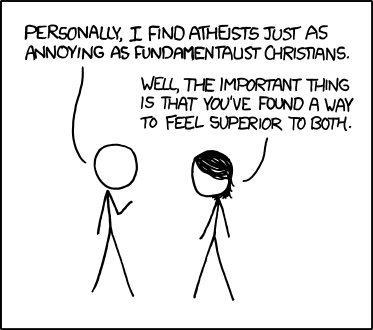
From  XKCD website. Added here because Atheism Plus and
Gnu Atheism types love to trot it out as a sort of shield, a
"no true Scotsman" claim that they're not annoying.
For those of you not too familiar with him, Chris Arnade is an atheist. Who used to work on Wall Street, with a Ph.D. Who now works with homeless people not too, too far from Wall Street.

And, via his work with them, and the seeming degree of attachment many of them have to religious belief, has led him to call atheism an "intellectual luxury for the wealthy." Which certainly isn't a life of "privilege" and, per the SJW hashtag of "social justice warriors," is working for social justice.

Here's the heart of his piece:
(The homeless) have their faith because what they believe in doesn't judge them. Who am I to tell them that what they believe is irrational? Who am I to tell them the one thing that gives them hope and allows them to find some beauty in an awful world is inconsistent? I cannot tell them that there is nothing beyond this physical life. It would be cruel and pointless. 

In these last three years, out from behind my computers, I have been reminded that life is not rational and that everyone makes mistakes. Or, in Biblical terms, we are all sinners. 

We are all sinners. On the streets the addicts, with their daily battles and proximity to death, have come to understand this viscerally. Many successful people don't. Their sense of entitlement and emotional distance has numbed their understanding of our fallibility

Soon I saw my atheism for what it is: an intellectual belief most accessible to those who have done well.   ...

I look back at my 16-year-old self and see Preacher Man and his listeners differently. I look at the fragile women praying and see a mother working a minimum wage custodial job, trying to raise three children alone. Her children's father off drunk somewhere. I look at the teenager fingering a small cross and see a young woman, abused by a father addicted to whatever, trying to find some moments of peace. I see Preacher Man himself, living in a beat up shack without electricity, desperate to stay clean, desperate to make sense of a world that has given him little. 

They found hope where they could.
I hadn't intended to write a full blog post about it. I thought it was interesting, but not something I totally agreed with, though I understood to some degree where he was coming from, or where I interpreted him as coming from.

I called it a version of Maslow's hierarchy of needs. In other words, after people get a stable, secure situation in regard to food and shelter, then safety, then social belonging, after that, they're going to feel comfortable — and have the mental energy — to question old beliefs and old values systems.

I agree with him, and against some, though not all Gnu Atheists, that H. sapiens isn't all that rational, even when we're higher up Maslow's hierarchy.

And, this is nothing new. Look at black slaves who adopted their owners' Christianity.

That said, it hasn't stopped the Atheism Plus junior subset of Gnu Atheists from jumping all over Arnade.

And, the one that has topped off the dogpile, all while insisting she's not writing about any one person?

Quelle horreur! It's Stephanie Zvan.

To refute just a couple of the hints she makes, even if at no one in particular, whether always to be believed or not:
1. Arnade never said that religion had no connection with predatory capitalism. That said, the claim of religion is usually just a fig leaf.
2. Unearned authority is a problem far outside of religious groups. Like Gnu Atheism. Besides, in many religious groups, the members of that group have no problem with believing their leaders have earned said authority.
3. I'm sure that if Gnu Atheism gets big enough, by the law of averages, it will have its own scandals. Only Gnu Atheists, even more than many an intensely inward group, will probably trot out "no true Scotsman" claims enough to earn themselves a listing in places like Skeptic's Dictionary under that entry.

Add to this somebody on Facebook using a compounded version of the magical word privilege in a post about Arnade's piece, and barf.

Meanwhile, let's ignore people like that and get back to people like Pamela J. Stubbart, with a more nuanced critique:
Frankly, Chris, I think that your piece has more to do with sig­nal­ing con­cern for the dis­ad­van­taged (and sig­nal­ing that you’re not a dick like Richard Dawkins) than it has to do with athe­ism per se. Not that these are bad things to do — but it doesn’t seem to me that your athe­ism was chal­lenged at all. As far as I can tell, you just revised your opin­ions regard­ing the dif­fer­ing value of truth in the con­text of var­i­ous kinds of people’s lives. (That would make a slightly less catchy title, how­ever). We can agree that it would be “cruel and point­less” to try to talk these peo­ple out of their the­ism. But label­ing athe­ism itself an “intel­lec­tual lux­ury” con­sti­tutes a near­sighted attempt to imbue athe­ism with the con­no­ta­tion that it’s unnec­es­sary and friv­o­lous. Please don’t for­get that in other con­texts, the non-religious do impor­tant work towards cur­tail­ing religiously-motivated harms (female gen­i­tal muti­la­tion, any­one? allow­ing chil­dren with eas­ily cured med­ical con­di­tions to die?) At those times, it is keep­ing quiet about unjus­ti­fied reli­gious claims (“think­ing dif­fer­ently” from athe­ists!) which would be cruel.
I could largely agree with that. Unfortunately, I don't think most Gnu-type atheists, and certainly not the subset of them Atheism Plusers, would agree with Stubbart.

Knowing what I do about the world of addiction, I will say that, in part because these alternatives aren't recognized by the court system, and in part for other, more sociological reasons, secular alternatives to 12-Step addiction support draw a different crowd.

Plus, also indirectly back to Zvan, and others.

Yes, atheists/secularists donate food to food pantries, and other "street level" support. However, secularists don't have their own homeless shelters, at least not that I'm aware of. Not all shelters that do exist are run by religiously oriented private organizations, of course, but many are. And, even those that aren't, in working with alcoholics and addicts, offer up the religious nostrums of the 12 Steps, in part because, again, they don't know the alternatives. 

In short, to bring out another psychological phrase, if Arnade "confronts" the homeless he helps with the illogic, and lack of empirical basis, of their beliefs, he risks giving them a massive case of cognitive dissonance. As many of the homeless are not only alcoholics or addicts, but "dual diagnosis" folks, this is about the last thing they need.

At the same time, Arnade's piece almost makes it sound like he's "deconverting." I asked him that on Twitter, and I'm putting it in here now. 

Why do I say that? The middle section of the block quote from above:
In these last three years, out from behind my computers, I have been reminded that life is not rational and that everyone makes mistakes. Or, in Biblical terms, we are all sinners.

We are all sinners. On the streets the addicts, with their daily battles and proximity to death, have come to understand this viscerally. Many successful people don't. Their sense of entitlement and emotional distance has numbed their understanding of our fallibility.
Sorry, but you, without the burden of being on the first or second level of Maslow's pyramid, have just made a logical/empirical disconnect, as I see it.

First, sinners implies sin. Sin is normally associated with religion. It's a word with all sorts of connotative overtones. It implies either a theistic god or a an impersonal karmic metaphysical force judging sin.

And, it sounds like it was written deliberately, as a face-slap, especially with the addition of the phrase "Biblical terms." (Having done that at times myself, I know it when I see it.)

Second, it seems to imply all atheists are part of the "successful people." Commenters on Zvan's page point out that's not true. And, I know that myself. I'm a community newspaper editor with extra money in the bank, but I'm nowhere near rich, and I personally know secularists worse off.

Third, per what I said before about "dual diagnosis," many of the people on the street have been sinned against much more than being sinners. Without causing them cognitive dissonance, you could at least lighten the religious chains for them by giving them some version of understanding of that, even if you have to still fertilize it with some religious manure.

Fourth, related to Nos. 2 and 3, it seems to imply most atheists are more like this than like you are.

This all said, Arnade promises a more nuanced follow-up.

I'd love to see it. I'd also love to see a more friendly reception for him from the social justice warriors, too. And, yes, I would note that, too. See three paragraphs above.