SocraticGadfly: SETI
Showing posts with label SETI. Show all posts

January 19, 2016

Stephen Hawking perfectly illustrates false appeals to authority

Stephen Hawking: Exhibit A on what
constitutes false appeal to authority.
Fallacious appeals to authority are a classic error of common-sense, informal logic, and Stephen Hawking continues to make statements that others give credence that might not be warranted. (Per the first commenter, it's the "others giving credence" that's a fallacious appeal to authority, per the third paragraph and following.)

His latest? We're about to wipe ourselves out.

Maybe we are, maybe we're not, but he brings no special scientific credence to the table on the issue, unless there's a previously undiscovered black hole hurtling toward earth, and even then, that would be the black hole wiping us out, not we ourselves.

Look, he may be right.

But, that's not because he says so, it's because the most pessimistic climate scientists turn out to be right, or the most pessimistic students of nuclear weaponry turn out to be right.

On the former, while I'm no Pollyanna, I'm no James Howard Kunstler, either. On the latter, while I'm no modern day Atoms for Peace type, I think the world, by slow fits and starts, continues to become slightly less nuclearized.

Back to Hawking.

He's been wrong in something halfway approaching his sphere of expertise before, which further undercuts his credibility outside that sphere.
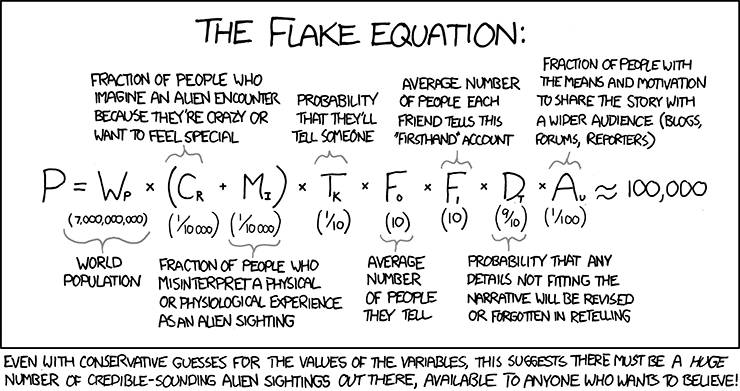
He has claimed, for example, that aliens could wipe us out. Given that we've not discovered any evidence of such aliens so far, and given that, IMO, many touters of SETI have overestimated the values of most variables in the Drake equations, may have psychological reasons for so doing, especially in America, and are deservedly spoofed, I highly doubt his claims.

Of course, his answer has been manned colonization elsewhere.

Per the commenter below, if use of sarcasm is an ad hominem
then we've opened the French window Overton Window.
Well, first of all, Prof. Hawking, if aliens attacked Earth, they'd attack Mars, too, and we certainly won't have the ability for interstellar colonization for thousands if not tens of thousands of years.

Second, given that you've been wrong about manned travel to Mars, overlooking the dangers of cosmic radiation, and other costs, your credibility in this whole area is kind of shot.

I'll grant a slightly higher likelihood Hawking is right about high-tech robots, but, to the degree I do, it's not because of his say-so, it's the say-so of experts in the field.

Back to the main point.

False appeal to authority is just one of a couple of dozen fallacies of informal logic. I encourage people to bookmark that link.

Update: I'm going to tackle the aliens part in further depth.

First, by when our first big radio telescopes were built, we know pretty well that there's no intelligent life within 100 light years of Earth.

Second, alien civilizations advanced enough to travel 100 light years or more probably wouldn't even bother wasting their time on us.

Third, if they did want to wipe us out, they'd have Star Trek-type cloaking devices or something. We'd never know what hit us.

Update 2: Per the second round of comments, I've tagged this post with the tag "salvific technologism." To explain, that's the idea that technology will always be the cavalry, always riding over the hill to save human nature. Having seen the massive problems with importing one invasive species to battle another, the idea that humans would go beyond that, the idea that human control of biology will always save us (it won't always fail us, though, and this should not be read as something anti-GMO), to the idea that human technological engineering will always save us, like in geoengineering against climate change, or blasting off to another planet after wrecking this one, is appalling, as well as being about as likely to be true as biological controls I mentioned at the start of the sentence.

And, for either of the commenters, or others, who have not read through my blog otherwise, those thoughts aren't just mine. I strongly suggest reading the likes of Evgeny Morozov.

==

Update, Oct. 20, 2018:

And since it's my blog, Seeker, I get to weigh in two years later with the next word, based in large part on John Horgan's review of Hawking's last book.

Hawking does practice scientism, though perhaps not as badly as other scientists. (I'm looking at you, Tyson.)

And, Horgan is right on another issue, which he touches on indirectly — the energy cost to settle any significant number of humans on Mars would be massively more than to address climate change or pandemics here. A Yucatan-like asteroid we should be able to deflect by the time one gets here. Hawking is far from alone in making these mistakes, but ... he's made them.


Beyond what I posted in comments below, I wish you so-called "scientific skeptics" would stop practicing scientism yourself, stop indulging others who practice it, and actually give yourself at least a basic acquaintance with philosophy.

I realize I might as well wish for Ted Cruz to support national health care, as far as the likelihood of that happening.

I will still wish and hope. 

July 20, 2011

More on why the Drake equation is problematic


Detailed readers of this blog know, or show, that I consider SETI, the Search for Extra-Terrestrial Intelligence, to have thin scientific foundations at best and to be quasi-religious at worst, just as the cartoon above from XKCD shows.

Well, a recent post at Skepticblog has only reinforced this. And, yes, it's by ... cornucopian futurist Michael Shermer.

Here's Wiki on the Drake equation and its background:
Considerable disagreement on the values of most of these parameters exists, but the values used by Drake and his colleagues in 1961 were:

R* = 10/year (10 stars formed per year, on the average over the life of the galaxy)
fp = 0.5 (half of all stars formed will have planets)
ne = 2 (stars with planets will have 2 planets capable of developing life)
fl = 1 (100% of these planets will develop life)
fi = 0.01 (1% of which will be intelligent life)
fc = 0.01 (1% of which will be able to communicate)
L = 10,000 years (which will last 10,000 years.
The first two parameters' estimates aren't controversial to me. From what we've seen of early exoplanetary findings, the third could be moderately too high.

From there, we really have shinola hitting the fan, IMO.

Fl at 100 percent? No way, Jose. Let's put it at 10 percent instead. Fi at 1 percent? No way again. Even if "intelligent" is defined loosely, let's take that down to 0.1 percent.

And, there again, we have problems with the "sieve," which modern evolutionary biology teaches us.

What's "intelligent" mean? Crows, ravens and other corvids are arguably intelligent, we now know. What's "communicate"? An animal like a vervet monkey not only has different calls/alerts for different predators, members of a tribe can fake the calls to steal food.

And "L"? Given exactly how we define "civilization," our own 10,000 years may be just about up, if we start with the development of agriculture. If we start with, say, the steam engine, we have plenty of life left. This is just Drake spitting in the wind on this number.

Another commenter there calls the set of equations a sieve. Well, that may or may not be true, but, shouldn't one show more rigor with defining a sieve? The numbers up to "L" could be more legitimately argued, but that one? Since it's so problematic, why didn't Drake leave its value blank.

(That said, Shermer is much more pessimistic on "L" than Drake, once setting it at just 420 years.)

Per Wiki, Michael Crichton notes:
The problem, of course, is that none of the terms can be known, and most cannot even be estimated. The only way to work the equation is to fill in with guesses. [...] As a result, the Drake equation can have any value from "billions and billions" to zero. An expression that can mean anything means nothing. Speaking precisely, the Drake equation is literally meaningless...
A basically undefinable sieve isn't much of one.

Beyond that, here's the bottom line on SETI, and the interpretation of the Drake equations that began with Frank Drake and extend to it:

If the unspoken presupposition of L is "communication with aliens," Davies covers all the *problems* with that one, too.

How do we know that aliens communicate the same way we do? Take the gold "CD" sent with Voyager. If aliens don't "hear" at all ... the music and other sounds on it mean not a damned thing to them.

In other words, I think SETI is still too anthropocentric and so does Paul Davies, as he discusses in detail in "The Eerie Silence."

May 13, 2008

No there doesn’t ‘have to’ be life in space – nor a manned trip to Mars

What I’ve called “secular metaphysics” or similar in the past, when on the lips of Carl Sagan, is now on the lips of our latest space shuttle astronauts:
“If we push back boundaries far enough, I’m sure eventually we’ll find something out there,” said Mike Foreman, a mission specialist on the Endeavour.

Unfortunately, Japanese astronaut Takao Doi agrees that “life like us must exist.”

NO. That’s where the whole set of Drake equations behind SETI is like holding pudding in your hands. We simply don’t have enough empirical evidence yet to make anything close to a stab at most the Drake parameters. To quote Wolfgang Pauli, SETI enthusiasts who ramp the Drake numbers up high “aren’t even wrong.”

But Foreman sounds the soul of rationality next to the quasi-mystical Gregory Johnson.
“I personally believe that we are going to find something that we can't explain. There is probably something out there but I’ve never seen it.”

“Believe” would be the right word indeed for this.

Fellow astronaut Dominic Goree trots out a twisted analogy, claiming that Columbus, et al, didn’t know what was awaiting them, either.

Wrong in so many ways. First, Columbus et al were looking for spices, not alien life. Second, especially once Dieu got around the Cape of Good Hope for Portugal in 1487, the Portuguese, at least, knew exactly what was awaiting them. Most Spaniards laughed Columbus out of court for underestimating the size of the world, but Ferdinand and Isabella had to do something.

Oh, and working on a trip to bring Martian soil samples back to Earth? Great idea. Seeing the trip as prep for a manned journey to Mars? Stupid idea.

May 09, 2008

Why aren’t Europeans searching for aliens?

More specifically, why is almost all the sky-scanning, etc., of the Search for Extra-Terrestrial Intelligence, or SETI done in American?

My thoughts?
Europeans have done a more realistic calculation of the Drake numbers and, from that, made a better prioritization of resources.

You don’t see any of these individual countries, or the European Space Agency as a whole, talking about manned missions to Mars, either.

A number of other commenters noted that SETI is looking for radio waves precisely when we’re moving away from that area of the frequency spectrum.

Also, as far as the Drake equation numbers, the explosion in planets discovered may show that the estimates of how commonly life develops on planets, let alone intelligent life, is way overblown.

Instead, European countries are spending money on things like national healthcare.

Or, on using their satellites to examine Antarctic ice.

Finally, there’s a philosophical reason, I think. Even many scientists here in America appear unable to accept the existential realities of our ever-expanding, heat-death dying universe.

It’s like American exceptionalism is getting projected onto SETI.

March 02, 2008

Is Frank Drake right about an intelligent galaxy?

Write your own Drake equations and make your guess on intelligent life in other solar systems!

Those of you familiar with the SETI project will love this. MSNBC lets you fill in your own guesstimates on the parameters of the Drake equations.

I tried it more than once. The first time, I got a Drake number of “1,” meaning I believe we’re all alone in this galaxy. The second time, being much less conservative, my calculations returned an estimate of 7,650 planets, still below Drake’s current guesstimate of 10,000.

While my “1” may be low, I think it’s a lot closer to the truth than 7,650, let alone 10,000; a third calculation gave me a Drake number of 988. I think Drake and some other people like him are somewhat of what I’ll call “secular salvationists,” wanting science to provide a quasi-metaphysical jolt to life on mundane Tellus Mater. In any case, I think they are WAY too optimistic.

The main bottleneck I see is on Drake point 3, how many planets in a solar system are habitable by virtue of having liquid water. I think that number is less than one per average solar system, something like 0.7 or so. I see lesser bottlenecks in the likelihood of life to develop, point 4, and that life to develop to our level of intelligence or more, point 5.