SocraticGadfly: Soviet Union
Showing posts with label Soviet Union. Show all posts

August 30, 2022

RIP Mikhail Gorbachev

The last leader of the old Soviet Union is dead at 91.

Was he a tragic figure, as Council on Foreign Relations lifer Mary Elise Sarotte talks about in "Not One Inch," a deep book about German reunification and the first round of NATO expansion? Yes, but "more and less" than that. Gorbachev was wedded to the USSR even as it became clear that ethnic and other centrifugal forces had doomed it, which Boris Yeltsin better grasped, even when deep in his cups. That's the less. The "more" is, of course, that he really hoped the USSR could be reformed. But, per Sarotte and others, Poppy Bush wasn't going to pay for that, and at some point, Helmut Kohl stopped paying, too. Even before the Soviet Union imploded, perestroika was also becoming mafiyyatroika, if I may invent a word in Russian. And glasnost was being turned inside out.

As part of the "more and worse," don't forget that wife Raisa, apparently love at first site, was herself a Communist apparatchik.

(Update: Related to that, read this Twitter thread by Kamil Galeev. He argues that Gorbachev in his first couple of years as as much a traditional USSR Communist "demand economy" guy as anybody else, including his mentor Andropov. It was only after oil prices started sagging, and the hits that gave to the Soviet economy, that he switched gears, Galeev argues. It's the source of the oil price graphic below.)
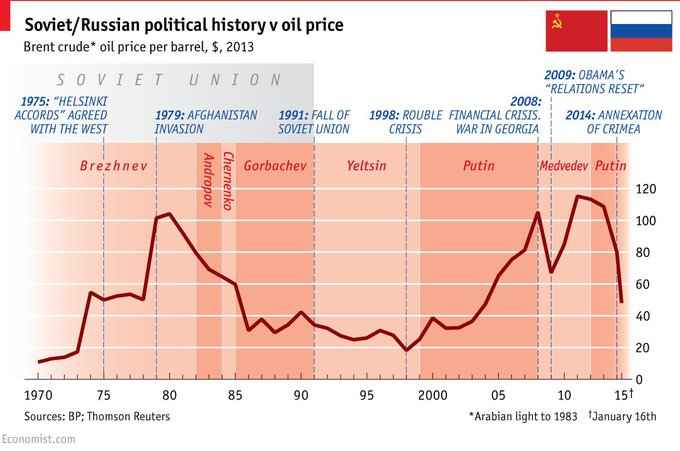
Keep that in mind for a couple of paragraphs down.

(Same update, continued. Many commenters reject Ganeev's take on both Gorby and Andropov, one claiming Andropov was a reformer play-acting a Stalinist. I'm not at all convinced by that claim. I'm not convinced by claims oil wasn't that important. Oil, wheat and heavy metals were all the USSR had, along with bits of gold and diamonds.)

That said, by early this year, Gorbachev so hated Vladimir Putin that he lied and claimed James Baker never said "not one inch further," and many of the Nat-Sec Nutsacks™ inside and outside the government parroted this. That's despite John Mearsheimer, in "The Great Delusion" and elsewhere also noting this was true. And, he, and even more Sarotte, notes this torpedoed nuclear arms talks while Yeltsin was still alive, which carried over to Putin.

The member states that emerged from the USSR would have been better off had Gorbachev recognized, and accepted, the same reality that Yeltsin did, and early on. The two Gorbachevs would have surely been far less tempted by corruption than Yeltsin's family. That, in turn, means that Gorbachev would have found a better successor than Putin. (Yeltsin tabbed him, Sarotte notes, precisely because he promised the Yeltsin family a clean slate.)

Well, Yeltsin faced trouble in both of his elections because oil remained in the pits, obviously. (That still doesn't excuse the graft.) And, while Clinton helped him as he could? 9/11, and likely its global exacerbation by Shrub Bush's invading Iraq, boosted oil prices and bailed out Putin. He might have been deemed a failure otherwise in four-five years.

The "love at first site" link, which Reuters calls "Gorbachev on Gorbachev," has this quote extract from his Dec. 25, 1991 "fare-thee-well" as USSR leader:

"For this reason, I never regretted that I did not use my position as General Secretary merely to 'reign' for a few years ..." 
"I leave my post with concern – but also with hope, with faith in you, your wisdom and spiritual strength. We are the heirs of a great civilization, and its revival and transformation to a modern and dignified life depend on all and everyone."

Makes it sound like he just casually decided to step down rather than rudely being elbowed out of the way, doesn't it? But, in reality, that's what happened. How much of that was Gorbachev seeking to preserve face, and how much of it was other things, who knows? If Yeltsin hadn't pushed, would he have moved on eventually on his own? Who knows? 

At Foreign Policy, Vladislav Zubok offers a detailed take on Gorbachev's legacy, starting with his ego. The title of the Reuters piece is no accident:

Gorbachev, who suffered from the sort of cheerful vanity that led him to speak of himself in the third person, told biographer William Taubman that “Gorbachev is hard to understand.”

Sounds about right, given the above.

At home? Even more tragic, beyond his possible self-delusion about holding the USSR together and other things. As the Yeltsin-era Russia faced catastrophic inflation, catastrophic grifting, and a fragile semi-democratic governance in which the West eventually bribed Yeltsin with money Gorbachev never got, just to get Yeltsin re-elected, Gorby regularly faced epithets of "traitor." Blamed by many for unleashing Yeltsin-era debauchery when that was actually all on Yeltsin, with an assist from the West. Sarotte is good on this, in her book. (UnHerd, meanwhile, has a simplistic hot take that omits Yeltsin being the primary cause of Putin's rise and tries to blame Gorbachev too much and the West not enough. Of course, this is of a piece with most of mainstream media, Gnu Media and Nat-Sec Nutsacks™ alike in the last 24 hours — performing a Joe Stalin "vanish the commissar" on Yeltsin and pretend there's a straight line in USSR-Russia history from Gorbachev to Putin.)

As far as Yeltsin shoving him aside? Per Zubak (it's paywalled, couldn't read all of it), it seems likely Gorbachev saw himself as the indispensible man. We know he kind of looked down on Yeltsin as a yokel. Probably couldn't believe that this drunken ass (Sarotte says that his alcoholism appears to have started as pain management after an accident) could outmaneuver him. But that's just what happened.

But, back to the West.

I found about his death by seeing his name trend on Twitter. And, then, it went back away and didn't pop up before I went to bed last night. For anybody much under my age in the West and not one of the Nat-Sec Nutsacks or close to them, he's probably most remembered by his Pizza Hut commercial if anything. Indeed, per Puff Hoes, THAT trended on Twitter.


Many Russians hated him for that too, and castigated him for the money he got. It never aired on Russian TV. Years and years later, having seen it and a certain movie more than once, I was reminded of the opening portion of "Cast Away."

That said, per all that I said above? If all politics is local, this cuts both ways. The Russia-Ukraine war of today connects both to Gorbachev's overestimation of his abilities to hold the USSR together and Poppy Bush's refusal to give him as much financial support as Clinton gave Yeltsin.

==

Interestingly, I had never had a "tag" or "label" for Gorbachev. No need to start now.

Update: In death, despite Putin trying to shunt him aside, Gorbachev became more popular than he had been in life inside Russia for most of the past 25 or more years, it appears.

February 03, 2011

Wired goes 'American exceptionalist' on space

Wired magazine is either dumb enough, hubristic enough, or a bit of both to claim that, besides Sputnik, the Russians have always played catch-up in space.

Right, right. Yuri Gagarin played catch-up to Scott Carpenter and John Glenn. Laika played catch-up to Ham. The Luna probes found Rangers or others already on the moon.

Forgot about all of that, Wired. Thanks for correcting me.

Oh, and even in other cases, the Russians didn't just copy us. Mir went far beyond Skylab.

December 16, 2010

Shimon Peres, hypocrite?

Contra Simon Wiesenthal, who emphasized all 11 million the Nazis killed for reasons of ideology, the former Israeli prime minister seems to be telling Ukranians "fuggedaboutit" on the idea that something happened in 1932-33 at the hands of Joseph Stalin that could be called genocide or more.
(Scholars' support for calling Stalin's actions genocide) raise some troubling questions. After all, if Stalin committed genocide, then the individuals who executed, supported, and condoned it must be considered his collaborators. Russians need to ask whether the Russian Federation’s status as successor state to the Soviet Union entails moral responsibility for Stalin’s crimes. Is a formal apology necessary? Might reparations be in order? They also need to ask why and how Russians, and their language, culture, and identity, came to be so deeply implicated in, and supportive of, Soviet institutions of oppression.

Both Russians and non-Russians need to ask who among them pulled the triggers, ran the concentration camps, and starved the peasants. Most post-Soviet states have avoided “lustration” — exposing crimes and barring perpetrators from office — on the grounds that it would be destabilizing. The case for not rocking the boat was plausible when the crime wasn’t genocide. If it is, can silence still be justified?

Communists, Soviet sympathizers, and fellow travelers in Western Europe and the United States need to ask whether they bear some moral responsibility for Stalin’s genocides. They knew of dekulakization, the Holodomor, and the murderous campaigns — and did nothing. Worse, they defended Stalin and the Soviet Union. Are mere mea culpas enough?

Finally, Western policymakers need to explain just how they can justify turning a blind eye to the Kremlin’s rehabilitation of Stalin. Reset buttons and cheap gas are important, of course, but perhaps mass murder masquerading as Armageddon matters, too.

Or should one just forget? Too bad President Peres didn’t say how.

The whole article is well worth reading.

October 29, 2009

Sounds like Afghanistan 2009

When did U.S. and NATO Afghanistan theater commander Gen. Stanley McChrystal say this?
“There is no piece of land in Afghanistan that has not been occupied by one of our soldiers at some time or another. Nevertheless much of the territory stays in the hands of the terrorists. We control the provincial centers, but we cannot maintain political control over the territory we seize. Our soldiers are not to blame. They’ve fought incredibly bravely in adverse conditions. But to occupy towns and villages temporarily has little value in such a vast land where the insurgents can just disappear into the hills.”

And, how soon before his “surge” request was it?

Answers? It wasn’t him, so, “never.”

Rather, per they column, they were spoken by Sergei Akhromeyev, the commander of the Soviet armed forces, to the Soviet Union’s Politburo on Nov. 13, 1986.

Food for thought, Mr. President Obama.

And, spend the money you save on building more Afghan schools.

April 27, 2008

New light shed on Raoul Wallenberg mystery

Wallenberg, as World War II buffs know, was the Swedish diplomat who saved as many as 100,000 Hungarian Jews from Auschwitz. But, after he and his Hungarian driver drove off from Budapest in early 1945 with a Soviet escort, he disappeared from the pages of history.

Did he die in 1947, as has long been believed, or did he live on for years or even decades? Was his rescue mission financed by the Office of Strategic Services, the forerunner of the Central Intelligence Agency? If so, was he spying on the Soviets as well as rescuing Hungarian Jews?

Some of those questions are starting to get answers attached to them.

In the 1990s, the CIA acknowledged that the OSS recruited Wallenberg. It would seem he was an operative for the Pond, a supersecret agency unknown to all but President Franklin D. Roosevelt and select War and State Departments insiders.
About the Pond, little is known. But later this year the CIA is to release a stash of Pond-related papers accidentally discovered in a Virginia barn in 2001. These are the papers of John Grombach, who headed the Pond from its creation in 1942. CIA officials say they should be turned over to the National Archives in College Park, Md. …

The Pond relied on contacts in private corporations and hand-picked embassy personnel. It worked closely with the Dutch electronics company N.V. Philips, “which had access to ‘enemy’ territory as well as a far-flung corporation intelligence apparatus in its own right,” said former CIA analyst Mark Stout, who wrote a brief unofficial history of the Pond.

The Swedish government has posted 1,000 pages of Wallenberg documents on government websites, which should also help.

As far as what happened to him inside the USSR, outside research suggests he lived until the 1980s, and not dying in 1947 as the Soviets claimed. He probably was in gulags, psychiatric hospitals and other Soviet custody situations.
n 1991, the Russian government assigned Vyacheslav Nikonov, deputy head of the KGB intelligence service, to spend months searching classified archives about Wallenberg.

“I think I found all the existing documents,” Nikonov e-mailed The Associated Press last month. The Soviets believed Wallenberg had been a spy, he said, but unlike many political detainees he never had a trial.

Nikonov’s conclusion: “Shot in 1947.”

Later in 1991, Russia and Sweden launched a joint investigation that lasted 10 years but failed to reach a joint conclusion.

The 2001 Swedish report said: “There is no fully reliable proof of what happened to Raoul Wallenberg,” and listed 17 unanswered questions.

The Russian report bluntly said, “Wallenberg died, or most likely was killed, on July 17, 1947.” It named Viktor Abakumov, the head of the “Smersh” counterintelligence agency, as responsible for the execution and cover-up. It said the Russians consider the Wallenberg case “resolved.”

Unsatisfied, independent consultants and academics have kept digging, analyzing, reassessing old information and pressing for the Kremlin to release missing files.

That said, Sweden admits it had chances to at least try to regain Wallenberg’s freedom in the two years between his arrest by the Soviets and their claimed date of his execution, but that it had a “passive” attitude.

That then leads to the question: Did Stockholm know the OSS had recruited Wallenberg? Was it forced to take a more passive attitude on trying to win his release?

In the mid-1950s, the Swedes pursued the case more aggressively, the story notes. That prompted a memo from Soviet Foreign Minister Andrei Gromyko in 1957 that Wallenberg had died of heart failure in detention 10 years earlier. Note how that contradicts Nikonov’s claim he was shot.

Here’s why the Soviets feared and mistrusted Wallenberg:
Wallenberg's very name may have been enough to arouse Russian distrust. Throughout the war, his cousins Marcus and Jacob Wallenberg, the czars of a banking and industrial empire, had done business in Germany, producing the ball bearings that kept its army on the move.

The Wallenbergs also were involved in discreet, unsuccessful peace efforts between the Allies and Germany, which Stalin feared would leave him excluded — a foretaste of global realignment that would lead to the Cold War.

There’s plenty of additional fascinating stuff at the link, enough for somebody to start thinking about a great movie. There’s also more testimony from Russians who claim to have seen him alive after 1947, and links to websites with more about Wallenberg and his humanitarian deeds.

I think Wallenberg lived; I think Stalin would not have been stupid enough to execute him. And, how could his name be brought up in post-1947 spy swaps?

Assuming he did live, or even if he was shot in 1947, it’s time for post-Soviet Russia to do the proper things. Repatriate his remains, and open all the archives.

Ditto for the U.S. Beyond Wallenberg, World War II historians would love to learn more about the Pond.