SocraticGadfly: electric cars
Showing posts with label electric cars. Show all posts

February 05, 2022

Top blogging for January

Between current and older posts, it was a baseball-heavy month as far as the most popular posts last month.

Tops? My hot take on Red Sox CEO Sam Kennedy using David Ortiz's induction into Cooperstown to make Ted Williams and Carl Yastrzemski into nonpersons.

Second? My scolding of a subset of the so-called Best Fans in Baseball™ for opening themselves to mockery by seriously thinking the Cardinals should sign Albert Pujols.

Third? My carefully showing that, even when just limited to this century, Shohei Ohtani's 2021 was nice but not all that.

Fourth? My callout of Jon Lester retirement fellation, especially when seemingly driven by Cubs homerism.

Fifth? My analysis of how blogsite Cooperstown Cred is as bad as Red Satan ESPN on a "Big Hall" mentality for the Baseball Hall of Fame.

Sixth? From last month, explaining why, in detail, Gil Hodges isn't really a Hall of Famer.

Seventh, and we're out of baseball. I take the antivaxxers to task for their Nuremberg Code bullshit.

Eighth, my deep dive on bipartisan bullshit on the border in Tex-ass, along with the accumulating troubles of Kenny Boy Paxton.

Ninth? Similar to No. 6, explaining why, in detail, Tony Oliva isn't really a HOFer.

Tenth? Challenging liberals, and fellow leftists, to talk honestly about how they're going to juice up 100 million electric cars in the future without nuclear power.

January 14, 2022

Where's the juice for those electric cars coming from? Will liberals and leftists face the N-word?

Sounds great, the idea of getting us to an all-electric fleet, doesn't it.

And, it WILL be great for the climate.

But, again, where's the juice coming from, since we will need NINETY PERCENT MORE OF IT in 2050 than today.

I was asking this question rhetorically late last year, and got this moron answer from "Devin Nunes' Lawsuits":

To which I responded:

And then part two of the thread, with the link above:

And, there you go.

And, yes, I saw "cola" in my first tweet and forgot to edit when I realized I would have to break into two.

The link mentions the word "nuclear." People concerned about climate change shy away from it. Greens hate it.

But, that's why I raise this.

Now, not all of that 90 percent increase in need is due to electric cars. Probably, they're about 50 percentage points of it. But, if you want electric heat replacing gas heat, and other green things, we're at 90 percent.

Oh, and hydropower isn't totally green, and in the US, current hydropower is going to fall, fall, fall, as anybody familiar with the Desert Southwest in particular knows.

Right now, renewables are about 20 percent of our power. So, they have to increase to cover all current electricity alone, they need to increase by 4x. For that plus that 90 percent increase, they'd have to go up 7.5 times. And, on the "reliability" issue, add MASSIVE battery storage.

Again, don't see this happening without the "n-word." And, contra Nunes' Lawsuits, growth was a little below 3 percent, about 2.6 percent, before 2005, and much lower since then due to electric conservation. Now, compounded, we might get there, BUT? Past performance is no guarantee of future results.

And, while I don't shy away from nuclear power, we face NIMBY-ism on both plant siting and toxic waste. And, growing up in the Four Corners, I'm quite familiar with uranium mining's dirty legacy.

==

That said, the need for nuclear power will only increase the more that environmentalists engage in NIMBYism on wind power, and a mix of NIMBY, legit concerns and overblown concerns on wind and solar in places like BLM desert lands.

June 07, 2021

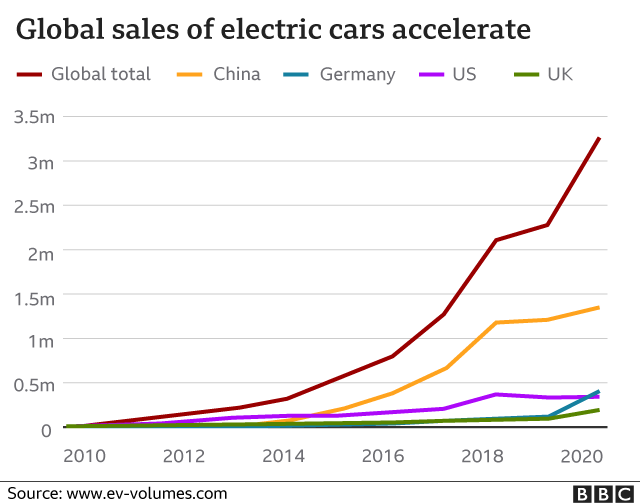
Electric cars are coming! Except to Merika, probably

The Beeb has a great story about how more and more car companies are planning to sell electric only vehicles, generally no more than 15 years in the future. It also notes that the cost of "juice" vs. "fuel" continues to drop and tilt the economic equation toward electrics, and adds that if you include maintenance costs specific to an internal combustion engine, the tipping has probably already gone electric-favorable.

So, everybody's rushing to buy, right?

Not quite, per this:

Shocked? 

Note also that Ford, unlike GM, at least for the story, mentions a Europe-only all-electric time frame. Chrysler-Fiat-Who Will Rescue Us Next? isn't even mentioned.

I am not sure of all the reasons behind that flat-to-slumping purple line, but I can think of a few.

Wingnuts being refusniks as part of "owning the libs." (I wondered last week if this attitude on COVID vaccines would stand up to free Budweiser.).

EVs in the U.S. associated too much with Tesla.

Fear of driving range. (This one is nonsense, as any new electric right now will go 250 miles without a charge. Of course, if you're Tesla and insist on your own charging system, this may be a problem, and were I a local government, contra Sulphur Springs, Texas, I wouldn't help build out a Tesla-specific charging site.

Interestingly missing from the story are the two pioneers of hybrid drives: Toyota and Honda.

August 19, 2017

India plans to go all-electric on cars by 2030

No, really! That's what the government claims, per the World Economic Forum.

Yeah, right.

Both Modi's currently ruling BJP AND Congress would be more likely to let Pakistan have Kashmir than for this to become a reality.

(And, as of August 2019, Modi's moved MUCH further away from that reality. The reality of Kashmir as a "giant prison camp" and how India  — led by the BJP, but with Congress and allies in acquiescence — got to this point is explained in detail by Arundhati Roy.)

I mean, given that by 2030, India will likely pass China as the world's most populous nation, thanks to Modi having declared a "birthrate war" with Beijing, AND, given that India's been a foot-dragger to this point on even voluntary efforts to help fight global climate change, this would be great.

But, it ain't happening.

There's ZERO charging infrastructure there. But, that's a minor problem.

One-third of rural Indian homes lack electricity, even though just about all the country (theoretically) is wired. Many houses that do have juice don't have it for a full 24 hours a day. It's intermittent and unreliable.

And, by India's current grid, going all-electric could be worse than having more gas-powered cars. Coal makes up nearly 60 percent of its power generation, and a fair amount of that is dirty lignite.

After all, in advance of the Paris Accord talks, the Modi government said India should be lumped with sub-Saharan Africa, not China, on standards. If it was telling the truth, then it knows it can't meet these promises. If it was lying, then it may well be lying now.

And, per that link and my "birthrate war" comment above, if ANYTHING is ANTI-climate change battling, it's deliberately asking your country to increase its birthrate.

To the degree India cleans up its electric generation, and produces more, other demands on it will go well ahead of electric cars.

July 31, 2010

Chevy Volt: An electric lemon

I knew it was priced more than the Nissan Leaf. I knew it was late to market. I knew it was a bit dowdy. What I didn't know, until now (gee, GM, hide this under a bushel basket), is that the miniature gas engine that recharges the battery needs premium fuel. Throw in the fact that the Volt's lease terms compare quite unfavorably to the Leaf, and, you've got problems galore, GM.

August 20, 2009

Is Toyota right to hold off on all-electrics?

Business-wise, I say yes, its stance is smart.

An aging Japan offers little market; Europe’s not big on them; the US market is still fickle, and sprawled Chinese cities, like many US ones, need an electric with more battery life.

This, though, is NOT good business sense: Akio Toyoda, Toyota’s new president, is a big backer of fuel-cell cars. Hydrogen power is just as much “just around the corner” as is peaceful nuclear fusion.

Toyota needs to be careful it doesn’t become the new “old GM.”

July 31, 2009

Nissan unveils all-electric hybrid car

The all-new Nissan Tilda, scheduled to go on sale in the U.S. next year, is indeed a hybrid-drive car in the sense that it uses regenerative braking for battery recharges, enabling it to go 100 miles, not 50 or so, between charges.

Toyota still pooh-poohs all-electrics right now, but we shall see. Meanwhile, at a price Nissan says will be “competitive” with gasoline-engine vehicles, a 100-mile charge life, and lithium-ion batteries, the Tilda has just kicked massive amounts of sand in the face of the Chevy Volt. (Not that that’s hard to do. And not that that’s not kind of fun to do, either.)

September 23, 2008

Chrysler gives us a laugh — while whore-mongering for Congressbucks

Chrysler — poster child for capitalism gone wrong — tries to play Congress and public like a fiddle

Chrysler claims it will produce an electric car by 2010.

Here’s more on two electric-priority hybrids (like the Volt) and a pure electric that makes a halfway attempt to challenge the Tesla.

First, is Cerberus that dumb, to pound sand down that rathole when the Chevy Volt and a plug-in version of the Toyota Prius are already in the works?

It’s like the last week have been a Darwin Award poster-child week for the stupidity of capitalism.

Second, there’s the tech side. Chrysler hasn’t done anything at all in the electric world, and as for this new vehicle, it says it is is still working with several partners on the battery technology for its vehicles.

Don’t you normally have things like that lined up in advance of splashy press announcements?
Vice Chairman Tom LaSorda said Tuesday that the company is further ahead on developing electric vehicles than many had thought, but it kept the cars secret until recently.

“We believe in the saying, ‘Actions speak louder than words,”’ LaSorda said.

Well, so far, Tom, you’re still in the “words” stage. When you make like Tommy Lasorda and win something, get back to us.

And, here’s the kicker (you knew there had to be one, didn’t you?):
Chrysler Chief Executive Bob Nardelli said the technologies the company displayed Tuesday would be accelerated if Congress funds a $25 billion loan program to help automakers and their suppliers modernize their plants to make more fuel-efficient vehicles.

I don’t know if Crazy Uncle Henry’s Damage Derivatives Bailout is good news or bad news here.

On the good news side, it could mean that Congress says, “We don’t have the money for this.”

On the much more likely bad news side, Congress could say, “Ahh, 25 bil? Or even the 50 bil you guys now want? Chump change!”

Hell, I wouldn’t be surprised to see Big Three “loans” rolled into the bailout plan.

And, it would be egregious enough for Ford or GM to get these loans.

But, Cerberus is a private equity company, the apotheosis of capitalism.

Take your fucking lumps.

August 20, 2008

Mitsubishi joining electric car explosion


Mitsubishi has signed three-year leases to bring this cutie to America starting in October. The agreements are with Pacific Gas & Electric and Southern California Edison to add the cars to their corporate electric fleets. (Photo from Wired.)

The i MIEV is a prototype for a full-blow EV to come out in two years. Edmunds has test ride info.

Specs? A 100-inch wheelbase means it’s not a kneecapper in size. Power? Lithium batteries, not nickel hydride.

Performance? On the power side, it’s 0-60 in just over 8 seconds, with 63hp. Endurance? It goes as much as 75 miles on a charge. If this is just a prototype, Mitsubishi could have something to offer in two years.

Per Edmunds, further improvement in the battery pack is the primary need between now and 2010 full model release.

July 31, 2008

Canada kills electric car

Transport Canada said a low-speed (30 mph) electric car was unsafe for city streets.
Dynasty got started after the federal government in 2000 created the new Low Speed Vehicle classification for electric cars restricted to 40 kilometres an hour on city streets.

But, 50 kph, although faster than that, apparently ain’t good enough. Nor was a $15,000 (Canadian) price tag, which made the cars affordable for all. A 30-mile battery life was decent.

It’s “nice,” or sad, to see that anti-green government officials are north as well as south of the border.

In this case, it’s actually worse north of the border. U.S. rules allow such types of electric cars.

May 03, 2008

Tesla unveils electric sports car

It’s been rumored and expected for some time, and now it’s here.
Specs, both environmental and performance?
• 0-60 in just under four seconds;
• 225 miles on one charge;
• 3.5 hours recharge time;
• Starts at $109K.

Flip side? Lithium-ion batteries, above all. Yes, they allow longer cruise times than more “conventional” car batteries, which typically require a visit to an electric outlet at 100 miles or so.

But, as anybody who has actually had a laptop computer on their lap for too long notes, lithium-ion batteries get HOT. Yes, Tesla has tested this car thoroughly, but, nonetheless, in a place like Phoenix, just how well will these batteries hold up? And, what’s the fire danger in a collision?

Tesla plans an electric family sedan, at a lower price, down the road. I’m interested, but wouldn’t buy without more assurance on real-world battery performance.