SocraticGadfly: uranium mining
Showing posts with label uranium mining. Show all posts

November 05, 2025

Reviving uranium mining and its possible consequences

This Inside Climate News piece notes that currently, very little uranium is mined in the US, but how there's a push to both open new mines and reopen old ones, either on the Colorado Plateau where Gallup, New Mexico, is, or the Wyoming Basin, or parts of southeast Texas. And, this includes the Church Rock mine. I grew up in Gallup, and remember when the berm-dam for the tailings pond at the Church Rock mine (owned by a Kerr-McGee subsidiary, by the way!) broke. I've written about that, the economic destructiveness of uranium busts, the environmental damages of uranium ore dust and more.

Today's methodology? Less destructive, in not involving surface-level pit mining, but it instead uses massive amounts of water, scarce in many places where the new mining push is in, and with its own environmental risks. 
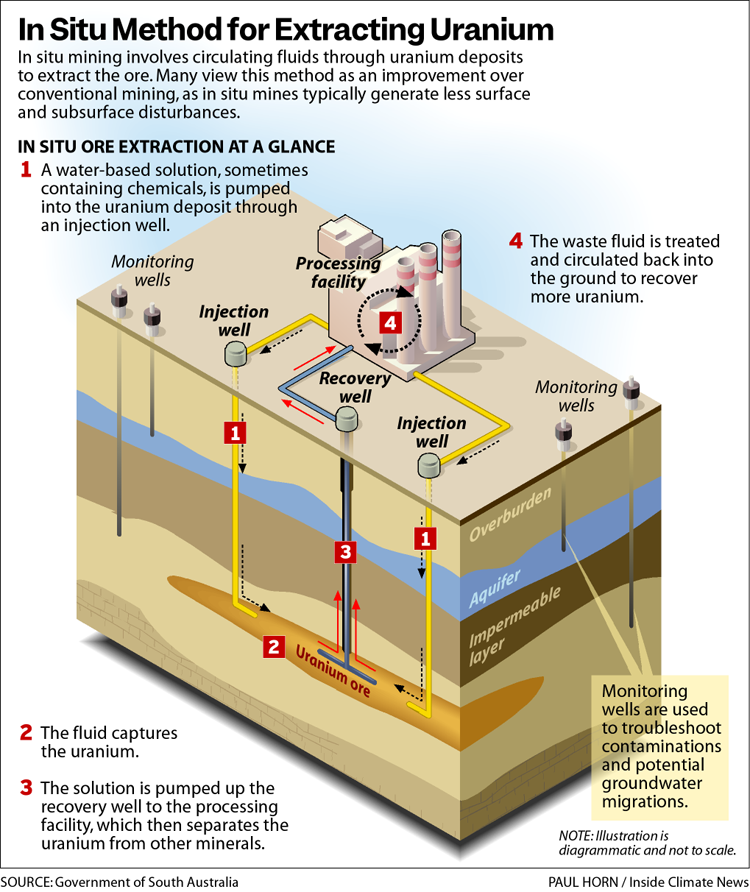
Rather than involving pit mines, like my New Mexico youth, it instead uses injection wells broadly similar to the oilfield. Here's a description, per the illustration above.

Unlike pit mines, which scrape away acres of earth, most modern uranium extraction projects drill hundreds of wells, inject them with solvents and suck up the mineral slurry they create.

That shows you why the water concerns are real, and not just in the Southwest, as we'll see.

There's also the problem that mines in the Southwest, while generally on federal land, also generally abut Indian sacred sites.

Some of the fast-tracked New Mexico mines border the lands of the Acoma and Laguna pueblos. In the nearby Navajo Nation, the new activity has sparked concern. 
The Navajo Nation “continues to be affected—not only from abandoned uranium mines and mill sites—but also from other contaminants,” said Perry Charley, chair of the Diné Uranium Remediation Advisory Commission, at a public meeting in August in Shiprock, New Mexico. 
From 1944 to 1986, mining activities left more than 500 abandoned mines and an enormous amount of uranium waste in various regions of Navajo land.

Once again, rich White America has zero sensitivity or care, for the most part, for American Indians. This includes, IMO, environmentalists pushing a revival and expansion of nuclear power with little foresight. 

And, albeit without American Indian cultural sensitivity, the water quality problems of modern water injection well mining are also coming to Texas.

The uranium mining revival has churned up similar concerns in the savannah of South Texas. Encore Energy, based in the Gulf Coast city of Corpus Christi, started production at its Rosita site in November 2023 and its Alta Mesa site in June 2024. In August, it acquired 5,900 more acres adjacent to Alta Mesa, where it plans to begin drilling in October. Another Corpus Christi-based company, Uranium Energy Corp., expects to start mining at its South Texas sites in early 2026. 
One rural groundwater conservation district is fighting the renewal of an old, unused mining permit UEC holds for a site in Goliad County. 
“We are extremely concerned that UEC’s uranium mining activities will lead to groundwater contamination,” said a request for a hearing on the mine permits filed by the district with Texas’ environmental regulator late last year. ... 
The Goliad site will use about 130 million gallons per year, according to Art Dohmann, vice president of the Goliad County Groundwater Conservation District. But mining is exempt from groundwater permitting requirements under Texas law, he said. 
“This may cause more wells in the area to go dry,” the district wrote in comments to the state. 
In August, the Texas Commission on Environmental Quality voted unanimously to grant the district’s request for a hearing on the permit. UEC did not respond to requests for comment. 
Separate state permits authorize UEC to inject up to 105 million gallons of mining wastewater underground for disposal every year at its Goliad site. UEC has four other projects under development in South Texas.

There you are.

It also notes the US currently has just one diffusion plant for enrichment, just one for processing into fuel and has NO domestic facilities for the fuel needed by more modern plants. Anything we need right now? We get mainly from the Russkies.  

In other words, just snapping our fingers to expand domestic mining will do little in and of itself to expand domestic nuclear fuel supply. 

October 03, 2022

Nuclear isn't part of the climate answer and don't try to make it

The nuclear industry will keep trying to tell you that, after that nuke plant is built, nuclear power is carbon-neutral. Not.Even.Wrong., as Counterpunch explains in high detail. They don't count the carbon costs of long-term waste disposal, for one thing (setting aside all its other issues), nor do they count the high carbon cost of mining uranium ore, which is generally very low grade (setting aside all its other issues).

Ahh, the other issues.

I grew up in Gallup, New Mexico, during the tail end of the original uranium boom. I moved to St. Louis with my dad, during the summer of, and just after the date of, the Church Rock mine's infamous tailings dam failure. Or damn failure. Counterpunch described that in detail. What I didn't realize at the time, but do more now, is the government's and uranium industry's exploitative treatment of miners. The same is true in placed like Congo where ore is mined today.

Joshua Frank then goes on to discuss lies and secrecy about nuke accidents. Three Mile Island, Chernobyl and Fukushima are but the tip of the iceberg.

==

The other reason not to try to make it part of the equation? Farhad Manjoo has that in an NYT column. The shorter version of it has three main points.

One is that nuke plants have too long of a build time, even as wind and solar both increase their efficiency.

Two is related and is that every dollar on nuke plants is a dollar not available for wind and solar.

Three? Many enviros mention the intermittency of wind and solar. Manjoo notes the expansion, and ever-higher efficiency, of various forms of battery storage of excess wind and solar.

==

If you're a real environmentalist, ask yourself this. Is a Nordhaus or Shellenberger promoting it, as with nukes, or a Noah Smith, as with hydrogen? Run away as fast as you can.

==

Yet another reason to oppose trying to make nuclear part of the solution? It's being pushed by neoliberals, like Nordhaus and Schellenberger, who have helped lead us to this situation in the first place.

January 14, 2022

Where's the juice for those electric cars coming from? Will liberals and leftists face the N-word?

Sounds great, the idea of getting us to an all-electric fleet, doesn't it.

And, it WILL be great for the climate.

But, again, where's the juice coming from, since we will need NINETY PERCENT MORE OF IT in 2050 than today.

I was asking this question rhetorically late last year, and got this moron answer from "Devin Nunes' Lawsuits":

To which I responded:

And then part two of the thread, with the link above:

And, there you go.

And, yes, I saw "cola" in my first tweet and forgot to edit when I realized I would have to break into two.

The link mentions the word "nuclear." People concerned about climate change shy away from it. Greens hate it.

But, that's why I raise this.

Now, not all of that 90 percent increase in need is due to electric cars. Probably, they're about 50 percentage points of it. But, if you want electric heat replacing gas heat, and other green things, we're at 90 percent.

Oh, and hydropower isn't totally green, and in the US, current hydropower is going to fall, fall, fall, as anybody familiar with the Desert Southwest in particular knows.

Right now, renewables are about 20 percent of our power. So, they have to increase to cover all current electricity alone, they need to increase by 4x. For that plus that 90 percent increase, they'd have to go up 7.5 times. And, on the "reliability" issue, add MASSIVE battery storage.

Again, don't see this happening without the "n-word." And, contra Nunes' Lawsuits, growth was a little below 3 percent, about 2.6 percent, before 2005, and much lower since then due to electric conservation. Now, compounded, we might get there, BUT? Past performance is no guarantee of future results.

And, while I don't shy away from nuclear power, we face NIMBY-ism on both plant siting and toxic waste. And, growing up in the Four Corners, I'm quite familiar with uranium mining's dirty legacy.

==

That said, the need for nuclear power will only increase the more that environmentalists engage in NIMBYism on wind power, and a mix of NIMBY, legit concerns and overblown concerns on wind and solar in places like BLM desert lands.

November 30, 2018

Grants, New Mexico: A story of a town's
promise and peril, uranium booms and busts

For the first time, I think, since I moved away from Gallup, New Mexico decades and decades ago as a teenager, I actually drove through all of Grants on old Route 66, rather than driving by on I-40. I had planned on driving up to the Mount Taylor trail and climbing to the peak, but time just got cramped.

Grants-old Uranium Cafe
The old former Uranium Cafe.
For those who don't know, Grants once billed itself as the Uranium Capital of the World. The "world" part was hyperbole, but it was, staying ahead of southeast Utah where Canyonlands National Park now is, definitely the Uranium Capital of the U.S.

That picture at left? The Uranium Cafe was the original name, and was when I was a kid in Gallup.

That being the Uranium Capital of the U.S., if not quite the world, ended the same year I moved out of Gallup, and for two reasons.

One is well-known to the general public: Three Mile Island.

The other, far less known, is a rupture of a tailings pond at the Church Rock Mine, near Gallup and west of Grants, that summer. It actually, it is believed, released more radiation than Three Mile Island, and per the link, the laggard response to it may indeed have had racism behind it. The mine employed mainly Navajos, who had already suffered from two decades of bigotry in uranium mine and milling safety. And, the tailings pond, when ruptured, eventually flowed into the Rio Puerco of the West, through "checkerboard" Navajo land and then through Gallup, often known at that time as "Drunk City."

Had Three Mile Island and the tailings pond rupture happen two years later? Not such a big deal. Sure, nuclear power plant building had already slowed down. But, this would have been in 1981, during the regulations-lightening Reagan Administration. And, after the Iranian oil embargo, which would have further pushed places like New England to move from fuel oil to electricity for heat if locales there hadn't yet done that.

But, that's not the way it happened.

Grants: The down side.
So, Grants kind of imploded. Fair chunks of the town still look like the site pictured at right.

And, I do mean fair chunks. I ran out of time to drive very far on the Forest Service roads, but I took NM 547 up to the first mile of FS road on the route to the Mount Taylor trailhead. There's more of Grants that looks like what I have here. Maybe 20 percent?

After I left Gallup, I used to joke that it and Española were the two armpits of the state. Maybe they're not alone.

Looking for tenants in Grants.
The city's still trying to recruit people and businesses to live there. Just a block away from the old Uranium Cafe building you have that fairly new business building I have at left.

Free rent on a relatively new business. Doesn't sound like a bad deal, does it? But, nobody's buying. That's with the city still growing, albeit tenuously, ever since losing one-quarter of its population, almost 3,000 people, in the 1980s. But, the growth is nothing more than natural population increase.

The lack of business interest shows in other ways.

Long before the current implosion in the newspaper industry, the old Grants Beacon, sometime after becoming the Cibola Beacon but long before today, went from five-day daily to semiweekly circulation. It then shut its doors two years ago, but was quickly replaced by the Cibola Journal.

Speaking of Journals, the Albuquerque Journal, at least on newspaper coin racks, appears to have deserted Grants. I grabbed some food at the Mickey D's there and saw two newspapers. One was the Cibola Journal, and the other was NOT the Albuquerque Journal.

It was the Gallup Independent.

Yes, Gallup is 15 miles closer than Albuquerque. But, seriously, if you're doing shopping outside of Grants, you're headed to Duke City, not Drunk City. This is to me another sign of how much the Albuquerque Journal is imploding in recent years. It's become more predictably wingnut on its op-ed pages, even as Albuquerque as a city becomes more liberal, and tightened its horns otherwise.

Part of Grants' River Walk Park area.
Anyway, Grants is trying. Gallup bills itself as The Indian Capital of the World, but Grants is nearer to Laguna, Acoma and the Rio Grande pueblos, and almost as close to the Ramah Navajos as Gallup is to the Big Rez. So, part of the city park, as shown at left, rightly ties in with this.

You can see three "bowls" here, all about the size of a large satellite dish. The block to the west has three more, on the same side of the street. This is all about in the center of town, next to city hall and the mining museum, which is pretty small. (It is closed on Sundays, so I couldn't check out it.

So, people are trying.

And, there's other "hooks."

Lava and life juxtapose at El Malpais National Monument.
Since I moved away, the core of El Malpais is now a national monument — with a nice visitors center on the east end exit off I-40. Bonus: It's a Park Service national monument, not a BLM one, though there is a BLM-run national conservation area flanking it.

It's still the main gateway to El Morro.

Both Acoma and Laguna have casinos, for people into that stuff. Albuquerque has plenty of arts and cultural life, museums, shopping and dining.

But yet, Cibola County's only grown 2,000 in the past 15-plus years, the same as Grants.

So, besides Grants' booms and busts, maybe it's the post-2000 history of New Mexico in a nutshell in some ways.

Get your kicks on Route 66? Well, maybe.
I don't know how well it markets itself not only for tourism, but as a retirement town. Yeah, snow on I-40 to Albuquerque can be bad at times, and those spring crosswinds are a mutha; I know both from experience.

Still, Grants isn't THAT isolated, and with all the nature stuff to do, and the history as well, you'd think it could draw more retirees who want a small town atmosphere while being relatively close to a big city.

On the other hand, the US as a whole was whiter 20 years ago, let alone 50 or 70 years ago, than today. A lot of retirees, even without the "bombed-out" buildings, would be leery of Grants.

And, we'll leave it all right there.


February 07, 2008

Forest Service allowing uranium exploration near Grand Canyon

With almost no public input, the U.S. Forest Service is allowing exp href="just three miles from a Grand Canyon overlook.

Let’s put it this way: Public input was so limited that not one of the more than half-dozen environmental groups who send me e-mail action alerts on a variety of issues had an alert on this baby.

Here’s the USFS spin:
Barbara McCurry, the Kaibab National Forest’s spokeswoman on this issue, said her agency had little choice but to allow the drilling under the 1872 mining law that governs hard-rock mining claims. “The exploratory drilling is pretty minimal,” Ms. McCurry said, adding, “Our obligation is to make sure that any impacts are mitigated.”

To the degree this is true, which is a fair amount, but not as much as the USFS claims, then we need to reform the 1872 mining law; the House has already passed amendments to it.