SocraticGadfly: science
Showing posts with label science. Show all posts

December 29, 2025

Science news roundup: Herbicides not oak wilt, orcas and dolphins

The first one is as what my header indicates. Herbicides, not oak wilt, are causing serious problems for oak trees in the midwestern US states. One problem is that few people recognize it as a problem worth monitoring. A second problem is that agribusiness-beholden states are loath to enforce laws against herbicide misuse already on the books. Dicamba, "shockingly," is one of the biggest problems. It's been made worse by creation of "Dicamba Ready" soybeans. (Due to copyright, they can't actually be called that, but that's what they are — a dicamba-resistant analogue to Roundup Ready beans.)

==

Sorry, Massimo, but contra this piece, Thales probably did NOT predict the famous 515 BCE eclipse and I even mentioned that to you before. And, of course, what he did know about partial success in predictions came from Babylon. See here, as well as on Thales' life in general. EVERY claim about Thales as a natural scientist is anecdotal and was regarded as such 2,000 years ago, if not 2,400 or more.

==

Orcas and dolphins team-hunting? Not your norm by any means, but in the US Pacific Northwest, they're doing just that to nab salmon. The orcas use the dolphins as scouts; the dolphins, who don't normally eat salmon, likely get protection from this Northern Resident pod of orcas against other, dolphin-eating orcas.


October 25, 2024

Science roundup: Starchy genes

Per Carl Zimmer, not only did the invention of fiber allow for the roasting of tubers and later, the roasting or baking of grains, as well as roasting meat, but a bit of evolution gave humans genes to create the enzyme amylase to break down starches.

That evolution came in two waves, actually, he says.

One was about the time generally guesstimated for the domestication of fire, and would of course spread globally as that was long before the exodus of modern Homo sapiens from Africa.

The other? About 12,000 years ago. That's before humans in Southwest Asia became sedentary farmers, but, it's right about at the time that they moved from pure hunter-gatherers to more of "multiple strategies" on their food, including more work on semi-domesticating wild grains. (We know bread was being baked and even toasted before this time.)

But wait, that's not all. Here's the tie to modern times and refined starches:

As ancient societies developed different diets, the new research suggests, they evolved to have different numbers of amylase genes. Dr. [Omer] Gokcumen speculated that people today who have fewer amylase genes may be more vulnerable to diseases like diabetes that are fueled by a starch-heavy modern diet. Down the line, the findings could point to potential amylase-based treatments for these diseases.

There you go.

The reason we know that the initial evolution was likely long ago is indirect, but smart. Neanderthals, we can tell, had also evolved extra genes for amylase creation. Peter Sudmant offered further correlation for the evolutionary timeline, but cautioned against trying to directly connect it to the domestication of fire at this time.

But wait, that's not all.

This new genetic information also has these scientists rethinking the role of amylase. They say that it may as much or more be for signaling the digestive and energy-distribution systems of the body in general that food is on the way, vs. being specific for starch digestion.

Thinking beyond the story, might this be a partial explainer for why many American Indians have such problems with diabetes? (Another partial explainer would be food deserts, as with African Americans.) Obviously, the second evolutionary round would have been after the first Amerinds entered the Americas, but the first evolutionary round could have had a small ingroup with fewer genes.

August 30, 2024

Science roundup: "Hobbit" evolution, African wave migration, origins of life, creationists

Carl Zimmer reports on discovery of 700,000-year-old teeth and an arm bone from Homo floresiensis, our "human hobbit" evolutionary kin. The biggest takeaway? They're even tinier than previously thought, as in 3 feet, 4 inches, or 1 meter or so. They would officially be "dwarves" in modern human height classification.

How they evolved? Under as much dispute as ever.

 ==

Indirectly related? Humans of Homo sapiens left Africa in multiple waves, it appears, starting 250K years ago. This, in turn, will surely offer new insight on Neanderthals and Denisovans, their interactions with Homo sapiens and more. It may also offer more insight on climate and human migration and related issues.

==

Zimmer also interviewed Sara Walker for her controversial "assembly theory" of the origins of life. And, yes, controversial. Rosemary Redfield, among people who blasted the "arsenicgate" claims about Mars, basically calls it dreck. (And, indeed, Zimmer, then at Slate, had one of the biggest callouts, citing Redfield extensively.)

Per friend Massimo Pigliucci, and per less harsh critics, the idea that you can number the complexity of molecules and use that number as part of a sharp cutoff between life and non-life? Sounds like another version of the demarcation problem, which itself is connected partially to the old sorites paradox. I also venture that it comes close to circular reasoning.

==

And, controversial but honest while lying? That's my summation of friend Paul Braterman's review of an article by two young-earth creationists. Rather than attack evolution by natural selection directly, like most YACs, who use the word "Darwinianism," of course (has any fundagelical ever called general relativity "Einsteinianism"?) attack its methodological presuppositions.


July 24, 2024

Science news: Brain plumbing, nekkid Lucy the Australopithecus, more

I've read recently that the amyloid plaque idea of Alzheimer's is not on the most solid ground, but it's verboten to question it, let alone offer alternatives, in serious research journals.

Well, what if it's partially right but not fully so?

This idea, that the brain's glymphatic system flushes brain waste during non-REM sleep, including but not limited to, amyloid plaque, would be one idea. In this case, then, two people with similar daytime levels might differ on Alzheimer's symptom degrees, or even whether they have it or not period, depending on whether their brain plumbing is working well or not.

==

An interesting piece here, ostensibly about Lucy the Australopithecus afarensis, but in reality about body-draped reconstructions off fossil bones of ancient hominins in general. Per the story, to use the old Texas word deliberately, Lucy, and her ilk, actually might have been more nekkid than they've been portrayed. Linked in the piece, the author, a philosopher, notes that the coevolutionary history of humanoids and humanoid-targeting body lice says that not only was Lucy nearly nekkid, her ancestors may have been nearly hairless as much as 1 million years earlier.

Stacy Keltner speculates that shame over nudity arose to reinforce pair-bonding by trying to shame actual or would-be cheaters. The idea sounds interesting, but it also sounds like it involves some backward-reading Ev Psych. Indeed, Keltner cites an evolutionary anthropologist. Nudity and nakedness, if you will, are indeed not the same. But, the speculation as to why nakedness became, essentially, shamed into nudity still seems like awfully thin ice. To put it another way, it looks like a somewhat self-referential take, unable to escape our 20,000? 50,000? years of post-nudity framing.

==

Related somewhat to Lucy, though not on the development of nudity and shame?

Carl Zimmer has reporting on human fossils in Tibet confirmed to be Denisovan. The age range is the biggie. It's from 160,000 years before present, confirming how early Denisovans split off the Homo family tree, to just over 30,000 years bp, including evidence of their interaction with Homo sapiens.

==

Another Zimmer story notes that new research indicates language evolved primarily for communication, and NOT for thinking. Fun sidebar? This is another overturning of Chomsky's claims about language. (I can't say "research," since Chomsky did basically none.)

==

It sure would be nice if NASA could work with the Chinese Space Agency and see some of those far side of the moon rocks that the Chang'e 6 spacecraft brought back to earth. But, because of US Congressional tribalism on China that predates COVID by nearly a decade, US law says it can't.

Meanwhile, bringing back 2 kilos of rocks by unmanned voyage? The American Cold War-based rationale for manned lunar missions (and a manned Martian mission beyond that) continues to lose more and more steam.

December 01, 2023

Science news roundup: mammal gayness

This one dips a bit hard into the ev psych world, so take it with a grain or two of salt, but reportedly, homosexuality in mammals may have evolved to reduce group conflict. Given that same-sex sexual behavior has been seen in non-mammalian animals as evolutionarily ancient as crickets, that's part of why I'm skeptical. 

This:

Dieter Lukas, an evolutionary biologist at the Max Planck Institute for Evolutionary Anthropology in Leipzig, Germany, who was not involved in the new study, was skeptical of this conclusion. “Taken together, the findings in this study have not convinced me that there is a single explanation for the occurrence of same-sex behavior,” he said.
His skepticism came in part from the data on which the scientists based their study. The challenges of observing animals in the wild may mean that same-sex behavior in some species goes overlooked. “It will be much easier to observe whether the behavior occurs if individuals are on open ground and active during daytime,” Dr. Lukas said.

Is a good starting point. 

And, per others, those crickets may suggest another answer:

Marlene Zuk, an evolutionary biologist at the University of Minnesota who was not involved in the study, commended the researchers for focusing their study on mammals alone, rather than the entire animal kingdom. “We’re trying to steer way from one explanation to rule them all,” she said.
In April, Dr. Zuk and Jon Richardson, a postdoctoral researcher in her lab, put forward a different explanation for same-sex behavior based on an experiment on crickets. They showed that male crickets will sometimes produce courtship songs and try to mate with other males and with juveniles.
Since the crickets don’t live in social groups, that can’t explain the behavior Dr. Zuk and Dr. Richardson documented. Instead, crickets and perhaps many other species may engage in same-sex sexual behavior as part of a strategy to take advantage of as many opportunities to mate as possible.
Dr. Zuk likened the strategy to a smoke detector. “You want a smoke detector that is sensitive enough to detect all fires,” she said. “And if it does that, occasionally it’s going to go off when you burn your toast.”

Or at least, per Lukas, that there is no single answer.

Another reason to be skeptical? It's a meta-study. They can be good, but overall, no better than the weakest of the individual studies. 

Yet one more reason for skepticism? Dean Hamer. Yes, I went there.

In addition, males of many of the species involved generally do NOT form social groups much of the year. Only in winter, for example, do wild ungulates become part of herds, and they're going to be more socialized at that point because they're testosterone-exhausted after the end of their rut.

At a minimum, I think we should say that already existing homosexuality perhaps underwent cultural evolution in some eusocial mammals.

October 03, 2023

Nobel Prize for mRNA work

No, not the COVID vaccine, but the scientists who first developed the idea of using messenger RNA as a transmission vector in a vaccine. #Schadenfreude for the antivaxxers in general and Dr. Robert Malone in particular, eh?

That said, I won't do quite as many huzzahs and handsprings at the Nobel Committee, let alone the old Skeptical Raptor. Let us remember on COVID, while an mRNA vax is better than nothing, contra what the presser at the first link indicates, it appears to be less effective than other types of COVID vaccines. Will this be true of other new plagues that visit us? Let us also remember the -100C or whatever temperatures these vaxxes need to be stored at, versus other COVID vaxxes that can be kept at something closer to conventional freezer temperatures, and also have longer lifespans.

I worry that this, especially in capitalist America, will indeed crowd out other vaccines.

Finally, a reminder from Retraction Watch that whether here or in other natural sciences, or in the Piss Prize (looking at you, Dear Leader, who according to James Bamford was trying to land a second in 2016), that Nobel Prizes aren't guarantors of all-around wisdom.

May 25, 2016

Neil Young, capitalist sellout — #hypocrisy alert (updated)

Neil Young (Wikipedia photo)
Neil Young has long been known for "reinventing" himself musically every several years, but he's long been seen as a consistent liberal political and social voice.

(Update, May 25, 2016: Well, maybe not a consistent liberal political and social voice. Sure, he endorsed Bernie Sanders earlier this year, but now, he's ready and willing to let Donald Trump use his music at campaign events, as long as he pays up.)

Back to the original ....

Well, maybe we should re-invent our understanding of him. And, his voice aside, part of a trilogy of "interesting" voices along with Bob Dylan and Willie Nelson, maybe we should re-invent our understanding of him as a musician — at least one who understands much about actual recording and engineering — as well.

And, why do I say this?

From this great piece from LA Weekly, which once and for all refutes the idea that "vintage vinyl" sounds better than CDs.

If anything, it actually is worse.

Due to the shorter "travel time" near the label, sound quality on a record deteriorates even further near the center of the black plastic. And (petard alert!) to get more than 40 or so minutes of sounds on a piece of vintage vinyl, the sound must be COMPRESSED! And, there's extra distortion, despite that compression.

And, no, you worshipers at the Altar of Vinyl, the Altar of Glass Vacuum Tubes won't help on this.

How does this all tie to Neil Young?

Simple.

It's his relationship to PonoMusic and the bullshit that Pono is selling to gullible worshipers at the Altar of Vinyl.

First, a background note. Pete Lyman, co-owner and chief mastering technician at Infrasonic Sound, notes that a lot of stuff being cut to vinyl is actually from stuff not only with digital masters, but with original engineering for digital. And, vinyl masters today aren't being produced the same way as they were in the pre-CD era.

Now, an introduction to more generalized hypercapitalist bullshit that's being sold to the Church of Vinyl:
As labels seek to capitalize on a physical medium that is gaining momentum, some marketing efforts offering superior sound are downright misleading. Most notable among these is "audiophile-quality 180-gram vinyl," which consumers assume is superior because it is heavier. Lyman, however, says the added weight offers no musical benefit at all. 
"It increases shipping costs and sales cost of the record. That's about it," he says. "It's the Super Big Gulp of vinyl, but you're not getting more [sound quality], really, you're just getting more vinyl."
OK, that sets the stage.

Here's the capitalist sellout:
With PonoMusic, Neil Young is leading fans down the digital version of a similar "bigger is better" sonic trail. 
It has long been believed that the human ear cannot hear frequencies above 22 kHz. This is why CDs sample sound at 44.1 kHz and 16 bits of information per sample. According to a theorem called Nyquist-Shannon, in order to reach a desired range, sound must be sampled at twice that range. Half of 44, obviously, is 22. 
Pono — along with some other digital retailers such as HDtracks.com — sells some tracks that sample music as high as 192 kHz, with 24 bits per sample. Pono also offers a PonoPlayer (retail price: $399), which the company says is optimized to play those tracks.
So, the 192 kHz is just bullshit. Per Wiki, 192kHz is at the upper end of bats' sonar-based hearing range!

It's bullshit in the same way as gold-plated audio connections and similar overpriced stupidity.

Since the human ear can't hear that high, a special music player that allegedly reproduces them — as well as engineers who claim they can tell the quality grade difference — is an even higher, pricier grade of bullshit.

Even if ol Neil ain't getting a direct cut of Pomo's money in exchange for his Kickstarter effort, he's still a capitalist sellout. If he is getting some payola (I see what I did there), he's a sellout in spades.

Actually, in play rights, etc., he IS getting a direct cut of Pomo's money, though:
You can buy an armload of used LPs for the $21.79 it costs to buy a 192 kHz version of Young's Harvest at the Pono store.
 Capitalist sellout.

I'm surprised that he hasn't offered an updated "After the Gold Rush," let alone "Heart of Gold." (I see what I did there.)

And, music engineering idiot, spouting New Agey-type nonsense like this:
As he's been pitching Pono, Young has continued to promote the idea that analog formats and recording gear offer the authentic sound, and digital is a compromise. 
"I don't think [Pono] can sound better than vinyl," he said earlier this month at the Consumer Electronics Show. "Because vinyl is a reflection and any digital is a reconstitution; it's not the same thing."
Or else, a — wait for it, wait for it ...

A capitalist sellout playing on his public persona, which would expect him to say something like this, and doing so at a capitalist palooza like the CES. 

That said, he's got plenty of suckers willing to buy into his capitalist sellout if Americans bought nearly 10 million vintage vinyl albums in 2014.

June 11, 2014

Farewell #Cosmos, for the #NBAFinals — 3.5 stars overall (updated)

Yep, that's what it was for me on Sunday night.

I flipped the channel halfway through the final episode of Neil deGrasse Tyson's remake of Carl Sagan's Cosmos, to watch Game 2 of the NBA Finals. And, didn't regret it a second.

Telescopes similar to this, but without the Cosmos theme,
were available at 40 percent less than these at Space.com.
Now, I'm jumping head-on into controversy, per the photo at right of a Cosmos-themed telescope with a ripoff price, along with other similar items offered for outrageous overcharges at Space.com.

I've blogged several times about various issues with Cosmos. Let's start with the name of the host, and the huge commercialization of the program and said host. Yes, some of that happened in Sagan's version, but not as much.

Second, I don't know if I was alone or not in channel-flipping. I do know that ratings, after the opener, had a steady fall until the finale. So, despite the earnest and hardcore touting of the program, like this wrap-up by Donald Prothero, viewers largely disagreed. It's interesting, or "interesting," that Prothero never mentions this aspect. I tried commenting there, but it didn't post; I think I'm still on ban there.

As for the why of the ratings slump, I think that's in part because Tyson and the production team never settled on a core audience.

If it was adults, those cheesy cartoon graphics never should have been part of the program. If it were for children, even pre-teen to teen older "youth," it should have had a different educational and didactic focus.

Back to Prothero, who compares Cosmos, on Fox, to Neil Shubin's "Inner Fish" three-parter on PBS. Tis true that is might not have had the same ratings. But, as I noted, it was MUCH better produced, better organized, and threw down the gauntlet of evolutionary challenge to creationists in a much better way. And, that was without the commercial money Tyson et al had to blow, which makes the Cosmos reboot sadder yet.

Related to that, as I note here and here, Cosmos had some "framing" errors, too, like its display of Robert Hooke as a cartoonish villain. There was a bigger one than that, though.

Tis true that Sagan, in the original, got the Library of Alexandria destruction wrong. In general, though, Sagan, like Steve Gould, believed in the idea of NOMA, or non-overlapping magisteria, between science and religion.

And, I think with things like Giordano Bruno, and his finale talking about "faith in science," Tyson has a different take.

I am in the middle. First, evolution by natural selection talks only about the development of life. It's different, to be technical, than the origins of life, which on naturalistic views, are some sort of abiogenesis.

So, can the neo-Darwinian synthesis be compatible with religious viewpoints? Yes. Is it an easy compatibility? No. Is it a likely or probably compatibility? No.

That said, one can still recognize that science, tentatively, specifically shuts down some metaphysical issues. I've blogged myself about chimeric births undercutting the idea of a metaphysical soul.

But, one can state that without deliberately looking for opportunities to take shots, especially when, in the Bruno case, they're not just mildly wrong, but hugely wrong.

And, on Bruno ... isn't science supposed to be about empirical research? Neil, there was plenty of stuff to tell you that you and your staff had Bruno wrong. It's this "framing" attitude that almost led me to down-star this half a point.

And, if you're evangelizing for science, why would you risk pissing off part of your target audience, too? No, not fundamentalists.

But, I see as what should have been the target audience as being 35-54 adults, moderately conservative both politically and religiously, but not stuck in ruts. Republican-leaning self-identified independents politically. Living in a large town, small city or suburb in the Midwest or more advanced portions of the South. Members of a mainline Protestant denomination like the United Methodist Church,  that trends moderately liberal nationally, but leans moderately conservative, but not hardcase, in the geographic areas I mention. And the bitch-slap of religion via Bruno wouldn't help you reach them.

Back to the ratings issue, though. Prothero unfairly compares the two Cosmos. First, PBS wasn't part of Nielsen ratings back then. Second, Prothero elsewhere in the piece semi-disparagingly compares PBS to commercial TV, so it's almost like he's setting up a straw man. Third, we may not have Neilsens, but Cosmos was the most watched PBS series, Wiki says, before Ken Burns' "Civil War" set. As for "Inner Fish," it's almost impossible to find full top-to-bottom Nielsen ratings of previous weeks online, including at Nielsen's own website, so I don't know what audience it had, just that it was a damn site better than Cosmos.

And, those sliding ratings are why I think Fox bumped up the sale date of Cosmos DVDs by two weeks. It wanted to sell, sell, sell before people forgot, forgot, forgot.

Was Cosmos nice in a reboot? Yes, but also "nice."

Three and a half stars, or a B-minus. Production values, editing, coherence all dragged this baby down like a lead anchor versus what it could have been. And, I don't need to participate in a quasi-tribalist rah-rah for it out of Tyson being a "scientific skepticism" hero or whatever. And, yes, I think there are bits of tribalism behind some of the blinder touting of the Cosmos remake.

Tyson himself reinforces this idea, and my thoughts of the reboot being less than ideal, when he talks about science as a "trending" issue. Really? I had no idea that "science" was something we had to monitor for SEO keyword usage, Twitter hashtags, etc.

It's this type of thinking that's behind the dumbing down of Discover, Scientific American, etc.

March 25, 2014

#Cosmosfail, part 2

Edmund Halley and Isaac Newton, fit for Saturday morning
and kiddie cartoons. / Fox via Mother  Jones.
"Imagine" ... a TV show that gives you a full five minutes of dialogue before running more commercials! But doesn't have more money for either better animation or live actors to recreate ancient science. Maybe Ken Burns will do HIS version of Cosmos some day.

I hadn't planned on doing another blog post about Cosmos after my post-opening night one. But, after getting teased by a second episode that was seemingly better overall, per that paragraph above, about the Isaac Newton episode.

Besides, if you were able to do, and you had money for, the CGI dinosaur in the first episode, couldn't you do a CGI Newton and Halley rather than the Saturday morning cartoons?

Next complaint? The kid looking at the sky for comets at the end of the main Newton segment.

Oh, lordy, is that a paid product placement for Google Glass? That little clip was totally unnecessary in general.

As for Halley? People who know why the comet is named after him know he didn't discover a comet. A bit of a straw man there, though it was nice to see him otherwise get his due. That said, I know that the people is invented for people, especially children, with less science knowledge.

But, if you're going to give people their due, why not mention Leibniz's independent invention of calculus at the same time as Newton? For that matter, why not take a 2-minute digression to go from science to math to talk about how calculus, as much as Newton's laws of gravitation, were the start of modern science?

Oh, I forgot. It's been five minutes and we have to run another commercial. No time for calculus!

Nor did we have time to spend more time on Kepler as the world's first science fiction writer, which would have been another great sidebar.

Or to actually get past Cosmos' myth about "evil Robert Hooke" stifling "saintly Isaac Newton" and look more at reality and learn about Hooke. And, since Newton made the "standing on the shoulders of giants" quote, elevating him to a science rock star has extra irony. On the other hand, Newton's famous quote, per this io9 piece, may have been an early modern era example of heavy sarcasm.

And, if we want to talk about "major league asshole," per W. Bush and Dick Cheney, Newton was just as much of one to Leibniz on calculus as Hooke was to Newton on gravity, if not more so.

As for the final section of this week's episode, I don't think all astrophysicists are sanguine that life on a planet in one of two colliding galaxies would be in no danger.  After all, just a small gravitational tweak could produce an orbital change of note. I mean, if Earth were just 10 percent closer to, or further away, from the Sun than it is, or its orbit were just 10 percent more elliptical than it is, the history of life here would be far different than it actually is.

Maybe it's not so much the cartoons (though I still find them cheesy) as the cartoons versus CGI represent a diversity in styles. Or even a mish-mash. Or even a clash.

I'm thinking that it's also an audience focus issue behind that. A number of people have said how they like that this one seems pitched even to kids at times. While Sagan wasn't trying to talk over anybody's heads, he seemed to have a more consistent focus as far as target audience.

That said, some of the CGI is better and some is worse. The comet brightening from this episode was cheesy within the CGI. And, it's not like we couldn't, instead, start from stills of actual comets, whether Halley's or Ison, or use clips transmitted from the Rosetta or Deep Space satellites.

But, Tyson wants the graphics, to pull at heartstrings.

I guess this can now extend to a gripe about the CGI dinosaur. In the original episode, I questioned why Tyson didn't go filming something in the actual Burgess Shale, or find clips of a field crew at work there. Ditto on planetary astronomy. I want actual pics and video, not graphics, whether CGI or cartoons. What's the point in talking about science if you're not showing the actual science?

March 10, 2014

NOT a fan of #Cosmos so far

Before last night, I was looking forward to Neil deGrasse Tyson's reboot of Carl Sagan's Cosmos. Now, after the first show, I'm not.

Why not?

Too much CGI graphics and heartstring-tugging music, and not enough content, for starters.

And, over-simplified, or outrightly incorrect, content, for seconds.

First, Giordano Bruno was NOT a "martyr to science." He was executed because he was a Unitarian heretic who was also a dabbler in Hermetic mysticism. Two hundred years earlier, that might have passed, but not in post-Reformation times. More here, with a bit of tongue in cheek, about how Bruno got himself killed.

And, Discover says that there was a real early scientific hero Tyson could have praised — Thomas Digges, who actually influenced Bruno (likely without credit by Bruno).

Does this mean that Neil deGrasse Tyson will next repeat Carl Sagan's perpetuation of the myth of Hypatia and the Library of Alexandria?


More on myth vs. reality of Hypatia and the Great Library here.

On oversimplification, the part about the formation of the moon was certainly that. It didn't mention one single major asteroid collision as the formation event, as is the commonly accepted theory, but seemed to imply a series of roughly equal impacts was involved.

Another issue?

What's so special about Olympic National Park for the late-show evolutionary sequence? (That's the scene with the lush greenery of tall ferns, masses of trees and m ore.)

Tyson hinted at the Cambrian explosion as part of his one-year calendar of the universe. Why not go to Canada and film that at the site of the Burgess Shale in Yoho National Park, where that's all documented.

My overall impression, other than repeating a myth that's not true? It's an impression of things being dumbed down. To be honest, I didn't learn a single new thing. And, beyond the graphics and music, for me at least, there was no "wow" factor of note.

And, this is just top observations. It's not meant to be a laundry list.

Maybe all this is the flip side, or part of the flip side, of Tyson taking his version of Cosmos to public TV. Regular readers know I'm not a blank check fan of PBS, but it does have its upsides. Another is that Tyson would have another 10 minutes each week, with a typical PBS 55-minute "hour" for the material of his show.

Anyway, I'll give it another shot next week.

Per the Library of Alexandria clip, Sagan didn't get everything right, either. That said, also, I was younger then. I knew a bit less about science and a lot less about critical thinking.

I'm hearing some skeptics say "chill" and a lot of people saying it's getting new people hooked on science. Perhaps. And, I could forgive the CGI and heartstrings music. But, oversimplification to the point of some inaccuracy is a different thing. And repeating myth as fact is a different thing entirely.

Maybe this is the bottom line:

"These are the voyages of the starship Cosmos. Its 13-episode mission is to sell new commercials, to make Fox look science friendly, to boldly go where Carl Sagan never went!"

And, related to that, the perceived omnipresence of Tyson, and the amount of hype, some of it self-driven, is probably a subconscious reason I've got a fair amount of "meh factor." I'll watch for that, too, next week. The rah-rah of many of its boosters is a similar factor. Per the Bruno myth, the show risks running the "noble science" vs. "ignorant fundamentalism" dichotomy.

And, here's the real bottom line: First episode ratings were kind of teh suck, and Fox is spinning pretty hard. 

February 18, 2014

Are scientists as religious as the general public?

Religious News Service would like you and I to believe that.

One basic, Mack Truck-sized loophole, though?

"Scientist" is nowhere defined, other than, possibly, but probably not, by membership in the American Academy for the Advancement of Science, whose findings are nowhere linked to in the piece. The AAAS did the research, but it's not clear who all was researched.

That only 20 percent of the general public attends worship weekly? Yes, using time logs rather than self-reporting, that's been confirmed. Question: were scientists surveyed the same way? I don't know, because I don't see a link. So, not only do I not know who was researched, I don't know how the research was done, and if we're comparing apples to apples or not.

Second, what counts as religious services? Unitarianism and Reform Judaism are at least somewhat non-metaphysical. Indeed, Judaism is higher among scientists than the general public.

So, claiming 18 percent of scientists attend services weekly? It's almost contentless. It's definitely apples to oranges, per that second link.

Plus, exactly the opposite of the general public (at least the general public in the past), scientific religiosity decreases with age. Religiosity also decreases by specific science field, with the "harder" sciences being less religious. Again, while RNS linked to that second piece, it didn't note that it undercuts almost all of what it is trying to claim.

Third, we have further evidence to the contrary. Some 92 percent of members of the National Academy of Sciences, for which a Ph.D. is a de facto membership requirement, are atheists or agnostics. Of the remaining 8 percent, even if 100 percent attend a religious service weekly (highly doubtful), that's just 8 percent. And, that was back in 1998.

And, the general public, when thinking about "scientists," is likely to be thinking about "hard" scientists doing Ph.D. level research, thus, much closer to the NAS than to whatever undefined standard Religious News Service has.

Given that, outside of behavioral psychology, large tracts of psychology aren't that scientific, even at the Ph.D. level, and that's somewhat true of sociology, I am going to lean toward Gould's 1998 link above. 

In one area that runs more religious than "hard" scientists, mathematics, I don't consider mathematics to be scientific. Rather, it is its own field. It can be put to use for cosmology and astrophysics, yes. It can also, under the old "lies, damned lies and statistics," of Twain, Disraeli or whomever, be put to use for unscientific psychology and sociology, or even more unscientific economics.

And, the fact that Chris Stedman of Faitheist fame retweets the RNS story without comment reinforces that, while he may be an evangelist for his "liberal Protestant" version of atheism, a skeptic he is not. Even if using Gould's NAS "greater scientists" angle is too narrow, whatever unexplained definition AAAS used is surely too wide.

Of course, this is all part of a broad tussle, that, speaking of Gould, goes back to his idea of "non-overlapping magisteria."


In biology, for example, evolution by natural selection is not the same as abiogenesis, though Darwin's "warm little pond" comment could be seen as including abiogenesis. And, in cosmology, no a Big Bang doesn't exclude a deity, especially if one notes that current physics understanding can't get on "the other side" of Planck time. 

On issues of science education, I have no problem, then, in atheists working with folks like the National Center for Science Education, just as I personally have no problem firing off the occasional First Amendment email drafted by Americans United for Separation of Church and State.

I'm an "accommodationist" in many Gnu Atheist eyes. So sue me, P.Z. Myers.

That said, I think Gould's idea, overall, is wrong. It's little more than the old "god of the gaps" in new drag.

And, in a Twitter exchange, RNS author Cathy Lynn Grossmann doubled down on this being a PR piece, claiming the NAS definition of scientist is more subjective than the no-definition "whatever" of her piece.

April 10, 2013

Does #altitude ameliorate #obesity? Color me skeptical


Theoretically, one might think that it would.

The exertion of working in oxygen-lessened air might cause people to burn more calories. Or, the fact that thinner air is less insulating, and it's generally cooler at higher elevations, might cause people to burn more calories to maintain constant body temperature.

That's why, why friend Leo Lincourt posted this link from the Public Library of Science, with the map image at top included, I was intrigued.

And skeptical.

Very skeptical. 

First, there's a lot of Mormons in high-altitude areas of the West. And, per a response on the PLoS page by the author, he admits that, while the study allowed for some demographics, it did NOT allow for religion. Given strong Mormon dietary strictures, including no drinking of alcohol with its "empty" calories, that seems like a pretty serious omission.

As I posted at the PLoS site, the only relatively easy way to determine whether it's likely that Mormonism is at least as causal as altitude or not is to compare obesity in high-altitude areas worldwide versus neighboring flatland areas, i.e., Himalayas vs Asia, Alps vs Europe and Andes vs South America.

I'll be skeptical until I see such research.

Second, the altitude-obesity correlation isn't very strong outside the Rockies.

It looks decent but not fantastic in the Sierras. It appears almost nonexistent in the Cascades.

Third, has this research been "normalized" to allow for larger margins of error in sparsely populated high-elevation counties? I don't know.

Fourth, don't these relatively numerous lower-obesity counties in flatland Florida, flatland New England and New Jersey, and lowland east Texas and coastal California, also undermine any obesity-altitude correlation claims. 

The study author does say that hypoxia is demonstrated as a cause of anorexia and weight loss. He doesn't say how much weight loss it causes. Nor does he say whether this is short-term laboratory-induced hypoxia, or what.

After all, we know that, speaking of the Andes and Himalayas, in the two highest-altitude areas of our world, long term residents, the Inca and Tibetans, actually have their bodies adjust to bind oxygen to hemoglobin more efficiently, or otherwise use oxygen better. Now, in more transient American society, such effects might not "take" for several years. So, obesity as a weight-loss aid might only be of shorter-term benefit.

Jamieson also doesn't say how much less oxygen is needed for the effect. This study mentions an Austrian study that used 1,700 meters, or about 5,500 feet, as a "baseline" altitude for noticeable benefits from hypoxia. In that case, almost all the Mountain States ... just about all of Colorado, Utah and Wyoming, most of Montana, much of New Mexico and Arizona, and a fair portion of Idaho ... should have no darker shading than the medium orange, third level of obesity, if there's much strength to the correlation. However, the map shows MASSIVE variations in those states.

Beyond that, failure to control for Mormonism in the US West, in this study, is questionable.

And, that Austrian study was of only 22 people, and for only three weeks.

Update, April 12: There's more reason to disbelieve these claims. Turns out "fat Southerners" are just more honest about their weight than other parts of the country, often. The Northern High Plains states are the biggest weight liars, and the Southeast among the mildest, research shows.

Here's the money quote on a possible "why," too:
"It is hard to know exactly what is going on, but my speculation is that people in the South are telling the truth more," (biostatistician George) Howard said. "Perhaps there is not as much stigma connected to obesity as say someone in California, or in this case, Minnesota."
Sounds plausible, at least. And, that white area in western Colorado? Ski resort heartland. Think rich, white, Volvo-driving, latte-sipping neoliberal narcissists.

April 17, 2012

Science ... isn't always so sciency!

For scientists, philosophers, and "scientific skeptics" who sometimes go rowing in the waters of scientism, this should give you pause: Whether from fraud, error or other reasons, the number of scientific papers needing retraction is rising, and rising exponentially.

Part of it's the general publish-or-perish issue. But, remember when that was laughed at by scientists among New Lit English majors and such? Hmm, shoe on the other foot now, perhaps. And, English majors never were grant-dependent.

And another is increasing numbers of Ph.D.s from abroad, even as the naive in the science world, possibly with a foot in the business world, too, like Bora Zivkovic, continue to believe the lie that we need more STEM graduates. Those two are related, of course; the publish-or-perish has more urgency either if you're looking over your shoulder at New Delhi OR trying to wedge your shoulder in from a bachelor's degree program in New Delhi.

Here's another, possibly much bigger reason why, but kind of related to No. 2:
University laboratories count on a steady stream of grants from the government and other sources. The National Institutes of Health accepts a much lower percentage of grant applications today than in earlier decades. At the same time, many universities expect scientists to draw an increasing part of their salaries from grants, and these pressures have influenced how scientists are promoted. 
Ahh, the university as business model nears its hypercapitalistic slouching toward Wall Street. Always follow the money.

And, that means that the ethics of science isn't so exalted either.

And, per research into Millenials, Occupyers, etc., one wonders if some of this, especially on the fraud angle, isn't a generational thing.

That said, read the whole story; the two scientists cited throughout have some specific suggestions for how to change this problem.

April 07, 2012

Let's not put science on too high a pedestal

The more cases of scientific cheating like this I see, the more and more I wish Gnu Atheists and others who sometimes elevate science to the point of “scientism” would be more honest that science, while noble in theory, and the best way of researching all its legitimate subjects, is nonetheless a human practice in reality, engaged in by humans for sometimes-flawed motivations.

That observation doesn’t mean, necessarily, that scientists are more prone to cheat than people in other professions. But, has the temptation to cheat grown?

It’s possible, given the ever-increasing fragmentation and specialization in the sciences. Look at the Alabama professor a year or so ago who went far beyond cheating to shooting people on her tenure committee. If not junior scientists striving for academic tenure, what about others yearning for grant money?

Let’s face it, there are serious financial incentives to do stuff like this.

And, it’s not just money and jobs for younger scientists. What about fame for older ones?

So, repeat after me: “Science is a human endeavor, engaged in by sometimes-flawed human beings.”

And, per my comment in the comments thread, this NYT Opinionator column explains just what philosophy still has to offer to science.

January 12, 2012

‘Healthy’ red wine data is bogus - Science, science and #scientism

An AP story has the details:
A University of Connecticut researcher known for his work on the benefits of red wine to heart health falsified his data in more than 100 instances, and nearly a dozen scientific journals are being warned of the potential problems after publishing his studies in recent years, officials said Wednesday.
UConn officials said their internal review found 145 instances over seven years in which Dr. Dipak Das fabricated and falsified data, and the U.S. Office of Research Integrity has launched an independent investigation of his work.
There’s no indication of the motive, but the university just turned down nearly $1 million in federal grants related to the fake research.

Meanwhile, at least one resveratrol seller is scurrying to distance itself from these findings.

It's not surprising.

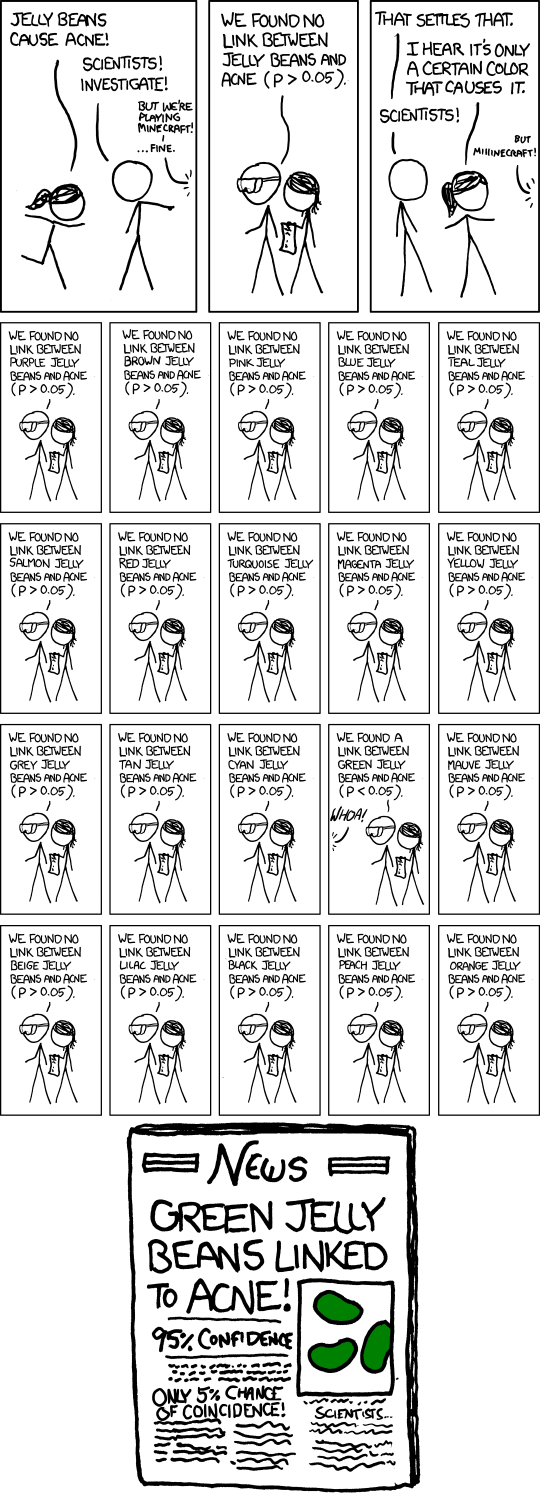
First, even legitimate medical claims have a much lower margin of error for false positives, or p-value, than do natural sciences research. 5 percen vs. 0.01 percent is huge indeed.

But, that's secondary to the huge nature of the fraud, and the second half of the header for this post.

Scientism is obvious to those who know about.

For those who don't, it's a bit of hyperrationalism that says almost everything in your, my and Horatio's universe is understandable by scientific investigation. Some Gnu Atheists engage in it, notably Sam Harris. Some "professional skeptics" at least skirt its edges.

Other "professional skeptics," along with some scientists, don't go that far but are bad enough.

For them, Science with a capital-S is put forth instead of science.

I use the capital-S Science for a Platonic Idea of science, if you will. The professional skeptics and some scientists claim that science is not only the best endeavor of the human mind, but that it's on a plane all by itself. In situations such as the above, though, they're stuck. Was Das never a scientist? Or, rather, a Scientist? Like a lapsed Christian, was he once a Scientist, only to become a heretic?

And here, though Science doesn't have exactly the same take on scientific research as does scientism, the end result ... idealizing science some way, and even as a quasi-belief system, is the same.

The reality? Science is no less a human endeavor and no more one, as far as ethics of its practitioners, than any other. Beyond the laughable but mild problems of Gnu-style atheists, we've seen Nazi and Japanese medical experimentation, Soviet Lamarckianism at the hands of Lysenko and much more.

The idea of rational, ethical, human behavior is one we hope for in fields outside of science, anyway. We shouldn't expect science to do better at it than we do other fields.

July 23, 2011

Science, scientism, skepticism, atheism, ethics

I'd been meaning to write a post like this for some time. Various issues within the worlds of science, philosophy, skepticism (which has a foot in both science and philosophy) and related issues have finally nudged me forward.

The first biggie was Sam Harris' "The Moral Landscape." I was pleasantly surprised when philosopher Massimo Pigliucci's review on Amazon largely agreed with mine in not only noting that Harris didn't have a good handle on morals and ethics issues in general, but also engaged in thought processes that rightfully could be called scientism.

Then, having read P.Z. Myers (he denies it, but Bob Carroll has a similar take on P.Z.) and Vic Stenger, amongst so-called Gnu Atheists, at least halfway claim to have proved the nonexistence of god, led me a bit further forward in this direction.

Add in the fact that, on a few recent posts on Skepticblog, some commenters there don't get, or else choose to ignore, the difference between empirical evidence for/against a particular idea of god vs. philosophical issues about what versions of a deity might logically be able to exist, and the issue grows.

Add in that a Michael Shermer post about SETI adds to what I see as one problem with many of its most ardent boosters: a quasi-religious faith that extraterrestrial life must exist.

Finally, some browsing on Amazon today, where a couple of reviews of a couple of books, bring back to mind claims that fundamentalist Christians make about horrific atheist murderers, i.e., Hitler, Stalin, Mao, and atheists, especially but not just Gnu Atheists, claiming that none of that terrible trio were atheists.

Well, now that I've laid all that out, here's where my thoughts go.

I'm going to tackle issues of religious belief, or lack thereof, and morality.

First, the "terrible trio."

Hitler? Yes, we know that he had a Catholic background and upbringing. What his adult religious beliefs are, we don't know. He cozied up to the Catholic church enough to get it to cozy up to him, while yet, early in his reign, ignoring it when he euthanized the mentally handicapped and others. So, let's bracket him.

Stalin? Yes, he went to an Orthdox seminary as a juvenile. So what. John Loftus went to a seminary. So did I. By this weak argument of atheists, John and I are both still Christians. Fact of the matter is, Stalin actively clamped down on Christianity in the Soviet Union, and otherwise gives clear indications of being an atheist. Beyond that, as Wikipedia notes in its article on Marxism and religion, the USSR was officially atheist.

Mao? We still don't know a lot about his personal life, but he gives no indication of being religious in any way.

As for studies which show that fundamentalist and evangelical Christians divorce as much as atheists in particular or nonreligious in general, that's also true. Two observations, though. Details below the fold.


June 19, 2011

Science news: Unemotional #Botox? Internet addiction?

It's becoming recognized that Botox's facial wrinkle elimination also cuts down on users' facial expressions. Does that, in turn, cut down on users' abilities to empathize with others' emotions and expressions?

Initial research says yes.

The "gorilla unawareness" problem with focused human psychology is well known. But, can we also miss real-life situations, not just staged ones?

Again, initial research says yes.

It turns out people focused on some compelling issue can miss something as serious as an assault on a city street.
Psychologist Ira Hyman of Western Washington University in Bellingham says the new findings illustrate people’s tendency to overestimate their awareness of immediate surroundings. “We don’t yet know how strong this illusion is,” Hyman says.
Stay tuned on this one.

Meanwhile, speaking of psychology, traditional ideas of free will may be taking yet another hit.

Did "the bacteria made me do it" sound real? Maybe it should. After all, it's well known what the parasite that causes toxoplasmosis can do to cats.

Internet "addiction," or actual addiction? Now, while "process" addictions are different from chemical ones, and some people prefer the term "compulsion," they're still real. And, the fact that the Net, with heavy enough usage, can "rewire" at least younger brains, says there is cause for ... at least some concern, right?

April 06, 2011

Why you can't really trust medical studies

From XKCD, the lowdown on medical studies, with their 5 percent p values (compared to natural sciences, with their 0.01 percent values:

Is there a p-value for Ronald Reagan making erroneous statements after eating Jelly Belly jelly beans?

Note Pane 5, Line 5.

March 03, 2011

The opposite of "scientism" is???

I have had no problem labeling the thought processes of people like P.Z. Myers and Sam Harris with the tag of "scientism" at times when it was clear they were trying to address nonscientific issues from a scientific point of view. Especially with Harris, allegedly a philosopher because he has a degree in the subject, it's frustrating, off-putting, undercuts the "cause" of secularism and more.

Philosopher Massimo Pigliucci also has no problem pegging people like that.

So, it's a bit disconcerting when he says social science research into people's moral judgment thinking not only is not philosophy, but that it can't even lead to philosophy, in his perspective.

And, so, I ask, the opposite of scientism, in this case, is ...

"Philosophism"?

His argument, in a nutshell, is in a comment of his near the end of the comment thread:
Similarly, we evolved the ability to make moral judgment, but that doesn't begin to equip us for professional-level moral reasoning ...
I saw "professional-level moral reasoning," which I inadvertently shortened to "professional moral reasoning" (though I don't think that significantly changed anything) and ... well, I cringed.

It's like Massimo wants to do data-free, research-free philosophy. And, even if (I'm not going to say "even though") he may not have meant it in an elitist way, it sure comes off that way, which is the main reason I cringed.

January 13, 2011

Science briefs - mitochondria and prions, climate change, more

So, mitochondria are implicated in prion formation, which then may have connections to the aging process. This sounds like news that's going to unfold for years to come, no pun intended.

A millennium of climate change ahead? That's what one new computer model says. Egads. A millennium of denialism, too?

One test to determine pre-conception more than 400 childhood diseases? Exciting, but, yes, with a huge psychological burden.