SocraticGadfly: Abbey (Ed)
Showing posts with label Abbey (Ed). Show all posts

May 20, 2025

Cactus Ed Abbey would cringe at the DFW Metroplex

The fact that Metromess exurb Princeton is over 35,000 people shows in a nutshell all the manifold things wrong with much of modern Merikkka. Cactus Ed Abbey was 127 percent right with "growth for growth's sake is the theology of the cancer cell." 

Mushrooming suburbs are bad enough. Mushrooming exurbs are horrible.

Next comes demands for widened highways so these people can commute to Wylie, Allen, Mesquite, Rockwall or wherever they should live.

Then comes the bitching when other folks move out to exurbia after them and they find out they can't pull the ladder up behind them.

After that comes the bitching when their formerly small-town school district gets overwhelmed and needs new buildings, but Joe and Jane Exurb won't vote for a bond issue.

Next comes the cringe when the school district deteriorates because of vouchers, courtesy of the Gov. Strangeabbott and Lite Gov. Dannie Goeb they voted for.

Princeton in specific? I remember, per Wiki, when it was a wide spot in the road of 3K people. That said, it looks like the escapees aren't so White as the long-ago population.

Shit, I remember when McKinney was a small town and Melissa and Anna were wide spots in the road.

June 12, 2024

RIP Jim Stiles and good riddance to your cult fanbois

Via a commenter on High Country News' Facebook page, on its story about a Moab developer planning (and now putting on hold) a new development named after Ed Abbey characters from The Monkey Wrench Gang (my take) ...

I heard the news about Stiles, long-time publisher of The Canyon Country Zephyr. His obit, on its website.

A few interesting thoughts, from that obit, and many more after that.

First, he was a true Cactus Ed groupie, if he moved to the Moab area after a friend of his dad gave him a copy of Desert Solitaire.

Second, why did he move to Coldwater, Kansas, of all places? Obit doesn't say. It does say he was born in Louisville, Kentucky. For the unknowing, Coldwater is a far more godforsaken place, at least to the Western White person's eyes, than Moab, and less scenic, too. It's about 100 miles west southwest of Wichita, Kansas, where the mixed-grass prairie changes to shortgrass. It's been eons, but I've been through there, Ashland, Protection, and all around on US 160, as well as US 54, US 400 (the old KS 96), etc. It's under 1,000 people; its whole county, which borders Oklahoma just east of the Panhandle, is under 2,000. It's a town of a bunch of old White farmers, average age over 55.

Third, this ties to the Zephyr. Good old Jim moved to Coldwater BACK IN 2011! In other words, per a Gannett, a Cherry Road, or some other "hollowing out" newspaper company, he was publishing the Zephyr remotely for THIRTEEN YEARS. What a fraud.

Indeed, it may be MORE than 13 years. I quote from this High Country News piece about Stiles in 2006:

We have been on a daylong memory-lane tour that’s a show-and-tell for Stiles’ first book, Brave New West: When Worlds Collide in Moab, Utah, which is under contract from the University of Arizona Press. The book ties together 30 years of experience and observation into what Stiles calls “a chronicle of Moab’s demise.” It is, truth be told, more a chronicle of his love affair with the town. ... 
To Stiles, [Abbey's] trailer’s fate is just another example of all that has gone wrong in the Moab area since Abbey came and went. In fact, three decades after having a “this-is-the-place-I’m-going-to-call-home-the-rest-of-my-life” epiphany, Stiles has pulled up stakes and moved to another town. 
But he hasn’t fled Canyon Country (he asked that I not reveal his new town) and he sure as hell isn’t backing down with The Zephyr. After 17 years of publishing, during which time he has tackled almost every imaginable issue in this poster-child region of the New West, he has found himself in a heated in-print brouhaha with the environmental movement. Specifically, he’s wrestling with the Southern Utah Wilderness Alliance (SUWA) — a group he once championed with enthusiasm. The resulting fracas has been downright ugly.

So, he had apparently left Moab by then, even if not yet moved to Coldwater, Kansas, and yet kept pontificating for 20 years? In other words, if he started it in 1989, and moved, in let's say, 2004 for some round numbers, that's publishing the Zephyr for 15 years while in Moab and 20 years while not.

(I am curious where he was at from 2006, or earlier, however much earlier, wherever in Canyon Country it was. Paradise? Tropic? Escalante? Or, if his bromance and boner for Mormons had already started then — Monticello? Blanding? Bluff? And why Coldwater? He was born in Louisville, Kentucky.)

Per one person in comments at his "official" obit, which will probably become about as hagiographized as Abbey's, I don't know what will happen to the Zephyr; obviously, if said person wrote a check, and made it out to Stiles personally, it gets returned. But, what if it was made out to the Zephyr?

Per another commenter there, and its online masthead on its homepage, who is running it now? Has it been a semi-ghost ship since the end of 2022? As that commenter noted, to the degree it had comment since 2022, it was a one-man band. And, much of that, per the commenter, in 2023 and early 2024, was recycled old material. (Apparently nobody's running it. Stiles' obit is the top item on the page, and the latest dated. RIP Zephyr.)

It's funny, even the world population clock below Stiles' mug is antiquated. As of the time I started working on this on May 18, it was still below 8 billion, whereas all reputable sites will tell you we've already passed that, by more than 150 million.

And, re the cult of Abbey? The Zephyr's Facebook page is now "fans of," and Stiles gave some insiders admin privileges before he died. It's clear a cult of Stiles will continue to mushroom, like mushrooms do, under a dark pile of shit.

As I said there, per the link up top about the development in Moab, it's too bad a Chuck Bowden isn't still alive to take the last measure of Stiles the way he did of Abbey.

That said, per the post making that announcement? This steaming pile of shit: 

Prior to his passing, Jim Stiles gave admin privileges on this page to a number of his close associates, with the hope that we would keep the page alive and dynamic. His articles going back decades still have great relevance to current events, and in light of the disheartening conflicts over Western lands, his wisdom seems timeless. There is currently a push to create a new national monument that would gobble up beautiful and resource rich lands in western Colorado. 
Stiles' research uncovered many disturbing details about the genesis of the Bears Ears National Monument which was imposed on San Juan County, Utah--against the will of the local people--by the Obama administration in January of 2017. To a large degree the Bears Ears movement was inspired and funded by Swiss billionaire, Hansjorg Wyss. 
It appears that Wyss' is involved with the "Monuments for All" coalition, now pushing the creation of the "Dolores National Monument" which is also vehemently opposed by those who live and work within its proposed boundaries. 
Below is but one of Stiles' numerous articles detailing the involvement of the Swiss billionaire's meddling in western lands issues. If you visit the Zephyr website and type "Hansjorg Wyss" into the search field, you will find many relevant articles.

Which got this response:

Good fucking doorknob. So, the "friends of Stiles" are conspiracy theory wingnuts who support extractive industries (uranium) and (like Stiles himself to fair degree) don't give a rat's ass about actual American Indians? Got it.

Beyond that? I've seen enough on Twitter to know that Hansjorg Wyss is kind of the new George Soros to wingnuts.

Nuff said for now, til we get to some old blog posts by me.

Oh, per that page? This 2020 article about romancing the way of the cowboy? Big ag cowboying today ain't no romance, but, on the Colorado Plateau, it is an extractive industry as well.

OK, now to my old blogging about him.

First, in 2008, at the start of the Great Recession, he was talking about "what America needs." TL/DR? A return to Eisenhower's America. Left unsaid? That America had good White people behind the white picket fences and everybody else was supposed to know their place. Coldwater, Kansas was about right as his final stopping place. That said, not all of it was bad. On the third hand, that Cowboy Bob piece also reflected his Eisenhower America mindset. And, yea, Jim, it IS "welfare ranching" with below-market BLM lease rates compared to what private land charges in the same area. Ditto to your Mormon blowhard friends. More on that immediately below.

Second, a decade later, in 2018, I called him at least half a blowhard. I left open the possibility of full blowhard. I'll split the difference now and call him three-quarters blowhard, specifically because he was already 100 percent full of shit back then about Bears' Ears, as well as being half full of shit about the recreational economy. Per Bears' Ears, and his comments then on its name? He was at a minimum hiding in a Whites-only enclave, and at a maximum, albeit with a different target, as much a racist as Abbey, per my response above to his groupies. (That includes, per the end of that piece, his becoming a Mormon propagandist. That, in turn, explains the flunkies/groupies/fanbois/cultists above.)

Third, in part in response that that, I blogged myself about the creation of Bears' Ears and the Trumpian reversal. As far as Friends of Cedar Mesa selling private tours? Maybe Stiles' Mormon friends were afraid that would interrupt their illegal pothunting, assuming some of them still do it. In his Cowboy Bob piece, he claims the feds are the biggest pot destroyers while claiming the Mormons were just innocents from a century earlier.

From the Cowboy Bob piece:

More than a century ago, when Mormon pioneers first settled parts of southeast Utah, they found these artifacts, thousands of them, abandoned hundreds of years ago, by ancient Native Americans. They found pots and projectile points and burden baskets, metates and manos, and the still intact remnants of their homes. The Mormons, exiles themselves, gathered the artifacts up and they took them home. They were beautiful, no one else seemed to want them, and it seemed to them logical to get them out of the weather. Most thought they were doing something good. Universities even hired the locals to lead archaeologists to the better sites.

Bullshit, refudiated by David Roberts and friends of his like Winston Hurst, who probably didn't color the pages of the Zephyr. (A search has Roberts only showing up once, in a sidebar reference to his Everett Reuss book. Hurst is even more briefly mentioned in one piece.)

Frankly, that was when I lost most remaining respect for him. I guess he forgot to get the new Mormon temple in Coldwater built before he died.

Further confirming my take on this? In my googling about Stiles, I saw an r/Moab subreddit with discussion of this. I posted a link to the 2006 HCN piece and said I considered him a fraud. The next morning, I discovered the moderator, a guy named ReaganCheese (with St. Ronald of Reagan icon, not your standard Reddit kit, showing the groupie this guy is), not only made some Dum Fuq response, but also gave me a flair called "Jim Stiles cucked me." Unfortunately, I hit the block on him before I posted my final edits to my response to him. And, unfortunately, since I blocked him, I don't see a way of reporting him, which I should have done first. I eventually figured out a way to do that, that may have gone to Reddit rather than him as moderator of the Moab site, and that's enough time wasted.

Of additional interest? Despite me telling Jeff St. Clair about it, no Stiles obit at Counterpunch. Nor has St. Clair managed to work in a satirical piece by me about Abbey, Stiles and Bates Wilson — despite saying it was in the hopper. And, St. Clair dropped an occasional piece for HCN in pre-2006 days, as did Stiles.

July 25, 2022

Aridzona still refuses to face water reality


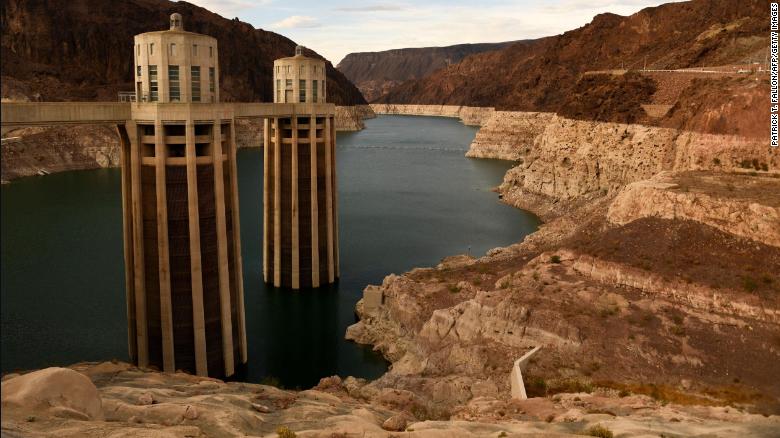
A year ago, I blogged about the first water cuts the Bureau of Reclamation announced for the Lower Colorado River states of Arizona, Nevada and California — and on this first round, mainly Aridzona, somewhat Nevada and not really California. Above, a drying Lake Powell, surrounded by summer-angry redrock, sits behind Glen Canyon Dam. That was about a decade ago, and the "bathtub ring" both there and at Lake Mead behind Hoover Dam have only gotten worse since then.

At that time, the feds announced that Lake Mead had fallen below the level to trigger the first round of water usage cuts next year. Within the three Lower Basin states (Google, and/or click the Wiki link, if you don't understand the Colorado River Compact), for a variety of reasons, the cuts hit Aridzona much more than Nevada. They don't hit California at all, though the next round, if triggered, will hit all three states. 

Meanwhile? Early predictions for US winter weather said that drought would remain and that the lower half of the West will also have dry weather, and these have panned out. Those 2023 cuts WILL happen. BuRec all but said so last month. I blogged about that here.

(Update: BuRec has indeed now dropped what I called a "semi-hammer." But, it's not a full hammer, or even that close. The question is, here, should it have been a full hammer? Will Aridzona continue to be scofflaws, so to speak? Will not dropping a full hammer make their intransigence even worse as the clock ticks to the 2026 expiration of the Compact?)

The first cuts looked to hit ag first.

But, what about urban water? The Aridzona Lege, several years ago, required new residential developments to prove they had a 100-year sustainable water supply. But, the language is loophole-ridden and is as much Jell-O as the Paris climate accords (which were similarly deliberately made so by Dear Leader and Xi Jinping). But, what about water banking? Well, Nevada (I think) is claiming that it's OK in part due to water banking. But, what if, in reality, such an account is already overdrawn? This is not like the federal government budget deficit, where you ignore it, or print more simollians if you have to. There is no more water to "print."

In addition, as of a couple of years ago, at least, it seems Aridzona did not have any withdrawal structure for water banked from the CAP. Since some of that water was banked for the state of Nevada? Erm, see above! In addition, per this piece, water banking was started for two reasons: one, as is true with most things Aridzona and water, as a reaction to those damned water-greedy Californians. Second, it was foisted as an idea for interstate water-banking and resale, as in, "we'll give those water-greedy Californians water if they pay us enough." But, it's hard to do that one, too, if you don't have a good mechanism for withdrawing water from the bank. See above! (The Wiki link also has thumbnail information on Aridzona's history of water animosity toward California.)
 
Robert Glennon, the University of Arizona prof who wrote the Conversation piece, agrees with me that cities and developers likely aren't yet going to smell the coffee.

More proof? This piece from the New Yorker, about Rio Verde Foothills, which bills itself as "North Scottsdale." It's sad and disgusting and schadenfreude all three.

  • People drilling 1,000-foot water wells — and hitting dry holes.
  • Others, who have been getting water delivered to underground cisterns, getting cut off. The city of Phoenix cut off deliveries to New River in 2018. And Scottsdale is cutting off Rio Verde Foothills next year.
  • Meanwhile, MOAR HOUSES are being built. One loophole in that 100-year requirement? Applies to developments of five or more houses. So, developers submit four-house systems, get them approved by county commission, and do the same two weeks later, lather, rinse, repeat.
  • Some homeowners want to start a Domestic Water Improvement District. To others? That's GUMMINT! Might TAX US! So, they want to have an upgraded agreement with a private water hauler. One problem? Only a water district, not a private hauler, can buy "second tier" water.
  • Meanwhile, MOAR HOUSES are being built. 
 
Per Ed Abbey's "growth for growth sake is the theology of the cancer cell"? On the other side of Phoenix, Maricopa, now an exurb of upper-middle-class white flight (Pinal County was about 55-45 Dem in the late 1990s, now 55-45 Republican) is 70,000 and mushrooming. Didn't even exist 20 years ago. 
 
==
 
For an excellent in-depth look at the long-term problem and possible "solutions" (which will NOT revert us back to pre-2000 status), and which take into account the full Law of the River, see this Science mag study. (Hell will freeze over or Ed Abbey will rise from the dead before that much in the way of cuts happens without heavy federal intervention, likely coupled with massive state-vs-state lawsuits, launched by the Aridzona whose obstructiveness put it behind the Colorado River 8-ball decades ago in the first place.)

August 17, 2021

Lake Mead water cuts invite Aridzona to face climate change reality; will it actually do so?

The question, of course, is, will it?

Yesterday, the feds announced that Lake Mead had fallen below the level to trigger the first round of water usage cuts next year. Within the three Lower Basin states (Google, and/or click the Wiki link, if you don't understand the Colorado River Compact), for a variety of reasons, the cuts hit Aridzona much more than Nevada. They don't hit California at all, though the next round, if triggered (the story is almost certainly correct that the next round WILL be triggered in just two more year), will hit all three states. 

(Update: Early predictions for US winter weather confirm that drought will remain and that the lower half of the West will also have dry weather. Those 2023 cuts WILL happen.)

(Update: As this piece at The Conversation reminds, canyons like the Black Canyon that holds Lake Mead, or the Glen Canyon of Lake Powell, narrow more and more as you get lower and lower, meaning that each additional foot of drop in elevation cuts water more than if you just had vertical square sides.)

The cuts on the lower Colorado start Jan. 1, 2022. Nevada must cut 7 percent, though it says it's already prepared. Aridzona must cut 18 percent. YES, you read that right.

Most of it will come out of the hide of agriculture, which makes the expansion of mega-dairies in Aridzona yet more problematic. Depleting groundwater for dairy cows and/or their alfalfa feed is beyond stupid.

But, what about urban water? The Aridzona Lege, several years ago, required new residential developments to prove they had a 100-year sustainable water supply. But, the language is loophole-ridden and is as much Jell-O as the Paris climate accords (which were similarly deliberately made so by Dear Leader and Xi Jinping). But, what about water banking? Well, Nevada (I think) is claiming that it's OK in part due to water banking. But, what if, in reality, such an account is already overdrawn? This is not like the federal government budget deficit, where you ignore it, or print more simollians if you have to. There is no more water to "print."

In addition, as of a couple of years ago, at least, it seems Aridzona did not have any withdrawal structure for water banked from the CAP. Since some of that water was banked for the state of Nevada? Erm, see above! In addition, per this piece, water banking was started for two reasons: one, as is true with most things Aridzona and water, as a reaction to those damned water-greedy Californians. Second, it was foisted as an idea for interstate water-banking and resale, as in, "we'll give those water-greedy Californians water if they pay us enough." But, it's hard to do that one, too, if you don't have a good mechanism for withdrawing water from the bank. See above! (The Wiki link also has thumbnail information on Aridzona's history of water animosity toward California.)
 
Robert Glennon, the University of Arizona prof who wrote the Conversation piece, agrees with me that cities and developers likely aren't yet going to smell the coffee.

Being ignored in this is how this affects hydroelectric generation. Mead has had new lower-elevation turbines installed in its penstocks which PARTIALLY alleviate the reduction in generation from a lower, lighter, lesser water load. But, it can't totally address that, and that's a one-time fix; if the lake falls to 950 feet elevation, it's near enough to "dead pool" to be a write-off. Per Glennon, the shape of canyons on water loss is a hydroelectric as well as a water issue, of course.

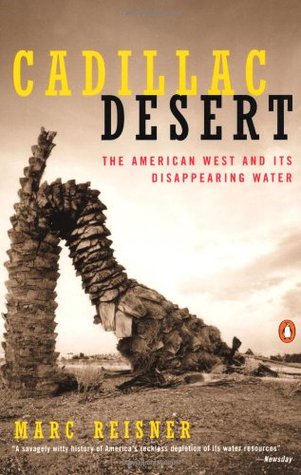
In essence, all of this above is part of Aridzonans wanting to continue to live in a "Cadillac Desert."

And, yes, I'm referencing Marc Reisner's book, which I own and have read cover to cover half a dozen times. (Reisner was good, as part of this, at tackling the socialism [no other word for it] that is the reality on Western water, and other thing, behind the myth of Western "rugged individualists.") As well as Donald Worster's "Rivers of Empire," which was able to pick up the climate change portion of the ball from where Reisner left it after his untimely death. And, the most recent installation in this on my shelves is James Powell's "Dead Pool," speaking of that subject. (Meanwhile, commenters at Glennon's piece are a mix of uninformed and delusional, mentioning things like pumping water from the Mississippi that Reisner already discussed 30-plus years ago, largely as wet dreams of hydrologist engineers with no connection to fiscal reality.)

And, with that, Glen Canyon Institute's proposal to reverse an atrocity, to "fill Mead first" and let Lake Powell essentially go away, seems to make sense. That said, what if water drops below outlet level there? How much does it cost to blow a hole in the dam, or the lesser option of "blowing multiple holes" in it by creation of new outlet tunnels? What about silt removal? (Powell did some initial looks at that.)
 
Related to that, Glennon reminds us of one other thing. Upper Basin states are required, by the Compact, to provide X acre-feet per year (on a 10-year rolling average, to be precise) to the lower basin. So dams of tributaries above Powell, like Flaming Gorge Reservoir, will be opening their penstocks wider and wider in the future.

And, this is only scratching the surface. Reisner discussed one other issue that has plagued irrigation-based civilizations throughout history — salinization. Especially if the rivers one uses for irrigation projects run through land with high salinity levels, also especially if irrigation canals are not carefully engineered with precise and even "drops," as in, say, 1/4 inch per foot, soil salinity builds up. Leaching is one tool to "flush" salinity from soil, when used with drainage, but ... it requires extra water beyond normal irrigation. Oops, that's not so available.

It's why, before Columbian, or Coronadan, contact, the Hohokam abandoned their canals in the Valley of the Sun. It's why a massive desal plant was built near the junction of the Colorado and Gila rivers. It's why clay 

We end with, what else? Two quotes from Cactus Ed Abbey:

"The desert always wins."

And:

"Growth for growth's sake is the theology of the cancer cell." 

November 02, 2018

Bears Ears — the controversy and concern

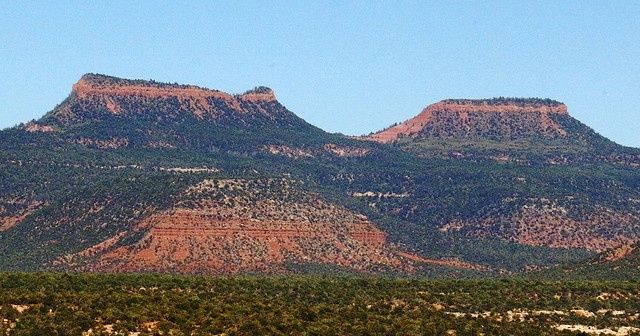
Bears Ears from Natural Bridges

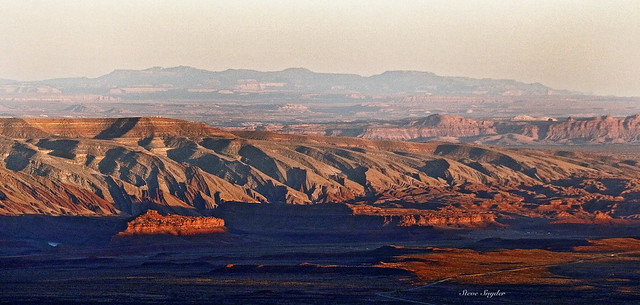
I have seen Bears Ears many a time — after all, they're visible from as far as 90 miles away in southeast Utah. I've seen them from the edge of Canyonlands. From the Abajos. From Natural Bridges. From the Moki Dugway. From Canyon of the Ancients in Colorado. From Garden of the Gods. From Monument Valley in Arizona.

Moki Dugway 1

But, I'd never driven the road up to them.

Which I rectified on my most recent vacation.

President Barack Obama's creation of Bears Ears National Monument, blogged about by me, President Donald Trump's downsizing that and splitting it into two units, the non-contiguous Shash Jáa in the south and Indian Creek in the north units, the former including the actual Bears Ears. And, Trump may be playing politics with the name for the new, and hopefully temporary by legal ruling first unit, as noted in the Salt Lake Tribune. (And I am SHOCKED that Interior Secretary chief hack Ryan Zinke, an even bigger Lyin Ryan than outgoing Speaker of the House Paul Ryan, lied about the renaming. (There's a good GIF map there of various proposals for the size of the area and the designation, whether national monument or not; by size, Obama's action is very close to what Utah's own Congresscritters Jason Chaffetz and Rob Bishop proposed, though without national monument designation.

Very worth a read: A new National Geographic article on Bears Ears and related issues.

Given things in Moab and in and around Arches National Park, I also get the concerns the likes of Jim Stiles had that the monument would bring an avalanche of recreational tourism. But, I think that's way overblown, as I've said before.

First, that has not happened in a Moab-like way in the Grand Staircase-Escalante area. There have been a few complaints that Escalante itself has gotten too tourist-dependent on some of its businesses, but from what I read about that recently in High Country News, it's nowhere near a Moab-type problem. (Beyond that, nothing's stopping Mormons in Southern Utah from ramping up heritage tourism.)

Second, there's a finite amount of both recreation time and dollars.

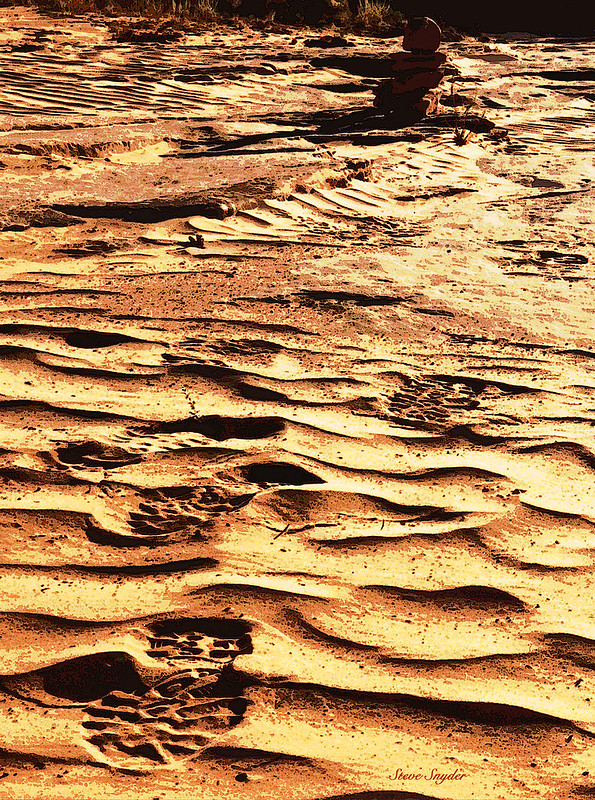
Grand Gulch-footprints stylized
Take only memories, leave only footprints, is very true in Grand Gulch.
Third, Bears Ears, like GSE, is more off the beaten path.

Stiles has recounted decades-old patrolling of that area by the BLM with presumed military surplus helicopters. Nobody wants that noise today. But, national monument designation might have led to drone patrols that wouldn't happen otherwise, among other things.

Beyond that, the Geographic story notes another concern. With digital cameras, and even more, smartphone cameras, geotagging photos, it becomes easy for more and more people to visit back-country ruins. Even if not vandals or for-profit thieves, they may still steal potsherds or masonry stones, or otherwise disturb the provenance of a site.

This:
“The strategy of leaving it alone and trying to keep it a secret is unsustainable,” says Josh Ewing, executive director of Friends of Cedar Mesa, a conservation group.
Sums it up.

I know Stiles rightly questions Friends of Cedar Mesa's old plans to sell guided tours of the monument's backlands. Fine, but here's a better idea than chucking that entirely. Cut the price on such tours to more reasonable levels, and have the tribes involved with monument management, not Friends of Cedar Mesa, run them.

Fines from lawbreaking, especially on violating antiquities, could have a cut go to the tribes, too.

Beyond that, Stiles has now graduated from being an Ed Abbey quasi-propagandist to a full-on Mormon propagandist, in my opinion. When he says that Mormons have not only been persecuted as bad as American Indians but also indicated that said persecution of Mormons had just as little justification, it's hard to take anything he says about anything without HUGE grains of salt, if he doesn't post a URL for me to read through and make my own determination of his interpretations.

Other thoughts:

Per that Tribune link, the Navajos' link to Bears' Ears is the most tenuous, and may come close to the cultural appropriation that marks much of Navajo religion. (All religions have degrees of cultural appropriation and syncretism, but very few on the level of the Navajo.)

For a plethora of petroglyph and ruins pictures from Cedar Mesa and elsewhere, go here, or to a blog post of Randy's here.

January 18, 2018

Jim Stiles, blowhard? Half blowhard? (updated)

The iconic Delicate Arch at Arches National Park. (Author photo)
Jim Stiles, proprietor of the Canyon Country Zephyr online newsmagazine, likes to portray himself as the intellectual heir to Cactus Ed Abbey. Maybe I should say "THE heir" to emphasize that. And, what led me to this blog post was seeing High Country News run a retrospective on the 50th anniversary of "Desert Solitare," Abbey's memoir, environmental manifesto and quasi-anarchist screed about his years of seasonal ranger service at Arches National Monument, today a national park. I checked the Zephyr, which I sometimes like as a tweaker of the more mainstream HCN, to see if Stiles had something similar up, and he didn't yet.

(Update, Feb. 9: Stiles doesn't have anything specific to the 50th in his new February-March issue, either.)

Among his heirship angles is attacking eco-tourism as wrecking Moab, Utah in particular and the American West in general.

I'm no defender of swapping the single-industry mining or logging nature of many Western towns for one of tourism. And, per that link just above, Stiles is half right, maybe more. But, to say that eco-tourism has caused the problem is itself bullshit. I told High Country News the same when it wrote a semi-puff piece about Moab's retiring mayor, Dave Sakrison. And I'll say the same now, on this updating, about Stiles reprinting a semi-puff piece about a former Grand County commissioner Bill Heddon.

Western small towns and counties, unless forbidden by state law, can ameliorate this issues with eco-tourism (or the stagnant wages of extractive economies on the decline) by:
1. Increasing the local minimum wage
2. Getting developers to build affordable housing, including through either the carrot of subsidies or the stick of requiring it as part of a larger development.

Stiles mentions neither of those. (Moab's mayor never mentioned trying to get the rest of the city council to sign off on such, either.)

That's not all. Other actions could include:
3. Funding for other things to broaden the local economy done via an increased hotel-motel tax, which would primarily tag high-end tourism.
4. Getting the nearest recreationally developed federal area to work better to promote local attractions and events.
5. Getting counties to adopt county zoning policies outside of city limits.

Stiles' ERMIGOD GREEN TOURISM reached shitstorm level over the creation of Bears Ears National Monument. With Trump's (will it stand?) downsizing of BENM, Stiles reiterates claims that national monument designation involved no additional protection, gave American Indian tribes in the area no additional empowerment, and other things.

He's half-right on the first; the protection would have been even better were it to have been moved to the custody of the National Park Service.

But, he's not all right, and that's because he's all wet on No. 2. Jonny Thompson covered that by noting specifically:
A monument manager would be overseen by a commission, made up of one representative from each of the five tribes, and one each from the U.S. Forest Service, BLM and National Park Service. The tribes, collectively, would have the loudest voice in decision-making.
That's more than just "advisory," Jim.

Yes, most of the tribal powers with Bears Ears are advisory, not statutory. But not all of them.

He then ventures into Anglocentric stances from the top, when he claims:
For the purposes of this story I refer to the area of Grand Gulch and Cedar Mesa as “Bears Ears.” But please note that in the forty-seven years I’ve known and wandered southeast Utah, literally NOBODY ever referred to the region as ‘The Bears Ears”  until two years ago. That title is a piece of product packaging and marketing by mainstream environmental organizations and the outdoor recreation industry and has never been a name that meant anything more than the two buttes that lie along the southern edge of Elk Ridge…JS
Gee, Jim, maybe you should expand your circles.

First, what do Navajos, or Ute, or Hopi, call "Cedar Mesa"? Or "Grand Gulch"? We know what the Navajos call "Bears Ears," and that is "Bears Ears."

Second, and related, what do they call the entire area? (Stiles can positively invoke southwestern American Indians in other cases, but it seems as selective, and as personally motivated, as some gang green groups he likes to attack.)

Third, other national parks and monuments are named after just one portion of the territory. Saguaro National Park, which surely was not called "Saguaroland" 100-plus years ago, has more than just saguaros. Really, Jim, this is dumb shit.

Fourth, related to Point No. 2 on my first bullet points? Why not empower tribal cops for patrolling? Since this is outside any reservation, I presume that they could, as appropriately deputized, arrest Anglos, which SCOTUS says they can't on their reservations. The "Jim Chees" comment aside, Stiles in that piece, and per this HCN submission of his last year, seems conflicted or schizo in general about the idea of antiquities protection actually being put in place.

More seriously, Stiles' alternative idea for Bears Ears isn't all bad. But, more seriously, 500 BLM cops aren't going to enforce ARPA any more than now. So, let the tribes put 500 more cops in there, paid by the feds. Even with that, or even more, because of that, we're going to have a Bundyville. You'll need to make it 1,000. More thoughts below the fold.

October 31, 2017

Would an #IkeDike help Houston? Or be a big ripoff? Say #carbontax (updated)

Update, Oct. 31: In a "trick or treat," Gov. Abbott now wants $12 billion for an Ike Dike as part of a $61 billion federal bailout. Yeah, that word's about right, especially if Texas Congresscritters refuse to support a Manhattan Dike, since NYC is a lot more vulnerable to oceanic-related global warming effects than Houston is.

With a storm like the current Harvey, or the old Tropical Storm Allison, the answer is simply no, an "Ike Dike," first proposed after Hurricane Ike, would be of no help. Simply wouldn't. That's not only due to a Harvey primarily being a problem due to inland rain-induced flooding, not a storm surge, but that the surge that Harvey wound up generating on its final run was partially from within Galveston Bay, not being brought from the larger Gulf of Mexico INTO the bay. And, that will be true of other storms that run up the coast rather than coming in from offshore.

Yes, per one of the links that friend Brains posted on Twitter, A&M-Galveston is touting it. Of course they are — it's A&M, a fricking engineering school. And, with the Corps of Cadets centered on the main branch in College Station, it's the state's military school, too. That will tie in here in a minute.

Besides, contra AM-Galveston, there simply is no such newfangled post-Katrina item in New Orleans called the "Greater New Orleans Barrier." There is NO Wiki page for it and less than 200 Google hits. (Actually, less than 40 if you eliminate near-duplicates.) This is a fraudulent attempt to put a label on a nonexistent item, which is actually a group of post-Katrina cobbled-together upgrades, expansions and improvements to existing storm surge barriers.

It's also fraudulent to say that the Netherlands' work, designed to face North Sea gales with normal max 60 mph winds, and almost never above 75-80 mph, is the same as trying to block out a Category 5 hurricane. (The same is true for Venice's tidal gate system.)

Wrong, wrong, wrong.

It's also like the Army Corps of Engineers saying yet-higher levees is always the answer for Mississippi River floods, or some newer, higher dam, is always the answer for floods out west.

Per ProPublica, in Houston, city and Harris County officials need to focus on inland solutions — green spaces, permeable ground, and zoning — that are cheaper than dikes that will likely cost $10 billion, not $3 billion, that are hubristic, and that won't help inland flooding, either. And, it's no wonder that a leading private contractor (especially on military stuff) is also touting the so-called Ike Dike. This is the military-industrial complex gravy train at work. And, that same military-industrial complex was at work getting at least one Houston suburb to push for it. (On the "less than 200 Google hits," there's a number of Houston suburbs with city ordinances or similar city council agenda items like that.) Speaking of, the Corps' New Orleans-area work, per Wiki, has long been known to be laden with pork. And, the Corps' post-Katrina levees work, when Isaac came, moved flooding around more than anything else.

And, the Seabrook Floodgate, if that's what's meant, is nothing like a "Greater New Orleans Barrier."

And, again, an Ike Dike would be of ZERO effectiveness against inland, rain-induced flooding.

Something else that would be cheaper? Fixing, or even reversing if possible, ground subsidence.

And, leaders of Sun Belt megalopolises also need to read Ed Abbey (that's YOU, former mayor Annise Parker) and remember: "Growth for growth's sake is the theology of the cancer cell."

But, per my Houston vs Harvey blog post, Houstonians and Harris County voters keep electing "open for business" growth-only mayors, city councilmen, county judges and county commissioners. Your local answer needs to start with "vote the rascals out." And get the new people to fire city and county flood staff.

When President Obama took office, I said he should have used some of the Great Recession stimulus money to make new moves to Phoenix and Vegas go back to Cleveland, St. Louis or wherever as part of buying out underwater mortgages, before climate change made those cities essentially unlivable. To be honest, the same probably needs to happen in Houston, and New Orleans. Beyond all the problems mentioned above, both cities also face land subsidence from groundwater pumping that has turned them into giant bowls.

An Ike Dike as the semi-magic solution to these problems? It's what Evgeny Morozov calls "solutionism." It's what I've called here "salvific technologism." It's the stuff that makes Silicon Valley tech-neoliberals (as well as the military-industrial complex) salivate.

Folks in other places — Baton Rouge and parts of South Florida come to mind — are already at work on inland mitigation effects, including permeability, smart building, etc. Why won't greater Houston, and why shouldn't it?

==

As for cost? Kuff has numbers with higher estimates, depending on the project, than does Brains. And state Land Commish Pee Bush, per Vox, says $15M. They're still surely underestimates, once the military-industrial complex gets its hands on this. But, at least we are getting somewhat more serious.

Something else that would be cheaper and would help with flooding, though not a storm surge, is an underground conduit draining Addicks and Barker reservoirs straight to the Houston Ship Channel. It was first discussed 20 years ago. Even that would be less pricey than an Ike Dike, though it would still have the Corps involved.

And, neither Brains nor Kuff talk about the other costs, like environmental. How would this affect marine life? At the intersection of environment and business, how would this affect fishing and shrimping? Or simply business — how would this affect offshore oil exploration? (The channel would also have some environmental effect, though surely less than an Ike Dike.)

I mean, this IS the Corps of Engineers we're talking about, that is generally in neck-and-neck running with the Bureau of Recreation for among the most environmentally UNfriendly federal government agencies.

Even that reservoir conduit? It would be like the Mississippi River levees or moving around the New Orleans ones. A blast from it like Harvey's would probably tear up portions of the Houston Ship Channel unless IT was re-engineered. And, for how much?

An Ike Dike is a nice dream. No more than that. Per the above, probably not tremendously more realistic than an air-conditioned dome above all of Phoenix, or geoengineering the atmosphere with soot to try to reduce climate change.

And, if the real cost is $20 billion? Or even close? The only way I would consider paying for that is a national carbon tax, which the wingnuts who run Harris County, and the accommodators who run Houston, would never back.

And, per Ed Abbey and other things, were I the occupant of 1600 Pennsylvania Ave., I'd refuse to fund an Ike Dike without a carbon tax. AND, I wouldn't sign off without Emmett, Turner et al agreeing to ALSO do mainland mitigation work.

In other words, if I were president, Houston and Harris County would have to pass zoning ordinances before getting money.

This is no different than my supporting single-payer national health care only if cost controls are attached. (And that is why I want the US to adopt at least elements of a British-style NHS.)

==

This is nothing against Perry, nor against other bloggers on the Texas Progressives list. Per what he said about another blogger, he's in many ways like a brother from another mother, or at least a cousin from another aunt. And, I have other friends, including two college classmates, who also live in Houston.

But, this is also about what's right for the country, what's right for the environment and what's realistic. I mean, we already have a country with unmet infrastructure repairs, improvements and upgrades so crappy in some places, along with income inequality, that an MIT economist recently labeled the US a "developing country."

And, on "realistic" and environmentalism, the Corps of Engineers usually runs neck and neck with the Bureau of Reclamation for lack of environmental concern among federal construction-type agencies.

And finally, no, it's not "too soon" to write this.

August 28, 2017

Politics and #Harvey and no, not too soon

This is going to be a roundup of stuff I've posted on Facebook and Twitter, or seen others post.

Houstonians, if Mayor Sylvester Turner won't stand up to developers and if Harris County Judge Ed Emmett lets a climate change denier, Russ Poppe, run the county's flood control board, and Stephen Costello, Mayor Sylvester Turner's flood control czar for Houston, also appears to be a climate change denier, when are YOU going to vote YOUR bastard out of office.

(Note to climate deniers — for every 1 degree Fahrenheit of air temperature rise, the air can hold 4 percent more water vapor. And, for Harvey, Gulf air temps were 2 degrees above normal. Was all of that climate change? Surely not. Was some of it? Surely yes.)

Don't forget Ted Cruz and John Cornyn both opposed federal aid for New York and New Jersey after Superstorm / Hurricane Sandy but immediately had their hands out on Harvey.

Also, if you live in Houston, better file property damage claims by Sept. 1, unless Gov. Greg Abbott finds a way to legally delay a bill — which he won't try to do — that this year's regular session of the Texas Legislature passed that reduces the penalty insurers pay when they chisel you.

Per that link, feel free to shit on Kelly Hancock's Twitter and Facebook accounts.

Why? Insurers give GOP money and the evil trial lawyers give Democrats money.

Local, regional and state politicians all pushing an "open for business" model (some Dems, like Turner, as co-signers) that says yes to everything the development industry wants.

Donald Trump, Tweeting about the Mexico border wall and still insisting on the idea that Mexico would be somehow made to pay for it, during the middle of the hurricane.

Texas Republicans — including old college friends who I know are politically conservative — may say this is unfair.

Sorry, but ... if you voted for these people, no its not. (That said, Turner is a ConservaDem.)

That said, if you live in Harris County and voted for these people, just look around. Start with Houston and Harris County both not having zoning ordinances.

If you support that, then .... to be honest ...

You got what you voted for. (And, you had an "open for business" Democrat Annise Parker running Houston before Turner and another nutbar Republican, Bob Eckels, before Emmett.)

At the local and regional level, especially, you've had 12 years since Rita and 9 since Ike to vote your bastards out. And, you've had Perry, then Abbott, in Austin.

For more on the issues faced by Houston, and how both recent and older politics have contributed, read this collection of articles by the Chronicle.

And, if you voted for Trump?

Well new FEMA head Brock Long (maybe he's also a climate change denier) is also among the politically connected useless idiots:
“You could not draw this forecast up. You could not dream this forecast up.”
Bullshit. Not only do we have ProPublica/Texas Tribune document Houston and Harris County exacerbating flooding, we have, from a year ago, the New York Times Sunday Review with a fictional-for-now essay modeling a Hurricane Isaiah far stronger than this. 

In other words, per an old phrase, if you've been voting for these people, you have "reaped the whirlwind.)

Of course, along with the refusal to have permeable green spaces, as the toxicity of floodwaters likely increases, is a city that has struggled for years with sewer issues.


Meanwhile, Trumpster himself says the National Flood Insurance Program won't go broke over Harvey and won't get caught in debt ceiling politics. And with that, I already see what's coming — he's going to demand the debt ceiling get connected to NFIP funding. Resist. Better yet, Dems need to offer a bill JUST for funding it. Now. Pre-emptively.

Two final notes.

First, "Nature bats last."

Second, per Ed Abbey, "Growth for growth's sake is the theology of the cancer cell."

Per that, if you really think that Rita is the only example on evacuation, not Ike, and that there's no way to truly evacuate Houston, then guess what? You got too damned many people living there.

April 08, 2015

'The desert always wins': The last word on California drought

The quote above, whether most popularized by Cactus Ed, good old Ed Abbey, or someone else, is true indeed. indeed.

As Marc Reiser demonstrated in "Cadillac Desert," along with many others, some before, many since him, the Colorado River was highly overappropriated among its seven basin states because the 1920s were an outstandingly wet period within a larger wettish period. While Colorado River system water is not the same as the snowmelt from the Sierras that fills (Californians hope) in-state reservoirs, it too is snowmelt-based, with all that implies in our era of global warming, El Niño-related oceanic oscillation changes and more.

Let's not forget that the Los Angeles Aqueduct of "Chinatown" fame was built less than 20 years before the Colorado River Compact, also during a wet period. And, although the 1960s of California State Water Project fame were less wet than the 1920s, they were far wetter than today, or than long-term droughts we know hit the Southwest in the past and are likely to do again in the near future. And, while that megadrought is expected to center on the Four Corners, not California, it will have its "fair share" of effect on the Golden State. And, for students of paleo-American history, this drought is expected, at least in the Southwest, to be worse than the one that shuttered Chaco Canyon and destroyed Anazasi culture. In other words, anthropogenic climate change, while part of the problem, is not all the problem. Rather, it is, in part, intensifying what's more "normal" than European settlers thought, 100 years ago.

So, that leads to Abbey's most famous statement certified statement: "Growth for growth's sake is the theology of the cancer cell."

This NYTimes graphic, from the linked story about
groundwater regulation, shows the amount of sinkage
in many areas; the largest red dots have shown
more than 100 feet of sinking. See story for more.
And thus, the quasi-rhetorical, yet seriously asked, question in this long New York Times piece has but one answer: "no." Relentless growth has limits. There is no perpetual motion machine in general and certainly not with water supplies. Meanwhile, even as Jerry Brown has imposed water cuts (that don't affect agriculture, don't affect oil fracking and don't start until July 1), there's really a bigger scandal in California water issues: groundwater, unlike in most western states (but, unfortunately, very much like in Texas) is currently not regulated at all, and under a weak-tea system the state finally, recently, adopted, will not be semi-effectively regulated until the 2040s.

By that time, the groundwater may be almost gone, with storage capacity, flow, and more of reservoirs irreversibly damaged.

(In turn, this is part of why I said last week that Californians should recall Jerry Brown.)

Now, Reisner did not directly cover these issues. But he did indirectly cover them when he wrote about overpumping of the Ogallala Aquifer.

Having grown up in New Mexico, and been the editor of one newspaper in that state, I personally know this.

Most Western states have a state water engineer, who is god and czar of the state's water supply, with the partial exception of any rivers that come under interstate compacts.

For example, in New Mexico, at least at the time I was editing there, if a person wanted to drill a new water well, they had to run an ad in the newspaper three weeks straight, giving a precise metes-and-bounds description of the well's location AND its planned depth. At the end of said legal notice had to be a date for a public hearing about that well. The regional office of the state engineer conducted that hearing.

From what I understand, even if California does have a state engineer, said office has nothing like that regulatory power.

Meanwhile, fallowing of the fields could damage the fields themselves.

Reiser, whether the water source was irrigation or groundwater, wrote about improper irrigation and the salination problems it caused to land. As California farmers are having to fallow more land, the salinity problems are apparently starting to show up in places in the Central Valley.

Add in that the current drought is worsened by climate change, and many Californians' blithe belief that the state will "escape again," like it escaped Enron gaming its electricity nearly 15 years ago, is kind of appalling. It's also a proof that blue states aren't exempt from the delusion of American exceptionalism.

Abbey addressed that, too:
“There is no shortage of water in the desert but exactly the right amount, a perfect ratio of water to rock, water to sand, insuring that wide free open, generous spacing among plants and animals, homes and towns and cities, which makes the arid West so different from any other part of the nation. There is no lack of water here unless you try to establish a city where no city should be.”
So, Californians? (And, Arizonans, Nevadans, etc.?) It's time for a lot of you to move back to Minneapolis, or Cleveland, or St. Louis — where the water is.

And, speaking of Arizonans and Nevadans? Here's Part 1 and Part 2 of what's going to be a three-part series on drought in the Colorado River basin, from the Arizona Republic.

For those who think desalinization is the answer? In the Colorado River Basin, per that Part 2 link immediately above, maybe think again. In coastal California, even if the price drops a lot, and quickly, which is open to debate, you have the issue of thermal pollution from "wastewater" being dumped into a coldwater ocean current. The only plant currently under construction is only going to meet 7 percent of San Diego's needs, a drop in the bucket for overall California use. If desalinization in Florida is any indication, it will probably not run as well as expected, and be pricier than expected. (Right now, the San Diego project will deliver water at twice the current cost, and the same company that built that troubled Florida desal plant is doing the one in San Diego. It would probably be cheaper to move people back to the Midwest.)

Salvific technologism, as I've called it before, has no guarantees. Re-read those Abbey quotes.

December 18, 2011

#Islamofascism, #BigTobacco, #Hitchens as a-hole

A Big Tobacco poseur trying to blow smoke in our eyes?
With some parallels to Ed Abbey ....

After putting the last touches on my "the dark side of Hitchens" blog post, I got to thinking about 9/11, his being one of the first people to use the word "Islamofascism" and similar, and a newspaper column I wrote on the first anniversary of Sept. 11, 2001.

I tied those thoughts together with Christopher Hitchens' known smoking history, his claims to be standing up against totalitarianism throughout his life, and his attitudes toward control of smoking in public places, and knew I had another blog post to write, even if it further angered people who want to think of nothing other than Secular St. Christopher.

So, here goes, starting with a synopsis of that 2002 newspaper column.

In that column, while not minimizing 9/11, I reminded readers of how many other things in America, usually recurring situations whose lessening was a matter of public policy in general or public health policy in particular, killed the same amount of people as al Qaeda did on 9/11, albeit perhaps over a week's time, or a month's rather than a day's time.

For example, I said diabetes kills X people per month, and is at least controllable, especially with Type 2, through diet. I said traffic accidents killed about 50,000 per year, and that safer driving, driving with seat belts, and driving while sober could eliminate many of those deaths.

Finally, I said that cigarettes killed about as many people every two days as al-Qaeda did that one day. And then killed about as many more the next two days. And again, the next two, ad infinitum.

Well, there's no "Big Sugar," re diabetes, not really. And even a "Big Alcohol" possible role in DWI fatalities is small.

Big Tobacco? Quite different. Now, that column didn't go beyond this, because that wasn't its focus.

But, I am now doing so, and going to riff on Big Tobacco and some of the issues Hitchens claimed to fight for, or against.

My focus now is, not just on Big Tobacco per se, but how, via being a poseur for Big Tobacco, Hitchens was a liar about what he claimed to stand for.

No, not just morally or psychogically inconsistent. Not even contradicting himself in a Whitmanesque, multitudes-containing way.

But lying to himself (and to us), and, I believe, quite consciously, all while being an asshole, to get in the last part of the title. More below the fold.

September 29, 2010

Mother Nature monkey wrenches the Lower Colorado

True, it's Lake Mead, not Lake Powell, behind Hoover Dam, not Glen Canyon Dam, that's drying up, but ... it looks like the whole lower Colorado River Basin is getting a stiff blast of morning joe from Mother Nature, as water allocations are going to have to be trimmed back.

And, if the lower Colorado puts a "call" on Lake Mead, even if the upper basin isn't using all of its water, anti-Californianism in the Interior West could get hot and heated. True, it will actually be water latecomers Arizona and Nevada trying to save their desert-scurvy necks, but California will look like the ultimate water hog to places like Utah, Colorado and Wyoming.

Even scarier, if you're Las Vegas, especially? If Lake Mead falls another 25 feet, that may make the dam's turbines inoperative. No more cheap hydroelectric power for the glitzy Strip.

What was it Abbey said?

Oh, yeah: "The desert always wins."

October 07, 2008

Jim Stiles tells us what he thinks America needs

Gadfly Utah journalist Jim Stiles, with at least somewhat a claim to Ed Abbey’s mantle, gives us his take on what he’d tell the American public, were he elected president.

He says we need to stop buying so damned much on credit. He would subsidize affordable housing up to 1,500 square feet. He’d limit income tax deductions to just the first two children in a family.

And, that’s just for starters.

September 29, 2008

A tribute to Ed Abbey and 'Desert Solitaire'

ARCHES 1968

Written within the mindset, and through the eyes and viewpoint of, Ed Abbey, as a reflection on the 40th anniversary of “Desert Solitaire.”

Goddam people.
Goddam stupid people questions.
Get the goddam fuck out of MY ARCHES.
I ought to shoot you.
Or sic one of my snakes on you.
Or bury you
Beneath blown-up rubble
From a destroyed Glen Canyon Dam.

Ahh, juniper.
Growing twisted and crazy,
Just like me.
That’s why I like you,
You slow-growing, stubbornly living
Anarchic bastard like me.

Ohh, the desert stars,
With a trace of moon,
And no goddam people.
Just enough waxing moon
For a nighttime hike
Through Fiery Furnace,
Then back home —
The red rock home, not the trailer one —
To bask in fading heat.

Goddam, Bates!
What’s this talk?
A National Park now?
Wasn’t Canyonlands enough?
I guess not.
Did Proudhon write about Park envy?

Maybe we need to blow up some park roads
When we blow up that goddam dam.


Moab, Utah, gateway to Arches National Park, or the former Arches National Monument Munnymint of Ed Abbey’s “Desert Solitaire,” will be the sight of the Confluence Literary Festival Oct. 14-19. The “confluence” comes from the confluence of the Green and Colorado rivers in Canyonlands National Park, west and southwest of Moab and another favorite tramping ground of Abbey, given that Lake Powell almost laps at its southwest corner.

The conference will have some heavy Western literary hitters, including Doug Peacock, Abbey’s model for Hayduke in the “Monkey Wrench Gang,” official Abbey biographer Jack Loeffler, and Craig Childs.

Abbey wrote “Desert Solitaire” in 1968, based on his experiences as a seasonal ranger in Arches.

August 25, 2008

‘Desert Solitaire’ turns 50 in Moab

Moab, Utah, gateway to Arches National Park, or the former Arches National Monument Munnymint of Ed Abbey’s “Desert Solitaire,” will be the sight of the Confluence Literary Festival Oct. 14-19. The “confluence” comes from the confluence of the Green and Colorado rivers in Canyonlands National Park, west and southwest of Moab and another favorite tramping ground of Abbey, given that Lake Powell almost laps at its southwest corner.

The conference will have some heavy Western literary hitters, including Doug Peacock, Abbey’s model for Hayduke in the “Monkey Wrench Gang,” official Abbey biographer Jack Loeffler, and Craig Childs.

Abbey wrote “Desert Solitaire” in 1962, based on his experiences as a seasonal ranger in Arches.

Boy, if I could get off some additional vacation time!

February 12, 2008

Lake Mead could be dead in a dozen years — pop your champagne corks now

Lake Mead dry by 2021? Like Ed Abbey, were he still alive, I would soooo cry, NOT, if this actually happens:
What are the chances that Lake Mead, a key source of water for more than 22 million people in the Southwest, would ever go dry? A new study says it’s 50 percent by 2021 if warming continues and water use is not curtailed.

“We were stunned at the magnitude of the problem and how fast it was coming at us,” co-author Tim Barnett of the Scripps Institution of Oceanography said in a statement. “Make no mistake, this water problem is not a scientific abstraction, but rather one that will impact each and every one of us that live in the Southwest.”

“It's likely to mean real changes to how we live and do business in this region,” added co-author David Pierce, a Scripps climate scientist.

Oh, and if you think this is a worst-case scenario, the authors say, not at all:
The researchers also noted that their estimates are conservative — in other words, the water shortage is likely to be even more dire than they estimate. The conservative approach included basing their findings on:
• The premise that warming effects only started in 2007, though most experts consider human-caused warming to have likely started decades earlier.
• Averaging river flow over the past 100 years, even though it has dropped in recent decades.

If you allow for today’s waterflow and an earlier start to global warming, here’s what the results actually could be, they say:
• A 10 percent chance that Lake Mead could be dry by 2014.
• A 50 percent chance that reservoir levels will drop too low to allow hydroelectric power generation by 2017.
• The system could still run dry even if recently proposed mitigation measures are implemented.

Speaking of Abbey, can we get the Monkey Wrench Gang to blow up Hoover Dam instead of Glen Canyon Dam at that point, since there will no longer be a need for it?