SocraticGadfly: problem of evil
Showing posts with label problem of evil. Show all posts

April 03, 2026

Science news — more problems with DNA chimeras

Just a fascinating story here. Imagine that a woman has chimeric egg cells and because of that, she's accused of faking a pregnancy to defraud a state welfare system. I have written before about chimeras, but had never before thought about chimeric egg cells. Per the story, the phenomenon, germ-line chimerism, is little known, and can hit sperm cells as well.

Here's one such story: 

One such case involved an American man who learned through a paternity test that he could not be the father of his child, who was conceived via assisted reproduction. He was preparing to sue the clinic, believing himself to be the victim of a semen mix-up, when a more precise test revealed that he in fact shared 25% of his DNA with the child. In other words, he was the child's uncle, genetically speaking. Further research showed that 10% of his sperm contained DNA from a vanished twin brother.

There's a religious side note, too. This gives a further swift kick to Catholic doctrine of ensoulment. 

Per the link, there's a new book out about this, and this piece excerpts from that book.

Beyond people allegedly trying to rip off the government, false DNA reports obviously affect criminal justice. Note that chimeras can result from an absorbed embryo of a "fraternal" twin as well as an identical one. So, DNA from a chimera might match a brother or sister more than the person who should be and might be the top suspect.

Here's that, from the book:

The oft-taught equation of "one individual, one genome" fails to capture the full complexity of reality. What seemed a long-established and unshakable certainty, even to me, has turned out to be imperfect knowledge in need of revision. We know too little about our own biology to have blind faith that DNA profiling will always reveal a person's identity or origins. 
Our ultimate proof is far from foolproof. Yet it is very often used to determine relationships, prove or disprove paternity, evaluate applications for family reunification, or convict persons otherwise presumed innocent.

Per the story, as with the woman at top? You might face fraud charges, as well as a criminal defense problem. You might face medical health problems that can't readily be identified, such as people discovered to be chimeras when needing a transplant. Then there's blood typing and other issues. 

On the science, we know that fetuses can make their mothers into chimeras.  

The author, Lisa Barnéoud, notes it's little known how many cases of chimerism exist in general. At least a dozen of specific germ-line cases are known. As I noted years ago about a Carl Zimmer piece, human chimeras, or chimeras plus the somewhat similar phenomenon of "mosaics," probably make up a lot bigger percentage of the population than most people think.

On the metaphysical and religious issues, as I have said before, this just gives a swift kick in the nads to "intelligent designer" claims. 

These two issues are also a challenge to the classical "dual-omni" god and starkly raise the problem of evil, as well as challenging Catholic (and other) ensoulment at birth ideas. 

October 29, 2017

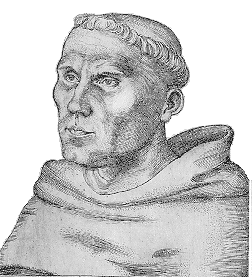
Luther legend shitstorm is about to hit (newly updated)


I blogged nearly three years ago about myth vs reality on Martin Luther, well in advance of the 500th anniversary of his allegedly doing something with some theses. Indeed, I started with that legend, for legend it is, that he nailed them to the door of the Wittenberg Castle Church.

And, I was already planning on starting a series of blog posts with the anniversary nearing vision.

Unfortunately, I didn’t think that a liberal American opinion magazine would be the spark for my memory, to get started.

But, it is.

The Nation uncritically repeats the legend about the 95 theses (It's unclear whether any of the books it reviews have this, or just itself) in a review of several new biographies about Luther and/or his times.

The 95 Theses has been refuted here and here. (OTOH, another Luther friend claims he nailed the Theses to other church doors in Wittenberg as well as the Castle Church. Doubtful. Wiki's article, with a link, claims this was university custom. In THAT case, Melancthon either got a distorted version of the story, or else clipped out the other churches for dramatic effect. In either case, they were in Latin and affected the average Wittenberger not one bit. However, I consider this doubtful, due to the length of the theses. Hand writing multiple copies of that, with a quill pen, in a relatively short time? Besides, not only was Georg Rörer not only not an eyewitness, he didn't even attend Wittenberg. 

Luther also did not say, as best as we know, "Here I stand, I can do no more," at the Diet of Worms in 1521. The "Here I stand" legend is refuted at the first of the two links in the paragraph above and also here.

He wasn't the son of peasants, either. His father owned copper-smelting operations and relatives of his mother advanced him the money to buy in. One of his mother's brothers was a doctor. A more distant relative was mayor of Eisenach at one time.

Oh, and Luther himself apparently started the "son of peasants" myth. That said, Eric Metaxas, who refutes that in his new Luther bio, repeats a polished-up version of the 95 Theses myth, along with several others in a book that won't get more than 3 stars on my review.

(That said, the link has been updated to my Goodreads review of the book. It SUCKS. It got 1 star because he does far worse than that, including running Luther through an American evangelical sheep dip, including neoconservativism and Islamophobia. See this blog post for an expansion on my original review. And go here for a better dual bio of Luther and Erasmus.)

Beyond that, the largest Lutheran denomination in the US rejects or questions some Luther myths, including the 95 Theses and the Here I stand. However (shock me) the Lutheran Church-Missouri Synod, the main denomination of the fundamentalist wing of American Lutheranism (and, yes, you are fundamentalists) accepts the castle church door legend wholeheartedly, as it does again in this timeline at a spinoff Reformation anniversary.

What else can it do? If you're a literalistic church body on things like the inspiration of scripture itself, you probably have to double down and be literalistic on the Textus Receptus history of your founder.

It's clear that on the theses, they were only submitted to Luther's superior, Archbishop Albrecht of Mainz, under cover of an explanatory level. Most the myth-busters note that the doors of churches, in general, were not used as community bulletin boards or even ecclesiastical ones. Had Luther wanted to provoke discussion, he would have posted a copy somewhere within the university, instead. I mean, that's where the academics were. Peasants walking by a church door, being illiterate in German, let alone Latin, would have cared less about a piece of paper tacked up there, or, as the split-the-difference smarmy Metaxas claims, pasted up there.

Also, the second "here" that is linked above notes that Luther granted indulgences himself early in his ecclesiastical career. He just didn't sell them.

A good bio of Luther shows he was sincerely tormented with guilt over sinfulness. And, contra Erickson, this was not misplaced Freudian paternal-directed anger. At the same time, he was far from alone. His anger seems to have become more intense, and floated to the surface, as he realized more how much the medieval church had strayed from its, say, pre-400 or pre-500 roots or semi-roots.

(Of course, Luther didn't look at how much the post-Nicene church strayed from its pre-200 roots in erecting a theological edifice that probably would have astounded Jesus and his followers.)

His anger was mixed with a stubborn obstinacy that spilled beyond indulgences and related issues, not only to the authority of the papacy, but to the formation of a new tradition.

That said, the church of Luther's era was not only led by corrupt popes, it was also increasingly ossified. Indulgences had been a problem for 300 years or more by the time Luther drafted his theses, yet neither the Fourth Lateran Council nor the Council of Constance, among other church meetings, seriously and lastingly addressed the issue.

Combined with incipient proto-German nationalism, the abuse was ripe for the plucking.

Let's remember that a fair amount of why Luther got a "name" was luck. Neither John Wyclif nor Jan Hus had a printing press to spread their ideas, nor, in Wyclif's case, to spread his vernacular Middle English bible. Wyclif had no relatively semi-critically edited Greek New Testament for the basis of that bible. Wyclif also was in an era where ferment for reform was fairly low, and being in England, he was at the edge of Western Christendom, unlike Luther or Hus.

Unfortunately, but only semi-surprisingly, not fully so, the S-USIH history blog repeats both of the two top Luther legends.

L.D. Burnett does back off his claims to certainty, on the first at least, in a follow-up comment. He does open more interesting questions with the attempt to nail the start of the Reformation to a certain date. But, what does that do to Hus or Wyclif? For that matter, what does that do to Zwingli, and how much or how little he was influenced by Luther?

POST-1521

And, as noted in that original piece, Luther’s virulent anti-semitism is no legend at all.

Peasants' Revolt

A lighter-hearted mythbusting site, from within the liberal wing of Lutheranism, itself gets a thing or two partially wrong. Luther perhaps may not have hated all peasants. But, citing the fact that his grandfather was a farmer is proof of nothing. Many acorns fall close to the tree, but to reverse the cliche, the dandelion seed head blows far away. It seems pretty clear that he DID hate "uppity" peasants, especially ones who might be trying to implement a 1500s version of social gospel, let alone liberation theology. Luther's "Admonition" to both peasants and lords was not as 50-50 as claimed. In any case, even for that day and age, arguably, The Twelve Articles of the Swabian Peasants are more irenic than, say, something written in conjunction with the Wat Tyler Revolt in England 150 years earlier.

The real issue is that, when he wrote "On the Thieving, Murderous Hordes," and afterward, Luther (in my own debunking of another myth) refused to admit he was wrong. Appeals to people to prove him wrong were, by 1525 at the latest, nothing more than rhetorical tropes.

Given his father being a member of the ownership class, and his mother coming from a family background both richer and much more educated, and more politically corrected, a few conclusions can be drawn.

Above all, that is that Luther was much closer to being a proto-capitalist than a proto-Marxist, despite East Germany's attempts to exploit Luther 450th anniversary events.

Meanwhile, as noted above, by 1525, that stubborn obstinacy at the core of Luther's character spilled elsewhere, with further major consequences.

Dealings with the Reformed

He shows this clearly in his dealings with non-Lutheran Reformed brethren, starting with, but by no means limited to, Ulrich Zwingli. Even a middleman like Martin Bucer came in for Luther's wrath. In general, he used the same language on Reformed leaders as he did on Catholics, even though their language in response was, and remained, much more irenic.

If there's a "fault," beyond irreconcilable doctrinal issues, that, in Germany and beyond, there wasn't a more united Protestantism (until the Prussian Union in much of Germany, and the rise of more liberal theology in general), the fault lies with Martin Luther more than any other single person.

As far as the keystone there, Luther's take on the "Real Presence" in the Eucharist, this was a literalistic vs more humanistic take on what the human nature of Jesus implied. That said, even in his post-Resurrection appearances, Jesus in a Pauline spiritual body, while shown appearing out of nowhere, is never shown as appearing in multiple ways at the same time.

On the other hand, neither Luther nor his Reformed brethren at the Marburg Colloquy appeared to wrestle with John 6 — only the Synoptics.

Speaking of, as Orthodoxy accepts John's timeline for the Passion, and more pertinently, rejects Augustinian ideas of original sin, a good bio of Luther, unlike Metaxas, will do at least a bit of putting Luther into the context of ALL Christianity, not just its western variants. Many Orthodox post-Nicaea theologians, or, per the real breaking point time, post-Carolingian ones, would have laughed, if nothing else, at Luther's turmoils. However, unlike a Cajetan telling Luther to just say "revoco" and follow Rome, Orthodox thinkers would  have laughed for other serious reasons.

Also, while Orthodoxy believes in penance as a sacrament, and in a quasi-purgatory, it has never had a practice of indulgences. Luther himself, other than noting the Eastern churches were free of Rome, made no real effort to learn about post-Nicene, and certainly not about post-Carolingian, Orthodoxy.

(Prayers for the dead, on which purgatory is partially based, have some tenuous New Testament basis. And more, below that, from early Christian tradition.) And, per Wiki (follow links) Philip Melanchthon accepted that prayers for the dead were part of Christian tradition in the Apology to the Augsburg Confession (XXIV 96). (That's of note given that Luther mailed out his 95 Theses copy on All Saints Eve.)

Also vis-a-vis the Reformed, Luther's luck again shines through. Unlike Zwingli, he didn't get killed. And, he happened to be older than Calvin, as well as Bucer and others who deliberated between Lutheranism and the Reformed stream of thought. Had Bucer been closer to Luther in age, more of Lutheranism might have been steered in a more Reformed direction.

Transubstantiation, the Real Presence and the pre-Reformed

The Reformed theologians, along with Luther, agreed in rejecting transubstantiation. Whether the Reformed thought about it or not, beyond their actually expressed reasons, they had others for rejecting Luther's stance.

Basically, Luther was trying to walk a petard between two horns of a dilemma with his stance, although neither he nor the Reformed appear to have seen that.

The horns?

One was ex opere operato, in other worse, the very thing that Luther found lying behind transubstantiation when he rejected it. In this case, if it is faith itself that makes Jesus bodily present for a believer in the sacrament, well that too is ex opere operato. Luther might raise two objections — the biggie is that belief comes from the Holy Spirit.

That leads to another problem. In that case, going beyond Luther's single-predestination version of predestination, a human in this case becomes nothing more than an automaton, a playtoy for Jethro Tull's "Bungle in the Jungle." Luther would also reject that, but he'd have no grounds for that other than his own stubbornness, or else appeals to god's inscrutability. THAT, in turn, leads to the Psychological Problem of Evil, about which I've blogged before, more than once.

The other horn? Scholasticism, and angels on heads of pins. If neither a state of faith nor a particular statement of faith at the time of the blessing and offering of the Eucharist makes Jesus bodily present, then exactly when and exactly how IS he? Does the reading of the Biblical words of the Institution, not as a priestly act, but simply the presence of the words, do it? In that case, the words of the bible are themselves close to becoming the fourth person of the Trinity. Islam, in some extremely "high" versions of theology of the nature of the Quran, ran into similar issues.

Infant baptism faces similar horns, unless one ditches Lutheran ideas and instead treats it merely as a sign of grace or entrance into a Christian covenant, paralleling circumcision.

Antichrist

Oh, and he was wrong about the papacy being the Antichrist. Antichrist, whether a person or spiritual stance, in 1 John, is not the same as the "man of lawlessness" in 2 Thessalonians. (That sets aside, of course, the issue of whether "the man of lawlessness" is the papacy. And, even on a literalist, even fundamentalist, reading of 2 Thessalonians, that's a hard stance to take.) 1 John mentions nothing about Antichrist being in a position of authority.

Critical theology, not mentioned much at the Wiki page, at least MY critical theology, says that, instead of Nero, the pseudo-Pauline author, like the Synoptic gospels, may have been envisioning the Jewish revolt, temple takeover and temple destruction, which also gives us a terminus a quo for the book.

Assuming the author wrote before Titus, in the name of Vespasian, finished the conquest, that would have us talking late-60s CE. I'd argue that it most likely refers to one or more of the Jewish leaders who took over the temple and started the revolt.

The Jews

Luther is well known for his violence-laden invective against Jews. That said, most people think it was confined to the latter years of his life, and his apologists use this, and his health issues then, as an excuse.

Not true. As Michael Massing notes in his great new "Fatal Discord," a parallel dual biography of Luther and Erasmus which is reviewed here, Luther was already expressing such thoughts in his pre-95 Theses lecture notes on the book of Psalms, right in the mix of the Reuchlin-Pfefferkorn controversy. This started in 1513; see pages 187ff of the book.

That said, Massing also notes that, while not violently, or too virulently, expressed, Erasmus had his own boatload of anti-Semitism. It was more anti-Jewish religion than Luther's, trading less in "moneygrubbing" stereotypes. A fair chunk of it was claiming that the "Law" of the Torah — legalism — led in a direct line to the legalism of the Catholicism of his own day. In other words, perpetuating a legend that goes in part all the way back to Paul. THAT then said, Massing notes that many humanists held ideas like this.

Today

The "yes I'm right" stance of Luther himself, not only vis-a-vis things where he clearly was, but other issues, such as versus the Reformed on the Eucharist, versus many Reformed and other Lutherans on the issue of adiophora and more, seems to still run strong in much of the conservative wing of Lutheranism. (Let's not forget that Luther thought he was competent to condemn Copernicus' heliocentric theory of the solar system, and rushed to do so when his book was published.)

That's not a total surprise, though. Fundamentalist versions of Christian denominations, just like fundamentalist strains in other world religions, stay fundamentalist due to mindsets.

Outside of being the largest single fulcrum for the Reformation, and secondly, the anti-Semitic issue, Luther contributed little to the larger world. No German state had any New World colonies, for one thing. Many individual Lutheran emigrants to early America were Mennonite, not Lutheran.

As "Anglo-Lutheran-Catholic" groups call for reunion with Rome, and as Stanley Hauerwas wrongly claims there's little difference between Protestants and Catholics today, Luther's importance in the religious world remains. Hauerwas has a fair degree of arrogance on "Protestants won," too.

"Mush god" believers from either the liberal wings of mainline denominations may have their own reasons for playing down differences, just as do Anglo-Catholics, etc. That doesn't mean they don't still exist, either in the minds of their more traditionalist Protestant brethren or Opus Dei type Catholics.

On that piece, not all Catholics of 1517 held to a "legalistic perversion," first. Second, transubstantiation divides Rome from all Protestants, as does a married priesthood. Even a non-transubstantiated Real Presence is a Eucharistic minority among Protestants, as is the idea of a priestly apostolic succession. Hauerwas also ignores papal infallibility ex cathedra, a renewed focus on sainthood under John Paul II and many other things.

Finally, not only does trying to pin the start of the Reformation to one date risk subsuming Wyclif and Hus, and a whole trend of the desire and ferment for reform of which they are two exemplars, it also risks subsuming the degree of independent thought that Zwingli brought to his own push for reform.

NB: Expect one major update three-plus years from now, with a further look at the Diet of Worms.

April 30, 2017

Jesus and god and tornadoes and Canton

Going beyond any snark-in-brief I've posted in past such cases on Twitter, and going beyond a briefer post about a woman allegedly "praying and diverting away" a tornado in metropolitan Dallas a year ago, in light of the tornado in Canton, Texas, that killed at least five people yesterday, and per the header, there's nothing to do but jump in.

Why are you, if you are, praying to your Jesus for the people of Canton, when he was either not strong enough, or else not morally good enough, to keep that tornado from happening in the first place?

In theology, the issue is called "theodicy," or the issue of divine judgment.

In this case within theodicy, where alleged omnipotence directly conflicts with alleged omnibenevolence, it's calls "the problem of evil."

Or, as Rabbi Kushner put it, "why do bad things happen to good people?" More on that in a minute.

Now, some of you, conservative evangelicals or fundamentalists, will quote either Job or Paul's quoting of Job, of god saying "my ways are not your ways."

Well, the alleged inscrutability of god is nothing more than a dodge itself.

Because you now have a god either not omnipotent, not powerful enough to make his ultimate plans clearly known to intelligent humans, his alleged creation, or else you have a god not good enough to keep his intelligent human creation from avoiding psychological pain by being left unaware of god's ultimate plans through a tragedy.

And don't try to go meta on me. If you claim that god or Jesus trying to explain himself would cause further turmoil itself, re-read the immediately preceding paragraph, because it's what I would repeat to you.

But, this isn't just a piece for the fundamentalist or nearly so — whether within Christianity or the other Middle East-based monotheisms.

If you believe in a more liberal version of your faith, whether Christianity, Judaism or Islam, have you ever wrestled seriously with this issue? Do you still, even if not taking your scriptures literalistically, still believe in a god who is both all-powerful and all-good?

What if' you don't?

How much short of omnipotent, or omnibenevolent, can a monotheistic deity be and still rightfully be accorded worship, etc.?

Or, if you're a New Ager, how much short of omnipotent, or omnibenevolent, can a depersonalized Higher Power be and still be trusted or sought out?

And, New Agers of certain stripes who literally believe in it (ditto for Hindus and Buddhists) do NOT cite "karma." That's more offensive than conservative Christians' "original sin." (And, yes, like Ken Ham, some Xns actually will attribute the cause of anything wrong in our world to original sin.)

And, this isn't just logic chopping. Divine goodness or not, human confusion in the face of trying to puzzle out an alleged divinity's actions and more are all highly emotional matters.

Also, this isn't just about so-called natural evil. Human evil falls in the same place.

Substitute "child sexual abuse" for "tornadoes."

I write this in a mix of sorrow and anger.

I feel sorrow for (and sorry for) people who can't or won't open themselves up fully to the deep feelings behind the confusion — and perhaps anger — they feel themselves over where they're at religiously at times like this.

And, per Hume, since reason should be the slave of the passions, yet guide it, I feel a second sense of sorrow that this means people can't or won't reason their way to new insights because they refuse to be fully in touch with their emotions.

And then I feel anger at those within conservative Christianity in the US who attack non-Christians, and especially secularists as allegedly immoral (not true on divorce or adultery), anti-American (we're not a Christian nation), or that there's a "war on Christianity" (hyped by Bill O'Reilly of moral problems galore).

Jesus allegedly spoke about specks of wood in others people's eyes vs. wood planks in one's own. Paul talked about believers who could only take milk, not being ready for meat or other solid food. Please take note.

Within faith-based major thinkers, of the last century or so, I suggest starting with Unamumo's "The Tragic Sense of Life," available in text online here. I'm not here to convert anybody to secularism; I am here to challenge shallow, unreflective belief systems when they're thrust in other people's faces.

February 04, 2017

One will be taken and the other left

For people not familiar with the Christian scriptures, whether some atheists, or some Xns both liberal and fundamentalist or conservative evangelical, that's Matthew 24:40 I'm referencing. And, whether riffing directly off Pauline material or not, the "Great Apocalypse" of the synoptic gospels at least arguably supports Rapture-type ideas, contra, oh, an L.D. Burnett at S-USIH, the Society for U.S. Intellectual History, who claims the Rapture is un-Christian.

Baptism for the dead, of Mormon doctrine, is also Christian, L.D. and others. Deal with it.

But let's get back to why that header I have us up there.

In the fairly small town to which I recently moved, a lady announced earlier this week that she had officially been pronounced cancer-free by her doctor after a fairly severe cancer with arduous treatment process.

She took this all as a gift from Jesus, etc. She also went so far as to say, even for comment to the newspaper, that she was using this as a tool to try to convert her atheist doctor.

Erm, not so fast, ma'am.

The very next day, a decade-younger emergency services worker, or former such worker due to extensive radiation-induced heart damage due to an infancy neuroblastoma cancer, died.

And, where was god then, when in an existential Rapture-like sense, one was taken and one was left.

Was it better for the firefighter to die as gain than live for Christ?

Well, the conservative Christian apologists will offer up the tender mercies of god, the inscrutability of god, silver linings that we can't see, etc.

Then, when the likes of me counter with Ye Olde Problem of Evil?

Some of them will counter with "original sin." (And, yes, like Ken Ham, some Xns actually will attribute the cause of anything wrong in our world to original sin.)

Do not go there, unless you really want your biblical literalism to be that repugnant.

Beyond that, what if someone from the firefighter's family gets mad at the lady's family? Is the lady's family really going to go there? Or what if the lady, and/or family, stop by the firefighter's funeral and offer the inscrutability statement?

Growing up in a conservative Protestant denomination, but one in the mainline tradition, not the US version of "evangelical" Christianity, people didn't try to attribute everything to the will of god. Perhaps one way in which the Midwest is still a bit different than the South.

But, seriously, would someone try that?

Or, to get back to the bible, how many people from either family would pray, in the next week, or offer words to the other, out of the mouth of Job: "The Lord gives and the Lord takes away; blessed be the name of the Lord"?

And, as for the claim of original sin as the ultimate cover up for the theodicy of a seemingly cruel god, I can quote Jesus healing the blind man in John: "Neither this man sinned, nor his parents but this happened so that the works of god would be displayed in him."

Of course, if there's an unhealed blind man, or an unhealed, now-dead firefighter, without either an actual sin, or a bloodline-like soulline of original since, we're back on the theodicy of an unjust god.

==

As for the likes of Burnett? Usually such people are more liberal Christians. And they usually know enough about Christianity, in my opinion, to know in their mind of minds, and even more, deep inside their heart of hearts, that "doctrine X" really IS Christian, and they're humiliated. Perhaps even appalled.

And, even ignoring the Old Testament, and the Priestly Code prohibitions on blending fabrics in clothes, prohibitions on tattoos, etc., I can find other things that many Christians would like to call un-Christian.

I've already refudiated both liberal Christians and some sympathetic atheists as to whether the New Testament is anti-gay or not. Paul is by active discourse and Jesus is by silence.

Tertullian's idea of saints in heaven gloating over sinners in hell is arguably backed up by Revelation, especially when joined with the Lucan parable of Lazarus and Dives. And, I'm sure I can think of more.

January 11, 2015

If god delivered you, then why ....

I don't do this often, because I'm not a Gnu Atheist, but I get tired of these "God put me in the right place" types of nuttery. Among the latest is one from Austin, and the nutbar would-be bomber Steve McQuilliams. Officer Johnson, if god were really involved, then why didn't he prevent Steve McQuilliams from getting his guns and bombs in the first place?

And, it's not just Christians, it appears.

Chandra Susanto, if he's from Indonesia, is likely to be thanking Allah for not boarding the recent Air Asia flight that crashed and killed all 162 on board.

The mainstream media don't help on things like this when, even before survivors use the word, they talk about someone "miraculously" surviving a crash of some sort. 

And, "true believers," whether in Jesus, Allah, Metatron (or Megatron?) or any other variety of an omnipotent deity, please do NOT trot out the "inscrutability of god" issue. I've covered the Psychological Problem of Evil here more than once.

July 13, 2014

Theistic evolutionist Ruse shoots himself in the foot

And I'm not talking about any theistic evolutionist. I'm talking about prominent biologist Michael Ruse, who testified against creationists and Intelligent Designers in the McLean case in Arkansas, etc.

But, in an interview with philosopher Gary Gutting, host of the new York Times philosophy blog/column The Stone, Ruse stumbles over Ye Olde Problem of Evil, just as do those creationists and IDers he shoots down on their own scientific, and philosophical, illiteracy.

Let's start here, with GG being Gutting and MR being Ruse, in this interview format:
G.G.: Do you think that evolution lends support to the atheistic argument from evil: that it makes no sense to think that an all-good, all-powerful God would have used so wasteful and brutal a process as evolution to create living things?

M.R.: Although in some philosophy of religion circles it is now thought that we can counter the argument from evil, I don’t think this is so. More than that, I don’t want it to be so. I don’t want an argument that convinces me that the death under the guillotine of Sophie Scholl (one of the leaders of the White Rose group opposed to the Nazis) or of Anne Frank in Bergen-Belsen ultimately contributes to the greater good. If my eternal salvation depends on the deaths of these two young women, then forget it.
So far, all fair and good, and I totally agree with Ruse that the attempts of the likes of Alvin Plantinga to counter the problem of evil have been massive flops.

But, next, Ruse immediately goes on:
This said, I have never really thought that the pains brought on by the evolutionary process, in particular the struggle for survival and reproduction, much affect the Christian conception of God. For all of Voltaire’s devastating wit in “Candide,” I am a bit of a Leibnizian on these matters. If God is to do everything through unbroken law, and I can think of good theological reasons why this should be so, then pain and suffering are part of it all. 
Sorry, Michael, but that IS a non sequitur from what you said just above, and higher above.

First, unless you ARE rejecting either the "omnipotent" or "omnibenevolent" forks of traditional Western monotheism and the problem of evil, you're simply wrong.

Second, if you do reject one or the other of those forks, then it's incumbent on you to expressly  declare such things.

Third, if you're citing Leibniz, I'm pretty sure you're not rejecting either fork.

That said, Ruse is himself a secularist, even though he thinks it's possible for religious belief and evolution to co-exist. Because of that, and other things, I'll stand behind calling him a theistic evolutionist. He reminds me of the atheists who work with liberal Christians to try to show that the Bible isn't anti-gay even though it clearly is.

Ruse has other interesting things to say in the interview, too. Like this:
I won’t say I accept the ontological argument for the existence of God — the argument that derives God’s existence from his essence — but I do like it (it is so clever).
Well, with that comment, I think I can really say that I think Ruse is overrated as a philosopher. The ontological argument is simplistic semantics and nothing more.

He strikes me as being a bit like Rodney Stark, the sociologist of religion. Despite saying he's some sort of agnostic, Stark went from Eastern Washington University to Baylor, has adopted with both fists Samuel Huntington's Christianist "clash of cultures" idea, and tells all sorts of lies about historical development to try to support himself.

While I agree with P.Z. Myers very little, Michael Ruse just showed why secularists always need to have a bit of care in working with theistic evolutionists. And the likes of Eugenie Scott should take note in the future. I still reject the label of accommodationist, but won't claim that PZ is all wet. And, given that this part of Gnu Atheism isn't all wet, I can see why Ruse doesn't call himself an atheist.

And while I agree with his anti-scientism stance, given all of the above, I think I'll pass on his new book, “Atheism: What Everyone Needs to Know.”

September 20, 2013

Chimerism causes problems for souls, life forces and other metaphysics

I had originally titled this post, pre-publication, as "How many individuals are inside each of us?" But, as I later expanded it more, I decided I wanted the change, especially when I, like one of the few good things Christopher Hitchens did as a Gnu Atheist, took Eastern as well as Western religion into my gunsights.

That first sentence? That's a rhetorical question, as regular readers of this blog might guess. But, it's one based on hard science, and this time, it's not based on neuroscience or philosophy ideas of Dan Dennett.

Carl Zimmer's latest science piece in the New York Times is simply fascinating. It appears that many more humans than previously recognized are chimeras.

That is, whether you were part of a twin birth or not, you were part of a twin conception, and you either absorbed some cells from your twin or, in many cases, you absorbed the entire twin.

Or, some of us may be a mosaic, just like the mosaic cats you see with two halves of their faces with definitely different colors. In humans, it seems the mosaic patterns don't show up in outward appearance; rather, more insidiously, they may be behind the formation of some cancers.

A mosaic is not a blend of two different persons' DNA, as one twin absorbing another. Per this new piece by Zimmer, rather, a mozaic is when one zygote undergoes mutations early in cell division, before any differentiation, and both (or three or more!) cell versions are preserved. Result? Part of the cells of a heart may be defective, but not all.

As regular readers of this blog know, I'm also an atheist. And, not just an atheist in the way the Dalai Lama is, or some New Agers claim to be. Rather, I'm also an anti-metaphysician.

And, while I'm not a Gnu Atheist, generally poking fun at Christians liberal and fundamentalist alike just because they're Christians, nonetheless, to anybody who believes in an immaterial, metaphysical soul, the fact of chimerism (and other issues of human conception behind it) present stark challenges to your belief. As they do to religious-based prolife stances. (What a Nat Hentoff does with information like this, I have no idea, but he may "elide" it too.)

My answer to the rhetorical question is that there's quite posssibly more than "one" inside of me, if we're talking about DNA. It's also that, Dennett's multiple-drafts theory of consciousness, and ideas of subselves, aside, that there's only one inside of me if we're talking about core personalities. That's because I have only one brain, and only one body to embody the consciousness that's inside me, and zero souls, no matter whether my DNA is from one fertilized zygote or two, representing that consciousness. 

This is why that, though my move from conservative-to-fundamentalist Lutheranism to eventually land in atheism, or secular humanism, began over psychological and philosophical issues related to the problem of evil, as well as doing intellectual judo on my religious upbringing from my own religious graduate school training, eventually, science issues also came into mind.

Now, liberal versions of Christianity can find themselves perfectly compatible with, say, evolution. But, any religion that believes in an individualized, metaphysical soul? I simply don't see how you reconcile these scientific findings with your beliefs. And, under "individualized, metaphysical soul" I include the likes of the Dalai Lama and millions of other Buddhists who believe that some individualized life force is reincarnated. If it's an item tied to an individual person and it's metaphysical, it fits the bill here.

Many people claim that the Dalai Lama has said that he'll accept whatever science says.

However, I have read (sorry, I never did bookmark it) that he has elsewhere said that if it is science vs. one of two core Buddhist principles — karma and reincarnation — then science goes and Buddhism stays. 

And I don't doubt that its true.

In other words, chimerism simply wrecks the idea of a soul being created at conception, unless one is prepared to stand by an even darker god than John Calvin was.  If you're of the ilk of Hobby Lobby,  or Catholics, then, in the case of chimeras, you have to quadruple down on the biblical myth of Jacob and Esau in the womb, and believe that one of two fraternal twins, in many births, is a cannibalistic soul-devourer. Or else, it's a physical cannibal with two souls "attached" to what on the outside seems to be one body, with one brain.

Chimerism also has other connections to the abortion debate, especially within the Western monotheistic/monotritheistic tradition.

It's another variant on the old problem of evil. How can a deity purportedly both all-powerful and all-good let human reproduction be such a minefield of problems? Beyond all the chimeras (which, to be most blunt, from the fundamentalist point of view, must be considered versions of tiny infant cannibalism) to the fact that as many as one in four, maybe even one in three, human conceptions is spontaneously aborted, it is not even close to being anything but an evolutionary minimum of success, it would seem. And, aside from the fundamentalist problems I just lined out already, it's also a vast waste of putative divine economy.

If any fundamentalist tries to do the old hand-waving about how god's ways aren't are ways and vice versa, and god is inscrutable, etc., therefore there's surely an ultimate good behind this, I answer twice.

The first is that a god who is all-powerful and all-good not only can but morally should make his plans scrutable to any sentient beings he creates. Therefore, this is just the problem of evil squred.

Second is that said god is illogical, and unless one wants to be Martin Luther and talk about "that whore, reason," not all-good and therefore self-refuting.

To any fundamentalist who says "original sin," I reply three ways.

First and second, the two answers above.

Third, that you believe in a monster who isn't even close to all-good. (And, yes, like Ken Ham, some Xns actually will attribute the cause of anything wrong in our world to original sin.)

And, speaking of "souls," maybe chimerism explains why identical twins aren't so identical, even in their brains. (Of course, this would require parental cells/DNA, or else a third, fraternal twin.)

Update, May 2, 2021: Fascinating Smithsonian piece here. If you're familiar with what chimeras are, namely a human fetus that has absorbed another in the womb, the discovery that moms can become chimeras from their fetuses is ... fascinating.

March 14, 2013

More thoughts on #Francis the talking pope & #PZMyers

I blogged some initial thoughts about the election of Frances the Unnumbered yesterday.

Just a couple more, though, and a bit on the snarkier side.

First, whether in cardinals electing a pope, a high-church Protestant denomination calling a pastor, or similar, if it is really a "divine call," then why doesn't god make his divine will immediately clear?

Why do the cardinals have to cast multiple ballots?

Or why does the initial divinely called Protestant pastor turn down the call?

Well, you know the real answer: "God works in mysterious ways."

Followed by various declarations about how "his ways are above are ways," etc.

Yep, more of the inscrutability of god.

And, if the pope turned over some of his own priests to the Argentinian junta, then ... that, too, was god's will, right? Because god foresaw all of this.

I don't often venture into snarky Gnu Atheist territory, but I do on occasion.

And this is one of them.

This is a simple, and clear, illustration of the "problem of evil," and of what length orthodox Christians will go to in an attempt to dodge the issue.

And, Gnu Atheist kingpin P.Z. Myers is right on this issue of "crunchy theology" vs "squishy theology." And, like him, I actually prefer dealing with crunchy theology at times.

Of course, on the narrow issue of the election of a pope, I'm not being half as snarky as Taslima Nasreen.

August 07, 2012

A failed attempt at theodicy

Rev. Timothy Keller makes a nice try, when he says that if one uses the existence of suffering or natural evil, and its seeming unfairness, as part of rejecting the existence of god, it doesn't work, because the suffering remains senseless without a deity.

Not true; that's a framing mistake. It's really similar to Gilbert Ryle's idea of category mistakes.

"Sense" and "senseless" are both related, in general, to the issue of agency. And obviously, nature (unless one is a New Ager) isn't a personal being with powers of agency. A good existentialist could do more to straighten out Keller.

That's just the first of four straw men that Keller sets up to knock down.

The second is that this means that any god who exists is less than omnipotent.
But that kind of God doesn’t really fit our definition of “God.” So that thinking hardly helps us with reconciling God and suffering.
Well, maybe your definition is wrong. Isn't it arrogant to assume it isn't? And, that's a problem I have with theologically liberal Christians. It's for similar reasons I unfriended on Facebook, and eventually blocked there, a Harvard Divinity student who claimed Plato's famous Euthyphro dilemma (is "good" what it is because god orders it? then god can be capricious; is "good" what it is by its own nature? then "good" has moral standing independent of god) didn't apply to the god of Christianity.

(Honest grasping of the dilemma, perhaps through distinguishing between contingent and necessary moral truths, while ultimately a failure, would still be an effort, at least, not a craven dismissal. The "false dilemma" claims of some Christian Fathers, as listed on Wikipedia, aren't very good, either; they're halfway on the road to the ontological argument for god's existence, and it's no wonder Anselm is among those making this claim.)


The third one is that some people suffer because they're more evil. Well, about no nontheist claims that. Many of us do claim that, within a monotheistic theodicy, it sure looks that way, though, even if we're not Gnu Atheist knife-twisters.


Fourth is what he says is a half-answer; it's the will of god, we have to but accept.


He spins on this to go to us needing to be like children before god.

Not true. In fact, a god who creates sentient, curious, thinking beings, but then says "hey, wait a minute" and hides behind inscrutability is ultimately guilty of inflicting psychological evil on those creatures, thereby making the "problem of evil" worse, if anything.


Now Keller is just a parish pastor, not a theologian. Nonetheless, he's a pastor in New York City for a mainline, vaguely liberal Protestant denomination. And, he can't do better than this?


March 23, 2012

Gary Gutting whiffs on 'problem of evil'

For theists, atheists, and philosophers of religion and beyond, the "problem of evil" is at the core of stumbling blocks of western monotheism.

How can a deity be both omnipotent, or all-powerful, AND omnibenevolent, or all-good?

Theistic apologists often appeal to god's inscrutability. In a nutshell, they claim that what appears to be evil now is for our ultimate good, or similar.

Gary Gutting says we need more than an appeal to ignorance, if we don't want to have a blind faith.

But, he misses what apologists also miss.

That such an all-powerful, all-good god, even if he or she must allow local evils, or allow short-term evils for long-term good, could still explain himself/herself better to sentient created beings, and *has chosen* not to do so.

That, as I have repeatedly identified it, is the "problem of psychological evil." And, I've yet to see a theistic apologist adequately answer it.

September 29, 2011

Baby torture in the name of God?

That's my take on this story.

We have a 20-month-old baby, with an incurable neurological disorder. The Canadian hospital originally treating him recommends to his parents he just be sent home to die. Now, before wingnuts think this has anything to do with Canada's national healthcare system ... wrong. Several U.S. hospitals, approached after that, said the same thing.

But, desperate parents don't stop there. Instead, they let themselves be exploited (or willingly join in letting their baby be exploited) by hardcore anti-abortion Catholics. The same ones who tried to intervene in Terri Schiavo's case.
Baby Joseph, who suffered from Leigh's disease, was brought to Cardinal Glennon Children's Medical Center in St. Louis by his father and Frank Pavone of the New York-based anti-abortion organization Priests for Life.
Coming up? One steaming platter of exploitation:
Pavone issued a statement Wednesday from Amarillo, Texas, saying, "This young boy and his parents fulfilled a special mission from God. Amidst a culture of death where despair leads us to dispose of the vulnerable, they upheld a culture of life where hope leads us to welcome and care for the vulnerable."
 Yep ... God gives babies incurable diseases (do NOT trot out "original sin" on me, anybody) to make us care more for others. (And, yes, like Ken Ham, some Xns actually will attribute the cause of anything wrong in our world to original sin.)

And, the "willingly join in," in parenthesis above? Yep on that:
"He passed away peacefully at home with his parents and family at his side. Praise God he had seven precious months with his family to be surrounded by love and was not put to death at the hands of doctors," family spokesman Brother Paul O'Donnell said in a Facebook posting.
So, you have sick parents who take "time out" from grieving to have a "family spokesman" post something for them on Facebook.

Conservatively religious people wonder why we secularists distrust them so much. There's your answer.

And, yes, it's torture. First, if you look at Leigh's disease, it has no known cure and its many, varied symptoms sound like they could be quite painful. Extending a child's life to "make a point" is torture; that's even more true if that forced life extension involves a painful procedure like a tracheotomy.

March 29, 2011

Michael Ruse, Dawkins fail to understand philosophical necessity

It's ironic to say that about a famed Ph.d. philosopher, and an atheist and skeptic of sorts to boot, as well as about a famous evolutionary biologist, if this is the case.

But, here, Ruse defends Richard Dawkins in advancing a secularist defense of natural evil in particular and, in relation to natural selection rather than a creator god, of the problem of evil in general.
But supposing that God did (and had to) create through law, then Richard Dawkins of all people offers a piece of candy to the Christian. Dawkins argues that the only physical way to get organic adaptation -- the design-like nature of living beings -- is through natural selection, that very painful mechanism that worried Darwin! Other mechanisms are either false (such as Lamarckism, the inheritance of acquired characteristics) or inadequate (such as saltationism, change by sudden jumps). In other words, although Darwinism does not speak to all cases of physical evil -- the earthquakes -- it does speak to the physical evil that it itself is supposed to bring on. It is Darwinism with suffering, or nothing.
So, Ruse seems to be claiming that Dawkins says a certain amount of "nature bloody red in tooth and claw" was necessary for evolution. And, as a philosopher, Ruse appears to be giving this the imprimatur that it was philosophically necessary.

But, just as there's no philosophical necessity for the amount of evil in the world for God to do good, there's no necessity for a certain amount of evil, in terms of natural evil, for natural selection to operate.

Dawkins isn't a philosopher, not even a real amateur one, so he can be partially forgiven. But, this is a BIG #fail for Ruse.

May 18, 2008

Ehrman – the ‘problem of evil’ and a personal journey

“The problem with evil” is where the collision between ideas of an omnipotent god and an omnibenevolent one hit the road.

It’s THE emotional/psychological reason many people question their faith, whether Christian, or perhaps Jewish or Muslim, and why some of the more courageous of them, willing to live with their new answers, leave their old faiths behind, especially if they have also raised and wrestled with intellectual questions such as the validity and accuracy of their bibles or other spiritual books.

Bart D. Ehrman has made such a journey, on both the emotional and intellectual sides. The Duke University New Testament professor deals with the “problem of evil,” often known by the theological name of “theodicy,” in his good new book, “God's Problem: How the Bible Fails to Answer Our Most Important Question — Why We Suffer.”

On Amazon, it got 1-starred by a lot of conservative Christians who simply couldn’t stand to see their worldviews challenged.

My response? Is your faith actually that weak, then?

Two-star reviewers there are either that, or people who can’t stand to have Ehrman provide a litany of suffering.

Well, that’s exactly why he needed to do that. Hardened hearts take more effort to break down.

After starting with the Holocaust and other examples of litany, Ehrman takes a look at what the Bible says about suffering.

Of course, and contrary to 1-star reviewers, the Bible was not written as one book, with one theology.

There are several theologies on suffering, including two different, uneasily co-existing ones, within the book of Job, cited by most Christians as the exemplar of such a theology.

First, there’s the theology of the Torah and the prophets: You sinned, and that’ why bad things are happening.

Then, there’s Job. Neither the prose nor the poetic sections ever say Job is a sinner. That’s not even on the lips of Yahweh (poetry) or Eloah (prose) sections of the book, again, contrary to what many people think.

In the prose section, we get a capricious God playing a giant poker game with The Satan, in his role as God’s devil’s advocate. Ehrman rightly notes the ending of the book, in the prose section, is offensive. God waves his magic wand, and restores all Job had lost, including doubling his family size with additional children popping up out of nowhere.

On the poetry side of Job, he notes Yahweh never gives Job an answer, which Paul also notes in Romans. Job never gets his this-world advocate (and NO, he is not asking for a Messiah to die for his sins with “my redeemer liveth, burn your KJVs) to argue his case before Yahweh that he is indeed blameless.

From there, Ehrman moves on to address the Stoic/Existentialist view of suffering in Ecclesiastes. He says as an agnostic that this is something he can accept; we’ll probably never get a “why” answer.

From there, he wraps up with Daniel, the book that originated the apocalyptic explanation for suffering that permeates the New Testament.

For me, this is a solid four-star book. Drawbacks? It’s a bit thin; I’d love to have heard more of Ehrman’s personal story. And, although he’s a New Testament scholar, to the degree he’s comfortable, I’d love to hear him tackle theodicy in other world religions.

For more on books I like, see my Amazon top-1,500 review link at right.

May 15, 2008

The Intelligent Designer at work in Greece (warning – graphic pic alert)

A 9-year-old girl in Athens went to a hospital with stomach pains. Doctors discovered she had an embryonic twin in her stomach:
Andreas Markou, head of the hospital’s pediatric department, said the embryo was a formed fetus with a head, hair and eyes, but no brain or umbilical cord.

Markou said cases where one of a set of twins absorbs the other in the womb occurs in one of 500,000 live births.
The usual questions abound, of course.

Here’s a sampling:
Picture via The Telegraph

• How could an Intelligent Designer botch this? And hundreds of similar births in the U.S. every year?
• Did the embryonic twin have a soul?
• Was this “soul-killing” to remove the embryonic twin? Let alone the 11-year-old Chinese girl’s much-larger embryonic twin pictured at right?
• Could the Grand Poobah of ID be so cruel, in the “problem of evil” crux, to let poor people go 11 years (or all their lives, not too many years before this), before having the option of surgery to remove an embryonic twin like the one shown?
• Would people who aren’t hardcore anti-choicers on reproductive rights soften their stances even more if this were presented as a counter-graphic example of the one-third or so of human conceptions that are “botched” in some way or another?
• Will IDers of an conservative Christian bent trot out “original sin” to try to explain away all of this? (And, yes, like Ken Ham, some Xns actually will attribute the cause of anything wrong in our world to original sin.)

Update, March 18, 2010: Abortion in the animal world provides an additional entree to this issue.

Beyond abortion in the animal world, both partially absorbed "Siamese" twins and an even more radical pregnancy development, a teratoma (when a second fetus is absorbed inside the first totally, and early in development) exist in the animal world, as do "mosaics" — when two fetuses "blend" to an even lower level. In humans, people who have different blood tests report them to have different blood types are an example. These are also often known as chimeras.

Connected is the fact that about one-third of human pregnancies are spontaneously aborted — as noted by a Ph.D. biologist who is also a professed Christian, while still telling fundamentalists that under their worldview, god must be called "The Great Abortionist."

April 30, 2008

Ayala to IDers – ‘God is the greatest abortionist’

Francisco Ayala, one of the world’s greatest evolutionary biologists, AND one of the most renowned biological scientists openly defending the compatibility of evolution and religious belief, has been a busy man with the controversy over “Expelled.”

And, he’s not afraid to be as blunt with IDers as Richard Dawkins:
In fact, he said, evolution “is more consistent with belief in a personal god than intelligent design. If God has designed organisms, he has a lot to account for.”

Consider, he said, that at least 20 percent of pregnancies are known to end in spontaneous abortion. If that results from divinely inspired anatomy, Dr. Ayala said, “God is the greatest abortionist of them all.”

Or consider, he said, the “sadism” in parasites that live by devouring their hosts, or the mating habits of insects like female midges, tiny flies that fertilize their eggs by consuming their mates’ genitals, along with all their other parts.

For the midges, Dr. Ayala said, “it makes evolutionary sense. If you are a male and you have mated, the best thing you can do for your genes is to be eaten.” But if God or some other intelligent agent made things this way on purpose, he said, “then he is a sadist, he certainly does odd things and he is a lousy engineer.”

That is also the message of his latest book, “Darwin’s Gift to Science and Religion.”

Ayala also offers his take on the “teach the controversy,” or similar statements, espoused by many evolution doubters from President Bush on down, as well as evolution denialists:
He dismisses the argument that it is only fair to teach both sides of the evolution/creationism controversy. “We don’t teach alchemy along with chemistry,” he said. “We don’t teach witchcraft along with medicine. We don’t teach astrology with astronomy.”

Ayala’s work on behalf of evolutionary biology is greatly appreciated.

But, his comments also underscore part of why I became an atheist.

If you accept the idea that God, in the Western monotheistic version, cannot be “all,” how much of a “less than all” do you accept and still find worthy of the label “God,” as far as powers or skills of design?

Or, second question – how much below “less than all” do you get until you recognize that your “God” is nothing but a “god of the gaps” and that these gaps have been being closed by both science and philosophy for 300 years or more?

Or transferring this issue beyond what philosophers call “natural evil” to “moral evil,” how much “inhumanity” (the older Mark Twain would say it’s quite human) do you accept as the production, whether active or passive, of a “morally less than all” divinity before junking the idea entirely?

And, that said, at the end of the NYT story, Ayala himself refuses to discuss whether he is still a religious believer or not.

Addendum: Issues like teratomas and the related human chimeras add to this issue.

Update, May 2, 2021: Fascinating Smithsonian piece here. If you're familiar with what chimeras are, namely a human fetus that has absorbed another in the womb, the discovery that moms can become chimeras from their fetuses is ... fascinating.