SocraticGadfly: Johnson (Lyndon)
Showing posts with label Johnson (Lyndon). Show all posts

August 23, 2023

King: the man, the myth, the complex reality, and the alternative history

King: A Life

King: A Life by Jonathan Eig
My rating: 5 of 5 stars

A powerful book in which Eig, in part with the help of recently declassified FBI files, access to materials from King's "unofficial archivist" L.D. Reddick, audio tapes by Coretta Scott King in the early months after Martin's assassination as editor's notes for her first memoir, and notes for an unpublished memoir by Daddy King, gives us a complex portrait of a complex person, and the times around him. In addition, more than 200 interviews went into the book.

First, a few notes about what I learned about the pre-famous King, from childhood to Montgomery bus time. They're behind a spoiler alert at Goodreads, but pulled out here:

1. Daddy King was a womanizer and MLK knew it before he went to Crozier. His pledge not to follow in daddy’s footsteps was doubted by a woman to whom he told it at the time.
2. King was non-academically plagiarizing sermons on occasion from early on.
3. Daddy King was a hypocrite over Gone with the Wind’s Atlanta premiere and big PR.
4. MLK seriously dated a white woman while at Crozier, but broke it off after accepting such a marriage would crush his reputation. Harry Belafonte and others said she was his one true love.
5. In the intro chapter, Eig says King made a couple of childhood halfhearted suicide attempts. It sounds like a mix of biological depression plus struggles already then with Daddy King’s full legacy.
6. And, this I didn’t know either. Guess it just never popped. His dad wasn’t born “Martin Luther” King and neither was he. It was “Mike.”  (To be more precise, I may have heard that before, but it never stuck. I do know that my racist conservative Lutheran pastor father hated Martin Luther King Jr. having that name.)

Moving to the adult King, Eig uses the new materials to show more of several things already known to some degree about his efforts with the SCLC. 

First is, from the additional FBI materials (and 2027 will reveal more) just how much Hoover’s hatred drove not just him, but senior assistants, on the spying on not just King, or King plus Stanley Levinson, but also tapping phones of Bayard Rustin and others. And, of course, the biggest laugh is that King only started to question the worst of capitalism, contra Hoover’s claim that he was a Commie, AFTER the taps and moles inside SCLC started. (The reality is that Rustin and HIS background were a bigger threat to “turn” King than Levinson ever was. Rustin knew that, and that’s why he often stayed in the background.

Related to that, and also in part from the new FBI materials, is just how much LBJ started signing off on Hoover’s claims, and how much, despite his trying to blame RFK (and a little, JFK) he wanted more. Sadly, Bobby’s first replacement, Katzenbach, was no better. It was only when Ramsey Clark became AG that the nonsense at least diminished.

Second is better discussion than other bios I’ve read of how not-so-popular King was, not with whites, but other organizations and their leaders. The NAACP and Roy Wilkins, as Eig notes, found him kind of a showboat early on and stressed that their legal victories, not King marches, were the big issue. Then, even before Stokley Carmichael and Black power, James Farmer at CORE, John Lewis preceding Carmichael at SNCC and others thought King too passive at times, too willing to compromise at times and also, not fully buying into nonviolence.

Through all of this, King walked various tightropes, often dependent on Ralph Abernathy as well as Coretta. Especially in earlier years, Eig fleshes him out well. (He didn’t want to move to Atlanta after Martin did, afraid of being under his PLUS Daddy King’s shadow, but eventually agreed.)

Third is King himself, as preacher and prophetic voice, movement inspirational leader, and movement manager. Eig, excerpting from sermons and speeches of his, notes his greatness in the first area while also noting the plagiarism problem that began pre-adult and went through academia never went away. The second? I think one good anecdote is of so many people meeting King in personal and being surprised that he was only 5-7 or so, expecting a much bigger man. His "presence" was huge and magnetic. The manager? Eig is honest on King's lack of organization at times (something he notes that — and notes was discussed by Blacks — seemed then at least to run through Black church denominations and ministers), also his battles for funding and focus with the other organizations mentioned above, but also his own sometimes scattershot approach to specific situations, like going north to Chicago. Plenty of details on all three aspects abound in this book.

Fourth, Eig talks about sexism in the civil rights movement in general. Part of this was due to its pre-feminist movement start. Part of it, he says, also relates to the Black church, and I think that's a fair judgment. On social issues outside of civil rights-related things today, even relatively more liberal Black church denominations and individual members tend to be more conservative than their White counterparts. There's a lot of details, most of it about simply refusing to accept women in leadership roles.

Fifth, per what he noted in the introduction?

There’s not a lot new to me on the personal side OTHER THAN Dorothy Cotton as his … mistress. THAT was all new, while Eig notes insiders called her his “second wife.” As part of this, I found Coretta Scott King’s denialism of it interesting, especially since she knew and accepted his womanizing foibles in general.

The epilogue is good in noting Reagan’s resistance to making his birthday a holiday, and how we still have failed to address King’s “call for an end to the triple evils of materialism, militarism, and racism.”

That said, Jason Sokol’s “The Heavens Might Crack” goes more into that resistance.

Note: While this is a biography, this leads to the speculative “What If” … as in, if King had not been assassinated by James Earl Ray. It’s beyond purview of a review, but as noted at Goodreads, I'm addressing it here.

View all my reviews

And with that, on to the alt history.

What would have happened had King not been assassinated? Starting with the nearest term, my first guess is that he might have got modestly more concessions for the Memphis strikers than Coretta but not a lot.

The Poor People's March? For reasons partially outside his control (the abysmal DC weather that hit the actual event), but largely reasons inside his control — his lack of focus, as noted above, and specific to this event, something warned about by Rustin strenuously, so much so that he refused to participate, and others as well — and the likelihood of a Vietnam tie-in "spoiling it" with national thought leaders, while probably not attracting "poor whites," many of them still (and today still) "mudsills" in their racism, means this would have been about as much a flop with him as with Coretta and with his name attached.

So, what then on his legacy after that? If Bobby is still assassinated, does King, who had never before endorsed a candidate but given hint that he might do that in 1968, swallow hard at the tail end and mention Humphrey's name after LBJ's bombing halt? Or does he call the halt itself hypocritical? And, what if Bobby is not assassinated? It's possible LBJ + Daley and other Northern urban bosses ram through the Hump anyway. 

Wiki's page on the 1968 convention notes that, after the Cal primary, Humphrey still had a plurality, albeit not a majority, of delegates.

At the moment of Kennedy's death the delegate count stood at Humphrey 561.5, Kennedy 393.5, McCarthy 258.

Those 1,200 or so delegates are less than half of the 2,600 or so voting at the convention, and they hugely rejected a "peace plank" and adopted a platform without one by a confortable margin before nominating Humphrey.

The platform was passed by a narrow margin, with 1,567 delegates voting for the platform while 1,041 voted against.

Sorry, Wiki, but that's not "narrow." It's 3-2, or 60 percent in favor. 

Getting into alt-history with RFK as well as MLK, I highly doubt he would have run a third-party candidacy. That means Bobby in 1972 vs. Tricky Dick. Does McGovern call Bobby a hypocrite in primaries, first? Or does he stand aside? In either case, Bobby running in 1972 covers up Teddy taking Mary Jo Kopechne to his favorite Chappaquiddick law firm of Weiner, Deiner, Dicher, Dunker.

So, King would have been stuck again. Side note: McCarthy, largely attacked years and decades later as "soft" on race issues, lost the California primary precisely because he was NOT soft and talked of having public housing for Blacks scattered throughout the LA Southland, a proposition radical for the time. Bobby explicitly rejected that in a debate just days before the primary vote.

Sidebar: While Eig doesn't go into details, just a bare statement of the facts of April 4, 1968, yes, yes, yes, James Earl Ray did it.

There are a couple of other points of alt-history to consider.

First, would Hoover have gotten more ruthless in his wiretaps, etc., and related, would Nixon had gotten more ruthless with what he wanted and did? A qualified yes to both.

Second, would King, having expanded his movement to accommodate poverty in general, and a focus on war, have ever come to terms with, let alone embraced, feminism? I doubt it, and I think the post-Roe world, especially, would have further diminished his reach. More feminists in general, and White liberal ones in particular, would have consider him yesterday's news.

October 26, 2022

The Squad is still the Fraud, despite Ryan Grim's turd-polishing; but, so is the Congressional Progressive Caucus

Most of the Congressional Progressive Caucus, of which The Squad Fraud is a part, sent a letter to Warmonger Joe Monday asking him to push maybe just a tiny bit for negotiations on Ukraine. As Grim spells out at the Intercept, they then had the door slammed shut on them.

Well, no, per the statement (also embedded) on behalf of the caucus by Rep. Pramila Jayapal, its chairperson (pictured at right), they shut the door on themselves in a sense, Ryan. They could have tried pushing back against that "door," but chose not to.

That's Groveling 101.

And, surrendering of leverage. Of course, the CPC surrendered leverage when all Dem Congresscritters, including all of the Fraud, voted for Warmonger Joe's first big Ukrainian arms bazaar bill. And, before AOC, Ilhan, etc. speak out, the Tweet above says Jayapal as CPC chair was speaking for the caucus, not just herself. (And, I checked AOC's Twitter Tuesday night.)

But wait, it gets better, which Grim's article was written too early to reveal.  And, that's seeing Jayapal throw her own staff under the bus:

"The Congressional Progressive Caucus hereby withdraws its recent letter to the White House regarding Ukraine. 
"The letter was drafted several months ago, but unfortunately released by staff without vetting. As chair of the Caucus, I accept responsibility for this."

Wow. Also "wow" is those trying to defend this, claiming that staff wrote this up in June or July, got the 30 who signed it to sign then, and there it sat, doing nothing, until the CPC policy director hit "send." So, you're defending Jayapal by claiming that she's not progressive and has a staff who recognizes it.

This:

But, note that Joe Cirincione is a member of the Nat-Sec Nutsacks™. And, he is essentially claiming that Progs Caucus staff didn't trust Jayapal, or rather, that they DID trust her to be exactly who she showed she is — someone who will grovel like a newspaper-smacked puppy by the military-industrial complex. And, the staff was right.

And, over at Rumble, Lee Camp destroys these claims by Cirincione and his ilk.

And then, there's people on that same Twitter feed saying replace Jayapal with AOC, when the real answer is "replace your AOC romance with a 'duopoly exit.'" For you folks, also from that Jayapal statement:

Democrats ... have strongly and unanimously supported and voted for every package of military (aid).

What part of "strongly and unanimously" do you not understand? Beyond my blogging about the Fraud's initial sellout?

And, since Grimm's article, for whatever reason, doesn't link to their original statement, let's go there. And quote:

But as legislators responsible for the expenditure of tens of billions of U.S. taxpayer dollars in military assistance in the conflict, we believe such involvement in this war also creates a responsibility for the United States to seriously explore all possible avenues, including direct engagement with Russia, to reduce harm and support Ukraine in achieving a peaceful settlement.

There you go.

You just surrendered your leverage, per your groveling response of saying you're going to vote for all new expenditures, or, per a sex-neutral upgrade of a famous LBJ saying?

You just put your gonads in Biden's pocket.

There you go.

Of course, the Congressional Progressive Caucus itself has become more and more bullshit. Per its own website, it has nearly 100 members, or 40 percent of the Dem Congressional caucus. If you think everybody in there is truly progressive, I've got beachfront in North Dakota to sell you. Proof of that? If those nearly 100 members, only 30 signed the letter to Warmonger Joe.

It's ALSO of course, interesting that the CPC says "we're nearly 100 members" but doesn't list them all by name on that link, probably because they know people like me would laugh. Well, if you click through from that link to "caucus members" you'll see them all. That includes the many who cut Israel blank checks (remember that dispute flaring up just a few weeks ago?).From here in Tex-ass, I can tell you Eddie Bernice Johnson is no progressive and Lloyd Doggett is not much better. Nor is Sylvia Garcia. Jared Huffman puts capitalism in front of environment at Point Reyes. And, I haven't even talked about members that oppose BDS.

Update, Nov. 18: Will the CPC call out Warmonger Joe's lying lackey about Russian missiles?

==

Update: All of the Squad but one (Tlaib) is also the Fraud on railway workers issues, as was about all of the CPC in general.

May 17, 2019

No, Trump is not a fascist; he's a disjunctive president

Rather, per Corey Robin, as most recently articulated here, and originally expressed here, he is a "disjunctive" president, usually the last type of president in each round of what has come to be known as the First through Sixth Party Systems.

The First Party System was our original 1789 start.

The Second Party System began with Andrew Jackson, and Martin Van Buren teaming with him to form the antecedents of the modern Democratic party after original parties disintegrated under Monroe's Era of Good Feelings.

The Third Party System started with Lincoln as first Republican president. Free-soil movements outside the Democratic and Whig parties, as well as some within the party, helped lead to the end of the Whigs and the formation of the new movement.

The Fourth Party System began with McKinley. Republicans worked, as did Democrats, to accommodate at least some ideas of the Populist, then the Progressive, movements.

The Fifth Party System started with FDR. FDR's Democrats had to accommodate surging union rights, then Socialist turned Democrat Upton Sinclair's EPIC and Huey Long's Share the Wealth, which lead FDR to the Second New Deal. Per Robin, myself and many historians and political scientists and contra Wiki's expressed uncertainty, it ended with Jimmy Carter.

We're now in the Sixth Party System. Is it ending, is the question.

And, we need to look at Robin now to consider that.

Robin, and others, postulate four types of presidents, explained at his second link. The first, who will kick off a new system, he calls "reconstructive." The second, he calls an "articulation" president. Think of LBJ working to broaden, deepen and expand the New Deal. The third is a "preemptive" president. These presidents usually come from the minority party in a system, and attempt to pick off elements of the majority party's program while rebaptizing them. Think of Nixon, as Robin says, agreeing to the creation of the EPA, among other things, recognizing that environmentalism was bipartisan, but pandering to whites on things like crime and integration.

The fourth is the "disjunctive" president mentioned up top. Robin notes that previous examples include Carter, Herbert Hoover and Frank Pierce. (I'd add Buchanan here, with the Second Party System ending with back-to-back disjunctive presidents.) They are, or have been in the past, of the presidential majority party, and essentially go down with the ship of a dying program, at least to some degree.

Now, we get to a key point.

Robin notes, as I have outlined above, that other than the fading-away disintegration of the First System, the others up to this point have had their demise hastened by outside pressures. At the same time, he notes that these disjunctive presidents often see the problems and try to reach outside their current structures, to the degree they feel they can.

Now, this didn't happen at all with Pierce-Buchanan. And, arguably, it didn't with Benjamin Harrison. However, Grover Cleveland, second presidency, weirdly acts almost like a Republican in this. It certainly did happen with Hoover, who did try some stimulus, and some parts of which, like the Reconstruction Finance Corporation, carried on under FDR. And Carter, arguably the first fully, or nearly fully, neoliberal Democratic president, deregulated airlines, trucking and other industries.

And, he says that that doesn't really seem to be the case, as he explains in detail at his first link.

Anti-free trade, Trump's one bellwether, has no more support among the ruling class of Democrats than among Republicans. It's the only real way he's reached outside his traditional party.

Is that alone anything like the free-soil movement, Populism or Progressivism? I think not and neither does Robin. Meanwhile, single-payer national health care has yet to reach that critical mass to prod leadership Democrats.

So, are we stuck with a Sixth Party System that won't die, but just becomes more broken? Maybe.

I certainly agree with Robin otherwise. Trump is not a fascist, no more than he's a colluder with Putin. But he does have some other parallels with Carter. Neither won a majority of popular votes in their respective primary drives; related, both had fractured primaries with multiple seemingly viable candidates.

To explain more, and adapted from a response comment by me below.


Robin's idea is that Trump is not a fascist precisely because he fits in an established arc of types of presidencies. A disjunctive-type presidency isn't really compatible with stereotypical fascist actions. I suppose in some sort of theoretical outlier, you could have a fascist president lurking behind seemingly disjunctive activities, or you could have an inept fascist who winds up as a disjunctive president but I see those as really hypothetical.

I don't see Trump as a non-inept fascist, and to some degree, I think inept fascist is a contradiction in terms. (Mussolini made the mistake of taking an unprepared Italy to war; in domestic policy from 1922-1938, he was actually pretty ept, so he doesn't fit the definition of inept fascist.)

So, with all that explainer? Robin is showing how pretty much one can't be a fascist and be a disjunctive president, and then showing how Trump IS a disjunctive president.

Personally, I've rejected the idea Trump was a fascist from the time he took office, and for two reasons.

One is that, like Robin, I don’t think Trump’s a fascist.

The second is that #TheResistance was near the forefront of calling him a fascist, as an epithet if nothing else. It was sometimes tied to the Putin collusion claims, and we’ve seen how wrong it was on that. Even if it/Donut Twitter HAD been partially right, I wasn’t going to play along.

BUT … Corey notes previous great alignments have had outside pressures too and none currently exist.
What we seem to be mooting now is a purely political reconstruction, shorn of the social movements that helped make previous left reconstructions what they were. 
Robin notes that this means the increased polarization of the two mainstream parties is less open to outside movements.

If he’s right, then maybe we’re still in the Sixth Party System, and assuming Trump loses and it’s not to Bernie Sanders, the transition goes on for a while — if we’re even going to be in a transition.

And, if he's right, it's all the more reason to not be tempted by the duopoly.

December 21, 2018

Alternative history: Ronnie runs in 1964, not 1980

Note: This and other counterfactual histories ahead are stimulated by the new bio, "Reagan: An American Journey," reviewed by me here. (Spoiler: I three-starred it.)

Picture Ronald Reagan first giving his famous "A Time for a Decision" speech not in October 1964 as a Barry Goldwater fundraiser but a year earlier, for whatever reason, but it getting just as much attention then as in reality.

Many of the SoCal conservatives who backed Goldwater might never have jumped on that train. They would have seen Reagan right then as both more packageable and more charismatic than Goldy. As to people saying he was a political novice? One answer would be the rhetorical "So was Ike." Another would point at his Screen Actors Guild presidency and related items.

How would Reagan have fared?

In my opinion, he would have bombed even worse than Goldwater.

First, he would have made some of the same gaffes as Goldwater.

Remember, he worried that GE would fire him, years before GE Theater's ratings slid and they mutually separated, over his attacks on the TVA — attacks just like Goldwater made.

Remember, already by this time, Reagan had mentioned voluntary Social Security.

And, parallelling Goldy's "Let's lob one in the men's room of the Kremlin," just move back 20 years Reagan's open mic mic-check of "The bombing begins in 5 minutes."

And, Reagan, just like Goldy, opposed the 1964 Civil Rights Act.

With no presidential debates, Reagan's 1980 "There you go again" to Carter would not have been heard. And, had he tried something like that, LBJ would have clobbered him over that.

Assuming he did something like his mic check or even close, LBJ would have run the Daisy commercial. He also would have run some sort of "affable doofus" commercial.

At some point he would have gotten under Reagan's skin, and a public blow-up by St. Ronald would have finished things off.

He would have lost at least as bad as Goldwater.

What if he then tried to repair things by a 1966 gubernatorial run?

Pat Brown — who should have taken him more seriously in the real world — would have been encouraged by LBJ to go for the kill in hopes of kayoing the entire California GOP. So, Reagan loses again.

That means, in 1968, he's not in competition with Nixon for the GOP nomination. He's a frustrated has-been. And American history changes a lot. He fails more than in reality in trying to get the 1976 Republican nomination. He's not even in the picture for 1980. And U.S. conservativism is forced to adapt, as Republicans and Democrats drift closer into neoliberal nuancings.

June 05, 2018

#RFK50 brings out whack jobs, as I see it

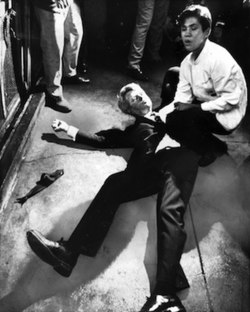
For the unfamiliar, the hashtag is for the 50th anniversary of Robert F. Kennedy's assassination by Sirhan Sirhan.

And, by whack jobs, I refer not to Sirhan Sirhan, but by assassination conspiracy theorists, many of whom are — of course — also JFK assassination conspiracy theorists.

I had forgotten that today was the 50th anniversary until one of those whack jobs, Jim DiEugenio, was given not one but two opportunities, to pontificate at Consortium News about how Sirhan Sirhan didn't do it, how Bobby was the greatest thing since Jack's Camelot sliced bread, and more.

Moldea, had I read through his piece, I would have seen that he's now rejected RFK conspiracy theories. I apologize sir, per your comment.

All bullshit, of course, other than Moldea's court correction. But, a mix of Camelot alcoholism and other things make it palatable.

Jean Romero tends RFK at the Ambassador.

See below, halfway down, on WHY Sirhan Sirhan shot RFK, his mental status at the time and afterward and more, that refute not only conspiracy theories but modern Democrats attempts to explain away the assassination, which was ultimately caused by Sirhan perceiving Kennedy as a Zionist.

We have good evidence on Vietnam that Jack wasn't leaving until he had a proven victory — and no, not the declare victory and leave schtick. We also have good evidence that the military ramp-up LBJ called into play after the Gulf of Tonkin was already on the Pentagon books well before Jack's assassination. It was probably detailed enough that he had semi-intimate knowledge of it.

DiEugenio's JFK is a puzzler in many other ways.

He's a genius on civil rights legislation, not only on how and with what timing to work Congress, contra the WTF? at that time of LBJ, but on how strong a piece to craft, despite neither LBJ nor MLK trusting him that much. As far as knowing how to work Congress, would you believe The Master of the Senate, per Robert Caro, or The Absentee of the Senate? No brainer in my mind.

Yet, this same genius, strong on how strong to be on civil rights, is also not only too weak to say no to the Bay of Pigs in early 1961 but also too weak to say no to the Diem coup just weeks before his assassination.

Well, if you'll believe that, it's no wonder you'll believe, and promulgate, conspiracy theory bullshit.

But, this is ultimately about Bobby, not Jack.

First, Bobby's 1968 political future.

Per this Politico piece, Bobby had about zero chance at the nomination. It reminds us only 14 states had primaries back then. The other states, through caucuses and conventions, were still largely controlled by "machines." LBJ made sure they stayed Humphrey.
Almost three-fifths of conventional delegates were selected by county committeemen, state party officers and elected officials, and those officials were squarely behind Humphrey.
In fact, that's why some were wondering if LBJ wasn't going to parachute into Chicago and elbow aside Hubert. And, had Bobby not been shot, he might just have done it.

And, on the ballot, Humphrey took two-thirds, not three-fifths, of the vote. Sure, some of Bobby's delegates went to him, instead of Eugene McCarthy, George McGovern, or somebody else. But, Bobby wasn't going to win, period.

(Also, there's the myth that Eugene McCarthy couldn't win Democratic primaries in minority-heavy states, which itself isn't so true, as the results show him beating Bobby in Massachusetts, Pennsylvania and New Jersey. Yes, it's true Bobby contested none of those, but that may be because he knew he couldn't win. And, Bobby was FROM Massachusetts, too. At the same time, Wiki repeats the Camelot 2.0 myth, claiming the antiwar movement was kaput with Bobby's death, which would be news indeed to McCarthy and many of his backers. [Note: He never would have released pledged delegates to Bobby, anyway. Never.])

At the same time, showing Wiki's problems with lack of editing uniformity, but further undercutting DiEugenio, in his first major campaign speech in 1968, per Wiki's piece on his campaign, he admitted:
"I was involved in many of the early decisions on Vietnam, decisions which helped set us on our present path."
Original quote from this piece, among others. Not quite either Camelot 1.0 OR 2.0. (DiEugenio accuses me of trolling in another comment to one of his pieces. If telling the truth is trolling, so be it. And, I'll get to that in a bit.)

The Politico piece also notes that if Bobby had somehow pulled off a miracle in Chicago, he might have had almost as much a George Wallace problem as Humphrey did.

Now, the Ambassador Hotel.

Sirhan Sirhan has gun in hand. He was in the right position to fire the fatal shot. He admitted the shooting. He described why he shot Bobby — over his support for Israel. (His journals are quite explicit as to all of this, too.)

Sirhan Sirhan?

Or, some lame conspiracy, or set of them, as, although less wild than with JFK, multiple RFK assassination conspiracy theories exist.

Occam's razor.

It was those four paragraphs above, with the third being simply "Or, some lame conspiracy theory?" that led DiEugenio to accuse me of trolling.

Oh, and I don't give a fuck that RFK Jr. claims that Sirhan Sirhan didn't do it. Bobby Jr. is an antivaxxer in particular and a believer in conspiracy theories in general himself.

And, some of the specific claims, like Sirhan Sirhan was given post-hypnotic suggestions and other stuff? Crazier yet.

That said? Per an essay by Moldea, Sirhan Sirhan had fired about 400 rounds with the revolver before he shot Bobby. Per Jeff Greenfield, what set him off was seeing Bobby wearing a yarmulke at an Israeli Independence Day celebration. And, that's not alt-history. The Jewish Press confirms it, complete with photo.


(Damn, I get tired of various versions of this photo disappearing. It's Bobby wearing a yarmulke at Neveah Shalom in Portland near the tail end of the 1968 Oregon Democratic Primary. In this case, that's because the Jewish Press, whether through link rot or other reasons, has disappeared the story where the previous version of the photo was.)

Anybody who doesn't believe in conspiracy theories about Bobby's death but has read much of Sirhan Sirhan's numerous parole hearings and other things will realize he'll say whatever he thinks will get him parole. (At other parole hearings, he's admitted shooting Bobby, while blaming booze or something.)


Wouldn't you?

And, the conspiracy theories, including but not limited to Manchurian candidate ones with hypnotic suggestion, have even less credibility than the JFK ones.

Even more interesting, but perhaps because it would be self-undercutting, no conspiracy theorist that I know of has proposed the most reasonable one.

And that is that some Palestinian organization — whether PLO, PFLP, or someone else — put Sirhan up to it. The undercutting would be that that would still mean he did it, unless combined with one of the actual conspiracy theories like a two-gunman idea.

Beyond that? In one of the very few true things he's uttered from prison, Sirhan Sirhan (Wiki) himself said he shot Bobby because he was a Zionist. Also, Sirhan Sirhan was NOT mentally ill. He was never legally adjudicated as such, and that's otherwise a Democrat lie.

==

Oh, although he doesn't explicitly endorse a JFK conspiracy theory in his uncle's death, RFK Jr's new book, which is a total teh suck of high-octane mendaciousness, basically claims the CIA did it.

April 09, 2015

Needed: "Appomattox Day," or better, "You Lost Day"

The New Republic sums the case up well, on the 150th anniversary of Robert E. Lee surrendering to Ulysses S. Grant at Appomattox.

First, given that a racist president susceptible to flattery via pretended groveling from his pre-war Southern "betters," Andrew Johnson, took Abraham Lincoln's already mild "rosewater policy" and gutted it, and then that the Supreme Court gutted the intent of the 14th Amendment from the 1870s through Plessy v. Ferguson, it's hard to believe at times that the South did, in fact, lose the Civil War. (Would Lincoln have done as much better with Reconstruction as some thing? I ask that in Part 1 of my sesquicentennial tribute to his death.)

But it did. And Brian Beutler is right. It should be a federal holiday, though there's less than zero chance of the current Congress making that so.

Per Beutler and a New York Times article he links, yes, we also ought to rename military installations named for Confederate generals, like Fort Hood here in Texas.

And, contra Tony Kushner and Steven Spielberg and their Lincoln movie, Lincoln was wrong. Maybe the Wade-Davis Act was too harsh, but Lincoln was too mild, and he refused to negotiate with Congress on this issue after his pocket veto of Wade-Davis. Would he, in the face of the rise of the Klan in 1866, gotten tougher? Well, he would have been tougher than Johnson, but would he have stopped downsizing the Army or even asked for more troops? Possibly not, and maybe, probably not.

For good alliteration of sorts, I've long said that Reconstruction might have worked with 200,000 bluecoats in the South for a generation rather than 20,000 for a decade.

Really, the U.S. South, without a little bit of an "iron heel," essentially promulgated its version of something like the Dolchstosslegende a half-century before General Ludendorff, Adolf Hitler and other right-wing nuts did in Weimer Germany. Beyond denying that the Civil War had been about slavery, the "Lost Cause" idea claimed that, due to various factors, it hadn't been a fair fight.

Anyway, Lee wasn't such a five-star general as the Lost Cause makes him out to be, despite even a Brit fawning over him in an awful book. He was often a poor strategist who refused to implement a semi-modern general staff for the Army of Northern Virginia. Nor was Stonewall Jackson Paul to Lee's Jesus, despite a Texas historian who isn't worth his reputation trying to claim that. (As for long marches, the Union Fifth Corps once marched 25 miles in a day to get in place for the start of Gettysburg.)

As far as Southern pre-war boasts of licking five Yankees?

Well, the US Census was conducted, per the Constitution, in 1860. You knew how much you were outnumbered. Well, you were wrong, even if you try to hide that fact in Lost Cause mythos and trailing clouds of glory.

Anyway, just like Hitler, et al, Southern leaders might have accepted the reality of "you lost" more had their been a bit more pain, as well as a bit more Reconstruction in general.

That said, the Congressional Radicals all needed to view freed slaves as human beings first, political tools second, or third. Some did have this view, but others did not. At the same time, non-Radicals in the GOP needed to get a bit more Radical. Also, outside of New England, blacks were still not just second-class citizens, but only semi-citizens in much of the North, and New England then (versus, say, South Boston today) was seemingly more enlightened precisely because there were so few blacks.

So, that part of Lincoln's Second Inaugural, lauded by me here, was partially correct. The North had its share of blame in the perpetuation of slavery — and the perpetuation of its profits, and even the push for increasing "efficiency," just like in Northern factories, as detailed in this book.

That said, Lincoln didn't go far enough. While the Second Inaugural wasn't meant to be a policy speech, nowhere before his death did he go beyond it to indicate that fair chunks of the North would need their own quasi-Reconstruction. Of course, some Radicals, and some modern historians, argue that part of that quasi-Reconstruction still may have needed to start at 1600 Pennsylvania, had Lincoln lived.

Yes, Lincoln had gotten past his colonization schemes. Yes, after listening to Frederick Douglass, he finally realized that the United States, not an African kingdom or another, was home for African-Americans. He even accepted that some of them had American ancestries older than his.

But, he still didn't understand — despite facts such as tiny, almost slave-free, Delaware having rejected graduated emancipation and Stephen Douglas' racism in 1858 — that many people in the Border States and the Old Northwest (not to mention the Irish of New York), hadn't evolved like he had over the previous four years.

And so, the failure to insist on a thoroughgoing Reconstruction — maybe not punitive, but more than "rosewater" — before his death wound up failing North and South alike.

This, though, is the bottom line. Much of what was "rosewater" was like giving an inch and the South taking a mile:

That lack of consensus was an ineluctable consequence of concerted postbellum efforts to sand down the seams reuniting the states. There was a real but inadequate constituency for crushing the Southern establishment after the Civil War, and reintegrating the country under an entirely different paradigm. Instead, the North enabled the South by giving it unusual influence over shaping the official mythology of the war. Yes, the South surrendered. The states ratified the 13th Amendment. The Union survived. These facts couldn’t be altered. But memorializing the rebellion as a tragedy of circumstance, or a bravely fought battle of principle—those narratives were adopted in part for the unspoken purpose of making the reunion stick. "You lost, we won, and we're all living in the USA," Talking Point Memo's Josh Marshall once wrote. "But we'll let you win in the battle of memory and valor and nostalgia."
Really, the U.S. South, with the "Lost Cause," was just living up to the "honor tradition" that led it to vapidly ingest the narratives of "Ivanhoe" and other Walter Scott novels, and otherwise claim to be Cavaliers, etc. These narratives were ready at hand to the South. (And, speaking of honor, and that book about the profits of slave capitalism? Southern "honor culture" hates nothing more than Southern-born whites writing about these things.)

Beyond that, as far as Southern "nobility"? It's easy to point a finger at Nathan Bedford Forrest and the slaughter of surrendered black soldiers at Fort Pillow in 1864. And, Southerners today probably wouldn't try to defend him. But, it's also easy to point a finger at Lee, watching wounded black soldiers at the end of the Battle of the Crater, during the 1864 Petersburg campaign, be bayoneted while he refused to intervene.

Beutler is right that a federal holiday for April 9 is unrealistic today.

But, we can rename those 10 forts, Fort Hood and others. "Fort Colin Powell" immediately comes to mind. We can stop federal dollars going to Confederate monuments. And, the rest of the nation in general can stoop kowtowing to Southern attitudes.

Beutler is kind enough to suggest "New Birth of Freedom Day" rather than either my straightforward or hard-core realism alternatives. But, I stand by his ideas — except, a bit, for making this part and parcel of American exceptionalism, which he hints at near the end.

And, while I've saluted Lincoln's Second Inaugural for questioning American exceptionalism, nascent at his time, and given an overall salute to the Lincoln movie, I stand by my caveats to that movie, too. Indeed, Lincoln was perhaps, like John Kennedy, lucky he died when he did. Unfortunately, he had the wrong Johnson as his vice president.

March 15, 2015

Harry Truman and national health care

A lot of people know that business organizations and the American Medical Association opposed Truman's national health care push. They don't realize that organized labor did as well .

But it did. As discussed in the great new book "The Age of Acquiescence," per my review, the New Deal "settlement" between labor and management-ownership in America was that organized labor would accept the financial settlement of wage gains and benefits offerings (which became more important during World War II with wages generally frozen or nearly so), in exchange for eschewing German-type unionism of sitting on corporate boards (see Volkswagen of America today) and other broader attempts to alter the labor-management power relationship.

So, in Truman's time, the bennies, including good private health insurance, that came with a union job, as well as the pay itself, were a recruiting incentive, and one that organized labor wasn't going to surrender, not even if this helped change the labor-management power relationship to the working man's benefit in general.

Even with LBJ's moves, and without formally stated opposition by organized labor, surely this is why he settled for Medicare and Medicaid. Senior citizens normally are retired and therefore not candidates for union job recruitment. Poor people are working in low-paying non-union jobs, if working at all; also, therefore, not part of organized labor's orbit.

That said, Truman was proposing something more than just national health care. He wanted a federal hospital oversight agency, and a federal form of workmen's compensation for work time lost due to medical treatment. That said, the Truman Library claims that organized labor was in support, but this is the first time I've seen such a claim. I've generally read elsewhere that, if not opposed, it was no more than neutral.

Anyway, the combination of ideas in the bill might have been better than just single-payer health care.

Why?

First, Truman probably could have said that, if surgery were needed, it would only be compensated for if performed at an accredited hospital. That, in turn, would have opened the door to federal pricing controls, including saying "no" with a capital "N" to outrageous pricing by Big Pharma.

(Today, the JCAHO only partially performs the accreditation idea, and as a private agency, doesn't have the same teeth that a federal regulatory board would.)

March 04, 2015

Lincoln rejects American exceptionalism and divine anointing

One hundred fifty years ago today, Abraham Lincoln challenged John Winthrop's (and later, Ronald Reagan's and today's religious right) idea that America was a "city on a hill." And, though this term wasn't around, arguably he at least indirectly challenged American exceptionalism.

First, Lincoln’s Second Inaugural Address, if anything, rejects the occasional off the wall claim, whether by some modern Gnu Atheists or his old law partner, William Herndon, that Lincoln was an atheist. Even when clerking with Herndon, he wasn’t; his “Doctrine of Necessity” pegs him as being something like a Deist run through a Calvinist filter.

But, by the time the Civil War was nearing its conclusion, even if he were not an “orthodox Christian,” he had become more religious than before, not less.

Let’s get to the meat of his Second Inaugural, which will show that, as he talks about the two sides in the Civil War.
Both read the same Bible and pray to the same God, and each invokes His aid against the other. It may seem strange that any men should dare to ask a just God's assistance in wringing their bread from the sweat of other men's faces, but let us judge not, that we be not judged. The prayers of both could not be answered. That of neither has been answered fully. The Almighty has His own purposes.
Since the Old Testament positively detailed slavery, and the New Testament had Paul telling Onesimus (and other unnamed slaves in other authentic writings of Paul) to accept slavery because the eschaton was near, Lincoln’s “strange” is interesting. I see it as being in part a rhetorical trope. Yet, I see it as being literally meant, as well. And Lincoln knew his bible well enough. This shows that he, whatever his religious background was at this point, was not a fundamentalist.

But, back to the main point. Because neither was fully right, and (taking Lincoln’s assumption of a divinity as fact for the sake of this piece), neither was fully granted its boons sought in prayer, a “divine anointing” of America, i.e., a city on a hill, simply wasn’t true. Nor was it true back in 1600s Massachusetts.

After all, Winthrop’s own Massachusetts explicitly legalized slavery in 1641. It was never huge, but it was about 2 percent of the population in the middle of the 1700s. And, as both Lincoln and Southerners knew, Massachusetts ships transported many of the South’s slaves from Africa. (And, Massachusetts never did formally and legally abolish slavery within its own borders until passing the 13th Amendment.)

So, if slavery were wrong, by some non-theistic natural law and morals, or whatever, Winthrop's city on a hill wasn't one so much.

And, further undermining at least the idea of American exceptionalism? This:
He now wills to remove, and that He gives to both North and South this terrible war as the woe due to those by whom the offense came, shall we discern therein any departure from those divine attributes which the believers in a living God always ascribe to Him? Fondly do we hope, fervently do we pray, that this mighty scourge of war may speedily pass away. Yet, if God wills that it continue until all the wealth piled by the bondsman's two hundred and fifty years of unrequited toil shall be sunk, and until every drop of blood drawn with the lash shall be paid by another drawn with the sword.
Divine justice, more than a denial of American exceptionalism, to be sure.

However, it is also a denial of American exceptionalism. If America were that exceptional, then it would not need to be so chastised by a deity as to learn again that:
(T)he judgments of the Lord are true and righteous altogether.
Now, some Christians of the conservative stripe may try to stand that on its head, and claim that the amount of chastisement god delivers to America is proof of his special love for America, and thus, as his city on a hill, its exceptionalism.

Hmm … Second Isaiah tried the same tack for post-exilic Judah. And, it was also wrong. And proven to be wrong by those post-exilic people.

As for Lincoln? He wasn't perfect, and he wasn't a 2-dimensional plaster saint, nor even the 2.5 dimensions that Spielberg made him. But, he was our best president and this shows why.

Meanwhile, 100 years later, Lyndon Johnson followed up on Lincoln with his "Selma" speech, explicitly calling for full civil rights for African-Americans — and Hispanics.

February 20, 2015

The problems with Selma

There's a bunch of stories out there about historic accuracy problems with the movie Selma. Rather than chase a dozen links, I'll post one from Truthout, that's about Selma and two other movies, one of them not in the Best Picture running, and go from there.

First, Selma's not the only big-history picture to deliberately alter history for drama; famously or infamously, Steven Spielberg de-unanimized Connecticut's Congressional vote on the 13th Amendment.

That said, that was different than this; it didn't fundamentally change the perception of a main character in the movie.

By claiming LBJ sicced J. Edgar Hoover on Martin Luther King, though, Selma does exactly that.

First, it's pretty clear that LBJ had no advance knowledge of Hoover's "tomcat" letter to King, in which he attempts to force King to drop his civil rights work, perhaps even commit suicide. It's not clear how long after it was sent, in fact, that LBJ knew about it.

Second, if anybody sicced Hoover on King, it was the Kennedys.

Third, since LBJ had as much trouble keeping his pecker in his pants as did Jack Kennedy, Hoover had the drop on him. If LBJ had known in advance about the "tomcat" letter, he might have acquiesced. Not that that would have been good, it's just the reality. (Sidebar: Presuming the homosexuality rumors about Hoover are true [deliberately not using the word "gay"], he obviously kept it buried through a mix of discretion and of having the goods on anybody who seriously thought about trying to leverage him.)

At the same time, the movie's handling of this is part of how it gets King wrong.

King didn't let this letter stop him from involvement in the second Selma march. Rather, that march didn't have a green light from a federal judge, so King wouldn't march, beyond the famous "turnaround," discussed in Wikipedia's overview of Selma 1965. This had nothing to do with Hoover's letter, and everything to do with details of King's nonviolence strategy, and not breaking the law when breaking the law would have hurt the movement.

And, thus, one error becomes compounded into two. Or more.

In turn, that seems to be part of larger problems with Selma the movie's treatment of King, and of King vis-a-vis other parts of the civil rights movement.

Basically, the movie underplays the level of distrust between King, and the likes of James Forman and others from SNCC, from what I understand. So, we get a sanitized view of the civil rights movement, along with a Manichean view of LBJ vs. MLK.

I also find this response, noted in the Wikipedia article about the movie, disturbing:

Director (Ava) DuVernay and U.S. Representative John Lewis (whom she portrays when a young man) responded separately that the film Selma is a work of art about the people of Selma, not a documentary. DuVernay said in an interview that she did not see herself as "a custodian of anyone's legacy". In response to criticisms that she rewrote history to portray her own agenda, DuVernay said that the movie is "not a documentary. I'm not a historian. I'm a storyteller". Lewis wrote in an op-ed for The Los Angeles Times: "We do not demand completeness of other historical dramas, so why is it required of this film?"
Actually, we do, John. See my note above about Lincoln. That was just one of several errors or issues of framing which drew a lot of critical comment, as Wiki notes. The opening scene, with Lincoln talking to the black soldiers, face to face, also drew potshots, as did the issue of whether history had been, in general, sacrificed on the altar of drama. That said, at least Lincoln offered an honest portrayal of the passage of a major Congressional action.

And, DuVernay's own comments indicate that she seems to have a postmodernist view of issues of historical accuracy, with her "accurate to whom?" comment. Besides that, she admits that it was about drama, and her own drama, when she says elsewhere that it's about "what I feel about LBJ."

LBJ was a bastard in a number of ways. And, after his falling out with MLK over Vietnam, he may have pulled some of his punches on civil rights, though he did manage to ram the Fair Housing Act through Congress in 1967.

When we're still far from being a post-racial nation, making out LBJ to be the bad guy doesn't help issues. Distorting what King's nonviolence angle was about doesn't help matters, either. Nor does making it look like Selma was a "King show" through and through, along with papering over both diversity and dissent in the civil rights movement.

Because this is an issue that's more ongoing than the legal end to slavery via the 13th Amendment (albeit Lincoln's larger legacy, and how much Andrew Johnson misunderstood it, or understood it correctly is still an issue), the Selma movie inaccuracies are also more potent than the Lincoln ones.

And, not all critics, or at least one Oscars voter, like the movie as art, either, and the narrative flow of the movie may add gasoline to that, too.

Is it a bad movie? I don't think so.

Could it have been an even better movie, within the budgetary, independent film constraints? Yes. Both more historically accurate AND, I think, more dramatic.

And, claiming that its critics are "smearing" the movie? Comes close to the social justice warrior POV, to me.

September 08, 2014

#Watergate: Jerry Ford proved his political ineptitude 40 years ago today

Lydon Johnson had a number of cracks about Gerald Ford, including that he had played football without a helmet too much.

Well, I am reminded of that today, as this is the 40th anniversary of Ford pardoning his predecessor, Richard Nixon, for crimes he may have committed in relation to Watergate. I'm old enough to remember the actual announcement, and the controversy, as well as both my parents somewhat believing, if not necessarily totally, that Nixon had done was no worse than anything of LBJ (possibly halfway true, on a state-level scale, with Landslide Lyndon of 1948 fame) or Jack Kennedy (probably not so true; both parties committed vote fraud in 1960). That said, neither JFK nor LBJ pulled an Anna Chennault out of their hats, and given that some aspects of Watergate are connected to what Tricky Dick thought LBJ knew, and had on the record, about his Logan Act violations in late October 1968, illegalities that would extend the Vietnam War by several years and kill an extra 20,000 US troops, no, mom and dad, Nixon was far worse.

That said, especially as an adult, with hindsight, I can't figure out why Jerry Ford couldn't at least wait two months until after the midterm elections were past. Even if (unlikely) Nixon was formally indicted before then, no legal proceedings would have started.

The GOP still would have taken a midterms bath, but maybe held 1 or 2 more Senate seats, and 5-7 House seats, than in reality.

And, how could he not think that the general public, and not just Democratic Party PR, would raise questions of Ford entering into a tradeoff with Nixon. Given that we know that resignation crossed Nixon's mind, if but briefly, before the resignation of Spiro Agnew as Veep — with Ford then of course replacing him — the question certainly wasn't illegitimate. In fact, in writing histories of Ford, of Nixon, and of Watergate today, it's still not illegitimate.

That said, this was one of a trifecta of gaffes that sank Ford's 1976 re-election chances.

The swiftness of the pardon kept alive rumors of such a bargain, which in turn helped fuel Jimmy Carter's "clean" campaign. Given the relatively closeness of the race, this magnified Carter's strengths and diminished his weaknesses in the Democratic primaries as well as the general election.

Then, there was Ford's famous "drop dead" to New York City in 1976. Combined with booting Rocky as his Veep, that guaranteed he'd lose New York State.

Add to that the claim that "there is no Soviet domination of Eastern Europe," in the second presidential debate, and East European "ethnics" in the Rust Belt loosened their allegiance. Ford added to that by stubbornly refusing to admit for several days that he had made a misstatement, offering up the traditional de jure US stance on Eastern European affairs instead of the de facto stance about reality on the ground.

Ford wound up losing Ohio and Pennsylvania as well as New York. Ohio was decided by one-third of one percentage point, and Pennsylvania by less than three percentage points. Ohio plus four other electoral votes (assuming the "faithless elector" from Washington State who voted for Reagan would have gone for Ford) would have given Ford the election. Given that Ford lost Wisconsin, which also has a lot of Eastern European "ethnics," by about 1.75 percentage points, there's the election right there.

Fortieth anniversaries of historic events usually have a few people alive from the original.

The Watergate 40th anniversary events take more life today, as only two principals remain alive.

John Dean, as I noted in my review of his new book, seems as much a liar as 40 years ago, and Gordon Liddy is, if anything, even more mentally unhinged today than then.

August 22, 2014

The perils of Obama vs LBJ and Congressional Democrats

I'm going to basically thumbs-up, with brief commentary, two pieces by friend Perry.

The first is from the last part of the header. It's about how Congressional Democrats will run with about anything and anyone with a D after the name or idea — as long as the name isn't Obama.

When you're giving the professorial version of the cold shoulder to as valiant of an ally as Harry Reid, it's both bad and sad. It's even worse when, in this case, he's fighting for confirmation of ambassadors that Obama nominated.

I saw this as part of his MO long ago. So did one chronicler of his first-term White House years, Ron Susskind in "Confidence Men." The man is so anti-political in some ways that, other than his hubris that his mellifluous voice could change how American politics works, or perhaps a bucket list that had "first black president" on it, or some Freudian wish-fulfillment for his mom, I have no damned idea why he even ran for the office.

Hell, for all I know, Obama doesn't have a clear idea himself; that wouldn't surprise me either.

The second is about why isn't Dear Leader like LBJ?

Perry riffs on a good column by Matt Bai, who in turn riffs extensively on LBJ biographer Robert Caro.

I agree that most Dems don't want LBJ's jerkitude, while a lot of Republicans like that. That said beyond (as a political operative, not political stances, where he rightly dings both) unfavorably comparing Dear Leader to Hillary Clinton, we can have somebody tougher than Dear Leader in a lot of ways without being a jerk.

And so, with that, as I told Perry, why isn't Obama at least a bit more like LBJ?

Because, to riff on an old LBJ phrase, Obama put his pecker in someone else's pocket long ago.

May 30, 2014

Texas early post-runoff election rumors

Kinky Friedman, moving from campaigner to general gadabout (for now), has reportedly borrowed an idea from Dan Patrick for his latest border-patrolling idea. Rather than "Five Mexican generals" being bribed to patrol the border better, it's "Five Mexican generals with bars of Ivory Soap" to keep out stinky Ill Eagles. A Texas Ranger will patrol for stinky Mexicans already here and report direct to The Stinking Anglo Formerly Known as Danny Goeb™. (Feel free to borrow.)

Joe Straus reportedly has bought a tranquilizer gun and Taser, and they're both located under the Speaker of the House's podium, within easy reach, just in case possible future Lt. Gov. Danny Goeb needs to be "managed" if he's ever in the Texas House. There's no word if he has a psychiatrist on cellphone speed dial.

Patrick, meanwhile, would reportedly set strict conditions on debating Democratic lite guv opponent Leticia Van de Putte. He allegedly would ask her to pass a "clean Mexican aroma test." Mental health issues were not going to be allowed to be part of any debate, he allegedly said.

Van de Putte, meanwhile, was rumored to be taking a page from LBJ's famous 1964 campaign against Barry Goldwater, namely, a slogan: "In your guts, you know he's nuts."

David Alameel may have been overheard saying that he would spend "whatever it takes" to not lose to John Cornyn by more than 15 percentage points. 

Ken Paxton allegedly decided he would take Alameel's self-financing Senate campaign one better in his run for state AG. There were rumors he was discussing setting up a private trading site where he could sell investment shares in his campaign.

Greg Abbott denied rumors that The Stinking Anglo Formerly Known as Danny Goeb™ had asked if the wife that Abbott had recently discovered to be Mexican-American stank. He also denied rumors that he threatened to run over The Stinking Anglo with his wheelchair if The Stinking Anglo ever talked about his wife again.

May 27, 2014

Texas GOP leaders comment on runoff elections

Texas Republican leaders took stock of where the party stands for the general election after Saturday's runoffs.


Rick Perry said: "What happened to the good old days when a college cheerleader with alleged homosexual tendencies could get nominated for governor? NO, not me. Didn't that guy before me cheer at Yale? Besides, I don't paint." After that, he was told to shut up, on advice of counsel who realized his pain meds were on overdose and thought something Perry might say would guarantee a first-degree felony indictment.

Ted Cruz said: "I applaud Texas Republican voters for nominating the moderate conservative Dan Patrick to run for lieutenant governor. I will do anything I can to help make him as solid in conservativism as I am."

John Cornyn said, "I believe exactly what Ted Cruz said. But I deny that I said that because I have voluntarily put his pecker in Cruz's pocket."

David Alameel said: "I'm not a Republican any more, but I used to be one, before the party got too conservative for me and I saw what I thought was an easy, vanity-fueled chance to run against John Cornyn, who still won't give me a refund on my old campaign donations."

Kesha Rogers said: "I'm just a crazy fucking loon. I'm crazy enough I should be a Republican, although I'm not."

Louie Gohmert said: "I'm glad I didn't face a runoff. Someday, there's going to be a stealth religious conservative who tries to run to my right. And we'll find out he's a dark-skinned stealth Mooslim like that Bobby Jindal guy."

Greg Abbott said: "Oh, Lord? Ken Paxton beat Dan Branch in the attorney general runoff and I have to face five months of possible questions as to why I, the current AG, never noticed any of his securities violations." He then denied he had a double standard on law enforcement and said it was a dirty liberal trick to talk about him and a  "stand"-ard for anything.

Dan Patrick said: "I'm grateful to be mentioned by Ted Cruz and in the same breath as him. I promise my statewide campaign supporters that no stinking Ill Eagles will pick up your old signs or set out new ones. Patrick also admitted that the hard campaign left him facing "fatigue and exhaustion," while saying he would be outraged by any blogger that suggested a fitting headline for his win would be: "GOP nutbars nominate true-blue nutbar."

David Dewhurst said: "I can't even have gay lieutenant governor rumors. How low has my career sunk?" He then went off to play 36 holes of golf at River Oaks Country Club, hoping to spot one of the Ill Eagles  Patrick allegedly hired long ago at his sports bar, who might caddy for cheap.

Jerry Patterson said: "I'm sorry my endorsement didn't help David Dewhurst get the lieutenant governor's nomination." He then asked the Dew if he wanted him to whip out his hogleg and scare the shit out of Patrick. Like one of the guns in the video below ...


Ken Paxton said: "I'm glad that the people helped by my under-the-table financial genius were enough to get me nominated." He then offered to cut Dan Branch in on a venture capital sweetheart deal.

Ralph Hall woke up from his nap and said: "I'm glad to be a part of the leadership of the Democratic party in Texas." His staff didn't have the heart to tell him the election results, let alone that he was either Rip van Winkle or else was showing the onset of senility.

Abbott and Patrick were both asked, since Abbott recently discovered he has a Mexican wife, what they thought about Patrick using the phrase "dirty Mexican" in the past. Patrick said that because he was facing fatigue and exhaustion, just as he said he was at the time he talked about a "dirty Mexican," he was unable to answer. Abbott threatened to stand up and punch Patrick even as his right arm started doing some Strangelovian crazy behavior.

Joe Straus said to himself, under his breath: "Good Lord, this means I have to run the Lege along with Dan Patrick?" He then said, doubly under his breath, "Well, at least Patrick didn't lose; we might have had to put him on suicide watch again."

April 25, 2014

Texas GOP discusses Cliven Bundy

Texas Republican leaders were quick to defend Nevada rancher Cliven Bundy, even before the librul media called him "sort of a welfare queen in a cowboy hat."


Rick Perry said that he couldn't say much of anything, on advice of counsel retained over the Public Integrity Unit veto, lest he be misinterpreted as intimidating somebody.

Ted Cruz said that the Bureau for Land Management reminded him of Castro's Cuba and therefore it was socialistic for trying to deny Bundy the right to freely appropriate land in the most libertarian of ways, by paying nothing for it. As for Bundy's talk about lazy Negros vs. hard-working Hispanics with better family structures than many whites, Cruz said, "Duh, look at me!"

John Cornyn said what Ted Cruz said because, per Lyndon Baines Johnson, Cornyn has voluntarily put his pecker in Cruz's pocket.

Louie Gohmert said "BLM? Blacklands Management? Black Land Management? Black Lazy Malingerers? Oh, yes, I agree with Bundy."
But he then qualified that, saying Hispanics only pretended to work hard until their first US-born anchor babies arrived.
Greg Abbott tried to claim the BLM was in the process of stealing millions of acres of Texas land when it actually has almost zero land in Texas. He then promised that questions about eminent domain for Keystone XL was just a trick by environmentalists to get him to mention that Earth Day was this week. He claimed that questions about seizure of the YFZ Ranch, knows for its previous fundamentalist Mormon ownwers and their underage marriages, was just a trick to remind people of Ted Nugent and underage girls. He then promised to tell even more lies about the BLM as preparation for his next suit against Obama. When asked about how he could have such apparent double standards, he said it was a dirty liberal trick to talk about him and a  "stand"-ard for anything.

He did add that Bundy was totally right about Hispanics. He said the Mexican-American wife he had recently discovered he had after 30-some years of marriage was proof of that.

Dan Patrick said Bundy was wrong about Hispanics. Although continuing to ignore his own getting some Ill Eagles to do lots of work for cheap, he said he knew that they stink and were contaminating America. Patrick said "no comment" if he had personal knowledge of the "contamination" from contracting venereal disease from a Hispanic.

David Dewhurst said he agreed that Hispanics were hard workers at every country club where he was a member. He said he was unfamiliar with Cliven Bundy, and wondered if he was related to Peg or Al Bundy.

Jerry Patterson promised to defend the Red River against Oklahoma and the BLM with the hogleg in his boot. He then invited Bundy to Texas, as long as he brought all his guns, and said he'd find Bundy land in the Christmas Mountains.

Ken Paxton touted his under-the-table financial genius, saying he would incorporate Bundy's ranch and sell stock to investors.

Joe Straus said to himself that he wished someone would let the air out of Abbott's wheelchair tires.

April 10, 2014

Texas GOP responds to LBJ civil rights 50th anniversary event

Former presidents Barack Obama, Bill Clinton, Jimmy Carter, and some Republican guy named W. all spoke in Austin yesterday and today at the 50th anniversary of President Lyndon B. Johnson campaign for civil rights.

Carter said we can't use the idea that "LBJ did it" to excuse us from not continuing to do the work that's still needed today. Clinton acknowledged his political debt to LBJ. (That said, Carter in pandering to Reagan Democrats in 1976 already, and Clinton in things like crack vs. powder cocaine, saw the light more after they finished their presidencies than before.)

But, even though that W. Bush guy is a Republican, and gave the finale of the presidential speeches, that doesn't represent all Republican opinion in the state. Because he's a squish and a liberal and not a true conservative, you know.

Rick Perry says that talk of civil rights is an attempt to distract from his record as Texas' job creator in chief. He said his record shows he favors full civil rights for all minimum-wage, no-benefits jobs.

Ted Cruz said that civil rights today is a code word for affirmative action which is a code word for quotas which is all about socialism. Besides, Cruz says, since the bible says there is no Jew or Gentile, that means that Jesus knows we don't need civil rights, especially since the Old Testament warns us not to mix different kinds, including not mixing "chosen" and "unchosen" people, you know?

John Cornyn repeats what Ted Cruz said because, per LBJ, Cornyn has voluntarily put his pecker in Cruz's pocket. Per Ted Cruz's bible-quoting and Cornyn's pecker-surrendering, Cornyn refuses to tell us whether he's circumcised or uncircumcised.

Louie Gohmert says complaining about civil rights is a plot to steal the precious bodily fluids of good, upstanding people who just happen to have upstanding race, gender and skin color.

Greg Abbott (who may again be MIA) says we can't afford pre-kindergarten, let alone full-day pre-K, for all students in our state until we do a rigorous cost analysis of the benefits. That cost analysis will include figuring out which of today's 4-year-olds is most likely to vote be allowed to vote, especially under terms of his proposed Vote Improvement Protection —Access Security System. (There's an acronym for that.) Abbott also indicated he has a "highly respected" educational guru to help him do all this. Beyond looking for valid drivers licenses and administering pre-1964 style poll tax questions, the (read the acronym) allows all voting stations to ignore the Americans with Disabilities Act for all voters under the rank of Attorney General or retired Attorney General. When asked about how he could stand for such blatant favoratism, he said it was a dirty liberal trick  to ask him to "stand" for anything.

Dan Patrick says getting some Ill Eagles to do lots of work for cheap, because they're Ill Eagles, doesn't violate their civil rights, because they have none, since they're Ill Eagles.

David Dewhurst says he agreed with all of the above in spades, because Ted Cruz put the Dew's pecker into a pig in a blanket 2 years ago. He added that he favors civil rights for (the grounds crew employees) at any country club where he is a member, and then asks Dan Patrick if he's got any phone numbers.

Jerry Patterson although previously promising to give women all the guns they want, is silent, then starts randomly waving his gun in the air and shooting.

Joe Straus says to himself that he is damn sure glad that Jewish counts as white with a fair amount of Republicans today.