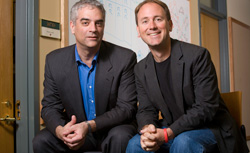
SocraticGadfly: pulling a Chris Mooney
Showing posts with label pulling a Chris Mooney. Show all posts

March 11, 2014

Are conserv-lib diffs genetically rooted? Not as much as Mooney implies

Chris Mooney/Wikipedia
Chris Mooney, he of "motivated reasoning" discussion, reviews here two books that discuss this issue. They are "Predisposed: Liberals, Conservatives, and the Biology of Political Differences," by John Hibbing et al, and "Our Political Nature: The Evolutionary Origins of What Divides Us," by Avi Tuschman.

The biggest caveat? Mooney never claims that evolution does select for political differences, but let's make that clear, because he wants to have his cake and eat it on this issue in general, specifically concerning political conservativism. The titles of the two books should indicate that.

So, again, let's be clear.

Evolution does not "select" for political differences. Psychological differences that are part of political differences, like anxiety/neuroticism, openness to experience, etc., may well be selected for, but political experience is not. That's just like religious belief is not "selected for," but rather, things like pattern recognition and agency imputation, which likely are selected for, become part of an overarching system that develops into religious belief. Mooney does halfway acknowledge this, as I note below, but, it's cursory, and probably not even halfway.

And, in terms of sexual reproduction, evolution certainly selects for many things, not just five personality issues.

Let's start right here with what's wrong:
Again and again, when they take the widely accepted Big Five personality traits test, liberals tend to score higher on one of the five major dimensions—openness: the desire to explore, to try new things, to meet new people—and conservatives score higher on conscientiousness: the desire for order, structure, and stability. Research samples in many countries, not just the U.S., show as much. And this finding is highly consequential, because as both Hibbing et al. and Tuschman note, people tend to mate and have offspring with those who are similar to them on the openness measure—and therefore, with those who share their deeply rooted political outlook. It’s a process called “assortative mating,” and it will almost certainly exacerbate our current political divide.  
First, men and women pair up for many reasons other than political inclinations. That includes perceived health by facial and bodily similarity, fat deposits in certain parts of the body (ahem), perceived ability to be a provider and much more. Note that those items I all spelled out are all purely physiological. No psychology involved.

So, once again, per the eponymously named (by me) intellectual shortcut, Mooney appears to be "pulling a Mooney."

If political inclinations were a primary driver of human mating, we'd see a lot more division than we currently do.

This is more nuanced than some of Mooney's writing on this issue, but not fantastic.

So, on to more counterpoints.

First and foremost?

What's heritable is a tendency, nothing more. And, while 40 percent (if correct, and that number is nothing more than a guesstimate) is significant, it's still less than half of 100 percent. There are a number of traits we know of, that a genetic tendency toward which has a 40-percent basis. And, I'm sure that 40 percent is high. If we take the five-type personality profile, as an example, and insist that the composite of all five types has a 40 percent heritability factor, each individual factor would have to be more than 80 percent heritable, if we're using the basic "and" conjunctiveness. (Do the math yourself.) Even if we allow for some looseness of overlap, and not a strict "and," still, for all five types to be 40 percent heritable as a chunk, the individual ones would still have to be at least 65 percent heritable, and NO human trait is that heritable.

Even if I re-read Mooney's reading of Hibbing to claim that each factor individually is 40 percent heritable, I'm still skeptical. Read the next few paragraphs for details.

Related to that is the fact that the five-type test, while perhaps better than the MMPI, is not the be-all and end-all of psychological research on personality types.

Related to that? None of the studies in either of the books Mooney reviews appear to make any allowance for epigenetics. None. In the case of neuroticism, a large part of which is anxiety-related, we know from lab animal experiments that there's an epigenetic, as well as a genetic, component to heritability of anxiety.

Indeed, that's an issue with twin studies, which are supposed to be the gold standard. Identical twins (setting aside chimera issues) not only share the same genes, but, vis-a-vis even fraternal twins, depending on the date of twin division of the original single egg, identicals may share a more similar womb environment, if it includes a single placenta or single amniotic sac. (Identicals, depending on date of division, may have separate amniotic sacs and placentas, one sac but separate placentas, or share both.)

Related to that? Even on the genetic side, we're still in the Neolithic, or at best, the Early Bronze, on pairing specific sets of genes (no single-gene claims for personality factors need apply) to heritability of personality factors.

This is a big failure of proponents of personality testing in general. It's another reason why, while I say that the five-type personality spectrum is better than the MMPI, it's not the be-all and end-all. It's probably not that on how it divides personality and what it considers as the most important aspects of personality. It's certainly not that on its explanation of how these differences arise. Wikipedia's article on the Big Five, while not exhaustive, is a good starting point. It notes, outside the "criticisms" section, that the five factors appear to not be total cultural universals, despite implications otherwise on Mooney's story.

Mooney does caveat the evolutionary angle, to be sure:
Moreover, in evolution, some things happen for an explicitly Darwinian “reason”—traits become more prevalent or fixed in populations because they advanced organisms’ chances of survival and reproduction in a particular environment—while others happen more accidentally. Some complex social traits may emerge, for instance, because they are a fortuitous by-product of other, more fundamental traits laid down by Darwinian evolution.  
He notes religion as a good "spandrel" example.

However, Hibbing then claims conservativism is probably the "default." Why? Because Hobbes, and life is "nasty, brutish and short."

It was 5000 BCE, after the invention of agriculture, to be sure. But, not to read too much into "The Gods Must Be Crazy," maybe it was NOT so in, say, 25,000 BCE. That's a failure of Hibbing more than Mooney, but it's also a failure of Mooney for not making this observation himself.

He then goes on to Tuschman's book. Problems are to be found here, some of which Mooney notes. The biggest is that Tuschman may be advocating group selection as a partial explainer. As an educated layperson, I'm not dead against the idea, and think some evolutionary biologists who are, are likely wrong. But, it's still controversial. But, Mooney notes it's not clear that he does advocate this.

Mooney does say:
In the end, Tuschman’s book attempts a feat that those of us monitoring the emerging science of politics have long been waiting for—explaining the now well-documented psychological, biological, and genetic differences between liberals and conservatives with reference to human evolution and the differential strategies of mate choice and resource allocation that have been forced on us by the pressures of surviving and reproducing on a quite dangerous planet. It may or may not stand the test of time, but it certainly forces the issue.
That said, Mooney seems to want this to "force the issue." I've documented that above well enough, I think. It's part of his history.

Beyond that, "liberal" and "conservative" in the US exclude libertarians. Arguably, Mooney's reasoning does in other countries as well. Germany's Free Democrats, and possibly Britain's Liberal Democrats, would reject being put in either half of Mooney's dichotomy. 

And, that's not all. On to a few other points, with briefer discussion.

Another part of his history is to want to wrong-foot conservatives on this issue. Specifically on some subpoints, like this:
Being defensive, risk aversive, hierarchical, and tribal makes sense when the threats around you are very real and immediate.
So, our second point? Liberals are arguably just as tribal as conservatives. The "social justice warrior" movement, especially as illustrated by a group like Atheism Plusers, is Example No. 1 of this, with phrases like "mansplaining" and online actions like the Twitter add-on of the Block Bot, all while blaming only "the other," often very broadly defined, for the problems and actions involved. Since Mooney has recently moved the online location of the Point of Inquiry podcast because of said tribalism, he knows this full well. He refuses to discuss or admit this, but it's true. Indeed, what I call his "wrong-footing" is itself a tribal action.

In their book "Blindspot: Hidden Biases of Good People," authors Mahzarin Banaji and Tony Greenwald show, with social-psychology research, how self-professed liberals can exhibit, unconsciously, "tribal" behavior toward people of other racial groups, the opposite sex, the elderly and people of different sexual orientation.

Related to that? Again,the Big Five factors don't totally translate within the developed world. Even less do "conservative" and "liberal. In the non-WEIRD portions of our world, say, a New Guinean tribal chief, he'd scratch his head over this discussion.

Third? "Conservative" and "liberal" aren't "conservative" and "liberal."

Let's get back to this quote:
Being defensive, risk aversive, hierarchical, and tribal makes sense when the threats around you are very real and immediate.
Behavioral psychologists like Daniel Kahnemann and Amos Tversky have shown that we're ALL risk-aversive in many ways, like fearing a small financial loss more than salivating over a possible big gain.

Mooney knows this, too, I'm sure, even if he doesn't want to tie it in with his discussions.

Fourth? As I've indicated above, and on previous posts about Mooney, and occasionally about personality psychology in general, the Big Five is NOT the be-all and end-all of personal psychology study. I'm afraid that a number of people, including Mooney, obviously, are making it into a new MMPI, though. In reality, approaching vs. avoiding temperaments, people driven by intrinsic vs. extrinsic motivation (which partially overlaps Jung's old introvert and extravert) and other takes on personality reveal things the Big Five doesn't.

And fifth? Along the lines of David Hume, is does not equal ought. People do change political and social allegiances, just like religious affiliation.

In short, while it's not quite Pop Ev Psych, it's in the neighborhood. And, while it's not the worst example of scientism I've seen, it is an example.

On personality profiles and related areas of psychology, Mooney either doesn't know that much about all the science issues that are at stake, or else he's cherry-picking. I'm sure the latter is part of it, based on his previous writing on political differences. But, I don't think that's all of it.

He's good on things like climate change, but on psychology in general and personality psychology in particular, I think there are some understanding deficits, too.

And, the more he writes on this, the worse he gets. I've written a lot about him on this issue; click the "pulling a Chris Mooney" tag (not totally about him, but primarily so) for more. There's no other way to put it, other than to say that "worse" is, in my opinion, a tribalism-based "worse."

November 16, 2013

Conspiracy theories to the right of me, conspiracy thinking to the left ...

With apologies to Stealer's Wheel's Steve Miller's song, "Stuck in the Middle with You," and with no apologies to Chris Mooney's insinuations that people of the political right are more likely to engage in "motivated reasoning" than those of the political left, our latest conspiracy theory?

The tea partiers are allegedly behind a would-be takedown of Obamacare's federal exchange website, conspiracy thinking most recently fostered by a selective reading of a Department of Homeland Security staffer's statement about cyberattacks:
A top Homeland Security Department official testified Wednesday that there have been approximately 16 cyberattacks on the HealthCare.gov website and one "denial of service" attack that was unsuccessful.

The testimony by Roberta Stempfley, acting assistant secretary of homeland security's Office of Cybersecurity and Communications, was the first public  acknowledgement by an administration official that there have been any cyberattacks on the Obamacare website.
However, there are several problems here.

First, it ain't serious. I knew that, before I read further. Just sixteen cyberattacks? I figured that wasn't much for a large federal government website. And, I was apparently right, as reading further confirmed.
On Wednesday, another department official admitted there had been “confusion” over statements on the issue, but added, “None of these incidents were considered significant. There have not been any reports … of any successful attacks on the HeathCare.gov website to date.”

The official noted, as a comparison, that DHS had recorded “approximately 228,700 cyber incidents” during the last fiscal year, “an average of more than 620 per day, involving federal agencies, critical infrastructure, and the department’s industry partners."
But, yet, many an Obamiac type says something to the effect of, no there has to be more.

Well, there isn't. And, the fact that there isn't, while many people want to believe there is, is yet another reason why, although I'm a left-liberal of some sort, at least in American terms, I regularly stress I'm a skeptical left-liberal.

Second, we don't even know who's behind the miniscule 16 cyberattacks. Pimply 16-year-old hackers? Anonymous types bored over no Occupy Wall Street? Chinese Red Army hackers wanting to further discredit Obama? Iran getting revenge for Stuxnet? Tea partiers? All of the above? Others?

How about identity thieves?
Noting the large amount of personal information that will be entered by consumers applying for health insurance on the site -- including Social Security numbers, addresses and income information — (Rep. Ron) McCaul said in his opening statement: "All of this information is a tempting target for hackers, identity thieves and other malicious actors. We already have reported cases of hacks, fraudulent websites and documented security vulnerabilities in the system."
Sounds as likely as anyone.

And, even if there is some semi-organized attempt to take down the website for ideological reasons, as Information Week says there is, it also notes, as conspiracy-mongers don't, that this is amateurish:
Eisenbarth said this DDoS tool most likely can't deliver what it promises. "The request rate, the non-distributed attack architecture and many other limitations make this tool unlikely to succeed in affecting the availability of the healthcare.gov site," he said. Furthermore, he noted that to date, Arbor has seen no "active use of this software." 
That said, my pleas to Obamiacs to stop the conspiracy thinking, to stop blaming, ultimately, anybody but Dear Leader in the mirror, will almost certainly fall on deaf ears.

Third, this isn't the first such conspiracy theory monging.

In October, something similar came up. Turned out that, first of all, the problem wasn't that bad, secondly, it was limited to New York State, and thirdly, New York State has a state-level exchange and nothing to do with the federal exchanges.

Fourth, let me offer an alternate conspiracy theory. This is all part of Obama recanting about Obamacare and preparing a true single-payer national health care system, since he's already become the best arguer for that.

Fifth, back to my first paragraph.

This is not even close to the first time liberals have engaged in at least a mild disconnect from rational thinking, even though Mooney claims conservatives are much worse; a claim that's not just wrong, but simplistic to the point of motivated reasoning itself. (Such problems run through his "Republican Brain" book.)

Don't try to hand-wave this away by talking only about Jenny McCarthy and anti-vaxxers. Some liberals, outside of legitimate corporate worries about Monsanto, still harbor a bunch of generally false beliefs about much of GMOs as foodstuffs. Others, even while wondering how we can cut fossil fuel use, refuse to have a rational discussion of the pros, as well as the cons, of nuclear power.

And, though not an actual conspiracy theory, the claim that Obama is actually fighting against the Trans Pacific Partnership by at least one Obamiac certainly is among the same vein of motivated reasoning.

That's why I even invented a blog tag called "pulling a Chris Mooney."

Mooney, in his book and other writings, has a huge blind spot about tribalism. Tribalism has a lot to do with motivated reasoning and very little to do with political leanings or ideologies. Therefore, both liberals and conservatives, scare quotes or not, can be equally tribal.

Beyond that, Mooney  went intellectually downhill in my book for other reasons, starting with buddying up with Sam Harris, then from there diving deep into the shallow pool of Gnu Atheism. (If you want to find a cesspool of tribalism and motivated reasoning, you at least dived into the right place, Mooney.)

This all said, I don't doubt that wingnuts who favor not giving health care to poor people, wingnuts who think the UN is about to take over our golf courses, will like this post. Well, overall, you're nuttier, and certainly more callous, than liberals. So, buzz off.

That said, it's frustrating to see just how willful Obamiacs can be about keeping the blinders up. Of course, assuming she runs for president, the Hillarystas will be even worse.

October 05, 2012

What’s wrong with Chris Mooney’s #TheRepublicanBrain?


Image via Goodreads
The Republican Brain has become a hot item among Democrats seeking to bash many Republicans for their climate change denialism, above all else. It's true that they do this, and that many Republicans do operate from a different mindset than many Democrats.

So, what's wrong with this book?

In a word, “scientism.” Mooney’s not as bad or as blatant about it as a Sam Harris, but, yes, the book does veer off into scientism.

And, Chris is not a scientist, but he is a science journalist of several years standing, and the author of previous books. He should know better.

And I suspect he DOES know better. But, not applying his own writing about “motivated reasoning,” or, as I have called it before on this blog, “pulling a Chris Mooney,” he’s engaged in politically driven motivated reasoning himself. As a left-liberal, albeit a skeptical one, I can say that without being a conservative ax-grinder of the likes of whom he obsessively-compulsively writes about to the degree of posting info about “bad” Amazon reviews of his book to Facebook.

Anyway, let’s look more at this scientism and motivated reasoning.

The scientism starts in the title.

The mind isn’t the brain, and no, I’m not saying that as an epistemological or ontological dualist. The mind arises from the brain, but it arises in interactions with other minds in social settings, perceptions of the world, etc. The mind isn’t a reductionistic artifact in a vacuum.

More below on other problems with the title, too.

Problem No. 2? Mooney fails to grapple with issues of evolutionary psychology, as properly done. I’m not talking about Pop Evolutionary Psychology. (That said, Mooney might possibly be guilty of what I’ve labeled in the past as Pop Evolutionary Sociology, what I consider Pop Ev Psych applied to particular social groups as a “just-so” explanatory device.

Yes, the personality issues on the five-type scale (more on that in a minute, in several ways) that can well be used to separate liberals and conservatives, did evolve hundreds of thousands, if not millions of years ago.

Others, though? If they didn’t evolve more recently, at the least, the modern degree of emphasis on them didn’t socially evolve until relatively modern times.

I think in specific about “authoritarianism.” Until the start of civilizations with the invention of agriculture about 10,000 years ago, there was much less call for authoritarian psychological issues than before, with small bands of hunter-gatherers.

But, major psychological changes don’t evolve that quickly, and Mooney knows that, too. Rather, among many people in early civilizations, the emphasis on authoritarianism socially evolved, and hence, authoritarian leaders gained in popularity, plural wives, etc. Whether even that contributed toward evolutionary growth in authoritarianism in a marginal way may be open to dispute, or at least, strong discussion.

Problem No. 3 is related to that, and back to the title.

“Republicans” didn’t exist 10,000 years ago, let alone 100,000 years ago. And, today’s GOP is not the party of Lincoln, or arguably even of Richard Nixon, recently named second-best environmental president ever by a group of environmental organizations.

Problem No. 4 is related to that.

The GOP is not the British Conservative Party, or Canada’s Conservatives, or the Rally for the Republic party in France, or the Christian Democrats in Germany. To think there’s a “Republican brain” that has specially come to exist in the U.S. is scientism squared.

These parties have a number of differences, between one another and even more, all of them in general vs. the US Republican Party.

Details in those differences include that most Conservatives (with the possibility of a fair minority of Canadian Conservatives) accept the facts of global warming. Ditto on evolutionary theory. And, other conservative parties accept the idea of national (and usually, single-payer) health care. And, I don’t know, because I’ve not read Chris’ book and won’t bother, if he allows for religiosity differences as a factor between the US and elsewhere.

Related to this, Chris executes a mainstream media error. Because he talks about Republicans vs. Democrats, from the title on, rather than liberals vs. conservatives, he plays the two-party game.

Left-liberals, whether buttering their bread more with Green types or with Socialists, are somewhat different from today’s Democrats. Libertarians, especially true libertarians like Gary Johnson, unencumbered with Ron Paul religiosity (or racism vestiges) are even more different from today’s Republicans. But, there’s no room for them in Mooney’s dyadic world.

And, here’s more thought on the five-type scale, and on using personality assessments, whatever they are, to make political assessments.

The five-type personality assessment scale, while an improvement over the Minnesota Multiphasic Personality Inventory (which isn’t all bad, either, and may in some ways still be better than the five-type scale), let alone Jungian type theory before that, isn’t perfect. Mooney is putting his eggs in a pretty new, possibly somewhat weak, basket. (Sidebar: Enneagram devotees have already tried to co-opt the five-type system.)

Beyond that, not all conservatives fit neatly in one half of each of the five personality traits, nor do all liberals.

For example, many liberals, whether through heredity, child or adult trauma, or other reasons, rank as high as the average U.S. conservative on neuroticism. I know I do.

Summary?

This is a decent three-star book, doing good work on collecting a lot of anecdotal evidence for different thought patterns between typical US conservatives and liberals. But, between scientism and all the omissions listed above, as well as thin explanatory information, it’s no more than three stars. And, because of all of these issues, on Goodreads, I classified it as a “politics/public policy” book, NOT a “science” book.


Jonathan Haidt, whom I don’t totally like for other intellectual reasons, seems to have a better take on these issues in “The Righteous Mind.”

May 02, 2012

The simplicity of #ChrisMooney on conservative brains vs #PTSD

Basically, his claim is that the conservative brain is more fearful and more desirous of predictable stability, as this Alternet story describes.

Of course, there's just a few problems with that.

One is that even good science journalists can't keep up well with the spate of science announcements, some newsy, some PRsy. 


The second is that arguably, per his own terminology, Mooney is a science communicator, not a science journalist.


The third is that he basically ignores both epigenetics and straight-up non-epigenetic environmental issues.


The fourth is that, on the environmental side, Chris' description could fit other things.


Like PTSD.


If conservativism is defined in part per the top paragraph, that's an almost stereotypical description of PTSD. Or even generalized anxiety disorder.


It's also just another example of a Sam Harris-type tendency to become overly dependent on neuroscience to make sociological pronouncements when neuroscience is still in the Bronze Age.


The fact is that "conservativism" is also more varied than Mooney notes, especially outside the U.S., which undercuts further any biologically reductionist claims.


And, per Mooney's talk about motivated reasoning, from previous books, he's at risk of becoming a more stereotypable liberal "science communicator."

April 06, 2012

Liberals can be anti-science too; #ChrisMooney barks up wrong tree

Good answer by Kevin Drum to Chris Mooney on Mooney's new book claims insinuating that modern Republicans' anti-science stance is somehow "de novo" and possibly in part genetic. In part, Drum that liberals used to oppose (and some still do) things like ev psych (and not just its overblown claims, the more supported ones). Remember Gould and Lewonton vigorously attacking E.O. Wilson? Remember the pitcher of water dumped on his head?

And, Steve Gould and Richard Lewontin weren't the stereotyped fringe left-liberal antivaxxers. Beyond this on the left, and global warming on the right and evolution on the religious right, politics motivates other science rejection. A lot of conservatives and libertarians refuse to discuss science-based behavioral economics. Other liberals, along the line of Drum, as well as religious conservatives, may reject more and more claims of cognitive science and neuroscience, the closer they come to making broad pronouncements about human consciousness.

This is why, in some ways, Mooney is barking up the wrong tree. Liberals and conservatives both engage in motivated reasoning. How and why do they differ in the degree and intensity of this, and what does this show about group psychology, and about how certain old, long-evolved traits have been co-opted what we call conservatism.

In short, he's approaching this issue a bit like a Gnu Atheist approaches religion; he should instead be taking a Scott Atran approach. Rather than "pulling a Chris Mooney," he should study how the practice in general has evolved.

Update, April 6: Mooney responds, on Drum's MJ blog. He gets it half right, his response, but no more. On the "liberals" issue, he says:
Kevin cites the “science wars,” noting that they emerged from the academic left. Yes, but what a classically liberal way of challenging science, replete with incomprehensible jargon (“deconstruction”), layer upon layer of nuance and complexity, and more than a whiff of “hey, over here” attention seeking.
The “science wars” were liberal in another way, too—faddish. Temporary. Fleeting. They didn’t last, we moved on to other things. Meanwhile, conservatives are going on a century of active anti-evolutionism in the United States, and climate change denial is now also decades old.
Similarly, I don’t think liberals are nearly as opposed to “sociobiology” or “evolutionary psychology” as they once were, because again, liberals change and shift their views more easily. I, as a liberal, find such explanations essential.
Chris, you're still half-wrong on the "liberals" section. Folks like Gould/Lewontin did NOT engage in "academic jargon" when they attacked the likes of E.O. Wilson. And, "alt-med" science wars continue today without going full-on into antivaxxer territory. As for the "evolution of stances" issue, why can't conservatives do that?
As for conservatives  bashing stem-cell research, I haven't seen that as rejecting the science itself, just the moral issue results. And Mooney never addresses the issue of why climate change denial is so much more virulent among U.S. conservatives.

February 14, 2012

Chris Mooney hearts Sam Harris - yikes!

I think Chris Mooney has had some good research on statistical information about psychological differences, on average, between liberal and conservative thought processes, etc. But, I'd agree with both Massimo Pigliucci and even Jerry Coyne that, basically, Mooney is making a couple of mistakes as he goes further down this road.


The first is that he's committing Science Error 101: Conflating statistical and causal correlation.


The second is that he's leaning too hard on the "nature" side of nature vs. nurture, including not noting that, to the degree some of these psychological differences evolved, they did long, long before Aristotle said man was an animal of society, let alone one who formed political parties and alliances.

Lesser critiques are that he's relying on thin reeds of single studies, and that he presents stuff, then won't defend it, claiming he just threw it out there. Another thicker reed is that Mooney may be getting too wrapped up in the agenda of a liberal think tank -- in other words, he's "pulling a Chris Mooney," engaged in the same time of motivated reasoning he's pointed out in other individuals and groups; stay tuned on this one.


But, that's nothing compared to Mooney saying this:
I’ve been in vigorous debates with the “New Atheists” in the past; but frankly, researching The Republican Brain pushed me a lot further towards their camp than I had been before. They’re upset with religion; I’m highly critical of psychological conservatism; and there turn out to be big overlaps between the two. Indeed, conservative religiosity also appears to have a genetic component to it. Liberal religiosity strikes me as also being psychologically liberal, and therefore quite a different beast; but conservative or authoritarian religion reflects much of the rigidity (and denial of reality) of psychological conservatism.

In other words, I’d be surprised if the New Atheists–especially folks like Sam Harris, who have tried to figure out the neuroscience of the religious mind–weren’t in agreement on this one. More soon.
 Good fucking doorknob.


Fiorst, Harris' "research" has largely pushed the envelope of "scientism," as Massimo, for one, and me for another, both well know.


Second, many Gnus don't regularly distinguish between more liberal and more conservative versions of religion. (Example A: P.Z. Myers' twisting poll results to claim atheist were more sexually liberated from guilt than anybody, when Unitarians and Reform Jews actually topped them.)


Third, Gnus in general have never cracked a page of a book on psychology or sociology of religion. Ergo ...


Fourth, re religion and genetic influences, they make the same types of mistakes as Chris appears to be making on Point No. 2 above the pull quote.


Nice company, Chris.

September 20, 2011

Gnu Athests are also guilty of "motivated reasoning"

Motivated reasoning, or, as I call it, "pulling a Chris Mooney," after Chris Mooney, who popularized studies of the psychology, is reasoning that is designed to strengthen "in-tribe" support for a certain idea.

Christian Righters have long made a "tarring the lot" claim that Hitler, Stalin, Mao and others, like Cambodian mass murderer Pol Pot were all atheists.

Well, Al Stefanelli, who I am taking as a Gnu, shows motivated reasoning isn't restricted to theists. He claims that neither Hitler, nor Stalin, nor Pol Pot were atheists. I tackle, in response to his posting his column link on Google-Plus (the Examiner page won't allow comments) on how this is just wrong, on Stalin.

The typical Gnu-type atheist claims that because Stalin went to an Orthodox seminary, that means he can't be an atheist. Stefanelli adds the claim that because Stalin "revitalized" the Russian Orthodox Church as part of developing patriotism during The Great Patriotic War (WWII), Stalin couldn't be an atheist. Well, WRONG!

I'll explain why, below the fold, as well as tackling another case of motivated reasoning by a more famous atheist who's gotten other things wrong.


September 15, 2011

#ChrisMooney and the axes of motivated reasoning

Having blogged yesterday about how I believe Chris Mooney misread Brendan Nyhan into the relative ease, or difficulty, of "converting" climate change denialists, I went to bed last night thinking something like this:

Chris has written before about the psychological differences between conservatives and liberals, including the commonly accepted one that conservatives prefer the tried and true, while liberals are more open to novelty and new experiences. Does he not realize this might mean they have different styles of motivated reasoning, and will "need" different "conversion tactics" than liberals engaged in motivated reasoning might need?

Lo, and behold, in his first post for ScienceProgress, he writes on something tangential to that, but ... doesn't extend his thinking far enough. He blogs about a survey, based on Meyers-Briggs types (while noting caveats about the MBTI which I agree with) between ... not conservatives and liberals, but scientists and the general public.

The title was promising: "Could Personality Differences Help Explain the Reality Gap on Climate Change?" Unfortunately, while he draws some right ideas, he's looking at only one set of research, and that on scientists vs. general public, not liberals vs. conservatives. 

He says:
My bottom line is that it is promising. I’m sure there are significant personality gaps between the average scientist and the average American (it would be shocking if there were not), and that these do indeed impair communication. So this study was long overdue.
Replace "scientist" and "general public" with "liberal" and "conservative" and, Chris either has the blog post he should have written, or has his assignment for his next one. After all, the research is out there. And, the logical leap is simple.

My take is that liberals and conservatives do engage in different types of motivated reasoning, and respond favorably, or unfavorably, to different avenues of persuasion. To the degree liberals are more open to new experience, their motivated reasoning is likely to be more open to external persuasion, whereas conservatives will have to internalize ideas much more. That means their persuasion period will take longer and be more dependent on "tribal" changes around them being more incorporated into their worldview.

Now, Chris, let's see you write about that.

Update: Well, now he's getting closer. He has another post at ScienceProgress noting a new survey which says better political knowledge among people disposed toward authoritarian thinking is more likely translated into political conservativism.


In other words, the relationship between political conservatism and authoritarianism should be stronger among those who develop political sophistication—e.g., by consuming a lot of political news (in this case, perhaps from Fox News, listening to Rush Limbaugh, etc).

This is likely to have big implications for those of us who care about ensuring scientific accuracy on issues like climate change and evolution.

Authoritarians, as explained in this book, tend to be “less likely to change their way of thinking when new information might challenge their deeply held beliefs.” So if engaging in politics and learning more about it activates their ideological tendencies, then we can expect these authoritarian sophisticates (no oxymoron!) to be among the hardest people around to convince of anything, regardless of the facts of the matter. (Because, again, being more sophisticated often makes you even more biased in favor of your preexisting views.)
So, in light of the last sentence of that pull quote, Chris, will you rethink your interpretation of Brendan Nyhan, including what seems to be your pre-existing views on how easy it is to convince denialists, even with "pretty pictures"?

September 14, 2011

#ChrisMooney: Get real about #AGW denialists

Chris Mooney claims nice graphs and other graphics will convince climate change deniers that they're wrong.


No, really. He makes it sound like a "conversion process" would probably be relatively simple.

Were DeSmog Blog insightful enough to have hired me, I would have written a far different post than his, titled: "New Research Says Motivated Reasoning May Not Always Be Easy to Overcome" and subhead "Self-Affirmation Can Inoculate Against Cognitive Dissonance." That's what took away from Brendan Nyhan's paper, which (linked below) was the basis for Mooney's post.


And, here's my take on what he should have written Sept. 14, and could have written at Science Progress Sept. 15, had he thought through connecting dots better, on the differences in motivated reasoning styles and motivators between conservatives and liberals. (Let's hope that Chris, with the platform he has, gets around to writing the post he should, with the knowledge he has to do so.)


Reality? Chris, like many a liberal who's not been "mugged by reality," to use the old cliche, I think has the idea that liberals and conservatives .... despite what he's written elsewhere ... have the same styles of motivated reasoning. And, they don't.


It's yet another example of how he's sometimes politically clueless while actually having a good grasp of global warming issues. He'd be a good Preznit Kumbaya lieutenant, with such beliefs about how easy it is to convert people, or conservatives in particular, from bad motivated reasoning.


In other words, Mooney himself is "pulling a Mooney," as I call it, trying to justify his own motivated reasoning.

And, yes, that may come off as a bit harsh, but ... this is also a person who praises Democrats for being better than the GOP at working with big business. (Sorry, Chris, but it "goes to motive" on political realities vs. your very good grasp of the science issues.)


The reality? Denialists will incorporate the information about global surface temperatures and then ... minimize the "anthropogenic" in AGW. In other words, you might get a denialist to become a minimalist, but, how much gain is that. If Chris didn't think of that, then he's not thinking that deeply. If he did, and rejected it, well, then his own reasoning is obviously "motivated."

There's plenty of reasons to confirm this, and at least partially undermine Mooney's optimism, in Brendan Nyhan's 56-page PDF upon which Mooney bases his post; And, I can say more that  Mooney's take on it ... and perhaps Nyhan himself, have other problems, too.


First, Nyhan says himself that his study focused only on temperature change, not the "anthropogenic," at least as far as stimuli, i.e, the graph at the top of this blog. Per page 34, body text of the PDF:
Since our stimuli only concern temperature change (and not the role of humans in causing it), we restrict our attention to the predicted probabilities that respondents will agree that “Global warming is just a theory” in Figure 4.

It's true, as I now see on the third reading of Mooney's post, that he does acknowledge that ... three-quarters of the way through the blog post. Given that this caveat undermines the strength of the claims of your whole blog post, as does another issue, immediately below, shouldn't you have been more upfront about this? I certainly think you should have.


Second, on body text page 4 of the Nyhan PDF is this:
However, unlike previous studies, we find little evidence that affirmation increases the persuasive power of corrective information.
In other words, the other-affirmation that Mooney touts isn't that powerful. (More on this below the fold.)

Followed by this a few pages later:
Individuals who encounter dissonant information that is threatening are thus motivated to restore their feelings of self-worth; resolving the dissonance directly is just one of many ways that this goal can be accomplished. Steele supports this claim with a series of experiments showing that individuals who completed an exercise in which they affirmed personally important values and thereby felt secure in their self-worth did not engage in dissonance reduction, suggesting that their need to do so had been eliminated.
(That's my emphasis within the pull quote.) In other words, rather than getting affirmation from a "scientific elitist," a John/Jane Doe can "pull a Stuart Smalley" and say, "I'm smart enough to have resisted such elitism." Nyhan goes on to add that the self-affirmation process can be contingent on personal or situational relevance.

So, the "attaboy" part of Chris' post ... has no "affirmation" from Nyhan. Rather, Nyhan makes very nuanced and very conditional claims, which Mooney simply doesn't note. (And, this part of Mooney's blog post gets back to what I see of political "naivete" from him on other issues.)

But, that's not the only issue with Mooney's post. Also, within Nyhan's generally great research, we may need to read further between the lines. More below the fold.


July 09, 2011

First Pop Ev Psych, now Pop Ev Sociology?

Remember those stories of a year or two ago about how things like obesity could be "socially contagious"?

Well, not so fast. It appears that they had a variety of statistical errors, the "research" behind them had never been published in a peer-reviewed scientific journal and other things.

Nicholas Christakis and James Fowler
That said, that didn't prevent the authors from giving a snazzy TED talk (it seems like TED is devolving more and more into pop science of various sorts and not always accurate pop science), and otherwise "selling" their findings.

That includes Fowler appearing on Colbert, where he made claims about losing weight himself as to not "infect" others. But, Fowler wants it both ways; he said he shouldn't have his research judged on comments like that.

Worse, showing once again that even actual science, not alleged science, isn’t perfect, the NEJM, per the story, is standing behind the claims.

And, that's sad, since the mainstream media never gives debunking stories the same play as it does original claims. If the NEJM isn't going to be a better gatekeeper, it's not so "good." Especially since it rejected a piece of debunking research. In short, professional journals like NEJM can "pull a Mooney," not just pseudoscience ones.

And, also "worse" is that Christakis and Fowler shoot legitimate research in the foot with antics like this:
So is obesity contagious? What about happiness and divorce and poor sleep? One irony of the contagion battles is that even if their methods are suspect Christakis and Fowler are obviously correct that peer influence exists and that it may be even more important than we realize. ...

But just because contagion is important in one context doesn't mean something like obesity spreads like a virus—much less one that can infect someone as remote from you as your son's best friend's mother. (For the record, I and my best friend's mother will eat our hats if it turns out to be true, as Christakis and Fowler claim, that loneliness is infectious, too.) Yes, we influence each other all the time, in how we talk and how we dress and what kinds of screwball videos we watch on the Internet. But careful studies of our social networks reveal what may be a more powerful and pervasive effect: We tend to form ties with the people who are most like us to begin with.
In other words, correlation is not always causation. And, to the degree causation is behind correlation, one had better get the correct order of cause and effect understood. Christakis and Fowler appear to be bad social scientists right there.