SocraticGadfly: Dennett (Dan)
Showing posts with label Dennett (Dan). Show all posts

May 31, 2014

I have to disagree with Massimo Pigliucci: a public intellectual misstep?

And, regular readers of this blog, or viewers of my comments on Google+, will probably be surprised. And they should be.

Oh, sure, we have some differences of opinion on what free will may or may not be. But, those are fairly nuanced positions on an issue where there's little certain knowledge at all.

Rather, I'm disagreeing a bit more substantially with ideas behind his latest post, On the Biology of Race.

Obviously, this can be an explosive issue. I certainly agree with the thumping he gives to Nicholas Wade's new book. He does acknowledge that Wade does give credence (if Wade isn't just using a rhetorical gambit; I've not yet read the book) to Hume's is/ought distinction.

But, trying to redefine the word "race"? No.

Massimo first notes this:
“Race” is a rather fuzzy concept in biology to begin with, even outside of the human case. More often than not, however, in biology a race is a subspecies, or incipient species
So far, so good.

But, then, we have at best, a stumble, at second best, a wrong turning, and at third best, a violation of at least the spirit of the Tractatus-era Wittgenstein and his famous quote, "Whereof one cannot speak, thereof one must be silent."

Here's that wrong turning.
If human races are not subspecies, is there any scientifically meaningful way to recover the concept of “race” as it applies to our species, and how does this square with the “folk” concept of species (i.e., with talk of “blacks, Caucasians, Asians,” and so forth)?

Jonathan Kaplan and I (first reference mentioned in [6]) think there is. We suggested that human races are really what biologists call “ecotypes” [11], geographically distinct populations that have evolved some special way of adapting to their local environment.
I'm not disagreeing with him as a biologist. I have no academic standing to do so. And, I have no doubt the word "race" can be defined as an "ectype," as he does.

The real question is, Should it be?

In other words, should be be using the word "race" at all?

I say no, firmly so.

We've at least gotten past "race" used for a cultural grouping from one country, like "the English race" or the "British race," etc., that was common out of the mouth of a Teddy Roosevelt or a young Winston Churchill. It's time to take the next step, and, as much as possible, stop using "race" for people of different skin tones.

Unfortunately, Massimo focuses his ecotypes for human races exactly on generalized, or overgeneralized, or even stereotypical, racial characteristics:
The idea, then, is that certain superficial physical characteristics in humans — chiefly, but not exclusively, skin and eye color — did evolve genetically, likely in response to natural selection for adaptation to certain types of environments, most obviously dark skin to protect people from high levels of UV radiation, and light skin to minimize inability to synthesize vitamin D in places where high incidence of sunlight is not the most pressing problem.
Eye color may be a spandrel, or, at least, co-evolved.

Skin color? H. sapiens arctus could have evolved a different mechanism for Vitamin D needs, like more efficient obtaining of it from food sources. After all, Andeans and Himalayans have evolved different mechanisms for living at high altitude. And, Southeast Asians have evolved a rough parallel to West Africans' sickle-cell defense against malaria.

And, on skin tone, many East Asians, even ones at more northerly latitudes, are of slightly to moderately darker skin than many Europeans.

That said, he goes on to acknowledge some of this.
For instance, light skin evolved following different genetic pathways in Western and Eastern Eurasian populations. Moreover, although South Asian populations retained the ancestral dark pigmentation, its genetic modulation appears to be very different from that of, say, West African populations.
Fair enough? Well, maybe, maybe not. It's only a partial acknowledgement, not a full one. Nor is it an acknowledgement that by focusing on skin tone, Massimo's barking up the wrong ecotype tree.

Docgee in comments speaks for me here:
If you already have a perfectly good term, i.e., “ecotype,” then what’s the point of tacking “race” onto it? You admit that your definition has little in common with the “folk” definition, which is in fact very different. So what is there that’s so attractive about “race” that you feel the need to revive (and redefine) the term at all? Since most people feel they already know what “race” means, using it as an alternative to “ecotype” will only lead to confusion. And in the process, encourage the many racists among us.

Moreover, when you actually study the literature of population genetics you’ll see that there is no such thing as a human “ecotype” either. At least not in any sense remotely comparable to race. What “race” are the Ainu of Japan, who are phenotypically “caucasian”? What race are the Andaman Islanders, who look “just like” African Pygmies, but are much closer genetically to Asians. What “race” are American “blacks,” many of whom are primarily of European or British descent, yet simply look “negroid” to your typical American.
Exactly. While Massimo again gives a nod to a narrow focus on ecotypes:
As we have seen, insofar as biologically meaningful races are conceptualized as populations more like ecotypes than like incipient species, many of the arguments purporting to show that there are no human races miss their mark.
He still doesn't discuss why skin tone, contra a Docgee, should be the starting point for defining, or defining into existence, human ecotypes.

So, I correct myself. As a layperson, I'm not disagreeing with his knowledge of biology, I'm disagreeing with the way he's constructing definitions.

So, let's say that this is a philosophical disagreement. It's about philosophy of language, and since it's about said branch of philosophy in the use of science, it's a philosophy of science disagreement of sorts.

But, it's more than that.

Massimo stresses the value of public intellectuals, and that's the ultimate grounds of my disagreement. I think, again with Docgee having taken the words out of my mouth, that he is indeed erring as a public intellectual.

Two paragraphs above the last one, he says:
The upshot is that when people think of “blacks” as a race, they are not actually picking a scientifically coherent unit, only one that is defined by a mishmash of small and superficial set of biological traits (skin color etc.) and a convoluted cultural history.
Followed by this in the same paragraph of the "as we have seen" quote:
But again, biology provides no support for the very strong, essentialist-style conception of ‘race’ that has, both historically and at present, underwritten racism (of both the individual and institutional varieties), and indeed, biology reveals that the assumptions underlying such a conception of race are false.
So, why still use the word "race"?

I think Massimo is missing the boat on a branch of evolutionary biology that we both agree is often overblown. However, it is a branch that, with both the word "pop" and the idea of it removed, does have some legitimate contributions.

I'm talking about evolutionary psychology.

Xenophobia is an evolutionarily-guided human trait. The idea of the "outgroup" is deeply rooted.

And, skin color, when people from different parts of the world are thrown into close proximity, especially in larger numbers, is a mentally easy way to distinguish "outgroups."

And, those outgroups have been labeled with the word "race." Even as "we" know that there's no connection between skin tone and other heritable characteristics, people with PhDs still claim there are such connections.

Like Phillipe Rushton. Or, without a PhD, Steve Sailer, referenced as an expert by a Jamaican native, JayMan, who says he is of part African ancestry, here.

Massimo, if dipping into the waters of evolutionary psychology is too much, this might actually be a good time for a quaff of Dan Dennett and his observations about folk psychology. You use the word "folk" yourself, but don't seem to see this as an "aha" moment.

So, no, Massimo.

Because, pace Wittgenstein above and the later linguistic Wittgenstein, to speak of a term loaded with baggage that has sociological and political science connotations, is to speak of a word that, in the public square can't be so easily redefined, and certainly not unilaterally so. (The repeated comments of JayMan, complete with references to posts from his blog, to which I shall not link, are proof positive of this.) And, since political science, in a case like this might even connect to political philosophy, we're definitely back in public intellectual territory.

To riff on John Roberts, the way to stop talking about "race" is to stop talking about "race." Except when necessary to refute the traditional "folk" concept.

Period and end of story.

To try to redefine the word, still using biological concepts, still leaves the door open for the racialist Sailers of the world to commit deliberate bull's-eye fallacies by defining "ecotypes" the way they want to.

Per that later Wittgenstein, and ordinary language philosophy, simply deny that "race" as understood in common language has biological standing.

February 01, 2014

This month in philosophy: Rejecting old ideas on free will

For new readers, this is actually a roundup of my philosophy-related postings for January.

At the start of the year, I talked about New Year's resolutions, and how ideas behind the making of resolutions relates to issues of free will and consciousness. 

Next, I took a look at the philosophy of fallacies and fallacious reasoning, especially the "informal" fallacies that most people think about when they talk about this issue.

Back in December, I did a second installment on what is becoming a bit of a series: saying "Mu" to the old polarities, old dichotomies and old inadequate definitions of the increasingly stale and sterile "free will vs. determinism" debate. Thoughts here are inspired in part by David Hume and his "fleeting self" ideas, which supplements theories of the likes of Dan Dennett about subselves and multiple drafts of consciousness.

I followed that at the end of January with Part 3, which focuses on problems I see with compatibilist ideas of free will. As often is the case when I write on these issues, there's usually an allusion to Dennett. That's especially here, since this is his modern baby. But, he's just as wrong on a lot of issues of free will as on a lot of issues of consciousness.

September 20, 2013

Chimerism causes problems for souls, life forces and other metaphysics

I had originally titled this post, pre-publication, as "How many individuals are inside each of us?" But, as I later expanded it more, I decided I wanted the change, especially when I, like one of the few good things Christopher Hitchens did as a Gnu Atheist, took Eastern as well as Western religion into my gunsights.

That first sentence? That's a rhetorical question, as regular readers of this blog might guess. But, it's one based on hard science, and this time, it's not based on neuroscience or philosophy ideas of Dan Dennett.

Carl Zimmer's latest science piece in the New York Times is simply fascinating. It appears that many more humans than previously recognized are chimeras.

That is, whether you were part of a twin birth or not, you were part of a twin conception, and you either absorbed some cells from your twin or, in many cases, you absorbed the entire twin.

Or, some of us may be a mosaic, just like the mosaic cats you see with two halves of their faces with definitely different colors. In humans, it seems the mosaic patterns don't show up in outward appearance; rather, more insidiously, they may be behind the formation of some cancers.

A mosaic is not a blend of two different persons' DNA, as one twin absorbing another. Per this new piece by Zimmer, rather, a mozaic is when one zygote undergoes mutations early in cell division, before any differentiation, and both (or three or more!) cell versions are preserved. Result? Part of the cells of a heart may be defective, but not all.

As regular readers of this blog know, I'm also an atheist. And, not just an atheist in the way the Dalai Lama is, or some New Agers claim to be. Rather, I'm also an anti-metaphysician.

And, while I'm not a Gnu Atheist, generally poking fun at Christians liberal and fundamentalist alike just because they're Christians, nonetheless, to anybody who believes in an immaterial, metaphysical soul, the fact of chimerism (and other issues of human conception behind it) present stark challenges to your belief. As they do to religious-based prolife stances. (What a Nat Hentoff does with information like this, I have no idea, but he may "elide" it too.)

My answer to the rhetorical question is that there's quite posssibly more than "one" inside of me, if we're talking about DNA. It's also that, Dennett's multiple-drafts theory of consciousness, and ideas of subselves, aside, that there's only one inside of me if we're talking about core personalities. That's because I have only one brain, and only one body to embody the consciousness that's inside me, and zero souls, no matter whether my DNA is from one fertilized zygote or two, representing that consciousness. 

This is why that, though my move from conservative-to-fundamentalist Lutheranism to eventually land in atheism, or secular humanism, began over psychological and philosophical issues related to the problem of evil, as well as doing intellectual judo on my religious upbringing from my own religious graduate school training, eventually, science issues also came into mind.

Now, liberal versions of Christianity can find themselves perfectly compatible with, say, evolution. But, any religion that believes in an individualized, metaphysical soul? I simply don't see how you reconcile these scientific findings with your beliefs. And, under "individualized, metaphysical soul" I include the likes of the Dalai Lama and millions of other Buddhists who believe that some individualized life force is reincarnated. If it's an item tied to an individual person and it's metaphysical, it fits the bill here.

Many people claim that the Dalai Lama has said that he'll accept whatever science says.

However, I have read (sorry, I never did bookmark it) that he has elsewhere said that if it is science vs. one of two core Buddhist principles — karma and reincarnation — then science goes and Buddhism stays. 

And I don't doubt that its true.

In other words, chimerism simply wrecks the idea of a soul being created at conception, unless one is prepared to stand by an even darker god than John Calvin was.  If you're of the ilk of Hobby Lobby,  or Catholics, then, in the case of chimeras, you have to quadruple down on the biblical myth of Jacob and Esau in the womb, and believe that one of two fraternal twins, in many births, is a cannibalistic soul-devourer. Or else, it's a physical cannibal with two souls "attached" to what on the outside seems to be one body, with one brain.

Chimerism also has other connections to the abortion debate, especially within the Western monotheistic/monotritheistic tradition.

It's another variant on the old problem of evil. How can a deity purportedly both all-powerful and all-good let human reproduction be such a minefield of problems? Beyond all the chimeras (which, to be most blunt, from the fundamentalist point of view, must be considered versions of tiny infant cannibalism) to the fact that as many as one in four, maybe even one in three, human conceptions is spontaneously aborted, it is not even close to being anything but an evolutionary minimum of success, it would seem. And, aside from the fundamentalist problems I just lined out already, it's also a vast waste of putative divine economy.

If any fundamentalist tries to do the old hand-waving about how god's ways aren't are ways and vice versa, and god is inscrutable, etc., therefore there's surely an ultimate good behind this, I answer twice.

The first is that a god who is all-powerful and all-good not only can but morally should make his plans scrutable to any sentient beings he creates. Therefore, this is just the problem of evil squred.

Second is that said god is illogical, and unless one wants to be Martin Luther and talk about "that whore, reason," not all-good and therefore self-refuting.

To any fundamentalist who says "original sin," I reply three ways.

First and second, the two answers above.

Third, that you believe in a monster who isn't even close to all-good. (And, yes, like Ken Ham, some Xns actually will attribute the cause of anything wrong in our world to original sin.)

And, speaking of "souls," maybe chimerism explains why identical twins aren't so identical, even in their brains. (Of course, this would require parental cells/DNA, or else a third, fraternal twin.)

Update, May 2, 2021: Fascinating Smithsonian piece here. If you're familiar with what chimeras are, namely a human fetus that has absorbed another in the womb, the discovery that moms can become chimeras from their fetuses is ... fascinating.

May 04, 2013

Dan Dennett, Doug Hofstadter get a double-barreled takedown

They've both got new books out, and one great paired set of reviews blasts both, especially Dennett.

It appears "Uncle Dan," as he suavely calls himself is being more snide than ever. And, yes (more below) he can be snide at times, and has been for some time. Hell, how do you think he got to be a Gnu Atheist "horseman"?

But, that snideness isn't just to the living. It also, per the review, includes the dead who can't speak back, like Steve Gould. For people familiar with their smash-ups over greedy reductionism, the formal structure of evolutionary theory and more, none of this is surprising:
Intuition Pumps is valuable in providing an overview of a body of recent work in the philosophy of mind, but it suffers as well from Dennett’s penchant for cleverness—no more egregiously than in his soi-disant playfulness in mapping nasty flaws on his favorite intellectual targets, like Stephen Jay Gould. It grows tiresome and tacky: He returns to a long-ago pissing match with Gould to discuss rhetorical sleights of hand, and even coins a new word to describe the tendency to advance straw-man arguments and false dichotomies—“Goulding.”
Can't believe Dennett has hit new levels of petty via-a-vis Steve Gould, for example, but he has. And, of course, he's pretty much been recycling old thoughts for more than a decade.

And, let me add that most of the time, re Gould, that Dennett was wrong, wrong, wrong.

Definitely on his claim that evolution is algorithmic. That statement's nowhere close to being provable, let alone proven. And I suspect it never will be. That statement is also an example of the greedy reductionism Dennett can see in others but never himself.

And, recycling? Hell, yes. Dennett hasn't had major new thoughts in 15 years. No, the idea of "brights" was not major. It arguably wasn't really thought, either, but just a subtler form of the polemics he seems to exhibit in this new book.

Meanwhile, beyond "Goulding," his intuition pumps sometime involve an element of straw-manning, if we're going to coin phrases.

Finally, Dennett didn't invent the concept of Cartesian theater, as philosopher of science Steve Toulmin noted 15 years ago. (After all, he wasn't the only smart student Gilbert Ryle ever had.) More, though, he failed to carry out the idea that we lack a Cartesian theater-running self to the next logical conclusion — there's no Cartesian free willer, either. Imperfectly, a Daniel Wegner has carried that ball further down the field, as have others. 

I thank Dan Dennett for giving me an introduction to modern philosophy of mind and related subjects in a nonformal way. I thank him for the general idea of intuition pumps (which he stole from Einstein's gedankenexperiment, of course). And, I thank myself for seeing how he can insert straw men into some of them. And, I thank myself for moving beyond Dennett's introduction to these modern philosophical issues.

Hofstadter gets off relatively lightly, but not unscathed.

The biggest criticism he gets is for taking the idea of analogies too far. For being too ... er, reductionistic with it! That said, it appears to be another book chock-full of his sense of word play in the service of analogies. But, with the reviewer, I think he's all wet if he really thinks analogical thinking is the core of human thinking. Ev psych is right when it points to pattern-detectors, agency-detectors, then discriminators, as being more core. And all of those are about concepts and categories first, analogies second.

January 20, 2013

Dennett has new thoughts,still won't reject computational theory of mind

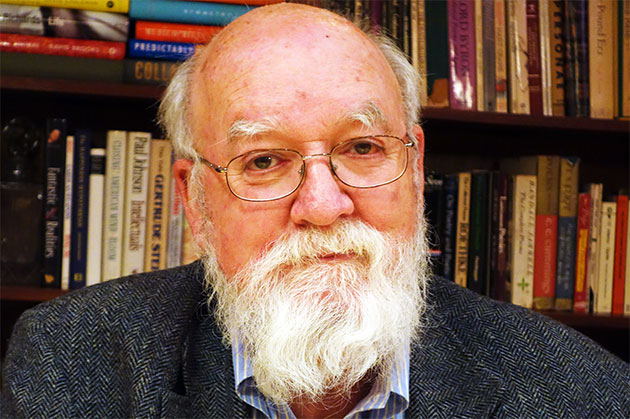
Dan Dennett/Edge magazine photo
Philosopher Dan Dennett has a very interesting interview in Edge.

Key takeaway? He junks a fair amount of what he's said in the past about the details of how the mind/brain is like a computer, 

BUT!

Still holds fast to the analogy that it's ... like a computer! Even though he admits that the details of this comparison or analogy simply are weak to nonexistent.

Let's look at some comments:
We're beginning to come to grips with the idea that your brain is not this well-organized hierarchical control system where everything is in order, a very dramatic vision of bureaucracy. In fact, it's much more like anarchy with some elements of democracy.  ...

The vision of the brain as a computer, which I still champion, is changing so fast. The brain's a computer, but it's so different from any computer that you're used to. It's not like your desktop or your laptop at all, and it's not like your iPhone except in some ways. ...

Control is the real key, and you begin to realize that control in brains is very different from control in computers. Control in your commercial computer is very much a carefully designed top-down thing.  I mean, with all that, there's no need to hang on to his analogy.  
I guess he simply can't admit it's a crappy analogy that just doesn't work, and walk away from it.

Because it was a crappy analogy a decade ago,. and it's in tatters now. (Ditto for his claim that evolution is algorithmic.) It's nonsensical. Yes, Dan Dennett, it's nonsensical. How can you analogize to something that nobody is used to? Especially since what we understand as a "computer" may never be like that?

That said, per the sentence in parentheses, I suspect it's all about the algorithms. He still wants to believe the human mind, like evolution by natural selection, is algorithmic. And, he's not even wrong, per Wolfgang Pauli.

This is also an example where Dennett should look in the mirror any time he uses the phrase "greedy reductionist."

That said, it's not all hubris in the interview. Dennett admits his new ideas (and it's nice to hear him have some) are speculative enough he'd "be thrilled if they're 20 percent right." And, his comments about brain plasticity, findings that maternal and paternal  inheritance genes in our cells may "war" much more than previously thought, are refreshing. 

At the same time, there IS hubris in other ways. His admissions of plasticity in the brain, combined with the "20 percent correct," should lead him to say that cognitive science, and related things such as artificial intelligence, may have advanced from the Neolithic to the Bronze Age in the last decade, but that's where they are and no further.'

Also unfortunately, his new ideas don't appear to extend to free will.

At the same time, though, the last section, about hypocrites in the pulpit, is great.

He's not talking about moral hypcrites, but unbelieving hypocrites in conservative Christian denominations. This is a follow-up to surveys and other work he and others have recently done.

Here's a sample:
How do they thread the needle so that they don't offend the sophisticates in their congregation by insisting on the literal truth of the book of Genesis, let's say, while still not scaring, betraying, pulling the rug out from under the more naïve and literal-minded of their parishioners? There's no good solution to that problem as far as we can see, since they have this unspoken rule that they should not upset, undo, subvert the faith of anybody in the church.
This means that there's a sort of enforced hypocrisy where the pastors speak from the pulpit quite literally, and if you weren't listening very carefully, you’d think: oh my gosh, this person really believes all this stuff. But they're putting in just enough hints for the sophisticates in the congregation so that the sophisticates are supposed to understand: Oh, no. This is all just symbolic. This is all just metaphorical. And that's the way they want it, but of course, they could never admit it. You couldn't put a little neon sign up over the pulpit that says, "Just metaphor, folks, just metaphor." It would destroy the whole thing. 
From personal experience with my own "coming out," I know how true this is. I also know that many agnostics or atheists in the pulpit have become wedded to the money. If you're the pastor, or senior pastor, of a decent-sized church in a mainline Protestant denomination, your total salary and benefits can easily be, say, 35-65 percent greater than that of a school teacher with comparative experience.

I just couldn't do that. And so, I'm schlepping on community newspaper editor salary, in a profession struggling even more than mainline Christianity. But, struggle it is; it's not just Catholic parishes going without priests, etc.

Anyway, that's good stuff to end on. Go read it.