You may have already read my earlier blog post, with
my thoughts about all that's wrong in how so-called social justice warriors attempted to hijack the aftermath of the recent killings of staff at French satirical newspaper Charlie Hebdo.
Now, below, is a an edited version of my own most recent newspaper column, which covered the attacks and issues of free speech — not in France but here in the US.
 |
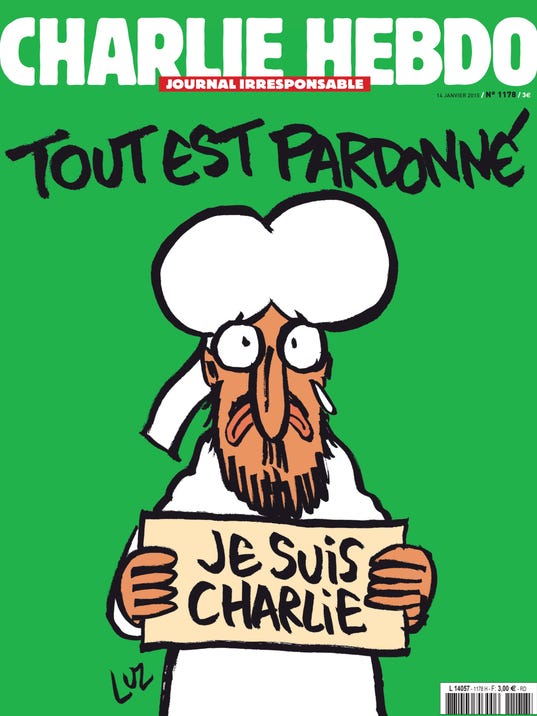
It would be nice if all were forgiven. Or, if USA Today
would have run other Charlie Hebdo cover art. |
The recent attack on the French satirical tabloid newspaper Charlie Hebdo are a reminder that freedom of speech, including satirical speech, is a commodity with an insecure purchase in our world.
It’s also a reminder that journalists, the professional practitioners of freedom of speech, don’t always have the safest jobs in the world. Per the advocacy group Reporters without Borders, in 2014, 66 journalists were killed, 11 assistants were killed, and 19 citizen journalists were, too. Numbers were about the same in 2013.
Charlie Hebdo’s work may not seem “fun” to fundamentalist Muslims, but free speech is free speech, and recognized as such in most of the “developed” world, including but not limited to the United States. (It should be noted that the French magazine doesn’t only skewer Muslims; one cover had the Pope and a Jewish rabbi, as well as a Muslim imam, all demanding the magazine be veiled.)
That said, while the Western world may not totally like Christian and Jewish beliefs and stances getting skewered, it doesn’t generally try to prevent such satire from being published by the media — or from being talked about by the general public.
That’s not quite so true for Muslim-majority nations. Four years ago, the United Nations’ Human Rights Council finally swatted down an attempt to get member nations to criminalize blasphemy. Previous such motions regularly passed the predecessor body to the Human Rights Council, but the United States, followed by the European Union, eventually recognized the free-speech issues that were at stake and voted no.
Various forms of freedom of communication are surely as protected in the U.S. as in modern Europe, are they not? After all, of the 10 original amendments to our Constitution, our Bill of Rights, the First Amendment safeguards exactly these issues.
On paper, yes.
In reality, maybe not so much.
In a country where we have had presidents and congressional leaders of both parties want to control the flow of news, usually on some vague “national security” grounds, we shouldn’t assume that the First Amendment, and what it’s supposed to protect, is on 100 percent terra firma inside America. If anything, we should operate on a deliberate assumption that the First Amendment is not on such firm ground.
And, it’s not just political leaders; many of the people that make up “We the People” say the same thing. In the past two years, the annual “First Amendment Survey” conducted by the Newseum Institute shows that a full one-third of Americans think the First Amendment’s protections go “too far.”
This is probably a good time to pull up the famous statement by the French literary giant Voltaire:
“I do not agree with what you have to say, but I’ll defend to the death your right to say it.”
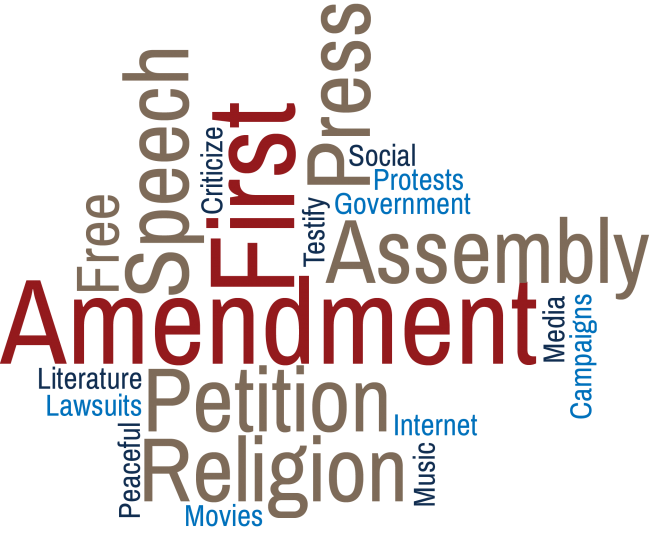
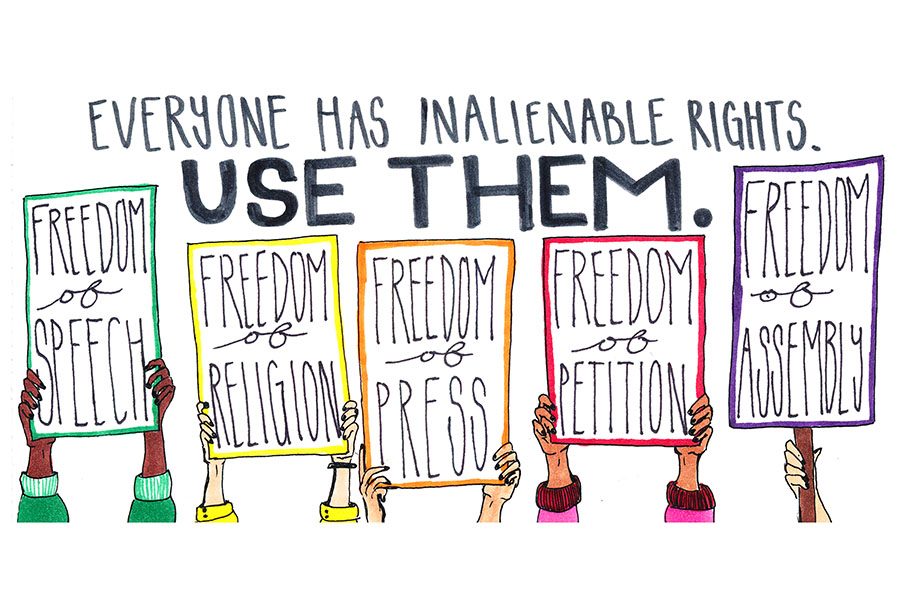
It’s also a good point to remind people that the First Amendment has five freedoms. We’re talking about freedom of the press. Many people know about freedom of religion, which most often results in court cases, and, especially over questions about what Thomas Jefferson’s “wall of separation” meant. This, outside of ideas that the press “abuse” their freedom, is usually the area where people think the First Amendment goes too far.
Also worth noting is that African-Americans and Hispanics are actually more likely than Caucasians in thinking that First Amendment freedoms go too far. So too, per
the 2013 survey, the younger people are, the more likely they are to think that the First Amendment goes too far. (Whether this is related to their having grown up in an "always on" world, and if so, whether that's a cause of, or a result of, them being more willing to surrender First Amendment rights and related civil liberties, I don't know. But, it is a good issue, and as ever more people enter adulthood from an "always on" world, one to keep an eye on.)
But, those are just two of five freedoms of the First Amendment.
Beyond that, the amendment also guarantees freedom of speech in general. If I as an individual, not just as a newspaper editor, want to say something like what Charlie Hebdo does, or utter obscenities, or whatever, I can do that. And so can you.
There’s also freedom of petition. We can write our presidents, members of Congress, governors and legislators, and ask them to undertake specific political actions.
And, there’s freedom of assembly. That includes unionizing, voter registration drives and other public organizing work. More controversially to some, it also covers protest marches by anybody from the Ku Klux Klan to the New Black Panther Party and more.
(I chose precisely this because
Marlin, Texas is about 50 percent African-American and about 35 percent Caucasian — many of that number being older, and not fully "reconstructed" whites — and thus knowing that one or the other of the two groups would be offensive to about everybody here.)
I presume that Voltaire would also defend to the death our right to assemble, to petition, and to engage in protests.
If Voltaire is not good enough, then we — and those who think the First Amendment goes “too far” — should remember Nazi-era German Lutheran minister Martin Niemöller and his famous poem:
“First they came for the Socialists, and I did not speak out—
Because I was not a Socialist.
“Then they came for the Trade Unionists, and I did not speak out—
Because I was not a Trade Unionist.
“Then they came for the Jews, and I did not speak out—
Because I was not a Jew.
“Then they came for me — and there was no one left to speak for me.”
If we remove free speech, assembly, religion or petition rights from others, or we think the press goes too far in using its freedoms and try to restrict it, there may eventually be nobody to speak for us.
It’s the same story George Orwell tackled in “Animal Farm” — free speech belongs to all of us and should be defended by all of us, for all of us.
Even unpleasant or antagonistic speech.
That's why I don't like public or private university hate speech codes here in the U.S. Even though
I think Steve Salaita is not all that, I still don't like him being tripped up over such codes. Humorous issues of schadenfreude that such codes produce at times, including for tripping up so-called "social justice warriors," when we get to serious brass tacks, I don't like them. And, they're not needed on college campuses anyway. Students who are intimidated by a professor have grievance channels. (And, since as much as 75 percent of teaching staff at the average modern higher education outlet today is part-time adjunct instructors, students are quite likely to win such grievances.)
Unfortunately, the American media has surrendered much of its own playing field on this issue in the last decade or so.
Look at the semi-cowardice with which it has self-censored American battlefield deaths in Iraq and Afghanistan. Or, now, self-censored in refusing to print any Charlie Hebdo covers, even ones like the one at left that skewer all three monotheisms at once, not just Islam. Or, in one case we know of, where an American newspaper
pixelated a picture of somebody in New York reading Charlie Hedbo, pixelating the issue's cover, and only the cover.
Back to my introduction to this column and the issue of unwarranted assumptions.
"We the People" should not assume that the mainstream media will remain a reliable guardian of the First Amendment. We shouldn't assume that it always is one today. Certainly not of the spirit of the First Amendment.
We also, as courts continue to look at the issue of bloggers and such as journalists, shouldn't limit our scope as to who is a member of the media, in part due to the paragraph just above.
#JeSuisCharlie.
#IAmMedia.