SocraticGadfly: World War I
Showing posts with label World War I. Show all posts

November 08, 2024

All Wrong on the Eastern Front

With apologies, or not, to Erich Maria Remarque, this is an expanded version of the Goodreads review of my most recent World War 1 reading. And, it's being posted just before Veterans Day, for people to savor.

The Eastern Front: A History of the Great War, 1914-1918

The Eastern Front: A History of the Great War, 1914-1918 by Nick Lloyd
My rating: 1 of 5 stars

Gack!

I had some heads-up via a two-star reviewer, Elliott — who nonetheless has the wrong thing he pitches the biggest fit about in his review (Lenin almost assuredly DID order the killing of the Romanovs), and is apparently a tankie in general and also a JFK conspiracy theorist, per his overall reviews at his first link that this book might be less than fantastic. (Said tankie has been blocked, too.)

Actually, presenting itself as a "magisterial" history? It's crap and needs to be crushed.

(On the "presenting itself," I have as one my Goodreads bookshelves "touted by critics." And, even if they didn't use the word "magisterial," the idea was clearly there, with talk about how this was the most tome-like and impressive book about the Eastern Front since Norman Lloyd 50 years ago.

So, if it's not "magisterial"?

It needed to be crushed, in my opinion, especially since I got my review in before the 25-reviewer mark and was the first one-star person to give it a review, not just a rating.

And crushed it will be in the paragraphs to follow.

I knew to ding this a star for including Italian front war as part of the Eastern Front, per seeing Elliott when stumbling across this just two weeks before seeing the book in my library. And, when we get there? Any noob about WWI history can see the front moved 10 miles in two and a half years. If you have to include it? Skip to the last year.

There are many more errors right off the bat in the introduction. Serious ones. "Rookie mistakes." 

Lloyd claims Trialism was a factor in Franz Ferdinand’s assassination. Reality? He had abandoned Trialism years earlier, in part due to fears that, whether the Triad included a third crown or not, it would stir up Quadrilateralism among Czechs. Given that, even before the start of the war, the Czechs were the noisiest minority in the Austrian parliament in its half of the Ausgleich, this wasn't an idle worry.

Whether the likes of Apis realized that or not, and cared or not, I don’t know. It's cited in many histories, whether of just the June-July Days, or the war in general, as inspiration for him sending the assassins to Sarajevo. That said, the 1908-14 relationship of Ferdinand to Serbia could get a book on its own. In reality Ferdinand was often almost as Serbia-bellicose as Conrad.)

Franz Joseph’s semi-mystic comment on Ferdinand’s death, quoted on the first page of Chapter 1 has generally been seen not as generic fatalism, but his last comment about the morganatic marriage bringing the hammer of fate down upon itself. Lloyd not getting this right further reduced my confidence in him. (And, as it turns out, we're just getting started.)

I wasn’t expecting a full book about the July Days, as I’ve read both "The July Crisis" and "Sleepwalkers". I was expecting a bit more than what we're actually offered in terms of background.

The bits of analysis sprinkled throughout pages of Austrian, Russian and Italian military deficiencies, such as in medium and heavy artillery, are nice. Or “nice.” Why not more of that? I've seen more in other histories of WWI that weren't limited to the Eastern Front. And, putting all of this together in a brief early chapter, up-front, would have been a good table-setter for a book being presented as "magisterial" or similar.

The maps are decent but not great for a book whose focus is military history. (One of the reasons I five-starred Lloyd's Passchendaele book was the quality of the maps.) Some of the maps show only borders/boundaries of military action. Those that do indicate location of armies don't show boundaries between armies on either side. None of them dive below the army level to the corps level.

OK, the biggie on the big picture? You can include Italy but not the Ottoman-Russian front in Armenia? True that this was second to Mesopotamia, and eventually Northwest Arabia-Palestine. But, it was there, and definitely more Eastern than Italy. And, it’s like Lloyd’s determined to write the Ottoman Empire out of WWI history while writing in Italy. For example, the Ottomans sending troops to the Salonkia Front? Not mentioned. (And, other things listed below, and hold on to that thought.)

But, even worse?

Lloyd misses entirely that Emperor Karl was reportedly talking with Serbian Prime Minister Nikola Pasiç as well as the French, via his Bourbon-Parma brothers-in-law, in early 1917. This is one reference. I’ve seen others. Wiki also has this. And, it lists a source: MacKenzie, David (1995). Black Hand on Trial: Salonika 1917. (I've just submitted an interlibrary loan request to my library; the book is rare enough that, while it's listed on Yellow Satan, it isn't here. So far, it's not available, though two copies are “out there,” it seems at the Houston Public Library.)

This one is a biggie and is far less known than Karl’s talks with Britain and France via his brothers in law. In fact, it was new to me until I stumbled across it while doing some Net-searching for notes for the review. But, it’s still real. And, for a book that presents itself as a “magisterial” history of the Eastern Front? Missing this is simply not acceptable. I'm not an academic, but I found the book, and PDFs of it are available through various academic systems.

Were these talks related to Apis’ eventual treason trial? Was it, in turn, related to a possible deal at what seemed to be near the low point for Serbia in the war? Was Apis' execution, per his own Nathan Hale-like words, part of a cover-up so that Pasiç’s own pre-knowledge of Sarajevo could never be nailed down?

By this point, and also per the paragraph below? I knew we were in two-star territory, and I was entertaining one-star thoughts.

Back to other stuff missed in re the Eastern Front? Where’s the Ottoman invasion of Qajar Dynasty Iran, in part because of Russian meddling there pre-WWI, that helped cause one of the worst famines of the 20th century and led to the toppling of the dynasty, replaced by the Pahlavis? Where’s the Central Powers getting Libyan tribes not yet subdued by Italy to invade Egypt from the West? (Well, not here because Palestine and anything Ottoman is not part of the Eastern Front.)

There's also the issue of a lack of a thesis, also a biggie in what's supposed to be a “magisterial” book or the first book of its like about the Eastern Front in 50 years. (Sidebar: I've not read Stone's book, but I obviously know plenty about the Eastern Front from other WWI books; maybe Stone's wasn't so magisterial, either.)

Actually, we're missing two theses.

One is the cause of the war. And a brief (and incorrect) reference to Trialism doesn't cut the mustard. Give me one. Even if if it's something I'd instantaneously reject, like an updated version of Fritz Fischer's German war guilt, at least we have a talking point.

Second? There's no thesis on why Lloyd defined “Eastern Front” as he did, especially in light of this being volume two of a three volume set. Again, I might disagree with your thesis when you present it, but we still have a talking point.

Other missing things, that I'll try to keep short?

We get relatively little analysis of generalship, whether Lloyd's own or a derivative round-up. Tannenberg is an example. “We” all know Hindenberg and Ludendorff glory-hogged, but Lloyd doesn't discuss generalship there.

That relates to issues of audience. Is this book for a more general reader, or for somebody who is a fairly serious student of The Great War?

Other minor issues include things like calling today’s Lviv by its Austrian name of Lemberg but NOT calling Wroclaw by its then-Prussian name of Breslau. And yet, Thorn it is, not Torun. I hate inconsistency in this in any WWI book.

Finally, while not having large font with blown-out leading, like some of today's non-fiction books trying to look more impressive than they are, this book did NOT have relatively small font and leading, either. In other words, there's not enough verbiage here to consider this “magisterial,” either.

In short, again, magisterial this is not. (Had it not been touted by critics and so billed, the rating would only be two stars, and a high two at that.)

The ONLY thing new to me of note was the first use of poison, or poison-like, gas (closer to tear gas than chlorine or mustard) was on the Eastern Front, not Western.

So, while this doesn't fall in my “bs-pablum” shelf, it's still a one-star book. It's otherwise overrated.

==

How to fix this book, beyond things like better maps, more maps and the niggling city names?

First, since Lloyd had already done a Western Front book, he should have already had the idea of a MENA front book queued up. Italy’s not really MENA, but it’s closer to that than it is Eastern Front. Palestine, Mesopotamia and the minor actions go there. Armenia and Iran go in the Eastern Front book. Since a third volume is supposed to follow, that may be it. In turn, that would have made it easy to present a “cur alii, non alii” thesis for why Italy is in, the Ottomans are out, in this book's introduction.

Supposedly, this was the second of three volumes. If so, then he divided wrongly, per what I just said above. If we get into things like German meddling in Iran and even in Central Asia, hoping the Ottoman Sultan would issue a call for jihad that Muslims in the British Raj would respond to, etc., he'll have plenty for a third volume, which means that he could have put what I said above in this volume.

Second? Better maps.

Third? Volume three had better address ALL of the fighting I mentioned above, or it will get a swifter grokking and faster crushing.

View all my reviews

March 31, 2023

Another pseudoskeptical fail by Michael Shermer

Conspiracy: Why the Rational Believe the Irrational

Conspiracy: Why the Rational Believe the Irrational by Michael Shermer
My rating: 1 of 5 stars

This is an expanded version of the Goodreads review for inside baseball Skeptics™,pseudoskepticism reasons. Semi-regular readers here should know that I'm not a huge fan of Shermer, and this book only makes it worse. 

Let's dig in on the expansion.

This is a horrible book, not on the conspiracy theories, which I don't need Shermer to tell me, but on him totally getting wrong the one actual conspiracy he discusses, which is why this is 1-starred on a grok.

Rather than there being JUST and ONLY an Austrian conspiracy against Serbia in 1914, the assassination of Franz Ferdinand instead traces directly through one "Apis," head of both Serbian military intelligence and the secret society named The Black Hand, and also directly or semi-directly through confederates of Apis in the nationalist organization Narodna Odbrana, to Serbian Prime Minister Pasic. All of this and more is documented by Christopher Clark in the excellent book "The Sleepwalkers," which Shermer ACTUALLY REFERENCES and then ignores for Tim Butcher's "The Trigger," which is
A. A piece of crap and
B. Only about 10-20 percent about lead assassin Gavrilo Princip and 80-90 percent directly or indirectly about Tim Butcher.

Shermer's right that this is arguably the world's deadliest conspiracy. He's dead wrong about where the conspiracy started.

==

The rest of the book, without this egregious ax-grinding, would probably be 3 stars, no more, so, even without this, it's not worth a read. It's a basic definition of conspiracy vs conspiracy theories, basic overview on why many people believe in conspiracy theories, and how to try to talk to them.

But, surely Shermer could have found something else to discuss as a true conspiracy. Rather, it appears that, following in Butcher's footsteps despite having read Clark's documenting the likely ties to the Serbian government, and despite mentioning the Black Hand, even in an overall superficial treatment (and even talking about an assassination conspiracy, though trying to limit it to just the Black Hand, if that), he thought he could use some intellectual judo to show an Austrian conspiracy.

In reality, despite Conrad having been pushing for pre-emptive war with Serbia for years, even after the assassination, the Dual Monarchy was divided on going to war. And, trying to treat its Byzantine turns in just a few pages will be a good way to get superficial treatment even if not wrong — which, of course, Shermer is. And, I can say that as having read "The Sleepwalkers" TWICE. 

==

It's also bad for those other, inside baseball reasons.

First, citing libertarian pseudoskeptic and convicted felon Brian Dunning will get you nowhere in my book.

Second and related, attacking the tobacco merchants and climate change deniers when, at a minimum, I don't think you have ever publicly called out Penn and Teller for promoting both of them, and I'm not sure they've ever backtracked on climate change, is an issue. You yourself, in fact, albeit to a lesser degree than Dunning, have mixed libertarianism and skepticism at times, including on climate change (and Kurzweil's "singularity"). You've also mixed both with bad political hot takes, like on Occupy Wall Street.

In addition, you and Dunning blocked me at Skepticblog, in part because I called out both you and Dunning on the libertarian pseudoskepticism, and you and the Not-So-Always-Amazing Randi also had at least a couple of toes in the world of #MeToo problems, including, allegedly, personally having committed sexual assault, and also, at Skeptic mag, you've been at a minimum, a racialist fellow traveler, tackled again here in passing when talking about Pop Ev Psych and sexism. And, to tie this all into one nice neat bow, the actual Serbian conspiracies, of which its prime minister almost certainly had some foreknowledge, and its army intelligence even more? Driven by ethnic-based Serbian nationalism, which isn't too many stones' throws away from racialism, as Serbia's post-1989 history shows. (Not that Croatia's been a lot better.)

Beyond that is Shermer's ignorance of actual philosophy. Or him being "no true Scotsman" at times on skepticism in his personal life.

View all my reviews

November 11, 2018

The 11th hour, of the 11th month, of the 11th day

No red blizzard of poppies on sale in shops, markets and at street corners can obliterate the absurdistan of four-plus years of senseless war that ended a century ago, nor ennoble the idea of sending men into a swamp-bog killing field. Neither can writing a poem about that which lead to people pinning poppies on puffed-out chests. That poem, as I discussed on the centennial of the start of the war, was a pro-war piece used by Britain as a recruiting tool. Stop romancing "In Flanders Fields."

"War ... is all hell."

No amount of patriotic prideful chest-puffing can hide the senseless loss of nearly 10 million military casualties plus an additional 8 million war dead, per Wikipedia estimates.

A November 1918 American teacher's riff on "In Flanders Fields" arguably is even worse. "Keep the Faith" by Moina Michael, who also started the poppy sales campaign in the U.S., isn't much less pro-war than McCrae. And, of course, the romanticizing of the war via the poppy was my ultimate condemnation, since the poppy campaign sprang from McCrae's original.

Looking ahead a century, if there are lessons in general, it's that World War I was begun from a case of nationalism run amok, and, at the same time, nationalism at its most petty at times.

In some cases, though, as with the Dual Monarchy of Austria-Hungary and the Ottoman Empire, it was a tottering, doddering pre-modern supra-naturalism, incarnate in an even more doddering, tottering dynasty, that led to war. The Hapsburgs surely combined the worst of this with the worst of pettiness in the name of nationalism.

Beneath their respective veneers, especially when compared with would-be peers, it was arguable that at the time the war started, the Hapsburg realm was even more the "Sick Man of Europe" than the stereotypical Ottoman patient. Add to that the Baroque Spanish court ritual that course through Viennese veins of protocol, and included Franz Joseph himself — the snubs that Count Montenuovo orchestrated for Franz Ferdinand and Sophie from marriage through funeral were ultimately not only approved, but pushed for by the kaiser — and Austria-Hungary had no business picking a war with the Serbs that threatened to expand.

Indeed, after losing the Seven Weeks War, with that being followed by Magyar disquietude that forced the Ausgleich on Franz Joseph, Vienna had no business, even less than the no business of Istanbul, of picking a war with anybody. The fact that Franz Joseph couldn't even get a better bargain on the Ausgleich than he did showed that he had little business being an activist emperor.

The war in Europe, once Gavrilo Princip assassinated Franz Ferdinand, quickly became overdetermined, as I have blogged before. In other words, if one works to make an honest assessment of who was primarily at fault, using percentages, one gets over 100 percent easily. And, that includes Britain, who had been subsidizing Belgian rearmament nearly a decade before the war started. Belgian neutrality was simply the excuse that Foreign Secretary Edward Grey used to pull non-interventionist Liberals onto the side of war. (Grey is the most under-recognized architects of duplicitousness in the entire run-up to war.)

That said, once war was launched, the U.S. had no damned business getting involved. We had no vital strategic interests. There was no grand moral issue, unlike Nazism in World War II. Indeed, the most anti-Semitic and most autocratic country in the war was one of the Allies, Tsarist Russia.

Yes, by international law of that time, German submarine war was illegal. So was the British blockade by extension, though Britain had not signed that particular agreement. But, considering food as contraband in any blockade was illegal per agreement that even the British had signed. Let us also remember that the U.S. went to war with Britain in 1812 over related freedom of the seas issues.

William Jennings Bryan
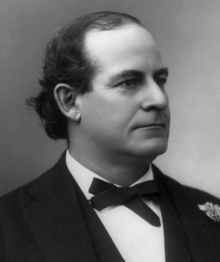
The only "interest" the US had was when President Woodrow Wilson eventually started offering government backing on private loans that American banks made to Britain and France, and his alleged neutrality had slipped long before that, as Secretary of State William Jennings Bryan knew even before he resigned his office, politely, rather than putting Wilson on the spot to fire him.

Had Wilson actually honored the letter of neutrality, even, he would have done like FDR in 1939, or John Adams long before, and issued some sort of actual neutrality proclamation. In this case, re the Lusitania incident, issued in advance, such a proclamation would have forbade Americans from sailing on ships of belligerents, among other things.

But, rather than learning from George Washington on steering a ship of neutrality, or from  John Quincy Adams and his famous "(America) goes not abroad, in search of monsters to destroy" speech, Wilson did just that. He ignored also Washington's Farewell Address warning about entangling alliances. He gave us a United Nations that we selectively engage with today, when it suits our imperial hubris, along with Wilsonian internationalism of Shrub Bush, Barack Obama, Hillary Clinton and many others. He gave us multiple Red Scares and their own spinoff Wilsonian intervention — whether the Korean War fits that or not, the Vietnam War and many coups do.

This is part of why I rank Wilson lower on the presidential scale than do many professional historians, putting him below average overall.

(I wrote more about the stupidity of America entering the war a year ago, on the centennial of that happening, and again a year ago today.)

What would have happened, had we not entered the war, or even, had Wilson not guaranteed House of Morgan and other banks' loans to Britain and France?

Well, by late 1916, France would have been stretched further than it was. The majority of US loans went to Britain, but almost as much to France, which of course was bearing the bulk of the fighting. Peace feelers might have been sent, either through Wilson, or through Switzerland, or through Norway. Or, France and Britain might have directly approached Kaiser Karl after the death of Franz Joseph, since, soon after his reign started in real history, he reached out on his own to France via brother-in-law Prince Sixtus.

Theobald von Bethmann-Hollweg as German Chancellor would surely have been amenable. He might have been able to drag along the Kaiser, Wilhelm, especially if he would have been able to outflank the budding military dictatorship in progression of Field Marshal Paul von Hindenburg and General Erich Ludendorff. (Yes, for the unawares, for about the last two years of the war, the duo of Hindenburg and Ludendorff ran Germany by an authoritarian quasi-dictatorship.)

What likely would have resulted, with Britain also recognizing that while its military reserves weren't stretched to the limit, it was running low on money and munitions for other Allies, might have been something like the Seven Years War — a status quo ante bellum, at least on the Western Front.

Certainly, if Germany had gone ahead with plans and let Vladimir Lenin smuggle himself across Germany to Finland and then Russia, the March Revolution, even with the Provisional Government in various incarnations determined to stay in the war — would have pushed Britain and France more toward peace.

In the East? Various things.

The Allies might have accepted Austria doing a set of Black Hand trials, handing over leaders. It might also have accepted deposing the Serbian royal house and reverting to the pre-1903 Obrenević house back to the throne.

In Russia? If the November Revolution wound up still happening, and all other parties were at least in the process of negotiating peace by this time, they might have done an intervention similar to what actually happened. As part of that, they might have united on a separatist Ukraine and negotiated some minor German or Scandinavian princeling — NOT related to the Hohenzollerns — to head the country. (A year ago, on the anniversary of the November Revolution, I wrote against people even further left than I am, as I attacked the romancing of the Revolution.)

In the Dual Monarchy, the Allies might have hinted to the Magyars that peace was dependent on them accepting Karl's plans for Trialism. They might have sweetened the pot by giving Austria a small part of southwestern Serbia.

For the Ottomans? They probably would have forfeit their Middle Eastern lands, with boundaries similar to actual post-dynastic Turkey.

For most of the Balkans, most of the post-1918 world, on one or another such idea of counterfactual history, surely would have been no worse than reality, at a minimum.

Could such a peace have held, without more revanchism?

Maybe, and just maybe, if Imperial Germany got a more liberal constitution, and Wilhelm abdicated in favor of his somewhat better (but not great, as his pre-World War II Nazi flirtations show) son, August Wilhelm. Germany also needed to do what Bismarck in nearly 20 years, and his successors in 25 after, had failed to do — incorporate Alsace-Lorraine into the German Empire as one of its states rather than ruling it as an occupied territory.

Had this all panned out, we would have been spared some of the worst of Leninist Marxism, and likely all of the worst of Stalinism. We would also have been spared much of Fascism. Postwar Italy might not have been bad enough for Mussolini to gain power. A still semi-intact Austria and a Germany spared revolution by a hair would have left no space for Hitler.

Otherwise, with France, Austria and Russia all more seriously weakened than it, Germany would have emerged as more clearly the leading power of Europe. With a more democratized government, it might have reached some sort of entente with Britain about future relationships between the two, the overall governance of Europe, and how to face the United States.

Had this NOT been done, but the US was not in the war? The Red Tide from Moscow surely would have swept over Germany, most likely over France, and likely would have touched the shores of Britain, despite George V denying exile to his royal cousin Nicholas precisely due to revolutionary fears. I discuss that possible alternative history in depth here.

If you want other alternative history? Germany, not Denmark, could have owned the then-Danish Virgin Islands at the start of the war.

For your listening meditation? Benjamin Britten's War Requiem.


Why this? The recitatives, beyond the traditional Latin Mass text, are those of poems by Wilfred Owen.

If you want more music, on my other blog, the three non-Ottoman imperial anthems of World War I.

November 11, 2017

#VeteransDay and the #WWI Centennial

If any Veterans Day is a day to remember the stupidity of war, it should be this one.

Veterans Day, of course, was started to remember World War I, as Armistice Day.

With us in the first year of America's centennial of entering World War I, that gets back to that opening line.

World War I was stupid long before America entered it. It began as a Great Powers conflict, with European nations on two sides of a trip-wire alliance egging each other on, including the Germany that forgot Bismarck's alleged dictum that "the whole of the Balkans is not worth the bones of a single Pomeranian grenadier." (Bismarck also allegedly said, "If there is another war in Europe, it will come out of some damned silly thing in the Balkans.")

Whether true or not, both are true to his spirit and insight.

Anyway, none of the countries was prepared for the war, not even the Germany most closely prepared for it, but most reliant on being totally prepared for it. Moltke the Younger's weakening of the Schlieffen Plan, originally in the west to appease the Crown Prince, then in the pre-Tannenberg east, killed Germany's chance of an early win.

And with that came further horrors.

They were only exacerbated by U.S. President Woodrow Wilson being decidedly NON-neutral well before the war. A truly neutral American president would have told the British that their blockade by extension was just as illegal under international law as German submarine warfare zones, and reminded Arthur Balfour that we went to war with his country in 1812 over freedom of the seas issues.

After that, Wilson would have launched a neutrality proclamation that, as best written, would have applied to both sides, and banned travel into either submarine zones or blockade by extension areas. A truly neutral president also would not have offered guarantees of private loans made to foreign governments.

Had things played out that way — perhaps aided by a threat by Secretary of State William Jennings Bryan to challenge Wilson's re-election in 1916 — the play of WWI from early 1915 on would have drastically changed.

By late 1916, both the Allies and Central Powers might well have been feeling out a truly neutral United States for armistice negotiations. Like the Seven Years War, at least on the Western Front, a treaty with no annexations might have resulted. (By this time, Tsarist Russia probably would have imploded anyway. A free Poland of some sort might well have resulted. The Ottoman Empire and the Dual Monarchy probably would have gone the way of the wind as well.)

Still, Communism of the murderist Marxist-Leninist-Stalinist variety might well have been prevented. And in Germany, no Hitler and no Nazism.

The U.S. would have been different, too. No Lenin and no November Revolution, combined with no U.S. war involvement, would have meant no Red Scare, either. Possibly no rise of J. Edgar Hoover. Possibly no xenophobia. Whether the U.S. would have address racial issues more quickly or not, I don't know.

(Reminder, while I'm on Lenin etc, since we're also at the 100th anniversary of the November Revolution, that a bunch of leftists need to start de-romanticizing Communism.)

Remember all of that. Remember the stupidity of Wilsonian idealism. Remember the stupidity of war. Remember that war today isn't all about video games or the drone equivalent. Remember that even professional philosophers can't justify stupid wars, even when they try.

"I tell you, war is Hell!" — William Tecumseh Sherman

April 06, 2017

#100YearsAgo — US enters #WorldWarI — with no need to be in #WWI

World War I was not the greediest or most imperialist war in American history. The Mexican War — or our post-treaty breaking wars with American Indians — are at the top, followed by the Spanish-American War.

But, as for the stupidest war in American history, I'll take it ahead of even Vietnam. And you should too, if you know the big picture. That includes knowing that the U.S. had even less national interest, in Realpolitik terms, in World War I than any other imperialist or non-imperialist war in history.

In case you're wondering, beyond the Luisitania or "unrestricted submarine warfare," what the final tipping point was, especially away from the British-tilting East Coast and especially in the Southwest, read this piece.

First, President Woodrow Wilson was NOT neutral between Aug. 4, 1914 and April 6, 1917. His first secretary of state, William Jennings Bryan, knew this. That's why he resigned over post-Lusitania events. (Well, Wilson was pushing him, actually.)

Related? The Lusitania was "technically" a passenger ship. It was also carrying small arms, ammunition and other munitions and that was known to people in a position to know in the U.S., British, and German governments. It was also armed with guns big enough to sink a submarine that tried to follow the letter of international law and surface and halt it.

Second, and speaking of? The British "blockade by extension," blockading the Netherlands, Denmark, etc., to keep them from importing goods above peacetime levels and reselling them into Germany, was as illegal under international law as was Germany's declaration of submarine warfare and sink-on-sight submarine blockade zones. In fact, matters similar to this are why we had gone to war with Britain 100 years earlier. But for Wilson, freedom of the seas was selectively enforced.

Here's how it worked, in the rough, from this Aug. 4, 2014 blog post of mine. If Denmark imported, say, a total of 100,000 pounds of wheat a year, on average, from, say 1900-1913, then in 1915, that's all Britain allowed. It couldn't import an additional 500,000 pounds, with the presumable intent of then exporting the surplus to Germany.

Third, there was no "bad guy" like Hitler in World War II. (That said, we had a "bad guy" on our side in Stalin then!) The most repressive governments? As in WWII, one was on each side — Tsarist Russia before the March Revolution, for the Allies, and the Ottoman Empire for the Central Powers. Pre-war, Hohenzollern Kaiser Wilhelm II was moderately authoritarian, but no more than moderately, and certainly not totalitarian.

Now, the Germans did burn the library at Louvain, Belgium. They did shoot franc-tireurs. Both illegal under international law. Bayoneting babies? Allied-American propaganda. They did also, tis true, shoot Edith Cavell. And? She had been duly convicted of being a spy. And she WAS a spy. Bad PR for the Germans? Of course. Unlawful? Not at all.

As for the "German war guilt" the Allies pinned on it afterward? Bullshit. Basically, Austria-Hungary and Serbia roughly tie for first on causing the war, with Germany running a somewhat distant third on what was a highly overdetermined conflict, as I note at the bottom of a roundup of some of the best — and some of the worst — books about World War I.

National interests? We had none. Germany never could have gained the type of mastery that Hitler aspired to, or that Napoleon briefly had. And, realistically, they weren't aiming at that level of control. Sure, they had greedy eyes that got bigger as the war lasted longer, especially in the East. But, already going back to Venezuela in the 1890s, Wilhelm had basically tried not to tangle too much with the Americans. And, without tanks, with artillery all still horse-drawn, they couldn't have done a Blitzkrieg to get to that point of domination.

Yes, it's true that Germany had various agents in Mexico during that country's revolution, per the story at the top link. But, until the time approaching the Zimmerman Telegram, they weren't planning to foment an invasion of the U.S.

Finally, this was the first, but far from the last, fateful plunge into "entangling alliances" that George Washington had warned about in his Farewell Address.

Related to that is some Realpolitik. We had one vital national interest in World War I. And that was letting the Entente and the Central Powers beat each other fucking senseless as long as they were determined to so do.

What would have happened had we stayed out — specifically, if Wilson (or a better President; he ranks below average in my book for many reasons, and Scott Berg's bio of him is atrocious) had warned Britain early on to stay away from the blockade by extension?

Probably, Britain would have gone ahead, gambling it could starve out Germany before Germany could do the same to it.

A truly neutral president would have then forbade American-flagged vessels from traveling into any war zone, and let the Allies and Central Powers beat each other senseless.

Assuming the Germans still smuggle Lenin into Russia, on a sensical view, the British double down on the blockade in 1918 while sending out peace feelers at the same time. France gets dropped a British hint and reluctantly falls in line. Germany decides to play defense rather than fight the Kaiserschlacht that Ludendorff and Hindenburg call up in 1918, with no Americans to face. That, then means more German farm horses still in place, and the British blockade doesn't bite as much. But Austria, war-weary, pushes it, and Germany sees Lenin trying to export the revolution, as he actually did. Italy and the Turks are both exhausted.

With luck, everybody heads to the table, and on the western and southern fronts, accepts a treaty like the Treaty of Hubertusburg that ended the Seven Years War. In the southeast, they agree to toss the Karađorđević dynasty in Serbia for the old, pre-1903, Austria-friendly Obrenović house.

And, in Russia, now the USSR? They do something about as dumb as actually happened.

Option two is much more pessimistic. Nobody lays down their arms. Lenin uses diplomatic immunity — or other means — to start the revolution in France and Britain, just like in Germany and Austria-Hungary.

Still, that revolution, even if successful all across Europe (doubtful) wouldn't have toppled the American government.

In either scenario, the U.S. isn't further glorifying citizen war in general and World War I participation in particular with Armistice Day, later Veterans Day. Americans wouldn't have absorbed the British romanticizing of the not-so-Great War, either. That romanticizing tends to overlook things like shell-shock, PTSD of a century ago before we knew what PTSD was.

That said, per all the above, World War I is fertile ground for alternative history buffs. Here's a sample of mine related to the Caribbean. Here's a much longer one, related to Sarajevo and Gavrilo Princip.

==

At the same time, per the old song, "How ya gonna keep em down on the farm after they've seen Paree?" it was indeed true.


See how military service transformed veterans from a small county in north Texas.

February 18, 2016

World War I's causes

With us near the midpoint of the centennial of World War I, per a couple of the newest books I've read on the issue, this is a matter for serious discussion.

A good starting point is The July Crisis. I've got it as a 5-star, though I may go back and change that again. Its biggest selling point is that it is ONLY about the events from the June 28, 1914 assassination of Franz Ferdinand to the start of World War I, hence the book's name.

July Crisis: The World's Descent into War, Summer 1914July Crisis: The World's Descent into War, Summer 1914 by T.G. Otte
My rating: 5 of 5 stars

A gripping account of the march to WWI, yet not quite perfect

A very, very good overview of the July Crisis. Not a tremendous amount of new information about any one individual, but enough new here, and a good dovetailing of all the intersecting story lines, to make this a worthy five-star book.

Key new points for me were above all the "second blank check" from Jagow to Vienna. After that, playing up Tschirschky's having cone native, looking at Lichnowsky's efforts to sincerely prevent war, while Germany and Prussia in particular claimed HE had gone native, and, at a lesser level, how "accepting" Franz Joseph was of a push to war were all important.

Per a couple of commenters, could ha have delved more into Serbia, and its knowledge of the Black Hand, specifically what Pasic might have known and what warning he might have given Vienna? Yes. He probably could have played up Hartwig's responsibility more, too.

Ideally, I'd 4.5 star this book. Unfortunately, Goodreads still won't give us half stars.


View all my reviews

In reality, though, one should start earlier, about 525 years earlier, with Serbia getting destroyed by the Ottomans at the Battle of Kosovo. And a book by this name does just that.

My rating: 5 of 5 stars
A clear lining out of how Serbian "martyrdom" has 700 years of history behind it. And, from there, the vectors are traced to Serbian thuggery, starting 100 years ago in the two Balkan Wars.


Don't let the shortness of the review fool you. This is not a 4.5-star book; it's a full 5-star, all the way.

Follow that, and counterbalance "The July Crisis," with this book.

My rating: 5 of 5 stars
Simply fantastic book about the run-up to World War I.

Things I learned include:
1. The Triple Entente, especially from the British angle, was not exclusively an anti-German grouping, and was "unstable" at times up close to the assassination of Franz Ferdinand.
2. Even more than I knew before, the governmental organization of the Dual Monarchy was rickety. (I knew that many ministries were dual, but until reading this book, did not realize it had dual prime ministers, which was part of the delay of formulating its response to Serbia.)
3. The idea of sole war guilt for Germany is ridiculous, given that Russia had given as much a blank check to Serbia as Germany did to Austria.
4. The Serb history of thuggery makes me want to believe in "cultural DNA."
5. British Foreign Secretary Sir Edward Grey made a number of quasi-guarantees to France that he never told the Cabinet about, let alone Liberals as a body.

That's just a sampling of a great book.


From there, go to a good overview of the War.

Adam Hochschild had relatives who fought on both sides. He also doesn't get bogged down in too much detail.

My rating: 5 of 5 stars
A unique telling of World War I in Great Britain.

I knew that Bertrand Russell had been arrested as a conscientious objector, but knew little else about the movement in Britain in general. This book gives excellent insight into how strong the movement was, considering the degree of opprobrium it faced.

Hochschild starts well in advance of the war, so as to set up the social background for this, including disputes over the "rightness" of actions in the Boer War, the suffragette movement in Britain, its splintering, along with trade unionism's splintering, over the war, and more.

Two most fascinating takeaways? Sir John French's sister was one of Britain's leading pacifists.

And .. in 1915 ... war on a full year ... Britain was so desperate for high-quality optics, primarily for binoculars, and knew that Zeiss was "it," for that, had British reps meet German counterparts in Switzerland and work out a deal, in exchange for rubber for Germany from British colonies. Most papers have been destroyed, so we don't know how long this lasted.

World War II trade by American companies with Germany, for the first few months of the war, has been documented. But, I had never heard anything about this before. 


Then, get a good overview of the war.

Here's a 50-year-old classic that's still not dated:

My rating: 5 of 5 stars
A classic, a classic, that I have reread many times. While Taylor was an American, his physiognomic description of many of the main players in the lead-up to the War, through its end, like Apis, Ludendorff and others, give this book a very British/European style, while adding to the fun of reading it.


There are also books NOT to read.

One is by Max Hastings, who for all of his greatness on WWII is a hack writer on WWI.

My rating: 2 of 5 stars
American readers: Take this British book with a grain of salt.

Why? Because while Max Hastings is very good on military tactical issues, and solid on strategic ones in the first shifting of his pen from World War II to World War I, he's close to being all wet on geopolitical issues related to the start of the war.

First, the good.

Hastings gives more detailed coverage to the Eastern Front at the start of the war than do many WWI intros, which often talk about the battles of Tannenberg and Masurian Lakes, and nothing else.

Hastings also covers how the Russians rolled back the Austrians in Galicia.

And, even more exposing the dry rot of the Hapsburg Empire, how Serbia, the cause of the war, also rolled back the Hapsburgs' two different early fall and late fall 1914 invasions.

On the Western Front, he rightly faults Joffre's Plan 17 and has little good to say about Sir John French as the BEF commander. And, he notes how Moltke had weakened the original Schlieffen Plan even before the start of the war, how he weakened it further with Tannenberg worries, and how he had a nervous collapse before the two sides made their race to the Channel. He also notes that the French army, outside of things such as the rouge pantaloons, was not that much worse than the German, and how some German commanders, like Kluck and Bulow, as well as the royal commanders, were either too old (them) or not fully competent for general reasons (some of the royals).

On larger strategic issues, he raises the issue of whether the Schlieffen Plan could even succeed with a pre-mechanized army. I say, just possible. The Germans would have needed to have more fodder ready for horses, and definitely more replacement boots for troops. If this AND an unaltered Schlieffen plan had been in place, the Germans might just have pulled it off.

The one thing Hastings gets right on geopolitics is wondering why Germany didn't do a better PR job on the international law violations of Britain's blockade by extension later in the war.

===

Now the bad, and why this book gets just three stars.

Hastings subscribes to the traditional German war guilt idea on the cause of the war, and from that, seeks to build a legal-type case for British intervention.

First, on a "balance of powers" issue, you don't have to have German war guilt as a primary cause, or even No. 2 after simple balance of powers issues. Britain's early 1700s intervention in the War of the Spanish Succession, for example, didn't go looking for "war guilt."

Second, related to that, is that his attempt to "pin the collar" on Germany is just wrong.

Hastings engages with Christopher Clark's excellent new book, "The Sleepwalkers," but only to reject it, and Clark's labeling of Serbia as a "rogue state."

I'll go one better than Clark, myself. I rarely use the term "cultural DNA," but with Serbia, having read books about the original battle of Kosovo and its aftermath, and seen the 1990s ethnic cleansing in Bosnia, I make an exception. "Rogue state" might be a bit mild; "semi-failed state" might be even better.

Third, and related to that, Hastings talks about the would-be violations of international law that were in Austria's ultimatum to Serbia. True, but it had less such violations than NATO's 1990s ultimatum to Serbia. This issue got mention online at about the time Hastings' book was headed to press. Surely, he could have addressed it in the prologue, within modern book publishing time frames. And, he chose not to.

Fourth, near the end, Hastings adds in what I can only call a "British imperialism whopper." In the last chapter, an epilogue though not officially titled as such, he claims the US contributed "little militarily" to World War I.

True in 1917; not true in 1918, where the US had 1 million troops on the Western Front by early July and 2 million by the end of the war. Yes, the US was using Allied artillery and some other munitions and weapons; it was cheaper than shipping them, since an unoccupied France could make them onsite. At the same time, the US had been supplying warhorses for Britain and France from the start of the war.

The increasing American flood of men spurred the desperation behind Ludendorff's Kaiserschlact, and the expected continuation of that into 1919 led to Ludendorff's collapse in October 1918.

Beyond that, at St. Michel and elsewhere, American troops contributed significantly to the Hundred Days Offense that rolled back German gains from spring 1918.

Without American intervention, Germany still couldn't have won the war. It might have been able to keep Austria propped up, and keep from losing, though.

In addition to justifying British entry, despite his dismissal of American military contributions, I have the feeling that Hastings is trying to sell American readers on the worthiness of American intervention.

Well, there, he's plain wrong.

It's true that a German Mitteleuropa, while certainly nowhere near as bad as Nazism, wouldn't have been ideal. But, it would have been much less a problem for the US than for Britain. And, if achieved only at the price of Austro-Hungarian collapse, might not have been worth that much anyway.

In any case, I've always said that we should have protested the British blockade by extension, on international law grounds, just as much as German submarine zones, then followed George Washington's warning against entangling alliances and let the Entente and Central Powers beat each other senseless.

Hastings' "war guilt" and seeming British imperialism get this book knocked down from 4-plus stars to 3. His whopper about American intervention costs it another star to fall to 2.


Even worse is Scott Berg's bio of Woodrow Wilson, a truly godawful writing.

My rating: 1 of 5 stars
At the end of this book, Scott Berg describes what propelled him to undertake this biography. He says he had read a number of biographies, and none of them captured Wilson's essence.

Well, now we can add one more to that list.

Berg has written, but not quite crafted, a tome that is clearly hagiographic, and in being such, also clearly lacks analysis and depth, despite some 750 pages of body text.

I found myself by the end of the first chapter questioning Berg's claims about the depth of Wilson's support for women's suffrage, and simply shaking my head at Berg's conceit that Wilson alleged wrestled all his life with issues of race.

And, it is on that subject, throughout the book, that Berg's hagiography is most apparent. While mentioning that Wilson grew up in the South, and that his father was briefly a Confederate Army chaplain, he nowhere explicitly talks about his father owning slaves.

He does mention that his Presidential cabinet was almost all Southerners, most of them unreconstructed, but doesn't mention how unreconstructed they were.

He tries to downplay Wilson's official segregation of Washington. And fails.

On women's suffrage, the proper analytical dots aren't connected. He doesn't ask if Wilson's refusal to support woman's suffrage on the federal level isn't due to his worry that this would make his failure to support black suffrage on the federal level — black suffrage already in the 15th Amendment — all the more hypocritical.

There's plenty of evidence Wilson was a racist by enlightened standards of his day, let alone ours. No, Scott Berg, not nearly every white person made "darkie" jokes, thought blacks were lazy, etc. And never did Wilson seriously "wrestle" with issues of race.

But, the lack of analysis doesn't stop there.

Wilson believed, overtly, he had been directly called to his office by god in a way no other president afterward did until George W. Bush. Berg, despite giving each chapter of his book a Biblical title like "Sinai" or "Gethsamane" (titles eyebrow-raising in and of themselves) never asks how this affected Wilson's domestic record. And, even when connecting it to World War I and Versailles and the League of Nations, he still doesn't go into a lot of detail.

Given that Wilson's religious background was not like Bush's, but was a traditional Calvinism theoretically including double predestination, unlike Bush's psycho-therapeutic evangelical Protestantism, I certainly would, and do, wonder: After the Senate defeat of the League, rather than pour out ire at Sen. Henry Cabot Lodge, etc., did Wilson just once, for a moment, wonder if this meant he had been negatively predestined on this issue? Berg never asks.

More to the point, and also related to Wilson's belief he had been messianically chosen — why was Wilson such a "hater"? And, it's more than in modern social media buzzspeak. Once he started hating somebody, he kept on hating them. He cut his successor as Princeton president and Col. House, among others, permanently out of his loop after he started hating them. Berg doesn't take a look at the "why" of this at all.

And, the hagiography, combined with errors of omission, also doesn't stop there.

Berg almost totally glosses over Wilson's massive amount of interventionism in Central America. Oh, sure, several pages are devoted to Mexico. But the Caribbean? A couple of mentions, no more than a paragraph's worth.

He nowhere wrestles with the reality of Wilson's quote: "I am going to teach the South American republics to elect good men."

His discussion of the formation of the Federal Reserve is superficial. As part of that superficiality, Berg doesn't ask whether the Federal Reserve, as a solution to U.S. banking needs, really was that progressive. (The 2008 meltdown and the actions, or non-actions, of the New York Federal Reserve tell us "no.")

But, the hagiography is just warming up!

On page 328, he claims that Wilson's 1913 record of accomplishments, including the Federal Reserve, Clayton Anti-Trust Act, creation of the Federal Trade Commission, a new tariff and other things, was the greatest legislative outburst since the foundation of the Republic!

Wrong!

I'll take Lincoln's 1862 over that — Homestead Act, Morrill Act for land-grant colleges, transcontinental railroad legislation, first and second Confiscation Acts that were slowly setting the country on the road to emancipation in the Civil War, and the preliminary Emancipation Proclamation itself.

Wouldn't you?

But, we haven't gotten to the outright errors of fact yet! There's several related to World War 1.

First, no, Japan was NOT "forced" to declare war because of its treaty with Great Britain. Rather, said treaty gave Japan the legal cover to declare war and not be an aggressor. How Berg got this wrong is totally beyond me, and frankly, I don't even want to try to figure it out.

Second, on page 395, the torpedoing of the Sussex, as a ship traveling between two belligerents and not a belligerent and a neutral, had nothing to do with the United States needing to consider entering the war.

Which now leads us from errors of fact back to hagiography.

Berg talks about his hero worship of Walter Bagehot (along with William Gladstone), and his wanting to graft British parliamentary government onto the American tripartate system.

He never asks how this might have made Wilson un-neutral not just in heart, but how his heart expressed itself, from the start of the war. (Author Walter Karp details how it did.) For example, why did Wilson never protest Britain's blockade by extension, just as illegal under international law as the German submarine zones?

The Bagehot issue leads us back to analysis of Wilson as public policy intellectual. Why, if these ideas are so brilliant, have none of them been adopted? Even LBJ, for all his effort to be like a prime minister in some ways, didn't go that far.

Was it in part, in the early years after Wilson's presidency, the fact that he was seen as such a hater? Had that alone made these ideas that toxic?

We're not done with the errors of fact yet, though!

Why, if Wilson wanted "no part" of invading Russia, was the U.S. in Russia as long as all the other Western countries? Actually, Wilson overrode the Department of War to approve the Archangel campaign. That said, Berg also gets issues of Polish involvement, Versailles and post-Versailles (it was a Polish nationalist fight) and Japanese involvement wrong, too. Add to that something not strictly a factual error, like calling the Czech Legion "freedom fighters," and you can see how bad this section of the book is.

As for his coverage of Versailles? Margaret MacMillan's "Paris 1919" is far better.

The only interesting thing to the good is Berg covering Wilson's health and his apparently suffering several mini-strokes during Versailles and after, up to his major stroke in Pueblo. But, given that Wikipedia notes Wilson's first stroke may have been in 1895, I'm sure any good bio of Wilson does similar.

I had planned on two-starring this book when I started writing my review from my notes. But I can't. It's that bad, and needs a serious one-star review.


If one wants a truly skeptical, critical take on Wilson, go here:

My rating: 5 of 5 stars
I never totally bought into the myth that Woodrow Wilson did everything he could to keep us out of war. But, before reading this book, on the recommendation of an Amazon commenter to another review of mine, I didn't realize that, instead, he did everything he could to drag us into that war, and was doing that long before he was successful.

That said, my eyes were actually even more opened as to the Machiavellian character of William McKinley. Far from circumstances forcing us into war with Spain over Cuba, he was pushing that angle as soon as he was inaugurated. AND, already then, looking at the Philippines as well. Karp argues it's precisely that, and related things, that led him to appoint TR as assistant secretary of the navy.

And, since Wilson couldn't have pulled off his degree of international meddling without McKinley doing it before him, McKinley is worse in some ways.

That said, Karp's contrarian take digs deep. He also notes that Wilson was far from being a progressive, including on the allegedly progressive creation of the Federal Reserve.

The one thing I found missing, if you will, is that I would have liked even more background from Karp on his take on the populist movement/People's Party. 


OK, all of this sets the table for that header.

If we're going to apportion blame for WWI, let's say, while ignoring Gavrilo Princip as the proximate cause: 
1. Apis, 22.5 percent; 
2. Berchtold + Hötzendorf, 17.5 percent; 
3. Austro-Hungarian Schlamperei, 15 percent — or maybe more, and outside of just the duo above's worsening of it; 
4. The Serbian government's partial knowledge of the Black Hand, etc., 15 percent; 
5. German pseudoconstitutionality, 15 percent; 
6. Wilhelm II, 7.5 percent; 
7. Nicholas II, 7.5 percent;
8. Sir Edward Grey, British foreign minister, for not accepting that he was as devious at times as he actually was, and for not making a guarantee of neutrality to Germany if it directly avowed it would not invade Belgium; 10 percent (that said, per a new to me for 2022 book I'm reading about the three cousin monarchs, Grey was warning Germany even before 1910, that Britain would not guarantee it would stay out of a continental war, whether said war included Belgium or not);
9. Maurice Paleologue, 5 percent; 
10. Sergei Sazonov, 5 percent; 
11. The failure of the old, tottering "Concert of Europe" to rein in Serbia before this, 5 percent, as in reign it in soon after the coup against the Obrenovich dynasty and certainly by the end of the second Balkan War
12. Nicholas de Hartwig, Russia's ambassador to Serbia, 5 percent;
13. Admiral Tirpitz, for pushing a naval arms race Germany never could win, while probably knowing that, 5 percent, and I'm willing to go 10 percent;
14. Pan-Slavism, 5 percent
15. Russian "rot" after the Russo-Japanese War, 5 percent.
16. Moltke the Younger, 5 percent.

Yes, that's 150 percent. WWI was "overdetermined." If I add, let's say, 2.5 percent more to Tirpitz, 2.5 percent more to Schlamperei, cut Grey to 7.5 but give George V 2.5 personally? 150 percent.

And, I haven't even added another 10 percent, after the war started, for Wilson's pseudo-neutrality.


August 06, 2015

#Hiroshima: 70 years ago today — reality vs. inaccurate revisionism

Contra some nuclear apologists of both years past and today, yes, nuclear weapons are, to some degree, qualitatively different than other so-called "conventional" arms.

Are they different from others in the class of what once was more neutrally called ABC weapons, for Atomic, Biological and Chemical, or what is today called, with emotional edge, "weapons of mass destruction"?

I think not.

Yes, radiation sickness and cancers killed people years after Hiroshima and Nagasaki.

And pneumonia and other pulmonary illnesses killed World War I veterans who hadn't gotten their gas masks on in time for years and years later, too.

As for the immorality in general?

Sorry, but the cadre of left-liberals who says we should never have dropped either bomb at all, like Gar Alperowitz, or yesterday, Christian Appy?

No, they don't leave me cold, they leave me angry. Because they're simply not correct, and not telling the truth. (And, people, don't claim I haven't read this stuff; I read Alperowitz's whole book.)

First, a sidebar. I have not said, and do not say, the bombings were "justified." Philosophy minded friends of mine in general should take note that I generally reject the use of that word period, based largely on Walter Kaufmann and his thought-provoking "Without Guilt and Justice," reviewed by me here.

Or, another way to look at Hiroshima is in the words of former Secretary of State Henry Stimson, who called the nuclear bombs the "least bad" option. I think that gets it about right.

First, naval blockade alone wouldn't have hastened the end of the war very much at all. Not even when the Soviet Union jumped in. Yes, that caught Japan off-guard. (It didn't catch them by "surprise"; Japanese leaders ignored that Stalin's lieutenants stopped talking to them after May 8, 1945 and that their neutrality treaty had a 90-day opt-out. Say what you will about Stalin elsewhere, and note that he used those 3 months to refit his European theater veteran units, but he scrupulously waited those 90 days, declared war, and attacked.)

But, Japan could have moved troops from elsewhere in China to Manchuria. Iwo Jima did bring us closer to bombing more of mainland China, to interdict roads and railroads, but, it wouldn't have stopped troop movements, just bollixed them. It could have pulled Unit 731's labs back into Korea, while releasing its terror on Soviet troops had it wanted to do so.

Meanwhile, more and more Japanese troops would have died in fighting in China, Southeast Asia, etc. More and more Chinese and Soviet troops, and American naval and air forces, and army troops in the Philippines, would have died, too.

I've blogged about this issue before; no, the Russkies didn't force an end to the war just by their entry into it.

To the degree a naval blockade might have had partial effect, more and more Japanese civilians would have died of starvation, or hunger-related illnesses. And, more and more would have died from conventional bombing. I've read estimates that, if we blockaded Japan for six months, and cut links between the different Home Islands as part of that, more Japanese would have died from starvation in 1946 than were killed at Hiroshima and Nagasaki combined.

As it was, Japan did not ask for the face-saving Imperial-conditional surrender until after the second bomb at Nagasaki.

AND, AND, AND ...

Hirohito, in his Imperial announcement or rescript, ONLY cited the Hiroshima and Nagasaki bombs and not the Soviet invasion of Manchuria. (He does mention reaching out to its government, as well as the American and British ones, in seeking peace; that's the only mention of the USSR, and there's not even a hint about its invasion of Manchuria.)

Ward Wilson says that Hirohito DID mention the USSR's war entry, and ignored the Bomb, on a separate rescript Aug. 17.

However, that just illustrates my point. It was for just the troops, not the general public. Given that the Japanese Army had long wanted to fight the Russkies, could be that's why Hirohito told the troops exactly what he did.

Beyond that, historians in general normally mean the rescript of the radio broadcast to the Japanese pubic, the link I first gave. And, I'm pretty sure Ward Wilson knows that.

As for how many, or how few, American or allied lives Hiroshima and Nagasaki saved? To put it in blunt war terms, if ONE life was saved, that was enough.

Unlike Appy, and perhaps a straw man he's creating, I've never claimed the bomb was an act of "mercy." I've long claimed, per the immortal William T. Sherman's "war is hell," that it was an act of realism indeed.

And, speaking of military officers, Chet Nimitz, Ernie King and others at the end of WWII should have read them some Sherman before blanketly opposing the bomb, too.

Maybe this is another way in which Clemenceau is right: "War is too important to be left to the generals."

Or, maybe the brass hats with scrambled eggs said this because, especially with things like the later 1940s tests of blowing up fleets with atomic weapons, they were worried about becoming irrelevant. They clearly exhibited that attitude later on in fights over what service branch would control the military missile program.

And, per this whole issue, this is definitely why I identify myself here as a "skeptical left-liberal."

As for leftists who call Hiroshima a war crime? No, the real war crime was that Hirohito, the man who knew plenty about Unit 731 and the Rape of Nanking at the time they were happening, didn't surrender sooner.

Also re Hirohito? Until late spring of 1945, he hoped to retain all Japanese possessions up to 1920, ie, what it got after World War I. Even up to just before the Soviet intervention, he appeared to hope to retain the Empire as it was in 1905, after the Russo-Japanese War.

==

A new book, "Unconditional," largely confirms Richard Frank's take in "Downfall" on Imperial Japan while putting this all within contemporary US politics, including people trying to tie what terms of surrender we offered Japan into trying to end the New Deal. That continued to play out in both postwar occupation and rebuilding of Japan, on the far side of the Pacific, and on continued assessments of Truman's decision over here.