SocraticGadfly: JPMorgan
Showing posts with label JPMorgan. Show all posts

November 23, 2016

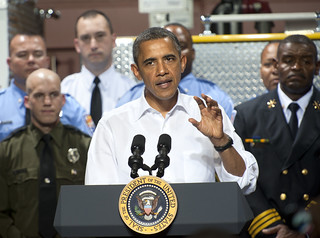
Obama had $500K reasons to be nice to
JP Morgan head Jamie Dimon (updated)

"I did not have financial relations with Jamie Dimon."
In a blog post yesterday, I asked, "How much can President Obama fellate Jamie Dimon?" (the JPMorgan CEO who appears almost willfully clueless about his bank's losses on derivatives trades).

Turns out Obama the person, not Obama the presidential candidate, has at least $500,000 reasons to "show his gratitude" to Dimon and JPMorgan.

Just what is a "JP Morgan Chase Private Client Asset Management Checking Account," anyway? And, does it buy you a London Whale hunting license?

That's not a total joke. Yes, it's a checking account, but, beyond the dollar amount, it's not like one you or I have.

First of all, with more than $500K, it's not fully covered by FDIC insurance. So, does he have extra insurance on the account? And, via whom?

Second, most people don't regularly write checks for $50K, say, let alone with an extra zero. So, this money isn't just sitting there to earn 0.3% quantitative easing interest like my checking account does. This money is being invested, somewhere, somehow.

But, in what? And what does Obama know about it? He has to know something, as this isn't a blind trust. And, given that Democratic National Procurer Vernon Jordan paraded Obama in front of Wall Streeters in 2003, he's no financial babe in the woods.

(Update, Nov. 23, 2016: It is NOT, contra Glenn Kessler's claim that Obama, while not using a blind trust, had all his money in Treasury bills or mutual funds. Obama's filing statement lists three different Vanguard 500 funds, which would be the mutual funds, plus Treasury bills and Treasury notes. A quick Net search — DuckDuckGoing around the Net, not Googling — revealed no more of what that checking account is. But, Kessler's wrong.

I also found this ... interesting that Kessler made such a claim while doing a fact check story about whether President-elect Donald Trump is correct or not in saying "The president can't have a conflict of interest." Per the Constitution's Foreign Emoluments Clause, which Kessler cites, I'd actually give Trump one Pinocchio, which Kessler did not, because Trump probably thinks "Two Corinthians" is in the Constitution, for as little as he is likely to have actually read it.

The clause (Article 1, Section 9, Clause 8)says:
No Title of Nobility shall be granted by the United States: And no Person holding any Office of Profit under them, shall, without the Consent of Congress, accept of any present, Emolumnet, Office, or Title, of any kind whatever, from any King, Prince or foreign State.
It was specifically meant for executive officials, believed to be more liability to bribery potential than members of Congress. (Which, as we know, isn't quite true.) It's why presidents go through fig leafs of donating items to their post-presidential libraries and museums.

The Nixonian overtone of the Trump statement is worth that ding by itself. Besides, as Kessler's newspaper competition at the New York Times notes, Trump's foreign investments, many with government-nationalized foreign companies certainly does bring the clause into play.

And, for misstating Obama's investments, and the seriousness of the bankster connection on that one, Kessler needs to give himself two Pinocchios.)

Beyond that, as the story said, he's got bigger amounts invested in T-notes and T-bills, for safe investments. This is money that, theoretically, can be played around with a bit more.

Dear Leader promises that the skewed whale harpooning would be "investigated." I'm sure. Probably about as closely as J. Edgar Hoover investigated Lee Harvey Oswald after realizing all the FBI screw-ups. (Note: For illustrative purposes only; I don't believe in conspiracy theories.) And, maybe about as loosely as Dimon's next contribution to the Obama 2012 professional checking account, or as soon as the "JP Morgan for Obama" Super PAC gets started.

That said, will the Congressional GOP suddenly discover new love for Dodd-Frank, if it is an angle on appointing an independent prosecutor, or holding House hearings, about a "JP Morgan Chase Private Client Asset Management Checking Account"?

Unfortunately, it doesn't help when the recent JP Morgan meeting is filled with fluffers of Dimon, as MoJo Dowd notes.

March 24, 2014

#ExxonValdez — remembering 25 years

One dead whale in Prince William Sound, 1989, via Exxon.
AP photo via Houston Chronicle
In the spring of 1989, I was in the first full year of graduate divinity school. I still belonged to, and believed in the tenets of, a fundamentalist Lutheran church. (No, family and friends, the Lutheran Church-Missouri Synod doesn't fit a narrower definition of Christian fundamentalists, but it does fit nicely in a broader sociology of religion definition.)

Anyway, I digress.

I was also, for the most part, still steeped in my parents' political beliefs, between my dad's Eisenhower-Main Street conservativism (with his twinge of Eisenhower-Main Street racism), and my mom's "None Dare Call It Treason" moving to Art Bell-listening Tea Party progenitorship (as I know with that anecdotal proof positive that the Tea Party idea is nothing new).

Anyway, again I digress.

I was already a bit of an environmentalist, at least in the sense of believing that Christian creationism did imply some sort of "good stewardship." And I was moving a bit beyond that, even.

Then, a seemingly drunken captain, Joseph Hazelwood, sailing a past-its-due-date, environmentally inadequate oil tanker, ran it aground on Alaskan rocks. And caused a massive animal die-off and other problems for which eXXXon (that's the correct spelling, folks) still refuses to admit full responsibility today.

That includes full financial responsibility, getting punitive damages cut to 10 percent of the original award due to "quirks" in maritime common law, per Wikipedia. And, since then? I've not seen either major party make major changes to environmental civil law to increase punitive damages for "takings" of reducing environmental and scenic value.

As for me? I took the next steps toward becoming a real environmentalist. (In the next five years, I took a chunk of steps toward becoming a real secularist [I avoid the Big A label, as much at times due to some Big As as well as Christian fundamentalists] and becoming a real liberal. By the end of the 1990s, I had moved beyond the Democratic Party, in fact and fortunately.) As part of that, I also became even more of an environmentalist, and a more activist one.

Indeed, while I had the pleasure of living in the Dallas area for most of the first decade of this century, I even "visited" a couple of eXXXon's annual shareholder meetings, as you can see. 

And, per the poster, we had even more to protest against eXXXon by 2008, or earlier. Since then, eXXXon has continued to be just as responsible of a corporate citizen on global warming and climate change, and now on oil and gas fracking, as it was on the Exxon Valdez. So eXXXon is the gift that keeps on giving.

And, in more ways than one. Per Wikipedia's story on the disaster, when in the original suit, eXXXon was hit with $5 billion in punitive damages, it got a $4.8 billion line of credit from J.P. Morgan. To insulate itself, Morgan created the first modern credit default swap.

In other words, eXXXon's Alaskan oil slick helped crap on the American economy nearly 20 years later. That said, why would anything about any unholy alliance between Wall Street and Big Oil surprise you? See: "Bros., Koch" for more.

Meanwhile, as High Country News notes, eXXXon's "cleanup" wasn't. There's still officially 21,000 gallons of oil in Prince William Sound and unofficially, much more.

===

And Perry reminds us, in light of the Houston Ship Channel collision over the weekend, that things haven't changed a lot. That includes the damage to wildlife, not just the inconvenience to the modern economy.

January 07, 2013

Don't trust the banks? Financial pros don't either

An in-depth article in the Atlantic says that Dodd-Frank (why is he overrated, anyway?) and other financial measures of the past four years have done almost nothing to make banks more transparent or more trustworthy.

And, that financial world experts know that, and that's why bank stocks remain depressed and more. Here's a good selection:
More and more, the people in the know don’t trust big banks either. .... Some four years after the crisis, big banks’ shares remain depressed. Even after a run-up in the price of bank stocks this fall, many remain below “book value,” which means that the banks are worth less than the stated value of the assets on their books. This indicates that investors don’t believe the stated value, or don’t believe the banks will be profitable in the future—or both. Several financial executives told us that they see the large banks as “complete black boxes,” and have no interest in investing in their stocks.
And, this issue is scary. Scary indeed, as a look at Wells Fargo shows:
Like other banks, Wells Fargo uses a three-level hierarchy to report the fair value of its securities. Level 1 includes securities traded in active, public markets; it isn’t too scary. At Level 1, fair value simply means the reported price of a security. If Wells Fargo owned a stock or bond traded on the New York Stock Exchange, fair value would be the closing price each day. 

Level 3 is hair-raising. The bank’s Level 3 estimates are “generated primarily from model-based techniques that use significant assumptions not observable in the market.” In other words, not only are there no data about the prices at which these types of assets have recently traded, but there are no observable data to inform the assumptions one might use to generate prices.  
Even worse, Wells Fargo has significant "exposure" to Enron-type Special Purpose Vehicles. But, because of the opacity of its reporting, you, I and even the best of journalists don't know how dangerous this "exposure" is.

First, the roots are bipartisan, going back to Larry Summers and other neolib Democrats leading the charge in the late 1990s to repeal Glass-Steagall. (Frank, though voting against the repeal, in his words was at best equivocal in his opposition.)

Second, that bipartisanship has increased through campaign finance corruption.

Third, there would be one way to stop it. FORCE Congressional pensions to be invested with these deceitful banksters.

Fourth, per the article's authors, we could make the rules much fewer, but much more broadly written. It was that way at one time, they note, and courts gave regulators more leeway.

The Jamie Dimons of today who complain about "overregulation"? They like it that way.

May 14, 2012

How much can Obama fellate Dimon?

After JPMorgan's $2 billion fiasco (and who knows, it may wind up being more than that), and after financial reform and consumer protection architect Elizabeth Warren said JPMorgan CEO Jamie Dimon has no business serving on the New York Federal Reserve, Dear Leader, President Obama, has shown where his heart campaign finance wallet lies, when he says JPMorgan is so well managed.

I said last week this is a test of how much Obama is in thrall to the banksters. If Dimon won't, out of embarrassment if nothing else, resign his NY Fed seat, then, will Obama lean on him?

And, we have our answer. It's not just "no," it's a resounding "no."

Expanding support of gay rights is all well and good, but continuing to support a Big Five bankster when the top five banks, since 2007, have upped their share of the banking monetary pie from 43 to 56 percent is in another category altogether.

In fact, if Dear Leader REALLY wanted to stop being in thrall to the banksters, this would be a perfect opportunity to propose reforms of the entire Federal Reserve system so that, especially in New York, but with all the regional Feds, there was more government control and less banksterism.

But, that's what we're not going to get.

And, that's another reason why, to punish Democrats who won't find a few more ideals as well as to support other ideals, you should vote Green.

Especially since we know Obama has $500K reasons to like Jamie Dimon.

May 13, 2012

Why is Dimon (still) on the NY Fed?

Elizabeth Warren is right. After JPMorgan's $2 billion fiasco (and who knows, it may wind up being more than that), its CEO, Jamie Dimon, has no business serving on the New York Federal Reserve.

Meanwhile, GOP Sen. John Thune is now making the loony arguments that this means we DON"T need more financial regulation.

No, what this really means is this is a test of how much Obama is in thrall to the banksters. If Dimon won't, out of embarrassment if nothing else, resign his NY Fed seat, then, will Obama lean on him?

Expanding support of gay rights is all well and good, but continuing to support a Big Five bankster when the top five banks, since 2007, have upped their share of the banking monetary pie from 43 to 56 percent is in another category altogether.

In fact, if Dear Leader REALLY wanted to stop being in thrall to the banksters, this would be a perfect opportunity to propose reforms of the entire Federal Reserve system so that, especially in New York, but with all the regional Feds, there was more government control and less banksterism.

But, now, it's clear that Dear Leader wants to be in thrall, when he says JPMorgan is so well managed. My ass.

August 16, 2008

Schadenfreude for Goldman Sachs outsourcing

Ahh, so sad for the daytraders, fund managers and other folks at the Goldman Sachs, JPMorgans and Morgan Stanleys of the world, having their six-figure, even high six-figure, jobs outsourced to India.

You know something?

That’s the WTO, biatches.

Many of the nearly 200,000 jobs that major U.S. banks expect to whack by the end of next year aren’t disappearing, they’re just disappearing from U.S. soil. Supposedly, somewhere from 20-40 percent of investment research jobs could be sent offshore.

You know something?

That’s free trade, biatches.

Beyond schadenfreude, it’s nail-biting and back-biting time in Manhattan’s downtown canyon walls, too. The NYT story says nobody from Morgan Stanley, Goldman Sachs, Merrill Lynch or Citigroup would talk to them.

That’s all right. Maybe you’ll hang around before the last NYT job is outsourced to Mumbai.

And, here’s part of why they don’t want to talk — silence is coming straight from the top:
“Some of that is self-serving,” Octavio Marenzi, chief executive of Celent, said of the impulse to keep quiet. “If I admit that research analysts can be off-shored to India, that means that I could too.”

So, Mr. CEO has to decide whether to go to New Delhi or accept a golden parachute buyout.

You know something?

That’s the real world, biatches, except we don’t get golden parachutes out here.

April 14, 2008

Buckle your seatbelt for a decade of fun

That’s the word from JPMorgan analysts, who say the current U.S. financial-sector problems will take a decade to shake out.
“We had the NASDAQ, we had LTCM, we had the various forms of emerging-market crises in the ’90s, we had the real estate crisis of 20 years ago: In most of these the direct impact on the behavior of the parties involved lasted more than 10 years,” Jan Loeys told Reuter. “It looks like it takes a generation for the memory to fade and for the same mistakes to be made again.”

Loeys expects financial sector regulation to increase. Obviously, Treasury Secretary Henry Paulson disagrees with that need.

The question is, will the next president change that mindset, and how much? Also, assuming the European Union implements some real reform, will we find out in the next decade who’s the dog and who’s the tail on the world economy?

Meanwhile, Wachovica dropped $400 mil in the first quarter and the head of major reinsurer Gen Re, Joseph Brandon, resigned, reportedly under federal pressure.

This baby is not close to being over yet.

April 07, 2008

Will Waxman subpoena Bernanke over Bear and BlackRock?

Will Henry Waxman, chairman of the House Oversight and Government Reform Committee, maybe even HAVE TO subpoena Ben Bernanke, The Worst Fed Head Since Greenspan™?

Well, as more and more comes out about the $30 billion line of credit to JPMorgan to buy out Bear Stearns, maybe the answer is yes. Waxman wants to know why the BlackRock financial management firm got a no-bid contract to manage this.

Well, Big Ben will tell you, Henry, that the depth of the emergency meant there wasn’t time to take bids, even if that further reflects on his already less-than-stellar reputation.
Waxman says he wants to know more about BlackRock's role in managing the money, why it received a no-bid contract and whether the company's portfolio has investments in distressed mortgages or anything that may be in conflict with its new role in managing the Fed's money during the housing meltdown.

A bit more info about BlackRock:

1. It’s 49 percent owned by Merrill Lynch. This gives credence to the story that the Street was ready to get out the long knives for Bear Stearns.
2. Despite a public protestation otherwise, one wonders if Waxman isn’t just barking up the right tree on BlackRock problems. In February, admitting it was against normal company policy to comment on rumors, BlackRock said it had no CDO exposure.

March 24, 2008

JPMorganWe taxpayers are on a bigger hook

THAT is the bottom line of JPMorgan upping its offer for Bear Stearns to $10 a share from the original $2 exacta.

That’s doubly true with Morgan’s tightened guarantee of Bear’s liabilities. The Fed hasn’t said it is any less backing this sweetened deal than the original one, so you and I, the taxpayers, are now on a bigger hook, being played as a bigger fish.

Ben Bernanke, The Worst Fed Head Since Greenspan™, continues to amaze.

March 18, 2008

JPMorgan takeover of Bear Stearns detailed – a bailout for THIS?

As of Saturday evening, Morgan was still willing to pay about $15 a share for Bear. But Morgan’s investment bankers weren’t sure how to value Bear’s holdings, Morgan officials started batting about the idea of a Federal Reserve guarantee.

The deal was finally closed a little after 7 p.m. Eastern time Sunday, less than an hour before Asian markets were due for Monday opening.

Meanwhile, a bunch of other financial players on the Street were deliberately talking Bear down for their own selfish reasons:
People forget that Wall Street is a fragile machine. Cash, or “liquidity,” as it is known in the trade, is the oxygen that keeps investment banks alive. No matter how healthy you are, you can’t breathe if someone puts a pillow over your head. That’s what Bear Stearns’s clients and rivals did, and they did it without remorse.

As Andrew Ross Sorkin points out, what is Bear going to do? Say no? It’s doubtful Morgan will raise its offer or that the Fed will support anybody else making an offer.

So, instead, we have the Federal Reserve not only involved with a Wall Street bailout, but also with Wall Street financial politics and inter-firm politics and schadenfreude.

Wonderful. I know that this isn’t in Ben Bernanke’s job description.

March 16, 2008

How the mighty Bear Stearns has fallen to a $2 exacta

JPMorgan is buying Bear Stearns for just that price — $2 a share. What’s next? Major job cuts, is my guess. No help for people with shaky home loans connected to Bear.

The pending Bear collapse, with its financial rating threatening to be devalued to junk-bond status Monday, had everybody in a panic:
The Federal Reserve and the U.S. government swiftly approved the all-stock buyout, showing the urgency of completing the deal before world markets opened.

And the Fed continued to stand behind its indirect bailout:
The Fed also essentially made the takeover risk-free by saying it would guarantee up to $30 billion of the troubled mortgage and other assets that got the nation’s fifth-largest investment bank into trouble.

JPMorgan Chief Financial Officer Michael Cavanaugh gave no indication what would happen to Bear’s 14,000 employees.

I can tell you. If JPMorgan wants to make some immediate turnaround money, and the credit market is so slow, it will probably whack as many as half of those employees.

Cavanaugh did say that Morgan was most interested in Bear’s prime investment business, which does deals with major players like hedge funds.

In other words, if you hold a home mortgage connected to Bear, and you’re feeling kind of shaky yourself, don’t expect much customer service from Morgan.